Starting a legal food business in 2026 requires identifying your food product category first, then obtaining the specific permits for that production method. You cannot sell a single jar to the public until your recipe, labeling, and kitchen pass regulatory review.
The FDA’s Code of Federal Regulations Title 21 Part 117 states that all food facilities must register and follow Current Good Manufacturing Practices. Even home-based businesses selling across state lines under cottage food laws must now meet evolving 2026 safety standards for allergen disclosure and traceability.
This guide will walk you through classifying your product, renting the right kitchen, filing your Scheduled Process if needed, and pricing your first batch so you actually earn a profit. We will cover the exact steps in the order that prevents costly, time-consuming do-overs.
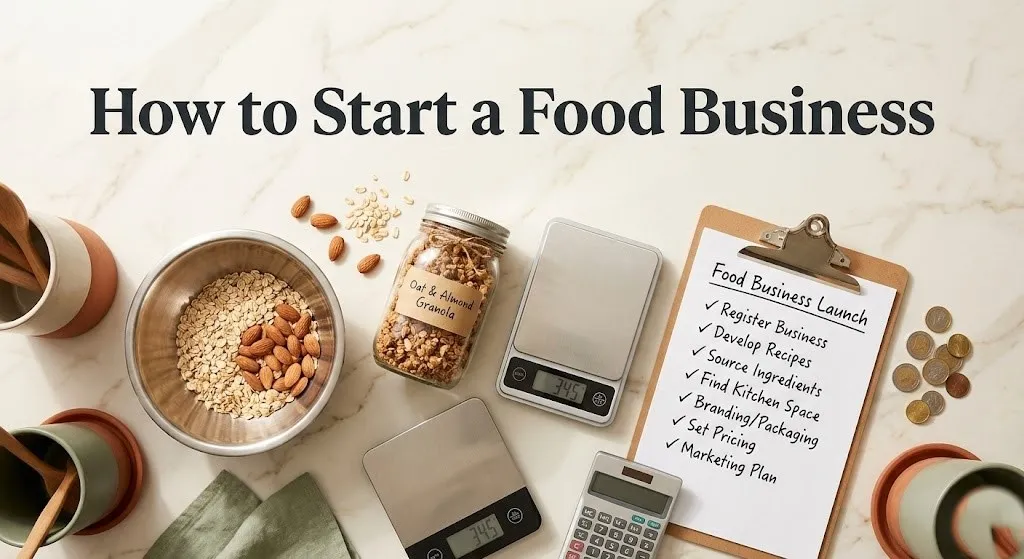
How to Start a Food Business
A food business starts by classifying your product into one of three regulatory buckets. The bucket determines your kitchen, your permits, and your labeling requirements. Choose wrong here and you will rebuild your entire business model later.
The first bucket is non-potentially hazardous or cottage foods. These are shelf-stable, dry, or acidified products like breads, granolas, jams, and certain pickles. These have the lowest barrier to entry and can often be made in a home kitchen depending on your state’s 2026 cottage food law.
The second bucket is refrigerated or frozen potentially hazardous foods. This includes fresh soups, prepared meals, and cheesecakes. These require time and temperature control for safety (TCS food). The third bucket is low-acid canned foods like canned green beans or meat stews, which demand a commercial cannery and a filed Scheduled Process.
| Regulatory Bucket | Product Examples | Kitchen Required | Relative Cost |
|---|---|---|---|
| Cottage Food (Non-TCS) | Dry granola, bread, jam | Home or Commercial | Low |
| TCS Food (Refrigerated/Frozen) | Fresh soup, hummus, meal prep | Commercial | Medium |
| Low-Acid Canned | Canned vegetables, meat stews | Commercial Cannery | High |
How to Start a Small Food Business
A small food business is a solo-founded, low-volume operation starting with one or two hero products. You are likely selling at a farmers market, on a local Shopify store, or through Instagram direct messages. You do not need a 10,000-square-foot facility or a full-time staff on day one.
Choose a single flagship product and ignore the rest. New entrepreneurs often try to launch with a full menu of 12 items. That fractures your ingredient sourcing, your label approvals, and your customer messaging. Master one product. Let customers ask for the second one before you build it.
Your initial legal structure is likely a Sole Proprietorship or a Single-Member LLC. The LLC separates your personal assets from business liabilities, which matters deeply if a customer ever claims a foodborne illness. You will need an Employer Identification Number (EIN) from the IRS, a state business license from your city hall, and a seller’s permit to collect sales tax at the point of sale.
Key Takeaway: Start with one legal product, one legal entity, and one sales channel; you can expand from solid legal ground later.
How to Start a Food Business With No Money
You start a food business with no money by using a licensed shared-use or commissary kitchen instead of building your own facility. This eliminates the massive upfront cost of plumbing, drains, ANSI-certified sinks, and walk-in refrigeration.
Shared-use kitchens rent by the hour, often between $15 and $30 per hour in 2026. You show up, cook, clean, and leave. They carry the liability insurance on the facility itself. You still need your own product liability policy, but the kitchen’s overhead is not your burden.
Validating your product costs almost nothing. Take your prototype batch, without a label, to a farmers market as a free sample. Gather email addresses. Poll people on whether they would pay $8 or $12 for a jar. Do not pay for packaging or a website until 50 real, non-family humans tell you they would hand you actual money for the product.
- Rent a shared-use kitchen by the hour instead of leasing a facility.
- Use free sample market testing before buying commercial packaging.
- Bootstrap one small batch and sell it to fund the next batch.
How to Open a Small Food Business
Opening day means you have legally passed a health department inspection or secured your cottage food registration. The physical opening could be your first farmers market tent, your first online delivery, or your first wholesale drop-off at a local coffee shop.
Before opening, you need your product label finalized. The FDA requires a statement of identity, net quantity of contents, ingredient list in descending order of predominance, and the responsible party’s contact information. Major food allergens (milk, eggs, fish, shellfish, tree nuts, peanuts, wheat, soybeans, sesame) must be declared in plain language.
You must also secure product liability insurance before you sell a single unit. General liability policies for a small food business start around $300 to $600 annually in 2026. A slip-and-fall at your farmers market booth or a broken tooth claim from your granola can bankrupt an uninsured sole proprietor. Proof of insurance is often required by market organizers and wholesale buyers.
How to Start Your Own Food Business
Your own food business needs a distinct, legally defensible brand name. Before printing labels or buying a domain, search the name in your state’s business registry and the USPTO trademark database. A cease-and-desist letter from an established brand will destroy your packaging inventory overnight.
Your recipes must be converted from home cook language to standardized commercial formulas. “A handful of cilantro” is not a scale-able instruction. Every ingredient is listed in baker’s percentages or by metric weight. A standardized recipe allows you to cost out a batch down to the penny and replicate the taste identically every production run, whether you make 10 jars or 200.
Your pricing must follow a consistent formula. Add ingredient cost, packaging cost, and labor cost for one unit. That is your Cost of Goods Sold (COGS). Multiply COGS by three to arrive at a wholesale price. Double the wholesale price to set your direct-to-consumer retail price. Selling below this formula means you are paying to give your food away.
Key Takeaway: Your home recipe must become a commercial formula, your brand name must be legally clear, and your pricing must build in actual profit from day one.
Can I Start a Food Business From Home
Yes, you can start a food business from home if your product falls under your state’s cottage food law. These laws vary by state. In 2026, most states allow high-acid or low-moisture products like baked goods, jams, dry mixes, and hard candies.
Your product must be non-potentially hazardous. This means it is shelf-stable and requires no refrigeration to remain safe. A moist pumpkin bread may be allowed. A pumpkin cheesecake that requires refrigeration is not a cottage food product. It requires a commercial kitchen.
Sales channels also matter. Some states allow only direct-to-consumer sales, meaning farmers markets and online orders for in-person delivery or pick-up. Wholesale to retail stores and interstate shipping may be prohibited under cottage food law. Your state’s department of agriculture website details the exact 2026 sales limits for home-registered businesses.
| State Law Type (2026 Example) | Allowed Home Products | Allowed Sales Channels |
|---|---|---|
| Restrictive Cottage Food Law | Dry baked goods, jams, candy | Farmers markets, direct pickup only |
| Permissive Cottage Food Law | Frozen TCS items, some meal prep | Direct, online with home delivery |
| No Cottage Food Law | None (Commercial Kitchen Required) | N/A |
What Do I Need to Start a Food Business
You need a food manager safety certification, a registered business entity, a suitable inspected kitchen, a standardized recipe, a compliant product label, and liability insurance. This is the six-point non-negotiable checklist for 2026.
The ServSafe Manager Certification is the standard food safety credential in the United States. The course covers pathogen control, cross-contamination prevention, time and temperature abuse monitoring, and HACCP principles. This certification is required in most jurisdictions for at least one person actively managing the food preparation facility.
Your kitchen must have a health department permit or be explicitly exempt under cottage food law. A home kitchen for a non-cottage food product will not pass a health department inspection. It lacks the required three-compartment sink for washing, rinsing, and sanitizing. It lacks a separate mop sink. It lacks the proper floor drains. Commercial kitchen requirements exist to prevent outbreaks, not to frustrate entrepreneurs.
What Do I Need to Sell Food to the Public
To sell food to the public, you need an approved label, a point-of-sale system for tax collection, and a clear channel for customer feedback and allergen inquiries. The label is your legal handshake with the public.
If you are making an acidified food, like pickles or hot sauce, you must have your recipe reviewed by a Process Authority. A Process Authority is a recognized expert in food microbiology who verifies that your acid levels and thermal processing step are sufficient to render the product shelf-stable. They issue a Schedule Process letter that you must keep on file.
Selling online adds a layer. You need a clear return and refund policy for damaged or spoiled goods. Perishable shipments in 2026 often require insulated boxes and cold packs, adding $3 to $7 to your shipping cost. The customer pays this, but you must disclose it upfront. A $12 jar of soup with $8 shipping needs to taste incredible to justify a $20 total experience.
Key Takeaway: A Process Authority letter and a legally compliant label are the two documents that stand between you and a public recall or lawsuit; do not skip either one.
How to Start My Own Food Business
Your own food business begins with a business bank account, not your personal checking account. Co-mingling funds is the most common mistake that triggers tax audits and liability issues for micro-entrepreneurs. A separate account tracks true profit and loss.
Your brand story is your market differentiation. The granola shelf is crowded. Why yours? The 2026 consumer buys based on ingredient sourcing, production transparency, and founder story. Your label copy should explain the specific reason you started, not generic platitudes about “healthy ingredients.”
Build a simple, static website with your product, your story, your ingredient philosophy, and a functioning order button. A Shopify or Squarespace site costs about $30 per month. This is your home base. Social media platforms change algorithms. Your email list and your own domain are controlled assets that build long-term customer value without paying rent to Meta or TikTok.
How to Start Your Own Food Business From Home
Starting from a home kitchen means you operate with the legal limitations of your state cottage food law. Your kitchen will likely be inspected by your local health department or department of agriculture, even for cottage food operations.
Zoning laws apply. A residential kitchen is zoned for residential use. Some municipalities require a Home Occupation Permit. Neighbors can file complaints about excessive delivery traffic, cooking odors, or noise. You must know your zoning code section. A violation can shut you down faster than a health inspection failure.
Home-based operations struggle with storage. Twenty cases of mason jars and 50-pound sacks of flour eat up a garage fast. Designate a locked, dry, pest-proof storage area that is separate from household groceries. Inspectors will check for pet access, chemical storage near food, and adequate shelving off the floor.
How to Start an at Home Food Business
An at-home food business works best for dry, shelf-stable, high-margin products. Granola, spice blends, tea mixes, and decorated sugar cookies are classic cottage food champions. These products have low risk, long shelf life, and high perceived value.
The home kitchen workflow must be separated from family life. You cannot cook a commercial batch of cookies while a toddler plays with flour on the floor. Schedule production during hours when the kitchen is a facility, not a family space. The FDA’s allergen cross-contact rules apply here. If you make wheat-based bread, a separate gluten-free line must be made on different equipment or after a documented cleaning procedure.
Labeling from a home kitchen requires your home address on the package. The FDA mandates the “name and place of business” of the manufacturer, packer, or distributor. This means your residential street address appears on every jar you sell to the public. If this privacy concern is a dealbreaker, you can rent a P.O. Box for the label, but the registration documents with the state still list your physical production address.
How to Start a Food Packaging Business
A packaging business means you are not necessarily the recipe developer. You are a co-packer, a private label reseller, or a value-added packager. You take bulk ingredients and package them into consumer-facing units. This business model requires a different permit called a wholesale food manufacturing license.
Your packaging facility must meet cGMP standards regardless of whether you cook the food. The warehouse or packing room must control for pests, dust, moisture, and temperature. Your scale must be NTEP-certified for legal trade if you sell by weight. Stating “Net Wt. 16 oz” on a package weighed on a non-certified scale is illegal.
Sourcing packaging is an industrial process. You will buy stand-up pouches, glass jars, or boxes by the pallet, not by the dozen. Uline, Berlin Packaging, and regional distributors are your suppliers. Your minimum order quantity will be in the thousands. Package design includes the mandatory Nutrition Facts panel, which must be generated by lab testing or by database analysis software compliant with FDA rounding rules.
Key Takeaway: Food packaging is a factory operation, not a kitchen project; your scale, your labels, and your packaging equipment must all meet commercial calibration standards.
How to Start Small Food Business
A small food business succeeds on local market penetration before chasing national scale. Your first 100 customers should all live within a 20-minute drive. You hand-deliver. You get immediate feedback. You fix problems before they scale.
Join a local farmers market as a vendor. The 2026 application requires your business license, food permit, and certificate of insurance. Market fees range from $25 to $75 per market day. You provide your own tent, tables, and product displays. A clean, professional white tent with clear signage and visible pricing sells double the volume of a cluttered, unbranded table.
Track every number from day one. Cost of ingredients. Packaging cost. Market fees. Gas mileage. Hours spent cooking, driving, selling, and cleaning. Most small food businesses fail because the founder calculates profit based on ingredients only, ignoring the time and overhead that eat the margin. A spreadsheet tracking total costs per batch tells the truth about whether your $8 granola bag is making $3 profit or losing $2.
- Track ingredient, packaging, travel, and labor costs on one spreadsheet per batch.
- Price wholesale at three times your total unit cost.
- Secure 100 local, repeat customers before investing in a national shipping operation.
Frequently Asked Questions About Starting a Food Business
What is the cheapest food business to start?
A dry cottage food product like spiced nuts or granola has the lowest startup cost.
You avoid commercial kitchen rental, cold storage, and extensive permitting.
Ingredient costs for a small batch can be under $100, with packaging adding another $50.
How much does a food business license cost?
A basic business license ranges from $25 to $500 depending on your city and business structure.
A health department permit for a commercial kitchen can run $100 to $1,000 annually.
A state cottage food permit ranges from $20 to $250, making it the lowest-cost legal entry path.
Can I sell food online without a license?
No, selling food online still requires a license, permit, or cottage food registration in your state.
An Etsy or Shopify storefront does not exempt you from FDA or state health department regulations.
Operating without a license can result in fines and immediate cease-and-desist orders.
What foods can I sell from home without a permit?
No prepared food can be legally sold from home without any permit or registration at all.
Cottage food laws allow low-risk items like bread and cookies with a registration, which is a form of permit.
The term “without a permit” is misleading; you always need some form of state authorization.
How long does it take to start a food business?
A cottage food business can launch in 30 to 60 days if your recipe and label are ready.
A commercial TCS food business typically takes 90 to 180 days to secure kitchen approval, permits, and insurance.
Recipe testing and Process Authority review for acidified foods can add 30 additional days.
The first legal jar you sell marks the end of a long regulatory checklist and the start of a real business. Your recipe, your label, and your process are now public. Treat every batch like an inspector is standing at your elbow.
Launch with one product, one channel, and a meticulous cost spreadsheet. Profit is not a goal. It is a math problem you solve by knowing your exact per-unit cost and refusing to sell below the price that pays you a living wage.
Your food is good enough. That is why you are here. Now go fill out the paperwork, rent the kitchen, and sell the batch that proves it to the world.