Standard boxed croutons are not healthy. They are small cubes of refined white bread, fried or toasted in oil, and heavily salted. A 2-tablespoon serving delivers roughly 30 to 35 calories, 5 grams of carbohydrate with zero fiber, and 50 to 80 milligrams of sodium while providing almost no vitamins or minerals.
The American Heart Association recommends that adults limit sodium to 2,300 milligrams per day and saturated fat to 5 to 6 percent of daily calories. A salad topped with a generous, unmeasured handful of croutons can easily contribute 200 milligrams of sodium and 3 grams of saturated fat before the dressing even touches the bowl.
We will walk through the exact nutritional profile, the specific ingredients that make boxed croutons a low-nutrient food, the 2026 healthy alternatives that provide crunch with actual nutritional value, and a 15-minute homemade recipe that solves the problem.
Are Croutons Healthy
No, standard commercially produced croutons are not a healthy food. They are a processed, low-nutrient food designed for texture, not nutrition. The primary ingredient is enriched wheat flour, which is white flour with a small number of B vitamins added back after the fiber and germ are stripped away.
The health evaluation depends on what you compare them to. Croutons are healthier than fried onion rings on a salad. They are less healthy than toasted nuts, seeds, or roasted chickpeas. They occupy the middle ground of processed salad toppings, neither the worst nor the best choice.
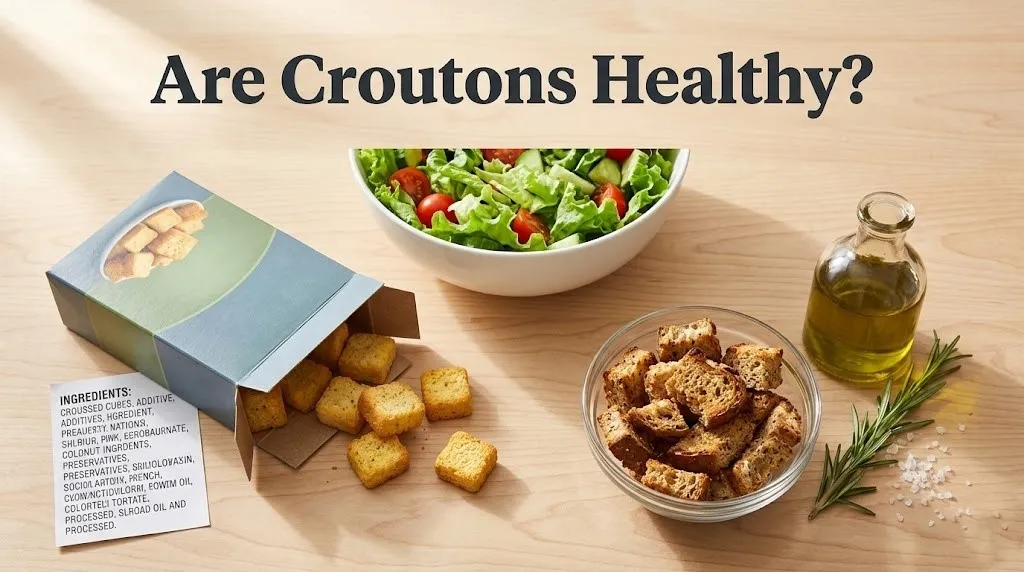
The real problem with croutons is not what they are but how they are used. They are a garnish that is eaten like a snack. A salad bowl with a quarter-cup of croutons scattered on top adds 70 empty calories. A salad that is half croutons and half lettuce is not a salad. It is a bowl of seasoned bread with some green decoration.
Are Crutons Healthy
The misspelling “crutons” leads to the same nutritional reality as “croutons.” The food is identical. The boxed, shelf-stable bread cubes in the supermarket aisle are the same product regardless of how you spell the name.
The nutritional profile does not change with the spelling. A serving of croutons or crutons contains the same refined flour, the same oil, and the same sodium load. The health evaluation is identical.
This is a common misspelling in search queries. The person typing “are crutons healthy” into Google is standing in the same kitchen, looking at the same box, and asking the same question as the person who spells it correctly. The answer is the same.
Are Croutons Healthy for You
Whether croutons are healthy for you specifically depends on your individual dietary goals, your sodium sensitivity, and how many you eat. For a healthy adult with no cardiovascular risk factors, a 2-tablespoon serving of croutons on a large, vegetable-rich salad is a minor dietary detail.
For someone with hypertension, the sodium in croutons adds to the daily total without contributing any potassium or magnesium to balance it. For someone managing blood sugar, the refined flour croutons add a small, rapid glucose load without any fiber to slow it down.
For someone on a weight-loss plan, croutons are an easy place to cut calories without reducing the satiety of the meal. Removing croutons from a salad eliminates 70 to 100 calories of low-nutrient, low-satiety food. Replacing them with an equal volume of chickpeas or toasted almonds adds protein and fiber that extend the meal’s fullness window.
Key Takeaway: Croutons are a minor dietary negative for a healthy person and an easy target for improvement for anyone managing sodium, blood sugar, or calorie intake.
Croutons Nutrition Facts
A standard 2-tablespoon, 7-gram serving of plain, boxed croutons contains 30 to 35 calories, 1 to 2 grams of fat, 5 grams of carbohydrates, 0 grams of fiber, less than 1 gram of protein, and 50 to 80 milligrams of sodium.
The fat source is typically soybean oil or palm oil. These are inexpensive, shelf-stable oils high in omega-6 polyunsaturated fat or saturated fat, respectively. The carbohydrate source is enriched wheat flour, which is white flour with iron and B vitamins added back but no fiber.
The micronutrient contribution is negligible. A serving of croutons provides less than 2 percent of the daily value for any vitamin or mineral except sodium. The USDA FoodData Central database lists croutons as a low-nutrient-density food.
| Nutrient | Boxed Croutons (2 tbsp) | Homemade Whole-Grain (2 tbsp) | Toasted Almonds (2 tbsp) |
|---|---|---|---|
| Calories | 30 to 35 | 25 to 30 | 55 to 65 |
| Fat | 1.5g (0.5g sat) | 2g (0g sat) | 5g (0.5g sat) |
| Carbs | 5g | 4g | 2g |
| Fiber | 0g | 1g | 1.5g |
| Protein | 0.5g | 1g | 2.5g |
| Sodium | 60mg | 30mg | 0mg |
How Many Calories in Croutons
A standard 2-tablespoon serving of boxed croutons contains 30 to 35 calories. This is a small number in isolation. The problem is that a “serving” on a restaurant salad or a self-serve salad bar is often 4 to 6 times this amount.
A typical restaurant Caesar salad contains half a cup to a full cup of croutons. This translates to 120 to 240 calories from croutons alone. The croutons contribute more calories than the grilled chicken breast on the same salad. A topping has become a main ingredient.
The caloric density is high for the volume. Two tablespoons of croutons is roughly 5 to 7 cubes. A small palmful. The visual smallness of a serving leads to heavy-handed scooping. A kitchen scale or a measuring spoon is the only reliable control mechanism.
Are Croutons Bad for You
Croutons are not actively bad for you in the way that trans fats or high-fructose corn syrup are bad. They are passively bad in the way that any refined, low-fiber, high-sodium food is bad when consumed in excess. They crowd out more nutrient-dense foods on the salad plate.
The sodium is the most concrete health concern. A half-cup of croutons can deliver 300 to 500 milligrams of sodium. This is 15 to 25 percent of the American Heart Association’s daily limit. The sodium adds up silently because croutons do not taste particularly salty. The seasoning is distributed across a large surface area and registers as savory, not salty.
The refined carbohydrates contribute to the total glycemic load of the meal. A salad with croutons, a sugary dressing, and dried fruit becomes a high-glycemic meal despite the lettuce base. The croutons are the stealth carbohydrate that turns a blood-sugar-friendly salad into a blood-sugar-spiking meal.
Are Croutons Good for You
Croutons are not good for you from a nutritional standpoint. They provide crunch and flavor without providing meaningful amounts of fiber, protein, vitamins, or minerals. They are a culinary enhancement, not a nutritional one.
There is one exception: croutons made from whole-grain, sourdough, or sprouted grain bread and baked with olive oil at home are a different food. These croutons contain fiber, resistant starch, and healthy monounsaturated fat. They are not a health food, but they are a legitimate, positive addition to a salad.
The distinction between “not good for you” and “bad for you” is important. Croutons are not toxic. They are not a dietary villain. They are an opportunity cost. The calories and sodium they contribute could be spent on a food that also provides satiety, fiber, or micronutrients.
Key Takeaway: Boxed croutons are nutritionally neutral at best; homemade whole-grain croutons are nutritionally positive, and toasted nuts or seeds are nutritionally excellent.
Are Croutons Bad for Weight Loss
Croutons are counterproductive to weight loss when eaten in unmeasured portions. They add low-satiety calories to a meal that could otherwise be high-volume and filling. Removing croutons from a daily salad saves 70 to 200 calories per day, a deficit that compounds to roughly one pound of fat loss per month.
The satiety-to-calorie ratio is poor. Two tablespoons of croutons and two tablespoons of chickpeas have similar calorie counts. The chickpeas provide fiber and protein that trigger satiety hormones. The croutons provide starch that digests rapidly and leaves the stomach quickly.
A 2026 weight-loss strategy for salad eaters is straightforward. Replace croutons with roasted chickpeas, toasted pepitas, or crushed walnuts. These alternatives provide crunch, flavor, and the satiety that croutons lack. The salad remains a crunchy, satisfying meal, and the calorie count stays similar or drops slightly.
Croutons Ingredients
The ingredient list on a standard box of Marzetti or Fresh Gourmet croutons reveals the processed nature of the product. A typical list includes: enriched wheat flour, canola or soybean oil, sugar, salt, yeast, wheat gluten, and a series of preservatives and flavor enhancers.
The specific additives to watch for are disodium inosinate, disodium guanylate, and hydrolyzed corn protein. These are flavor enhancers that work synergistically with the salt to create an intensely savory, almost addictive flavor profile. They are not harmful in isolation, but they signal that the croutons are an engineered food product, not a simple toasted bread cube.
High-fructose corn syrup appears in some flavored crouton varieties, particularly the “Italian” and “Garlic” flavors. The sugar content is small per serving, usually less than 1 gram, but it is a marker of the product’s processed-food status.
Are Croutons Processed Food
Yes, boxed croutons are an ultra-processed food. They fit the NOVA classification system’s definition of a product formulated from refined food substances, containing ingredients not found in a home kitchen, and designed to be hyper-palatable and shelf-stable.
The refining process strips the wheat of its bran and germ, removing the fiber, B vitamins, and minerals. The remaining white flour is combined with oil, sugar, salt, and flavor enhancers. The mixture is baked or fried, dehydrated, and packaged in a nitrogen-flushed bag to prevent oxidation.
A homemade crouton made from day-old bread, olive oil, and a pinch of salt is a processed food in the literal sense of having been cut, oiled, and baked. It is not an ultra-processed food. The ingredient list is short, recognizable, and replicable in a home kitchen. This is the dividing line between the boxed and the homemade.
Are Croutons Gluten Free
Standard croutons are not gluten free. They are made from wheat flour, which contains gluten. The primary ingredient is enriched wheat flour, and many brands add additional wheat gluten to improve the texture and crunch of the final product.
Gluten-free croutons are available in the 2026 market. Brands like Aleia’s and Canyon Bakehouse produce gluten-free croutons from rice flour, tapioca starch, and other gluten-free grains. These products are safe for individuals with celiac disease or non-celiac gluten sensitivity.
Homemade gluten-free croutons are straightforward. Cube day-old gluten-free bread, toss with olive oil and dried herbs, and bake at 375 degrees Fahrenheit for 10 to 12 minutes. The texture is slightly different from wheat-based croutons, more crumbly and less shatteringly crisp, but the flavor is entirely under your control.
Healthy Crouton Alternative
The healthiest crouton alternatives in 2026 are roasted chickpeas, toasted nuts, seeds, and crispy lentils. These foods provide the same crunchy texture contrast that croutons add to a salad while contributing meaningful amounts of protein, fiber, and healthy fats.
Roasted chickpeas are the closest textural match. When tossed in olive oil, seasoned, and roasted at 400 degrees Fahrenheit for 25 to 30 minutes, they become shatteringly crisp on the outside and slightly creamy inside. They contain 6 grams of protein and 5 grams of fiber per quarter-cup serving, compared to 0 grams of both for croutons.
Pumpkin seeds, sunflower seeds, and sliced almonds are the simplest swap. They require no preparation. A tablespoon of toasted pumpkin seeds adds 40 calories of healthy fat, magnesium, and zinc. A tablespoon of croutons adds 15 empty calories. The nutritional exchange rate is heavily in favor of the seeds.
Homemade Healthy Croutons
Homemade healthy croutons start with the right bread. Whole-grain sourdough, sprouted grain bread, or 100% whole wheat bread provide the fiber and flavor base. The bread should be a day old. Fresh bread steams in the oven instead of crisping.
To make healthy homemade croutons:
- Preheat the oven to 375 degrees Fahrenheit.
- Cube 2 cups of day-old whole-grain bread into roughly half-inch pieces.
- Toss the cubes with 1 tablespoon of extra virgin olive oil, 1/4 teaspoon of garlic powder, and a pinch of kosher salt.
- Spread the cubes in a single layer on a rimmed baking sheet.
- Bake for 10 to 12 minutes, flipping once at the 8-minute mark, until golden and crisp.
Cool the croutons completely on the baking sheet before storing. They will continue to crisp as they cool. Store in an airtight container at room temperature for up to 5 days. Do not refrigerate. The cold air introduces moisture that softens the crunch.
Best Healthy Croutons to Buy
The best healthy store-bought croutons in 2026 are made with whole grains and a short, recognizable ingredient list. Olivia’s Organics and Fresh Gourmet’s Whole Grain line are the two most accessible options in mainstream grocery stores.
What to look for on the label: the first ingredient should be whole wheat flour, not enriched wheat flour. The oil should be olive oil or avocado oil, not soybean or palm oil. The sodium should be 100 milligrams or fewer per serving. The ingredient list should be short enough to read in one breath.
Avoid croutons with cheese powder, artificial colors, or flavor-enhancer acronyms. The “cheesy garlic” and “Italian herb” varieties often contain powdered cellulose, MSG, and disodium inosinate. The plainer the flavor, the cleaner the ingredient list tends to be.
Croutons vs Nuts on Salad
Toasted nuts are nutritionally superior to croutons in every category except calorie count, and even that difference is small and justified by the nutritional return. A 2-tablespoon serving of toasted almonds contains 65 calories, 5 grams of fat, 2.5 grams of protein, and 1.5 grams of fiber. The same volume of croutons contains 35 calories, 1.5 grams of fat, 0.5 grams of protein, and 0 grams of fiber.
The extra 30 calories in the almonds come with protein, fiber, vitamin E, magnesium, and monounsaturated fat. The calories in the croutons come with refined starch and sodium. The nutritional economics favor the nuts heavily.
The texture comparison is close. Toasted nuts are crunchy and savory. They hold up to dressing without becoming soggy. They add a similar textural contrast to the soft lettuce and juicy tomato. The flavor is richer, nuttier, and more complex than the one-note salt-and-oil flavor of croutons.
Key Takeaway: Croutons are empty crunch; nuts are crunch with protein, fiber, and micronutrients attached, worth the 30 extra calories.
Frequently Asked Questions About Croutons
Are croutons healthy for weight loss?
No, standard croutons are not ideal for weight loss because they add empty calories without satiety.
Replacing croutons with roasted chickpeas or nuts provides the same crunch with protein and fiber that keep you full longer.
A daily swap of croutons for seeds can create a meaningful calorie deficit over a month.
What are croutons made of?
Standard boxed croutons are made from enriched wheat flour, soybean or palm oil, salt, sugar, yeast, and preservatives.
Enriched wheat flour is white flour with a few B vitamins added back after the fiber and germ are removed.
Flavored varieties add cheese powder, MSG, and disodium inosinate for savory intensity.
Can I eat croutons every day?
A small, measured portion of croutons daily is fine for a healthy adult.
The concern is the cumulative sodium intake and the opportunity cost of the calories that could come from more nutrient-dense toppings.
Homemade whole-grain croutons are a better daily option than boxed croutons.
Are there any healthy store-bought croutons?
Yes, brands like Olivia’s Organics and the Whole Grain line from Fresh Gourmet offer cleaner ingredient lists.
Look for whole wheat flour as the first ingredient, olive oil instead of soybean oil, and under 100 milligrams of sodium per serving.
Avoid varieties with cheese powder, MSG, and artificial colors.
What can I put on my salad instead of croutons?
Roasted chickpeas, toasted pumpkin seeds, sliced almonds, and crispy lentils are the best crunchy alternatives.
These options add protein, fiber, and healthy fats that croutons lack.
A tablespoon of seeds or a quarter-cup of roasted chickpeas provides the same crunch with significantly better nutrition.
The crouton is a texture delivery device, not a health food. It is a small cube of refined flour and oil that adds crunch to lettuce and nothing meaningful to your body. This does not make it a villain. It makes it optional.
The box on the shelf is the problem. The long ingredient list, the industrial oils, the flavor enhancers. The homemade version on your counter is the solution. Whole-grain bread, olive oil, 12 minutes in the oven. The same crunch, a better ingredient list, and a lunch that actually supports your goals.
Make them on Sunday. Use them all week. The salad deserves a topping that works as hard as the vegetables.