
Hiring a food truck for an event in 2026 costs between $800 and $6,000 total, depending on guest count, menu type, event duration, and your city. The national average for a standard two to three hour event with 50 to 100 guests falls between $1,500 and $3,500. Per-person pricing typically ranges from $12 to $30 for standard fare like tacos or burgers, and climbs to $25 to $50 per person for premium menus featuring seafood, steak, or chef-driven specialties.
The food truck industry has matured considerably since 2020. What started as a recession-era side hustle is now a structured catering sector with standardized pricing models, professional booking platforms, and clear health department oversight. The National Restaurant Association reported in 2025 that food truck catering revenue grew 18 percent year over year, driven by corporate events, wedding receptions, and private parties seeking alternatives to traditional banquet halls. That growth means more trucks competing for bookings, which gives event hosts more negotiating power than they had five years ago.
This guide covers every major cost factor: hiring prices by event type, per-person versus flat-rate pricing models, what a deposit looks like, travel fees, hidden costs to watch for, and how dietary restriction requests affect your total. It also explains what the truck operator is paying on their end for licenses, permits, insurance, and the vehicle itself, because those operating costs are baked into every quote you receive. Understanding the business side makes you a smarter negotiator.
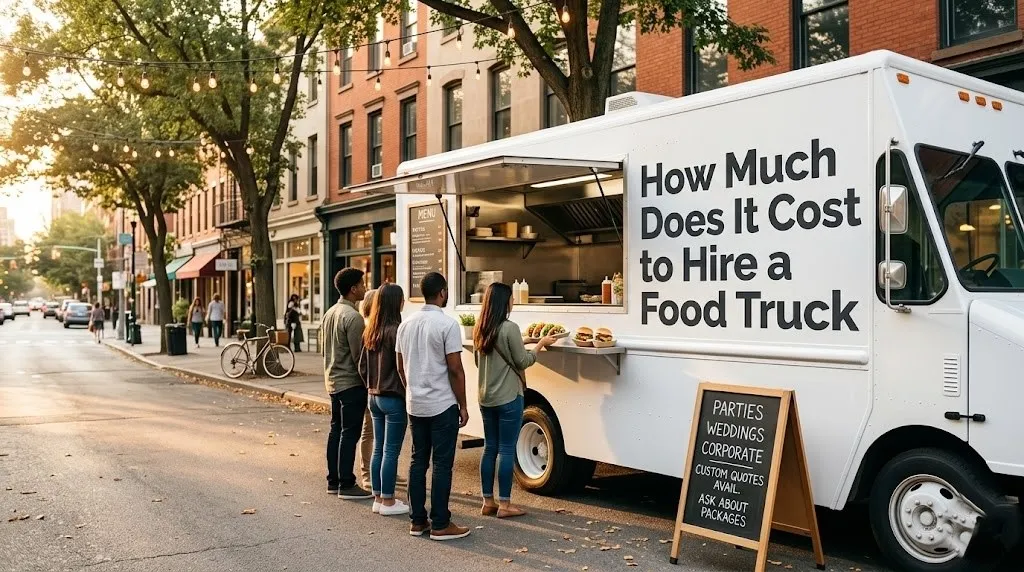
How Much Does It Cost to Hire a Food Truck
Hiring a food truck for a private event in 2026 costs between $1,000 and $4,500 for most standard bookings. The price covers the truck, staff of one to three people, ingredients, cooking equipment fuel, and a set service window. A taco truck serving 75 guests for two hours in a mid-sized city like Austin or Denver will land around $1,800 to $2,500. A gourmet burger truck serving 150 guests for three hours in New York or San Francisco can push past $4,000. The national average, based on booking platform data and operator interviews, sits at approximately $2,200 for a single-truck, two-hour event with 75 guests.
The single largest factor in your quote is the menu. Simple, high-volume foods with overlapping ingredients cost less to produce and therefore cost less to hire. Tacos, sliders, hot dogs, and pizza slices use a small number of raw ingredients that the operator buys in bulk. A menu built around grilled fish tacos with mango salsa, multiple protein options, and gluten-free tortillas requires more specialized ingredients, more prep labor, and more time per order, all of which raise the quote. The price difference between a basic two-topping taco bar and a fully customized build-your-own-bowl station can be $8 to $15 per person.
Service style changes the total too. Order-at-the-window service where guests walk up, order, and carry their own food is the standard included model. Full-service staffing where the truck crew also busses tables, refills drinks, or provides plated service adds $200 to $500 in labor costs. Some trucks offer hybrid service: they cook and plate from the truck while hired event staff handle delivery. That arrangement splits the labor cost between the truck operator and the event host, who pays separately for service staff.
| Event Type | Guest Count | Typical Duration | Average Cost Range (2026) | Per-Person Range |
|---|---|---|---|---|
| Casual backyard party | 30 to 50 | 2 hours | $1,000 to $1,800 | $15 to $25 |
| Birthday party | 50 to 75 | 2 to 3 hours | $1,500 to $2,800 | $18 to $30 |
| Corporate lunch | 75 to 150 | 1.5 to 2 hours | $2,000 to $4,000 | $15 to $28 |
| Wedding reception | 100 to 200 | 3 to 4 hours | $3,000 to $6,000 | $25 to $50 |
| Festival or large public event | 200+ | All day | $4,000 to $10,000+ | Varies |
Weekend events and peak-season dates from May through October carry a 15 to 30 percent premium over weekday and off-season bookings. A Tuesday corporate lunch in February costs less than a Saturday wedding in September, even with the same menu and guest count. Booking four to six months in advance gives you access to standard pricing. Last-minute bookings inside four weeks often incur a rush fee or simply get declined because the truck calendar is already full.
How Much for Food Truck Catering
Food truck catering is the full-service version of hiring a truck, and it runs higher than a basic service-only booking. Catering means the truck provides not just the food but also plates, utensils, napkins, condiments, setup, breakdown, and sometimes service staff beyond the standard cook team. The average food truck catering quote in 2026 lands between $2,000 and $5,500 depending on the same variables that affect hiring costs, plus the added expense of disposable or compostable serviceware and any staffing above the two-person minimum crew.
Catering pricing breaks into two standard models. The per-person model charges a fixed rate per guest with a minimum guest count that functions as the floor. If the truck quotes $25 per person with a 50-guest minimum, you are paying at least $1,250 regardless of whether 35 people show up. The flat-rate model charges a single price for the entire event with a maximum guest cap. A flat rate of $2,800 for up to 80 guests means you pay the same whether you have 60 or 80 attendees. Both models protect the operator from under-eating crowds and the client from runaway costs.
Some trucks blend the two approaches. They charge a base minimum that covers a set number of guests, then an additional per-person rate above that threshold. A quote might read $1,500 for the first 40 guests, then $22 per person for each guest beyond 40. This structure works well for events where the final headcount is uncertain until close to the date. You lock in the base, and the variable portion adjusts with your actual RSVPs.
Trucks that offer full-service catering typically include one or two menu options served buffet-style or as a limited-choice window. Full custom menus with multiple proteins, sides, and dietary-specific options cost extra because they break the high-efficiency, low-variety model that makes food trucks profitable. A standard catering menu might offer two taco proteins, one vegetarian option, rice and beans, chips and salsa, and bottled drinks. Asking for gluten-free tortillas, a vegan protein, a nut-free dessert option, and craft beverages moves you into custom menu territory, which can add $5 to $12 per person depending on the specific requests.
Key Takeaway: Food truck catering quotes include serviceware and setup, ranging from $2,000 to $5,500. Know which pricing model you are being offered (per-person, flat rate, or hybrid minimum-plus) so you can compare quotes accurately.
How Much Does It Cost to Book a Food Truck
Booking a food truck requires a deposit and a signed contract, and the deposit amount directly affects your upfront cost. Most operators require a 50 percent deposit at the time of booking, with the remaining balance due 7 to 14 days before the event. A $3,000 event therefore requires $1,500 to secure the date. Some trucks ask for a flat booking fee of $200 to $500 that is separate from the food cost and functions as a date-hold retainer. That fee is typically non-refundable even if the food portion is refundable under certain cancellation terms.
The booking timeline matters for cost. Booking 4 to 6 months before your event date gives you the widest selection of trucks and the most competitive pricing. Waiting until 4 to 6 weeks out limits your options to trucks with calendar gaps, which often means paying full menu price without room for negotiation. Some trucks offer an early-booking discount of 5 to 10 percent for events booked 6-plus months in advance, though this is not universal. Corporate clients with flexible dates can sometimes negotiate lower pricing by accepting a Tuesday or Wednesday slot instead of a weekend.
The booking process itself follows a standard sequence. You reach out with your event date, location, estimated guest count, preferred service window, and any dietary requirements. The operator sends a preliminary quote, usually within 48 hours. If the numbers work, they send a formal contract that specifies the pricing model, deposit amount, payment schedule, cancellation terms, travel fee, service duration, menu details, and any overtime rate. Read the contract carefully. The overtime clause is the one that surprises people. If your event runs 45 minutes long because speeches went over, you may owe an additional $150 to $300 per half-hour beyond the contracted window.
Quick Tip:
- Ask for the overtime rate in writing before you sign. Some trucks charge their standard hourly rate divided into 30-minute blocks. Others charge a premium overtime rate 1.5 times the standard rate. Know which one applies to your contract.
- Confirm whether the deposit counts toward the total balance or is a separate fee above the event cost. In most cases, the deposit is credited against the final invoice. In some cases, it is a standalone booking fee and the event cost is separate.
- Get the cancellation policy in the contract. Standard terms allow a full refund of the food portion if cancelled 30-plus days out, with the deposit becoming non-refundable inside 30 days. Weather-related cancellations should have their own clause.
How Much Is a Food Truck for a Party
A food truck for a private party like a birthday celebration, graduation, anniversary, or backyard barbecue costs between $1,200 and $3,000 for a standard 2 to 3 hour service window with 40 to 80 guests. The lower end of that range covers a simple menu from a single truck with order-at-the-window service. The higher end covers a more elaborate menu, larger guest count, longer service time, or a premium cuisine type. A backyard birthday party for 50 people with a pizza truck runs $1,200 to $1,800. The same party with a lobster roll truck can run $2,500 to $3,500 for the same number of guests.
Party pricing differs from wedding or corporate pricing primarily in duration and formality. Parties tend to be shorter, 2 to 3 hours instead of 3 to 4 hours for a wedding. Party hosts rarely request full-service staffing with bussing and table management, which keeps labor costs contained to the cooking crew. Parties are also more likely to be held at a private residence rather than a commercial venue, which introduces logistical questions about parking, power, and generator noise that affect the final price.
Residential events bring a set of cost considerations that commercial venues do not. The truck needs a level parking surface, typically a driveway or a wide street parking spot with enough clearance for the service window and any pop-up canopies. If street parking is not available or the driveway is sloped, the truck may need to park on the lawn, which requires the operator to assess ground softness and the risk of sinking. None of this adds to the quote directly unless it requires special equipment, but an inaccessible site can cause the operator to decline the booking. Always share photos of the parking area during the quote process.
Generator noise is a residential concern that does not apply at commercial venues. Food truck generators produce 65 to 75 decibels at close range, roughly the volume of a vacuum cleaner. Running that generator for 3 hours in a quiet suburban neighborhood can draw complaints. Some trucks offer a quiet generator upgrade for $100 to $200. Others can plug into a residential 50-amp outlet if one is available, eliminating the generator entirely. Ask about power source options during the quoting process so your party does not end with a noise complaint from the neighbors.
| Party Type | Guest Count | Typical Menu | Cost Range | Notes |
|---|---|---|---|---|
| Kids birthday | 20 to 40 | Pizza, hot dogs, grilled cheese | $800 to $1,500 | Shorter window, simpler menu |
| Adult birthday | 40 to 70 | Tacos, sliders, BBQ | $1,500 to $2,800 | Evening event, may include late-night snack |
| Graduation | 50 to 100 | Varied, often buffet-style | $1,800 to $3,500 | Longer window, higher volume |
| Holiday party | 50 to 80 | Seasonal, premium options | $2,000 to $4,000 | December premium pricing applies |
| Backyard BBQ | 30 to 60 | BBQ, burgers, comfort food | $1,200 to $2,500 | Residential parking and power logistics |
People hiring for a child’s party should ask whether the truck offers smaller portion sizes or a kids’ menu rate. Some trucks charge a reduced per-person rate of $8 to $12 for children under 12. Others count children as full guests at the standard rate. Clarify this before you budget for 30 adults and 20 kids.
How Much Are Food Trucks for a Party
Food trucks for a party are priced identically to the standard party hiring rates described in the previous section. The phrasing “how much are food trucks for a party” searches the same information with slightly different wording. A single truck for a 50-person party runs $1,200 to $2,800 depending on menu and location. The search intent is often comparative: the searcher wants to know whether one truck is enough or whether they need multiple trucks, and what the price difference looks like between one truck and two.
A single food truck can handle roughly 60 to 80 guests per hour of service, assuming an efficient menu with average order complexity. A taco truck with a streamlined two-protein setup can push 80 to 100 orders per hour. A made-to-order crepe truck or a gourmet grilled cheese truck with multiple customizations might max out at 40 to 50 orders per hour. The math is straightforward. If you have 150 guests and a two-hour service window, one fast truck handling 75 orders per hour can serve everyone in two hours. One slower truck handling 45 orders per hour will leave roughly 60 guests still in line when the service window closes.
Two trucks are necessary for parties above 120 to 150 guests or when the service window is tight (under 90 minutes for a full meal service). The cost of a second truck is not simply double the first truck’s rate. Some operators offer a multi-truck discount of 10 to 15 percent when you book two trucks from the same company or booking platform. Two trucks from different operators will each charge their standard rate plus their own travel fees. The total for two trucks at a 150-person party typically lands between $3,500 and $6,000, or roughly $23 to $40 per person depending on the menu.
Booking multiple trucks also introduces menu coordination considerations. Ideally, the two trucks serve complementary foods rather than competing menus. One truck serving tacos and another serving churros and ice cream creates a cohesive meal flow. Two trucks both serving burgers creates redundancy. Some booking platforms allow you to search by cuisine type and will flag complementary pairings. If you are coordinating trucks yourself, aim for one savory main and one dessert or snack truck, or two trucks with distinctly different cuisines that avoid overlap.
Key Takeaway: A single party food truck handles 60 to 80 guests per hour. Above 120 guests, book two trucks. Multi-truck discounts exist but are not universal. Coordinate complementary menus, not competing ones.
How Much Does a Food Truck Cost for an Event
The cost of a food truck for a generic event, meaning any gathering not specifically a wedding, party, or corporate function, ranges from $1,000 to $5,000 based on guest count, duration, and menu. This category captures community events, school fundraisers, charity galas, farmers markets, sports tournaments, and church gatherings. These events often operate on tighter budgets than private parties and may involve the truck selling directly to attendees rather than the event host covering the full cost.
The pricing model for community and fundraiser events frequently shifts to a minimum guarantee plus revenue share. The event organizer guarantees the truck a minimum in sales, say $1,200. If the truck sells $1,800 worth of food to attendees, the organizer pays nothing and the truck keeps the full revenue. If the truck only sells $900, the organizer pays the $300 difference to meet the $1,200 minimum. This model shifts risk from the truck operator to the event host while capping the host’s maximum exposure at the guarantee amount. It is common at events where the organizer is not paying for all the food upfront but wants to offer food options.
Some events use a booth fee model instead. The event charges the truck a flat fee, typically $100 to $500, to set up and vend. The truck keeps all food sales revenue. The event earns from the booth fee and the improved attendee experience. This model puts all the food-cost risk on the truck operator. It works well for established events with proven foot traffic where the truck can reliably project sales. For a new event with uncertain attendance, trucks may decline a flat booth fee and prefer the minimum guarantee structure.
Large-scale events with multiple trucks and high guest counts require more logistical planning. A festival with 10 food trucks and 5,000 attendees needs a layout plan, designated generator placement, grease disposal stations, and possibly portable restrooms for truck staff. The event organizer is responsible for these logistics unless the contract specifies otherwise. Health department inspectors may visit large events unannounced, so ensuring each truck has its current permit displayed and its handwashing station accessible is a real compliance concern that affects whether the event proceeds without fines or shutdowns.
| Event Type | Pricing Model | Typical Host Cost | Truck Keeps Sales? |
|---|---|---|---|
| Community fundraiser | Minimum guarantee + rev share | $500 to $1,500 guarantee | Yes, above guarantee |
| Farmers market | Booth fee | $100 to $300 per day | Yes, all sales |
| School event | Flat fee or minimum guarantee | $800 to $2,000 | Varies by agreement |
| Sports tournament | Booth fee or minimum | $200 to $500 booth fee | Yes, all sales |
| Charity gala | Flat fee (host pays) | $2,000 to $5,000 | No, host covers all |
Event hosts should verify that each truck carries liability insurance, typically a $1 million to $2 million general liability policy. Most professional operators carry this as a standard business expense. Request a certificate of insurance naming your event or organization as an additional insured. This protects you if a guest gets foodborne illness or if the truck’s equipment causes property damage.
How Much to Rent Food Truck for Party
Renting a food truck for a party, as distinct from hiring one for full catering service, refers to the truck arriving, cooking, and serving food without the extras that come with a full-service catering package. Rental pricing runs slightly lower than catering pricing because plates, utensils, setup, and breakdown are not included. A party rental for 50 guests averages $1,000 to $2,500 in 2026. The truck provides the cooking equipment, the staff, and the food. The host provides tables, chairs, servingware, and cleanup.
This model works well for casual parties where the host wants good food without formal service. Guests line up, order at the window, grab their own drinks from a cooler, and find a seat. The vibe is relaxed and self-directed. The truck operator focuses entirely on cooking speed and food quality because they are not managing table service or bussing. The result is often faster service and hotter food than a full-service setup where the crew splits attention.
Some trucks offer a rental-only option where the host purchases the ingredients separately and the truck provides only the cooking platform and chef. This arrangement is rare for standard consumer parties. It is more common for film and television productions, where craft services buys the food in bulk and the truck functions as a mobile kitchen. For a private party, a rental-only arrangement likely requires the host to hold a temporary food service permit from the local health department, because the food is not being sold by a permitted vendor. Most party hosts are better served by the standard hiring model where the truck handles everything from ingredients to service.
Residential rental logistics matter. Confirm with the operator that they can fit the truck in your available parking area. A standard food truck is 18 to 26 feet long, 8 to 10 feet wide, and 11 to 13 feet tall. It needs approximately 30 feet of clear length to park and set up the service window with a canopy if needed. Overhead clearance matters too. Tree branches, low power lines, and carport overhangs can make a site inaccessible. Measure your available space and share photos with the operator during booking.
Key Takeaway: Renting a food truck for a party costs $1,000 to $2,500 for 50 guests and is a lighter-service alternative to full catering. The host handles tables, chairs, and cleanup. Confirm the truck fits your parking area before booking.
How Much Does It Cost to Cater a Food Truck
“Cater a food truck” can mean two things: either hiring a food truck to provide catering for your event, or operating a food truck that caters other people’s events from the business side. For the consumer side, the cost is the same as food truck catering: $2,000 to $5,500 for a full-service event with a single truck. The phrasing is a variant of the core hiring question. The search intent is typically from someone who has seen food trucks at events and wants to know if they can get that experience at their own gathering.
For the operator side, moving into catering is a revenue diversification strategy. A food truck that also books private catering gigs can fill weekday calendar gaps with guaranteed-revenue events rather than relying entirely on walk-up street vending. Catering gigs typically pay 20 to 40 percent more per hour than street vending because the guaranteed headcount eliminates the risk of a slow sales day. The trade-off is that catering requires more administrative work: contracts, deposits, custom menu planning, and client communication.
The food cost percentage is lower on catering gigs than on street vending. Street vending involves food waste when projected sales outpace actual foot traffic. A catered event with a confirmed guest count and a guaranteed minimum allows the operator to purchase precisely enough food with minimal waste. That efficiency is partly why some trucks offer a slightly lower per-person rate for catering than what the same food would cost if ordered individually from the window. The operator trades a lower margin for guaranteed volume and zero weather risk.
For the event host, catering from a food truck rather than a traditional caterer offers a price advantage in the casual-to-semi-formal range. A traditional caterer for a 75-person wedding with buffet service might quote $55 to $95 per person. A food truck caterer for the same event quotes $25 to $50 per person. The difference is in the service level, the food presentation, and the formality of the experience. The food truck cannot provide the white-glove plated dinner experience. It can provide excellent food that guests remember. The cost savings of $30 to $45 per person across 75 guests is $2,250 to $3,375, which funds other parts of the event budget.
| Service Level | Food Truck Catering | Traditional Caterer |
|---|---|---|
| Per-person cost (75 guests) | $25 to $50 | $55 to $95 |
| Staff included | 1 to 3 cooks | 4 to 8+ servers, chef |
| Serviceware | Compostable plates, napkins | China, glassware, flatware |
| Setup and breakdown | Minimal | Full event setup |
| Menu customization | Limited, 2 to 3 options | Extensive, multi-course |
| Indoor service | Rare, some trucks offer station setup | Standard |
| Total for 75 guests | $1,875 to $3,750 | $4,125 to $7,125 |
Event hosts planning a wedding or formal event should consider a hybrid: a food truck for the main meal and a traditional caterer for passed appetizers and bar service. This combines the cost efficiency of the truck with the service formality that a seated dinner requires.
What Is the Average Startup Cost for a Food Truck
The average startup cost for a food truck in 2026 is $55,000 to $95,000 for a fully outfitted, permit-ready operation. This figure covers the truck or trailer purchase, kitchen equipment installation, initial ingredient inventory, permits and licenses, insurance, a point-of-sale system, branding and wrap design, and the first three months of operating capital. The U.S. Small Business Administration recognizes food trucks as a moderate-capital small business category, requiring more upfront investment than a home-based business but less than a brick-and-mortar restaurant, which averages $250,000 to $500,000 to open.
The truck itself is the single largest line item. A used food truck in functional condition with some kitchen equipment included runs $30,000 to $60,000. A brand new, custom-built food truck with a full commercial kitchen runs $75,000 to $150,000. The used truck saves on upfront cost but carries higher maintenance expenses and may require equipment upgrades to pass health department and fire marshal inspections. A used truck built in 2015 may have a hood suppression system that no longer meets current fire code, requiring a $5,000 to $8,000 replacement.
Permits and licenses are the second most expensive startup category that new operators underestimate. A standard set of permits for one city includes a business license, a health department food service permit, a fire marshal inspection certificate, a commissary kitchen agreement, and a mobile vending permit. The total permit cost for the first year of operation ranges from $2,000 to $8,000 depending on the city. Los Angeles County requires a $794 annual public health permit plus a commissary agreement costing $400 to $1,200 per month. New York City requires a $280 mobile food vending license plus a $200 permit for the truck unit, with commissary costs adding $800 to $1,500 monthly.
| Startup Cost Category | Low Estimate | High Estimate | Notes |
|---|---|---|---|
| Truck/trailer purchase | $30,000 (used) | $150,000 (new custom) | Largest single cost |
| Kitchen equipment | $5,000 | $25,000 | Grill, fryer, fridge, hood, water system |
| Permits and licenses (first year) | $2,000 | $8,000 | Varies widely by city |
| Commissary kitchen (first 3 months) | $1,200 | $4,500 | Monthly rental for prep space |
| Insurance (first year) | $2,500 | $6,000 | Liability, commercial auto, workers comp |
| Initial food inventory | $1,500 | $4,000 | Dry goods, proteins, produce, disposables |
| Point of sale system | $500 | $2,000 | Hardware plus first-year software |
| Vehicle wrap and branding | $1,500 | $5,000 | Design, print, and installation |
| Working capital (3 months) | $10,000 | $25,000 | Fuel, propane, payroll, marketing |
| Total | $55,200 | $229,500 | Most land between $55k and $95k |
The difference between the $55,000 entry point and the $95,000 mid-range is mostly the truck purchase decision. A used truck with functional equipment bought from a retiring operator can get you into business for under $60,000. A new custom build with all new equipment, a designer wrap, and a top-tier POS system pushes past $90,000. Both trucks can produce identical quality food.
Key Takeaway: Starting a food truck costs $55,000 to $95,000 with the truck purchase as the largest variable. Used trucks save upfront cash but carry higher maintenance costs. Permit expenses surprise many first-time operators with their city-by-city variability.
How Much Does It Cost to Get a Food Truck Started
Getting a food truck started means turning the idea into a legal, operational business that can serve food to paying customers. The cost to get started is the subset of the total startup cost that covers only the launch phase: the first dollar spent to the first dollar earned. Getting started costs $15,000 to $35,000 beyond the truck purchase itself. This number covers permits, inspections, initial inventory, insurance down payments, commissary kitchen setup, POS system activation, and the first few weeks of payroll and fuel.
The distinction between “starting up” and “total startup cost” matters because some capital expenses like the truck purchase can be financed. The getting-started costs are the cash you need in hand before you can open the service window. Lenders and investors want to see this number broken out in a business plan. They want to know how much liquidity the operator needs to survive the launch window before revenue starts coming in.
Permit processing time dictates part of the getting-started cost. Health department permit applications in major cities take 4 to 12 weeks to process. During that time, the operator is paying for a commissary kitchen, insurance, and possibly truck loan payments with zero revenue. Building a 12-week permit window into the launch timeline and budgeting for three months of pre-revenue operating expenses is standard industry practice. Cutting that timeline short by trying to operate without a final permit can result in fines, permit denial, and a damaged relationship with the health department that complicates future renewals.
The commissary kitchen is the single largest pre-revenue monthly cost. A commissary is a licensed commercial kitchen where the food truck operator preps ingredients, stores dry goods, disposes of wastewater, and cleans equipment. Most cities require a signed commissary agreement as part of the health permit application. Commissary rental costs $300 to $1,500 per month depending on the city, the kitchen’s amenities, and whether storage space is included. The first three months of commissary rental, plus any deposits, must be paid before the truck serves its first customer.
Quick Tip:
- Some cities allow a “self-contained” permit for trucks that have full prep, water, and waste capabilities onboard, potentially eliminating the commissary requirement. Ask your local health department if this option exists before committing to a commissary lease.
- Factor permit processing time into your launch budget. A 12-week health department review means three months of commissary, insurance, and loan payments with zero revenue. Start the permit process the day you sign the truck purchase agreement.
- Join a local food truck association if one exists in your city. The membership fee of $200 to $500 often includes permit guidance, commissary referrals, and group insurance discounts that offset the membership cost within the first year.
How Much Does a Brand New Food Truck Cost
A brand new food truck with a custom-built commercial kitchen costs between $90,000 and $200,000 in 2026. The low end represents a step van conversion from a manufacturer like Prestige Food Trucks with standard equipment: a flat-top griddle, a two-basket fryer, a sandwich prep refrigerator, a three-compartment sink, a handwashing sink, a hood suppression system, and a freshwater and wastewater tank system. The high end represents a full custom build on a new chassis with premium equipment, a generator, advanced electrical, custom cabinetry, and a designer exterior wrap.
New truck pricing breaks into two components: the base vehicle and the kitchen build-out. The base vehicle, typically a Ford, Freightliner, or Mercedes-Benz step van or cargo truck chassis, costs $40,000 to $65,000 new. The kitchen build-out adds $50,000 to $135,000 depending on equipment grade, layout complexity, and labor rates in the builder’s region. Builders in California and the Northeast charge higher labor rates than builders in the Southeast or Midwest. The same kitchen layout can cost $15,000 more to build in Los Angeles than in rural Tennessee.
Customization is the price driver. A standard build with a straightforward equipment layout and off-the-shelf stainless steel fixtures lands at the lower end of the range. Adding a wood-fired pizza oven, a custom ventilation system rated for solid fuel, a multi-tier refrigerated prep station, a point-of-sale integration with multiple screens, and a designer exterior wrap with hand-painted signage pushes toward $175,000 and up. Each additional piece of specialized equipment requires power, ventilation, and fire suppression modifications that cascade through the build cost.
Used new-generation trucks, those built since 2021 by reputable manufacturers, represent a middle ground between new and old used trucks. A 2023 model year food truck with 15,000 miles and a full kitchen suite might sell for $65,000 to $95,000. This is $25,000 to $105,000 less than an equivalent new build. The equipment is modern, the fire suppression system meets current code, and the depreciation curve has already absorbed its steepest portion. For operators who want reliability without the new-build premium, a one to three-year-old truck from a retiring operator is the value play.
| Truck Type | Price Range | Typical Condition | Best For |
|---|---|---|---|
| New custom build (2026) | $90,000 to $200,000 | Pristine, warranty included | Well-capitalized first-time operators |
| New step van conversion (2026) | $75,000 to $110,000 | New vehicle, standard kitchen | Simpler menus with standard equipment |
| Used (2021 to 2025 build) | $65,000 to $95,000 | Good, minor wear | Value-conscious operators wanting modern equipment |
| Used (2015 to 2020 build) | $30,000 to $60,000 | Fair to good, some repairs likely | Budget startups, DIY-skilled operators |
| Trailer only (new, no truck) | $30,000 to $60,000 | New, requires tow vehicle | Operators who already own a suitable truck |
Buying a trailer instead of a self-contained truck reduces the vehicle cost significantly. A new food trailer with a full kitchen runs $30,000 to $60,000. The operator must supply a tow vehicle separately. This works for operators who already own or can lease a suitable truck. The trailer option also allows the tow vehicle to serve double duty as a personal vehicle when the trailer is unhitched, which a self-contained food truck cannot do.
How Much Does It Cost to Build a Food Truck
Building a food truck, as distinct from buying one pre-built, costs between $50,000 and $135,000 for the kitchen build-out on top of the base vehicle cost. The build process includes design and engineering, equipment procurement, stainless steel fabrication, plumbing for freshwater and wastewater, electrical wiring for the generator and shore power, propane line installation, hood and fire suppression system installation, flooring, cabinetry, and final health department and fire marshal sign-off. A do-it-yourself build where the operator does some or all of the labor can reduce the build cost to $25,000 to $50,000 in materials, equipment, and specialized subcontractor work.
The build timeline for a professional shop is 8 to 16 weeks from deposit to delivery. The timeline for a DIY build with the operator working nights and weekends is 4 to 12 months. The professional build costs more but gets the truck generating revenue faster. The DIY build saves on labor but costs in time, and time is the one resource a new business has the least of. The break-even calculation depends on the operator’s construction skills and their opportunity cost for the months spent building instead of operating.
The most expensive single component of the build is the hood and fire suppression system. A Type I hood with an Ansul R-102 fire suppression system, required for any truck with a fryer, griddle, or open flame cooking equipment, costs $8,000 to $15,000 installed. This system is not optional. The fire marshal will not sign off on a truck without a compliant suppression system, and the health department will not issue a permit without fire marshal approval. Attempting to save money by installing a used or non-compliant hood system results in permit denial and wasted build time.
Plumbing and electrical are the second largest build cost category. The truck needs a freshwater tank (30 to 50 gallons) with a pump and distribution lines to the sinks and any water-using equipment. It needs a wastewater tank sized at 15 percent larger than the freshwater tank to satisfy health code requirements. The electrical system needs to power refrigeration, ventilation, lighting, and the point-of-sale equipment. A properly sized generator from a brand like Honda or Cummins Onan costs $4,000 to $8,000 installed and wired.
Key Takeaway: Building a food truck kitchen costs $50,000 to $135,000 professionally, or $25,000 to $50,000 DIY. The hood and fire suppression system alone costs $8,000 to $15,000 and is non-negotiable for permit approval.
How Much Is a Food Truck License
A food truck license is not a single document. It is a bundle of permits and certifications from multiple agencies that collectively authorize the truck to operate legally in a specific jurisdiction. The total cost for all required licenses and permits in the first year of operation ranges from $2,000 to $8,000 depending on the city, the county, and the specific food being served. Some cities require five separate permits. Others consolidate them into fewer but more expensive filings.
The core permits in most jurisdictions include a business license ($50 to $400 annually), a health department food service permit ($200 to $1,200 annually), a fire marshal inspection certificate ($100 to $300), a mobile vending permit ($200 to $1,500), and a commissary kitchen agreement ($300 to $1,500 per month, which includes the inspection component). Additional permits may include a propane permit if the truck uses propane for cooking, a grease disposal contract if the truck has a fryer, and a special event permit if the truck plans to vend at festivals.
The health department permit is the most involved. It requires a plan review where the department examines the truck’s layout, equipment list, and commissary agreement before the truck is built or before a permit is issued. The plan review costs $100 to $300 separately from the permit fee. After the plan is approved and the truck is built, an inspector visits the truck at the commissary or an approved inspection site to verify that the build matches the plan and that all equipment functions. If the truck fails inspection, a re-inspection fee of $100 to $200 applies per visit. Budgeting for one re-inspection is realistic.
Some cities cap the number of mobile vending permits issued, creating a secondary market where existing permits sell between operators for $5,000 to $20,000. This is most common in cities with historic food truck restrictions like New York City, where the number of full-city mobile food vending permits has been capped for decades. A new operator in a capped city must either wait for a permit to become available through the lottery system or buy an existing permit from a retiring operator. The permit cost in a capped city is a business purchase decision separate from the regulatory fees.
| Permit Type | Issuing Agency | Cost Range | Frequency |
|---|---|---|---|
| Business license | City clerk or county | $50 to $400 | Annual |
| Health department food permit | County health department | $200 to $1,200 | Annual |
| Plan review | Health department | $100 to $300 | One-time |
| Fire marshal inspection | Local fire department | $100 to $300 | Annual |
| Mobile vending permit | City transportation or public works | $200 to $1,500 | Annual |
| Commissary agreement | Licensed commissary kitchen | $300 to $1,500/month | Monthly |
| Propane permit | Fire department | $50 to $150 | Annual |
| Grease disposal contract | Licensed renderer | $30 to $80/month | Monthly |
Operator tip: start the health department plan review before you buy the truck. A plan review that catches a layout problem on paper costs $100 to fix. Discovering the same problem during a physical inspection after the truck is built costs thousands in rework.
How Much Does a Food Truck License Cost
The phrase “how much does a food truck license cost” is a variant of the previous question with identical practical meaning. The total cost for the bundle of permits that constitute a food truck license is $2,000 to $8,000 for the first year, with annual renewal costs of $1,500 to $5,000 depending on the jurisdiction and whether the commissary agreement renews at the same rate.
Some cities have streamlined the permit process into a single food truck license that bundles health, fire, and vending into one application and one fee. Denver, Portland, and Austin are examples of cities with relatively streamlined food truck permitting. Other cities maintain separate silos where each department operates its own application timeline, fee schedule, and inspection process. Chicago and New York are examples of multi-agency permitting environments where the operator must coordinate between the health department, the fire department, the department of transportation, and potentially the department of consumer affairs.
The annual renewal process is faster and cheaper than the initial application. The health department re-inspects the truck and the commissary. The fire marshal re-checks the suppression system. The business license and vending permit renew with a fee and a form. Budgeting $2,500 to $5,000 per year for permit renewal is a standard operating expense in a food truck’s profit and loss statement. Operators who let permits lapse face fines, permit reinstatement fees that are higher than renewal fees, and, in worst cases, impoundment of the truck by city enforcement.
A special event permit is an additional cost for trucks that vend at one-off events outside their regular permitting zone. A truck permitted in the city of Los Angeles that wants to vend at a festival in Pasadena or Santa Monica needs a temporary event permit from that city. These cost $50 to $200 per event and typically require a certificate of insurance naming the event jurisdiction as an additional insured. The cost is modest but the administrative overhead adds up for operators who do frequent multi-city events.
Key Takeaway: Food truck license and permit costs total $2,000 to $8,000 in year one and $1,500 to $5,000 annually thereafter. Start the health department plan review before buying the truck to avoid expensive post-build rework.
How Much Does a Food Stand Cost
A food stand, as distinct from a food truck, is a temporary or semi-permanent vending structure that is not motorized. Food stands include pop-up tents at farmers markets, kiosk-style setups at malls, and custom-built wooden or metal booths at festivals and boardwalks. The cost to start a food stand ranges from $3,000 to $30,000, a fraction of food truck startup costs, because there is no vehicle to purchase, no engine to maintain, and no vehicle insurance to carry.
The stand itself costs $500 to $10,000. A basic pop-up canopy tent with folding tables from a restaurant supply store runs $500 to $1,500. A custom-built wooden or metal stand with a counter, overhead cover, and built-in storage runs $5,000 to $15,000. A mall kiosk with permanent electrical hookups and custom millwork can exceed $20,000. The stand cost is driven by whether it is a temporary setup that packs into a car or a permanent installation that requires construction.
Food stands also face lower ongoing costs than food trucks. There is no fuel cost, no vehicle maintenance, no generator fuel or maintenance, and significantly lower insurance premiums. A food stand liability policy might cost $500 to $1,500 annually versus $2,500 to $6,000 for a food truck. The trade-off is reach. A food stand cannot drive to a new location daily to follow foot traffic. It is stationary, dependent on the landlord’s or event’s existing customer flow.
Permitting for food stands follows a similar health department process as food trucks but is usually simpler because there is no vehicle to inspect. The operator needs a health permit for the stand, a business license, and potentially a temporary vending permit for the specific location. Some farmers markets handle permitting centrally and require only that the vendor provide proof of a valid health department certificate and liability insurance. The total permit cost for a food stand is $500 to $2,500 annually versus $2,000 to $8,000 for a food truck.
| Food Stand Type | Setup Cost | Monthly Operating Cost | Best Location |
|---|---|---|---|
| Pop-up tent at farmers market | $3,000 to $8,000 | $500 to $1,500 | Weekly markets, seasonal |
| Custom festival booth | $10,000 to $20,000 | $800 to $2,000 | Traveling festival circuit |
| Mall kiosk | $15,000 to $30,000 | $2,000 to $5,000 | Indoor mall, year-round |
| Boardwalk stand | $10,000 to $25,000 | $1,500 to $3,000 | Seasonal beach or lakefront |
A food stand is the lowest-risk way to test a food business concept. An operator can run a weekend farmers market stand for a season on a $5,000 investment, validate the menu and pricing, build a customer following, and then decide whether to invest in a truck. If the concept fails, the financial loss is $5,000 rather than $75,000. If it succeeds, the truck purchase is funded by proven revenue rather than speculation.
How Much to Open a Food Truck
Opening a food truck means reaching the point where the service window opens and paying customers order food. The total cost to reach that milestone, all-in, is $55,000 to $95,000 as detailed in the startup cost section above. The phrase “how much to open a food truck” is the broadest question in the cluster, encompassing the truck purchase, the build-out, the permits, the inventory, the insurance, and the working capital to survive the launch period.
The single piece of advice that experienced operators give to newcomers is to over-budget for working capital. The truck and equipment costs are visible and easy to plan. The hidden cost is the gap between opening day and the point where daily revenue covers daily expenses plus a paycheck for the owner. That gap averages 3 to 12 months in the food truck industry. Operators who budget $5,000 in working capital often run out of money before the truck finds its regular customer rhythm. Operators who budget $25,000 survive long enough to build repeat business and refine their route strategy.
Financing is available for qualified buyers. The U.S. Small Business Administration offers 7(a) and microloan programs that cover food truck startups. SBA loans can fund truck purchases, equipment, and working capital with terms of 7 to 10 years and interest rates of 8 to 13 percent as of 2026 depending on credit profile. Equipment financing companies offer truck-specific loans with the truck itself as collateral. Some food truck manufacturers offer in-house financing with 10 to 20 percent down and terms of 3 to 7 years. The financing cost, meaning the interest paid over the loan term, adds $8,000 to $25,000 to the total cost of opening the truck depending on the amount financed and the loan terms.
The final pre-opening step is a practice service, often called a soft opening or friends-and-family night. The operator runs the full menu for 20 to 40 invited guests at no charge or at a heavy discount. The goal is to test the kitchen workflow, identify equipment issues, train staff on the POS system, and get real feedback on food quality and speed. A soft opening costs $300 to $800 in food and supplies. It saves thousands by catching problems before paying customers are involved. Every experienced operator recommends at least one soft opening before the real launch date.
Key Takeaway: Opening a food truck requires $55,000 to $95,000 total, with working capital of $15,000 to $25,000 as the most under-budgeted category. A soft opening costs $300 to $800 and catches expensive mistakes before the paying public arrives.
Frequently Asked Questions About Hiring a Food Truck
How much is a food truck deposit?
Most food truck operators require a 50 percent deposit to secure a booking date, with the remaining balance due 7 to 14 days before the event.
A $2,500 event therefore needs $1,250 upfront at the time of contract signing.
Some trucks charge a flat booking retainer of $200 to $500 instead of a percentage-based deposit.
Do food trucks charge extra for travel?
Yes, most food trucks charge a travel fee for events outside a set radius from their commissary kitchen, typically 15 to 30 miles.
Travel fees range from $1.50 to $3.00 per mile for the round trip beyond that radius, or a flat $100 to $300 for distant locations.
Ask for the travel radius and per-mile rate during the quoting process so it appears in your contract rather than as a post-event surprise.
How many food trucks do I need for 100 guests?
One food truck with an efficient menu can serve 100 guests in 90 minutes to 2 hours.
For events with a tight meal window of 60 minutes or less, two trucks prevent long lines and ensure every guest eats within the allotted time.
Budget approximately $2,500 to $4,000 for one truck serving 100 guests, or $4,500 to $7,000 for two trucks.
Is a food truck cheaper than traditional catering?
Yes, food truck catering typically costs $25 to $50 per person compared to $55 to $95 per person for traditional catering of similar food quality.
The savings come from reduced staffing, simpler serviceware, and no venue kitchen rental.
Food trucks work best for casual and semi-formal events where guests are comfortable walking up to order rather than receiving plated table service.
Can food trucks accommodate dietary restrictions and food allergies?
Most professional food trucks can accommodate common dietary restrictions such as vegetarian, vegan, gluten-free, and dairy-free with advance notice.
Allergen protocols vary by truck, so anyone with a severe allergy should ask the operator directly about their cross-contact prevention practices before booking.
Custom menus for specific dietary needs typically add $5 to $12 per person to the quote because specialized ingredients cost more and require separate prep.
The price of hiring a food truck in 2026 sits between $1,000 and $6,000 for almost everyone reading this article. Your number lands somewhere in that range based on guest count, menu type, event duration, and your city’s cost of living. The fastest way to get an accurate quote is to email three trucks with your event date, location, estimated guest count, and any dietary requirements. You will have real numbers within 48 hours.
The connection between hiring costs and startup costs is direct. Every quote you receive reflects the operator’s truck payment, permit fees, commissary rent, insurance premiums, and food costs. Understanding those numbers, even at the level of this article, helps you recognize a fair quote when you see one. A taco truck quoting $12 per person for 50 guests in a major city is either losing money, cutting corners on food quality, or operating without proper permits. A truck quoting $28 per person with a clear contract and proof of insurance is pricing their service sustainably.
Book early, get everything in writing, confirm the overtime and cancellation terms, and enjoy the experience. A food truck at your event is one of the few catering choices that combines fresh, hot food with genuine entertainment value. The truck itself is part of the atmosphere. That combination is what the price delivers.