Healthy banana cookies are cookies where the banana does the work of sugar, egg, and fat. The recipe requires three core ingredients: ripe bananas, rolled oats, and a pinch of salt. Everything else is variation. The banana provides natural sweetness from fructose and glucose, moisture from its water content, and binding from its fiber and pectin. The oats provide structure, chew, and soluble fiber. The result is a cookie that contains no added sugar, no flour, no eggs, and no butter, and still tastes like a cookie.
A medium banana contains 14 grams of natural sugar and 3 grams of fiber, according to USDA FoodData Central. The fiber slows the absorption of the sugar, producing a gentler blood glucose response than a cookie made with refined sugar and white flour. A standard banana cookie recipe made with butter, sugar, and all-purpose flour contains 120 to 150 calories per cookie with 8 to 10 grams of added sugar. The healthy version contains 55 to 90 calories with zero grams of added sugar. The banana is the sweetener. It is not an added sugar. The Academy of Nutrition and Dietetics distinguishes between naturally occurring sugars in whole fruit, which come with fiber and nutrients, and added sugars, which deliver calories without nutritional value.
This guide provides the core 3-ingredient recipe, variations for dietary restrictions including vegan, gluten-free, nut-free, and low-FODMAP, flavor variations including chocolate chip, peanut butter, and protein, and the food science behind why banana ripeness matters for both texture and glycemic impact. Each recipe includes specific measurements, temperatures, and times tested in a home kitchen.
Healthy Banana Cookies
The core healthy banana cookie recipe is three ingredients: bananas, oats, and salt. That is it. The cookies are flourless, eggless, dairy-free, nut-free, and free of added sugar. They take 5 minutes to prepare and 12 to 15 minutes to bake. The texture is soft and chewy, similar to a baked oatmeal bite. The flavor is banana-forward with a subtle oat background.
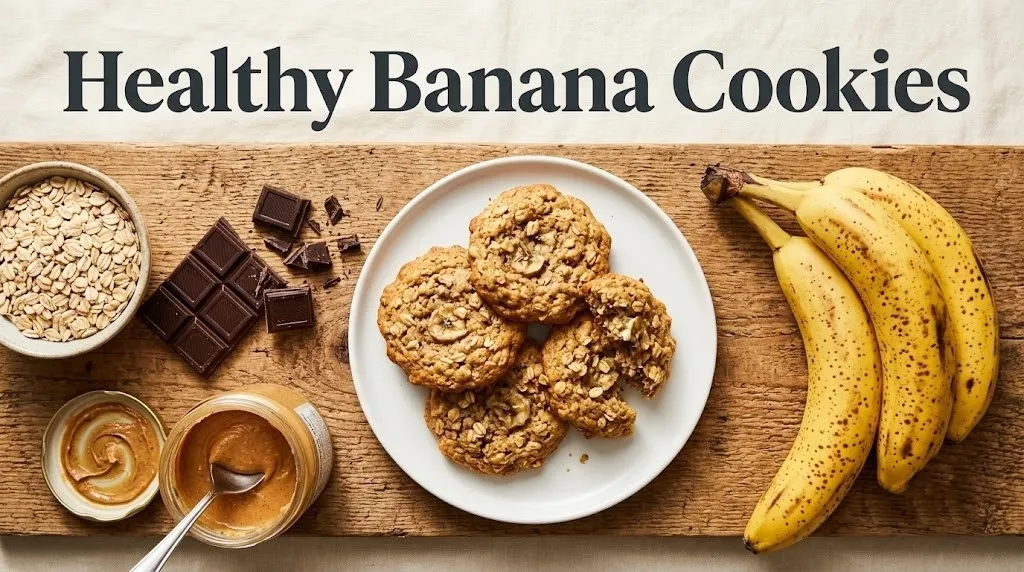
Ingredients for 12 cookies:
- 2 medium very ripe bananas (brown spots on peel, soft to touch), about 200 grams
- 1 cup rolled oats (100 grams), not quick oats
- 1/8 teaspoon fine sea salt
Optional additions (choose one or combine in small amounts):
- 1/4 cup dark chocolate chips
- 1/4 cup chopped walnuts or pecans
- 1 tablespoon chia seeds or flaxseed meal
- 1/2 teaspoon vanilla extract
- 1/2 teaspoon ground cinnamon
- 2 tablespoons unsweetened shredded coconut
To make the cookies:
- Preheat the oven to 350 degrees F. Line a rimmed baking sheet with parchment paper or a silicone baking mat.
- In a medium mixing bowl, mash the bananas with a fork until they form a mostly smooth puree with a few small lumps. You should have approximately 3/4 cup of mashed banana.
- Add the rolled oats and salt to the mashed banana. Stir with a spatula or wooden spoon until the oats are evenly coated and the mixture forms a cohesive dough.
- Fold in any optional add-ins. Do not exceed 1/4 cup total add-ins or the cookies may not hold together.
- Drop the dough by rounded tablespoons onto the prepared baking sheet. You should have 12 mounds. Flatten each mound slightly with the back of the spoon. The cookies will not spread during baking. Shape them into the approximate thickness you want the finished cookie to be.
- Bake for 12 to 15 minutes. The cookies are done when the edges are lightly golden and the tops feel set to a gentle touch. They will still be soft when they come out of the oven. They firm up as they cool.
- Let the cookies cool on the baking sheet for 5 minutes. Transfer to a wire rack to cool completely.
The texture of these cookies is soft and chewy, not crisp. They are not a crunchy biscuit. If you want a firmer cookie, bake them for an additional 2 to 3 minutes and let them cool completely on the baking sheet. The oats absorb moisture from the banana as the cookies cool, so the texture changes over the first hour after baking.
Key Takeaway: The core healthy banana cookie is bananas, oats, and salt. The cookies are soft and chewy with zero added sugar. Total add-ins must stay under 1/4 cup or the cookies will not bind.
3 Ingredient Banana Cookies Healthy
The 3-ingredient version of healthy banana cookies is the core recipe above: bananas, oats, and salt. The salt is a flavor enhancer, not a preservative. It makes the banana flavor more pronounced and balances the natural sweetness. If salt were not counted as an ingredient, this would be a 2-ingredient cookie. The salt earns its place on the short ingredient list.
The nutritional profile of a 3-ingredient banana cookie, without add-ins, is approximately 55 calories per cookie, 1 gram of protein, 1 gram of fat, 11 grams of carbohydrate, 2 grams of fiber, and 4 grams of natural sugar. There is zero added sugar, zero sodium beyond the pinch of salt, and zero saturated fat. A standard bakery oatmeal cookie contains approximately 150 calories, 6 grams of fat, 20 grams of carbohydrate, 1 gram of fiber, and 10 grams of added sugar. The healthy version reduces calories by roughly 60 percent and eliminates added sugar entirely.
The simplicity of the 3-ingredient recipe is both its strength and its limitation. The cookies are genuinely healthy. They are also plain. A child accustomed to cookies with chocolate chips and butter may not embrace the 3-ingredient version immediately. The add-ins section of the core recipe exists for that reason. A tablespoon of dark chocolate chips added to the batch adds roughly 5 calories and less than 1 gram of added sugar per cookie. That small addition increases the cookie’s appeal without undermining its nutritional integrity.
| Cookie Type | Calories | Added Sugar (g) | Fiber (g) | Protein (g) |
|---|---|---|---|---|
| 3-Ingredient Healthy Banana Cookie | 55 | 0 | 2 | 1 |
| Healthy Banana Cookie + 1 tbsp choc chips per batch | 60 | Less than 1 | 2 | 1 |
| Standard Bakery Oatmeal Cookie | 150 | 10 | 1 | 2 |
| Standard Banana Nut Muffin (store-bought) | 220 | 18 | 1 | 3 |
Quick Tip:
- Make a double batch of the 3-ingredient dough. Bake half as plain cookies for snacks. Add chocolate chips to the other half for a dessert version. One bowl, one baking session, two different cookies for different occasions.
Healthy Banana Oatmeal Cookies
Healthy banana oatmeal cookies are the same recipe as the core version. The distinction between “banana cookies” and “banana oatmeal cookies” is semantic. The oats are the oatmeal. The cookies are oatmeal cookies. The term “banana oatmeal cookies” is what some searchers type when they want a cookie that tastes like banana bread in oatmeal cookie form.
The type of oats matters for texture. Rolled oats, also called old-fashioned oats, produce a chewier cookie with visible oat flakes. Quick oats, which are rolled oats that have been cut into smaller pieces and rolled thinner, produce a softer, more uniform cookie. Steel-cut oats do not work in this recipe. They are too hard and do not soften adequately during the 12 to 15 minute bake time. If you only have steel-cut oats, pulse them in a food processor for 10 to 15 seconds until they resemble coarse quick oats. Do not grind them to a flour.
Oat flour can replace up to half of the rolled oats for a smoother-textured cookie. The ratio is 1/2 cup rolled oats plus 1/2 cup oat flour. The oat flour absorbs more moisture, so the dough will be stiffer. The resulting cookie is softer and less chewy. This variation is closer to a traditional soft-baked cookie texture while remaining flourless and gluten-free (if certified gluten-free oat flour is used).
| Oat Type | Cookie Texture | Notes |
|---|---|---|
| Rolled oats (old-fashioned) | Chewy, visible oat flakes | Best all-purpose choice |
| Quick oats | Softer, more uniform | Works well, slightly less texture |
| Steel-cut oats | Too hard, do not use | Pulse in food processor first |
| Half rolled, half oat flour | Soft, smooth, less chewy | Closest to traditional soft cookie |
Quick Tip:
- Toast the oats in the preheating oven for 5 minutes before mixing them into the dough. Spread them on the baking sheet while the oven preheats, then remove and let cool slightly before mixing. Toasting intensifies the oat flavor and adds a nutty note without adding nuts.
Banana Cookies No Sugar
Banana cookies with no sugar means no added sugar. The bananas provide all the sweetness. The Academy of Nutrition and Dietetics defines added sugar as sugars and syrups added to foods during processing or preparation. The natural sugars in whole fruit are not added sugar. They are intrinsic sugar, packaged with fiber, water, and micronutrients. A banana cookie sweetened entirely by banana contains zero grams of added sugar on the nutrition facts panel.
The sweetness level of a no-sugar banana cookie depends entirely on the ripeness of the bananas. A banana with a yellow peel and some brown spots is ripe and sweet. A banana with a fully brown peel is very ripe and very sweet. A banana with a green peel is starchy and not sweet. The sugar content of a banana increases as it ripens because enzymes convert starch into sugars. A green banana is roughly 80 percent starch and 20 percent sugar. A fully ripe banana with brown spots is roughly 20 percent starch and 80 percent sugar. The total carbohydrate content is roughly the same. The form of the carbohydrate changes from complex (starch) to simple (sugars).
For a no-sugar cookie that is sufficiently sweet for a palate accustomed to less sugar, use bananas with brown spots covering at least half the peel. If the eaters are accustomed to standard American sweets, add 1/2 teaspoon of vanilla extract and 1/2 teaspoon of cinnamon. Neither is sugar, but both enhance the perception of sweetness. Vanilla amplifies sweet flavors in the brain. Cinnamon adds warmth that reads as sweet. These are the tools for making a no-added-sugar cookie taste sweet enough.
Key Takeaway: Banana cookies with no sugar rely entirely on ripe banana for sweetness. Use bananas with brown spots. Vanilla and cinnamon enhance perceived sweetness without adding sugar. The cookies contain zero grams of added sugar.
Flourless Banana Cookies
Flourless banana cookies use oats as the structural ingredient instead of wheat flour. The oats are a whole grain. They are not a flour. The cookies are flourless in the sense that no wheat flour, all-purpose flour, or grain flour is added. The oats hold their shape during baking and provide the chew that flour would contribute in a traditional cookie.
The flourless nature of these cookies makes them naturally gluten-free if certified gluten-free oats are used. Oats are inherently gluten-free, but they are frequently cross-contaminated with wheat, barley, or rye during growing, harvesting, and processing. The FDA permits a gluten-free label on products containing less than 20 parts per million of gluten. Standard bulk-bin or conventionally packaged oats may contain gluten above this threshold. People with celiac disease or gluten sensitivity must use oats labeled “certified gluten-free.”
Flourless cookies rely on the banana as the sole binding agent. There is no gluten network to trap air and create structure. There is no egg protein to coagulate and set the cookie. The banana’s pectin and fiber hold the cookie together. This is why the cookie texture is soft and the dough must be flattened before baking. The cookies will not spread in the oven. They exit the oven in roughly the same shape they entered. Shaping matters. A dome-shaped dough mound produces a dome-shaped cookie. A flattened disc produces a flat cookie.
| Flourless Cookie Attribute | Result |
|---|---|
| Binding agent | Banana (pectin, fiber) |
| Structure | Rolled oats (whole grain) |
| Spread during baking | None, shape before baking |
| Gluten-free status | Yes, if certified GF oats used |
| Texture | Soft, chewy, oat-forward |
Quick Tip:
- To make flourless banana cookies crispier, bake them for an additional 3 to 4 minutes at 350 degrees F and let them cool completely on the baking sheet. The extended bake time drives off more moisture. The cookies will be firmer and slightly crisp at the edges, though they will never be as crisp as a butter-based cookie.
Healthy Banana Cookies for Toddlers
Healthy banana cookies for toddlers must address two concerns beyond nutrition: choking safety and added sugar limits. The American Academy of Pediatrics (AAP) recommends zero added sugar for children under 2 years old. The 3-ingredient banana cookie contains zero added sugar, making it appropriate for toddlers over 12 months who have been introduced to oats and bananas.
Choking safety requires modification of any add-ins. Chocolate chips, whole nuts, large dried fruit pieces, and coconut flakes are choking hazards for children under 4. For toddler-safe banana cookies, eliminate these add-ins entirely or modify them: mini chocolate chips instead of standard chips (still a choking risk and should be avoided for children under 2, used with caution and supervision for ages 2 to 4), finely ground nuts instead of chopped nuts, and no dried fruit unless finely chopped into pieces smaller than a pea.
The cookie itself is soft and easily gummed by a toddler with few teeth. The soft texture reduces choking risk compared to a crisp or hard cookie. The size of the cookie should be appropriate for the child’s age. A full cookie is appropriate for a 3-year-old. A half cookie or quarter cookie is appropriate for a 12-month-old developing their pincer grasp and bite control. Always supervise toddlers during snack time.
| Toddler Age | Banana Cookie Modification |
|---|---|
| 12 to 18 months | Plain 3-ingredient cookie, broken into quarters, no add-ins |
| 18 to 24 months | Plain or with cinnamon, broken into halves, no chocolate chips or nuts |
| 2 to 3 years | Mini chocolate chips optional (supervised), soft add-ins like finely grated apple |
| 3 to 4 years | Standard recipe with age-appropriate add-ins, still supervise for choking |
Quick Tip:
- For a teething toddler, freeze the baked cookies. The cold cookie provides a soothing texture for sore gums while delivering the same nutrition as a room-temperature cookie. The frozen cookie is harder and takes longer to eat, which extends the distraction time.
Banana Cookies Vegan
Banana cookies made with the core 3-ingredient recipe are naturally vegan. Bananas, oats, and salt contain no animal products. The banana replaces eggs, which are a common cookie ingredient that is not vegan. The absence of butter, milk, and honey means the recipe requires no vegan substitutions. It is vegan by default.
The egg replacement function of banana is worth understanding because it explains why the recipe works without eggs. Eggs provide three functions in traditional cookies: binding (holding the ingredients together), moisture (hydrating the flour), and leavening (trapping air for rise). Banana provides binding from pectin and fiber, moisture from its water content, and a small amount of leavening from the air incorporated during mashing. It does not provide the protein coagulation that gives egg-based cookies their structure, which is why banana cookies are softer.
For a vegan banana cookie with a firmer texture, add 1 tablespoon of ground flaxseed meal mixed with 2 tablespoons of water. Let the flaxseed mixture sit for 5 minutes to form a gel, then add it to the banana before mashing. The flaxseed gel mimics the binding and structure of eggs. The resulting cookie is firmer and holds its shape more like a traditional cookie.
| Vegan Egg Replacement for Cookies | Amount per Egg Replaced | Effect on Banana Cookies |
|---|---|---|
| Banana (mashed) | 1/4 cup | Soft, moist, banana-flavored |
| Flaxseed meal + water | 1 tbsp flax + 2 tbsp water | Firmer texture, nutty flavor, added fiber |
| Chia seed + water | 1 tbsp chia + 2 tbsp water | Similar to flax, slightly crunchier texture |
| Unsweetened applesauce | 1/4 cup | Similar moisture to banana, less binding |
Key Takeaway: Banana cookies are naturally vegan because banana replaces eggs and no animal products are required. Flaxseed or chia gel adds structure for a firmer cookie without compromising vegan status.
Banana Cookies Gluten Free
Banana cookies are gluten-free when made with certified gluten-free oats. The recipe contains no wheat flour, no barley, no rye, and no other gluten-containing ingredients in its core form. The gluten-free status depends entirely on the oats. Standard oats are cross-contaminated with gluten during processing. Certified gluten-free oats are grown, harvested, and processed under protocols that prevent cross-contamination and are tested to contain less than 20 parts per million of gluten.
The add-ins must also be gluten-free. Chocolate chips should be labeled gluten-free. Some brands use barley malt as a sweetener, which contains gluten. Vanilla extract is gluten-free. Baking powder, if used in any variation, should be labeled gluten-free because some brands use wheat starch as a carrier. Nuts and seeds are naturally gluten-free but may be processed in facilities with wheat. Check labels.
People with celiac disease should be aware that the soft, flourless texture of these cookies is different from a wheat-based cookie. The absence of gluten means the cookie will never have the chewy, stretchy texture of a traditional oatmeal cookie. The cookie is soft and crumbly. That is the gluten-free reality. It is not a flaw in the recipe.
| Ingredient | Gluten-Free Status | Notes |
|---|---|---|
| Rolled oats | Only if certified GF | Standard oats cross-contaminated |
| Bananas | Naturally GF | N/A |
| Salt | Naturally GF | N/A |
| Dark chocolate chips | Check label for barley malt | Many brands are GF, verify |
| Vanilla extract | GF | Standard vanilla is GF |
| Baking powder | Check label for wheat starch | GF baking powder available |
| Nuts and seeds | Naturally GF | Check for facility cross-contamination |
Healthy Banana Cookies With Chocolate Chips
Adding chocolate chips to healthy banana cookies turns a plain snack into a treat without adding significant sugar if the chips are chosen carefully. Dark chocolate chips with 60 percent or higher cocoa content contain less sugar than semi-sweet or milk chocolate chips. One tablespoon of dark chocolate chips (60 to 70 percent cocoa) contains approximately 5 grams of added sugar. Distributed across 12 cookies, that is less than 1 gram of added sugar per cookie.
The chocolate chips should be folded in after the oats are fully incorporated into the banana. The amount is 1/4 cup for the full batch of 12 cookies. This is the maximum add-in amount the cookie structure can support. Exceeding 1/4 cup of chocolate chips will cause the cookies to crumble because the chips interrupt the banana-oat binding.
Mini chocolate chips distribute more evenly through the dough than standard chips. Each bite gets a small amount of chocolate rather than large chocolate pockets. For a toddler-safe version, mini chips are still a choking hazard for children under 2 and should be used with caution for ages 2 to 4. Cacao nibs are an alternative: they are crushed cacao beans with no added sugar. They are intensely bitter and crunchy. A child accustomed to milk chocolate will not accept cacao nibs as a substitute. An adult looking for chocolate flavor with zero added sugar may find them acceptable.
| Chocolate Addition | Added Sugar per Cookie (approx.) | Best For |
|---|---|---|
| 1/4 cup dark chocolate chips (60 to 70%) | Less than 1g | General treat, children and adults |
| 1/4 cup mini dark chocolate chips | Less than 1g | More even chocolate distribution |
| 2 tbsp cacao nibs | 0g | Adults, zero sugar, bitter flavor |
| 1/4 cup semi-sweet chips | 1 to 2g | Sweeter cookie, still moderate sugar |
Banana and Peanut Butter Cookies Healthy
Adding peanut butter to healthy banana cookies increases the protein and healthy fat content and changes the flavor profile from banana-forward to a banana-peanut butter blend. The peanut butter also changes the texture, making the cookie richer and slightly denser. The recipe adaptation replaces some of the banana’s binding function with peanut butter’s fat and protein.
Peanut butter banana cookie ingredients for 12 cookies:
- 2 medium very ripe bananas, mashed
- 1 cup rolled oats
- 2 tablespoons natural peanut butter (unsalted, no added sugar or oil)
- 1/8 teaspoon fine sea salt
The peanut butter is stirred into the mashed banana before the oats are added. The mixture will be slightly thicker than the plain banana version. The oats are added last. The baking time and temperature remain the same: 350 degrees F for 12 to 15 minutes. The cookies will spread slightly more than the plain version because the peanut butter adds fat, which melts during baking.
The nutritional profile changes. Each peanut butter banana cookie contains approximately 70 calories, 2 grams of protein, 2 grams of fat, 12 grams of carbohydrate, 2 grams of fiber, and 4 grams of natural sugar. The added protein from the peanut butter is 1 gram per cookie. The added fat is 1 gram per cookie, primarily monounsaturated fat from the peanuts.
| Peanut Butter Variation | Protein (g) | Fat (g) | Calories |
|---|---|---|---|
| Plain 3-ingredient cookie | 1 | 1 | 55 |
| Peanut butter cookie | 2 | 2 | 70 |
| Peanut butter + chocolate chip | 2 | 3 | 80 |
Quick Tip:
- For nut-free schools or households with tree nut or peanut allergies, replace the peanut butter with sunflower seed butter. The nutritional profile is similar. The flavor is distinct. Sunflower seed butter is widely accepted in nut-free environments and does not trigger peanut or tree nut allergies.
Key Takeaway: Peanut butter adds 1 gram of protein and 1 gram of fat per cookie. Replace with sunflower seed butter for nut-free. The baking time and temperature remain the same.
Banana Protein Cookies
Adding protein powder to banana cookies increases the protein content from 1 gram to 4 to 6 grams per cookie, making them suitable as a post-workout snack or a more satiating option for active children and adults. Protein powder changes the dough’s moisture balance. It absorbs liquid. The dough will be drier and stiffer than the plain version. A small amount of milk or milk alternative restores the workable consistency.
Protein banana cookie ingredients for 12 cookies:
- 2 medium very ripe bananas, mashed
- 1 cup rolled oats
- 2 tablespoons vanilla or unflavored protein powder (whey, pea, or soy)
- 1 to 2 tablespoons milk or unsweetened almond milk, as needed
- 1/8 teaspoon fine sea salt
Mix the protein powder into the mashed banana before adding the oats. Add the milk one tablespoon at a time until the dough reaches the consistency of a thick oatmeal. It should be scoopable and hold its shape on the baking sheet. The baking time remains 12 to 15 minutes at 350 degrees F. Protein powder can cause baked goods to dry out. Check the cookies at 12 minutes. They are done when the edges are lightly golden.
The type of protein powder affects the texture and flavor. Whey protein produces a softer, more traditional cookie texture. Plant protein powders (pea, soy, hemp) absorb more liquid and produce a slightly drier, denser cookie. Unflavored or vanilla protein is best. Chocolate protein powder works but creates a chocolate-banana flavor that not everyone prefers.
| Protein Powder Type | Effect on Cookie | Protein Added per Cookie |
|---|---|---|
| Whey protein (vanilla or unflavored) | Softer texture, neutral flavor | 3 to 4g |
| Pea protein | Denser, may need more milk | 3 to 4g |
| Soy protein | Similar to whey | 3 to 4g |
| Collagen peptides | No effect on texture, dissolves completely | 3 to 4g |
Quick Tip:
- Protein powder is not appropriate for young children at adult supplement doses. The amount in this recipe (2 tablespoons per 12 cookies, roughly 1.5 to 2 grams of protein powder per cookie) is within a reasonable food-level range for school-age children and teens. For toddlers, use the plain version without protein powder.
Banana Breakfast Cookies
Banana breakfast cookies are the core recipe with add-ins that make them more substantial for a morning meal. Breakfast cookies need more protein and fiber than a snack cookie to sustain energy from morning until lunch. The breakfast version includes nut or seed butter for protein, chia or flaxseed for fiber and omega-3s, and optional dried fruit for chew and natural sweetness.
Breakfast banana cookie ingredients for 12 cookies:
- 2 medium very ripe bananas, mashed
- 1 cup rolled oats
- 2 tablespoons natural peanut butter or sunflower seed butter
- 1 tablespoon ground flaxseed meal or chia seeds
- 1/4 cup chopped dried fruit (raisins, chopped apricots, dried cranberries with no added sugar)
- 1/8 teaspoon fine sea salt
- 1/2 teaspoon ground cinnamon
Each breakfast cookie contains approximately 90 calories, 3 grams of protein, 3 grams of fat, 15 grams of carbohydrate, 3 grams of fiber, and 6 grams of natural sugar. Two breakfast cookies with a piece of fruit and a glass of milk is a complete breakfast for a school-age child or an adult on the go.
The breakfast cookies can be made ahead and frozen. Make a double batch on Sunday. Freeze the baked cookies on a baking sheet until solid, then transfer to a freezer bag. Thaw two cookies overnight in the refrigerator or for 30 seconds in the microwave for a grab-and-go breakfast. The cookies thaw to the same soft, chewy texture they had when fresh.
| Breakfast Cookie Add-In | Nutritional Function |
|---|---|
| Peanut butter or seed butter | Protein, healthy fat |
| Flaxseed or chia seeds | Fiber, ALA omega-3 |
| Dried fruit (no added sugar) | Natural sweetness, chew, fiber |
| Cinnamon | Blood sugar regulation, flavor |
| Hemp hearts | Protein, omega-3 |
Key Takeaway: Breakfast banana cookies include nut butter, seeds, and dried fruit for a more substantial morning snack. Two cookies with fruit and milk is a complete breakfast. Freeze a batch on Sunday for grab-and-go mornings.
Low Calorie Banana Cookies
The lowest calorie version of banana cookies is the plain 3-ingredient recipe at 55 calories per cookie. Calorie reduction beyond that requires reducing the oats, which reduces the structural integrity of the cookie, or reducing the banana, which reduces moisture and binding. The minimum viable recipe is 1 medium banana, 1/2 cup rolled oats, and a pinch of salt, yielding 8 smaller cookies at approximately 40 calories each.
These smaller cookies are half the size of the standard recipe. Use a teaspoon rather than a tablespoon to portion the dough. The baking time reduces to 10 to 12 minutes at 350 degrees F. Watch the cookies closely in the final 2 minutes. Smaller cookies burn faster.
Oat fiber can replace a portion of the oats for an even lower calorie version. Oat fiber is an insoluble fiber with zero calories that absorbs moisture and adds bulk. Replace 2 tablespoons of the rolled oats with 2 tablespoons of oat fiber. The cookies will be less sweet and slightly drier. The calorie reduction is roughly 30 calories per batch, or 3 calories per cookie, which is unlikely to be worth the flavor trade-off for most people.
| Calorie Reduction Strategy | Calories per Cookie |
|---|---|
| Standard 3-ingredient recipe | 55 |
| Smaller cookies (teaspoon scoop) | 40 |
| Replace 2 tbsp oats with oat fiber | 52 |
| Replace half banana with unsweetened applesauce | 45 |
Quick Tip:
- The simplest calorie control strategy is portion size. Make the standard recipe but portion 18 smaller cookies instead of 12. Each cookie is 35 to 40 calories. The smaller cookie satisfies the desire for a cookie without the full calorie load.
How Ripe Should Bananas Be for Cookies
Bananas for cookies should be very ripe with brown spots covering at least half the peel. The ripeness level determines the sweetness, moisture, and starch-sugar balance of the cookie. A banana with a fully yellow peel and no brown spots is ripe enough to eat but not ideal for baking. It contains more starch and less sugar, producing a less sweet, potentially pasty cookie.
As a banana ripens, enzymes break down starch into simple sugars. The starch content drops from approximately 80 percent of the carbohydrate in a green banana to approximately 20 percent in a fully ripe banana with brown spots. The sugar content rises from 20 percent to 80 percent of the carbohydrate. The total carbohydrate remains roughly constant. The form changes. The riper banana is sweeter because the sugars are in a form the tongue can detect.
The moisture content also changes. A ripe banana is softer and wetter than an under-ripe banana. The moisture from the banana is the only liquid in the dough. An under-ripe banana produces a drier, stiffer dough that may not fully hydrate the oats. A very ripe banana produces a wetter dough that spreads slightly more during baking.
| Banana Ripeness | Peel Appearance | Sugar Content | Best for Cookies? |
|---|---|---|---|
| Green | Fully green | Low (mostly starch) | No, too starchy and dry |
| Yellow | Yellow, no spots | Moderate | Acceptable, not ideal |
| Ripe | Yellow with brown spots | High | Yes, ideal |
| Very ripe | Mostly brown | Very high | Yes, very sweet, softer cookie |
| Overripe/black | Fully brown to black | Maximum | Yes, but may be too wet and soft |
Quick Tip:
- If your bananas are not ripe enough, bake them in their peels at 300 degrees F for 15 to 20 minutes. The heat accelerates the starch-to-sugar conversion. The peels will turn black. Let the bananas cool, then scoop out the softened, sweetened flesh. This is an emergency ripening technique, not a replacement for natural ripening. The flavor will be slightly less complex.
How to Store Banana Cookies
Banana cookies store well at room temperature, in the refrigerator, and in the freezer. Their high moisture content from the banana means they have a shorter shelf life than crisp, dry cookies. They should be stored in an airtight container to prevent them from drying out or absorbing refrigerator odors.
Room temperature storage: Place completely cooled cookies in an airtight container with a piece of paper towel at the bottom and another on top. The paper towels absorb excess moisture and prevent the cookies from becoming soggy. Store at room temperature for up to 3 days. The cookies will soften slightly each day. By day 3, they are very soft but still edible.
Refrigerator storage: Place in an airtight container and refrigerate for up to 1 week. The cookies firm up in the cold. They can be eaten cold or brought to room temperature for 15 minutes. The texture is denser when cold.
Freezer storage: Place the cooled cookies on a baking sheet in a single layer. Freeze until solid, about 2 hours. Transfer the frozen cookies to a freezer bag or airtight container. Freeze for up to 3 months. Thaw at room temperature for 30 minutes or microwave for 30 seconds. The thawed cookie is nearly identical in texture to a freshly baked cookie.
| Storage Method | Container | Duration | Texture Change |
|---|---|---|---|
| Room temperature | Airtight, with paper towels | Up to 3 days | Softens over time |
| Refrigerator | Airtight | Up to 1 week | Firms up, denser |
| Freezer | Freezer bag after flash freezing | Up to 3 months | Thaws to fresh-like texture |
Quick Tip:
- Freeze the unbaked cookie dough instead of the baked cookies. Scoop the dough into mounds on a parchment-lined baking sheet. Freeze until solid, then transfer to a freezer bag. Bake directly from frozen, adding 2 to 3 minutes to the baking time. Fresh-baked cookies on demand from the freezer.
Frequently Asked Questions About Healthy Banana Cookies
Are banana cookies actually healthy?
Yes, the 3-ingredient banana cookies are genuinely healthy. They contain whole fruit, whole grains, and zero added sugar.
One cookie provides 55 calories, 2 grams of fiber, and 4 grams of natural sugar from the banana.
The USDA Dietary Guidelines definition of healthy includes whole fruits, whole grains, and limited added sugars, all of which these cookies meet.
Can I make banana cookies without oats?
Yes, replace the oats with an equal amount of quinoa flakes, buckwheat flakes, or a blend of almond flour and coconut flour.
Quinoa and buckwheat flakes produce a texture similar to oats. Almond flour and coconut flour absorb more moisture and require additional banana or a tablespoon of milk.
The cookies will not have the same chewy texture that oats provide, but they will hold together.
Why are my banana cookies falling apart?
The cookies fall apart when the ratio of add-ins to banana-oat base is too high or when the bananas were not ripe enough to provide adequate binding moisture.
Limit add-ins to 1/4 cup total for the standard batch. Use very ripe bananas with brown spots.
If the dough seems crumbly before baking, add an extra half banana or a tablespoon of nut butter to increase binding.
Can babies eat banana cookies?
Babies over 6 months who have been introduced to bananas and oats can eat the plain 3-ingredient banana cookies.
The cookies must be broken into age-appropriate pieces. For a 6- to 12-month-old, break into very small pieces or soften with a small amount of milk.
Never add chocolate chips, nuts, or large dried fruit pieces for children under 4 due to choking risk per AAP guidelines.
How do I add protein to banana cookies?
Add 2 tablespoons of protein powder (whey, pea, or soy) to the mashed banana before adding the oats. Add 1 to 2 tablespoons of milk if the dough is too dry.
Each cookie gains 3 to 4 grams of protein, increasing from 1 gram to 4 to 5 grams per cookie.
For a whole-food protein boost, add 2 tablespoons of peanut butter or almond butter, which adds 1 gram of protein per cookie.
Banana cookies are what happens when you let the ingredients do the work. The banana is the sweetener, the binder, and the moisture. The oats are the structure. The salt makes it taste like something. Everything else is optional. The cookies that come out of the oven are soft, chewy, and genuinely made of food. They are not a protein bar dressed up as a cookie. They are not a “guilt-free” version of anything. They are cookies made from bananas and oats.
Bake a batch when the bananas on the counter are too brown for anyone to eat out of hand. That is the moment. Freeze half the batch for the week ahead. Let your kids eat them for breakfast with a glass of milk. Let yourself eat one after dinner with a cup of tea. The cookie is not going to change your life. It is going to be a good cookie made from good ingredients that you can eat every day if you want to.