A healthy rice pudding starts with whole grain brown rice, a protein-rich dairy or plant base, and natural sweetness from whole fruit or spices rather than refined sugar. You get all the creamy comfort of the classic dessert with more fiber, more protein, and a gentler effect on blood sugar.
The Academy of Nutrition and Dietetics confirms that dessert can absolutely fit into a balanced eating pattern when it is built from nutrient-dense ingredients. Traditional rice pudding made with white rice, whole milk, and heavy sugar lands around 350 calories per cup with minimal fiber and protein. A reworked version using brown rice and Greek yogurt cuts the added sugar and boosts protein to roughly 15 grams per serving.
This article walks you through the exact technique, the best ingredient swaps with their nutritional reasoning, and full recipes for the base version plus vegan and no-sugar-added variations. You will find a detailed nutrition comparison table, a diabetic-friendly approach using resistant starch science, and clear storage and freezing instructions.
What Is Healthy Rice Pudding?
A healthy rice pudding is a version of the classic comfort dessert that prioritizes whole grains, unsweetened milk or milk alternatives, and natural flavorings over refined white rice, heavy cream, and added sugar.
The dish has roots across multiple food cultures. In India, kheer simmers rice with milk and cardamom. In Mexico, arroz con leche combines rice, milk, and cinnamon. Scandinavian risgrynsgröt is a warm rice porridge often served during the holidays. Each tradition uses similar building blocks. The healthy version does not erase those traditions. It applies modern nutritional understanding to make them more nourishing while keeping the spirit of the dish intact.
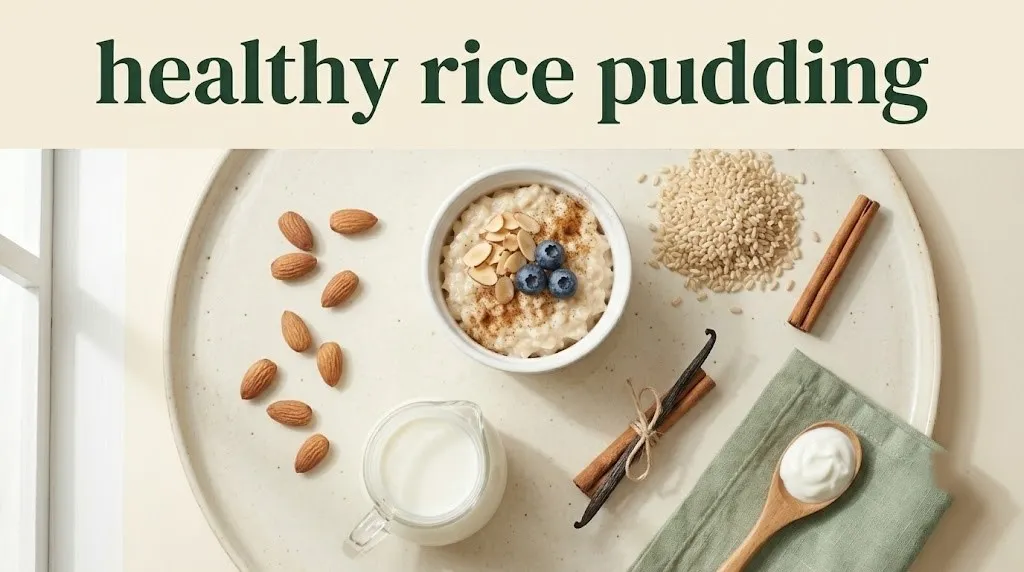
Three characteristics define a nutritionally upgraded rice pudding. The rice is whole grain when possible, supplying fiber and minerals that white rice lacks. The liquid base contributes protein and calcium, with Greek yogurt, dairy milk, or fortified soy milk being strong choices. The sweetener is scaled back and preferably comes from whole sources like mashed banana, date paste, or a measured amount of maple syrup or honey. Spices like cinnamon and cardamom add perceived sweetness without adding sugar, a sensory trick that helps reduce added sugar by up to 25 percent in some recipe tests.
Is Rice Pudding Healthy?
Rice pudding can be healthy when it is made with whole grain rice, unsweetened milk, and little to no added sugar. Traditional versions made with white rice, whole milk, and significant amounts of sugar are less nutrient-dense and best treated as an occasional dessert.
The health value of rice pudding depends almost entirely on the ingredient choices and portion size. A standard cup of traditional rice pudding delivers roughly 350 calories, 8 grams of protein, 1 gram of fiber, and 25 grams of added sugar. That added sugar amount exceeds the American Heart Association recommended daily limit of 25 grams for women and approaches the 36 gram limit for men, and the pudding provides very little satiating protein or fiber in return.
A nutritionally upgraded version changes the math. Brown rice increases fiber to about 3.5 grams per serving. Greek yogurt boosts protein to 15 grams or more. Cutting added sugar to a tablespoon of maple syrup per serving reduces the sugar load while cinnamon and vanilla keep the flavor satisfying. The result is a dessert that also functions as a reasonable snack or even a post-workout recovery food when protein needs are higher.
The American Diabetes Association notes that whole grain choices and reduced added sugar help manage post-meal blood glucose. Rice pudding is not inherently off-limits for anyone. The ingredients and the portion determine whether it is a regular option or a once-in-a-while treat.
Key Takeaway: Rice pudding is only as healthy as its ingredients. Whole grain rice, protein-rich dairy or plant milk, and minimal added sugar transform it from a sugar-heavy dessert into a balanced snack.
Healthy Rice Pudding Recipe (Base Version)
This healthy rice pudding recipe delivers a creamy, lightly sweet dessert with 15 grams of protein and 4 grams of fiber per serving. It serves four and takes about 40 minutes on the stovetop.
The base recipe uses short-grain brown rice for its natural creaminess, though the starch in brown rice behaves differently from white. Brown rice holds its shape more and requires more liquid and time. The Greek yogurt stirred in at the end cools the pudding slightly and adds a tangy richness that balances the sweetness.
Ingredients:
- 1 cup short-grain brown rice, uncooked
- 3 cups unsweetened almond milk or dairy milk
- 1 cup water
- 1/4 teaspoon salt
- 1 cinnamon stick or 1 teaspoon ground cinnamon
- 1 teaspoon vanilla extract
- 2 tablespoons pure maple syrup
- 1 cup plain Greek yogurt (nonfat or 2 percent)
- Optional toppings: toasted sliced almonds, fresh berries, extra cinnamon
To prepare:
- Rinse the brown rice under cold water in a fine-mesh strainer for 30 seconds.
- Combine the rice, milk, water, salt, and cinnamon stick in a medium saucepan.
- Bring to a gentle boil over medium-high heat. Stir once. Reduce heat to low.
- Cover and simmer for 35 to 40 minutes, stirring every 10 minutes. Brown rice takes longer than white.
- Check doneness. Rice should be tender with a slight chew. If the liquid is absorbed but rice is still firm, add 1/4 cup more milk and continue cooking.
- Remove from heat. Discard the cinnamon stick if used.
- Stir in vanilla extract and maple syrup.
- Let the pudding cool for 5 minutes. This step prevents the yogurt from curdling.
- Fold in the Greek yogurt until fully incorporated.
- Serve warm or chilled, topped with almonds and berries if desired.
Nutrition per serving (approximately 1 cup): 270 calories, 15g protein, 42g carbohydrate, 4g fiber, 8g fat, 8g added sugar.
Quick Tip:
- For a thicker pudding, use 2 percent Greek yogurt and reduce the milk by 1/4 cup
- Leftovers thicken in the refrigerator. Stir in a splash of milk when reheating
- Dairy-free eaters can swap Greek yogurt for unsweetened coconut yogurt with a tablespoon of chia seeds for thickness
Rice Pudding Recipe Healthy Variations Worth Trying
The base recipe is a starting point. Three variations target specific dietary patterns while maintaining the creamy texture and balanced nutrition of the original.
High-Protein Rice Pudding increases the Greek yogurt to 1.5 cups and reduces the almond milk to 2.5 cups. One scoop of unflavored collagen peptides (about 10 grams protein) stirred in with the vanilla adds protein without changing the taste or texture. The result is roughly 28 grams of protein per serving. This version works well as a post-workout recovery meal or a filling breakfast. Collagen is not a complete protein, but combined with the dairy and grain protein, the amino acid profile is robust.
Anti-Inflammatory Spiced Rice Pudding leans on turmeric and ginger. Add 1 teaspoon of ground turmeric and 1 teaspoon of freshly grated ginger along with the cinnamon. Black pepper is non-negotiable here. A pinch, about 1/8 teaspoon, increases the absorption of curcumin, the active compound in turmeric, by up to 2,000 percent according to research on piperine bioavailability. The color turns a warm golden yellow. Coconut milk replaces almond milk for a richer mouthfeel that complements the spices.
Chocolate Cherry Rice Pudding satisfies dessert cravings with more nutritional heft. Stir 2 tablespoons of unsweetened cocoa powder into the milk mixture before cooking. Replace the maple syrup with 1/4 cup of mashed ripe banana for sweetness. After cooking, fold in 1 cup of frozen dark cherries, thawed and halved. The cherries provide vitamin C and anthocyanins, and their tartness cuts through the cocoa. This version contains no added sugar if the banana is sufficiently ripe.
How to Make Healthy Rice Pudding Step by Step
Making healthy rice pudding is a low-effort cooking project that requires patience more than skill. The process works on the stovetop, in a rice cooker, in the Instant Pot, or in the oven.
The stovetop method, described in the base recipe above, offers the most control over texture. Frequent stirring in the last 10 minutes prevents scorching and encourages the rice to release its starch, which creates the signature creamy consistency. Do not skip the stirring step. Rice can stick and burn quickly once the liquid reduces.
| Cooking Method | Time | Texture Result | Best For |
|---|---|---|---|
| Stovetop | 35 to 45 minutes | Creamy, slightly chewy | Traditional pudding, most control |
| Rice Cooker | 45 to 50 minutes | Softer, more porridge-like | Set-it-and-forget-it convenience |
| Instant Pot | 20 minutes (high pressure) | Very soft, uniform | Speed, hands-off cooking |
| Baked | 60 to 75 minutes | Firmer top, custard-like | Holiday presentation, larger batches |
For the rice cooker method, combine all ingredients except the yogurt and vanilla. Use the white rice setting. When the cycle finishes, let it sit on “keep warm” for 10 minutes. Stir in yogurt and vanilla after cooling slightly.
For the Instant Pot, combine rice, 2.5 cups of milk, water, salt, and cinnamon. Cook on high pressure for 20 minutes. Allow a natural pressure release for 10 minutes. The quick release can cause the milk to sputter through the valve. Stir in the remaining half cup of milk, vanilla, maple syrup, and yogurt after the pudding cools slightly.
Key Takeaway: Stovetop stirring, especially in the final 10 minutes, is the secret to creamy rice pudding. Choose your cooking method based on how much attention you want to give the pot.
Healthy Rice Pudding Recipes for Every Dietary Pattern
A good healthy rice pudding recipe adapts to different dietary patterns without losing its identity. Here are three fully developed variations.
Vegan Brown Rice Pudding uses full-fat canned coconut milk for creaminess and plant protein. Combine 1 cup brown rice, 1 can coconut milk, 1.5 cups oat milk, and a pinch of salt. Cook per the stovetop method. Stir in 2 tablespoons chia seeds during the last 5 minutes of cooking. The chia seeds absorb liquid and swell, mimicking the thickening effect of egg yolks used in traditional recipes. Sweeten with 2 tablespoons of date paste or maple syrup. This version contains no dairy, no eggs, and no refined sugar. One serving provides roughly 5 grams of fiber from the brown rice and chia seeds combined.
Gluten-Free Rice Pudding is naturally achieved since all rice is gluten-free. The concern is cross-contamination for people with celiac disease. Use certified gluten-free oats only if making an oat milk version, as oats are frequently processed on shared equipment. All other ingredients in the base recipe are inherently gluten-free.
Keto rice pudding is a misnomer since rice is a carbohydrate. A low-carb alternative uses cauliflower rice as the base. Simmer 2 cups of finely riced cauliflower in 1 can of coconut milk with cinnamon and vanilla until tender, about 15 minutes. Stir in 2 tablespoons of chia seeds and a low-glycemic sweetener like monk fruit. The texture is softer than rice pudding, but the flavor profile is close. One serving contains roughly 8 grams of net carbohydrate. This is not rice pudding in the traditional sense, but it serves the same craving for people who need to strictly limit carbohydrates.
Why Brown Rice Pudding Is the Healthier Choice
Brown rice pudding is healthier than white rice pudding because the whole grain retains its bran and germ, where fiber, magnesium, selenium, and B vitamins are concentrated.
White rice is brown rice with the bran and germ removed during milling. That processing strips away about 75 percent of the magnesium, 60 percent of the iron, and almost all of the fiber. A cup of cooked short-grain white rice contains 0.4 grams of fiber. The same amount of cooked short-grain brown rice delivers 3.5 grams of fiber. That fiber slows digestion, softens the blood sugar response, and contributes to satiety.
| Nutrient (per 1 cup cooked) | Short-Grain White Rice | Short-Grain Brown Rice |
|---|---|---|
| Calories | 205 | 215 |
| Protein | 4.2 g | 5.0 g |
| Fiber | 0.4 g | 3.5 g |
| Magnesium | 9 mg | 84 mg |
| Selenium | 7 mcg | 19 mcg |
| Glycemic Index (approximate) | 70 to 80 (high) | 50 to 60 (medium) |
Brown rice does require cooking adjustments. It absorbs liquid more slowly. The liquid-to-rice ratio shifts from 3:1 for white rice to roughly 4:1 for brown rice. Cooking time increases by 15 to 20 minutes. The final texture is chewier. Some people prefer white rice for texture reasons, and that is a valid choice. If white rice is your preference, balance the meal by adding a protein source like Greek yogurt and a fiber source like chia seeds or flaxseed meal to blunt the glycemic response.
How to Make Healthy Rice Pudding With No Added Sugar
Making healthy rice pudding with no added sugar is a technique challenge solved by using whole fruit, spices, and the natural sweetness of milk.
The USDA Dietary Guidelines for Americans recommend that added sugars make up less than 10 percent of total daily calories. A dessert that contains zero added sugar creates room for other choices throughout the day. The key is understanding where sweetness can come from naturally.
Ripe banana mashed and stirred in after cooking adds sweetness and a creamy texture. One medium banana contributes about 14 grams of natural sugar along with potassium and vitamin B6. The banana flavor pairs well with cinnamon and walnut toppings. Date paste, made by blending soaked pitted Medjool dates with a small amount of water, is a whole-food sweetener that retains the fiber from the fruit. Two tablespoons of date paste sweeten a whole batch.
Spices create the perception of sweetness without adding any sugar. Cinnamon, cardamom, nutmeg, and vanilla extract all activate sweetness receptors on the tongue indirectly. A study published in the Journal of Food Science found that cinnamon can enhance perceived sweetness enough to reduce added sugar in recipes by up to 25 percent without a detectable difference in taste for most participants.
Dairy milk and some plant milks contain natural sugars. Lactose in dairy milk tastes mildly sweet. Unsweetened oat milk has a naturally sweet grain flavor. Leaning on these base ingredients reduces the need for added sweeteners.
Vegan Rice Pudding That Is Actually Healthy
A vegan rice pudding that is genuinely healthy avoids the common pitfalls of vegan desserts: excessive saturated fat from coconut products and reliance on refined sugar.
The healthiest vegan rice pudding combines a lower-saturated-fat plant milk base with a whole-grain rice and a whole-food sweetener. Unsweetened soy milk is the strongest nutritional choice. It contains 8 grams of protein per cup, comparable to dairy milk, and is fortified with calcium and vitamin D in most commercial brands. Oat milk and almond milk are lower in protein but still work if the pudding includes a protein boost from chia seeds, hemp seeds, or a scoop of plant-based protein powder.
| Plant Milk (1 cup) | Calories | Protein | Fat | Calcium (fortified) |
|---|---|---|---|---|
| Unsweetened soy milk | 80 | 8 g | 4 g | 300 mg |
| Unsweetened oat milk | 45 | 1 g | 1.5 g | 350 mg |
| Unsweetened almond milk | 30 | 1 g | 2.5 g | 450 mg |
| Canned coconut milk (light) | 150 | 2 g | 15 g | 20 mg |
Full-fat canned coconut milk creates the richest vegan rice pudding. The texture is luxurious. The trade-off is about 24 grams of saturated fat per half-cup serving, which is more than the American Heart Association recommends in an entire day for a 2,000-calorie diet. Using light coconut milk or blending half coconut milk with half soy milk reduces the saturated fat while keeping a creamy texture. A cashew cream, made by blending soaked raw cashews with water until smooth, adds creaminess with a better unsaturated fat profile.
Key Takeaway: Unsweetened soy milk and brown rice create the most nutritionally balanced vegan rice pudding. Full-fat coconut milk should be a sometimes ingredient, not the everyday base.
Rice Pudding Calories and Full Nutrition Breakdown
The calorie and nutrition profile of rice pudding varies widely based on ingredients. A standard homemade healthy rice pudding ranges from 220 to 310 calories per cup depending on the milk, rice, and sweetener choices.
The USDA FoodData Central database lists traditional rice pudding made with whole milk, white rice, sugar, and eggs at approximately 350 calories per cup with 8 grams of protein, 10 grams of fat, and 55 grams of carbohydrate, of which roughly 25 grams are added sugar. This is a dessert. It is not a nutrient-dense snack.
The healthy version described in this article, using brown rice, almond milk, Greek yogurt, and 2 tablespoons of maple syrup across four servings, comes in at 270 calories per cup with 15 grams of protein, 4 grams of fiber, and 8 grams of added sugar. The protein and fiber shift make it a reasonable snack or light breakfast rather than a sugar-forward dessert.
| Rice Pudding Type (1 cup) | Calories | Protein | Fiber | Added Sugar |
|---|---|---|---|---|
| Traditional (white rice, whole milk, sugar) | 350 | 8 g | 0.5 g | 25 g |
| Healthy base (brown rice, almond milk, Greek yogurt, maple syrup) | 270 | 15 g | 4 g | 8 g |
| Vegan (brown rice, coconut milk, date paste) | 310 | 4 g | 5 g | 0 g |
| High-protein (extra Greek yogurt, collagen) | 290 | 28 g | 4 g | 8 g |
The vegan version is lower in protein but higher in fiber. People who need more protein can add a scoop of plant-based protein powder or a swirl of almond butter on top. The high-protein version rivals a protein shake in protein content, making it suitable for muscle repair after exercise.
Rice Pudding With Greek Yogurt for Extra Protein
Rice pudding with Greek yogurt is a protein upgrade that turns a carb-heavy dessert into a balanced snack. The yogurt adds 17 grams of protein per 6-ounce serving, along with calcium and probiotics.
Greek yogurt is made by straining whey and lactose from regular yogurt. The result is a thicker, tangier, more protein-dense product. When stirred into warm rice pudding, it cools the pudding slightly and adds a creamy richness that eliminates the need for heavy cream or butter. The tanginess balances the sweetness, making the pudding taste more complex than it actually is.
The technique matters. Greek yogurt will curdle if added to boiling-hot rice pudding. The proteins denature and separate, creating a grainy texture. Let the cooked pudding cool for at least 5 minutes, until it is warm but not steaming. Stir the yogurt in gently with a folding motion rather than beating it vigorously. Vigorous stirring breaks the yogurt structure and releases water.
For people who are lactose intolerant, Greek yogurt may be better tolerated than milk because most of the lactose is removed during straining. It still contains dairy proteins and is not suitable for a milk allergy. Lactose-free Greek yogurt is available in some markets. A dairy-free alternative that provides similar protein is unsweetened soy yogurt, though the texture is less thick. Adding a tablespoon of chia seeds to soy yogurt pudding helps mimic the thickness of Greek yogurt.
Key Takeaway: Stirring Greek yogurt into cooled rice pudding adds 12 to 17 grams of protein per serving and eliminates the need for cream or butter.
Can Rice Pudding Fit Into a Weight Loss Plan?
Rice pudding can fit into a weight loss plan when portion size is controlled, protein is prioritized, and added sugar is minimized. Dessert is not the enemy of weight loss. Uncontrolled portions and mindless eating are.
Weight loss ultimately comes down to a sustained calorie deficit. The Academy of Nutrition and Dietetics emphasizes that overly restrictive eating patterns that eliminate all desserts are rarely sustainable. Including a satisfying, portion-controlled dessert like healthy rice pudding can actually support long-term adherence to a reduced-calorie eating pattern.
The calorie density of rice pudding is moderate, similar to oatmeal with toppings. A one-cup serving of the healthy base recipe at 270 calories fits within most weight loss meal plans. The protein and fiber content helps with satiety, meaning you are less likely to reach for additional snacks an hour later. Compare that to a typical serving of ice cream, which delivers similar calories with far less protein and no fiber.
A few adjustments make rice pudding more weight-loss-friendly. Reduce the portion to 3/4 cup and serve it in a small bowl. Add a tablespoon of ground flaxseed for extra fiber and omega-3 fatty acids. Use a zero-calorie sweetener like stevia or monk fruit if you are strictly limiting carbohydrates. Pair the pudding with a source of lean protein at the same meal, such as a hard-boiled egg on the side, to further increase satiety.
Diabetic-Friendly Rice Pudding Tips and Recipe
A diabetic-friendly rice pudding uses brown rice, a low-glycemic sweetener, added protein and fiber, and exploits a fascinating piece of food science called resistant starch.
Resistant starch is a type of carbohydrate that resists digestion in the small intestine and ferments in the large intestine, behaving more like fiber than starch. Cooked and cooled rice contains more resistant starch than freshly cooked rice. According to research published in the Journal of Nutritional Science, cooling cooked rice for 12 to 24 hours in the refrigerator increases its resistant starch content, which reduces the post-meal blood glucose response when the rice is reheated or eaten cold.
This means a diabetic-friendly rice pudding strategy involves cooking a batch of brown rice, refrigerating it overnight, and then using it to make pudding the next day. The process of cooling and reheating triggers retrogradation, where starch molecules reorganize into a structure less accessible to digestive enzymes.
The recipe adjustments for a diabetic-friendly version:
- Use brown rice that has been cooked and refrigerated for at least 12 hours
- Replace maple syrup with 1 to 2 teaspoons of monk fruit sweetener or stevia, or use 1/4 cup mashed banana which has a lower glycemic impact than refined sugar
- Increase the Greek yogurt to 1.5 cups for more protein
- Add 1 tablespoon of chia seeds or ground flaxseed per serving for additional fiber
- Top with cinnamon, which some research suggests may improve insulin sensitivity
This version contains roughly 230 calories, 18 grams of protein, 6 grams of fiber, and a significantly lower glycemic load than traditional rice pudding. The American Diabetes Association recommends that people with diabetes work with a registered dietitian to determine individual carbohydrate targets.
Key Takeaway: Cooking, cooling, and reheating brown rice increases resistant starch. The cooled-rice technique plus protein and fiber additions make rice pudding far more blood-sugar-friendly.
Leftover Rice Pudding Recipe That Reduces Food Waste
Leftover rice pudding is the fastest path to the dessert because the rice is already cooked. Starting with cooked rice cuts the total preparation time to about 15 minutes.
This method solves two problems at once. It uses up leftover rice that might otherwise sit in the refrigerator until it spoils. The USDA recommends using cooked rice within 4 to 6 days when refrigerated properly. It also eliminates the longest step in the recipe, which is waiting for the rice to absorb liquid and become tender.
Leftover rice behaves differently from uncooked rice in the pudding pot. It does not absorb liquid the same way. The ratio shifts dramatically. For 2 cups of cooked brown or white rice, use 1.5 cups of milk and 1/2 cup of Greek yogurt. The cooking time drops to 10 to 15 minutes, just enough to heat everything through and let the flavors meld.
To prepare leftover rice pudding:
- Combine 2 cups of cooked brown rice, 1.5 cups of milk, a cinnamon stick, and a pinch of salt in a saucepan.
- Heat over medium-low, stirring frequently, until the mixture is warm and the rice has absorbed some of the liquid, about 8 to 10 minutes.
- Remove from heat. Let cool for 3 minutes.
- Stir in 1/2 cup Greek yogurt, 1 teaspoon vanilla extract, and 1 tablespoon maple syrup.
- If the pudding is too thick, add a splash of milk. If too thin, let it sit for 5 minutes. The rice will continue to absorb liquid.
- Serve warm or transfer to the refrigerator to chill.
This method works with any plain cooked rice. Rice that was cooked with salt, oil, or aromatics like garlic should be reserved for savory dishes. Rice from takeout containers, rinsed briefly to remove any sauce residue, can work if the flavor profile was neutral.
Can You Freeze Rice Pudding Without Ruining It?
Rice pudding can be frozen, but the texture changes. Freezing causes ice crystals to rupture the starch structure in the rice and can cause dairy-based puddings to separate upon thawing. Understanding what to expect prevents disappointment.
The texture of thawed rice pudding is grainier and sometimes watery. The rice grains lose some of their structure. The creamy, cohesive mouthfeel of fresh rice pudding does not fully return. Despite this, frozen rice pudding is still perfectly edible and safe. The flavor remains intact. Reheating with a splash of milk and a good stir restores some, but not all, of the original texture.
Rice pudding made with full-fat coconut milk freezes and thaws better than dairy-based versions. Coconut milk contains less water and more fat, which reduces ice crystal formation. Vegan rice pudding is the best candidate for freezing.
To freeze rice pudding correctly:
- Cool the pudding completely in the refrigerator. Never freeze warm food.
- Portion into airtight freezer-safe containers. Leave a half-inch of headspace for expansion.
- Label with the date. Rice pudding can be frozen for up to 3 months.
- To thaw, transfer to the refrigerator overnight.
- Reheat gently on the stovetop over low heat with a splash of fresh milk. Stir constantly to re-emulsify the mixture.
- If the texture separates, a quick blitz with an immersion blender can smooth it out, though this changes the rice texture further.
The USDA notes that frozen cooked rice dishes are safe indefinitely from a food safety perspective, but quality declines after 3 months. If freezer space is limited, consider halving the recipe to make only what will be eaten within 5 days.
Key Takeaway: Rice pudding can be frozen for up to 3 months, but expect a grainier texture upon thawing. Vegan coconut milk versions freeze with the least textural damage.
Rice Pudding vs Oatmeal: Which Breakfast Is Healthier?
Oatmeal and rice pudding are both grain-based breakfast dishes, but oatmeal has a nutritional edge for everyday eating. Rice pudding holds its own as a satisfying occasional breakfast or a dessert.
A bowl of oatmeal made with 1/2 cup dry rolled oats, 1 cup water or milk, and a sprinkle of cinnamon delivers roughly 150 to 200 calories, 5 to 7 grams of protein, 4 grams of fiber, and zero added sugar before toppings. Oats contain beta-glucan, a soluble fiber that the American Heart Association recognizes as effective for lowering LDL cholesterol when consumed regularly.
Rice pudding, even the healthy version, is slightly higher in calories and carbohydrate per comparable serving. The fiber content of brown rice pudding approaches oatmeal if brown rice is used. White rice pudding falls significantly behind. The protein in rice pudding can be higher if Greek yogurt is incorporated, giving it an advantage for satiety.
| Nutrient (1 cup serving) | Oatmeal (rolled oats, milk) | Brown Rice Pudding (Greek yogurt) |
|---|---|---|
| Calories | 200 | 270 |
| Protein | 10 g | 15 g |
| Fiber | 4 g | 4 g |
| Iron | 2 mg | 0.8 mg |
| Calcium | 200 mg | 250 mg |
| Beta-glucan | 2 g | 0 g |
Oatmeal is the better daily breakfast choice because of the beta-glucan, the lower calorie density, and the faster cooking time. Rice pudding is a more indulgent option that works better as a pre-made breakfast when you want something that feels like a treat. Both are whole-grain dishes that support a healthy diet when made with minimal added sugar.
Frequently Asked Questions About Healthy Rice Pudding
Is rice pudding good for you?
Rice pudding made with brown rice, Greek yogurt or fortified plant milk, and minimal added sugar can be a nutritious snack or dessert.
It provides protein, calcium, and fiber when made with whole grain rice and protein-rich dairy.
Traditional versions with white rice, sugar, and cream are less nutrient-dense and best eaten occasionally.
How many calories are in a bowl of rice pudding?
A cup of traditional rice pudding contains roughly 350 calories with 25 grams of added sugar.
A cup of healthy rice pudding made with brown rice, almond milk, Greek yogurt, and a small amount of maple syrup contains about 270 calories with 8 grams of added sugar.
The exact number depends on the specific ingredients and portion size.
Can I eat rice pudding if I have diabetes?
Rice pudding can fit into a diabetic eating plan with specific adjustments.
Use brown rice that has been cooked and cooled to increase resistant starch.
Choose a low-glycemic sweetener and add Greek yogurt and chia seeds for protein and fiber to slow digestion.
What is the healthiest rice for rice pudding?
Short-grain brown rice is the healthiest choice because it retains the bran and germ, supplying fiber, magnesium, and selenium.
The natural starchiness of short-grain rice also creates a creamier texture.
If white rice is preferred for texture, balance the meal with a protein and fiber source.
How long does homemade rice pudding last in the fridge?
Homemade rice pudding lasts 4 to 5 days in the refrigerator in an airtight container.
The USDA recommends consuming cooked rice dishes within this timeframe for safety.
Rice pudding will thicken as it sits, so stir in a splash of milk when reheating.
Healthy rice pudding proves that dessert and nutrition are not opposites. The same creamy spoonful that feels like comfort food can deliver 15 grams of protein, 4 grams of fiber, and the warmth of cinnamon and vanilla without a sugar crash afterward.
Make a batch on Sunday. Portion it into small containers. You will have a grab-and-go breakfast, a post-workout recovery snack, or a dessert that does not derail your eating goals. Use the brown rice if you can. Stir in the Greek yogurt after the pot cools. Add the cinnamon generously. Your future self, standing in front of the fridge looking for something satisfying, will thank you.