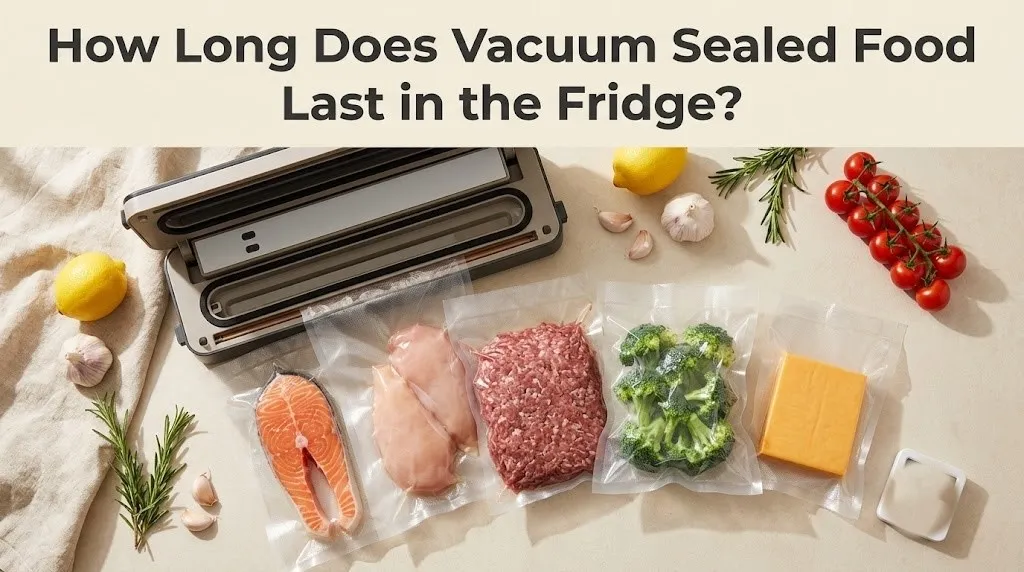
Vacuum sealed food stored in a refrigerator at 40 degrees Fahrenheit or below generally lasts 2 to 3 times longer than the same food stored in standard packaging, with cooked meats lasting 2 to 3 weeks, raw meats lasting 5 to 10 days, and hard cheeses lasting 4 to 8 months. A chicken breast that would spoil in a standard zip-top bag after 2 days can remain safe and fresh-tasting for roughly 6 to 8 days when properly vacuum sealed and refrigerated. The vacuum sealer does not stop time. It removes most of the oxygen that spoilage bacteria need to multiply, which slows the clock dramatically. It does not stop it.
The difference between food that lasts and food that makes someone sick comes down to understanding what a vacuum sealer actually does and does not accomplish. Removing air from a bag eliminates obligate aerobic bacteria, the oxygen-dependent microorganisms that cause surface mold, discoloration, and off-odors. It does nothing to stop anaerobic bacteria, including Clostridium botulinum, which actually thrive in oxygen-free environments. A 2025 food safety advisory from the USDA Food Safety and Inspection Service specifically warns that vacuum packaging creates anaerobic conditions that require strict temperature control because the botulinum toxin can form in low-oxygen environments held above 38 degrees Fahrenheit. The vacuum sealer is a powerful food preservation tool. It is not a substitute for refrigeration or food safety common sense.
This guide covers exactly how long every major food category lasts when vacuum sealed and refrigerated, why the extension works differently for different foods, which foods should never be vacuum sealed raw, the critical distinction between vacuum sealing and modified atmosphere packaging used in commercial products, and how freezer storage multiplies shelf life far beyond what refrigeration alone can deliver. Every timeline is sourced from USDA, FDA, or university extension food safety research current as of 2026. No vague estimates. No wishful thinking from people who claim their vacuum sealed salmon lasted six weeks in the fridge and tasted fine. You will learn what is safe, what is risky, and how to tell the difference before anyone gets sick.
How Does Vacuum Sealing Extend Food Life?
Vacuum sealing extends food life by removing oxygen from the storage environment, which slows the growth of aerobic spoilage bacteria, molds, and yeasts that require oxygen to multiply. Oxygen also drives oxidative rancidity in fats, the chemical process that turns nuts bitter, makes whole grain flours smell like old cardboard, and gives meat an off-color brown-gray hue. When a vacuum sealer pulls the air out of a bag and creates a tight seal, it physically removes the gas that powers most of the spoilage reactions visible to the naked eye. The food inside the bag looks the same on day five as it did on day one because the oxygen-driven breakdown never started.
The science is straightforward but the limits are real. Vacuum sealing removes roughly 90 to 95 percent of the atmospheric oxygen in the bag, dropping the internal oxygen concentration from the normal 21 percent to roughly 1 to 2 percent. That is low enough to suppress aerobic bacteria but not low enough to kill anything. The bacteria already present on the food before sealing remain alive. They simply shift their metabolism or stop reproducing. Psychrotrophic bacteria, the cold-tolerant organisms that can multiply at refrigerator temperatures, continue to grow slowly regardless of oxygen level. Listeria monocytogenes is facultatively anaerobic, meaning it grows with or without oxygen. Vacuum sealing does not slow it down at all. This is why refrigeration temperature remains the primary safety control. The vacuum extends the timeline. The refrigerator enforces the safety limit.
A useful way to think about vacuum sealing is to compare it to a slowdown, not a shutdown. The food is still aging. Enzymes naturally present in meat tissue continue to break down proteins. Fish flesh continues to degrade through autolysis. Vegetables continue to respire unless blanched first. The vacuum sealer removes one spoilage accelerator. The others keep ticking. The refrigerator temperature, the initial bacterial load on the food at the time of sealing, the acidity of the food, and the water activity level all contribute to how long the food actually lasts. A piece of fish sealed immediately after purchase from a high-turnover fish counter will last longer than fish that sat in the back of a home fridge for two days before sealing.
Key Fact: Removing oxygen stops aerobic spoilage organisms but does not affect anaerobic pathogens. The refrigerator temperature, not the vacuum, is the primary safety control against botulism and listeria.
Vacuum Sealed Food Refrigeration Timelines by Food Type
The timeline extension from vacuum sealing varies dramatically by food type. High-moisture, high-protein foods like raw fish and poultry gain a few extra days. Low-moisture foods like hard cheese and cured meats gain months. The difference comes down to water activity, the amount of unbound water available for microbial growth. Bacteria need free water to reproduce. A hard cheese with a water activity below 0.85 inherently resists spoilage far longer than a raw chicken breast with a water activity near 0.99. The vacuum sealer adds time on top of that baseline.
The table below represents the 2026 consensus refrigeration timelines drawn from USDA FoodKeeper app data, FDA food code guidelines, and published research from the National Center for Home Food Preservation. These timelines assume continuous refrigeration at or below 40 degrees Fahrenheit, food that was fresh and properly handled at the time of sealing, and vacuum sealer equipment that achieved a proper seal with no leaks. A bag that slowly reinflates in the fridge lost its seal and should be treated like unsealed food from the moment the leak is discovered.
| Food Type | Standard Refrigerator Life | Vacuum Sealed Refrigerator Life | Extension Factor |
|---|---|---|---|
| Raw beef, pork, lamb (steaks, roasts) | 3 to 5 days | 8 to 12 days | 2.5x |
| Raw ground beef, ground pork | 1 to 2 days | 5 to 7 days | 3.5x |
| Raw chicken, turkey (whole or parts) | 1 to 2 days | 5 to 7 days | 3.5x |
| Raw fish (lean, fillets) | 1 to 2 days | 3 to 5 days | 2.5x |
| Raw fish (fatty, like salmon) | 1 to 2 days | 2 to 4 days | 2x |
| Cooked meats (roast, steak, chicken) | 3 to 4 days | 12 to 21 days | 4x |
| Cooked casseroles, soups, stews | 3 to 4 days | 7 to 10 days | 2.5x |
| Hard cheese (cheddar, Parmesan) | 3 to 4 weeks (opened) | 4 to 8 months | 6x |
| Soft cheese (brie, mozzarella) | 5 to 7 days | 14 to 21 days | 3x |
| Fresh vegetables (blanched) | 3 to 7 days | 14 to 21 days | 3x |
| Fresh vegetables (raw, unblanched) | 3 to 7 days | 7 to 10 days | 1.5x |
| Fresh berries | 2 to 5 days | 7 to 14 days | 3x |
| Deli meats (opened from package) | 3 to 5 days | 10 to 14 days | 3x |
| Cured meats (salami, prosciutto) | 2 to 3 weeks | 3 to 6 months | 6x |
| Coffee beans (whole) | 2 to 3 weeks | 3 to 6 months | 6x |
Key Takeaway: Lean cooked meats and hard cheeses gain the most from vacuum sealing in the refrigerator. Raw meats and fish gain a few extra days. The technique is most useful for preventing freezer burn during frozen storage rather than pushing refrigerator timelines to their limit.
Does Vacuum Sealing Make Food Last Longer Than Standard Storage?
Vacuum sealing makes food last 2 to 5 times longer in the refrigerator compared to standard storage methods like plastic wrap, zip-top bags, or open containers, with the exact extension depending on the food’s moisture content, initial bacterial load, and the temperature consistency of the refrigerator. The comparison is not theoretical. Side-by-side refrigeration studies conducted by the University of Georgia Cooperative Extension have documented that vacuum sealed beef steaks remain visually fresh and free of off-odors roughly twice as long as identical steaks stored in butcher paper or foam tray overwrap. The difference is visible, measurable, and consistent.
The mechanism of the extension is the same as described earlier: oxygen removal slows the aerobic spoilage cascade. Standard storage leaves food in contact with 21 percent atmospheric oxygen constantly. Every time the refrigerator door opens, new oxygen-rich air circulates. Zip-top bags slow this exchange somewhat by creating a partial barrier, but most home-use zip-top bags are polyethylene, which is moderately gas-permeable. Oxygen diffuses through the plastic slowly even without a physical leak. Vacuum sealer bags are typically multi-layer laminates that include a barrier layer, often ethylene vinyl alcohol (EVOH) or nylon, that is far less permeable to oxygen. The combination of air removal plus a gas-barrier bag material produces the extension. One without the other, removing air but storing in an oxygen-permeable bag or using a barrier bag without removing the air inside, produces a partial effect at best.
The practical value of the extension depends on how the household shops and cooks. A person who buys meat on Sunday for the week ahead gains genuine convenience from knowing the chicken breasts sealed on Sunday afternoon are still safe and fresh-tasting on Friday. A person who shops daily or every other day gains less because their food rarely approaches the standard spoilage timeline. For meal preppers, batch cooks, and households that buy in bulk at warehouse stores, the extension translates directly into less food thrown away and fewer midweek grocery trips. The USDA Economic Research Service estimates that American households discard roughly 30 to 40 percent of the food they purchase, with spoilage being the most commonly cited reason. Vacuum sealing directly addresses that waste stream.
Can Vacuum Sealed Food Go Bad in the Refrigerator?
Vacuum sealed food can absolutely go bad in the refrigerator because the vacuum environment does not kill bacteria, does not stop enzymatic breakdown, and does not prevent the growth of anaerobic pathogens that multiply without oxygen. The vacuum sealed bag is not a sterile environment unless the food inside was sterilized before sealing, which almost no home-cooked food is. The bacteria that were on the food when it entered the bag remain there. The difference is which bacterial populations dominate. In standard refrigeration, aerobic Pseudomonas species multiply on meat surfaces and produce the slime and off-odors that signal spoilage within days. In vacuum sealed conditions, the Pseudomonas are suppressed and replaced by slower-growing lactic acid bacteria and Brochothrix thermosphacta, which produce different spoilage compounds that take longer to reach detectable levels.
The food eventually spoils. It just takes longer and smells different when it does. Vacuum sealed meat past its prime may not smell putrid the way aerobic spoiled meat does. It may smell slightly sour, cheesy, or sour-milky, which are the metabolic byproducts of lactic acid bacteria fermenting the meat’s carbohydrates and proteins. The texture also degrades. Meat proteins continue to denature over time even in the absence of oxygen, leading to a softer, mushier bite that many people find unappealing even if the meat is technically safe. Spoilage is not the same thing as pathogenicity. A food can be spoiled and unsafe. A food can be unspoiled and unsafe. The vacuum environment specifically creates a scenario where a food can look and smell acceptable while harboring dangerous levels of anaerobic pathogens if it was stored at an improper temperature.
Spoilage signs specific to vacuum sealed food include:
- Gas production inside the bag causing it to balloon or inflate, which is a danger sign that may indicate Clostridium botulinum or other gas-producing pathogen growth and requires immediate disposal without opening
- A sour, cheesy, or acidic smell upon opening a bag of meat that should smell neutral, indicating lactic acid bacterial overgrowth that, while not necessarily dangerous, means the food is past its quality peak
- Slimy or tacky surface texture on meat that was dry when sealed
- Discoloration, particularly greening or browning beyond what normal myoglobin oxidation produces
- Any mold visible inside the bag, which means the seal failed and oxygen entered
Key Takeaway: Vacuum sealing extends refrigerator life 2 to 5 times depending on the food, but the extension is not infinite. The food still ages. Anaerobic pathogens still pose a risk if refrigeration temperatures are not maintained. Spoilage signals are different in an oxygen-free environment. Learn them.
The Botulism Risk and Temperature Safety Rules
The most serious food safety risk associated with vacuum sealing is Clostridium botulinum, an anaerobic, spore-forming bacterium that produces a neurotoxin capable of causing paralysis and death at doses measured in nanograms. The spores of C. botulinum are widespread in soil, water, and agricultural products. They are harmless in their dormant spore form. The problem begins when spores find themselves in a low-oxygen, low-acid, high-moisture environment at temperatures above 38 degrees Fahrenheit. Those conditions, exactly the conditions inside a vacuum sealed bag of raw meat or fish held in a refrigerator that is running slightly warm, allow the spores to germinate into active bacterial cells that multiply and produce toxin.
The toxin is colorless, odorless, and tasteless. Food contaminated with botulinum toxin can look, smell, and taste completely normal. This is what distinguishes botulism from conventional spoilage, which is typically detectable by sensory cues. The USDA specifically warns against storing vacuum sealed raw meat or fish in the refrigerator for extended periods because the risk-benefit calculation shifts unfavorably once the storage timeline exceeds a week. The same concern applies to vacuum sealed cooked vegetables, garlic-in-oil mixtures, and any low-acid, high-moisture food held in an anaerobic environment without additional preservation barriers such as acidity, salt, or freezing.
The safety rules are unambiguous and are not negotiable for home cooks:
- Vacuum sealed raw meat, poultry, and fish must be refrigerated at 38 degrees Fahrenheit or below, which is colder than many home refrigerators maintain. The standard refrigerator setting of 40 degrees Fahrenheit is at the upper boundary of safety for anaerobic storage.
- Vacuum sealed cooked foods should be refrigerated within two hours of cooking and consumed within the timelines in the refrigeration table above.
- Any vacuum sealed bag that shows signs of gas production, including ballooning, puffing, or trapped air bubbles that were not present at sealing, should be discarded without opening. Do not sniff-test a ballooned bag.
- Pregnant women, older adults, young children, and immunocompromised individuals should follow the most conservative storage timelines because listeriosis, also a concern in anaerobic refrigeration, disproportionately affects these groups.
How Long Does Vacuum Sealed Food Last in the Freezer?
Vacuum sealed food in a freezer maintained at 0 degrees Fahrenheit lasts 3 to 5 times longer than the same food stored in standard freezer packaging, with most foods remaining at peak quality for 2 to 3 years compared to the 6 to 12 months typical of conventional freezer storage. The mechanism is different from refrigeration. Freezer temperatures stop bacterial growth entirely. The spoilage process that continues in the freezer is not microbial. It is freezer burn, a quality defect caused by sublimation, the process where frozen water molecules transition directly from solid ice to water vapor without passing through a liquid phase. The vacuum sealed bag prevents sublimation by eliminating the air space around the food where water vapor can escape.
Freezer burn is safe to eat. It is also unpleasant. Freezer-burned chicken breast is tough, dry, and carries off-flavors that no marinade can mask. The USDA states that freezer-burned food is safe but may be “unpalatable.” Vacuum sealing eliminates the condition that causes freezer burn by removing the air pocket that drives sublimation and by creating a tight, form-fitting barrier that prevents moisture loss from the food surface. A vacuum sealed steak pulled from the freezer after 18 months looks essentially identical to the day it was sealed, with no ice crystals on the surface, no gray-brown dehydrated patches, and no loss of texture upon thawing and cooking.
The cost savings compound over time. Bulk purchases of meat, fish, and poultry on sale can be portioned, vacuum sealed, and frozen in meal-size quantities. A household that buys a whole beef tenderloin on holiday sale, portions it into steaks, vacuum seals them individually, and freezes them will be eating high-quality steak for 18 months at roughly half the per-pound cost of buying individual steaks at full retail each week. The vacuum sealer pays for itself within a few bulk-purchase cycles. The environmental benefit runs in parallel. Freezer-burned food is one of the most commonly discarded food categories in American households. Preventing that waste keeps food out of landfills and money in the checking account.
| Food Type | Standard Freezer Life (0 F) | Vacuum Sealed Freezer Life | Extension Factor |
|---|---|---|---|
| Beef steaks, roasts | 6 to 12 months | 2 to 3 years | 3x |
| Ground beef | 3 to 4 months | 12 to 18 months | 4x |
| Pork chops, roasts | 4 to 6 months | 18 to 24 months | 4x |
| Chicken (whole, parts) | 9 to 12 months | 2 to 3 years | 3x |
| Fish (lean, like cod) | 6 months | 18 to 24 months | 3x |
| Fish (fatty, like salmon) | 2 to 3 months | 8 to 12 months | 4x |
| Cooked meats, casseroles | 2 to 3 months | 12 to 18 months | 5x |
| Vegetables (blanched) | 8 to 12 months | 2 to 3 years | 3x |
| Berries and fruit | 6 to 12 months | 2 to 3 years | 3x |
| Soups, stews, sauces | 2 to 3 months | 12 to 18 months | 5x |
Key Takeaway: Freezer storage is where vacuum sealing delivers its largest practical benefit. Freezer burn is eliminated, quality is preserved for years instead of months, and bulk purchasing becomes genuinely economical without the risk of throwing away freezer-burned food six months later.
Does Vacuum Sealed Food Need to Be Refrigerated?
Vacuum sealed food needs to be refrigerated if it is perishable, meaning it requires temperature control to prevent pathogen growth, regardless of whether the bag is under vacuum. The vacuum environment does not preserve food at room temperature. It removes oxygen but does nothing to control temperature-dependent bacterial growth rates. A vacuum sealed bag of raw chicken left on the counter at room temperature for four hours is just as dangerous as an unsealed bag of raw chicken left under the same conditions. The bacteria that cause foodborne illness multiply rapidly in the danger zone between 40 degrees Fahrenheit and 140 degrees Fahrenheit, and the absence of oxygen does not stop them.
The confusion on this point often stems from the existence of commercially shelf-stable vacuum sealed products like canned tuna packets, retort-pouched rice, and vacuum-sealed beef jerky. These products are shelf-stable because they were processed using methods that achieve commercial sterility, not because of the vacuum seal alone. Retort canning, where sealed pouches are pressure-cooked at 240 to 250 degrees Fahrenheit for a specified time, kills all vegetative bacteria and spores capable of growing at room temperature. The vacuum seal then prevents recontamination. Home vacuum sealers cannot replicate this process. They remove air. They do not sterilize. Food sealed at home must be refrigerated or frozen unless it is a shelf-stable dry good like nuts, crackers, or dehydrated fruit that would be safe at room temperature without vacuum sealing.
There is a narrow exception for high-acid foods and dried foods. Vacuum sealed dried beans, rice, pasta, and dehydrated fruits and vegetables are safe at room temperature because their low water activity already prevents microbial growth. The vacuum seal extends their quality shelf life by preventing oxidative rancidity and insect infestation. Vacuum sealed high-acid foods, including properly pickled vegetables with a pH below 4.6, may be safe for short-term room temperature storage, but the USDA recommends refrigeration for all home-processed vacuum sealed items unless a tested canning or acidification process was specifically followed. The risk of botulism in low-acid, anaerobic, room-temperature conditions is not theoretical. Cases occur every year.
Foods You Should Never Vacuum Seal Raw
Certain foods should never be vacuum sealed raw because they create conditions that specifically favor the growth of dangerous pathogens or because the vacuum process physically damages the food. The list is short but each entry carries genuine risk, not just quality concerns.
Raw mushrooms should never be vacuum sealed and refrigerated raw. Mushrooms are low-acid, high-moisture vegetables that naturally harbor C. botulinum spores in the soil particles that cling to their surfaces. Vacuum sealing mushrooms creates exactly the anaerobic, low-acid, moist environment that allows spores to germinate and produce toxin. The risk is high enough that the National Center for Home Food Preservation explicitly warns against vacuum packaging raw mushrooms for refrigerator storage. Mushrooms should be stored in paper bags or breathable containers that allow air circulation. They can be vacuum sealed for the freezer without the same risk because freezing temperatures prevent spore germination.
Raw garlic and raw onions present the same anaerobic safety concern as mushrooms. Garlic is particularly high-risk because botulinum spores concentrate in soil and garlic bulbs grow underground in direct contact with soil. Garlic-in-oil mixtures that are vacuum sealed and left at room temperature, or even in the refrigerator for extended periods, have been responsible for multiple botulism outbreaks documented by the CDC. Commercial garlic-in-oil products are acidified to a pH below 4.6 or include preservatives that inhibit spore germination. Home versions have neither protection. The safe approach is to freeze vacuum sealed garlic or to acidify it with citric acid at a tested concentration before sealing.
Soft cheeses like brie, camembert, mozzarella, and ricotta should not be vacuum sealed raw for refrigerator storage. The issue here is not botulism. It is mold and texture degradation. Soft cheeses are live foods with active mold rinds and bacterial cultures. Vacuum sealing suffocates the aerobic molds that give brie its character and can promote the growth of unwanted anaerobic bacteria that produce off-flavors and gas. The cheese does not become acutely dangerous. It becomes unpleasant. Hard and semi-hard cheeses like cheddar, Parmesan, and Gouda vacuum seal beautifully and last for months in the refrigerator. The dividing line is moisture content. Cheeses below roughly 39 percent moisture by weight are generally fine for vacuum sealing. Cheeses above that threshold should be wrapped in cheese paper or wax paper and stored in a breathable container.
Raw cruciferous vegetables including broccoli, cauliflower, cabbage, and Brussels sprouts release gases during storage that cause vacuum sealed bags to inflate. The vegetables themselves are not rendered unsafe, but the gas production indicates ongoing metabolic activity that degrades texture and can cause off-flavors. The solution is blanching. A three-minute blanch in boiling water followed by an ice water bath stops the enzymatic activity and allows these vegetables to be vacuum sealed safely for the refrigerator or freezer.
Modified Atmosphere Packaging Versus Home Vacuum Sealing
Commercially packaged refrigerated foods that appear vacuum sealed are often packaged using modified atmosphere packaging (MAP), a technology that home vacuum sealers cannot replicate and that produces different spoilage and safety characteristics. MAP replaces the air in the package with a specific gas mixture, typically 70 percent oxygen and 30 percent carbon dioxide for red meat, 100 percent carbon dioxide for some poultry, or 100 percent nitrogen for snacks and coffee. Each gas blend is designed for the specific spoilage pathway of that food. High oxygen keeps myoglobin in its oxygenated form, oxymyoglobin, which is cherry-red and appealing to consumers. Carbon dioxide is antimicrobial, actively inhibiting the growth of many spoilage bacteria at concentrations above 20 percent.
Home vacuum sealing removes gas without replacing it with anything. The food sits in a near-total vacuum, roughly 1 to 2 percent residual oxygen, with no active antimicrobial gas present. This is the key distinction that explains why commercially MAP-packaged ground beef might carry a 21-day sell-by date while the same ground beef vacuum sealed at home should be used within 5 to 7 days in the refrigerator. The commercial package includes antimicrobial carbon dioxide. The home package does not. The home vacuum sealed package also creates an anaerobic environment without the temperature controls that commercial processors maintain across the entire cold chain from factory to truck to distribution center to store shelf. Home refrigerators cycle above and below 40 degrees as the compressor turns on and off. Commercial cold chains are monitored continuously and maintained within a much tighter band.
Understanding this distinction prevents the dangerous assumption that home vacuum sealed food should last as long as store-bought MAP products. It should not. The packaging looks similar. The technology inside is fundamentally different. The home vacuum sealer user should follow the USDA and National Center for Home Food Preservation guidelines for home-vacuum-sealed foods, not the sell-by dates printed on commercial MAP products, which are set based on the specific gas blend and the controlled cold chain that delivered the product to the store.
Key Takeaway: Commercial modified atmosphere packaging is not the same as home vacuum sealing. MAP uses antimicrobial gases like carbon dioxide to actively suppress spoilage organisms. Home vacuum sealing removes oxygen passively. The two technologies produce very different shelf lives and should not be compared.
Best Practices for Vacuum Sealing Food for Refrigeration
Getting the maximum safe extension from vacuum sealing requires more than putting food in a bag and pressing a button. The quality of the food at the moment of sealing, the cleanliness of the work surface and equipment, the temperature of the food, and the integrity of the seal all affect how long the food stays safe and appealing. A few specific practices make a measurable difference between a bag that holds for three days and a bag that holds for two weeks.
Start with the coldest food possible. Meat, fish, and poultry should be sealed while still cold from the refrigerator, ideally at 35 to 38 degrees Fahrenheit. Cold food has a lower bacterial count because refrigeration slows reproduction. Cold food also seals more cleanly because cold fat and moisture do not smear onto the sealing edge of the bag the way warm, soft fat does. If fat or liquid gets onto the area where the bag will be heat-sealed, the seal may fail within hours or days. A failed seal is invisible to the eye. The bag looks closed. Air slowly leaks in and the food spoils at the standard rate without the cook knowing the protection was compromised. Drying the sealing edge of the bag with a clean paper towel before inserting food prevents most seal failures.
Portion food before sealing. A vacuum sealed bag that is opened, partially used, and resealed has lost its original timeline. The food inside was exposed to room air and airborne bacteria when the bag was opened. It should be treated like freshly packaged food with a standard storage timeline from the reopening date, not the original sealing date. Portioning into meal-size quantities before sealing eliminates the need to open and reseal. A family of four that eats four chicken breasts per meal should seal four breasts per bag. A single person should seal one breast per bag. The cost of the extra bag material is less than the cost of the food that would be thrown away after a partially used bag spoils.
Maintain the vacuum sealer itself. The foam gasket that creates the vacuum seal inside the machine wears out over time. A worn gasket fails to pull a full vacuum, leaving more residual air in the bag than intended. Gaskets should be replaced every 6 to 12 months depending on frequency of use. The sealing strip that heats and fuses the bag closed should be cleaned with a damp cloth after every use to remove any fat, moisture, or food particles that could compromise the next seal.
To properly vacuum seal food for refrigeration:
- Start with cold food, a clean work surface, and clean hands. Wash hands for 20 seconds with soap and warm water before handling food or bags.
- Portion the food into the quantities you will use in a single meal. Do not plan to open and reseal.
- Pat the sealing edge of the bag dry with a clean paper towel. Any moisture or fat on the sealing area will prevent a clean seal.
- Insert the food without touching the inside of the bag’s sealing edge. Fold the top of the bag outward like a cuff during filling to keep the sealing area clean, then unfold before sealing.
- Run the vacuum and seal cycle. Inspect the seal visually. It should be a continuous, unbroken line with no wrinkles, gaps, or liquid channels.
- Label the bag with the contents and the date sealed using a permanent marker on the designated label area or a piece of masking tape.
- Place the sealed bag in the coldest part of the refrigerator, typically the back of the bottom shelf, not the door.
Signs of Spoilage in Vacuum Sealed Food
Recognizing spoilage in vacuum sealed food requires a different set of sensory criteria than standard packaging because the normal spoilage signals, surface slime, putrid odors, discoloration, are suppressed by the oxygen-free environment. The spoilage organisms that dominate in a vacuum sealed bag produce different metabolic byproducts that smell and look different. A home cook who applies standard spoilage criteria to vacuum sealed food may discard perfectly good food or, more dangerously, may eat food that is contaminated with anaerobic pathogens and smells deceptively acceptable.
The most important and serious spoilage signal is a ballooned or inflated bag. Gas production inside a vacuum sealed package that was previously tight to the food indicates that microorganisms inside the bag are actively metabolizing and producing gas as a byproduct. The gas could be carbon dioxide from lactic acid bacteria, which is a spoilage organism but not generally a pathogen. The gas could also be from Clostridium botulinum or Clostridium perfringens, which are dangerous pathogens. There is no way to tell the difference by looking at the bag. Any ballooned vacuum sealed bag of meat, poultry, fish, or cooked food should be discarded without opening. Do not sniff-test. Do not taste-test. Throw the entire bag directly into an outdoor trash bin where children and pets cannot access it.
When opening a vacuum sealed bag that is not ballooned, a sour, acidic, or cheesy odor is the most common spoilage signal. Fresh raw meat should smell faintly metallic or neutral. A sour milk or yogurt smell indicates lactic acid bacterial growth. The meat is not necessarily unsafe if cooked to a proper internal temperature, but the quality is degraded and most people find the odor and flavor unappealing enough to discard it. A sulfurous or rotten-egg odor indicates more advanced spoilage and the food should be discarded. Discoloration, particularly greening, is a sign of bacterial pigment production and the food should be discarded.
Spoilage signs to watch for:
- Bag inflation, ballooning, or trapped gas bubbles that were not present when the bag was sealed
- Sour, cheesy, or yogurt-like odor when the bag is opened
- Sulfurous, rotten-egg, or putrid odor
- Slimy or tacky texture on meat surfaces
- Greening, darkening beyond normal oxidation, or any unusual pigmentation
- Visible mold anywhere inside the bag, which indicates a seal failure
Frequently Asked Questions About Vacuum Sealed Food Storage
How long does vacuum sealed cooked chicken last in the fridge?
Vacuum sealed cooked chicken lasts 12 to 21 days in a refrigerator maintained at 38 degrees Fahrenheit or below.
The wide range accounts for variations in initial bacterial load, how quickly the chicken was chilled after cooking, and how cold the specific refrigerator runs.
Chicken sealed while still slightly warm will spoil faster than chicken sealed after rapid cooling to refrigerator temperature.
Does vacuum sealed raw meat last longer than deli packaging?
Vacuum sealed raw meat typically does not last longer than commercially modified atmosphere packaged meat because commercial packages often include antimicrobial carbon dioxide gas.
Home vacuum sealed meat should be used within 5 to 10 days depending on the type, compared to the sell-by dates on commercial packages that may extend 14 to 21 days from packing.
The technologies are different and the storage timelines should not be compared directly.
Can you vacuum seal and refrigerate cooked pasta?
Cooked pasta can be vacuum sealed and refrigerated for 7 to 10 days if it was cooled rapidly and handled with clean utensils before sealing.
Plain pasta without sauce seals well and reheats without significant texture loss.
Pasta in cream-based or tomato-based sauces has a shorter safe window of 5 to 7 days because the sauce adds moisture and nutrients that support bacterial growth.
Why did my vacuum sealed bag inflate in the fridge?
A vacuum sealed bag that inflates in the refrigerator is undergoing active microbial gas production, which can indicate either spoilage bacteria or dangerous pathogens like Clostridium botulinum.
The food should be discarded without opening the bag.
Improper sealing temperature or a leaking seal does not cause inflation. Gas production does.
Is vacuum sealing food worth it for a small household?
Vacuum sealing is worth it for a small household that buys in bulk, meal preps, or regularly throws away spoiled food before it gets eaten.
The cost of a home vacuum sealer, roughly $50 to $150, is recouped within months through reduced food waste and the ability to buy larger, cheaper package sizes.
Single-person households benefit most from portioning and freezing because standard grocery portions are often too large for one person to finish before spoilage.
Vacuum sealing is the most effective home food preservation tool available outside of a freezer, but it is a tool with specific rules, not a magic bag that stops time. The vacuum removes oxygen and slows the aerobic spoilage that makes food look and smell bad. The refrigerator maintains the temperature that keeps anaerobic pathogens from multiplying. The freezer stops everything. Used correctly, a vacuum sealer cuts a household’s food waste by a noticeable margin, makes bulk purchasing genuinely practical, and keeps frozen food tasting fresh for years instead of months.
The single most important number in this guide is 38 degrees Fahrenheit. If your refrigerator runs warmer than that, and many do, vacuum sealed food carries a botulism risk that standard packaging does not. Buy an inexpensive refrigerator thermometer, place it on the shelf where you store meat, and check it tomorrow morning. If it reads 40 degrees or above, adjust the temperature control down and recheck. The vacuum sealer is an extension tool. The refrigerator is the safety tool. Get the temperature right first. Then vacuum seal with confidence.