Healthy options at Texas Roadhouse exist, and you can walk out of that restaurant feeling satisfied without consuming an entire day’s worth of calories, saturated fat, and sodium. The key is knowing what to order before you walk in, because the environment is designed to make restraint difficult. The free bread and cinnamon butter arrive immediately. The peanuts are on the table. The menu is built around large portions of red meat and fried food. A plan is not optional if health matters to you.
The average restaurant meal in the United States contains 1,200 to 1,500 calories, according to research from the American Heart Association, and steakhouse chains like Texas Roadhouse routinely exceed that average. A 16-ounce prime rib with a loaded baked potato and Caesar salad can exceed 2,000 calories, 60 grams of saturated fat, and 4,000 milligrams of sodium in a single sitting. That is more than an entire day’s recommended intake for an average adult on all three measures. The same kitchen can also produce a 6-ounce sirloin with green beans and a house salad that lands around 500 to 600 calories, 8 grams of saturated fat, and reasonable sodium.
This guide gives you the specific menu picks, calorie counts, and ordering strategies you need to eat well at Texas Roadhouse without abandoning your health goals. You will find recommendations for weight loss, keto, heart health, diabetes management, and gluten-free eating. Every suggestion is based on Texas Roadhouse’s published nutrition data and the dietary guidelines from the American Heart Association and the USDA.
Is Texas Roadhouse healthy
Texas Roadhouse is not a healthy restaurant by design. It is a steakhouse built on large portions of red meat, fried appetizers, butter-laden sides, and complimentary bread with cinnamon butter that arrives before you order. The core menu items, the 16-ounce ribeye, the country fried steak, the loaded cheese fries, are indulgent foods intended for occasional celebration, not routine eating. The restaurant’s nutritional profile reflects its identity as a special-occasion destination, not a health food establishment.
That said, Texas Roadhouse offers enough customizable, lean protein and vegetable-forward options that a health-conscious diner can construct a reasonable meal. The 6-ounce sirloin, the grilled chicken, and the grilled salmon are lean protein sources prepared to order. The house salad, green beans, and fresh vegetables are sides that add fiber and micronutrients without excessive calories. The kitchen is willing to accommodate modifications like dressing on the side, no butter on vegetables, and no croutons. The healthy meal exists on the menu. You just have to assemble it intentionally from components that were not designed to go together in the standard combinations.
The Academy of Nutrition and Dietetics recommends that when dining at restaurants, you treat the menu as a set of ingredients rather than a set of predetermined meals. A steak is an ingredient. A side of vegetables is an ingredient. A baked potato is an ingredient. You can combine them in ways that match your health goals, regardless of the combinations suggested on the page. This mindset shift is the foundation of eating well at any restaurant, and it works at Texas Roadhouse.
Key Takeaway: Texas Roadhouse is not a healthy restaurant, but it offers enough lean protein and vegetable options to build a reasonable meal if you order strategically.
Healthy food at Texas Roadhouse
Healthy food at Texas Roadhouse centers on the grilled proteins and the vegetable-based sides, ordered with specific modifications to reduce the butter, oil, and sodium that the kitchen applies by default. The restaurant’s approach to food is generous and indulgent. Butter is added to steaks, vegetables, and potatoes. Dressings are poured heavily. Portions are large. Your job as a health-conscious diner is to request that some of these additions be left off or served on the side.
The lean protein options form the foundation of a healthy Texas Roadhouse meal. The 6-ounce sirloin steak is the best red meat option, providing approximately 250 calories, 6 grams of saturated fat, and 35 grams of protein. It is a lean cut with visible fat trimmed. The grilled chicken is a leaner alternative at approximately 200 calories and 3 grams of saturated fat with similar protein. The grilled salmon adds heart-healthy omega-3 fatty acids at approximately 350 calories and 6 grams of saturated fat for a 5-ounce portion. These three proteins can anchor a healthy meal.
The vegetable sides that support health goals include the house salad without croutons and with dressing on the side, the green beans, the fresh vegetables, and the plain baked sweet potato. The green beans are cooked with bacon and onion, which adds flavor and a modest amount of fat and sodium, but they remain a vegetable serving with fiber and micronutrients. The fresh vegetables are steamed and can be ordered without the butter that is typically added. A plain sweet potato provides vitamin A, potassium, and fiber without the 300 to 500 additional calories that come from the marshmallow and caramel loaded version.
Key Takeaway: Build a healthy meal around the 6-ounce sirloin, grilled chicken, or grilled salmon paired with house salad, green beans, and plain sweet potato.
Healthy meals at Texas Roadhouse
Healthy meals at Texas Roadhouse are combinations of lean protein and vegetable sides that keep the total meal under 700 calories with 15 grams or less of saturated fat and controlled sodium. These meals require intentional ordering. The menu does not present them as pre-built combinations. You construct them by selecting a healthy protein, choosing two healthy sides, and declining or modifying the free bread.
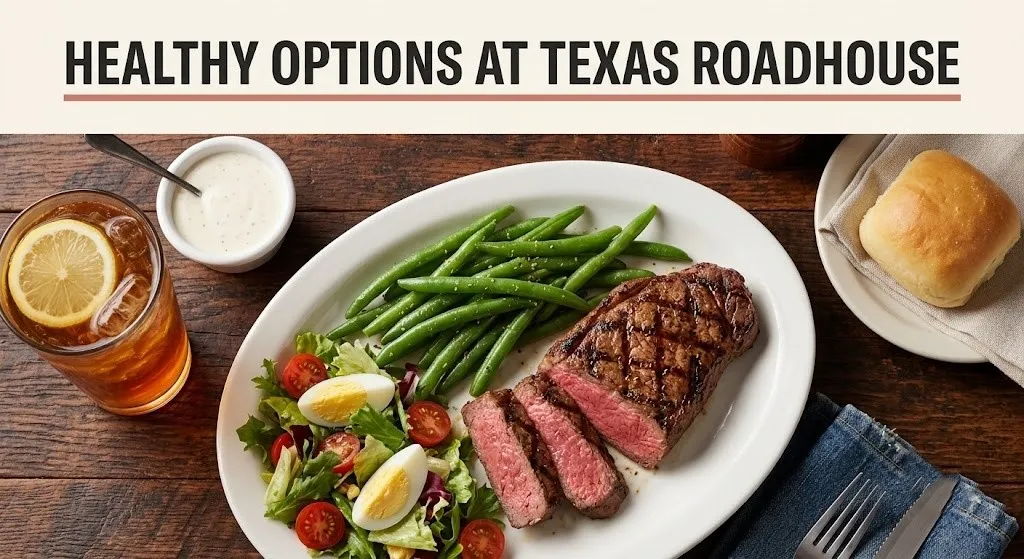
A sample weight management meal includes the 6-ounce sirloin steak with a house salad (no croutons, light dressing or dressing on the side) and green beans. This combination provides approximately 500 to 600 calories, 35 grams of protein, 8 grams of saturated fat, and a full serving of vegetables. The protein and fiber combination promotes satiety. The calorie count leaves room for a reasonable breakfast and lunch within a standard weight loss calorie budget.
A sample heart-healthy meal includes the grilled salmon with fresh vegetables (no butter) and a plain baked sweet potato. This combination provides approximately 600 to 700 calories, omega-3 fatty acids from the salmon, fiber and potassium from the sweet potato, and vitamins from the steamed vegetables. The saturated fat is controlled by choosing salmon over red meat and avoiding butter on the vegetables and potato. The American Heart Association recommends limiting saturated fat to 5% to 6% of daily calories, approximately 13 grams for a 2,000-calorie diet. This meal stays within that range.
Key Takeaway: A healthy Texas Roadhouse meal combines lean protein with two vegetable sides, avoids butter and heavy dressings, and totals 500 to 700 calories.
Healthy choices at Texas Roadhouse
Healthy choices at Texas Roadhouse extend beyond the entree to include the appetizer, side, and beverage decisions that collectively determine the meal’s nutritional profile. The free bread and cinnamon butter that arrive at the table are the first decision point. Each roll with butter contains approximately 200 to 250 calories and 8 grams of saturated fat. Eating two rolls before the entree adds 400 to 500 calories before the meal begins.
The appetizer section of the menu is a nutritional minefield. The Cactus Blossom, a battered and fried onion with dipping sauce, contains over 1,500 calories. The Fried Pickles and Cheese Fries are similarly calorie-dense. The grilled shrimp appetizer or a side salad eaten as an appetizer are the only reasonable choices. If you are with a group that orders appetizers, take a small portion of one item and leave it at that. The appetizer course is where many otherwise healthy meals go wrong.
Beverage choices matter because Texas Roadhouse is known for its margaritas and sweetened iced teas. A strawberry margarita can contain 400 to 600 calories, all from sugar and alcohol. A sweet tea can add 150 to 200 calories per glass from added sugar. Unsweetened iced tea, water with lemon, or diet soda are the calorie-free options. Alcohol, if consumed at all, should be limited to one light beer or a single glass of wine, both of which add 100 to 150 calories. The beverage decision affects the total meal calorie count as much as the side dish decision.
Key Takeaway: Skip or limit the bread, avoid fried appetizers, and choose calorie-free beverages to keep the total meal within healthy ranges.
Texas Roadhouse nutrition facts
Texas Roadhouse nutrition facts reveal that portion size is the primary driver of calorie and saturated fat content across the menu. The restaurant’s published nutrition information, available on their website and in-restaurant upon request, shows dramatic differences between smaller and larger cuts of the same type of meat. The 6-ounce sirloin contains approximately 250 calories and 6 grams of saturated fat. The 12-ounce sirloin doubles those numbers to approximately 500 calories and 12 grams of saturated fat. The 16-ounce prime rib reaches approximately 1,200 calories and 40 grams of saturated fat on its own, before sides.
The side dishes vary from nutritionally neutral to nutritionally destructive. The house salad with ranch dressing contains approximately 400 calories, with the dressing contributing more calories than the vegetables. Ordering the dressing on the side and using half reduces the salad to approximately 250 calories. The loaded baked potato with butter, sour cream, cheese, and bacon contains approximately 500 to 600 calories. A plain baked potato contains approximately 160 calories. The difference is the toppings. The same principle applies to the sweet potato, where the plain version is approximately 200 calories and the loaded version with marshmallow and caramel is over 500 calories.
The nutritional data should be viewed as estimates that can vary by location and by individual cook. A kitchen employee with a heavy hand on the butter or oil bottle adds calories that do not appear on the standard nutrition guide. This variability is inherent to restaurant dining and is a reason to request sauces, dressings, and butter on the side even when the published numbers for a dish appear reasonable.
Key Takeaway: Texas Roadhouse nutrition varies enormously by portion size. Smaller steak cuts and plain sides keep the meal reasonable. Published data is an estimate.
Texas Roadhouse calories menu
The Texas Roadhouse calories menu spans from approximately 500 calories for a carefully constructed meal to over 3,000 calories for the largest combinations. The calorie content of individual items has been reported based on the restaurant’s published nutrition information. The protein options range from the grilled chicken at approximately 200 calories to the 20-ounce bone-in ribeye at approximately 1,400 calories. The difference is entirely in portion size and fat content. The chicken and the smaller sirloin cuts are the lowest-calorie protein options that still deliver a satisfying meal.
The side dishes contribute 150 to 600 calories each to the meal total. The lowest-calorie sides are the house salad without dressing, the green beans, and the fresh vegetables, all under 150 calories before additions. The mashed potatoes, steak fries, and seasoned rice add 300 to 500 calories. The loaded baked potato, loaded sweet potato, and mac and cheese add 500 to 600 calories. Choosing two loaded sides turns a modest steak into a 1,500-calorie meal. Choosing two vegetable sides keeps the same steak meal under 600 calories.
The calorie counts do not include the free bread, which adds 200 to 500 calories depending on consumption, or the peanuts, which add 160 calories per ounce. A diner who eats two rolls, an appetizer, a large steak, two loaded sides, and a margarita can easily consume a full day’s calories in a single meal. A diner who skips the bread and appetizer, orders a small sirloin, and chooses two vegetable sides can stay under 700 calories. The calorie range at Texas Roadhouse is entirely under the diner’s control.
Key Takeaway: Texas Roadhouse meals range from 500 to over 3,000 calories. Protein size and side choices are the two variables that determine where your meal falls.
Texas Roadhouse sodium content
Texas Roadhouse sodium content is high across the menu, reflecting the restaurant industry’s reliance on salt, seasoning blends, and sodium-containing ingredients for flavor. The American Heart Association recommends limiting sodium intake to 2,300 milligrams per day, with an ideal limit of 1,500 milligrams for people with hypertension or cardiovascular risk factors. A single Texas Roadhouse entree with sides can contain 2,000 to 4,000 milligrams of sodium, exceeding even the higher limit.
The 6-ounce sirloin with green beans and a house salad contains approximately 1,200 to 1,500 milligrams of sodium. This is the lower end of the menu’s sodium range and still represents 65% to 100% of the ideal daily limit. The country fried steak with gravy, mashed potatoes, and seasoned rice can exceed 3,500 milligrams. The prime rib with loaded sides approaches 4,000 milligrams. Sodium is the most difficult nutrient to manage at Texas Roadhouse because it is embedded in the seasoning, the marinades, the sauces, and the sides.
Practical sodium reduction strategies include requesting that your steak be cooked without added salt or seasoning salt, asking for sauces and dressings on the side, and choosing the baked potato or sweet potato without salt. These requests reduce sodium but do not eliminate it. The meat itself is seasoned before cooking in most cases, and the green beans and vegetables are cooked with salted ingredients. If you are on a strict sodium restriction for medical reasons, Texas Roadhouse is a challenging environment. A home-cooked meal gives you the control that the restaurant kitchen cannot provide.
Key Takeaway: Texas Roadhouse meals are high in sodium, often exceeding the daily limit in a single entree. Sodium-conscious diners should request no added salt and choose the simplest preparations.
Texas Roadhouse low calorie options
Texas Roadhouse low calorie options center on the smaller protein cuts and the vegetable-based sides, combined to keep the total meal under 600 calories. The 6-ounce sirloin steak is the best low-calorie steak option at approximately 250 calories. The grilled chicken at approximately 200 calories is the lowest-calorie protein on the menu. The grilled salmon at approximately 350 calories is higher in calories due to its healthy fat content but provides omega-3 fatty acids that justify the calorie difference for many diners.
The lowest-calorie sides are the house salad with light dressing, the green beans, the fresh vegetables, and the side of chili. The house salad without croutons and with half a packet of ranch dressing contains approximately 200 calories. The green beans contain approximately 100 calories. The fresh vegetables without butter contain approximately 80 calories. Combining the 6-ounce sirloin, green beans, and a house salad with light dressing creates a 550-calorie meal that includes protein, fiber, and multiple vegetable servings.
The free bread is the variable that can push a low-calorie meal into moderate-calorie territory. A single roll with cinnamon butter contains approximately 225 calories. Two rolls add 450 calories. A diner who eats two rolls before a 550-calorie sirloin meal has consumed 1,000 calories without ordering an appetizer or dessert. The most effective low-calorie strategy at Texas Roadhouse is to ask the server not to bring the bread, or to bring one roll per person and remove the rest. This single decision can reduce the meal’s calorie total by 30% to 50%.
Key Takeaway: A 6-ounce sirloin with green beans and a house salad totals approximately 550 calories. Removing the bread basket protects that low-calorie total.
Texas Roadhouse keto options
Texas Roadhouse keto options are plentiful because a steakhouse menu is naturally low in carbohydrates once you remove the bread, potatoes, and sugary sauces. The ketogenic diet requires keeping net carbohydrates below 20 to 50 grams per day, which means avoiding the rolls, potatoes, corn, seasoned rice, and any sauces or dressings with added sugar. The proteins and non-starchy vegetables that remain form the basis of a keto-compatible meal.
The best keto proteins at Texas Roadhouse include the 6-ounce sirloin, the filet medallions, the ribeye (for higher fat content), the grilled chicken, and the grilled salmon. These proteins contain zero carbohydrates before sauces or marinades are applied. Request that the steak be cooked without barbecue sauce or sweet glazes, as these add sugar. The Dallas filet is topped with a peppercorn sauce that contains minimal carbohydrates. The smothered chicken with mushrooms and jack cheese is keto-compatible as long as the sauce is not thickened with flour.
Keto-compatible sides include the house salad without croutons and with a full-fat dressing like ranch or blue cheese (which are low in carbohydrates), the green beans, the fresh vegetables with butter, and a side of sautéed mushrooms. The green beans contain some carbohydrates from the beans themselves but are low enough in net carbs to fit within a keto budget at typical portion sizes. The baked potato, sweet potato, corn, steak fries, and seasoned rice must be avoided. The free bread is incompatible with keto and should be declined or given to dining companions.
Key Takeaway: Texas Roadhouse is keto-friendly. Order a fatty steak or grilled protein, pair it with green beans and a house salad with full-fat dressing, and skip the bread and potatoes.
Texas Roadhouse heart healthy options
Texas Roadhouse heart healthy options prioritize lean proteins, vegetable sides, and preparations that limit saturated fat and sodium. The American Heart Association recommends limiting saturated fat to 13 grams per day on a 2,000-calorie diet and sodium to 2,300 milligrams. A heart-healthy Texas Roadhouse meal meets or comes close to meeting the saturated fat limit while keeping sodium as low as the menu allows.
The grilled salmon is the single best heart-healthy entree at Texas Roadhouse because it provides omega-3 fatty acids that support cardiovascular health while keeping saturated fat at approximately 4 grams for a 5-ounce portion. The grilled chicken is the lowest saturated fat protein at approximately 2 grams. The 6-ounce sirloin contains approximately 6 grams of saturated fat, which is acceptable within a heart-healthy pattern if the rest of the day’s saturated fat intake is minimal. The larger steaks, the prime rib, and anything fried should be avoided.
Heart-healthy sides include the house salad with olive oil and vinegar or a light vinaigrette, the green beans, the fresh vegetables without butter, and the plain baked sweet potato. Olive oil and vinegar is the only dressing option that avoids the saturated fat and sodium in creamy dressings. The sweet potato provides potassium, which supports healthy blood pressure. Requesting no added salt on the protein and no butter on the vegetables reduces sodium. Even with these modifications, the meal will still contain 1,000 to 1,500 milligrams of sodium, which is a significant portion of the daily limit.
Key Takeaway: Grilled salmon with vegetables and a plain sweet potato is the best heart-healthy meal. Request no added salt and use olive oil and vinegar.
Texas Roadhouse diabetic options
Texas Roadhouse diabetic options manage the total carbohydrate load of the meal by replacing high-carbohydrate sides with vegetable options and avoiding the free bread and sugary beverages. The American Diabetes Association’s carbohydrate recommendations vary by individual, but a starting point of 45 to 60 grams of carbohydrates per meal is common. A standard Texas Roadhouse meal with bread, a loaded potato, and a sugary drink can exceed 150 grams of carbohydrates.
The protein choices for a diabetic meal are straightforward. All grilled proteins are carbohydrate-free. The 6-ounce sirloin, grilled chicken, and grilled salmon contain zero carbohydrates before sauces. Request no sweet glazes or barbecue sauces. The grilled chicken salad is a good all-in-one option, with the carbohydrates coming from the vegetables and any croutons. Request no croutons to reduce the carbohydrate count.
The carbohydrate load of a diabetic-friendly Texas Roadhouse meal comes from the sides. A plain baked sweet potato contains approximately 40 grams of carbohydrates, which fits within a 45 to 60 gram meal budget when the rest of the meal is low-carb. The green beans and fresh vegetables contain 5 to 15 grams of carbohydrates per serving. The house salad with vegetables contains 10 to 15 grams without croutons. A meal of grilled chicken, a house salad, and green beans contains approximately 20 to 30 grams of carbohydrates, leaving room for a small portion of sweet potato or a few bites of a dinner roll if desired.
Key Takeaway: Diabetic diners should skip the bread, choose grilled protein, and select green beans or salad as sides, keeping total carbohydrates under 45 grams per meal.
Texas Roadhouse gluten free options
Texas Roadhouse gluten free options are available across most of the protein menu, but careful ordering is required because shared cooking surfaces and fryers create cross-contamination risk for people with celiac disease. Texas Roadhouse does not have a dedicated gluten-free menu, but the corporate website provides a gluten-friendly guide that identifies items made without gluten-containing ingredients.
The grilled steaks, grilled chicken, and grilled salmon are naturally gluten free in their unseasoned forms. The seasoning blends used on steaks may contain gluten-derived ingredients or be processed in facilities that handle wheat. Request that your steak be cooked without seasoning salt and with salt and pepper only to reduce gluten exposure risk. The country fried steak is battered and fried, making it incompatible with a gluten-free diet. The grilled shrimp is gluten free. The chili is reportedly gluten free according to the restaurant’s allergen guide.
Gluten-free sides include the baked potato, sweet potato, green beans, fresh vegetables, and house salad without croutons. The steak fries, onion rings, and seasoned rice contain gluten or are fried in shared fryers. The salad dressings vary. Oil and vinegar is safe. Creamy dressings like ranch and blue cheese are generally gluten free but verify with the server, as recipes and thickeners can change. The free bread is wheat-based and must be avoided. The peanuts are gluten free but may be processed in shared facilities.
Key Takeaway: Texas Roadhouse offers gluten-free steak, chicken, salmon, and vegetable sides. Request salt and pepper only, avoid fried items, and skip the bread and croutons.
Best steak at Texas Roadhouse for diet
The best steak at Texas Roadhouse for diet purposes is the 6-ounce sirloin, which delivers 35 grams of protein for approximately 250 calories and 6 grams of saturated fat. It is the leanest steak on the menu that still provides a satisfying steakhouse experience. The sirloin is a working muscle cut from the hip of the cow, which means it has more flavor than filet mignon and less fat than ribeye. It is the Goldilocks steak for health-conscious diners.
The Dallas filet is a close second at approximately 300 calories for a 6-ounce portion, with slightly more marbling and a more tender texture than the sirloin. The filet medallions are the most tender option and are leaner than the ribeye, at approximately 350 calories for a 6-ounce portion. The ribeye and the prime rib are the cuts to avoid on a diet. The ribeye is the fattiest steak on the menu, with a 12-ounce cut containing approximately 800 calories and 25 grams of saturated fat. The prime rib is similarly high in fat and calories.
The steak should be ordered without butter, which the kitchen typically adds on top of the finished steak. Request that the steak be cooked without butter and without seasoning salt if sodium is a concern. The peppercorn sauce on the Dallas filet adds approximately 50 calories and is worth keeping for flavor. The mushroom and onion topping adds approximately 80 calories and some vegetable matter. Barbecue sauce and steak sauce add sugar and should be used sparingly or skipped.
Key Takeaway: The 6-ounce sirloin is the best steak for diet purposes at Texas Roadhouse, delivering high protein for moderate calories and saturated fat.
Texas Roadhouse salad healthy
Texas Roadhouse salads can be healthy or they can be calorie bombs dressed in ranch, depending entirely on the salad selection and the dressing choice. The house salad is the simplest option, a bowl of mixed greens with tomatoes, eggs, and croutons. Without dressing, it contains approximately 150 calories. With ranch dressing, it jumps to approximately 400 calories. With blue cheese dressing, similar numbers apply. The dressing is the salad’s nutritional pivot point.
The grilled chicken salad is the best all-in-one meal option on the Texas Roadhouse menu for a health-conscious diner. It combines grilled chicken breast with mixed greens, tomatoes, eggs, and cheese for approximately 500 to 600 calories with ranch dressing, or 400 calories with a lighter dressing or oil and vinegar. The protein and vegetable combination makes it a complete meal that does not require side dish navigation. Requesting dressing on the side and using half reduces the calorie count by 100 to 150 calories. Omitting the croutons and cheese further reduces calories, fat, and sodium.
The Caesar salad is the less healthy salad option. The Caesar dressing is high in calories, saturated fat, and sodium. Adding grilled chicken creates a reasonable meal, but the base salad is nutritionally weaker than the house salad. The steakhouse filet salad is an entree salad with a significant portion of steak. It is higher in calories than the grilled chicken salad but provides more protein and iron. For a diner who wants steak and salad in one dish, it is a reasonable choice with dressing on the side.
Key Takeaway: The grilled chicken salad with house salad base and dressing on the side is the healthiest salad meal. The dressing doubles the calorie count.
Texas Roadhouse healthy sides
Texas Roadhouse healthy sides are the house salad, green beans, fresh vegetables, and plain baked sweet potato. These four sides provide fiber, vitamins, minerals, and volume for 80 to 200 calories each, compared to 300 to 600 calories for the loaded and fried sides. Choosing two of these sides turns a steak into a balanced meal. Choosing two fried or loaded sides turns the same steak into a dietary problem.
The house salad is the most nutrient-dense side on the menu. It provides a serving of leafy greens, tomatoes, and egg. Ordered without croutons and with light dressing, it contributes vitamin A, vitamin C, folate, and fiber for approximately 150 calories. It is a genuine vegetable serving, which is rare in a restaurant side dish. The green beans are cooked with bacon and onion, which adds flavor and a small amount of fat. They retain their fiber and micronutrient content. They are one of the few restaurant sides that are actually a vegetable rather than a starch.
The fresh vegetables are steamed broccoli, carrots, and squash. Ordered without butter, they are the lowest-calorie side at approximately 80 calories. The plain baked sweet potato provides complex carbohydrates, fiber, vitamin A, and potassium for approximately 200 calories. It is significantly more nutritious than the white baked potato, which has a higher glycemic index and fewer micronutrients. The loaded sweet potato with marshmallow and caramel sauce adds approximately 300 calories of sugar and should be avoided by health-conscious diners.
Key Takeaway: House salad, green beans, fresh vegetables, and plain sweet potato are the four healthy sides. They add fiber and nutrients for 80 to 200 calories each.
Texas Roadhouse bread calories
Texas Roadhouse bread calories are a hidden meal within a meal that arrives before you order and disappears quickly if you are not paying attention. Each fresh-baked roll with cinnamon butter contains approximately 200 to 250 calories, with the butter contributing about 100 of those calories. Two rolls, which is a conservative estimate for most diners, add 400 to 500 calories to the meal. Four rolls, which is common when dining with a group over a long meal, add 800 to 1,000 calories before the appetizer arrives.
The bread calories come from the refined white flour in the roll and the butter, sugar, and cinnamon in the cinnamon butter. A single roll contains approximately 30 grams of carbohydrates, mostly refined starch that digests rapidly and spikes blood glucose. The butter adds 8 grams of saturated fat per roll. Two rolls deliver 16 grams of saturated fat, which exceeds the American Heart Association’s daily limit of 13 grams for a 2,000-calorie diet. The bread is not just empty calories. It is actively harmful to cardiovascular health goals when eaten in the quantities that the restaurant’s free-refill policy encourages.
Strategies for managing the bread include asking the server not to bring it, which is the most effective but socially difficult option when others at the table want bread. Asking for a single roll per person and removing the basket from the table is a compromise. Eating one roll slowly and mindfully, then pushing the basket away, works for diners with good impulse control. The bread is not a required part of the meal. It is a complimentary item that the restaurant provides because it encourages overconsumption and increases customer satisfaction. Recognizing it as a marketing tactic, not a gift, helps with the decision to decline it.
Key Takeaway: Each roll with cinnamon butter is 200 to 250 calories. Two rolls exceed the daily saturated fat limit. Ask the server not to bring the bread basket.
Healthy options Texas Roadhouse
Healthy options at Texas Roadhouse, when combined into a full meal strategy, allow you to enjoy the steakhouse experience without the nutritional consequences that usually come with it. The meal strategy involves three decisions made before you walk in: what you will order, what you will not order, and how you will handle the bread. Arriving with these decisions made prevents the menu, the environment, and the server’s suggestions from determining your meal.
The ideal healthy order is the 6-ounce sirloin steak, cooked without butter, with a house salad (no croutons, dressing on the side) and green beans. This meal provides approximately 550 calories, 40 grams of protein, 8 grams of saturated fat, and multiple vegetable servings. If you prefer chicken, substitute the grilled chicken. If you prefer fish, substitute the grilled salmon. The structure remains the same: lean protein, salad, green vegetable. The bread basket is declined or limited to one roll.
The post-meal strategy involves what happens after you leave the restaurant. A single indulgent meal does not derail a healthy eating pattern. The Academy of Nutrition and Dietetics emphasizes that overall dietary pattern matters more than any single meal. Return to your normal healthy eating at the next meal. Do not skip meals to compensate. Do not feel guilty. You made the best choices available in the environment. That is the standard for success.
Key Takeaway: A healthy Texas Roadhouse meal is a lean protein plus two vegetable sides, with the bread basket declined. Return to normal eating at the next meal.
Frequently Asked Questions About Texas Roadhouse
Is Texas Roadhouse healthy overall?
Texas Roadhouse is not a healthy restaurant by default because the menu is built around large portions of red meat, fried foods, and butter-laden sides.
However, the menu offers enough lean proteins and vegetable sides that a health-conscious diner can construct a reasonable meal.
The key is ordering strategically and treating menu items as customizable components rather than fixed combinations.
What is the lowest calorie meal at Texas Roadhouse?
The lowest calorie meal is the grilled chicken with a house salad (light dressing) and fresh vegetables without butter, totaling approximately 400 to 450 calories.
The 6-ounce sirloin with the same sides adds about 100 calories for a 500 to 550 calorie meal.
Skipping the free bread is essential to keeping the meal in this calorie range.
Can I eat keto at Texas Roadhouse?
Texas Roadhouse is naturally keto-friendly because grilled meats and non-starchy vegetables are low in carbohydrates.
Order a fatty steak or grilled salmon with green beans and a house salad with full-fat dressing.
Skip the bread, potatoes, corn, and sweet glazes.
Are Texas Roadhouse salads actually healthy?
Texas Roadhouse salads can be healthy when ordered with dressing on the side and without croutons.
The grilled chicken salad is the best all-in-one meal option at approximately 400 to 500 calories with light dressing.
The ranch and blue cheese dressings add 200 to 300 calories, so using half is recommended.
How do I avoid overeating at Texas Roadhouse?
Ask the server not to bring the bread basket, or limit yourself to one roll.
Order a small steak cut like the 6-ounce sirloin rather than the 12-ounce or 16-ounce portions.
Choose two vegetable sides instead of potato or fried sides, and have the server box half of your entree before it reaches the table.
Texas Roadhouse is a challenging restaurant for health-conscious eating, but it is not impossible. The difference between a 1,500-calorie meal and a 550-calorie meal comes down to five decisions: the bread, the protein size, the sides, the dressings and sauces, and the beverage. Make those five decisions consciously, and you walk out with a meal that fits your goals. Make them on autopilot, and the restaurant’s indulgent defaults take over.
The most practical strategy is to check the nutrition guide on the Texas Roadhouse website before you go. Pick your order in advance. Walk in knowing what you will say to the server. That two minutes of preparation is the difference between a meal you regret and one that supports your health. The restaurant will be there. The bread will be warm. The menu will be tempting. Your advance decisions are the anchor that holds.