Kittens should start eating wet food at around 3 to 4 weeks of age, when their eyes are open, they can stand steadily, and their deciduous teeth (milk teeth) are just beginning to emerge. This is the start of the weaning window, and wet food is the right first solid food because its soft texture and high moisture content match what a kitten’s developing digestive system can actually handle.
Getting this timing right matters more than most new kitten owners realize. According to the Cornell Feline Health Center, the 3-to-8-week weaning period is one of the most nutritionally sensitive phases in a cat’s entire life. The nutrients a kitten receives during this window directly affect immune function, neurological development, and long-term organ health.
This guide covers the full picture: exact ages and developmental markers, how to introduce wet food correctly, what textures to use and when, how much to feed, what the label on that can actually needs to say, and what to do if you’re raising a kitten without its mother. A vet is the right partner for any kitten showing signs of low weight, digestive trouble, or failure to thrive, and this article will tell you exactly when that visit should happen.
When Should Kittens Start Eating Wet Food?
Kittens should start eating wet food between 3 and 4 weeks of age, which aligns with the natural start of the weaning process in domestic cats.
At this age, a kitten’s sensory and motor systems have developed enough to investigate food. Their eyes have been open since approximately week 2. Their legs carry their body steadily. The first baby teeth are just breaking through the gum line. All of these are physical signals that the digestive system is also beginning to mature toward handling something other than mother’s milk or kitten milk replacer (KMR).
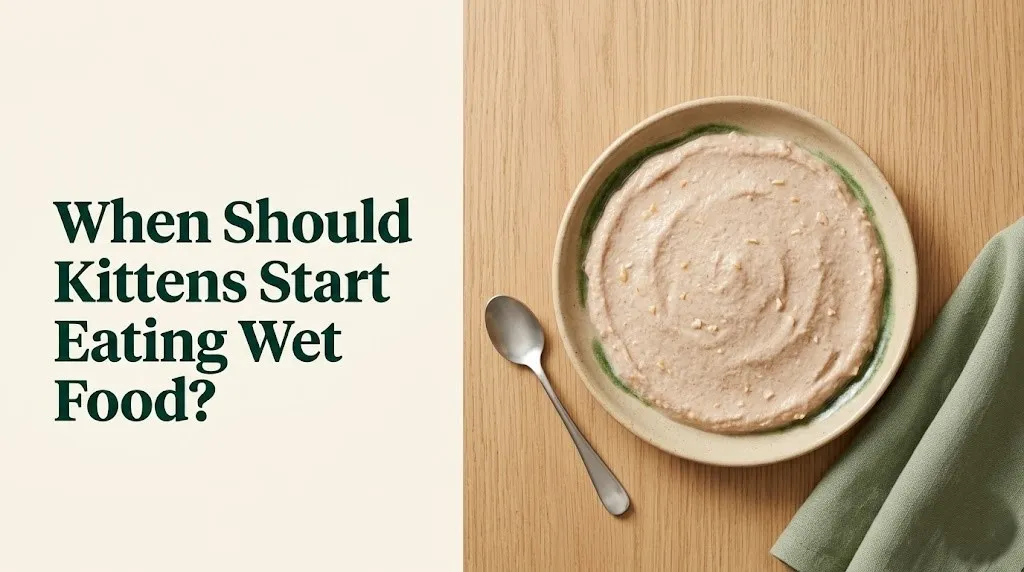
Wet food is the only appropriate solid food at this stage. The texture of canned or pouch-style food blended with a little warm water mimics the consistency a kitten can manage before its jaw muscles are strong enough to bite through dry kibble. Forcing dry food too early puts strain on teeth that aren’t ready for it and may create negative associations with eating that can persist for weeks.
Breed and litter size can affect readiness slightly. Kittens from larger litters sometimes begin showing interest in food a few days earlier because competition for nursing creates hunger motivation. Smaller, slower-developing kittens from premature births may need a few extra days at the KMR stage. Watch the individual kitten for behavioral cues more than the calendar alone.
| Developmental Marker | Age Range | Feeding Stage |
|---|---|---|
| Eyes closed, fully nursing | 0 to 2 weeks | Milk or KMR only |
| Eyes open, unsteady movement | 2 to 3 weeks | Milk or KMR; begin offering gruel |
| Eyes open, steady standing, first teeth | 3 to 4 weeks | Introduce wet food gruel |
| Active, playful, teeth emerging | 4 to 6 weeks | Wet food with less water, still soft |
| Running, jumping, all milk teeth in | 6 to 8 weeks | Full wet food; begin dry kibble introduction |
What Age Can Kittens Start Eating Wet Food?
The most common answer you’ll see online is 3 to 4 weeks, and that range is accurate for most normally developing kittens raised with their mother.
However, there’s a meaningful difference between “can eat” and “should eat.” At 3 weeks, a kitten isn’t choosing wet food because it’s hungry for variety. It’s beginning to follow its mother’s lead as she starts nudging the litter toward independence. The mother cat begins spending less time nursing at this point, creating a natural caloric gap that solid food needs to fill.
By 4 weeks, most kittens are actively showing interest in whatever is in front of them, including food. This is the right time to make wet food consistently available. By 6 weeks, wet food should be the primary caloric source. By 8 weeks, the kitten should be eating entirely on its own without nursing.
For kittens that are underweight, lethargic, or not gaining approximately 10 to 15 grams per day during the first 8 weeks of life (a benchmark commonly cited by veterinary nutrition resources including the ASPCA), a veterinary evaluation is warranted before or alongside any dietary transition.
When Do Kittens Stop Drinking Mother’s Milk?
Kittens naturally stop depending on mother’s milk between 6 and 8 weeks of age, though they may continue nursing opportunistically if the mother allows it up to 10 to 12 weeks.
The weaning process is gradual, not a single cutoff moment. At 3 weeks, a kitten might be nursing 80% of its caloric needs and eating 20% from wet food. By 6 weeks, that ratio typically reverses. By 8 weeks, nursing has usually stopped or become purely comfort-based rather than nutritionally significant.
During the transitional phase from weeks 3 to 6, wet food is not a replacement for nursing. It’s a supplement. If you’re managing this process without a mother cat, kitten milk replacer (KMR) should continue alongside wet food introduction until the kitten is eating enthusiastically and gaining weight consistently.
Think of the weaning process like training wheels on a bicycle. The mother’s milk is the balance support, and wet food is the pedaling the kitten is learning to do on its own. You don’t remove the training wheels the first day the kitten pedals. You remove them when they don’t need them anymore.
Cow’s milk is not a substitute for KMR at any stage. Most cats lack sufficient lactase enzyme to digest cow’s milk lactose. Offering it can cause diarrhea, dehydration, and caloric deficit at exactly the wrong developmental moment.
When to Introduce Wet Food to Kittens
The best time to introduce wet food is at 3 to 4 weeks old, starting with a thin gruel made from wet food mixed with warm water or KMR.
The introduction should be gradual and low-pressure. Place a small amount (about 1 teaspoon) of warm gruel on a shallow dish or even on your fingertip for the kitten to lick. Most kittens will investigate out of curiosity and may not take a full “meal” the first few attempts. That’s normal.
Timing within the day matters. Offer wet food when the kitten is active but not just after nursing. A kitten that just finished nursing has no appetite drive. Wait until it’s been 1 to 2 hours since the last nursing session or KMR feeding, then offer the wet food.
Temperature is relevant. According to the Cornell Feline Health Center, kittens and cats are more likely to accept food served at body temperature (around 100°F / 38°C) because it mimics the temperature of fresh prey. Cold wet food straight from the refrigerator is frequently rejected, especially by kittens who are still learning what food is.
Key points for first introduction:
- Start with a thin, water-diluted or KMR-diluted consistency
- Serve warm, not cold
- Use a shallow dish or flat surface, not a deep bowl
- Keep sessions short: 5 to 10 minutes maximum
- Never force the kitten’s face into the food
- If rejected today, try again tomorrow
When Can Kittens Eat Soft Food?
Kittens can eat soft food as early as 3 weeks old, as long as the food is blended smooth enough for their immature jaw and gut.
“Soft food” in this context means something with the consistency of thin soup at first, thickening gradually to yogurt consistency, then to the standard pate texture found in most canned kitten food. It does not mean any texture is fine as long as the product says “wet.” Large chunks or heavily textured varieties may be appropriate at 6 to 7 weeks but are not suitable for a 3-week-old still learning to lap from a dish.
The key is matching the texture to the kitten’s current tooth and jaw development. At 3 weeks, no kitten has the mechanical ability to bite or chew. Swallowing soft gruel is what they can manage. By 5 to 6 weeks, with baby teeth more established, they can handle pate-style canned food without additional water added.
One note on ingredients: some soft food products marketed for adult cats contain larger pieces, gravies with thickeners, or caloric profiles designed for maintenance rather than growth. The AAFCO (Association of American Feed Control Officials) “kitten” or “all life stages” designation on the label is the right marker to look for, regardless of texture.
Kitten Food Texture Progression by Week
The texture of food a kitten can eat changes meaningfully week by week, and offering the wrong consistency at the wrong time creates problems on both ends of the spectrum.
A 3-week-old kitten lapping thin gruel and a 7-week-old kitten eating full pate are both eating “wet food,” but their actual ability to process that food is completely different. Thinking about this as a texture timeline makes the feeding process much clearer.
| Age | Recommended Texture | Consistency Description |
|---|---|---|
| 3 to 4 weeks | Thin gruel | KMR or warm water blended with wet food 3:1 ratio |
| 4 to 5 weeks | Thicker gruel | Wet food mixed with KMR or water 2:1 ratio |
| 5 to 6 weeks | Mashed pate | Wet food with minimal added water, slightly chunky |
| 6 to 7 weeks | Full pate | Standard canned pate, no water needed |
| 7 to 8 weeks | Pate plus introductory dry | Wet food as primary; dry kibble offered alongside |
| 8 weeks and older | Wet and/or dry | Full transition to complete kitten diet |
Progress at the kitten’s pace, not the calendar’s. Some kittens move through these stages faster; some need more time at the gruel stage. The reliable signal to move to the next texture is enthusiastic, mess-free eating at the current stage for at least two or three consecutive days.
Key Takeaway: Kittens should start with wet food gruel at 3 to 4 weeks, and the texture should thicken gradually week by week to match tooth and jaw development, not on a fixed calendar.
How to Introduce Wet Food to Kittens
Introducing wet food to kittens works best as a gentle, warm, low-pressure process repeated consistently across several days.
To introduce wet food to a kitten for the first time:
- Choose a AAFCO-certified kitten formula wet food in pate or smooth loaf style.
- Scoop 1 teaspoon into a small bowl or flat plate.
- Mix with 2 to 3 teaspoons of warm water (or KMR if the kitten is still nursing from a bottle) to create a thin soup-like consistency.
- Warm the mixture to approximately 100°F (38°C), testing on your wrist like baby formula.
- Place the dish in a quiet area away from high foot traffic or noise.
- Allow the kitten to approach on its own. Dip your finger lightly in the gruel and offer it at nose level to encourage investigation.
- If the kitten eats, offer a second small serving after 10 to 15 minutes.
- If the kitten refuses, remove the dish and try again in 2 to 3 hours.
- Increase food volume and thickness every 3 to 4 days as the kitten eats enthusiastically.
- By 6 weeks, the kitten should be eating standard pate-consistency wet food without any water dilution.
A critical technique note: never force the kitten’s snout into the food dish. This can trigger a fear response that delays voluntary eating by days. Patience at this stage saves significant frustration later.
Orphaned Kitten Feeding Schedule and Wet Food Timeline
Orphaned kittens follow the same developmental milestones as mother-raised kittens, but the absence of the mother’s natural weaning cues means the caregiver has to manage the transition more actively.
Without a mother cat providing the physical signal of reduced milk access, the transition from KMR to wet food requires deliberate introduction rather than natural motivation. The ASPCA recommends beginning wet food introduction for orphaned kittens at the same age, around 3 to 4 weeks, but notes that the weaning process may take slightly longer without the mother’s behavioral cues.
| Age | KMR Schedule | Wet Food Schedule |
|---|---|---|
| 0 to 3 weeks | Every 2 to 3 hours around the clock | None |
| 3 to 4 weeks | Every 4 hours | Offer thin gruel 2 to 3 times daily |
| 4 to 5 weeks | Every 5 to 6 hours | Offer thicker gruel 3 to 4 times daily |
| 5 to 6 weeks | Reduce to 2 to 3 bottles daily | Wet food 4 times daily as primary |
| 6 to 7 weeks | 1 bottle daily or none | Full wet food 4 to 5 times daily |
| 7 to 8 weeks | Wean off KMR entirely | Wet food 3 to 4 times daily |
Orphaned kittens are at higher risk for failure to thrive, hypoglycemia, and aspiration pneumonia from improper bottle feeding. Any orphaned kitten under 4 weeks old should have a veterinary assessment early in the process. Your vet can confirm the kitten’s actual weight, hydration status, and whether the dietary transition is on track.
How Much Wet Food to Feed a Kitten
The amount of wet food a kitten needs depends on its age, weight, and whether it is still nursing or fully weaned.
A general starting point from veterinary nutrition resources including the Cornell Feline Health Center: a fully weaned kitten needs approximately 200 calories per kilogram of body weight per day during the rapid growth phase from 2 to 4 months. For a typical 8-week-old kitten weighing around 800 grams (about 1.75 lbs), that’s approximately 160 calories per day from food.
Most commercially prepared kitten wet food contains between 90 and 120 calories per 3 oz (85g) can or pouch. That means a typical 8-week-old kitten may need 1.5 to 2 standard pouches or cans per day, divided across meals.
| Kitten Age | Approx. Weight | Daily Wet Food Amount | Meal Frequency |
|---|---|---|---|
| 3 to 4 weeks | 250 to 400g | Gruel, small amounts; KMR primary | Every 4 to 5 hours |
| 4 to 6 weeks | 400 to 600g | 1 to 1.5 oz wet food per day | 4 to 5 times daily |
| 6 to 8 weeks | 600 to 900g | 2 to 3 oz wet food per day | 3 to 4 times daily |
| 8 to 12 weeks | 900g to 1.2kg | 3 to 4 oz wet food per day | 3 times daily |
| 3 to 6 months | 1.2 to 2.5kg | 4 to 6 oz per day | 2 to 3 times daily |
These are baseline ranges. Always cross-check with the feeding guidelines on the specific product label, as caloric density varies meaningfully between brands and formulas. A kitten’s body condition score is the most reliable guide: ribs should be easily felt but not visually prominent, and the kitten should feel firm and muscular, not bony or doughy.
Key Takeaway: A fully weaned kitten needs approximately 200 calories per kilogram of body weight daily, which typically means 1.5 to 2 standard cans of kitten wet food per day divided into multiple meals.
Kitten Feeding Schedule by Age
A consistent feeding schedule does more than just deliver calories. It regulates blood sugar in very young kittens, prevents both overeating and caloric deficit, and helps establish the mealtime behavior patterns that make adult cats easier to feed.
The most important rule for kittens under 8 weeks: they cannot go long periods between meals. Their stomachs are tiny and their blood glucose drops quickly without regular caloric input. This is why newborn kittens need feeding every 2 hours and newly weaned kittens still need 3 to 4 meals per day.
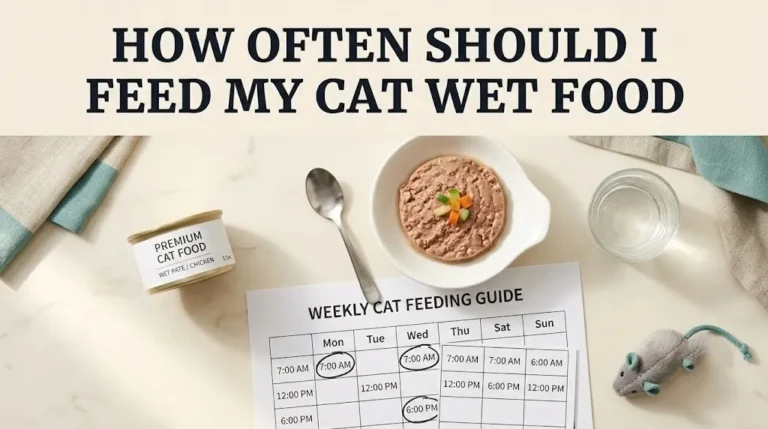
| Age | Meals Per Day | Notes |
|---|---|---|
| 3 to 4 weeks | 4 to 5 | Gruel plus KMR as supplement |
| 4 to 6 weeks | 4 to 5 | Wet food increasing; KMR decreasing |
| 6 to 8 weeks | 3 to 4 | Wet food primary; dry kibble can be introduced |
| 2 to 3 months | 3 | Full kitten diet; meals rather than free feeding |
| 3 to 6 months | 2 to 3 | Growth phase continues; high caloric need |
| 6 to 12 months | 2 | Transitioning toward adult feeding patterns |
Free feeding (leaving food out all day) is sometimes used for young kittens in the 6-to-8-week range when they need maximum caloric availability. By 3 months, scheduled meals are generally preferred because they make monitoring food intake easier and help prevent the overeating patterns that can develop in early adulthood.
Wet Food vs Dry Food for Kittens
Wet food is generally the better choice for kittens under 8 weeks, primarily because its moisture and texture match the developmental needs of a young feline digestive system.
This isn’t simply about preference. Cats as obligate carnivores have a naturally low thirst drive, a trait that evolved from ancestors who obtained most of their hydration from prey. Wet food, which contains 75 to 82% moisture, aligns with this biological design in a way that dry kibble at 8 to 10% moisture cannot.
For kittens specifically, the argument for wet food is even stronger because:
- Dry kibble is mechanically inappropriate before 6 to 8 weeks when baby teeth are established
- Wet food delivers higher protein bioavailability in most commercial formulas
- The moisture in wet food actively supports kidney function and urinary tract health during the period when these organs are still maturing
- Wet food’s caloric density per volume is often better matched to a kitten’s small stomach capacity
That said, introducing dry kibble alongside wet food at 6 to 8 weeks has a practical benefit: kittens that learn to eat both textures early are easier to feed throughout life. A kitten fed exclusively wet food from the start may resist dry kibble entirely as an adult.
According to the National Research Council’s Nutrient Requirements of Cats, the protein requirement for growing kittens is approximately 56% of dietary calories from protein, which quality wet kitten food typically meets. Many budget dry kibble formulas fall short of this threshold.
Can Kittens Eat Adult Cat Wet Food?
Kittens can technically eat adult cat wet food without immediate harm, but it is not nutritionally appropriate as a consistent diet during the growth phase.
Adult cat wet food is formulated to meet maintenance energy and nutrient needs, not the elevated demands of a growing kitten. The key differences matter:
| Nutrient | Kitten Requirement | Adult Cat Requirement |
|---|---|---|
| Crude protein | Minimum 30% dry matter | Minimum 26% dry matter |
| Fat | Minimum 9% dry matter | Minimum 9% dry matter (lower end acceptable) |
| DHA (docosahexaenoic acid) | Required for brain/eye development | Not required in adult formulas |
| Calcium | Higher ratio required | Lower maintenance ratio |
| Calories per serving | Higher density needed | Moderate density for weight management |
| Taurine | Required (true of all life stages) | Required |
The AAFCO “complete and balanced for growth” or “complete and balanced for all life stages” statement on the label is the definitive indicator of whether a food is appropriate for kittens. If the label reads “formulated for adult maintenance,” it does not provide the caloric density, DHA content, or calcium ratios a kitten needs.
For occasional or emergency use (the only thing in the house at 11pm), adult wet food for a day is not a crisis. For a kitten’s primary diet through 12 months, it’s not appropriate.
Key Takeaway: Always choose wet food bearing the AAFCO “complete and balanced for growth” or “all life stages” statement. Adult maintenance formulas lack the DHA, calorie density, and calcium ratios kittens need during their first year.
What Nutrients Does Kitten Wet Food Need?
Kitten wet food needs to provide a specific set of nutrients that cats cannot synthesize themselves, some of which are entirely absent in plant-based formulas.
Cats are obligate carnivores. This is not a dietary preference; it is a biological classification. Their metabolic pathways do not convert plant precursors to active forms of several nutrients the way that omnivores like humans and dogs can. A kitten’s wet food must supply these in their active, bioavailable form.
The nutrients every quality kitten wet food must contain:
- Taurine: an amino acid essential for cardiac function and retinal health in cats. Cats cannot synthesize taurine from other amino acids, unlike most mammals. Taurine deficiency causes dilated cardiomyopathy and retinal degeneration.
- Docosahexaenoic acid (DHA): an omega-3 fatty acid critical for brain and retinal development in kittens. Unlike humans, cats cannot efficiently convert alpha-linolenic acid (ALA) to DHA.
- Arachidonic acid: an omega-6 fatty acid cats cannot synthesize from linoleic acid. Must come from animal-based fat sources.
- Preformed vitamin A (retinol): cats cannot convert beta-carotene from plants to vitamin A. The vitamin A in kitten food must be retinol from animal sources.
- Niacin: cats have a very limited ability to synthesize niacin from tryptophan and require preformed dietary niacin.
- Calcium and phosphorus: in an appropriate ratio (typically 1:1 to 1.3:1) for bone development
Any kitten wet food bearing the AAFCO “complete and balanced for growth” statement has been formulated to meet these requirements. Foods labeled “complementary,” “treat,” “topper,” or “supplement” have not.
When Can Cats Eat Wet Food?
Adult cats can eat wet food at any age, and many veterinary nutrition experts consider it the healthier long-term dietary choice for felines.
This question often comes from owners of older cats who were raised on dry food and are wondering whether switching makes sense. The answer depends on the individual cat’s health status, dental condition, and any concurrent medical conditions.
Wet food is particularly well-suited for adult cats with:
- Chronic kidney disease, where increased dietary moisture is a primary management tool
- Lower urinary tract disease or a history of urinary crystals
- Obesity, where the higher water content creates satiety with lower caloric density per volume
- Dental disease that makes chewing dry kibble uncomfortable
- Diabetes mellitus, where wet food’s typically lower carbohydrate content may help with glucose regulation (always managed in coordination with a veterinarian)
For healthy adult cats with no medical conditions, a mixed diet of wet and dry food is a practical and nutritionally sound approach. The key is choosing a product with the AAFCO “adult maintenance” or “all life stages” statement and feeding to maintain a healthy body weight.
Age-related considerations exist at the senior end of life (cats 11 years and older), where appetite, dental health, kidney function, and taste acuity all change. Wet food tends to be more palatable and easier to eat for cats in this phase, particularly high-protein formulas designed for senior felines.
When Should Kittens Switch from Wet Food to Dry Food?
Kittens can begin transitioning from an exclusively wet food diet to include dry food at 6 to 8 weeks, but the full transition to dry-only (if that’s the owner’s preference) is generally appropriate after 12 months of age.
The transition itself should never be abrupt. Switching food types suddenly can cause diarrhea, refusal to eat, and digestive upset in cats of any age because gut bacteria need time to adjust to a new substrate. A gradual 7-to-10-day transition works better.
To transition from wet to dry or mixed feeding:
- Days 1 to 2: feed 75% current food, 25% new dry kibble, mixed or offered side by side
- Days 3 to 4: feed 50% wet, 50% dry
- Days 5 to 6: feed 25% wet, 75% dry
- Days 7 to 10: feed 100% dry if that’s the goal, or settle at the preferred wet/dry ratio
For kittens under 12 months, dry food should be labeled AAFCO “complete and balanced for growth.” Dry adult maintenance kibble is not nutritionally complete for a kitten, regardless of the transition method.
Many cats thrive on a long-term mixed diet of wet and dry food. This approach provides the hydration benefits of wet food alongside the dental benefits and convenience of dry kibble. There is no requirement to choose one or the other permanently.
Key Takeaway: Dry kibble can be introduced at 6 to 8 weeks alongside wet food, but transition gradually over 7 to 10 days to avoid digestive upset, and always use kitten-labeled AAFCO-certified food until 12 months.
Frequently Asked Questions About When Kittens Should Start Eating Wet Food
Can a 3-week-old kitten eat wet food?
Yes, a 3-week-old kitten can eat wet food when it’s blended with warm water or KMR to a thin soup consistency.
At this age, the food should contain no chunks and should be served warm, around 100°F (38°C).
This is the start of weaning, not a replacement for KMR or nursing; both should continue alongside early wet food.
How do I get my kitten to start eating wet food?
Offer a small amount of warm, thinly diluted wet food on your fingertip or a flat shallow dish, never in a deep bowl.
Most kittens respond to the smell and temperature cues within a few attempts; consistency across days matters more than any single session.
If a kitten refuses for more than 5 to 7 days and is not gaining weight, a veterinary check is the right next step.
Is it okay to give kittens wet food every day?
Wet food is an entirely appropriate daily diet for kittens, and most veterinary nutrition guidelines support it as the primary food source through at least 8 weeks.
Choose a product with the AAFCO “complete and balanced for growth” or “all life stages” statement to ensure it meets all developmental nutrient needs.
Daily wet food supports hydration, protein intake, and caloric density in ways that dry kibble alone at this age cannot match.
When should I stop feeding my kitten wet food and switch to dry?
There is no nutritional requirement to stop wet food at any specific age; many cats eat wet food their entire lives.
If you prefer to transition to dry food, doing so gradually after 8 to 12 weeks (with kitten-appropriate kibble) is appropriate, using a 7-to-10-day mixing schedule.
Full transition to adult dry kibble should wait until after 12 months when the kitten’s growth-phase nutrient needs have been met.
Can kittens eat wet food meant for adult cats?
Adult cat wet food will not immediately harm a kitten but should not be used as the regular diet before 12 months of age.
Adult formulas are formulated for maintenance, not growth, and lack the elevated protein, DHA, and calcium levels that kittens need during development.
Look for the AAFCO “complete and balanced for growth” or “all life stages” statement on the label before feeding any wet food to a kitten under 12 months.
What Every Kitten Owner Should Know
The 3-to-4-week mark is your practical target for starting wet food. Match the texture to the kitten’s age, warm it to near body temperature, and keep early sessions calm and low-pressure.
Every kitten moves through the weaning process at its own pace, and body weight gain is the most reliable measure of whether the diet is working. Kittens losing weight, refusing all food after multiple days, or showing repeated digestive upset deserve a veterinary evaluation, not just a different recipe of gruel.
Choosing food with the AAFCO “complete and balanced for growth” statement takes most of the guesswork off the table. The label does the nutritional work so you can focus on getting the timing, texture, and temperature right.