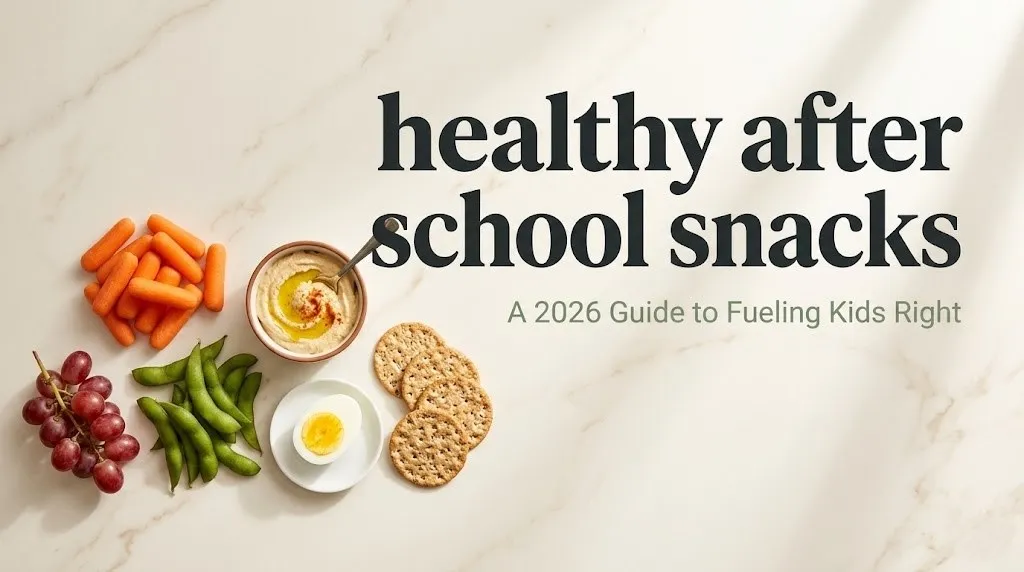
A truly healthy after school snack is not a random handful of something from the pantry. It is a deliberate combination of fiber, protein, and healthy fat timed to stabilize a dropping blood sugar level between 3 p.m. and 5 p.m. This exact definition will guide every snack recommendation that follows.
The 30-minute window after your child walks through the door is more metabolically important than most people realize. The Academy of Nutrition and Dietetics notes that the extended gap between a noon school lunch and a 6 p.m. dinner represents the longest stretch many children go without eating during their waking hours. What you serve in that window either stabilizes their energy and mood or sets them up for a cycle of craving, overeating, and an energy crash that makes homework a battle.
You will learn the nutritional mechanics behind the after-school hunger spike, see protein targets organized by your child’s age and activity level, and get specific snack combinations that take under 10 minutes to assemble. Every idea includes a clear substitution for the most common allergens and at least one make-ahead option. The goal is not a list of snack ideas you have already seen on every other website. It is a system you can use daily.
What Makes a Snack Actually Healthy for After School
A healthy after-school snack contains at least two of three specific macronutrient groups: complex carbohydrates for immediate energy, protein for satiety, and healthy fat for blood sugar stability. The absence of all three forces the body to digest the snack rapidly, sending blood glucose on a sharp spike followed by a crash that typically arrives within 90 minutes.
Think of a snack built only on simple carbs as kindling on a campfire. It flares bright and hot but leaves you digging for more fuel almost immediately. Adding protein and fat is like placing a dense hardwood log on that fire. It catches slowly, burns evenly, and keeps the heat steady for hours.
The Academy of Nutrition and Dietetics recommends that a snack for school-aged children fall somewhere between 150 and 250 calories depending on the child’s age and activity level. The snack should also provide at least one meaningful micronutrient benefit, such as the calcium in a stick of string cheese or the potassium in a sliced banana.
What a balanced snack contains:
- A complex carbohydrate source: whole-grain crackers, oats, fruit, or vegetables
- A protein source: Greek yogurt, deli turkey, edamame, or beans
- An optional healthy fat source: avocado, nut or seed butter, or olive oil
Quick Tip:
- Build snacks with the “at least two of three” rule
- Aim for 3 to 5 grams of fiber per snack to slow gastric emptying
- A whole apple with the skin provides about 4.4 grams of fiber on its own
Key Takeaway: A snack is only as healthy as its metabolic effect. Pair fiber and protein with every carbohydrate source or the snack will drive hunger again within an hour.
Why Kids Are So Hungry After School: The Blood Sugar Science
Children arrive home ravenous because the simple carbohydrates in a typical school lunch digest fully within roughly two to three hours. By the time they walk through the door, their blood glucose has dipped below the level that signals the hypothalamus to trigger strong hunger cues. This is a neuroendocrine event, not a behavioral failing.
The hormone ghrelin, produced in the stomach, rises when the stomach is empty. At the same time, a dropping blood glucose level triggers a cortisol release that can make children irritable, unfocused, or emotionally fragile. A parent who interprets this as a discipline problem is misreading a blood sugar problem.
The composition of lunch predicts the severity of the after-school crash. A turkey sandwich on white bread with a juice box digests faster than the same sandwich on whole-grain bread with an apple and water. The Harvard T.H. Chan School of Public Health notes that whole grains and solid fruit slow carbohydrate absorption because their intact fiber matrix physically delays enzymatic breakdown in the small intestine.
- A lunch high in refined carbohydrates produces a blood glucose peak about 45 minutes after eating
- The subsequent drop begins about two hours post-meal
- By 3 p.m., circulating ghrelin is high and blood glucose is at a daily nadir
- Protein and fat at lunch can delay this drop by an additional 60 to 90 minutes
Key Takeaway: The 3 p.m. hunger crash is not a lack of willpower. It is a predictable metabolic response to the digestion timeline of a noon meal.
Protein Requirements for After-School Snacks by Age
Protein needs for after-school snacks scale with the child’s age, body weight, and activity level. The USDA Dietary Guidelines for Americans 2025-2030 recommend that children aged 4 to 8 consume about 19 grams of total daily protein, children 9 to 13 need about 34 grams, and teens aged 14 to 18 require roughly 46 to 52 grams.
An after-school snack should provide approximately 15 to 20 percent of that daily total. That translates to specific protein targets per snack window. A child who eats enough protein in this window tends to feel fuller through homework and after-school activities and arrives at dinner with a regulated appetite rather than a desperate one.
The American Academy of Pediatrics notes that protein consumed in the afternoon also supports the muscle repair and enzymatic processes that are particularly active in growing bodies during the late afternoon and evening hours. This is not a marginal benefit. It is a direct support for developmental physiology.
| Age Group | Total Daily Protein (g) | Snack Protein Target (g) | Example Food Equivalent |
|---|---|---|---|
| 4 to 8 years | 19 | 3 to 4 | 1 string cheese stick |
| 9 to 13 years | 34 | 5 to 7 | 1/2 cup Greek yogurt |
| 14 to 18 years (female) | 46 | 7 to 9 | 1/2 cup edamame |
| 14 to 18 years (male) | 52 | 8 to 11 | 3 oz deli turkey |
Protein options that match these targets:
- 1 large hard-boiled egg: 6 grams of complete protein
- 1/2 cup shelled edamame: 9 grams of protein with 4 grams of fiber
- 1 single-serve container of plain Greek yogurt (5.3 oz): 12 to 15 grams of protein
Key Takeaway: Aim for 15 to 20 percent of your child’s daily protein during the after-school snack. The exact amount rises with age and spikes during the early teen growth surge.
Healthy After School Snack Ideas for Kids
The most reliable after-school snack formula for kids pairs a familiar texture with a new or less-preferred food in a deconstructed format. Young children are naturally neophobic about mixed dishes and casseroles. They accept food more readily when they can see and identify every component separately on a plate or in a compartmentalized container.
The Ellyn Satter Institute’s Division of Responsibility framework clarifies that a parent’s job is to decide what food is offered, when, and where. The child decides whether to eat and how much. Applying this to after-school snacks means offering two or three simple, whole-food components without pressuring the child to clean the plate. The absence of pressure is what allows appetite regulation to develop naturally.
Children younger than 10 often eat with their eyes first. A snack arranged into three small piles on a plate or in a bento-style box outperforms the same ingredients chopped and mixed together. The visual separation reassures them that no food is hiding inside another food.
Five tested snack combinations for kids under 12:
- Apple slices with a single-serve sunflower seed butter pouch and a few whole-grain crackers
- A hard-boiled egg split in half, baby carrots, and a small ramekin of hummus
- A small bowl of plain Greek yogurt drizzled with a teaspoon of honey and a separate pile of frozen blueberries
- Rolled slices of deli turkey with thin cucumber rounds and a string cheese stick
- A half-cup of thawed edamame pods with a sprinkle of sea salt and a tangerine
Quick Tip:
- Serve snacks on a plate at the kitchen table rather than in a bag in front of a screen
- Hungry children eat more variety when they are seated and not distracted
- Keep cut vegetables submerged in water in a sealed container in the refrigerator for instant access
Key Takeaway: Serve kids two or three whole-food components they can see, recognize, and eat separately. The bento box approach works better than any mixed dish.
Easy Healthy After School Snacks
An easy healthy after school snack is defined by the time between when you think of it and when it lands on the table. The upper limit for most parents on a weekday is 10 minutes. Any snack that requires more prep time than that is not an everyday solution. It is a weekend project.
The simplest snacks are assembly tasks, not cooking tasks. You are not applying heat. You are combining ingredients that are already washed, prepped, and stored in ready-to-grab containers. This is the difference between a snack habit and a snack aspiration. The habit succeeds because the barriers to execution are nearly zero.
A 2023 observational study published in the Journal of the Academy of Nutrition and Dietetics found that parents who pre-portion snack ingredients on Sunday evenings were three times more likely to serve a fruit or vegetable during the after-school window on weekdays. The result held regardless of income level or number of children in the household.
Seven assembly-only snacks ready in under 5 minutes:
- Rice cake with avocado mash and a pinch of salt
- Baby bell peppers halved and filled with pre-made hummus
- A banana sliced lengthwise and spread with sunflower seed butter
- Cherry tomatoes and mozzarella balls on toothpicks
- A small bowl of frozen peas thawed under warm water and tossed with a little butter
- Whole-grain pretzels with a single-serve guacamole cup
- A pear quartered with a small wedge of cheddar cheese
Key Takeaway: Assembly snacks win over cooking snacks on weekdays. Pre-portion produce and proteins on Sunday to make assembly a 3-minute decision.
Make-Ahead Healthy Snacks for School Days
Make-ahead snacks transfer the decision-making and prep labor to a single weekend window so that weekday afternoons require nothing more than opening the refrigerator or pantry. The structure protects you from the 4 p.m. negotiation where a tired parent agrees to a processed snack that nobody actually wanted.
The best make-ahead snacks maintain their texture for at least four days in the refrigerator or up to three months in the freezer. Texture deterioration is the primary reason make-ahead snacks fail. Soggy energy balls or leathery egg muffins send a child straight to the chips. Choose snacks that freeze and thaw cleanly.
Refrigerator-stable make-ahead options (4 to 5 days):
- Pre-portioned snack boxes with cheese cubes, grapes, and whole-grain crackers in lidded containers
- Hard-boiled eggs, peeled and stored in a sealed container with a damp paper towel
- Washed and dried snap peas, carrot sticks, and bell pepper strips in a container with a dry paper towel
- Chia pudding made from 3 tablespoons of chia seeds, 1 cup of milk, and 1 teaspoon of maple syrup
Freezer-stable make-ahead options (up to 3 months):
- No-bake energy bites made from oat flour, sunflower seed butter, and mini chocolate chips
- Whole-grain mini muffins with grated zucchini or mashed banana
- Smoothie freezer packs with pre-portioned fruit, spinach, and a scoop of plain protein powder
No-Bake Energy Bite Recipe:
To make 12 energy bites:
- Combine 1 cup of rolled oat flour, 1/2 cup of sunflower seed butter, 1/3 cup of honey, and 1 tablespoon of ground flaxseed in a mixing bowl
- Stir until the mixture forms a cohesive dough that holds together when pressed
- Fold in 2 tablespoons of mini dark chocolate chips
- Roll into 12 equal balls using slightly damp hands
- Place on a parchment-lined tray and freeze for 1 hour before transferring to a sealed bag
Each bite contains approximately 110 calories, 4 grams of protein, and 2 grams of fiber.
Key Takeaway: Make-ahead snacks collapse the weekday decision window to zero. Freeze energy bites and mini muffins in labeled bags so your child can grab one without your help.
No-Cook After School Snacks for Busy Weekdays
No-cook snacks rely on foods that are ready to eat in their purchased form or require nothing more than assembly, rinsing, or thawing. Heat is entirely absent from the process. This is the category parents lean on during the weeks when no weekend prep happened and the refrigerator looks sparse.
The nutritional quality of a no-cook snack depends on what you keep stocked in your pantry and freezer. A pantry with only crackers and cereal produces a carbohydrate-only snack by default. A pantry with a few strategic shelf-stable protein and fat sources changes the outcome significantly.
Shelf-stable ingredients are the backbone of no-cook snacks. Canned beans, vacuum-sealed tofu, jerky sticks, nut and seed butter pouches, freeze-dried fruit, and shelf-stable milk boxes can all sit in the pantry for weeks and become an instant snack when combined with one fresh item.
| Pantry Protein Source | Shelf Life (Unopened) | Pairing Suggestion |
|---|---|---|
| Canned chickpeas | 2 to 3 years | Rinse, drain, toss with olive oil and paprika |
| Sunflower seed butter pouch | 1 year | Spread on a whole-grain rice cake |
| Shelf-stable milk box | 6 to 9 months | Serve with a handful of whole-grain cereal |
| Turkey jerky stick | 1 year | Pair with an apple |
| Vacuum-sealed silken tofu | 6 months | Blend into a smoothie with frozen mango |
No-cook snack combinations using only pantry and freezer ingredients:
- A shelf-stable milk box poured over a bowl of plain shredded wheat cereal with a handful of freeze-dried strawberries
- Canned chickpeas, drained and patted dry, tossed with olive oil, salt, and smoked paprika
- A whole-grain rice cake spread with a sunflower seed butter pouch and topped with freeze-dried banana slices
- A smoothie blended from shelf-stable silken tofu, frozen mixed berries, and a splash of oat milk
Key Takeaway: A no-cook snack only works if your pantry contains at least two protein sources and two fiber sources. Stock shelf-stable milk, seed butter, and canned beans as your safety net.
Nut-Free Healthy After School Snacks
Nut-free after-school snacks exclude all tree nuts and peanuts while still hitting the protein and fat targets that make a snack satisfying. Schools, daycare centers, and sports leagues increasingly enforce nut-free policies, which means many parents need a daily rotation of allergen-safe options that go beyond the obvious fruit-and-vegetable plate.
The most common pitfall in nut-free snacking is a protein deficit. When peanut butter and almond butter disappear from the rotation, many parents default to carbohydrate-only options like pretzels, fruit, or crackers. The child eats, feels full for 30 minutes, and then crashes. The fix is having at least three nut-free protein sources in constant rotation.
Sunflower seed butter, tahini made from sesame seeds, and roasted chickpeas are the three most practical nut-free protein anchors for after-school snacks. They are shelf-stable, widely available, and generally accepted by children who are accustomed to nut butter textures.
Nut-free snack ideas that contain protein:
- Sunflower seed butter on whole-grain toast with banana slices
- Roasted chickpeas tossed with a little olive oil and za’atar seasoning
- Tahini stirred into plain yogurt with a drizzle of maple syrup
- A smoothie made with oat milk, a tablespoon of chia seeds, and frozen mango
- Seed-based granola bars that list sunflower seeds or pumpkin seeds as the first ingredient
What to check on packaged food labels:
- “May contain traces of tree nuts” means the product was made on shared equipment
- “Processed in a nut-free facility” is the strictest standard and safest for anaphylactic allergies
- Always read labels every time you buy, because manufacturing processes change without notice
Key Takeaway: Rotate sunflower seed butter, tahini, and roasted chickpeas as your three non-negotiable nut-free protein sources. Check packaged labels every single time you shop.
Dairy-Free Healthy After School Snacks
Dairy-free after-school snacks eliminate all cow’s milk products including milk, cheese, yogurt, and whey-based ingredients. This is necessary for children with a diagnosed cow’s milk protein allergy, lactose intolerance, or for families who avoid animal products. The primary nutritional gap created by removing dairy is calcium and vitamin D.
The National Institutes of Health lists the recommended dietary allowance for calcium at 1,000 milligrams per day for children aged 4 to 8 and 1,300 milligrams for those aged 9 to 18. Dairy products supply roughly 300 milligrams of calcium per cup of milk, which makes them a dense calcium source. Dairy-free snacks need to compensate through fortified products or naturally calcium-rich whole foods.
Fortified soy milk and fortified oat milk provide comparable calcium and vitamin D levels to cow’s milk when the label specifies fortification. Without fortification, these plant milks contain negligible calcium. Always check the label for at least 300 milligrams of calcium and 2.5 micrograms of vitamin D per 8-ounce serving.
| Whole Food Source | Calcium per Serving | Serving Size |
|---|---|---|
| Firm tofu (calcium-set) | 250 to 350 mg | 1/2 cup |
| Canned sardines with bones | 325 mg | 3 ounces |
| Fortified orange juice | 300 mg | 1 cup |
| Chia seeds | 179 mg | 2 tablespoons |
| Cooked collard greens | 268 mg | 1 cup |
| Almonds (if nuts are allowed) | 76 mg | 1 ounce |
Dairy-free snack combinations:
- Calcium-set tofu cubed and tossed with soy sauce and sesame oil, served cold
- A smoothie made with fortified oat milk, chia seeds, and frozen peaches
- Canned sardines mashed on whole-grain crackers with a squeeze of lemon
- Sliced bell peppers with a dairy-free yogurt dip made from coconut or almond base
Key Takeaway: Eliminating dairy eliminates the easiest calcium source. Replace it deliberately with calcium-set tofu, fortified plant milks, or canned fish with soft bones.
Healthy After School Snacks for Active Kids
Active kids who play sports or train after school need a snack that provides rapid glycogen replenishment plus a protein source timed to arrive in the bloodstream within the recovery window. The snack structure shifts depending on whether the child eats before the activity or immediately after.
A pre-activity snack consumed 45 to 60 minutes before practice should emphasize easily digestible carbohydrates with only a small amount of protein. Fat and fiber in large amounts slow gastric emptying and can cause stomach discomfort during running, sprinting, or high-intensity drills. A banana with a light drizzle of honey is the classic pre-practice fuel for exactly this reason.
A post-activity snack consumed within 30 minutes of finishing exercise should flip the ratio toward protein with a carbohydrate source to restore muscle glycogen. The American College of Sports Medicine describes this as the glycogen window, a period when muscle cells are most receptive to glucose uptake and protein synthesis. Missing this window delays recovery and can leave a child dragging through homework.
Pre-activity snack ideas (eat 45 to 60 minutes before):
- Banana with a thin spread of sunflower seed butter
- Half a whole-grain bagel with a small amount of honey
- A small bowl of applesauce with a sprinkle of cinnamon
Post-activity snack ideas (eat within 30 minutes after):
- Chocolate milk or a fortified soy milk alternative, which naturally provides the 3-to-1 carbohydrate-to-protein ratio recovery research supports
- A hard-boiled egg with a whole-grain rice cake
- A smoothie with Greek yogurt, frozen berries, and a splash of milk
Key Takeaway: Before exercise, lean on quick carbohydrates with minimal fiber. After exercise, prioritize the 3-to-1 carb-to-protein ratio that the recovery window demands.
Nutritious Snacks for Teens After School
Teenagers metabolically resemble adults more than children, and their after-school snack needs reflect this shift. The adolescent growth spurt, which peaks around age 13.5 for females and 14.5 for males, drives a significant increase in calorie, protein, calcium, and iron requirements. A snack that satisfied them at age 10 will not even register at age 15.
The USDA Dietary Guidelines for Americans 2025-2030 identify adolescence as the period of highest nutrient demand relative to any other life stage except pregnancy and lactation. Iron needs are particularly notable. The recommended dietary allowance for iron rises from 8 milligrams per day in younger children to 11 milligrams for adolescent males and 15 milligrams for adolescent females, who lose iron through menstruation.
A teenager’s after-school snack often serves as a de facto second lunch. It may need to provide 400 to 500 calories of nutrient-dense food, especially if the teen is an athlete or does not eat a full lunch during the rushed school period. Lean proteins, whole-food carbohydrates, and iron-rich plant foods should anchor the rotation.
Teen-specific snack ideas with higher calorie and nutrient density:
- A whole-grain wrap filled with deli turkey, hummus, and spinach
- A large smoothie with fortified soy milk, two tablespoons of peanut butter, a banana, and a handful of spinach
- A bowl of lentil soup reheated from a weekend batch, served with whole-grain crackers
- Three scrambled eggs with black beans, shredded cheese, and salsa
Nutrient targets for a teen after-school snack:
- 8 to 15 grams of protein
- 3 to 5 milligrams of iron
- 300 to 500 milligrams of calcium
- At least 4 grams of fiber
Key Takeaway: Treat a teenager’s after-school snack as a second lunch. It should deliver iron, calcium, and at least 8 grams of protein to support the adolescent growth peak.
After School Snacks and Weight Management
Weight management conversations around children’s snacks require particular care. The goal is never to restrict calories in a way that triggers food obsession or secret eating. Instead, the goal is to structure snack timing and composition so the child’s own satiety hormones, primarily ghrelin and peptide YY, naturally regulate intake by the end of the snack.
The American Academy of Pediatrics advises against using snacks as a reward or restricting them as a punishment. Both behaviors disconnect eating from physiological hunger and attach it to emotional contingencies. A more effective approach is to serve snacks at a predictable time, at the kitchen table, from a plate, with no screens present. This structure allows the child’s brain to register the food and send satiety signals before the portion is gone.
Mindless eating from a large bag or box is the single greatest driver of excess snack intake. Research consistently shows that people of all ages eat more when food is served from a large container. Portioning a snack onto a plate or into a small bowl is a nearly costless intervention with a measurable effect on total intake.
Structure-based strategies that support weight management:
- Serve all snacks on a plate or in a bowl rather than from the original package
- Offer the snack at the same time each day so the child trusts that food will be available and does not eat urgently
- Include at least one high-water-content food like cucumber, orange slices, or cherry tomatoes to increase volume without a large calorie load
- End the snack window 90 minutes before dinner so hunger has time to rebuild
Snack ideas that emphasize volume and satiety:
- A large plate of cucumber rounds, cherry tomatoes, and bell pepper strips with a small bowl of hummus
- A broth-based vegetable soup with a handful of whole-grain crackers
- A smoothie made with unsweetened almond milk, a cup of spinach, half a banana, and a scoop of plain protein powder
Key Takeaway: Manage snack calories by managing the eating environment. A plate at the table with a predictable snack time does more for weight regulation than any calorie-counting tactic.
How to Store After-School Snacks Safely
Perishable after-school snacks require cold storage below 40 degrees Fahrenheit (4 degrees Celsius) until the moment they are eaten. The USDA identifies the temperature zone between 40 degrees and 140 degrees Fahrenheit as the range where pathogenic bacteria multiply most rapidly. A snack left in a lunchbox or backpack from 7 a.m. until 4 p.m. has spent nine hours in the danger zone and must be discarded.
The USDA FoodKeeper App provides specific storage timelines for common snack ingredients. Hard-boiled eggs last up to one week in the refrigerator. Cut vegetables stored in a sealed container with a dry paper towel stay crisp for four to five days. Hummus stays safe for seven days after opening. These timelines are not suggestions. They are food safety limits backed by microbial growth data.
Freezer storage is safe indefinitely from a food safety standpoint, but quality declines predictably. No-bake energy bites maintain texture for three months. Smoothie freezer packs last up to six months before ice crystal formation degrades the fruit texture. Labeling every container with the date it was made is the only reliable way to track what is still good.
Refrigerator storage guidelines for common snack components:
- Cut vegetables in water: 4 to 5 days
- Hard-boiled eggs: up to 7 days
- Opened hummus: 7 days
- Cooked edamame: 5 days
- Chia pudding: 5 days
- Opened deli turkey: 3 to 5 days
| Freezer Item | Maximum Quality Window |
|---|---|
| Energy bites | 3 months |
| Mini muffins | 3 months |
| Smoothie packs | 6 months |
| Pre-portioned soup | 4 months |
Key Takeaway: The 40-degree rule is firm. Any snack containing dairy, eggs, meat, or cut produce that has been unrefrigerated for more than two hours must be thrown out.
Common Mistakes When Preparing After-School Snacks
The most common snack preparation mistake is building snacks around a single macronutrient, almost always carbohydrates. Goldfish crackers, pretzels, dry cereal, and fruit alone all digest within an hour and leave ghrelin surging just as homework starts. The fix is the two-out-of-three rule discussed earlier, applied consistently.
A second widespread error is mistaking a packaged health claim for evidence of nutritional quality. The phrase “made with whole grains” on a granola bar wrapper means very little if the first ingredient is brown rice syrup or sugar. The American Heart Association recommends that added sugars stay below 25 grams per day for children. Many “healthy” packaged snacks deliver 12 to 15 grams of added sugar in a single serving.
The third major mistake is failing to plan for the specific after-school energy demand. Parents who do not pre-plan snacks end up in a daily negotiation with a hungry child, and willpower is never the winner in that scenario. The child grabs the most convenient item, which is often the least nutritious one.
The five most common snack mistakes summarized:
- Building a snack from carbohydrates only with no protein or fat
- Trusting front-of-package health claims without reading the ingredient list
- Failing to pre-portion snacks, which leads to eating directly from large containers
- Serving the snack too close to dinner, which suppresses appetite for the more nutrient-dense evening meal
- Treating snack time as an unstructured free-for-all rather than a predictable, seated mini-meal
Key Takeaway: Fix the carb-only default, read ingredient lists not marketing claims, and serve snacks at a consistent time from a portioned plate.
Frequently Asked Questions About Healthy After School Snacks
What is the best time for an after-school snack?
The optimal window is 30 to 45 minutes after arriving home, which is typically between 3 p.m. and 4 p.m.
Waiting until 5 p.m. puts the snack too close to dinner and suppresses appetite for the more nutritionally complete evening meal.
Serving the snack at roughly the same time each day helps regulate the child’s ghrelin cycle.
How many calories should an after-school snack have?
A snack for children aged 4 to 10 should contain between 150 and 200 calories.
Active teens may need 300 to 500 calories depending on their sport and whether they ate a full lunch.
Focus on nutrient density rather than counting calories precisely.
Are store-bought granola bars a healthy after-school snack?
Most conventional granola bars are not a balanced snack on their own because they are high in added sugar and low in protein.
Look for bars with at least 5 grams of protein, 3 grams of fiber, and less than 8 grams of added sugar per serving.
Pair any bar with a protein source like a string cheese or a glass of milk to improve the nutritional balance.
What can I give my kid instead of chips after school?
Roasted chickpeas, snap pea crisps, seaweed snacks, and air-popped popcorn all provide the crunchy texture children want with more fiber and less sodium.
Thinly sliced and baked sweet potato rounds with a sprinkle of salt also work.
Pair these crunchy options with a protein like hummus or yogurt to prevent the snack from being pure carbohydrate.
How do I stop my kid from overeating snacks before dinner?
Serve the snack on a plate at the kitchen table rather than handing over the entire package.
End the snack window at least 90 minutes before dinner to allow hunger to rebuild.
A consistent snack schedule removes the urgency that drives a child to overeat out of fear that food will not be available again soon.
The afternoon snack window is one of the most powerful nutritional levers you can pull for your child’s daily energy, mood, and focus. The formula does not require culinary skill or expensive ingredients. It requires a protein source, a fiber source, and a consistent routine that removes decision fatigue from a part of the day when both parent and child are running low on patience.
This week, pick three snack combinations from the lists above and prep their components on Sunday. Put washed vegetables in water-filled containers. Boil six eggs. Make one batch of energy bites and freeze them in a labeled bag. Walk into Monday knowing the 3 p.m. window is already solved.
Once the structure is in place, the daily negotiation disappears. Your kid eats something genuinely nourishing. You save 20 minutes of bargaining. That is what a healthy after-school snack system actually delivers.