Yes, you can eat Chinese food while pregnant. You can also make specific, informed choices that transform a standard takeout order into a meal that supports your health and your baby’s development.
Pregnancy cravings are powerful and real, and for many, the specific, complex flavors of Chinese cuisine are at the top of the list. The U.S. Food and Drug Administration (FDA) does not issue a blanket warning against any entire cuisine. Instead, the FDA provides specific guidance on ingredients, food handling, and cooking temperatures that apply directly to the Chinese food you order from your local takeout spot or a national chain.
This guide moves past the vague “be careful” warnings you have read on other sites. You will learn exactly which dishes to order and which to avoid, the truth about MSG, the real sodium numbers in your favorite sauces, and how to handle leftovers so they are safe to eat. You will walk away with a clear, practical system for enjoying Chinese food during any trimester.
Is It Safe to Eat Chinese Food While Pregnant?
Chinese food is safe to eat during pregnancy when you choose fully cooked dishes, limit high-sodium sauces, and avoid raw or undercooked ingredients. The core safety question is not about the cuisine. It is about the specific dish, its preparation method, and the ingredients it contains.
The American College of Obstetricians and Gynecologists (ACOG) advises pregnant people to avoid raw or undercooked meat, fish, shellfish, and eggs because of the risk of foodborne illnesses like listeriosis and toxoplasmosis. These pathogens can cross the placenta. A well-cooked chicken and broccoli dish presents no such risk. A raw seafood salad does.
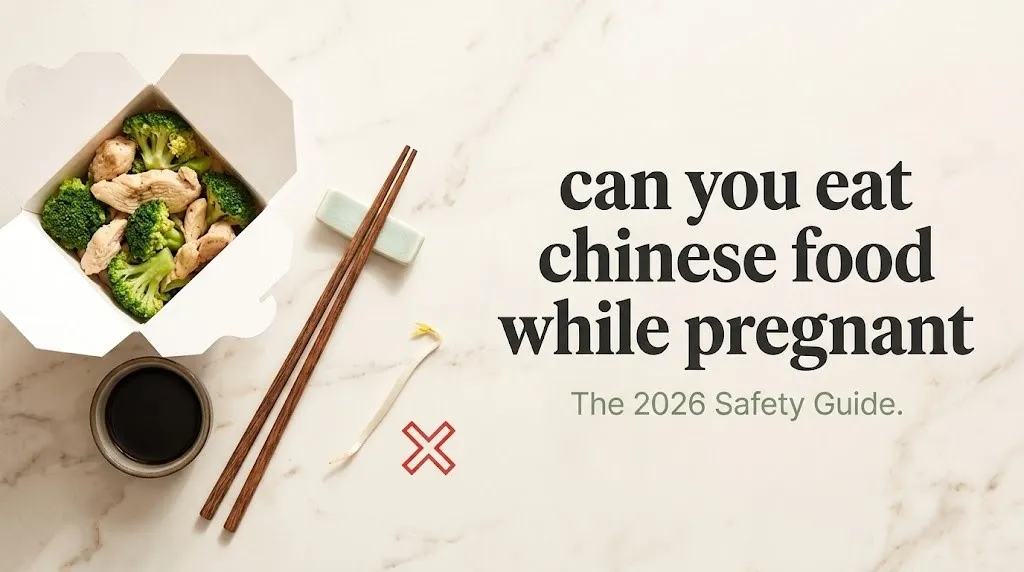
The primary risks with Chinese food are the same as any other restaurant meal. Sodium levels can be high. Ingredients like bean sprouts may be raw. Fried foods carry a high calorie load that can displace more nutrient-dense options. The cuisine itself is not unsafe. The choices you make within it determine the safety profile of your meal.
The foundation of a safe Chinese food order during pregnancy:
- All animal proteins must be cooked to a safe internal temperature (165 degrees Fahrenheit for poultry, 145 degrees Fahrenheit for whole cuts of beef or pork)
- Raw sprouts, including bean sprouts, must be fully cooked
- Dishes with heavy, sugary sauces should be requested with the sauce on the side
Key Takeaway: Chinese food is not a banned category during pregnancy. The switch from “Is it safe?” to “How do I order safely?” is the most important mental shift you can make.
Which Chinese Food Dishes Should I Avoid While Pregnant?
Avoid any Chinese food dish that contains raw or undercooked animal proteins, raw sprouts, or unpasteurized dairy. This means ruling out a specific set of menu items regardless of the restaurant. It also means thinking twice about dishes where the cooking method leaves an ingredient in a high-risk state.
High-risk dishes fall into three categories. The first category contains raw ingredients. This includes any sushi-grade fish roll, raw beef carpaccio-style appetizers, or salads topped with raw bean sprouts. The second category is dishes that are traditionally cooked but often arrive with a risk note. An egg fried rice where the egg is still runny is a prime example. The third category is dishes that pose a storage risk if you order them for delivery and do not eat them immediately.
The Centers for Disease Control and Prevention (CDC) specifically warns pregnant people against eating raw sprouts. The warm, humid conditions required to sprout mung beans are also ideal for the growth of Listeria monocytogenes, Salmonella, and E. coli. Rinsing sprouts does not remove the bacteria. Only cooking them to a high temperature makes them safe.
| Order with Caution or Avoid | Reason for Caution | Safer Alternative |
|---|---|---|
| Raw seafood dishes (sashimi, raw oysters in sauce) | Risk of Listeria, parasites | Steamed fish fillet with ginger and scallions |
| Dishes topped with raw bean sprouts | Raw sprouts are a CDC-identified Listeria risk | Stir-fried noodle dishes where sprouts are cooked |
| Runny egg fried rice or sunny-side-up eggs | Undercooked eggs risk Salmonella | Egg fried rice with fully scrambled, firm eggs |
| Unpasteurized dairy or custard desserts | Risk of Listeria | Steamed sponge cake or baked buns |
| Dishes with mystery meat or unidentifiable organ parts | Cannot verify internal cooking temperature | Whole, identifiable cuts of beef, chicken, or tofu |
Key Takeaway: If a dish arrives at your table with raw sprouts, raw fish, or a runny egg, it is a hard pass. Send it back or choose a fully cooked alternative from the start.
What Are the Real Risks of MSG During Pregnancy?
Monosodium glutamate, known as MSG, is safe to eat during pregnancy. The FDA classifies MSG as Generally Recognized as Safe (GRAS), a designation reserved for food additives with a long history of common use and a strong body of scientific safety evidence.
The myth that MSG causes headaches, palpitations, or other acute symptoms originated from a single 1968 letter to the New England Journal of Medicine describing “Chinese Restaurant Syndrome.” Decades of subsequent double-blind, placebo-controlled studies failed to reproduce these symptoms reliably when MSG was consumed with food. A review published in the Journal of Nutrition concluded that MSG is safe for the general population, including pregnant people.
Glutamate is not a foreign chemical to your body. It is a naturally occurring amino acid found in high concentrations in tomatoes, aged cheeses, mushrooms, and breast milk. Your body does not distinguish between the glutamate in a parmesan cheese wheel and the glutamate added to your stir-fry. It metabolizes them identically.
That said, heavily MSG-seasoned food can be a marker for a dish that is also high in sodium. The concern with a high-MSG dish during pregnancy is not the MSG molecule itself. It is the overall sodium level. If you are managing high blood pressure or edema, ask for your dish to be prepared without added MSG so you can control the total sodium yourself with low-sodium soy sauce.
Key Takeaway: MSG is not a teratogen or a neurotoxin. It is a concentrated flavor source that the FDA and global health bodies recognize as safe. Your attention should shift to the total sodium in the dish.
How Much Sodium Is in Soy Sauce and Chinese Takeout?
One tablespoon of standard soy sauce contains approximately 900 to 1,000 milligrams of sodium. That single spoonful represents nearly half of the 2,300-milligram daily limit recommended by the American Heart Association for the general population. The numbers become a real issue when a single dish uses three or four times that amount in its sauce.
A 2024 study in the journal Nutrients analyzing sodium levels in takeout meals found that some popular Chinese dishes contain more than 3,000 milligrams of sodium per single-serving container. General Tso’s Chicken and Beef with Broccoli in a heavy brown sauce are frequent offenders. The sodium comes from multiple sources. Soy sauce, hoisin sauce, oyster sauce, and the standard pinch of salt during wok cooking all add up.
Excessive sodium intake during pregnancy can worsen fluid retention and contribute to elevated blood pressure. For someone with gestational hypertension or preeclampsia, a single high-sodium meal can have a measurable short-term effect. You do not need to fear soy sauce. You do need to understand the scale of its sodium delivery.
| Sauce/Condiment (1 tbsp) | Approximate Sodium (mg) |
|---|---|
| Regular Soy Sauce | 900 mg |
| Low-Sodium Soy Sauce | 500 mg |
| Hoisin Sauce | 260 mg |
| Oyster Sauce | 490 mg |
| Sweet and Sour Sauce | 110 mg |
| Duck Sauce | 55 mg |
Ways to cut the sodium in your Chinese food order:
- Request the sauce on the side. Dip your fork in the sauce first, then spear the food.
- Ask if the kitchen can use low-sodium soy sauce. Many restaurants keep it stocked.
- Choose steamed dishes and drizzle them with a measured amount of sauce yourself.
- Limit soups like hot and sour soup, which can contain a full day’s sodium in a single bowl.
Key Takeaway: Soy sauce is the single largest sodium vector in Chinese food. Requesting sauce on the side or asking for low-sodium soy sauce eliminates the majority of the problem without changing what you eat.
Is Fried Rice Safe to Eat During Pregnancy?
Fried rice is safe to eat during pregnancy only if you know it was made fresh, the egg in it is fully cooked, and the rice was not left sitting at room temperature. Cooked rice has a specific food safety risk that surprises most people.
The bacterium Bacillus cereus forms spores that survive the initial boiling of rice. If cooked rice cools slowly and sits in the temperature danger zone between 40 degrees Fahrenheit and 140 degrees Fahrenheit, the spores germinate and produce a heat-stable toxin. Frying the rice again does not destroy this toxin. Eating contaminated rice can cause vomiting within a few hours, which is a miserable and dehydrating experience during pregnancy.
The safest fried rice is the one you order in a restaurant and eat immediately while the rice is piping hot. The rice has gone from the steamer to the wok to your plate without an intermediate room-temperature holding period. The riskiest fried rice is from a buffet, where the rice may have sat in a warming tray that does not maintain a safe temperature, or from delivery that cooled down on a long ride.
Ordering fried rice safely during pregnancy:
- Eat it at the restaurant rather than having it delivered
- Ensure the egg, meat, and seafood in the rice are fully cooked
- Never eat fried rice that has cooled to room temperature
- When reheating leftover fried rice at home, ensure it reaches 165 degrees Fahrenheit
- Discard any leftover fried rice that has been in your refrigerator for more than one day
Key Takeaway: The danger in fried rice is not the frying. It is the holding time between cooking and eating. Order it fresh, eat it hot, and treat leftovers with strict caution.
What About Chinese Seafood and Sushi Dishes?
Chinese seafood dishes are safe during pregnancy when the seafood is fully cooked. This distinction separates the vast majority of Chinese seafood preparations from the sushi bar. Steamed whole fish, shrimp with lobster sauce, and kung pao shrimp are all cooked-through dishes that pose no special pregnancy risk.
The nutritional benefit of eating cooked seafood during pregnancy is well-documented. The Dietary Guidelines for Americans recommend that pregnant people consume 8 to 12 ounces of low-mercury seafood per week. The omega-3 fatty acids, specifically docosahexaenoic acid (DHA), support fetal brain and eye development. A steamed fish fillet with ginger and scallions is one of the most nutritious orders on a Chinese menu.
The concern arises with dishes that use raw or lightly cured seafood. A Chinese restaurant that also serves Japanese-style sushi or sashimi is serving raw fish, which carries the risk of Listeria and parasites. Even a ceviche-style preparation where acid “cooks” the fish does not kill bacteria. Only heat does. Cantonese-style steamed fish, salt and pepper shrimp, and fully seared scallops are all safe. Raw marinated fish or raw oysters in black bean sauce are not.
| Safe Seafood Dishes (Fully Cooked) | Unsafe Seafood Dishes (Raw or Undercooked) |
|---|---|
| Steamed whole fish with ginger and scallions | Sashimi or raw fish slices |
| Kung Pao Shrimp | Raw oysters on the half shell |
| Shrimp with Lobster Sauce | Ceviche-style marinated fish |
| Salt and Pepper Squid (fried) | Dishes with a “raw” or “rare” marker on the menu |
| Fish filets in black bean sauce (steamed or pan-fried) | Cold seafood salads with unverified cooking status |
Key Takeaway: Cooked Chinese seafood dishes are a nutritional win during pregnancy. The line in the sand is heat. If heat was not applied, do not eat it.
Are Bean Sprouts and Raw Vegetables Safe in Chinese Food?
Bean sprouts are not safe to eat raw or lightly cooked during pregnancy. The CDC and the FDA have consistently linked raw and undercooked sprouts to foodborne illness outbreaks, including listeriosis, which is particularly dangerous during pregnancy.
Mung bean sprouts, the most common sprout in Chinese cooking, grow in warm, humid conditions. Listeria monocytogenes bacteria thrive in those same conditions. A stir-fry that tosses sprouts in at the very end for 30 seconds does not heat them to a temperature high enough to kill the bacteria. The sprouts wilt slightly but remain fundamentally raw in the center.
This does not mean you must avoid every dish with sprouts. It means you must verify that the sprouts are fully cooked. A noodle dish where bean sprouts are wok-fried for several minutes until limp and translucent is generally safe. A cold noodle salad topped with crisp, raw sprouts is not. The texture of the sprout tells the story. Crisp means raw. Limp and reduced in volume means cooked.
Other raw vegetables in Chinese food, like shredded lettuce, cucumber garnishes, and raw herbs, carry a lower risk profile than sprouts but should still be washed thoroughly. A reputable restaurant washes its produce. A restaurant with questionable health department scores might not. Your safest path is to eat at establishments you trust and to avoid raw sprouts altogether unless you personally saw them go into a hot wok.
Key Takeaway: Raw bean sprouts are a documented listeria risk and should be avoided entirely during pregnancy. Request your dish without them or ensure they are stir-fried until fully wilted and hot.
How to Reheat Chinese Takeout Safely During Pregnancy
Chinese takeout leftovers must be reheated to an internal temperature of 165 degrees Fahrenheit. This is the temperature at which the common bacterial pathogens that cause foodborne illness are killed. A microwave on a low, gentle setting is not sufficient.
The USDA guidelines for safe reheating state that leftovers should be placed in the refrigerator within two hours of cooking. Chinese takeout that sat on the counter during a movie or a long conversation has entered the danger zone. A large container of food also cools slowly in the center. For faster, safer cooling, divide your leftover fried rice or lo mein into a shallow, flat container so the heat dissipates quickly in the refrigerator.
Rice and noodle dishes require special attention. As discussed, Bacillus cereus on rice can produce a heat-stable toxin if the rice was left out too long before refrigeration. Reheating does not remove this toxin. If you do not know how long the rice sat out before it was refrigerated, or if the rice is more than 24 hours old, discard it. The risk is not worth the $4 worth of leftover food.
Safe reheating steps for Chinese takeout:
- Transfer leftovers from the takeout container to a microwave-safe plate or bowl
- Spread the food into an even layer so it heats uniformly
- Reheat on high power until the food is visibly steaming throughout
- Check the center of the thickest piece with a food thermometer; it must read 165 degrees Fahrenheit
- Discard any leftovers that have been in the refrigerator for more than three days
Key Takeaway: The 165-degree-Fahrenheit rule and the two-hour storage window are non-negotiable. Rice-based leftovers have an even narrower safety margin.
Chinese Food and Gestational Diabetes
Eating Chinese food with gestational diabetes requires managing the carbohydrate load of the meal, which primarily comes from white rice, noodles, batter, and sugary sauces. These four components can deliver 100 grams of carbohydrates or more in a single plate, which will spike blood glucose in someone with reduced insulin sensitivity.
The glycemic index (GI) of white jasmine rice is high, ranging from 70 to 80. This means it digests rapidly and floods the bloodstream with glucose. Brown rice is a lower-GI alternative, but many Chinese restaurants do not offer it. If the restaurant only has white rice, portion control becomes your primary tool. Limit your rice serving to one-half cup, which is about the size of a small fist.
Sauces are the hidden carbohydrate source. Sweet and sour sauce, orange chicken glaze, and General Tso’s sauce are thickened with cornstarch and contain added sugar. A single order of sweet and sour chicken can contain 40 grams of sugar from the sauce alone. A stir-fry with a light garlic or ginger sauce has a fraction of that.
A lower-glycemic Chinese food order for gestational diabetes:
- Steamed protein (chicken, shrimp, or tofu) with mixed vegetables
- Sauce on the side, choosing a thin garlic sauce or low-sodium soy sauce over a thick, sweet glaze
- One-half cup of white rice or skip the rice entirely
- Skip the fried appetizers, egg rolls, and breaded proteins
- Avoid sweetened beverages like bubble tea or sweetened iced tea
Key Takeaway: The rice, noodle, batter, and sweet sauce combination is the blood sugar challenge in Chinese food. Deconstruct the meal, measure the rice, and choose steamed or wok-seared proteins.
Chinese Food and High Blood Pressure During Pregnancy
High blood pressure during pregnancy, including gestational hypertension and preeclampsia, demands strict sodium awareness. Chinese food can be one of the highest-sodium meals available in the standard American takeout rotation. A single order of lo mein with soy sauce can deliver more than 3,000 milligrams of sodium.
The sodium sensitivity of pregnancy is real. Blood volume expands by roughly 50 percent during pregnancy, and the kidneys are already under increased filtration load. Adding a high-salt meal forces the body to retain more fluid, which can raise blood pressure further. The ACOG recommends that pregnant people with hypertension work with their healthcare provider on specific sodium targets, which often fall between 1,500 and 2,000 milligrams per day.
Choosing the right dish matters more than avoiding the restaurant. A steamed Buddha’s Delight with tofu, steamed rice, and a side of garlic sauce contains a manageable sodium load. The same order but fried, with a heavy soy-based sauce poured over it, is a completely different nutritional proposition.
Low-sodium Chinese food ordering strategy:
- Start with steamed dishes rather than stir-fried ones
- Ask for all sauces on the side and use them sparingly
- Order brown rice or steamed white rice without added salt
- Skip the soup course entirely; even egg drop soup can be high in sodium
- Avoid all dishes described as “crispy,” “fried,” or “battered”
Key Takeaway: If you are managing high blood pressure, the “sauce on the side” rule is not a suggestion. It is the single most impactful action you can take at a Chinese restaurant.
Can I Eat Chinese Herbal Soups While Pregnant?
Chinese herbal soups require extreme caution during pregnancy. Many traditional Chinese herbs are potent pharmacological agents that have not been studied for safety during pregnancy, and some are known to stimulate uterine contractions or affect hormone levels.
Ginseng, a common ingredient in Chinese herbal tonics, is listed by the American Academy of Family Physicians as a botanical that pregnant people should avoid due to its potential teratogenic effects in animal studies. Dong quai, another herb frequently used in soups and teas, can act as a uterine stimulant and is contraindicated during pregnancy by herbal safety guidelines.
The issue is compounded by the fact that restaurant herbal soup recipes are proprietary and the specific herbs and their quantities are rarely disclosed. A soup described as “nourishing” or “strengthening” may contain a blend of ingredients that a Western-trained obstetrician would never recommend. The safest course is to avoid Chinese herbal soups entirely during pregnancy unless the soup is a simple broth-based soup with identifiable whole-food ingredients.
Simple, clear soups like egg drop soup or a basic vegetable broth soup with tofu and bok choy are safe alternatives. They provide warmth and comfort without the unknown pharmacological variable of traditional herbs.
Key Takeaway: Avoid Chinese herbal soups during pregnancy. The herb blend is rarely disclosed, and some common ingredients like ginseng and dong quai are specifically contraindicated.
How to Order Safe Chinese Takeout While Pregnant
Ordering safe Chinese takeout while pregnant is a matter of communicating clearly and choosing dishes based on their cooking method, not just their name. The person taking your order on the phone or online app does not know you are pregnant. You must ask the specific questions that guarantee your food is safe.
A direct script works better than a vague request. Saying “Can you make that dish without MSG?” is fine but incomplete. Saying “Can you steam the chicken and broccoli with the sauce on the side, and please cook the chicken to well-done?” communicates exactly what you need. Most Chinese restaurant kitchens are accustomed to modifications and will accommodate them.
The delivery time window matters. If your food will take 45 minutes to arrive, it will spend that time cooling down in the temperature danger zone. A long delivery window is most problematic for fried rice and noodle dishes. Consider pickup instead of delivery, or choose a restaurant that is close enough for a short transit time.
Your pregnancy-safe ordering script:
- Ask whether the restaurant uses pasteurized eggs for dishes like fried rice
- Request that all proteins be cooked well-done, with no pink in the center
- Tell them to leave off the raw bean sprouts entirely
- Ask for low-sodium soy sauce or for the sauce to be served on the side
- Request that your meal be prepared fresh rather than pre-made and held on a steam table
Key Takeaway: Be specific and polite with the kitchen. “Sauce on the side, well-done protein, no raw sprouts” is a complete safety order that any restaurant can follow.
What to Look for on a Chinese Menu When You’re Pregnant
Scanning a Chinese menu through a pregnancy lens means identifying dishes with steamed, braised, or lightly stir-fried proteins and a high proportion of cooked vegetables. The language of the menu gives you clues, and you can learn to read them in seconds.
The safest menu sections are often the “Chef’s Specials” or “Healthy Selections” lists that national chains and forward-thinking independent restaurants have added over the past several years. These dishes tend to use less oil, less sugar, and more vegetable-forward compositions. P.F. Chang’s, for example, offers a Ginger Chicken with Broccoli and a Buddha’s Feast that fit the pregnancy-safe criteria well.
Regional American-Chinese restaurant menus can vary widely, and nutritional data is rarely available at small independent establishments. The Panda Express website provides detailed nutritional information, showing that a serving of their String Bean Chicken Breast contains 210 calories and 590 milligrams of sodium, while their Beijing Beef contains 480 calories and 920 milligrams. The difference in a single dish is substantial.
Ordering-safe language to scan for:
- “Steamed” or “braised” (best bets)
- “Wok-seared” or “lightly stir-fried” (good options)
- “Crispy,” “fried,” “battered,” or “sweet and sour” (order less frequently)
- “Raw,” “cold,” or “rare” (avoid)
Ordering-safe proteins and vegetables:
- Chicken, beef, shrimp, or tofu
- Broccoli, bok choy, snow peas, carrots, bell peppers, mushrooms
- Steamed whole fish with ginger and scallions
Key Takeaway: The best menu items are verbed with “steamed,” “braised,” or “wok-seared.” Avoid anything described with “crispy,” “battered,” or “raw.”
Dim Sum Safety During Pregnancy
Dim sum is safe during pregnancy when you choose fully cooked dumplings, buns, and rice dishes and avoid any items that are cold, raw, or have been sitting on a cart for an unknown length of time. The cart-service model introduces a food safety variable that does not exist with a made-to-order kitchen.
Steamed har gow (shrimp dumplings), shumai (pork dumplings), char siu bao (steamed barbecue pork buns), and steamed rice noodle rolls are all safe choices. The fillings reach a high temperature during steaming and are served hot. The danger lies in cold appetizers like marinated jellyfish, cold sliced meats, or any dim sum item that arrives at your table lukewarm rather than steaming.
Cart temperature is your primary concern. A cart that makes a long loop through a crowded dining room may hold food at a temperature that is below the safe holding threshold of 140 degrees Fahrenheit. You cannot know the full time-temperature history of a dim sum dish that has been circulating. Choose a restaurant where you see fresh bamboo steamers coming directly from the kitchen. Order from the menu rather than the cart when possible so you receive a freshly steamed portion.
Safe dim sum choices during pregnancy:
- Steamed shrimp or pork dumplings (har gow, shumai)
- Steamed barbecue pork buns (char siu bao)
- Steamed rice noodle rolls with shrimp or beef
- Stuffed sticky rice in lotus leaf (lo mai gai)
- Pan-fried turnip cakes (served hot and fully cooked through)
Key Takeaway: Hot, freshly steamed dim sum is safe. Avoid items that are cold, marinated but not cooked, or have been circulating on a cart at an uncertain temperature.
Frequently Asked Questions About Chinese Food and Pregnancy
Is it safe to eat Chinese food in the first trimester?
Yes, Chinese food is safe in the first trimester when you choose fully cooked dishes and avoid raw ingredients.
The first trimester is when the fetal neural tube is developing, so prioritizing nutrient-dense dishes like steamed fish and vegetables over fried and heavily sauced options is wise.
Foodborne illness is dangerous at any stage, but the dehydration from vomiting associated with Bacillus cereus poisoning can be particularly severe when you are already managing morning sickness.
Can I eat sweet and sour chicken while pregnant?
You can eat sweet and sour chicken during pregnancy as an occasional meal, not a dietary staple.
A typical order of sweet and sour chicken is deep-fried and coated in a sauce that contains roughly 30 to 40 grams of added sugar, making it a high-calorie, low-nutrient-density choice.
If the craving hits, order it from a restaurant that makes it fresh, eat a smaller portion, and pair it with a side of steamed vegetables.
What is the safest Chinese soup to eat during pregnancy?
Egg drop soup and a simple vegetable broth soup with tofu are the safest Chinese soups during pregnancy.
These soups are made from a simple broth base, fully cooked egg, and soft tofu, with none of the unstudied herbs found in traditional Chinese medicinal soups.
Hot and sour soup is fully cooked but can contain more than 1,000 milligrams of sodium per bowl, so order it infrequently if you are managing blood pressure.
Can I eat a fortune cookie while pregnant?
A fortune cookie is safe to eat during pregnancy.
It is a simple baked wafer made from flour, sugar, vanilla, and oil, with no raw ingredients or specific food safety concerns.
A single fortune cookie contains about 30 calories and 4 grams of sugar, so it is a negligible addition to an occasional meal.
Is it safe to eat at a Chinese buffet while pregnant?
A Chinese buffet is not the safest choice during pregnancy.
The food sits in warming trays that may not maintain a safe 140-degree Fahrenheit holding temperature, and the time a dish has been on the line is unknown.
If a buffet is your only option, eat only dishes that are visibly steaming, being actively replenished from the kitchen, and are fully cooked without raw garnishes.
The bottom line on Chinese food during pregnancy is straightforward. You can eat it. You should order thoughtfully. The framework of “fully cooked, sauce on the side, and hold the raw sprouts” gets you 90 percent of the way to a safe, satisfying meal at any Chinese restaurant.
Next time you open a takeout menu, scan for the steamed and braised dishes first. Ask the specific questions about preparation and sauce placement that we covered. Eat the meal while it is hot, and store and reheat any leftovers with the 165-degree-Fahrenheit rule in mind.
Cravings do not have to be a source of guilt or worry. They are a signal to find a safe, nourishing way to eat what sounds good. Chinese food, ordered with these guardrails in place, fits into a healthy pregnancy diet without compromise.