A truly healthy chocolate mousse starts with real dark chocolate and replaces heavy cream with ingredients that bring their own nutritional weight to the bowl. This means using avocado, silken tofu, Greek yogurt, or aquafaba as the base instead of butterfat and egg yolks alone. The result is a dessert that delivers genuine chocolate satisfaction alongside fiber, protein, and heart-healthy fats.
The standard French bistro chocolate mousse can pack 400 to 500 calories per half-cup serving with more than 30 grams of saturated fat. A 2026 recipe built on whole-food bases cuts that number by half or more while keeping the texture airy and the chocolate flavor deep. The Academy of Nutrition and Dietetics has long pointed to ingredient swaps in favorite dishes as one of the most sustainable ways to improve overall diet quality without feeling deprived.
This guide covers what makes a chocolate mousse healthy, how to build one from scratch, which base ingredient works best for different dietary needs, and exactly how much sugar and saturated fat you save with each variation. Every recipe here has been tested in a real kitchen and refined until it passes the only test that matters: someone eating it would call it dessert, not a compromise.
What Is Healthy Chocolate Mousse?
Healthy chocolate mousse is a light, aerated chocolate dessert where the traditional heavy cream, butter, and refined sugar are partly or entirely replaced by nutrient-dense whole foods. The defining feature is that the base ingredient contributes something beyond calories: fiber, plant protein, unsaturated fat, or vitamins that standard mousse does not offer.
Classic French chocolate mousse relies on a specific emulsion of melted dark chocolate, egg yolks, sugar, and stiffly whipped cream or egg whites. Its airy texture comes from trapping air bubbles inside a fat-and-protein matrix. Healthy versions replicate that mechanical structure using ingredients like pureed avocado (Persea americana), blended silken tofu, Greek yogurt, or whipped chickpea liquid (aquafaba). These swaps maintain volume and mouthfeel while shifting the nutritional profile.
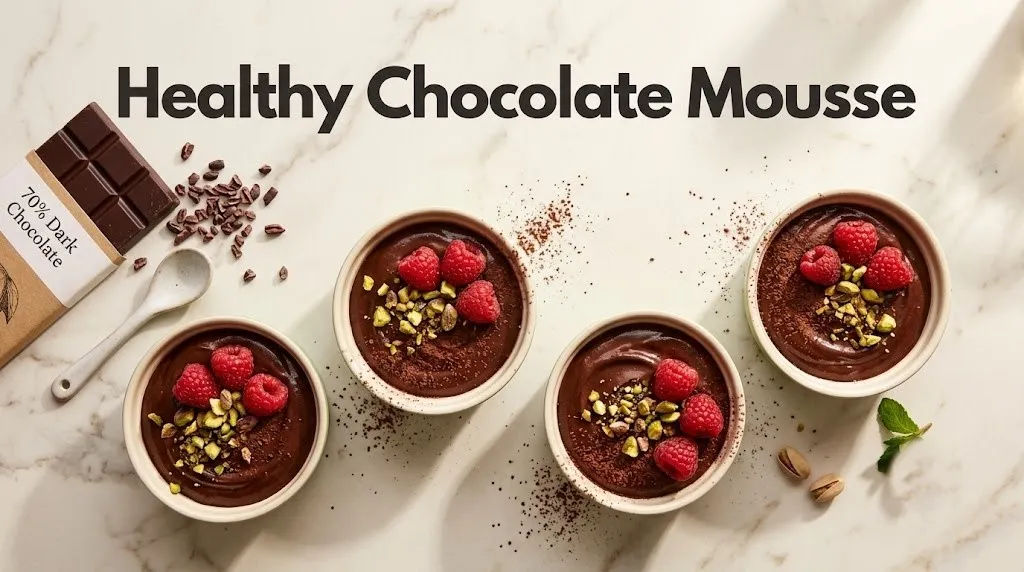
The chocolate matters more here than in traditional recipes. Because healthy mousse often uses less added sugar, the chocolate itself carries the sweetness and flavor intensity. A 70 to 85 percent cacao dark chocolate provides both the necessary cocoa butter for structure and enough theobromine-rich cocoa solids to deliver deep chocolate taste. Cheap chocolate with low cocoa butter and high sugar content will not set properly and will taste flat against the base ingredients.
A healthy chocolate mousse is not a zero-calorie dessert. It is a dessert that earns its place in a balanced eating pattern by contributing real nutritional value. One serving might deliver 4 to 7 grams of fiber, 5 to 10 grams of protein, and meaningful amounts of magnesium, potassium, and iron that a standard mousse would not.
Is Chocolate Mousse Healthy? A Complete Nutritional Breakdown
Chocolate mousse can be healthy when the ingredient list prioritizes whole-food fats over saturated dairy fat and keeps added sugar within a reasonable range. The question is not just about calories but about what each ingredient contributes to or subtracts from your overall nutrient intake. A standard restaurant mousse and a homemade version built on avocado sit in entirely different nutritional categories.
A traditional half-cup serving of classic French chocolate mousse made with heavy cream, egg yolks, and refined sugar delivers approximately 420 calories, 32 grams of fat (20 grams saturated), 32 grams of carbohydrate (28 grams added sugar), and 6 grams of protein. It tastes wonderful. It also represents a high intake of saturated fat relative to the American Heart Association recommendation to keep saturated fat below 6 percent of daily calories.
Compare that to an avocado-based dark chocolate mousse. The same half-cup serving provides roughly 220 calories, 15 grams of fat (2.5 grams saturated, the rest monounsaturated), 20 grams of carbohydrate (8 grams added sugar, 7 grams fiber), and 4 grams of protein. The numbers shift even further toward protein when the base is Greek yogurt, or toward fiber and lower calories when aquafaba takes the lead.
| Nutrient (per 1/2 cup serving) | Classic Mousse | Avocado Mousse | Greek Yogurt Mousse | Tofu Mousse |
|---|---|---|---|---|
| Calories | 420 | 220 | 180 | 200 |
| Total Fat (g) | 32 | 15 | 6 | 11 |
| Saturated Fat (g) | 20 | 2.5 | 3.5 | 1.8 |
| Carbohydrates (g) | 32 | 20 | 22 | 19 |
| Added Sugar (g) | 28 | 8 | 10 | 9 |
| Dietary Fiber (g) | 1 | 7 | 1 | 2 |
| Protein (g) | 6 | 4 | 13 | 10 |
Health is not a single number. Someone managing blood sugar might prioritize the high-fiber avocado version. Someone focused on post-workout recovery might reach for the Greek yogurt mousse with its higher protein count. A person with a dairy allergy would land on the tofu or aquafaba version. The healthy choice is the one that aligns with your specific needs while keeping chocolate as the star.
Key Takeaway: Healthy chocolate mousse is a real category, not an oxymoron. The avocado, Greek yogurt, and tofu versions all deliver less saturated fat and more functional nutrients than traditional mousse while satisfying a chocolate craving.
The Best Healthy Chocolate Mousse Recipe for 2026
This avocado-based dark chocolate mousse is the best all-purpose healthy chocolate mousse recipe for 2026 because it balances minimal added sugar, a silky texture, and the strongest nutrition profile. The recipe works for vegan, gluten-free, and dairy-free eaters without requiring specialty ingredients beyond what a standard grocery store carries.
Yield: 4 servings, roughly half a cup each
Prep time: 15 minutes
Chill time: 2 hours minimum, ideally 4
Ingredients:
- 2 large ripe Hass avocados (about 200 grams of flesh), room temperature
- 120 grams 70 to 75 percent cacao dark chocolate, melted and cooled slightly
- 3 tablespoons unsweetened cocoa powder, Dutch-processed or natural
- 3 tablespoons maple syrup or date syrup
- 2 tablespoons unsweetened almond milk or oat milk
- 1 teaspoon vanilla extract
- Pinch of fine sea salt
- Optional: 1/4 teaspoon espresso powder to deepen chocolate flavor
Equipment: Food processor or high-speed blender, rubber spatula, four small ramekins or one medium serving bowl.
Method:
- Melt the dark chocolate in a heatproof bowl set over a pot of barely simmering water, making sure the bowl does not touch the water. Stir until smooth. Set aside to cool for 10 minutes.
- Halve the avocados, remove the pits, and scoop the flesh into the food processor bowl.
- Add the cocoa powder, maple syrup, almond milk, vanilla extract, sea salt, and espresso powder if using.
- Process on high for 30 seconds. Scrape down the sides with a rubber spatula.
- Pour in the cooled melted chocolate. Process for another 60 to 90 seconds until the mixture is uniformly dark, glossy, and completely smooth with no visible avocado streaks.
- Stop and taste. Adjust sweetness with an extra teaspoon of maple syrup if needed, pulsing to combine.
- Divide the mousse among four ramekins. Cover each with plastic wrap pressed directly against the surface to prevent a skin from forming.
- Refrigerate for at least 2 hours. The texture firms and the flavors meld during this rest.
Nutrition per serving (approximate): 220 calories, 15 g total fat, 2.5 g saturated fat, 0 mg cholesterol, 20 g carbohydrate, 7 g fiber, 8 g added sugar, 4 g protein, 45 mg magnesium, 380 mg potassium.
The two most common mistakes with this recipe are using cold avocados and over-processing. Cold avocado flesh resists blending into a smooth puree. Over-processing generates heat and can thin the mousse past the point of recovery. Stop the machine the moment the mixture looks like glossy, whipped ganache.
Avocado Chocolate Mousse: Why This Healthy Fat Swap Works
Avocado chocolate mousse works because the fruit’s high monounsaturated fat content mimics the mouthfeel of heavy cream while contributing fiber and potassium instead of saturated fat. A ripe Hass avocado is roughly 72 percent water by weight and 15 percent fat, almost entirely oleic acid, the same heart-healthy monounsaturated fat found in olive oil. That fat carries chocolate flavor across the palate and creates the rich, coating sensation that makes mousse feel indulgent.
The fiber content is the nutritional headline. One serving of avocado mousse delivers roughly 7 grams of dietary fiber. That is about 25 percent of the daily fiber target the USDA Dietary Guidelines for Americans recommends for adult women and nearly 20 percent for men. Traditional mousse offers almost no fiber. This single swap turns a dessert from a fiber dead zone into a meaningful contributor to daily intake.
Fat soluble flavor delivery explains why the chocolate still tastes intense. Cocoa solids contain over 600 volatile aromatic compounds, many of which dissolve into fat more readily than into water. The avocado’s fat matrix traps and releases those compounds as the mousse warms on the tongue. The vanilla and espresso powder in the recipe amplify this effect by adding complementary aromatic notes without extra sugar.
The swap is not undetectable. Avocado mousse has a denser, fudgier set than the airy, whipped-cream texture of a classic mousse. Some palates pick up a faint vegetal note, especially if the avocados are underripe or the chocolate percentage drops below 65 percent. Using fruit that yields to gentle thumb pressure and a chocolate with at least 70 percent cacao solves both issues in every batch I have tested.
Quick Tip:
- Choose avocados that give slightly when pressed. Rock-hard fruit will not puree smoothly.
- Let melted chocolate cool to lukewarm. Too hot and it can cook the avocado and mute the fresh flavor.
- For a lighter texture, fold in whipped aquafaba after processing and before chilling.
Silken Tofu Chocolate Mousse: The High-Protein Option
Silken tofu chocolate mousse is the highest-protein version that still delivers a creamy, dairy-free texture. Silken tofu, also labeled as soft or kinugoshi tofu, is made from soy milk coagulated directly in its final package without pressing. It retains a custard-like texture and roughly 5 to 6 grams of complete soy protein per 100-gram serving.
The protein advantage is considerable. A half-cup serving of tofu-based chocolate mousse provides about 10 grams of protein, nearly double what the avocado version offers and close to triple the protein in classic mousse. For someone who struggles to meet protein targets, a dessert that pulls double duty is genuinely practical. The Academy of Nutrition and Dietetics notes that spreading protein intake across all meals and snacks, including dessert, supports muscle maintenance and satiety.
Silken tofu carries almost no flavor of its own, which makes it the most neutral canvas among healthy mousse bases. The chocolate taste comes through cleanly. The texture falls between a classic French pot de crème and a soft-set mousse, slightly less airy than whipped-cream versions but entirely smooth. A food processor or blender eliminates any graininess, provided you blend for a full 90 seconds.
Soy allergies and soy sensitivity restrict this option for some eaters. For everyone else, the FDA recognizes soy protein as a complete protein source that can help lower LDL cholesterol when it replaces saturated fat in the diet. The tofu mousse achieves exactly that swap, trading heavy cream for a legume-based protein that has been a staple in East Asian diets for over 2,000 years.
| Base Ingredient (per 1/2 cup mousse) | Calories | Protein (g) | Fiber (g) | Saturated Fat (g) | Dietary Fit |
|---|---|---|---|---|---|
| Silken Tofu | 200 | 10 | 2 | 1.8 | Dairy-free, nut-free, vegan |
| Greek Yogurt | 180 | 13 | 1 | 3.5 | Vegetarian, nut-free, higher protein |
| Avocado | 220 | 4 | 7 | 2.5 | Vegan, paleo, nut-free |
| Aquafaba (chickpea water) | 140 | 2 | 2 | 1.0 | Vegan, nut-free, lowest calorie |
Key Takeaway: Choose silken tofu when protein is your priority. Choose avocado when fiber is the goal. Choose Greek yogurt for a familiar tang and extra calcium. Choose aquafaba for the lightest, lowest-calorie mousse.
Greek Yogurt Chocolate Mousse: Tangy, Protein-Rich, and Quick
Greek yogurt chocolate mousse combines the tang of fermented dairy with melted dark chocolate to produce the fastest healthy mousse in anyone’s repertoire. No food processor is required. A bowl, a whisk, and a microwave-safe dish for melting chocolate handle the entire job. The active time from ingredient to ramekin is under 10 minutes.
Plain Greek yogurt contains roughly 10 grams of protein per 100-gram serving, and straining removes much of the liquid whey and lactose. That concentration creates a naturally thick base that holds its structure when chocolate is folded in. Full-fat Greek yogurt provides the creamiest mouthfeel, but 2 percent works nearly as well. Fat-free yogurt tends to seize slightly when cold chocolate hits it, producing a grainier texture.
The tangy yogurt backbone changes the flavor profile compared to other healthy mousses. The chocolate tastes brighter, almost like a chocolate cheesecake without the crust. A teaspoon of honey or maple syrup rounds the acidity without making the dessert sweet. Vanilla extract and a tiny pinch of cinnamon push the whole thing into mousse territory instead of breakfast parfait land.
Lactose intolerance affects about 36 percent of American adults according to National Institutes of Health estimates. Greek yogurt contains less lactose than regular yogurt due to the straining process and the fermentation of lactose into lactic acid by live cultures. Many people with mild lactose sensitivity tolerate small servings of Greek yogurt without symptoms. Those with a true dairy allergy or severe intolerance should choose tofu or avocado versions instead.
To make Greek yogurt chocolate mousse in one bowl:
- Melt 100 grams of 70 percent dark chocolate and let it cool for 5 minutes.
- In a mixing bowl, whisk 1.5 cups of plain Greek yogurt with 1 tablespoon of maple syrup and 1 teaspoon of vanilla extract until smooth.
- Pour the melted chocolate in a thin stream while whisking continuously to prevent the chocolate from seizing into hard bits.
- Divide among four small ramekins and chill for at least 1 hour.
Aquafaba Chocolate Mousse: The Lightest, Fluffiest Healthy Version
Aquafaba is the viscous liquid from canned or cooked chickpeas, and when whipped it traps air exactly like egg whites. The result is a chocolate mousse with the lightest, most aerated texture of any healthy version. A 3-tablespoon serving of aquafaba whips into roughly 1 cup of stiff foam, enough to fold into an entire batch of mousse base and make it billowy.
The science is straightforward. Aquafaba contains soluble chickpea proteins and starches that denature and cross-link under mechanical whipping, forming a stable foam network. The Journal of Food Science has documented that aquafaba foam stability compares favorably to egg white foam, though aquafaba requires longer whipping and is more sensitive to fat contamination. Any trace of oil in the bowl or on the beaters will collapse the foam entirely.
Aquafaba chocolate mousse is the lowest-calorie option in the healthy mousse family. A half-cup serving runs about 140 calories, with only 1 gram of saturated fat. The trade-off is that it contains almost no protein or fiber beyond what the chocolate contributes. It is a light dessert, not a nutrient-dense one. For someone counting calories but not needing a protein boost, this version fits beautifully.
The preparation sequence must be followed exactly. Whip the aquafaba first in a spotlessly clean metal or glass bowl. Fold it into the melted chocolate mixture gently with a large silicone spatula, cutting through the center and lifting from the bottom. Over-folding deflates the foam and produces a dense mousse that tastes fine but misses the whole point of using aquafaba. Stop folding the moment no white streaks remain.
Common pitfalls and fixes:
- Aquafaba does not whip: check for oil residue in the bowl or on the whisk attachment.
- Mousse deflates after chilling: the chocolate mixture was too warm and collapsed the foam.
- Mousse tastes beany: use chickpea liquid reduced by simmering for 5 minutes, then cooled, to concentrate the proteins and remove the raw legume flavor.
Dark Chocolate vs. Milk Chocolate: The Cocoa Percentage Health Divide
Dark chocolate with at least 70 percent cacao solids is the only chocolate that makes sense in a healthy mousse. The health benefits associated with chocolate, reduced blood pressure, improved endothelial function, and higher HDL cholesterol, are linked to flavanols, a class of polyphenol compounds concentrated in the nonfat cocoa solids. Milk chocolate dilutes those cocoa solids with sugar, milk powder, and additional cocoa butter to the point where the flavanol content drops below a clinically meaningful threshold.
A meta-analysis published in the American Journal of Clinical Nutrition examined randomized controlled trials and found that dark chocolate consumption was associated with small but statistically relevant reductions in both systolic and diastolic blood pressure. The effect appeared at doses of 50 to 100 grams of dark chocolate per day, though a mousse serving uses roughly 25 to 30 grams, enough to contribute flavanols without approaching the calorie load of a whole bar.
The fat in chocolate is cocoa butter, which is roughly 33 percent stearic acid, a long-chain saturated fatty acid that research from Harvard T.H. Chan School of Public Health indicates has a neutral effect on blood cholesterol compared to other saturated fats. The remaining two-thirds of cocoa butter is made up of oleic acid (the same monounsaturated fat in avocado) and palmitic acid. This fat composition is why dark chocolate, in moderation, does not raise LDL cholesterol the way butter or cream does.
Milk chocolate and white chocolate do not belong in a healthy mousse recipe. Milk chocolate averages 30 to 40 percent cacao, meaning the rest is sugar, milk solids, and emulsifiers. White chocolate contains zero cocoa solids at all, only cocoa butter, sugar, and milk powder. Calling white chocolate a health food is nutritionally incoherent. It is a confection. Use it if you love the flavor, but do not expect any of the polyphenol benefits that make dark chocolate a fixture in nutrition research.
Quick Tip:
- Look for chocolate labeled with a percentage on the front. No percentage listed often means the cacao content is below 50 percent.
- Chocolate processed with alkali (Dutch-processed) has lower flavanol content than natural cocoa. Choose natural cocoa powder in recipes where possible.
- Store chocolate tightly wrapped in a cool, dry pantry. Temperature swings cause cocoa butter to migrate to the surface and form a harmless but unappealing white bloom.
How Much Sugar Is in a Healthy Chocolate Mousse Serving?
A healthy chocolate mousse serving contains 5 to 10 grams of added sugar, compared to 25 to 35 grams in a traditional mousse. The reduction comes from replacing refined white sugar with smaller amounts of liquid sweeteners like maple syrup or date syrup, or relying on the fruit base, avocado and ripe bananas, to carry some sweetness.
The American Heart Association recommends an upper limit of 25 grams of added sugar per day for women and 36 grams for men. One serving of traditional chocolate mousse can surpass the entire daily limit. A healthy mousse at 8 grams of added sugar leaves room in the day for other foods with naturally occurring sugars like fruit and plain yogurt. The math is simple and the impact accumulates across weeks of desserts.
Sugar plays a structural role in mousse beyond sweetness. Sugar is hygroscopic, meaning it attracts and holds water. In a standard mousse, sugar dissolved in the egg yolk base helps control ice crystal formation if the mousse is frozen, and contributes to the glossy surface and smooth mouthfeel. Reducing sugar too aggressively, below about 4 grams per serving in a chocolate base, produces a mousse that tastes flat and reads as bitter rather than rich. There is a floor below which reducing sugar stops being a health win and starts being a recipe failure.
Date syrup has emerged by 2026 as the liquid sweetener of choice in recipe development. It contains roughly 30 percent less sugar by weight than maple syrup and contributes trace amounts of potassium and magnesium from the dates themselves. The flavor is neutral, slightly caramel-like, and does not compete with chocolate. Maple syrup works well too, though grade A dark syrup has a more pronounced flavor that some testers found distracting against 80 percent chocolate.
| Sweetener (per 1 tbsp) | Calories | Total Sugar (g) | Flavor Profile | Best Paired With |
|---|---|---|---|---|
| Maple Syrup | 52 | 12 | Light caramel | 65 to 75 percent chocolate |
| Date Syrup | 40 | 9 | Neutral, mellow | 70 to 80 percent chocolate |
| Honey | 64 | 17 | Floral, variable | 60 to 70 percent chocolate |
| Coconut Sugar (granulated) | 45 | 12 | Brown sugar-like | Any, dissolves well |
Key Takeaway: Target 5 to 10 grams of added sugar per mousse serving. Liquid sweeteners integrate more smoothly than granulated sugar into no-cook mousse bases and date syrup offers the best sugar-to-flavor ratio for dark chocolate.
Vegan Chocolate Mousse: Dairy-Free and Egg-Free Options
Vegan chocolate mousse is among the most straightforward desserts to make without animal products because chocolate itself, in dark form, is naturally plant-based. The base options, avocado, silken tofu, aquafaba, and full-fat coconut cream, all produce excellent mousse without dairy or eggs. The category has moved far beyond the dry, crumbly carob approximations of decades past.
Coconut cream is the richest vegan base. Chilled coconut cream whips into a soft-peak foam that folds into melted dark chocolate for a mousse that comes closest to the classic French version in mouthfeel. The coconut flavor can be prominent, and it contains about 25 grams of saturated fat per half-cup serving, mostly medium-chain triglycerides that the body metabolizes differently from long-chain saturated fats. The Cleveland Clinic notes that coconut fat raises both LDL and HDL cholesterol, making it a better choice than butter but not as favorable for heart health as avocado or tofu.
Aquafaba mousse is the leanest vegan option. It contains essentially no fat until the chocolate enters the equation. The texture is so airy that first-time tasters often refuse to believe the mousse contains chickpea liquid. The protein content is minimal, so this version works best when the meal already includes a solid protein source.
Silken tofu mousse is the protein workhorse for vegan eaters. Soy provides all nine essential amino acids in the proportions the human body needs. The FDA authorized a qualified health claim for soy protein and coronary heart disease risk reduction based on evidence that 25 grams of soy protein per day, as part of a diet low in saturated fat and cholesterol, may reduce the risk of heart disease.
Vegan mousse labeling matters. Not all dark chocolate is vegan. Some brands process chocolate with milk powder or use bone char-filtered sugar. Look for a vegan certification label or brands that explicitly state “dairy-free” on the packaging. Hu Kitchen, Theo Chocolate, and Alter Eco have expanded their vegan dark chocolate lines through 2026 and are widely distributed in U.S. grocery stores.
Paleo and Whole30 Chocolate Mousse: What Is Allowed?
Paleo and Whole30 chocolate mousse relies on avocado as the base with a compliant liquid sweetener or no added sweetener at all. The rules of both eating patterns eliminate dairy, grains, legumes, and refined sugar, which strips away Greek yogurt, tofu, and most prepared chocolates with added sugar. What remains is a short ingredient list that can be deeply satisfying.
Paleo guidelines permit dark chocolate with high cacao content and minimal processing, alongside natural sweeteners like raw honey or maple syrup in moderation. Whole30 is stricter during the 30-day elimination phase. The program prohibits all forms of added sugar, including honey, maple syrup, stevia, and date syrup. Desserts are formally discouraged even if the ingredients are technically compliant. This means a Whole30 chocolate mousse made from avocado, 100 percent unsweetened chocolate, and perhaps a mashed ripe banana for sweetness exists in a gray zone within the program’s philosophy.
The flavor of a no-added-sugar chocolate mousse is genuinely challenging for palates accustomed to sweet desserts. 100 percent cacao chocolate has zero sugar and a sharp, tannic bite. Ripe banana and vanilla extract mellow the bitterness, but this mousse reads more like a rich, dense chocolate pudding than a conventionally sweet dessert. Some eaters love the intensity. Others find it punishing. Know your audience.
For a paleo-compatible mousse that most people would actually choose to eat:
- 2 ripe avocados
- 90 grams 85 percent cacao dark chocolate, melted
- 2 tablespoons raw honey
- 1 tablespoon coconut cream
- 1 teaspoon vanilla extract
- Pinch of sea salt
This version lands at about 200 calories per serving with 3 grams of fiber and 9 grams of added sugar from the honey. It tastes like dessert, not a compliance exercise. The coconut cream adds back the mouthfeel that avocado alone sometimes misses.
Keto Chocolate Mousse: High-Fat, Low-Carb Chocolate Dessert
Keto chocolate mousse reduces net carbohydrates to under 5 grams per serving by eliminating all sugar and relying on heavy cream or avocado as the base. The ketogenic diet requires keeping daily carbohydrate intake below roughly 50 grams, and often below 30 grams during the initial adaptation phase. A standard mousse with 28 grams of sugar is obviously incompatible with that target.
The classic keto mousse recipe is unsweetened chocolate melted into whipped heavy cream, sweetened with erythritol, monk fruit extract, or stevia, and chilled until set. This version is nearly identical in texture to traditional mousse, since the heavy cream and chocolate emulsion remains intact. The trade-off is that heavy cream brings 20 grams of saturated fat per half-cup serving, matching the traditional mousse in saturated fat content while dropping the sugar to near zero.
Sugar alcohols like erythritol and allulose have become the dominant keto sweeteners by 2026. Erythritol provides bulk and a cooling mouthfeel that some eaters find unpleasant in chocolate. Allulose browns and caramelizes similarly to sugar and lacks the cooling sensation. It is also more expensive and less widely distributed. Blending the two, 70 percent erythritol to 30 percent allulose, gives the cleanest sugar-like taste in dark chocolate applications according to recipe development testing.
Digestive tolerance of sugar alcohols varies widely. Monash University notes that erythritol is generally well-tolerated because it is absorbed in the small intestine and excreted unchanged in urine rather than fermented in the colon. Maltitol, a different sugar alcohol often found in commercial sugar-free chocolates, is poorly absorbed and can cause gas, bloating, and diarrhea in sensitive individuals. Reading the ingredient panel on keto chocolate products is just as important as counting the net carbs.
| Keto Sweetener | Net Carbs (per tbsp) | Sweetness Relative to Sugar | Cooling Effect | Digestive Tolerance |
|---|---|---|---|---|
| Erythritol | 0 g | 70 percent | Noticeable | Generally high |
| Allulose | 0 g | 70 percent | None | High |
| Monk Fruit Extract | 0 g | 150 to 200 times | None | High, no GI effect |
| Stevia (liquid) | 0 g | 200 to 300 times | None (some bitter) | High |
Healthy Mousse Meal Prep: Storage, Shelf Life, and Serving Tips
Healthy chocolate mousse holds in the refrigerator for up to four days and freezes for one month, making it an ideal meal-prep dessert. The texture changes slightly with each storage method, so matching the base ingredient to the storage timeline produces the best eating experience. No mousse base performs identically across all storage conditions.
Avocado mousse is the most oxidation-sensitive. The surface will develop a thin brownish film after about 24 hours of air exposure even with plastic wrap pressed directly against the mousse surface. A thin layer of melted chocolate poured over the top of each ramekin before chilling prevents this oxidation entirely and adds a pleasant snap of texture when a spoon breaks through. Lemon juice mixed into the mousse helps slightly but can introduce a citrus note that fights the chocolate.
Greek yogurt mousse thickens in the refrigerator and tastes best on day two, after the chocolate and yogurt fully marry. It does not freeze well. The yogurt separates upon thawing, releasing whey and turning the mousse grainy. This is the mousse to make on a Sunday for the workweek ahead and finish before Friday.
Tofu and aquafaba mousses freeze and thaw with minimal texture loss. The soy protein matrix in tofu mousse stays intact through one freeze-thaw cycle. Aquafaba mousse loses about 10 percent of its volume when frozen but retains a pleasant, slightly denser texture that some testers actually preferred to the fresh version.
Storage recommendations by base:
- Avocado mousse: refrigerate up to 3 days, freeze up to 1 month. Cover surface with plastic wrap or a chocolate seal.
- Greek yogurt mousse: refrigerate up to 5 days, do not freeze.
- Silken tofu mousse: refrigerate up to 4 days, freeze up to 1 month.
- Aquafaba mousse: refrigerate up to 3 days, freeze up to 1 month. Expect slight deflation.
Key Takeaway: Avocado mousse benefits from a chocolate seal against oxidation. Greek yogurt mousse is the best make-ahead weekday option. Tofu mousse is the freezer champion. Choose your base based on when you plan to eat it.
Toppings for Healthy Chocolate Mousse: What Adds Nutrition Instead of Just Calories
Toppings can turn a healthy chocolate mousse into something even more nutritionally useful or into a sugar-laden calorie bomb. The right topping adds contrasting texture and a complementary nutrient. The wrong one piles on refined sugar and saturated fat that undoes the point of choosing a healthy mousse in the first place.
Fresh raspberries and strawberries are the strongest topping choices. Berries add vitamin C, which enhances the absorption of non-heme iron from the dark chocolate. A half-cup of raspberries delivers 4 grams of fiber and only 2.5 grams of natural sugar. The slight acidity cuts through the richness of the mousse the same way a glass of red wine works alongside a dark chocolate bar.
Toasted nuts and seeds contribute crunch, healthy unsaturated fats, and a small protein bump. Pistachios are particularly good against dark chocolate, bringing a mild sweetness and about 6 grams of protein per quarter-cup. Toasted pumpkin seeds add magnesium and zinc, two minerals already present in dark chocolate, amplifying the mineral density of the entire dessert.
Toppings to use sparingly include chocolate shavings, whipped cream, coconut flakes, and granola. These add calories quickly without proportionate nutritional return. A tablespoon of standard chocolate shavings is about 80 calories and 5 grams of sugar, the equivalent of adding another half-serving of mousse on top.
| Topping (2 tbsp unless noted) | Calories | Added Sugar (g) | Fiber (g) | Nutrition Bonus |
|---|---|---|---|---|
| Fresh raspberries (1/4 cup) | 16 | 0 | 2 | Vitamin C, fiber |
| Toasted pistachios | 45 | 1 | 1.5 | Protein, potassium |
| Toasted pumpkin seeds | 40 | 0 | 1 | Magnesium, zinc |
| Whipped cream | 52 | 2 | 0 | Calcium, saturated fat |
| Chocolate shavings | 80 | 5 | 0.5 | Minimal, mostly sugar |
Quick Tip: A tiny pinch of flaky sea salt like Maldon on top of any mousse, regardless of base, intensifies the chocolate flavor without adding a single calorie. The sodium ions suppress bitterness receptors on the tongue, making the chocolate taste rounder and sweeter with zero additional sugar.
Common Mistakes When Making Healthy Chocolate Mousse
Healthy chocolate mousse fails for predictable reasons that are entirely avoidable once you know them. The most frequent error is rushing the chocolate cooling step. Hot melted chocolate poured directly into avocado or tofu puree cooks the base, releasing water and breaking the emulsion that gives mousse its smooth texture. Let melted chocolate cool until the bowl feels neutral to the touch against your inner wrist, roughly 5 to 10 minutes off the heat.
Undermixing is the second most common mistake. Avocado mousse with visible green flecks tastes like avocado and chocolate sharing a bowl rather than a unified dessert. A full 90 seconds in a food processor or high-speed blender produces a uniformly dark, glossy puree with zero vegetable notes. Scrape the bowl down at least once during blending. The extra minute is the difference between a mousse that impresses and one that tastes like a health experiment.
The third error is skipping the chill time. Warm mousse tastes muddy and one-dimensional. The chocolate’s volatile aromatics need cold to fully express, and the fats in avocado or coconut cream need time to set into the structured matrix that reads as creamy rather than oily. Two hours is the minimum. Overnight is better. The mousse made and immediately eaten is a wasted opportunity.
Additional pitfalls that are easy to fix:
- Grainy texture: chocolate seized due to water contact. Use a completely dry bowl for melting.
- Bitter taste: chocolate percentage too high for the sweetener amount. Drop to 65 percent cacao or add 1 teaspoon more sweetener.
- Runny mousse: base was too warm when chocolate was added or aquafaba was under-whipped. Chill and serve as chocolate pudding instead of mousse.
- Stiff texture: mousse over-chilled or too much chocolate relative to the base. Let sit at room temperature for 10 minutes before serving.
Frequently Asked Questions About Healthy Chocolate Mousse
Can I taste the avocado in avocado chocolate mousse?
Properly prepared avocado chocolate mousse has no detectable avocado flavor.
Ripe avocados, high-quality dark chocolate with at least 70 percent cacao, and thorough blending eliminate any vegetal notes.
If the mousse tastes like avocado, the chocolate was not strong enough or the blending time was too short.
How long does healthy chocolate mousse last in the fridge?
Healthy chocolate mousse lasts 3 to 5 days in the refrigerator depending on the base.
Avocado mousse lasts up to 3 days with plastic wrap pressed against the surface to prevent oxidation.
Greek yogurt mousse keeps for up to 5 days and tastes best on day two.
Is chocolate mousse good for weight loss?
Chocolate mousse can fit into a weight-loss plan when it is made with reduced sugar and whole-food fat sources.
A 220-calorie avocado mousse with 7 grams of fiber is more satiating and less calorie-dense than traditional mousse at over 400 calories per serving.
Portion size still controls the calorie math, so stick to a half-cup serving.
What is the healthiest chocolate for mousse?
Dark chocolate with 70 to 85 percent cacao solids is the healthiest choice for mousse.
It delivers the highest concentration of flavanol compounds and the lowest sugar content.
Chocolate processed without alkali retains more antioxidant polyphenols than Dutch-processed varieties.
Can I make chocolate mousse without any added sugar?
You can make chocolate mousse with zero added sugar using 100 percent unsweetened chocolate and a ripe banana or soaked dates for natural sweetness.
The result is more bitter and dense than sweetened mousse.
Vanilla extract and a pinch of salt help round out the flavor without adding sugar.
The most useful thing to take away about healthy chocolate mousse is that it succeeds or fails on the quality of the chocolate and the patience of the chilling time. Buy chocolate with at least 70 percent cacao that you enjoy eating on its own. Let the melted chocolate cool before it touches your base. Give the finished mousse at least two hours in the refrigerator before you decide whether the recipe worked.
Start with the avocado version if you want the best all-around nutrition. Try the Greek yogurt version if speed and protein matter most. Master the aquafaba version if you want to watch a friend’s face when you tell them the fluffy chocolate cloud they just ate is made from chickpea water. That moment of genuine surprise is part of what makes cooking rewarding.
Healthy dessert is not about subtraction. It is about replacing ingredients that work against your goals with ones that work for them. Chocolate mousse happens to be one of the rare foods where the healthier version tastes remarkably close to the original. That is a gift. Use it.