
Healthy gums come in a range of colors from light coral pink to deeper rose and even brownish-purple depending on your skin tone, melanin levels, and genetic background. The color alone does not tell you whether your gums are healthy. Texture, firmness, and whether they bleed when you brush or floss matter just as much as what you see in the mirror. Someone with darkly pigmented gums can have perfectly healthy tissue, and someone with picture-perfect pink gums can have active inflammation hiding underneath.
The Academy of Nutrition and Dietetics and the American Dental Association agree that nutrition directly influences the integrity of gingival tissue, the soft tissue that forms a protective seal around your teeth. Vitamin C, folate, and coenzyme Q10 are three nutrients with direct, researched links to gum tissue health and visible color. Deficiencies in these nutrients can change the appearance of your gums before you feel pain, making the mouth a surprisingly honest mirror of your dietary patterns.
This guide covers the full color spectrum of healthy and unhealthy gums, explains why melanin pigmentation is a normal and protective variation, and outlines exactly which foods support gum tissue integrity from the inside out. You will learn what to look for in the mirror, what to eat to support gum health, and when a color change means it is time for a professional evaluation.
healthy gum color
Healthy gum color is a range that includes light coral pink, salmon pink, deeper rose, and brownish tones with an orange or purple undertone, depending entirely on an individual’s melanin production and ethnic background. The American Academy of Periodontology describes healthy gingiva as “coral pink” in lighter-skinned individuals but explicitly acknowledges that physiologic pigmentation produces darker, brownish tones in people of color, and this pigmentation is a sign of normal tissue function, not disease.
The color you see in the mirror is determined by the thickness of the gum tissue, the blood flow in the capillaries beneath, and the amount of melanin deposited in the basal cell layer of the epithelium. Thicker, keratinized gum tissue attached firmly to the bone appears lighter and more opaque. Thinner tissue near the tooth margin appears redder because the underlying blood vessels show through. Both textures are healthy. Both color variations are normal. The combination of melanin on top of this vascular background creates the full palette of healthy human gum colors.
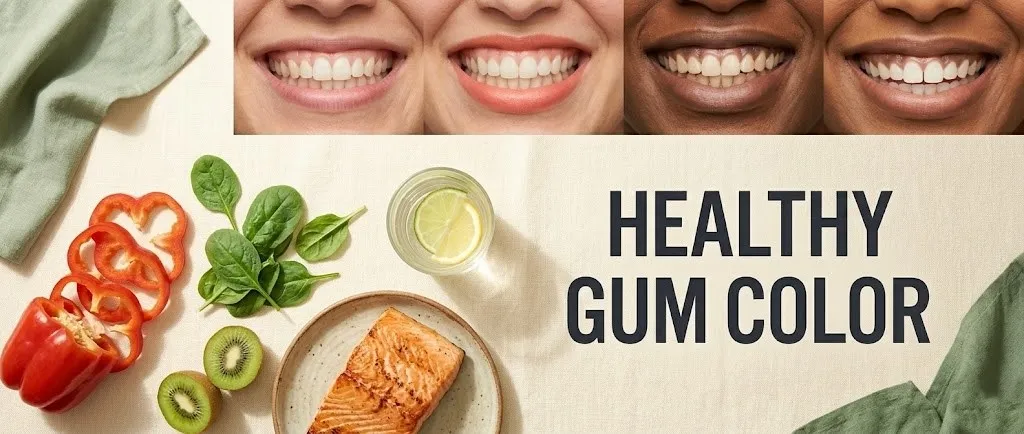
What matters more than the exact shade is the uniformity, firmness, and absence of bleeding. Healthy gums should look consistent in texture across the arch, feel firm when you press them with your tongue, and not bleed during routine brushing or flossing. A sudden change in color, a patch of new darkness that was not there before, or gums that shift from firm to puffy in a matter of days are the signals that warrant attention, not the baseline color you were born with.
| Gum Characteristic | Healthy Presentation | Unhealthy Presentation |
|---|---|---|
| Color | Consistent pink, coral, rose, or brown tones | Red, bright red, pale white, or patchy color loss |
| Texture | Firm, stippled like an orange peel | Puffy, smooth, shiny, or swollen |
| Contour | Flat, scalloped along teeth | Rounded, bulbous, or receding |
| Bleeding | None during brushing or flossing | Bleeds easily during cleaning |
what color are healthy gums
Healthy gums are coral pink, salmon pink, or various shades of brown, rose, and purple depending on your ethnicity and natural melanin production. There is no single correct gum color for all humans. The idea that only pink gums are healthy is a clinical teaching artifact from decades of textbooks that used white patients as the default anatomical model. Modern dental education, updated by the American Dental Association, now teaches that physiologic melanin pigmentation is a normal and healthy variant.
Lighter-skinned people typically have pink to coral-pink gums because their oral epithelium contains less melanin, allowing the blood in the capillaries to dominate the visible color. People with more melanin, including individuals of African, South Asian, Middle Eastern, and Indigenous descent, frequently have gums that appear brown, dark rose, or purplish-blue. This is melanin, the same pigment that determines skin color, deposited in the gum tissue as a normal part of development. It is not a stain. It is not a sign of disease. It is your body doing exactly what it evolved to do.
The clinical term for this is physiologic gingival pigmentation, and studies estimate it occurs in 30 to 50 percent of the global population depending on the population studied. The pigmentation is usually symmetrical, appearing on both sides of the mouth, and most concentrated on the gum tissue attached to the bone rather than the loose tissue near the cheeks. If you have had dark gums your entire adult life and they do not bleed or hurt, you have normal, healthy gums.
Key Takeaway: The healthy gum color spectrum stretches from light coral to deep brown, and the “pink only” standard is an outdated clinical assumption, not a biological rule.
what color should healthy gums be
Healthy gums should be a consistent shade of pink, coral, rose, or brown that matches your genetic baseline, without patches of bright red, white, blue, or grey that appear suddenly or feel different from the surrounding tissue. The word “should” in this question causes unnecessary anxiety because it implies one correct answer. The better framing is: healthy gums should look like your healthy gums have always looked. Your personal baseline is the standard.
A person with light skin and pink gums should expect those gums to stay pink, firm, and non-bleeding. A person with melanin-pigmented gums should expect those gums to stay their baseline brown or rose tone, also firm and non-bleeding. The warning signs are the same across all skin tones. Redness around the tooth margins, a bluish-purple cast to tissue that is normally pink or brown, pale gums that look washed out, or dark patches that are new, raised, or asymmetrical all warrant a dental evaluation.
Texture and bleeding provide the most reliable health check when color is ambiguous. Run your tongue along your gum line. Healthy gums feel smooth but firm, with a slight texture like the surface of an orange peel, a quality dentists call stippling. Inflamed gums feel puffy, smooth, and almost slick. If your gums bleed when you floss, the color is almost irrelevant. Bleeding gingiva is inflamed gingiva, and inflammation is the first stage of gum disease no matter what shade your tissue happens to be.
- Consistency: Your gum color should match across both sides of your mouth.
- Firmness: Healthy gums resist gentle pressure without indenting.
- No bleeding: Blood on the floss or toothbrush means active inflammation.
- No rapid change: A color shift over days or weeks is more concerning than lifelong brown gums.
healthy gum color in humans
Healthy gum color in humans ranges from light pink through coral, rose, brown, and deep purple-brown, a spectrum created by the interaction of vascular blood flow, epithelial thickness, and genetically determined melanin deposition. The human species displays more variation in gum color than any other oral trait, and this variation is physiologically normal across all continents and ethnic groups.
The biological mechanism behind the variation is straightforward. The gingival epithelium contains melanocytes, specialized cells that produce melanin pigment. These melanocytes are present in everyone but are more active in people with darker skin tones, producing more melanin granules that accumulate in the basal cell layer of the gum tissue. This melanin serves a protective function, absorbing ultraviolet radiation and neutralizing free radicals, just as it does in skin. Dark gums are not a cosmetic defect. They are a functional adaptation.
The distribution pattern of healthy pigmentation matters more than its presence. Physiologic pigmentation is typically bilateral, meaning it appears on the same areas on the left and right sides of the mouth. It is most prominent on the attached gingiva, the firm tissue that hugs the tooth roots, and fades toward the looser alveolar mucosa near the cheeks. Pathologic pigmentation, by contrast, is often unilateral, appears as an isolated spot or patch, may be raised, and can change in size or darkness over weeks. This distinction helps dental professionals separate normal variation from something that needs a biopsy.
| Human Population | Typical Healthy Gum Color Range |
|---|---|
| European descent | Light pink to coral pink |
| East Asian descent | Pink to rose pink |
| South Asian descent | Rose pink to brown with purple undertone |
| African descent | Brown, dark brown, or purple-brown |
| Middle Eastern descent | Rose to brown, often mottled pattern |
| Indigenous / Pacific Islander | Rose to dark brown |
what color gums are healthy
Gums that are coral pink, salmon pink, rose, brown, or dark brown with purple undertones are all healthy colors, provided the tissue is firm, stippled, and does not bleed. The color that is healthy for you is the color your gums have been since early adulthood, maintained consistently, without recent changes, pain, or bleeding.
Many people first notice their gum color in adulthood and panic because their gums are not the pale pink they see in toothpaste commercials. Those commercials feature models. They do not represent the human range. A 2021 review in the Journal of Periodontology confirmed that physiologic melanin pigmentation is a normal variant with no pathological significance, and the dental profession has formally moved away from describing pink as the only healthy standard.
The practical test for healthy gum color is the comparison between the gum tissue directly between your teeth and the gum tissue near the tooth roots. The interdental papillae, the little triangles of gum between teeth, are often slightly redder because they are less keratinized. This is normal. If those papillae are puffy, rounded, and bleed when you floss, that is gingivitis regardless of whether they are pink, brown, or any shade in between.
Quick Tip:
- Take a photo of your gums today and compare it to a photo taken six months from now. Subtle changes in color or contour are easier to spot when you have a baseline reference.
- Ask your dental hygienist at your next cleaning to confirm whether your gum color is normal for you.
Key Takeaway: The color that is healthy for your gums is whatever color they have been since adulthood, as long as they are firm, consistent, and bleed-free.
are pink gums healthy
Pink gums are usually healthy in lighter-skinned individuals, but pink gums can also be inflamed, and a person with pink gums can still have active gingivitis hiding under a deceptively normal-looking surface. Pink is the expected color for people with less melanin, but it is not a guarantee of health any more than brown gums are a sign of disease.
The issue with treating pink as a health proxy is that early-stage gingivitis does not always turn gums bright red. Mild inflammation can produce a dusky pink or slightly deepened pink that most people would not recognize as abnormal. The gums may look pink but feel puffy to the tongue, or they may bleed during flossing. These are the true markers of gingivitis. Color alone misses the diagnosis.
People who just finished a thorough dental cleaning may notice their gums are a lighter pink than before. This is not a color improvement. It is the result of removing plaque biofilm and tartar that were mechanically irritating the tissue. The inflammation subsided, so the increased blood flow to the surface decreased, and the gums returned to their baseline vascular appearance. The gums did not “become healthier pink.” They became less inflamed, and less blood meant a lighter color. Understanding this mechanism matters because it stops you from chasing a specific shade of pink as a health goal.
| Pink Gum Scenario | Health Status |
|---|---|
| Lifelong pink, firm, no bleeding | Healthy |
| Pink but puffy, bleeds when flossing | Gingivitis present despite color |
| Pink with one dark isolated spot | Needs evaluation, possible pathology |
| Pale, washed-out pink | Possible anemia or low hemoglobin |
are dark pink gums healthy
Dark pink gums can be entirely healthy, representing either a normal genetic variation in a lighter-skinned person or the beginning of melanin pigmentation, but they can also signal early inflammation that has not yet progressed to the bright red stage of advanced gingivitis. Dark pink is the most ambiguous gum color because it occupies the middle ground between healthy rose tones and the deepening pink that precedes inflammation.
In someone with a naturally pink gum baseline, a shift from pale pink to dark pink around the tooth margins often indicates increased blood flow to the area, which is the first vascular response to plaque accumulation. The body dilates capillaries to deliver immune cells to the gingival sulcus, and that vasodilation darkens the visible color. If the dark pink gums also feel tender, bleed during brushing, or appear shiny rather than stippled, the cause is almost certainly early gingivitis.
In someone with a melanated baseline, dark pink may be the transition zone between the brown attached gingiva and the pinker alveolar mucosa. This is a normal color gradient. The distinction between healthy and unhealthy dark pink comes down to recent change. Gums that have always been dark pink, firm, and non-bleeding are healthy. Gums that have recently shifted from light pink to dark pink and now bleed when flossed are not. The timeline and the bleeding, not the color itself, tell the real story.
- Healthy dark pink: consistent lifelong color, firm texture, no bleeding.
- Inflammatory dark pink: recent color change, puffy feel, bleeds on contact.
- Genetic dark pink: normal for family members, symmetrical across the arch.
healthy vs gingivitis
Healthy gums are firm, stippled, and coral-to-brown in color with no bleeding, while gingivitis gums are red or dusky, puffy, smooth, and bleed readily when brushing, flossing, or probing. Gingivitis is the earliest stage of gum disease and is completely reversible with improved oral hygiene and dietary support. The visual difference between the two is often dramatic, but early gingivitis can be subtle enough that only the bleeding during flossing gives it away.
The biological process underlying gingivitis is an inflammatory response to plaque biofilm. Bacteria in the biofilm release enzymes and toxins that penetrate the gingival sulcus, the narrow pocket between the tooth and gum. The body’s immune system responds by increasing blood flow, which makes the tissue redder and warmer, and by allowing fluid to leak from capillaries into the tissue, which causes the puffy, swollen appearance. The increased fluid also makes the epithelial layer more permeable and fragile, which is why inflamed gums bleed at the slightest touch.
Gingivitis does not always cause pain. Many people live with low-grade gingivitis for years without discomfort. The absence of pain is one of the reasons gum disease progresses silently. The visible and tactile signs, redness, puffiness, smooth texture, and bleeding, are the only warnings before the condition advances to periodontitis, where the bone supporting the teeth begins to resorb. A dental professional can diagnose the exact stage, but the mirror and the floss give you a reliable home screening test.
| Feature | Healthy Gums | Gingivitis |
|---|---|---|
| Color | Coral pink to brown | Bright red to dusky red-purple |
| Texture | Firm, stippled | Puffy, smooth, shiny |
| Contour | Flat, scalloped | Swollen, rounded, bulbous |
| Bleeding | None during flossing | Bleeds within 10 to 30 seconds |
| Pocket depth | 1 to 3 millimeters | 2 to 4 millimeters |
| Pain | None | Possible tenderness |
Key Takeaway: Bleeding during flossing is the single most reliable home test for gingivitis, and it trumps color every time when you are trying to decide if your gums are healthy.
healthy gums vs unhealthy gums
Healthy gums display firm texture, consistent color, scalloped contour hugging the teeth, and zero bleeding during cleaning, while unhealthy gums span a spectrum from mild gingivitis with surface redness and bleeding to advanced periodontitis with gum recession, deep pockets, and loose teeth. The difference between healthy and unhealthy is not one thing. It is a gradient, and catching the earliest shift gives you the best chance at reversing the damage.
The visual markers of unhealthy gums fall into recognizable patterns. Bright red gums that bleed easily indicate acute inflammation, often from plaque accumulation at the gum line. Pale, whitish gums may signal anemia, where reduced hemoglobin leaves the tissue under-perfused. Bluish or purplish gums can indicate poor oxygenation, sometimes from smoking-related vasoconstriction or from certain heart and lung conditions. Dark patches that are new, raised, or asymmetrical may represent oral melanoma or other pathology and require an immediate dental examination.
Gum recession, where the gum line pulls away from the tooth exposing the darker root surface, is a sign of chronic damage. It can result from aggressive brushing, long-term inflammation, or orthodontic forces. Once gums recede, the tissue does not grow back on its own. The goal at that point is preventing further recession rather than reversing what has already been lost. A periodontist can evaluate the extent of recession and discuss grafting options if the recession threatens tooth stability.
- Bright red, puffy gums: acute gingivitis, reversible with hygiene improvement.
- Pale, white gums: possible anemia, needs blood work evaluation.
- Receding gums: chronic damage, not reversible at home, needs dental assessment.
- Dark patches: new or changing pigmented spots need a biopsy rule-out.
can diet change gum color
Diet can change gum color indirectly by reducing inflammation, which restores gums from a red, puffy state to their baseline pink or brown tone, but diet cannot lighten genetically determined melanin pigmentation in gum tissue. The color change you can achieve through nutrition is the reversal of inflammatory redness, not the bleaching of normal pigment.
The mechanism works through specific nutrients that modulate the inflammatory response and support tissue repair. Ascorbic acid, known commonly as vitamin C, is a cofactor in collagen synthesis, and collagen is the primary structural protein in gingival tissue. Without adequate vitamin C, the gums produce weak collagen, the tissue weakens, and the capillaries become fragile and prone to bleeding. Restoring vitamin C through foods like red bell peppers, kiwi fruit, and broccoli improves collagen integrity and reduces the redness and bleeding associated with deficiency.
Folate, or vitamin B9, supports the rapid cell turnover required to maintain the oral epithelium. The cells lining the gum surface replace themselves every few days, one of the fastest turnover rates in the body. Folate deficiency slows this turnover, leaving the gum tissue thin and vulnerable. Leafy greens, lentils, and asparagus are concentrated food sources of folate. Coenzyme Q10, found in salmon, organ meats, and whole grains, supports cellular energy production in gum tissue, and some research suggests it reduces gingival inflammation when tissue levels are low.
- Vitamin C foods: red bell pepper, kiwi, broccoli, strawberries, citrus.
- Folate foods: spinach, lentils, asparagus, black-eyed peas, fortified grains.
- CoQ10 foods: salmon, mackerel, chicken heart, whole grains, peanuts.
Key Takeaway: You can eat your way from inflamed, red gums back to your personal healthy baseline color, but no food will turn genetically brown gums pink, and that is not a goal worth pursuing.
how to get healthy pink gums naturally
You can achieve naturally healthy pink gums by reducing inflammation through consistent oral hygiene, a nutrient-dense diet, and eliminating habits like smoking that disrupt gum tissue blood flow. The “pink” in healthy pink gums refers to the natural, uninflamed baseline color for people whose gums are genetically pink. If your genetic baseline is brown, the goal is healthy brown gums, not a color change.
Oral hygiene is the foundation. Brush twice daily with a soft-bristled toothbrush using gentle, circular motions. Hard brushing causes gum recession, not cleaner teeth. Floss once daily, sliding the floss gently below the gum line to disrupt the plaque biofilm that a toothbrush cannot reach. An electric toothbrush with a pressure sensor helps people who tend to brush too aggressively. If your gums bleed during flossing, you have inflammation. Keep flossing. The bleeding usually stops within one to two weeks as the inflammation resolves.
Nutrition supports the hygiene effort from the inside. A 2020 study in the Journal of Clinical Periodontology found that a diet rich in fruits, vegetables, and omega-3 fatty acids was associated with lower rates of gingival inflammation compared to a processed-food diet, independent of oral hygiene habits. The combination of vitamin C for collagen, folate for cell turnover, and omega-3s for inflammation resolution creates the nutritional environment for healthy gum tissue. No single food does this alone. The overall dietary pattern matters more than any individual ingredient.
To support naturally healthy gums:
- Brush twice daily with a soft brush using gentle, circular strokes.
- Floss once daily, curving the floss around each tooth into the gum line.
- Eat a vitamin C source daily: one red bell pepper, two kiwi fruit, or a cup of strawberries.
- Include folate-rich greens like spinach or lentils at least three times per week.
- Eat fatty fish like salmon twice per week for omega-3 fatty acids.
- If you smoke, seek smoking cessation support, as tobacco use directly impairs gingival blood flow and healing.
foods for healthy gums
Foods that support healthy gums deliver concentrated amounts of vitamin C, folate, omega-3 fatty acids, and coenzyme Q10, the four nutrients with the strongest research backing for gingival tissue integrity and inflammation control. The food-first approach to gum health is not about one miracle ingredient. It is about the consistent presence of these nutrients in your weekly eating pattern.
Red bell pepper is the most concentrated common food source of vitamin C, containing roughly 152 milligrams per cup, which exceeds the daily recommended intake for adults in a single serving. Vitamin C is water-soluble and heat-sensitive, so eating bell peppers raw or lightly cooked preserves the nutrient. Kiwi fruit, strawberries, and citrus are strong alternatives. A person who eats no fresh produce is at genuine risk of gingival changes from vitamin C deficiency, a condition that in severe form is called scurvy and presents with swollen, bleeding, purplish gums.
Spinach and other dark leafy greens deliver folate and vitamin K. One cup of cooked spinach provides roughly 263 micrograms of folate, more than half the daily adult requirement. Folate supports the rapid cell division needed to maintain the oral epithelium. People who eat few leafy greens may not be clinically deficient but may still have suboptimal folate status that shows up as slow-healing gum tissue after a dental procedure or persistent low-grade inflammation.
Salmon is the best widely available food source of both omega-3 fatty acids and coenzyme Q10. A 3-ounce serving of wild salmon provides roughly 1.5 grams of combined EPA and DHA omega-3s and a meaningful amount of CoQ10. The omega-3s modulate the resolution of inflammation through specialized pro-resolving mediators. The CoQ10 supports mitochondrial energy production in cells with high energy demand, including gingival fibroblasts that maintain the gum tissue matrix.
| Nutrient | Top Food Source | Amount per Serving | Function in Gum Health |
|---|---|---|---|
| Vitamin C | Red bell pepper (1 cup) | 152 mg | Collagen synthesis, capillary integrity |
| Folate | Cooked spinach (1 cup) | 263 mcg | Epithelial cell turnover |
| Omega-3 | Wild salmon (3 oz) | 1.5 g EPA/DHA | Inflammation resolution |
| CoQ10 | Chicken heart (3 oz) | 8 to 10 mg | Cellular energy, antioxidant in tissue |
Key Takeaway: The foods that build healthy gums are the same foods that build a generally healthy body, with an emphasis on daily vitamin C, regular folate, and weekly omega-3 intake from fatty fish.
why are my gums turning dark
Gums can turn dark due to increased melanin production from hormonal shifts, certain medications, smoking, or harmless genetic patterns, but a new, isolated, or rapidly changing dark spot requires a dental evaluation to rule out pathology. The cause of darkening gums divides into two categories: the common, benign causes and the rare but serious ones.
Physiologic melanin pigmentation is the most common cause of dark gums worldwide. It appears symmetrically, usually becomes noticeable during adolescence or young adulthood, and remains stable throughout life. Hormonal changes during pregnancy, puberty, or while taking oral contraceptives can stimulate melanocytes to produce more pigment, darkening the gums temporarily. This is called melasma of the gingiva and is as benign as pregnancy-related skin darkening. It typically fades after the hormonal trigger resolves.
Smoking produces a distinct form of gum darkening called smoker’s melanosis. The melanocytes in the gum tissue are stimulated by nicotine and other compounds in tobacco smoke, causing a patchy or diffuse brown pigmentation that is more pronounced on the lower gums and the inside of the lips. Smoker’s melanosis is not precancerous by itself, but it indicates significant tobacco exposure, which is a risk factor for actual oral cancer. A person with smoker’s melanosis should have a dentist map the pigmentation and monitor it while working toward smoking cessation.
- Hormonal darkening: pregnancy, birth control pills, puberty onset.
- Smoker’s melanosis: diffuse, often on lower gum, improves after quitting.
- Medication-induced: antimalarials, minocycline, certain chemotherapy drugs.
- Pathologic: oral melanoma, raised, irregular borders, asymmetrical, needs immediate biopsy.
healthy gum color for black person
Healthy gum color for a Black person typically ranges from rose-pink to brown, dark brown, or purple-brown, with the pigmentation appearing symmetrically across the gums and most concentrated on the attached gingiva near the teeth. This is called physiologic gingival pigmentation, and it is a normal, protective melanin deposit that has no health implications beyond the cosmetic.
The gum color in Black individuals varies as widely as skin color does. Some Black people have uniformly pink gums. Others have gums that are almost entirely dark brown with a purple undertone. Many have a mottled or patchwork pattern where melanin deposits create a speckled look across an otherwise pink base. All of these are normal. The pigmentation is caused by melanocytes in the basal layer of the gingival epithelium producing melanin granules, exactly as they do in skin. The gums are simply skin tissue specialized for the oral environment.
The medical community has historically over-pathologized dark gums because dental textbooks used white patients as the default. A Black patient with lifelong brown gums who sees a dentist unfamiliar with physiologic pigmentation may be told their gums look abnormal. This is a failure of dental education, not a failure of the patient’s gums. The American Academy of Periodontology now explicitly includes pigmented gums in its description of normal gingival appearance. If your brown gums are firm, symmetrical, and have not changed recently, they are healthy.
| Feature | Healthy Pigmented Gums | Concerning Pigmentation |
|---|---|---|
| Onset | Lifelong, stable since adolescence | New, appeared recently |
| Symmetry | Bilateral, same on both sides | Unilateral, isolated spot |
| Texture | Flat, same as surrounding tissue | Raised, nodular, or ulcerated |
| Change | No change over years | Growing, darkening, or changing shape |
| Symptoms | None | Pain, bleeding, or looseness of teeth |
Key Takeaway: Brown and purple-brown gums in Black individuals are a normal expression of melanin, and a dentist who understands physiologic pigmentation will recognize them as healthy tissue, not pathology.
Frequently Asked Questions About Healthy Gum Color
What do healthy gums look like?
Healthy gums look firm and scalloped along the tooth line, with a color ranging from coral pink to brown depending on your skin tone.
They do not bleed when you brush or floss.
The surface has a slight orange-peel texture called stippling rather than looking smooth and shiny.
Can pale gums be a sign of anemia?
Pale gums can be a sign of anemia because low hemoglobin reduces the red color in the tissue.
Pale gums from anemia usually appear alongside fatigue, shortness of breath, and pale skin on other parts of the body.
A blood test ordered by your primary care provider is the only way to confirm anemia as the cause of pale gums.
Why are my gums two different colors?
Gums that are two different colors are usually showing the normal transition between attached gingiva and the looser alveolar mucosa.
The attached tissue near the teeth is often paler and firmer, while the tissue near the cheeks is redder and more vascular.
New, asymmetrical two-tone patterns that appeared recently should be checked by a dentist to rule out pathology.
Do gums get darker with age?
Gums can gradually darken with age due to cumulative melanin deposition and changes in tissue thickness.
Smoking over decades also contributes to age-related gum darkening.
A slow, symmetrical darkening over years is typically benign, but a sudden change at any age warrants a dental examination.
Can I make my gums pinker naturally?
You cannot lighten genetically dark melanin-pigmented gums through diet or natural remedies.
You can reduce inflammatory redness through improved oral hygiene and a nutrient-rich diet, which returns gums to your personal healthy baseline color.
Gum bleaching procedures exist but carry risks including burns, sensitivity, and recurrence of pigmentation.
Your gum color is as personal as your skin color, and the range of healthy extends far beyond the pale pink you see in advertisements and old textbooks. Firmness, texture, and the absence of bleeding reveal more about your gum health than the shade in the mirror ever will. If your gums have been the same color since early adulthood and do not hurt or bleed, they are almost certainly healthy.
The most practical step you can take today is a two-minute mirror check. Look at the color. Run your tongue along the texture. Floss one tooth. If the gums are firm and the floss comes back clean of blood, your current routine is working. If you see bleeding, puffiness, or a color patch that was not there last month, book a dental appointment and bring your questions with you.
Eat your bell peppers. Eat your greens. Floss before bed. Your gums will tell you, in their own color and their own language, exactly how they are doing. The skill is learning to listen.