Indian food is genuinely healthy when you know which dishes, preparations, and ordering strategies to choose. The cuisine is built on legumes, vegetables, fermented foods, and some of the most researched anti-inflammatory spice compounds on the planet.
The problem is that restaurant versions of Indian classics often bear little resemblance to their traditional forms. According to the Academy of Nutrition and Dietetics, a single restaurant serving of a cream-based curry can contain more saturated fat than most people should consume in an entire day.
This guide covers 16 specific aspects of healthy Indian food: which dishes are worth ordering, which spices actually have research behind them, how cooking methods change what you’re eating, and how to build a genuinely nutritious plate whether you’re cooking at home or grabbing takeout on a Tuesday night.
What Makes Healthy Indian Food Genuinely Good for You?
Healthy Indian food stands apart from many other cuisines because its nutritional foundation is built on plant proteins, complex carbohydrates, and potent bioactive spice compounds rather than processed ingredients or refined starches.
Traditional Indian cooking relies heavily on lentils (Lens culinaris and related species), chickpeas (Cicer arietinum), fresh vegetables, fermented dairy, and a spice palette that researchers have studied for decades. These ingredients form the backbone of dishes that deliver fiber, plant-based protein, iron, folate, magnesium, and calcium in a single meal.
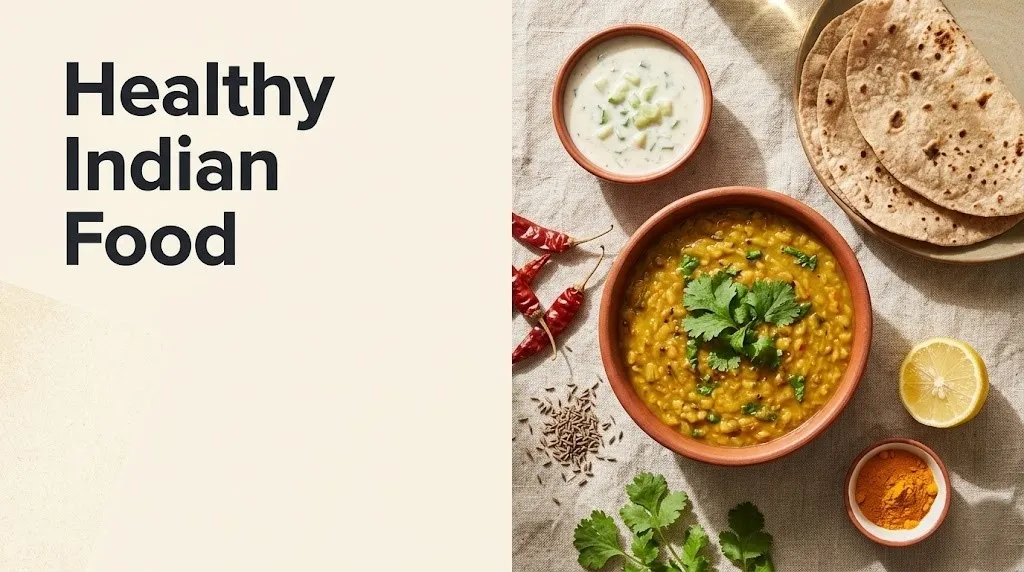
The USDA Dietary Guidelines for Americans 2020-2025 recommend that adults consume at least 1.5 cups of legumes per week. A standard serving of dal already gets you most of the way there in a single bowl.
Indian cooking also uses yogurt (curd) extensively, both as a base for marinades and as a side dish (raita). Fermented dairy products like yogurt contain live Lactobacillus cultures, which support digestive function. That’s a concrete, specific mechanism, not a vague claim.
| Nutritional Strength | Key Indian Foods That Deliver It |
|---|---|
| Plant-based protein | Dal, chana masala, rajma, moong dal cheela |
| Dietary fiber | Dal, sabzi, rajma, whole wheat roti |
| Anti-inflammatory compounds | Turmeric, ginger, garlic, coriander |
| Calcium | Paneer, raita, lassi, palak paneer |
| Iron | Spinach dishes (saag), lentils, rajma |
| Probiotic bacteria | Curd (dahi), lassi, idli, dosa |
What makes the cuisine complicated is preparation. The same dish can be nutritionally excellent or calorie-heavy depending on how much ghee, cream, or refined flour it contains.
The Nutritional Profile of Common Healthy Indian Dishes
The nutritional value of a healthy Indian dish depends almost entirely on its main ingredients and the amount of added fat used in cooking.
Here are accurate per-serving nutrient ranges for dishes commonly found at Indian restaurants and in home kitchens. These figures represent typical home-cooked portions unless noted.
| Dish | Serving Size | Calories | Protein | Fiber | Key Nutrients |
|---|---|---|---|---|---|
| Dal (plain, cooked) | 1 cup | 230-260 | 18g | 15g | Folate, iron, magnesium |
| Chana Masala | 1 cup | 270-310 | 14g | 10g | Iron, vitamin C, potassium |
| Palak Paneer | 1 cup | 280-350 | 14g | 4g | Calcium, vitamin A, iron |
| Tandoori Chicken | 2 pieces (~150g) | 200-250 | 30g | 0g | B vitamins, phosphorus |
| Raita | 1/2 cup | 60-80 | 3g | 0.5g | Calcium, probiotics |
| Idli (plain, steamed) | 2 pieces | 130-150 | 4g | 1.5g | Carbohydrates, B vitamins |
| Rajma (kidney bean curry) | 1 cup | 250-290 | 15g | 11g | Iron, potassium, folate |
| Whole wheat roti | 1 medium | 70-90 | 3g | 2g | Complex carbohydrates, iron |
These figures shift considerably in restaurant preparations. A restaurant serving of dal makhani, for example, often contains added cream and butter that can push the calorie count past 400 to 500 per cup.
People watching sodium intake should note that restaurant Indian food is frequently high in salt. Some restaurant curry dishes contain 900 to 1,200 milligrams of sodium per serving. Individuals managing hypertension or following a low-sodium diet should ask restaurants to reduce salt and avoid high-sodium condiments like pickles (achar).
Healthy Indian Food for Weight Loss: What Actually Works
Indian food can absolutely support weight loss, but the approach matters more than the cuisine label itself.
The foods that work best for weight management in Indian cooking share a few consistent traits: high protein, high fiber, moderate calories, and minimal refined carbohydrates or added fats. Think of dietary fiber the way you’d think of a slow-release timer on your appetite. The more fiber you consume with a meal, the longer satiety signals stay active.
A study published in the American Journal of Clinical Nutrition found that diets rich in legumes (lentils, chickpeas, kidney beans) were associated with greater feelings of fullness and reduced overall calorie intake compared to protein-matched diets without legumes.
Best Indian dishes for weight loss:
- Dal (any variety): High protein and fiber; keeps you full for 3 to 4 hours per serving
- Chana masala: Chickpea-based; approximately 14g protein and 10g fiber per cup
- Tandoori chicken: Lean protein, minimal added fat, approximately 200 to 250 calories for two pieces
- Saag (spinach-based dishes without added cream): High in iron and vitamin C; low in calories
- Raita: Protein-rich yogurt side that adds satiety without significant calories
- Moong dal cheela (lentil crepes): High protein, low glycemic index, approximately 150 calories each
What to minimize for weight loss:
- Dishes made with heavy cream (malai) or butter (white/yellow gravies)
- Deep-fried items: samosas, bhatura, pakoras
- Refined bread: naan, puri
- Rice dishes with added ghee or nuts: biryani, pulao
The weight loss equation is about total calorie balance, not cutting out Indian food. A bowl of chana masala with one whole wheat roti is a nutritionally dense, approximately 370-calorie meal. That’s not a compromise.
Key Takeaway: Indian food supports weight loss best when built around high-fiber legumes like dal and chana masala, lean protein like tandoori chicken, and vegetable-forward dishes, while keeping cream-based curries, fried bread, and added ghee as occasional choices.
High-Protein Indian Foods Worth Adding to Your Diet
Indian cooking is one of the most protein-rich plant-based cuisines in the world, which is why it’s a dietary mainstay for hundreds of millions of vegetarians globally.
The Academy of Nutrition and Dietetics recognizes that well-planned vegetarian diets, including those built around legumes as Indian cuisine frequently is, can meet all protein requirements for adults, including athletes and older adults.
Top high-protein Indian foods by protein content per standard serving:
| Food | Serving | Protein |
|---|---|---|
| Paneer | 100g | 18-20g |
| Chana (chickpeas, cooked) | 1 cup | 14-15g |
| Rajma (kidney beans, cooked) | 1 cup | 15g |
| Moong dal (cooked) | 1 cup | 14g |
| Urad dal (black lentils, cooked) | 1 cup | 18g |
| Tandoori chicken (boneless, 150g) | 1 serving | 30g |
| Greek-style dahi (strained yogurt) | 1 cup | 12-15g |
| Egg curry (2 eggs) | 1 serving | 12g |
For vegetarians, combining dal with whole grains like rice or roti within the same meal provides a complete amino acid profile. This isn’t a strict requirement at every meal, but eating varied plant proteins throughout the day covers all essential amino acids.
People with kidney disease should work with a registered dietitian before significantly increasing protein intake from any source, including legumes.
Low-Calorie Indian Dishes for Everyday Eating
Low-calorie Indian food exists in abundance when you focus on steamed, roasted, or lightly tempered dishes rather than deep-fried or cream-enriched ones.
The South Indian repertoire in particular offers some of the lowest-calorie everyday options in the cuisine. Idli (steamed rice and lentil cakes) clock in at roughly 130 to 150 calories for two pieces. Upma (semolina porridge with vegetables) runs approximately 200 calories per bowl. Rasam, the thin South Indian tamarind-based soup, contains roughly 50 to 80 calories per cup and provides vitamin C and iron.
Low-calorie Indian meals under 350 calories:
- Moong dal soup with one roti: approximately 280 calories
- Grilled or tandoori fish with raita and salad: approximately 280 to 320 calories
- Idli (3 pieces) with sambar: approximately 220 to 250 calories
- Saag (without cream) with one roti: approximately 200 to 260 calories
- Khichdi (rice and lentils, plain): approximately 250 to 300 calories per cup
Khichdi deserves particular mention. It’s one of the oldest documented Indian preparations: a simple one-pot dish of rice and split lentils cooked together. It’s naturally low in fat, easy to digest, and genuinely satisfying. Think of it as the Indian equivalent of chicken soup: basic, restorative, and nutritionally complete in a humble way.
People with celiac disease should be aware that some Indian dishes contain besan (gram flour, derived from chickpeas), which is naturally gluten-free, while others may use wheat-based thickeners. Always verify with the cook or restaurant when gluten sensitivity is a concern.
Healthy Traditional Indian Food with Lasting Nutritional Value
Traditional Indian food, prepared the way home cooks have made it for generations, is often considerably healthier than its restaurant counterpart.
Traditional preparations use whole spices rather than spice mixes with fillers, small amounts of ghee or mustard oil for flavor rather than large quantities for richness, and minimal cream or sugar. The flavor comes from technique and spice depth, not fat content.
Dishes like khichdi, dal, sabzi (seasoned vegetable preparations), and curd rice have sustained the Indian subcontinent for thousands of years. They’re not health trends. They’re functional food traditions that happen to align well with what modern nutrition science recommends.
A 2021 review in the journal Nutrients found that traditional Indian dietary patterns, characterized by high legume and vegetable intake with moderate use of dairy, were associated with lower rates of cardiovascular disease markers compared to Westernized Indian diets high in refined carbohydrates and processed foods.
| Traditional Dish | What Makes It Healthy |
|---|---|
| Khichdi (rice and moong dal) | Easily digestible complete protein; low glycemic |
| Curd rice (dahi chawal) | Probiotic-rich; cooling; gentle on digestion |
| Sabzi (dry-cooked vegetables) | High fiber; low fat when prepared with minimal oil |
| Poha (flattened rice with vegetables) | Iron-fortified; light and low in calories |
| Sprout salad (moong sprouts) | Raw plant protein; vitamin C; low calorie |
Key Takeaway: Traditional Indian home cooking, built around whole legumes, vegetables, and modest amounts of dairy and fat, consistently aligns with modern dietary guidelines and outperforms restaurant versions nutritionally.
What Indian Spices Do for Your Health (and What the Science Actually Says)
Indian spices are not folklore. Several of the most commonly used spices in Indian cooking have been studied extensively in peer-reviewed research for their bioactive compounds and physiological effects.
Turmeric (Curcuma longa): The active compound is curcumin, which makes up approximately 2 to 5% of dried turmeric by weight. A 2023 meta-analysis in the journal Nutrients found that curcumin supplementation was associated with statistically lower markers of systemic inflammation (C-reactive protein and interleukin-6) compared to placebo. However, curcumin has low bioavailability on its own. Adding black pepper (Piper nigrum), which contains the alkaloid piperine, increases curcumin absorption by approximately 2,000%, according to research published in Planta Medica.
Ginger (Zingiber officinale): Contains gingerols and shogaols, compounds studied for their effects on nausea, delayed gastric emptying, and inflammatory markers. The NIH National Center for Complementary and Integrative Health acknowledges ginger’s evidence base for reducing nausea in pregnancy and chemotherapy-related nausea.
Garlic: Contains allicin, a sulfur compound formed when raw garlic is crushed or chopped. The American Heart Association notes that garlic consumption has been studied for its modest effects on LDL cholesterol reduction, though evidence remains moderate in strength.
Fenugreek (Trigonella foenum-graecum): Seeds are high in soluble fiber and contain galactomannan, a compound associated with slower glucose absorption. Research in the Journal of Diabetes and Metabolic Disorders found fenugreek supplementation improved postprandial blood glucose in people with type 2 diabetes.
The key limitation: most spice research uses concentrated extracts or supplements, not culinary amounts. Eating a curry with turmeric is beneficial, but it’s not the same as the doses used in clinical trials. The real value is cumulative and consistent use over time.
How Indian Cooking Methods Change What You’re Actually Eating
The same dish can range from a nutritionally excellent choice to a calorie-heavy indulgence depending entirely on how it’s cooked.
This is the gap that most healthy eating guides miss. Knowing that “saag paneer is a healthy option” is useless information if the restaurant version is cooked with 4 tablespoons of cream and 2 tablespoons of butter per serving.
Tandoor cooking: The tandoor is a clay oven that reaches temperatures between 480 and 550 degrees Celsius (approximately 900 to 1,000 degrees Fahrenheit). Proteins cooked this way (chicken, fish, paneer, vegetables) are exposed to high dry heat. Fat drips away from the food during cooking. The result is a high-protein, relatively low-fat preparation with excellent texture from the Maillard reaction.
Pressure cooking: Used for dal and legumes. Preserves water-soluble vitamins better than prolonged stovetop boiling. Does not require added fat.
Tempering (tadka): Adding hot oil or ghee with spices directly to cooked food. A small tadka of 1 teaspoon of ghee with cumin and garlic adds approximately 40 to 45 calories and delivers fat-soluble spice compounds into the dish effectively.
Deep frying: Used for samosas, pakoras, puri, and bhatura. Adds 150 to 250 calories per piece and significantly increases saturated fat. Deep-fried items can absorb 15 to 20% of their weight in cooking oil.
| Cooking Method | Calorie Impact | Fat Added | Best Used For |
|---|---|---|---|
| Tandoor roasting | Minimal | None | Chicken, fish, paneer, vegetables |
| Pressure cooking | None | None | Legumes, lentils |
| Steaming | None | None | Idli, dhokla |
| Tadka (1 tsp ghee) | +40-45 cal | 5g fat | Dal, rice, vegetables |
| Stir-frying (1 tbsp oil) | +120 cal | 14g fat | Sabzi, egg dishes |
| Deep frying | +150-250 cal/piece | 15-20g fat | Samosas, pakoras |
Key Takeaway: Choosing tandoori, steamed, or pressure-cooked Indian dishes over deep-fried equivalents can reduce calorie intake by 150 to 300 calories per serving without reducing nutritional value.
Healthy Options at Indian Restaurants: A Practical Ordering Guide
The healthiest choices at Indian restaurants are almost always the ones built on legumes, lean protein, and vegetables cooked in tomato or broth-based sauces rather than cream or butter gravies.
Most Indian restaurants will accommodate modification requests. Asking for less cream, less ghee, or more vegetables is a normal and accepted request at the vast majority of establishments. It’s genuinely worth asking.
Ordering by category:
Best starter choices:
- Tandoori vegetables or paneer tikka (grilled, not fried)
- Soup: tomato shorba, rasam, or mulligatawny (broth-based)
- Raita as a side from the beginning: it slows eating pace and adds satiety
Avoid for starters:
- Samosas (deep-fried; 200 to 250 calories each)
- Pakoras or bhajis (deep-fried; 150 to 200 calories per piece)
- Pappadums with heavy chutneys (adds calories quickly before the main meal)
Best main course choices:
- Dal (any variety, especially dal tadka or dal fry)
- Chana masala (tomato-based chickpea curry)
- Saag or palak dishes (spinach-based; ask for reduced cream)
- Tandoori or tikka preparations without extra butter finishing
- Fish or chicken in tomato-based sauces
Approach with awareness:
- Dal makhani: Nutritionally excellent base (black lentils), but restaurant versions often contain significant cream and butter; ask for a lighter preparation
- Biryani: Calorie count varies widely from 400 to 700 per serving depending on rice-to-protein ratio and ghee used
- Tikka masala: Base sauce often contains 200 to 400 calories from cream alone in restaurant versions
Menus vary by location, region, and season. Calorie counts at the same restaurant can differ between branches. Verify specific dish contents by asking the staff directly, particularly regarding cream, butter, and sodium levels.
Healthy Indian Food to Order for Takeout
Healthy Indian takeout is easier to navigate than most people assume, with one caveat: portion sizes from restaurants are typically 30 to 50% larger than a standard nutritional serving.
The USDA defines a standard serving of cooked legumes as half a cup. Most Indian restaurant dal or chana masala servings are 1.5 to 2 cups. That’s nutritionally generous, but it means calorie counts will be higher than the per-serving figures on food databases suggest.
Smart takeout ordering strategy:
- Order dal as your protein base rather than a cream-based curry
- Request roti or naan on the side rather than included; this lets you control bread intake
- Add raita to every order; it costs almost nothing calorically and stretches the meal
- Skip the rice if ordering naan; having both in one meal adds unnecessary starchy carbohydrates
- Order tandoori protein as a separate item rather than a sauce-based preparation
Takeout items by calorie tier:
| Tier | Dish | Estimated Calories (restaurant serving) |
|---|---|---|
| Lower calorie | Dal tadka, chana masala, saag | 300-400 per serving |
| Moderate calorie | Biryani, palak paneer, rajma | 400-550 per serving |
| Higher calorie | Dal makhani, korma, tikka masala | 500-700 per serving |
| Use sparingly | Samosas, naan, puri, pulao with ghee | 200-300 per piece/serving |
Individuals managing sodium intake should be aware that takeout Indian food frequently contains 900 to 1,500 milligrams of sodium per main-course serving.
Is Dal Healthy? What the Research Shows
Dal is one of the most nutritionally complete plant foods available, and the research consistently supports its value in a balanced diet.
Dal refers collectively to dried, split legumes: lentils (Lens culinaris), split moong (Vigna radiata), urad (Vigna mungo), chana dal (Cicer arietinum), and toor/arhar dal (Cajanus cajan). Each variety has a slightly different nutritional profile, but all share a core set of benefits.
A 2014 study in the American Journal of Clinical Nutrition found that eating one serving of legumes per day was associated with a 5% reduction in LDL cholesterol compared to control diets. Dal is a primary legume source for hundreds of millions of people across South Asia.
Per 1 cup of cooked dal (approximately):
- Calories: 230 to 260
- Protein: 17 to 18g
- Dietary fiber: 14 to 16g
- Folate: 90% of the Daily Value (DV)
- Iron: 35 to 40% of the DV
- Magnesium: 20% of the DV
- Potassium: 18% of the DV
Raw lentils contain lectins and trypsin inhibitors, compounds that interfere with protein digestion. Thorough cooking neutralizes these compounds completely. Do not consume raw or undersoaked lentils.
Dal is naturally gluten-free, making it suitable for people with celiac disease or non-celiac gluten sensitivity. People with irritable bowel syndrome may experience gas or bloating from high-fiber legumes; starting with smaller portions and building tolerance gradually is a practical approach. Those with kidney disease should discuss legume intake with a registered dietitian because of the potassium and phosphorus content.
Key Takeaway: Dal is one of the most researched, nutrient-dense plant foods in the world, with documented benefits for cholesterol, blood sugar, and satiety backed by peer-reviewed studies, not just traditional use.
Is Paneer a Healthy Choice?
Paneer is a healthy food when eaten in appropriate portions as part of a balanced diet, but it’s calorie-dense enough that portion size genuinely matters.
Paneer is an Indian fresh cheese made by curdling whole milk with an acid (lemon juice or vinegar) and pressing the curds. It is not aged, not ripened, and contains no rennet in traditional preparation. The resulting cheese is high in protein, high in calcium, and high in saturated fat.
Per 100 grams of paneer:
- Calories: 265 to 280
- Protein: 18 to 20g
- Fat: 20 to 22g (mostly saturated)
- Calcium: 480 to 520mg (approximately 50% of DV)
- Vitamin B12: approximately 0.8mcg
A typical restaurant serving of palak paneer or shahi paneer contains 150 to 200 grams of paneer, putting the paneer-only calorie count at 400 to 550 calories before the sauce.
From a protein standpoint, paneer is excellent: 100 grams delivers roughly the same protein as 100 grams of cooked chicken breast, with additional calcium and B12. For vegetarians who eat dairy, it’s a practical high-quality protein source.
The saturated fat content (approximately 12 to 14 grams per 100g) is worth factoring in for people with elevated LDL cholesterol. The American Heart Association recommends limiting saturated fat to less than 10% of total daily calories. A 150-gram serving of paneer provides approximately 18 to 21 grams of saturated fat, which is significant.
Paneer is not suitable for vegans and may be problematic for people with lactose intolerance in larger amounts, since fresh cheese retains some residual lactose.
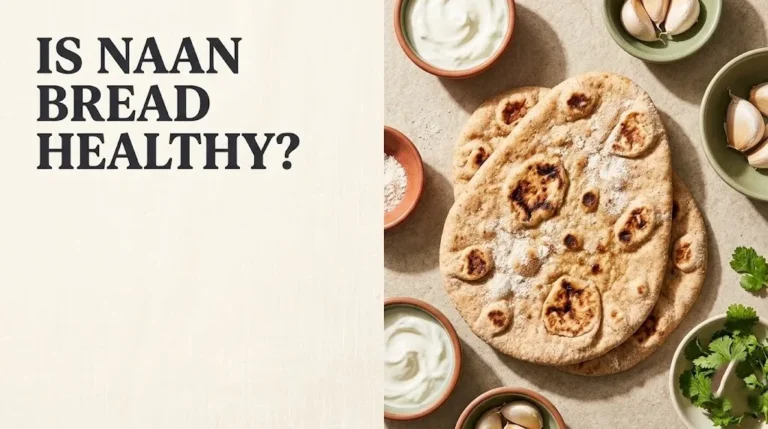
Is Naan Healthy, or Should You Skip It?
Naan is not a health food in the traditional sense, but it also doesn’t need to be avoided entirely. Context and frequency determine whether it’s a problem.
Traditional naan is a leavened flatbread made from refined wheat flour (maida), yogurt, a small amount of oil or ghee, and yeast or baking powder. It’s baked in a tandoor oven, which gives it characteristic charred bubbles and a slightly chewy texture.
One standard restaurant naan contains:
- Calories: 260 to 320 (restaurant naans are often larger than published estimates)
- Carbohydrates: 45 to 55g
- Protein: 8 to 10g
- Fat: 4 to 8g (higher with butter finishing)
- Fiber: 1 to 2g
The issue is not that naan is inherently harmful. It’s that most restaurant naans are finished with a brush of butter or ghee, which adds 40 to 80 calories. They’re also made from refined flour, which has a higher glycemic index than whole grain alternatives.
Whole wheat roti comparison:
| Item | Calories | Fiber | Glycemic Impact |
|---|---|---|---|
| Restaurant naan (1 piece) | 260-320 | 1-2g | Higher (refined flour) |
| Whole wheat roti (1 medium) | 70-90 | 2-3g | Moderate (whole grain) |
| Multigrain roti (1 medium) | 80-100 | 3-4g | Lower |
For people managing blood glucose, such as those with type 2 diabetes or prediabetes, replacing naan with whole wheat roti or skipping bread altogether in favor of a larger serving of dal or vegetables is a practical swap.
People with celiac disease or wheat allergy should avoid all wheat-based Indian breads including naan, roti, paratha, and puri.
Is Biryani Healthy?
Biryani can be a reasonably nutritious meal, but its calorie content varies so widely that the dish’s healthfulness depends almost entirely on how it’s prepared and how much you eat.
Biryani is a layered rice dish cooked with aromatics, spices, and protein (chicken, lamb, fish, eggs, or vegetables). Traditional dum biryani is slow-cooked in a sealed pot, which preserves moisture without requiring excessive added fat. Restaurant biryani, however, often uses significantly more ghee, fried onions, and caramelized fats to achieve richness.
A standard home-cooked chicken biryani serving (approximately 300 grams):
- Calories: 380 to 450
- Protein: 22 to 28g
- Fat: 12 to 18g
- Carbohydrates: 45 to 55g
- Fiber: 2 to 3g (modest)
A restaurant serving of mutton (goat) biryani can range from 550 to 700 calories per serving, with higher fat content from the meat and additional ghee.
Biryani made with basmati rice has a moderately lower glycemic index than biryani made with regular long-grain rice, because basmati contains more resistant starch, a type of carbohydrate that resists digestion in the small intestine and acts more like fiber.
For people with diabetes or those managing weight, pairing a smaller portion of biryani with a generous serving of raita (which slows glucose absorption) is a practical strategy. A full restaurant serving of biryani eaten alone is not an ideal meal for blood sugar management.
Healthy Indian Food for People with Diabetes or Heart Concerns
People managing type 2 diabetes or cardiovascular disease can eat Indian food regularly, but certain dishes and preparation methods deserve closer attention than others.
For type 2 diabetes management, the key variables are glycemic index, fiber content, and portion size of starchy foods. Harvard T.H. Chan School of Public Health research on dietary patterns consistently shows that higher legume intake is associated with better glycemic control in people with type 2 diabetes.
Best Indian food choices for diabetes management:
- Dal (all varieties): Low glycemic load; high protein and fiber
- Moong dal cheela: Low glycemic; high protein
- Tandoori preparations: High protein, no starchy carbohydrates
- Non-starchy vegetable sabzi (bitter gourd/karela, spinach, fenugreek leaves): Very low glycemic impact
- Raita: Adds protein and slows carbohydrate absorption
Choices that require portion control:
- Biryani and rice dishes: Limit to half a cup of cooked rice per meal
- Roti: One to two whole wheat rotis per meal rather than unlimited bread
- Paneer dishes: Nutritious but calorie-dense; one cup maximum per meal
Heart health considerations:
The American Heart Association recommends limiting saturated fat. For people with elevated LDL cholesterol, dishes cooked in ghee, cream, or butter should be occasional rather than daily. Choosing dal, saag, and tandoori preparations most days and reserving dal makhani or shahi paneer for occasional meals is a practical cardiac diet strategy for people who love Indian food.
People with hypertension should specifically avoid high-sodium items including pickles (achar), papadums, and heavily salted restaurant curries. Requesting less salt in restaurant preparations is worthwhile.
Key Takeaway: For people with diabetes or heart concerns, Indian food built around dal, tandoori protein, and vegetable dishes provides genuine nutritional benefit; the dishes to limit are cream-based gravies, refined bread, and high-sodium restaurant preparations.
How to Cook Healthy Indian Food at Home
Cooking healthy Indian food at home gives you control over the single biggest variables: fat quantity, sodium level, and ingredient quality.
Most foundational Indian dishes are not technically difficult. Dal, chana masala, and basic sabzi are genuinely accessible for home cooks with intermediate kitchen skills and standard equipment. The technique that requires practice is building spice flavor in layers (bhuno, or the art of cooking spice paste until the oil separates), which is the foundation of most Indian curries.
Basic Moong Dal (serves 4):
- Rinse 1 cup of split moong dal (Vigna radiata) under cold water until water runs clear.
- Combine rinsed dal with 3 cups of water and 0.5 teaspoon of turmeric (Curcuma longa) in a medium saucepan.
- Bring to a boil, then reduce heat and simmer uncovered for 20 to 25 minutes. Stir occasionally. Dal is ready when fully soft and beginning to lose its shape.
- Season with 0.75 teaspoon of salt. Remove from heat.
- For the tadka: heat 1 teaspoon of ghee (or neutral oil) in a small pan over medium-high heat. Add 1 teaspoon cumin seeds. Let them splutter for 30 seconds.
- Add 2 minced garlic cloves and 1 dried red chili. Stir for 45 seconds until garlic is golden but not browned.
- Pour the hot tadka directly over the cooked dal. Stir to combine.
- Serve with whole wheat roti or plain steamed rice. Squeeze fresh lemon juice over the top before eating for vitamin C, which increases iron absorption from the lentils.
Nutritional profile per serving (without roti): approximately 215 to 230 calories, 14g protein, 12g fiber, 35g carbohydrates, 3g fat.
Home cooking tips for healthier Indian food:
- Use 1 teaspoon of oil or ghee per serving rather than the 3 to 4 tablespoons many restaurant dishes use
- Replace cream in recipes with strained yogurt (dahi); it adds richness with significantly less saturated fat
- Use tomato-based masalas as the flavor base; they add depth without the calories of cream gravies
- Cook legumes in a pressure cooker or Instant Pot; it reduces cooking time by 60% and retains water-soluble vitamins better than long stovetop simmering
Frequently Asked Questions About Healthy Indian Food
What is the healthiest Indian dish you can order at a restaurant?
Dal, chana masala, or a tandoori protein preparation are consistently the healthiest options at most Indian restaurants.
Dal delivers 17 to 18 grams of protein and 14 to 16 grams of fiber per cup, with a calorie count under 300 for a home-style preparation.
In a restaurant setting, ask for dal tadka or dal fry, which are typically lighter than dal makhani.
Is Indian food good for weight loss?
Indian food can support weight loss when centered on high-fiber, high-protein dishes like dal, chana masala, and tandoori preparations rather than cream-based curries or fried bread.
A meal of dal with one whole wheat roti and raita provides approximately 350 to 400 calories with 20 to 25 grams of protein and 15 grams of fiber.
That combination keeps most people full for 3 to 4 hours, which is a practical advantage for controlling total daily calorie intake.
Is naan bread healthy?
Naan is a refined-flour flatbread that provides 260 to 320 calories per restaurant piece with minimal fiber and a moderate-to-high glycemic index.
It’s not harmful as an occasional food, but whole wheat roti, which has 70 to 90 calories and more fiber per piece, is a better everyday choice.
People managing blood glucose or following a low-calorie diet should use naan sparingly and avoid the butter-finishing that most restaurants add.
What makes dal so nutritious?
Dal is nutritious because it combines high plant-based protein (17 to 18 grams per cup), exceptional dietary fiber (14 to 16 grams per cup), and a broad range of micronutrients including folate, iron, magnesium, and potassium in a single low-fat dish.
The fiber in dal is primarily soluble fiber, which slows carbohydrate digestion and has been associated with lower LDL cholesterol in studies published in the American Journal of Clinical Nutrition.
It’s also naturally low in sodium when cooked at home and adapts to almost any flavor profile.
Can you eat Indian food every day and stay healthy?
Yes, you can eat Indian food daily and maintain excellent health, provided the meals are built around legumes, vegetables, and lean proteins rather than cream-heavy restaurant curries or deep-fried items.
Traditional daily Indian meals, which form the dietary foundation for over a billion people, center on dal, roti, sabzi, and curd. These align well with USDA Dietary Guidelines recommendations for fiber, protein, and vegetable intake.
The version of Indian food that causes nutritional problems is the restaurant banquet version, not the everyday home-cooked version.
The Bottom Line on Healthy Indian Food
Indian cuisine, at its core, is built on exactly what nutrition researchers recommend most: legumes, vegetables, fermented dairy, and a spice palette with genuine bioactive benefits. The challenge is that popular restaurant interpretations often bear little resemblance to the traditional preparations behind those dish names.
The practical path is clear. Prioritize dal, chana masala, saag, raita, tandoori proteins, and whole grain roti. Be selective with cream-based gravies, deep-fried bread, and high-sodium restaurant dishes. Cook at home when possible and use fat deliberately rather than generously.
Indian food is not something to navigate carefully around. When you understand which dishes genuinely deliver nutritional value and which are occasional indulgences, it becomes one of the most satisfying and health-supporting food traditions available.