Turkey chili is an exceptionally healthy one-pot meal that delivers high-quality lean protein, a massive dose of dietary fiber, and a concentrated mix of anti-inflammatory spices and vegetables, all for a very reasonable calorie count. A standard bowl sits around 350 to 400 calories while pushing 30 to 35 grams of protein.
Chili often gets lumped into the “heavy comfort food” category, but the turkey version flips that script. The American Heart Association specifically recommends replacing high-saturated-fat red meats with lean poultry to manage low-density lipoprotein cholesterol levels. This swap alone makes the dish cardiologist-approved.
We will walk through the exact nutrition numbers, explain why the ingredient synergy matters for your metabolism, and hand you a recipe that sidesteps the sodium trap. Whether you are meal-prepping on a Sunday or trying to hit a specific macro target, you will know exactly how to build the bowl that fits your life.
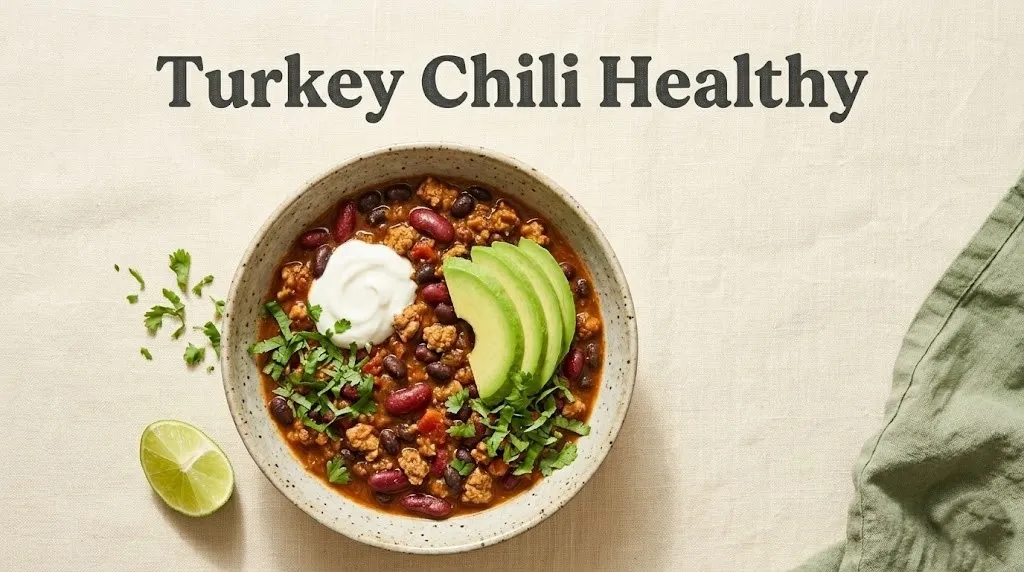
Turkey Chili Healthy
Yes, a well-constructed turkey chili is a genuinely healthy food that functions as a complete meal, delivering lean protein, complex carbohydrates from beans, and fat-soluble vitamins from the tomato-based broth, all within a high-volume, low-energy-density matrix. The health profile depends entirely on controlling the sodium and the fat percentage of the ground turkey you choose.
The base of any chili is the tomato. Cooked tomatoes are the primary dietary source of lycopene, a carotenoid that the National Institutes of Health identifies as a potent antioxidant. Unlike fresh tomatoes, the heat processing of the chili breaks down the tomato cell walls and concentrates the lycopene, making it far more bioavailable. Your body absorbs significantly more lycopene from a bowl of simmered chili than from a raw tomato salad.
The lean turkey provides a complete amino acid profile with a specific abundance of tryptophan and selenium. Selenium is integrated into selenoproteins that regulate thyroid function and protect cellular DNA from oxidative damage. A single bowl can provide 40 to 50 percent of your daily selenium requirement, according to USDA FoodData Central figures.
The dish becomes unhealthy when recipes call for a packet of high-sodium seasoning mix, full-fat sour cream, and a mountain of shredded cheddar. The core stew itself is pristine. It is what you dump into it at the end that shifts the metabolic outcome. You must audit the toppings with the same rigor you apply to the pot.
Is Turkey Chili Healthy for Weight Loss?
Turkey chili is an excellent tool for weight loss because its high protein and fiber content create a powerful satiety cascade that keeps you full on fewer calories for longer periods. The weight loss benefit is not about some magic fat-burning spice. It is about the volumetric physics of the bowl.
The dietary fiber in the beans and vegetables absorbs water and swells in the stomach, triggering stretch receptors that signal mechanical fullness to the hypothalamus. At the same time, the lean protein stimulates the release of cholecystokinin, a gut hormone that directly suppresses appetite. You are attacking hunger from two separate neural pathways simultaneously.
A randomized trial published in the American Journal of Clinical Nutrition confirmed that higher-protein meals increase diet-induced thermogenesis. Your body burns about 20 to 30 percent of the calories from the protein in that bowl just to digest and process the amino acids. That is a hidden metabolic tax that carbohydrates and fats do not have to the same degree.
The practical weight loss strategy is to use turkey chili as a meal-prep anchor. Portion it into five identical containers on Sunday. You now have a 380-calorie lunch that physically prevents you from hitting the vending machine at 3 PM. The liquid volume in the stew also slows the eating process, allowing your brain to catch up with your stomach.
Turkey Chili Nutrition Facts
A standard 1.5-cup serving of homemade turkey chili, made with 93 percent lean ground turkey and two types of beans, contains approximately 370 calories, 35 grams of protein, 45 grams of carbohydrate, and 10 grams of fat. This macronutrient split lands it squarely in the balanced-meal zone recommended by the Academy of Nutrition and Dietetics.
The carbohydrate number requires context. Those 45 grams are not coming from white rice or processed flour. They come bundled with 15 grams of dietary fiber, meaning the net carbohydrate impact on blood glucose is blunted significantly. The soluble fiber from the kidney beans and black beans forms a gel in the small intestine that traps sugar molecules and slows their absorption into the portal vein.
The micronutrient density is where the chili quietly shines. The combination of kidney beans, tomatoes, onions, and garlic contributes a measurable dose of potassium, roughly 800 to 1,000 milligrams per bowl. The 2020-2025 USDA Dietary Guidelines for Americans highlight potassium as a nutrient of public health concern because it directly counteracts the hypertensive effects of sodium on the vascular endothelium.
The fat content is mostly unsaturated. The ground turkey thigh adds a small amount of saturated fat, but if you use 99 percent lean ground turkey breast, the saturated fat content drops below 2 grams per serving. This makes the recipe easily adjustable for someone following a strict low-saturated-fat protocol for familial hypercholesterolemia.
| Nutrient | Amount per 1.5 Cups | Daily Value (%) |
|---|---|---|
| Calories | 370 kcal | N/A |
| Protein | 35 g | 70% |
| Dietary Fiber | 15 g | 54% |
| Potassium | 950 mg | 20% |
| Iron | 5 mg | 28% |
| Saturated Fat | 3 g | 15% |
Turkey Chili Macros
The macronutrient distribution of a balanced turkey chili recipe typically lands at 40 percent protein, 45 percent carbohydrate, and 15 percent fat, creating a metabolic profile that supports muscle repair, sustained energy release, and hormonal function without an insulin spike. This is not a keto macro split. It is an athlete’s macro split.
The 35 grams of protein per serving is the standout number. That dose provides roughly 3 to 4 grams of leucine, the branched-chain amino acid that acts as the primary trigger for mammalian target of rapamycin (mTOR) signaling. mTOR is the cellular pathway that kickstarts muscle protein synthesis. A sedentary person needs about 2.5 grams of leucine per meal to turn on this pathway. Turkey chili clears that threshold comfortably.
The carbohydrate load is strategically slow-burning. You are not consuming 45 grams of simple sugars. You are consuming prebiotic fibers and resistant starches that ferment in the colon to produce short-chain fatty acids like butyrate. Butyrate is the primary fuel source for the cells lining your colon, and research from the Harvard T.H. Chan School of Public Health links higher butyrate production to a reduced risk of colorectal inflammation.
If you need to manipulate the macros for a specific diet, the recipe is remarkably plastic. Reducing the beans by half and adding extra turkey drops the carbs and boosts the protein into a 50-plus-gram zone. Doubling the beans and cutting the turkey to half a pound shifts the dish toward a plant-forward, high-fiber profile suitable for a flexitarian pattern.
Key Takeaway: Turkey chili is a nutritional workhorse that delivers a complete protein package, a massive soluble fiber payload, and high-satiety volume, all while keeping saturated fat low and lycopene bioavailability high.
Is Turkey Chili Healthier Than Beef Chili?
Yes, turkey chili is nutritionally healthier than traditional beef chili for managing cardiovascular risk, primarily because it cuts the saturated fat and dietary cholesterol content by roughly 50 to 70 percent per serving, while still providing a comparable amount of total protein. The health difference is a matter of fatty acid composition in the meat.
A standard bowl of chili made with 80/20 ground chuck carries a saturated fat load of 8 to 12 grams. The USDA Dietary Guidelines explicitly recommend limiting saturated fat to less than 10 percent of daily calories. A single 12-gram hit from one bowl of beef chili consumes a massive chunk of that limit. Substituting 93/7 ground turkey drops the saturated fat to 3 to 4 grams, freeing up caloric space for healthier fat sources like avocado or olive oil.
The dietary cholesterol difference is also measurable, though the 2026 dietary consensus has shifted away from cholesterol as the primary dietary villain. Still, turkey is significantly lower in total cholesterol than beef. For a person with a specific genetic hyper-response to dietary cholesterol, this substitution matters.
Beef chili, however, wins on the taste of rendered fat and the bioavailability of heme iron. If you are an athlete, particularly a female athlete with low ferritin stores, the extra iron from grass-fed beef might be therapeutically necessary. The “healthy” designation shifts depending on the consumer. For the general population managing blood pressure and LDL cholesterol, the turkey bowl is the objectively better choice.
| Component (1.5 cups) | 93% Turkey Chili | 80/20 Beef Chili |
|---|---|---|
| Total Calories | 370 | 450 |
| Saturated Fat | 3 g | 9 g |
| Dietary Cholesterol | 70 mg | 110 mg |
| Protein | 35 g | 32 g |
| Heme Iron | 1.5 mg | 3.5 mg |
Best Healthy Turkey Chili
The best healthy turkey chili is not a single recipe. It is a flexible flavor scaffold that uses dark meat turkey for moisture, fire-roasted tomatoes for depth, and a blend of ancho and chipotle chiles for a smoky heat that eliminates the need for excessive salt or sugar. The best version is the one you can adapt to your dietary pattern without breaking it.
The turkey selection is the first fork in the road. A 93/7 lean ground turkey mix is the sweet spot for a healthy chili that does not taste like dry cardboard. Straight 99 percent fat-free turkey breast becomes stringy and chalky after a 40-minute simmer. The 93/7 blend has just enough intramuscular fat to stay tender while still being classified as a lean protein by FDA standards.
The liquid matters. Dumping in water dilutes flavor. You need to use a low-sodium chicken bone broth as the cooking liquid. The collagen in the bone broth melts into the chili, adding a silky body and a shot of glycine, which supports joint connective tissue. Check the label on the bone broth for sodium content. Some brands pack 400 milligrams per cup, which negates the low-sodium strategy.
The spice bloom technique separates the best chili from the average pot. You must sauté the cumin and chili powder in the residual pan fat after the turkey is browned. Heat activates the volatile oils in the spices. If you just dump dry spice into the wet tomato base, it never loses the raw, dusty taste. Blooming takes 60 seconds and changes the entire flavor ceiling of the dish.
Healthy Ground Turkey Chili
Healthy ground turkey chili begins with browning the ground turkey (Meleagris gallopavo) properly, which means resisting the urge to constantly stir it and allowing a deep golden-brown crust to form on the bottom of the pot. That crust is called the fond, and it is the flavor backbone of the entire dish.
A common mistake is treating ground turkey like a crumbled topping. If you overcrowd the pot and stir the meat constantly, you steam it in its own released water. The result is a gray, mushy texture that tastes boiled. You need a heavy-bottomed pot, a tablespoon of high-smoke-point oil like avocado oil, and the patience to let the meat sit undisturbed for a full three to four minutes before the first stir.
Once the turkey is browned and the fond has developed, you deglaze the pot with a splash of the broth or a can of diced fire-roasted tomatoes. Scrape up every brown bit. That deglazing step lifts the caramelized meat proteins off the steel and suspends them in the broth, guaranteeing that the chili tastes like it simmered for hours, even if you only have 30 minutes.
The vegetables need to be diced uniformly. A half-inch dice on the onion and bell pepper ensures they soften into the chili without disintegrating into a mush. You are looking for a bite of soft pepper in the final bowl, not a homogenous paste. Sauté the vegetables in the same pot after the turkey is removed so they also pick up the residual fond flavor.
Healthy Turkey Chili Recipe
This is the 2026 anchor recipe, built for a 40-minute stovetop execution and designed to land a precise 40-45-15 macro split. The yield is six 1.5-cup servings.
The ingredient list is deliberate. Every vegetable serves a dual purpose of flavor and nutrition. The carrot is not just filler. It is a natural sweetness source that allows you to skip the sugar that many chili recipes call for to cut the acidity of the tomatoes. The zucchini melts into the chili invisibly, adding volume and potassium without any detectable flavor or texture.
The 2026 Macro-Balanced Turkey Chili Recipe:
- Heat 1 tablespoon avocado oil in a 5-quart heavy-bottomed pot over medium-high heat.
- Add 2 pounds of 93/7 lean ground turkey. Spread it flat and let it brown undisturbed for 4 minutes. Flip, break apart, and cook until no longer pink. Remove the meat and set aside, leaving the fat in the pot.
- Reduce heat to medium. Bloom 2 tablespoons chili powder, 1 tablespoon ground cumin, and 1 teaspoon smoked paprika in the residual fat for 45 seconds, stirring constantly to prevent burning.
- Sauté 1 large diced yellow onion, 1 diced red bell pepper, and 1 finely diced carrot until softened, about 5 minutes. Add 4 minced garlic cloves and 1 diced jalapeño (seeds removed for mild). Cook for 1 minute.
- Deglaze the pot with 1 cup low-sodium chicken bone broth, scraping up the fond.
- Add 1 (28-ounce) can of crushed fire-roasted tomatoes, 1 (15-ounce) can of drained and rinsed kidney beans, and 1 (15-ounce) can of drained and rinsed black beans.
- Return the turkey to the pot. Bring to a simmer, then reduce heat to low and cook partially covered for 25 minutes, stirring occasionally.
- In the last 10 minutes, fold in 1 cup finely diced zucchini. Season with salt and black pepper right before serving.
Healthy Turkey Chili Recipe Low Sodium
A low-sodium turkey chili recipe requires you to completely eliminate canned bean liquid, replace boxed broth with a homemade or verified no-salt-added version, and use fresh tomatoes where possible, capping the sodium at roughly 250 milligrams per bowl. The standard restaurant chili bowl can exceed 1,500 milligrams of sodium. You are cutting that by over 80 percent.
The primary sodium villains are the canned beans and the broth. Rinsing canned beans under cold water for 60 seconds removes roughly 40 percent of the sodium from the canning liquid. Rinsing them thoroughly and then letting them drain in a colander while you prep the other ingredients removes even more. This is a non-negotiable step for a low-sodium protocol.
The seasoning shift is critical. When you drop the salt, you must punch up the acid and the heat to keep the flavor perception high. A squeeze of fresh lime juice right before serving brightens the entire bowl. The citric acid binds to the same tongue receptors that sodium does, tricking your palate into perceiving a saltier dish than what actually exists.
Use no-salt-added crushed tomatoes and specifically look for “no salt added” on the bean cans. If you cannot find those, pressure-cooking dried beans from scratch eliminates the sodium question entirely. The extra step adds an hour to the process but gives you absolute control over the mineral content of the final bowl.
Low-Sodium Seasoning Boosters:
- Fresh lime juice added at serving.
- Extra smoked paprika for depth.
- A dash of apple cider vinegar during the simmer.
- Fresh cilantro and diced raw onion on top for crunch.
Low Calorie Turkey Chili Recipe
A low-calorie turkey chili recipe stretches the vegetable volume and uses 99 percent fat-free ground turkey breast to push a 1.5-cup serving down to roughly 260 calories, while still delivering over 32 grams of protein. This version is for the aggressive fat-loss phase where every calorie must count.
The calorie dilution strategy relies on zero-calorie or low-calorie bulking agents. Finely diced zucchini, yellow squash, and chopped spinach are almost entirely water and fiber. They take up physical space in the bowl, fill your stomach, and add micronutrients for a negligible caloric cost. You can add two cups of chopped spinach to the pot, and it wilts down into almost nothing, leaving only the nutrition behind.
The turkey choice is the biggest lever. 99 percent lean ground turkey breast contains roughly 120 calories per 4-ounce raw portion. A 93/7 blend pushes 170 calories for the same weight. If you are making a six-serving batch, that swap saves 50 calories per serving. Across a week of meal prep, that difference adds up to a half-pound of body fat equivalent.
You must be cautious with the simmer time. Lean turkey breast dries out and turns mealy if it simmers for more than 20 minutes. You should add the pre-browned turkey breast back into the pot during the last 15 minutes of the simmer, not at the beginning. This poaches it gently in the acidic tomato sauce and keeps the protein strands tender.
Key Takeaway: The gap between a healthy turkey chili and a standard beef chili is roughly 100 calories and 6 grams of saturated fat per bowl, making the swap one of the simplest cardiovascular upgrades you can make in your weekly meal rotation.
Healthy Turkey Chili Crockpot
A healthy slow-cooker turkey chili relies on a low-and-slow breakdown of the bean starches and the tomato collagen, but you must still brown the turkey on the stovetop first, because a crockpot will never achieve the Maillard reaction required for a deep, meaty flavor. The slow cooker does not brown. It simply stews.
Dumping raw ground turkey into a crockpot results in a grey, granular texture that ruins the mouthfeel. You need to take the extra ten minutes to sear the turkey in a skillet until it is deeply browned and then transfer it to the slow cooker insert. The fond you build in the skillet transfers to the crockpot when you deglaze the skillet with a splash of broth and pour every last brown bit into the pot.
The crockpot excels at the slow simmer. Once the turkey is browned and the vegetables are sautéed, you combine everything and set the dial to Low for 6 hours or High for 3 hours. The long, gentle simmer allows the soluble fiber in the beans to fully hydrate and soften, creating a creamy texture without any added dairy. The flavors marry together in a way that a 25-minute stovetop simmer cannot replicate.
Food safety is critical with a crockpot. Do not start with frozen ground turkey. The meat must pass through the danger zone of 40 to 140 degrees Fahrenheit within the first two hours. A frozen block of turkey in a slow cooker will sit in the bacterial growth danger zone for far too long. Always thaw the meat completely before it enters the ceramic insert.
Healthy Turkey Chili Toppings Bar
A healthy toppings bar turns a single pot of chili into a customizable nutritional strategy, allowing each family member to add fats, acids, or probiotics based on their specific dietary needs, rather than blanket-loading the bowl with cheese and sour cream. The toppings are where the health profile is won or lost.
The base chili is lean. The toppings allow you to strategically add back healthy unsaturated fats. Avocado is the gold-standard chili topping. It adds monounsaturated oleic acid, which supports HDL cholesterol, and a creamy mouthfeel that replaces the need for sour cream. A quarter of an avocado adds about 80 calories and 7 grams of fat, neatly balancing the lean protein below.
Plain nonfat Greek yogurt is a direct nutritional upgrade over sour cream. It has the same tangy acidic profile, the same creamy texture, and a near-identical mouthfeel, but it swaps saturated fat for an extra 5 to 8 grams of protein. Most people cannot tell the difference in a heavily spiced bowl of chili.
Fresh pico de gallo functions as a zero-calorie flavor bomb. The raw onion and jalapeño add a fresh, crisp bite that contrasts with the slow-cooked stew. The lime juice adds the acid hit that wakes up the whole bowl. You are essentially adding a fresh salsa salad on top, which increases the vegetable serving count without adding any meaningful calories.
| Topping | Calories (per serving) | Nutritional Benefit |
|---|---|---|
| 1/4 Avocado (sliced) | 80 | Monounsaturated fat, potassium, fiber |
| 2 tbsp Nonfat Greek Yogurt | 25 | Protein, probiotics, zero saturated fat |
| Fresh Pico de Gallo | 10 | Vitamin C, lycopene, zero added fat |
| Shredded Cheddar (1 oz) | 110 | Calcium, but high saturated fat |
| Full-Fat Sour Cream (2 tbsp) | 60 | High saturated fat, minimal protein |
Frequently Asked Questions About Healthy Turkey Chili
Is turkey chili good for high blood pressure?
Yes, turkey chili made with no-salt-added canned goods and rinsed beans is an excellent meal for managing high blood pressure.
The potassium from the beans and tomatoes directly counteracts sodium’s effect on the blood vessel walls.
The DASH diet, the gold standard for hypertension management, specifically features meals built around lean poultry, beans, and vegetables.
Can I put cheese on healthy turkey chili?
You can add cheese if it fits your saturated fat budget for the day, but it is the quickest way to undo the lean advantage of the turkey.
A single ounce of shredded cheddar adds 9 grams of fat, with 6 of those grams being saturated.
Nutritional yeast or a dollop of Greek yogurt provides a savory, creamy note without the saturated fat load.
How long does turkey chili last in the fridge?
Properly stored turkey chili lasts for four days in the refrigerator in an airtight container and up to four months in the freezer.
You must cool the chili to below 40 degrees Fahrenheit within four hours of cooking to prevent bacterial spore germination.
Freeze in flat, single-serving bags so they thaw quickly and portion without waste.
Is turkey chili keto without the beans?
Yes, you can remove the beans from turkey chili to make it strictly keto.
You must add a low-carb bulking vegetable like chopped zucchini or mushrooms to replace the physical volume the beans provided.
The net carb count drops to under 10 grams per bowl without beans, fitting cleanly into a standard ketogenic macro split.
Why is my turkey chili watery?
Your turkey chili is watery because you did not drain the beans, used too much broth, or overcrowded the pot while browning the meat.
Water from the vegetables and meat accumulates and cannot evaporate if the lid is on too tight or the simmer is too low.
Cook the chili uncovered for the last 15 minutes to let the excess liquid reduce to a thick, spoon-coating consistency.
A healthy bowl of turkey chili is a decision you make in the pot, not just in the ingredient list. It is choosing to rinse the beans, to bloom the spices in the fat, and to swap the cheddar for avocado when you see the saturated fat number creeping up.
Next time you pull out the Dutch oven, brown that ground turkey until it actually looks like it has spent time in a hot pan. Deglaze the fond. Smell the cumin hitting the hot oil. Layer the vegetables and let the tomatoes cook down until the chili is thick enough to hold its shape on a spoon.
That bowl holds 35 grams of protein, a day’s worth of fiber, and a warmth that sits in your stomach without weighing you down. It earns its place in your meal-prep rotation every single week.