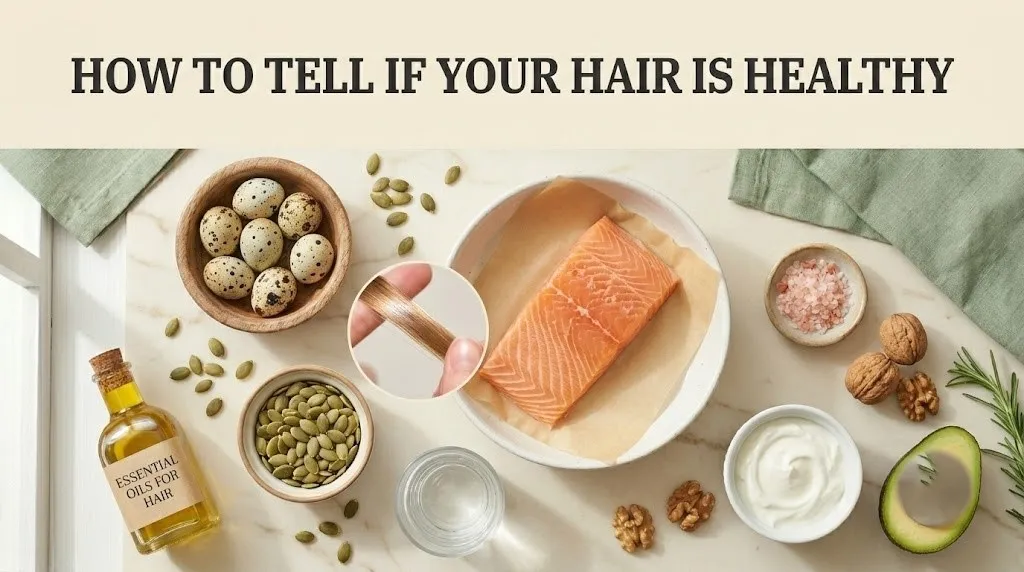
You can tell if your hair is healthy by looking at its shine, feeling its texture between your fingers, and testing how it stretches before breaking. Healthy hair has a smooth cuticle that reflects light, feels consistently smooth from root to tip, and stretches slightly before returning to its original length.
The American Academy of Dermatology explains that hair health is not just about what you put on your strands. It is largely determined by what you feed your hair follicles through your diet. The hair you see in the mirror today began forming inside the follicle roughly three to six months ago, built from the protein, fats, vitamins, and minerals circulating in your bloodstream at that time. Your hair is a running record of your nutritional status.
This guide walks you through the at-home tests that tell you whether your hair is genuinely healthy. You will learn what healthy hair feels like, why softness is not always a sign of health, and which specific nutrients and foods determine the texture, strength, and shine of every strand on your head.
How to Tell If Your Hair Is Healthy: The Quick Assessment
You can tell if your hair is healthy by evaluating three characteristics in under two minutes: shine, texture when you run your fingers upward, and how a single strand behaves when gently stretched. These three signs cover the cuticle condition, protein structure, and moisture balance of the hair.
Start with the shine test. Stand in natural light, not harsh bathroom lighting. Healthy hair reflects light evenly along the length of the strand. The reflection looks like a smooth ribbon of light, not scattered sparkles. A smooth cuticle, the outermost layer of the hair shaft, creates this effect. Damaged cuticles scatter light in multiple directions, making hair look dull even if it is clean.
Next, do the texture test. Take a small section of hair between your thumb and forefinger. Run your fingers upward from the ends toward the roots, against the direction of the cuticle. Healthy hair feels smooth in both directions, with only slight resistance going upward. Damaged hair feels rough, bumpy, or catches noticeably when you run your fingers upward. This roughness is the physical sensation of lifted, broken, or chipped cuticle scales.
Finally, the stretch test reveals elasticity. Take a single shed hair. Hold it between both hands with about two inches of length exposed. Gently pull. Healthy hair stretches 20 to 30 percent of its length before breaking. When it breaks, it should not snap immediately. Hair that snaps with almost no stretch lacks moisture or protein. Hair that stretches and stretches without breaking may have too much moisture and not enough protein structure.
How to Know If Your Hair Is Healthy at Home
Knowing if your hair is healthy at home requires observing how it behaves across a full day and through different conditions, not just how it looks right after washing and styling.
Healthy hair maintains its shape and texture throughout the day. It does not dramatically frizz when you walk into a humid room, nor does it fall completely flat within hours of styling. The protein structure inside the cortex, the inner layer of the hair shaft, gives hair its strength and shape memory. When that protein matrix is intact, the hair holds its style and resists environmental stress.
Observe how your hair behaves when it is wet. Healthy wet hair feels slightly slippery and does not tangle immediately upon contact with water. The smooth cuticle allows water to run off rather than absorbing too quickly. Hair that becomes a tangled mat the second water hits it often has a damaged cuticle with lifted scales that grab onto each other. Hair that feels gummy or overly stretchy when wet may have compromised protein bonds.
Shedding is another at-home indicator. Losing 50 to 100 hairs per day is normal according to the American Academy of Dermatology. Excessive shedding that suddenly increases, clogs the shower drain, or leaves visible thinning patches may indicate a nutritional deficiency, stress response, or hormonal shift. Look at the shed hairs themselves. Healthy shed hairs have a tiny white bulb at the root end, which is the follicle base. Shed hairs that are broken mid-shaft with no bulb indicate breakage, not natural shedding. Breakage is a cuticle and cortex problem. Follicle shedding is a growth cycle problem.
Key Takeaway: Healthy hair holds its style all day, does not tangle aggressively when wet, and sheds with a visible root bulb rather than breaking mid-shaft.
Signs of Healthy Hair You Can See and Feel
The signs of healthy hair fall into visual, tactile, and behavioral categories. Learning to read all three gives you a complete picture of your hair’s condition.
Visually, healthy hair has a natural luster that is not the same as product-induced gloss. Natural shine looks like a soft, uniform reflection along the hair length. It does not look wet or oily. The ends of healthy hair look similar to the roots. There may be a slight taper, but the ends should not look dramatically thinner, lighter, or more frayed than the hair near the scalp.
Tactile signs include a smooth, consistent feel when you slide your fingers down the hair shaft. There should be no rough patches, no sudden texture changes, and no areas that feel sticky or gummy. Healthy hair feels cool to the touch initially because the smooth cuticle conducts heat away from your fingers. Damaged, porous hair often feels slightly warm or room temperature immediately because the rough surface does not conduct heat as efficiently.
Behavioral signs include how hair responds to combing and styling. Healthy hair detangles with minimal resistance. A wide-tooth comb should glide through damp hair without catching or snapping strands. Healthy hair also takes color evenly if you dye it. Patchy, uneven color uptake can indicate areas of porosity damage where the cuticle is more open in some sections than others.
| Healthy Hair Sign | What It Looks or Feels Like | What It Indicates |
|---|---|---|
| Even shine | Uniform light reflection, not scattered | Smooth, intact cuticle |
| Consistent texture | Smooth root to tip, no rough patches | Undamaged cuticle scales |
| Elasticity | Stretches 20 to 30% and returns | Balanced protein and moisture |
| Minimal tangling | Comb glides through damp hair | Closed cuticle scales |
| Ends match roots | No dramatic thinning or splitting at tips | Low breakage rate |
What Does Healthy Hair Feel Like to the Touch?
Healthy hair feels smooth, cool, and consistently textured when you touch it. The feeling is similar to running your fingers over a silk ribbon. There should be no rough spots, sticky sections, or areas that feel dramatically different from the rest of the strand.
The smoothness comes from the cuticle, which is made of overlapping scales like shingles on a roof. When those scales lie flat and tight against the cortex, the surface feels uniform. Conditioners and oils can temporarily smooth the cuticle. True cuticle health means the scales lie flat even after the hair is clarified, which is washed with a stripping shampoo that removes all product buildup.
Healthy hair also has a subtle weight to it. It does not feel insubstantial or flyaway. This weight comes from the protein density of the cortex. Hair that has lost protein through chemical processing, heat damage, or nutritional deficiency feels lighter and more airy because part of its internal structure has been broken down.
Temperature is a lesser-known tactile cue. Healthy hair feels cool when you first gather it in your hand. The smooth, dense surface transfers heat away from your skin efficiently. Porous, damaged hair feels closer to room temperature because the rough, lifted cuticle creates tiny air pockets that insulate rather than conduct heat.
How Should Healthy Hair Feel When You Run Your Fingers Through It?
Healthy hair should feel smooth and slippery when you run your fingers through it from root to tip, with no catching, dragging, or sudden texture changes along the way. The fingers should glide without interruption.
Running your fingers upward from tip to root should produce a slight texture, like very fine tooth on a smooth surface. The cuticle scales point downward, so going against the grain should feel mildly textured but not rough or jagged. If the upward motion feels like running your fingers over a pinecone, the cuticle is severely damaged. If you feel nothing at all in the upward direction, the cuticle may be completely stripped away, which is also a problem.
After washing and air-drying without any product, healthy hair still feels reasonably smooth. It may not feel as slick as it does with conditioner, but it should not feel like straw, cotton, or a tangled mess. The baseline texture of untreated hair reveals the true cuticle condition. Many people never experience their natural hair texture because they always apply conditioner, leave-in products, or heat styling. A clarifying wash followed by air-drying without product is the most honest assessment you can do.
Key Takeaway: Run your fingers down the hair shaft for smoothness and upward for mild texture. The gap between those two sensations tells you the condition of your cuticle.
Is Soft Hair Always Healthy?
Soft hair is not always healthy. Softness can be a sign of healthy cuticles, but it can also be a sign of over-conditioned, moisture-overloaded hair that lacks protein strength. The context matters.
Healthy soft hair feels smooth, has weight, and bounces back when you squeeze a handful. It is soft without being limp. Over-conditioned hair feels soft but mushy, almost gummy, and lacks any resilience. It stretches too easily and does not snap back. This is sometimes called hygral fatigue, a condition where the hair shaft has absorbed too much water and the repeated swelling and contracting has weakened the protein structure.
Chemically relaxed or heavily processed hair can feel artificially soft because the chemical treatment has broken down the protein bonds that give hair its strength and structure. The hair feels soft because it has lost its internal rigidity, not because it is healthy. This type of soft hair often breaks easily, stretches without returning, and looks frizzy even when it feels smooth to the touch.
True healthy softness comes from adequate moisture balanced with adequate protein. The cuticle lies flat, the cortex maintains its structure, and the hair feels pleasant to touch without being fragile. Think of a healthy strand of hair like a well-built rope. The inner fibers are strong and resilient. The outer surface is smooth. Softness is the outer surface. Strength is the inner core. Both must be present.
Does Soft Hair Mean Healthy Hair? The Full Answer
Soft hair means healthy hair only when the softness is accompanied by elasticity, shine, and strength. Soft hair that breaks easily, feels limp, or lacks any resilience is not healthy, regardless of how pleasant it feels to the touch.
The hair care industry has trained consumers to equate softness with health because softness sells conditioner. The real picture is more nuanced. Hair can be soft for several reasons: a smooth cuticle, adequate moisture in the cortex, a heavy coating of conditioning agents, or a breakdown of the protein structure from chemical processing. The first two are signs of health. The last two are not.
To determine whether soft hair is healthy hair, add one test. Take a strand of wet hair and stretch it gently. Healthy soft hair stretches about 20 to 30 percent and returns to its original length. Over-conditioned or protein-damaged soft hair stretches excessively, feels gummy, and may not return to its original shape. Dry but healthy hair may not feel particularly soft but will have elasticity and shine.
Hair texture also influences softness expectations. Curly and coily hair types have a naturally different texture than straight hair. The cuticle on curly hair is often slightly lifted at the curves, which means it does not feel as smooth as straight hair even when perfectly healthy. Judging curly hair by straight hair softness standards leads to a false conclusion. Curly hair should be assessed for elasticity, defined curl pattern retention, and minimal frizz rather than straight-hair smoothness.
Quick Tip:
- Clarify your hair once to assess your true texture. Conditioner buildup creates artificial softness that masks damage.
- Pair the softness test with the stretch test. Soft and stretchy with no return is weak. Soft with elasticity is healthy.
- Curly and coily hair should not be held to the same smoothness standard as straight hair.
Healthy Hair Characteristics and Texture Explained
The characteristics of healthy hair are consistent across all hair types, though the expression of those characteristics varies. Shine, elasticity, porosity balance, and minimal breakage are the universal markers.
Shine is the visual result of a smooth cuticle. Light hits the flat surface and reflects at a uniform angle, creating a ribbon of shine. Curly hair does not reflect light in a continuous ribbon because the curves scatter light, but it should still have visible luster at the crest of each curve. Dull hair that absorbs light rather than reflecting it has a rough or damaged cuticle.
Elasticity is the hair’s ability to stretch and return. It is a direct reflection of the protein bonds inside the cortex. These bonds, called disulfide bonds, are formed by the amino acid cysteine. A diet rich in complete protein sources provides the cysteine and methionine needed to build strong disulfide bonds. Elasticity is the most nutrition-dependent characteristic of hair health.
Porosity refers to the hair’s ability to absorb and retain moisture. Low porosity hair has a tightly closed cuticle that resists moisture absorption. Normal porosity hair absorbs and retains moisture appropriately. High porosity hair has a lifted, damaged, or missing cuticle that absorbs moisture quickly but loses it just as fast. High porosity hair is almost always damaged hair.
Breakage is the end result of compromised structure. Hair that breaks mid-shaft has a cuticle or cortex problem. Hair that sheds naturally from the root has a growth cycle issue. The distinction matters because the nutritional and care solutions are different.
Key Takeaway: Shine reflects cuticle health. Elasticity reflects protein structure. Porosity reflects moisture management. Breakage pattern reveals whether the issue is structural or cyclical.
Healthy Hair Shine and the Elasticity Test
The shine and elasticity tests are the two most reliable at-home assessments of hair health. They measure different things but together paint a complete picture.
To test shine accurately, wash your hair with a clarifying shampoo to remove product buildup. Let it air-dry completely without any leave-in products, oils, or heat styling. Stand near a window with natural light. Look at your hair. A healthy strand reflects light in a defined band. Unhealthy hair absorbs light and looks matte. The clarifying step is non-negotiable because silicones and oils in conditioners create an artificial shine that masks cuticle damage.
The elasticity test requires a single shed hair, ideally one that still has the root bulb attached. Hold the hair between your thumbs and forefingers with about two inches of length exposed. Slowly pull. Healthy hair stretches by about one-fifth to one-third of its original length before breaking. Hair that snaps immediately, at less than 10 percent stretch, is too dry or has damaged protein bonds. Hair that stretches far beyond 30 percent and does not bounce back is overly porous or has compromised structure.
| Test | What You Do | Healthy Result | Unhealthy Result |
|---|---|---|---|
| Clarified shine | Air-dry with no product, view in natural light | Uniform light reflection along strand | Dull, matte, scattered reflection |
| Dry elasticity | Stretch a shed hair slowly | Stretches 20 to 30%, returns | Snaps immediately or stretches without return |
| Wet elasticity | Stretch a wet hair strand gently | Stretches further, returns when released | Gummy, excessive stretch, no return |
Elasticity can also be tested on wet hair. Wet hair should stretch slightly more than dry hair. The same strand tested dry and then wet gives you a sense of its protein and moisture balance. A dramatic difference between dry and wet elasticity suggests one component is out of balance.
Hair Porosity and What It Means for Hair Health
Hair porosity measures how readily your hair absorbs and retains moisture, and it is a direct reflection of cuticle condition. Understanding your porosity helps you interpret other health signs correctly and choose the right foods and care strategies.
The float test is the simplest at-home porosity test. Take a clean, dry, product-free shed hair and place it in a glass of room-temperature water. Watch what happens over two to three minutes. Low porosity hair floats at the top and resists sinking. The tightly closed cuticle repels water. Normal porosity hair floats for a moment and then slowly sinks. The cuticle allows gradual water absorption. High porosity hair sinks immediately. The damaged, lifted, or missing cuticle offers no resistance to water entry.
High porosity hair is almost always damaged hair. The cuticle has been raised by heat styling, chemical processing, sun exposure, or mechanical friction. The gaps in the cuticle allow water to enter and leave quickly. This is why high porosity hair dries fast, frizzes in humidity, and often feels dry even after conditioning.
The nutritional connection to porosity involves essential fatty acids and vitamin E. The scalp produces sebum, a natural oil that coats the hair shaft and helps seal the cuticle. A diet low in omega-3 fatty acids and vitamin E can reduce sebum quality and quantity, leaving the cuticle less protected against environmental damage. Foods like salmon, walnuts, flaxseed, and sunflower seeds support healthy sebum production.
Key Takeaway: Hair that sinks immediately in a water glass has high porosity, which usually means cuticle damage. Omega-3s and vitamin E from foods support the natural oils that protect the cuticle.
Signs of Unhealthy Hair and Breakage Patterns
Unhealthy hair announces itself through visible, tactile, and behavioral signs. Recognizing these early prevents further damage and points toward the nutritional or care adjustments needed.
Split ends are the most obvious sign. The hair shaft literally splits into two or more strands at the tip because the cuticle has worn away and the cortex has unraveled. Split ends cannot be repaired. They must be cut off. The goal is preventing new ones from forming. Split ends indicate either mechanical damage from brushing and heat styling, nutritional deficiency affecting protein structure, or both.
Breakage mid-shaft looks like short pieces of hair that are not full-length shed strands. If you find small, inch-long pieces of hair on your pillow, collar, or bathroom counter, those are broken hairs, not naturally shed hairs. The distinction matters. Shed hairs have a root bulb. Broken hairs have blunt or frayed ends. Excessive breakage points to a structural problem in the hair shaft, often related to protein deficiency or chemical damage.
Other signs of unhealthy hair include a rough texture when running fingers upward, excessive tangling that worsens over time, dullness that does not resolve with clarifying, and a consistent feeling of dryness even after conditioning. Hair that has lost its elasticity and snaps at the slightest tension is critically damaged and needs both topical and nutritional intervention.
- Split ends that travel up the hair shaft
- Mid-shaft breakage producing short fragments
- Rough texture felt when running fingers upward
- Dullness that persists after clarifying
- Tangling that worsens and forms matted sections
- Snap-and-break at minimal tension
Nutrients That Determine Your Hair Health
The nutrients that determine hair health are the same ones that build every protein structure in the body. Protein, iron, zinc, omega-3 fatty acids, vitamin D, and vitamin E are the most directly involved. Deficiencies in any of them show up in the hair.
The NIH Office of Dietary Supplements identifies iron deficiency as the most common nutritional cause of hair shedding and texture changes. Ferritin, the protein that stores iron, is required for the rapid cell division happening inside the hair follicle. When ferritin levels drop, the follicle slows production and may enter the resting phase prematurely. The hair that does grow may be thinner, weaker, and less pigmented.
Zinc supports the protein synthesis that builds the hair shaft. The Academy of Nutrition and Dietetics notes that zinc deficiency can cause hair to become brittle, dull, and prone to breakage. Zinc also supports the oil glands around follicles, which produce the sebum that naturally conditions the cuticle. A diet consistently low in zinc often results in hair that feels dry and rough regardless of topical conditioning.
| Nutrient | Hair Function | Food Sources | RDA (Adults) |
|---|---|---|---|
| Protein (cysteine, methionine) | Builds keratin structure | Eggs, salmon, Greek yogurt, lentils | 0.8 g per kg body weight |
| Iron (ferritin) | Oxygen delivery to follicles | Lentils, spinach, beef, pumpkin seeds | 8 to 18 mg |
| Zinc | Protein synthesis, sebum production | Oysters, pumpkin seeds, chickpeas, yogurt | 8 to 11 mg |
| Omega-3s (DHA, EPA) | Scalp hydration, cuticle smoothness | Salmon, sardines, walnuts, flaxseed | 250 to 500 mg combined |
| Vitamin D | Follicle cycling regulation | Salmon, fortified milk, sunlight | 600 IU (15 mcg) |
| Vitamin E | Antioxidant protection for cuticle | Sunflower seeds, almonds, spinach | 15 mg |
Key Takeaway: Hair texture, shine, and strength are built from protein, iron, zinc, and omega-3s. A deficiency in any one of these nutrients will show up in your hair before it appears on a standard blood test.
How Protein Builds Your Hair Structure
Protein builds hair structure from the inside out. The hair shaft is composed of roughly 95 percent keratin, a fibrous structural protein. The amino acid composition of your diet directly determines the quality of the keratin your body produces.
Keratin is rich in the sulfur-containing amino acid cysteine. Cysteine forms disulfide bonds with other cysteine molecules, creating cross-links that give hair its strength, shape, and elasticity. These disulfide bonds are permanent structures. They are what make curly hair curly and straight hair straight. When disulfide bonds break, through chemical processing or extreme heat, the hair loses its structural integrity. The only way to rebuild them is with new hair growth.
Methionine is another essential amino acid for hair. It is the initiating amino acid in protein synthesis, meaning it starts the process of building new keratin proteins. Methionine also donates sulfur for disulfide bond formation. A diet adequate in complete protein sources supplies both cysteine and methionine.
The Academy of Nutrition and Dietetics recommends 0.8 grams of protein per kilogram of body weight as a minimum for adults. Hair is non-essential tissue. When dietary protein intake drops too low, the body prioritizes vital organs like the heart, lungs, and brain. Hair follicles get deprioritized. The result is weaker, thinner, more brittle hair that grows more slowly. For people experiencing hair weakness or breakage, some dermatologists suggest increasing intake to 1.0 to 1.2 grams per kilogram.
Foods That Make Hair Feel Softer and Stronger
Specific foods supply the nutrients that make hair feel softer and stronger. The change does not happen overnight, but consistent intake over weeks and months builds hair with better texture from the follicle outward.
Salmon and other fatty fish deliver omega-3 fatty acids, specifically docosahexaenoic acid (DHA) and eicosapentaenoic acid (EPA), along with complete protein and vitamin D. The omega-3s support the scalp’s oil production, which naturally coats the hair shaft and smooths the cuticle. A 3-ounce serving of wild salmon contains roughly 2.3 grams of omega-3s and 22 grams of protein. The American Heart Association recommends two servings of fatty fish per week, a guideline that aligns well with hair health goals.
Eggs are one of the most concentrated food sources of biotin, a B vitamin that functions as a coenzyme in keratin production. One large egg contains about 10 micrograms of biotin, roughly one-third of the Adequate Intake level. Eggs also supply complete protein and vitamin D. Cook eggs thoroughly to neutralize avidin, a protein in raw egg whites that binds biotin and prevents its absorption.
Greek yogurt delivers protein and zinc in a convenient package. A 6-ounce container of plain Greek yogurt provides about 17 grams of protein and 1.4 milligrams of zinc. The calcium in yogurt also supports overall cellular function. For those who are lactose intolerant, Greek yogurt’s straining process removes most of the lactose.
Pumpkin seeds and sunflower seeds supply zinc and vitamin E respectively. Two tablespoons of pumpkin seeds provide about 2.2 milligrams of zinc. A quarter cup of sunflower seeds provides roughly 7 milligrams of vitamin E, about half the daily Recommended Dietary Allowance.
Key Takeaway: Salmon, eggs, Greek yogurt, pumpkin seeds, and sunflower seeds form the core of a hair-softening, hair-strengthening diet. Eat them consistently. The hair you are growing right now will reflect these foods in about three months.
A Hair Health Meal Plan for Better Texture
A one-day hair health meal plan translates nutrient science into actual food. This plan supplies roughly 75 grams of protein, 18 milligrams of iron, 15 milligrams of zinc, and adequate omega-3s and vitamin E.
This meal plan is a template. Adjust portion sizes based on body weight, activity level, and hunger. The nutrient timing is intentional. Protein is spread across the day to maintain steady amino acid availability for keratin synthesis.
Breakfast (7 to 9 AM): Two scrambled eggs cooked in olive oil. One slice of whole-grain toast with mashed avocado. A small orange on the side. The eggs supply biotin and protein. The avocado adds vitamin E and healthy monounsaturated fat. The orange provides vitamin C, which enhances iron absorption from the whole-grain toast.
Morning Snack (10 AM): A 5.3-ounce container of plain Greek yogurt with two tablespoons of pumpkin seeds and a half-cup of fresh blueberries. The yogurt supplies protein and zinc. The pumpkin seeds add zinc and magnesium. The blueberries contribute antioxidants that protect the follicle from oxidative stress.
Lunch (12 to 1 PM): A bowl built from 3 ounces of grilled salmon, 1 cup of cooked quinoa, massaged kale with lemon juice, and diced red bell pepper. The salmon provides omega-3s and protein. Quinoa is a complete plant protein. The kale and bell pepper supply vitamin C and iron. The lemon juice enhances non-heme iron absorption.
Afternoon Snack (3 PM): A smoothie blending 1 cup unsweetened almond milk, 1 tablespoon flaxseed, 1 cup baby spinach, half a banana, and a small handful of frozen mango. The flaxseed delivers plant-based omega-3s (ALA). The spinach adds iron.
Dinner (6 to 7 PM): A 4-ounce serving of roasted chicken thigh with roasted sweet potato wedges and steamed broccoli. Olive oil drizzled over the vegetables. The chicken supplies complete protein. The sweet potato delivers vitamin A for follicle cell turnover. The broccoli contributes vitamin C and fiber.
How Diet Changes Hair Texture Over Weeks and Months
Diet changes hair texture on a delay. The hair you feel today was built inside the follicle about three to six months ago. Dietary improvements you make now will be visible in the new hair that emerges during that window.
The hair growth cycle explains the timeline. The anagen phase, the active growth stage, lasts two to seven years. During this phase, the follicle pulls amino acids, minerals, and fatty acids from the bloodstream to build keratin. If your diet improves, the hair produced during the anagen phase improves in quality. That improvement becomes visible at the scalp about one to two months later and reaches the ends, depending on hair length, many months after that.
A 2019 study in the Journal of the American Academy of Dermatology found that women with self-perceived hair thinning who adopted a Mediterranean diet supplemented with specific nutrients showed measurable improvements in hair density and texture after six months. The supplement group saw faster changes. The diet-only group required more time but showed improvements in shine, tensile strength, and subjective texture ratings.
Patience is the hardest part of using diet to improve hair texture. The most common mistake is changing one’s diet for two weeks, noticing no difference, and concluding that nutrition does not matter. Hair is a slow-turnover tissue. Consistent protein, iron, zinc, and omega-3 intake over three to six months is the minimum window for observable texture changes. A photo taken in consistent lighting today and another in six months is a more reliable progress tracker than the mirror.
Key Takeaway: Dietary improvements affect hair texture on a three to six month delay. The hair you grow today reflects the food you ate last season. Consistency is the only strategy that works.
Frequently Asked Questions About Hair Health and Nutrition
What does healthy hair look like?
Healthy hair has a uniform shine, consistent texture from root to tip, and ends that resemble the roots without dramatic thinning or splitting. It reflects light in a smooth ribbon rather than scattered sparkles. The appearance is the result of a smooth cuticle, intact protein structure, and balanced moisture.
How can I test my hair health at home?
The three best at-home tests are the clarified shine test, the dry strand elasticity test, and the porosity float test. Wash hair with a clarifying shampoo, air-dry without products, and observe the shine in natural light. Stretch a shed hair to test elasticity. Float a clean strand in water to test porosity.
Does shiny hair mean healthy hair?
Shiny hair usually indicates a healthy, smooth cuticle that reflects light evenly. However, product-induced shine from silicones and oils can mask damage temporarily. Clarify your hair first to determine whether the shine is natural or product-coated.
Can diet change my hair texture?
Diet changes the texture of new hair growth over several months. The hair you see today was built from nutrients available three to six months ago. Consistent intake of protein, iron, zinc, and omega-3 fatty acids produces hair that feels softer, stronger, and more elastic as it grows out.
How long does it take for diet to improve hair health?
Dietary changes take three to six months to produce visible improvements in hair texture and strength. The hair follicle needs time to build new, better-quality strands. A photo journal with consistent lighting is more reliable than day-to-day mirror checks.
Run the tests. Clarify your hair. Stretch a strand. Float one in water. Pay attention to what you see and feel without the mask of conditioner and styling products. Your hair is telling you exactly what it needs.
Now feed it. Not with another expensive hair mask. Feed it with the protein, iron, zinc, and omega-3s that build the structure from the inside. The salmon on your plate tonight is going to become the hair you run your fingers through three months from now. Make it a good strand.