Healthy marshmallows are a real thing, not a wellness myth. Made with better sweeteners, clean-source gelatin, and no corn syrup or artificial flavoring, they deliver the same pillowy texture with a fraction of the additives found in the commercial bag.
The average American eats well over 22 teaspoons of added sugar per day, according to the USDA. The American Heart Association recommends no more than 6 to 9 teaspoons daily. Standard commercial marshmallows push up against that limit fast, with about 23 grams of sugar per 28-gram serving.
This guide covers what actually makes a marshmallow healthier, the complete nutritional picture, a step-by-step base recipe, variations for keto and honey-based versions, a vegan alternative using agar-agar, and honest guidance for people managing blood sugar.
What Are Healthy Marshmallows?
Healthy marshmallows are confections made with reduced or alternative sweeteners, clean protein sources like grass-fed gelatin or agar-agar, and no artificial additives. They replicate the structure and texture of conventional marshmallows without relying on corn syrup, tetrasodium pyrophosphate, or artificial vanillin.
The word “healthy” here means something specific and measurable. It doesn’t refer to a vague wellness quality. It refers to a marshmallow that reduces added sugar content, eliminates synthetic stabilizers, and uses ingredients with a cleaner sourcing profile.
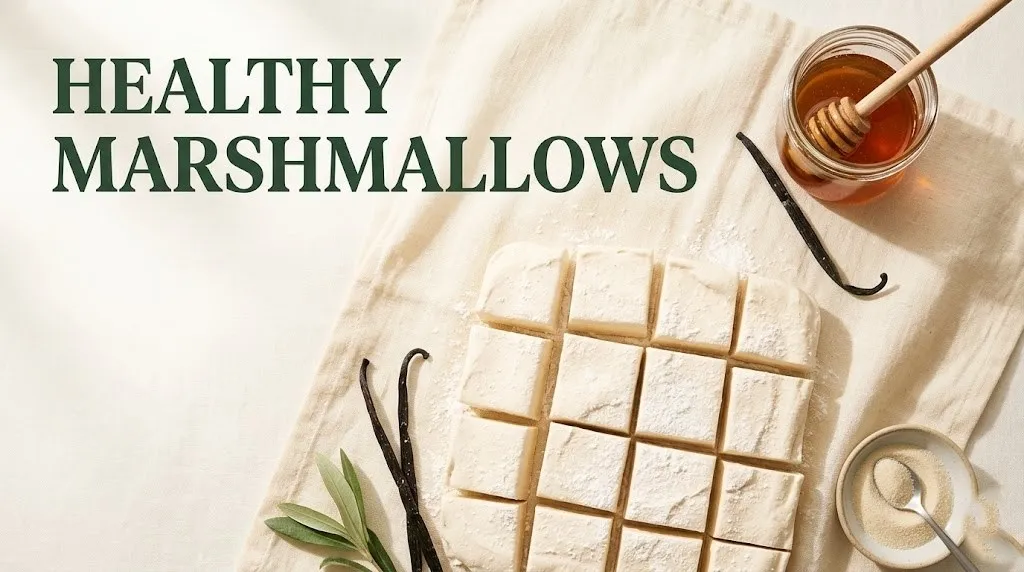
A standard commercial marshmallow gets its structure from corn syrup solids, modified starch, and gelatin. A homemade version replaces corn syrup with raw honey, maple syrup, or a non-nutritive sweetener, and uses unflavored gelatin as the sole structural agent.
Key differences between conventional and healthier marshmallows include:
- No high-fructose corn syrup or glucose syrup
- No tetrasodium pyrophosphate (a synthetic emulsifier used in commercial production)
- No artificial vanillin (derived from petrochemical or wood pulp sources rather than Vanilla planifolia)
- Sweetener source that allows more nutritional control
- Protein contribution from quality gelatin or plant-based alternatives
People with corn allergies, those on low-sugar diets, and parents looking for a more transparent treat option are typically the ones most motivated to make the switch.
Are Marshmallows Healthy?
Standard commercial marshmallows are not a nutritious food. They are almost entirely composed of added sugar and modified starch, with minimal protein and no fiber, fat, or meaningful micronutrient content.
That said, no individual food is inherently off-limits within a balanced eating pattern. The concern with commercial marshmallows isn’t that they’re toxic. It’s that they are high in added sugars, which the USDA Dietary Guidelines for Americans 2020-2025 advise limiting to less than 10% of total daily calories.
For a person eating 2,000 calories per day, that cap is 200 calories from added sugars, or roughly 50 grams. A 28-gram serving of Kraft Jet-Puffed marshmallows contains 23 grams of added sugar, which accounts for nearly half that daily limit before any other food enters the picture.
Homemade healthy marshmallows can reduce that sugar content by 40 to 70%, depending on the sweetener used. They also eliminate the synthetic additives. Whether that makes them “healthy” depends on serving size, frequency, and what the rest of the diet looks like.
| Marshmallow Type | Added Sugar per Serving | Notable Additives |
|---|---|---|
| Kraft Jet-Puffed (28g) | 23g | Corn syrup, tetrasodium pyrophosphate, artificial vanillin |
| Honey-based homemade (28g) | 13 to 16g | None synthetic |
| Monk fruit-sweetened homemade (28g) | 0g | None synthetic |
| Dandies Vegan Marshmallows (28g) | 17g | No gelatin; contains carrageenan |
People managing diabetes or insulin resistance should approach all marshmallow types with caution, since carbohydrate content remains present even in reduced-sugar versions.
What Are Marshmallows Made Of?
Marshmallows consist of three structural components: a sweetener, a protein network, and air. The protein network holds the whipped air in suspension. The sweetener provides body and flavor. Together, they create the foam-gel structure that gives marshmallows their distinctive chew.
In commercial production, the sweetener is glucose syrup or corn syrup, and the protein network comes from gelatin derived from porcine (pig) or bovine (cow) hide and bone. Manufacturers add modified starch for texture stability, tetrasodium pyrophosphate to prevent proteins from clumping, and artificial vanillin for flavor.
Homemade versions strip that down to essentials:
- Unflavored gelatin (bovine or porcine; 2.5 to 3 teaspoons per batch bloomed in cold water)
- Sweetener (raw honey, pure maple syrup, coconut sugar syrup, or non-nutritive alternatives)
- Water (for the sugar syrup; typically 0.5 cup per cup of sweetener)
- Vanilla extract (pure Vanilla planifolia extract, not artificial vanillin)
- Tapioca starch or arrowroot (for dusting the pan; replaces cornstarch for corn-free versions)
For vegan versions, agar-agar (a polysaccharide extracted from red algae, primarily Gracilaria and Gelidium species) replaces gelatin. The technique and the set quality differ meaningfully, which is covered in the vegan section below.
Quick Tip:
- Bloom gelatin in cold water for at least 5 minutes before adding hot syrup; skipping this step creates lumps.
- Use a candy thermometer. Guessing syrup temperature is the most common cause of batches that won’t set.
- Tapioca starch creates a lighter coating than cornstarch, with a less chalky finish.
Key Takeaway: Healthy marshmallows are defined by what they remove (corn syrup, synthetic stabilizers, artificial flavoring) and what they substitute (better sweeteners, quality gelatin, real vanilla), not just by being homemade.
Marshmallow Calories Per Serving
A standard serving of commercial marshmallows is 28 grams (approximately 4 regular-size marshmallows), which contains about 90 calories. That calorie count comes almost entirely from simple carbohydrates, with virtually no fat and less than 1 gram of protein.
Homemade healthy marshmallows made with honey or maple syrup land in a similar calorie range per gram of weight, but the carbohydrate profile differs. Raw honey contributes trace antioxidants (primarily flavonoids), while maple syrup provides small amounts of manganese and riboflavin. These are not large enough quantities to constitute a nutritional benefit, but they do represent an ingredient upgrade.
Versions sweetened with monk fruit sweetener (extracted from Siraitia grosvenorii, also called luo han guo) or erythritol drop the calorie count to approximately 15 to 25 calories per 28-gram serving, with 0 to 4 grams of net carbohydrates.
| Marshmallow Type | Calories (28g) | Total Carbs | Protein | Fat |
|---|---|---|---|---|
| Commercial (Kraft Jet-Puffed) | 90 | 23g | 0.5g | 0g |
| Honey-sweetened homemade | 70 to 85 | 18 to 21g | 1g | 0g |
| Maple syrup homemade | 75 to 90 | 19 to 22g | 1g | 0g |
| Monk fruit/erythritol homemade | 15 to 25 | 2 to 5g | 1g | 0g |
| Dandies Vegan Marshmallows | 90 | 22g | 0g | 0g |
People with diabetes or those tracking net carbohydrates should note that honey and maple syrup versions still carry meaningful carbohydrate loads. Serving size matters significantly with all versions.
Commercial vs Homemade Marshmallows Nutrition
The nutritional gap between commercial and homemade healthy marshmallows is clearest in the ingredient list, not just the macros. Calorie counts can look similar, but the source quality and additive profile differ substantially.
Kraft Jet-Puffed marshmallows list their ingredients as: sugar, modified corn starch, corn syrup, dextrose, water, gelatin, tetrasodium pyrophosphate, artificial flavor, and blue 1. The first four ingredients are all forms of sugar or glucose polymer. Blue 1 is a synthetic dye with no nutritional value.
A homemade version using raw honey, grass-fed bovine gelatin, water, and pure vanilla extract has four ingredients total. Every one of them is recognizable. None requires a chemistry degree to source.
According to the USDA FoodData Central database, the commercial version delivers 90 calories with 23 grams of added sugars per 28-gram serving and essentially zero micronutrients. A homemade version with the same gelatin base but half the sweetener delivers 45 to 55 calories, 10 to 13 grams of sugar, and marginally more protein from a higher gelatin ratio.
The practical difference for most households:
- Homemade versions give full control over sweetener type and quantity
- Commercial versions are more convenient but offer no real nutritional upside
- Natural store-bought brands like Dandies avoid corn syrup but still contain 17 grams of sugar per serving and use carrageenan as a gelling agent
- Grass-fed gelatin in homemade versions adds glycine and proline, two amino acids absent in plant-based alternatives
People following halal or kosher diets should verify gelatin sourcing. Porcine gelatin is not halal or kosher. Bovine gelatin certified halal or kosher is available from several specialty suppliers.
Gelatin Marshmallow Health Benefits
Gelatin contributes specific amino acids, primarily glycine, proline, and hydroxyproline, that are underrepresented in most modern diets. These are the structural amino acids of collagen, the most abundant protein in the human body.
A 2019 review published in the journal Nutrients found that glycine supplementation showed potential benefits for sleep quality and metabolic function in controlled studies. The amounts in marshmallows are small, but regular gelatin consumption contributes meaningfully to dietary glycine intake if the rest of the diet is gelatin-poor, which most Western diets are.
Gelatin used in homemade healthy marshmallows is typically sourced from bovine hide and bone. Grass-fed bovine gelatin has a similar amino acid profile to conventionally sourced gelatin but comes from cattle raised without added growth hormones or routine antibiotics. Bloom strength (a measure of gelatin’s setting power) matters for recipe results: a Bloom rating of 200 to 225 is standard for confectionery use.
Gelatin is not a complete protein. It lacks tryptophan, one of the nine essential amino acids. It should not be treated as a primary protein source. Think of it more like adding a useful supporting amino acid contribution alongside dietary protein from whole food sources.
| Amino Acid | Amount per 10g Gelatin | Role in the Body |
|---|---|---|
| Glycine | 2,300 to 2,700mg | Collagen synthesis, nervous system support |
| Proline | 1,200 to 1,400mg | Connective tissue repair |
| Hydroxyproline | 1,000 to 1,300mg | Collagen stabilization |
| Alanine | 800 to 1,000mg | Energy metabolism |
People who are vegetarian, vegan, or observant of halal or kosher dietary laws will need to use agar-agar or carrageenan instead of gelatin. These plant-based alternatives do not contribute the same amino acids.
Key Takeaway: Gelatin in homemade marshmallows adds glycine and proline to the diet, which most modern eating patterns are low in, but the protein contribution is modest and should not be the primary reason to eat them.
Healthy Alternative to Marshmallows
The best healthy alternative to marshmallows depends on what you’re using them for. If the goal is a campfire s’more or a hot cocoa topping, you want something that holds its shape and browns under heat. If the goal is a sweet, chewy snack on its own, the requirements are different.
For hot drinks: A small amount of whipped coconut cream (from chilled full-fat coconut milk) creates a similar rich, floating topping without any gelatin or sugar syrup. It melts more quickly but contributes healthy fats from medium-chain triglycerides rather than simple sugars.
For s’mores and toasted applications: Dandies brand vegan marshmallows are the most widely available natural alternative. They’re made with tapioca starch, carrageenan (a polysaccharide from red seaweed), and organic cane sugar. They toast and melt comparably to conventional marshmallows but still contain 17 grams of sugar per serving.
For rice crispy-style treats: Homemade versions using nut butter, oats, and a small amount of maple syrup or brown rice syrup bind well without requiring any gelatin or marshmallow base at all. This approach is lower in sugar and higher in fiber and protein per serving.
Common healthy alternatives:
- Unsweetened whipped coconut cream (for drinks and dessert toppings)
- Dandies vegan marshmallows (for toasting and s’mores)
- Oat and nut butter no-bake bars (for crispy treat applications)
- Frozen banana pieces (for sweet, creamy dessert bites without any added sugar)
- Date and nut truffles rolled in shredded coconut (for a chewy, confection-style snack)
People with tree nut allergies should avoid coconut cream and nut butter alternatives. People with seaweed or iodine sensitivities should be cautious with carrageenan-containing products.
Vegan Marshmallow Recipe: The Healthy Way
A healthy vegan marshmallow uses agar-agar instead of gelatin. The result is a firmer, slightly denser marshmallow with less elasticity, but one that sets reliably and works well in hot drinks and baked applications.
Agar-agar is derived from Gracilaria and Gelidium red algae species. It sets at room temperature and produces a firm gel even in acidic environments where gelatin can struggle. The standard substitution is roughly 1 teaspoon of agar powder to replace 1 tablespoon of gelatin powder, but texture will be firmer and less stretchy.
Aquafaba (the liquid from canned chickpeas) replaces egg whites in the whipping process. It whips to stiff peaks with cream of tartar and creates a foam that holds air well. The result won’t be identical to a gelatin-based marshmallow, but it’s genuinely workable.
Ingredients for vegan healthy marshmallows (yields approximately 24 pieces):
- 2 teaspoons agar-agar powder
- 0.5 cup aquafaba (from one 15-oz can of no-salt-added chickpeas)
- 0.25 teaspoon cream of tartar
- 0.75 cup pure maple syrup
- 0.25 cup water
- 1 teaspoon pure vanilla extract
- 3 tablespoons tapioca starch (for dusting the pan)
People with legume allergies should not use aquafaba. For those with soy allergies, confirm chickpeas are processed in a soy-free facility. Agar-agar is naturally vegan, gluten-free, and kosher/halal.
Quick Tip:
- Agar must be boiled to fully activate. Simmer the agar-water mixture for 2 full minutes before adding sweetener.
- Aquafaba whips best when chilled. Refrigerate the chickpea liquid for at least 1 hour before using.
- Vegan marshmallows made with agar will not toast the same way gelatin-based ones do. They hold their shape under heat rather than melting and browning.
Key Takeaway: Agar-agar is the right structural swap for vegan marshmallows, but expect a firmer, less elastic texture than gelatin-based versions. Aquafaba handles the whipping job well, and the result is both kosher and halal.
The Core Healthy Marshmallow Recipe
This healthy marshmallow recipe uses grass-fed bovine gelatin, raw honey or maple syrup, and pure vanilla extract. It produces 36 standard-size marshmallows with no corn syrup and no synthetic additives.
Ingredients (yields 36 pieces):
- 2.5 tablespoons unflavored grass-fed gelatin powder (bloomed in 0.5 cup cold water)
- 1 cup raw honey or pure maple syrup
- 0.25 cup water (for the syrup)
- 1 teaspoon pure vanilla extract
- 0.25 teaspoon fine sea salt
- 3 tablespoons tapioca starch (mixed with 3 tablespoons arrowroot powder, for dusting)
Equipment needed:
- Candy thermometer
- Stand mixer with whisk attachment (or hand mixer)
- 9×13-inch baking pan, lightly greased
- Medium heavy-bottomed saucepan
Approximate nutritional profile per 2-marshmallow serving (honey version): 40 to 50 calories, 10 to 12g carbohydrate, 0.5g protein, 0g fat.
People with bee pollen allergies should use maple syrup instead of raw honey. The recipe is naturally gluten-free when tapioca starch is used for dusting.
How to Make Healthy Marshmallows Step by Step
Making healthy marshmallows correctly depends on sugar syrup temperature above all else. A candy thermometer is the single piece of equipment that separates a successful batch from a liquid mess.
Think of the marshmallow-making process like building a suspension bridge. The gelatin strands are the cables. The whipped air is the structure in between. The hot syrup is the cement that locks everything in place. Get the temperature right, and the bridge holds. Get it wrong, and the whole thing collapses.
To make healthy marshmallows:
- Combine 2.5 tablespoons gelatin powder with 0.5 cup cold water in the bowl of your stand mixer. Stir once, then let it bloom undisturbed for 5 to 8 minutes until fully hydrated and gel-like.
- Combine 1 cup raw honey and 0.25 cup water in a medium heavy-bottomed saucepan over medium heat. Clip the candy thermometer to the side of the pan.
- Bring the syrup to a boil without stirring. Continue cooking until the thermometer reads exactly 240°F (116°C). This is the soft-ball stage. Remove immediately from heat.
- With the stand mixer running on low speed, slowly pour the hot syrup in a thin, steady stream down the side of the bowl directly onto the bloomed gelatin. Do not pour the syrup onto the whisk. It will splatter.
- Once all the syrup is added, increase the mixer speed to high. Beat for 10 to 12 minutes until the mixture is thick, glossy white, and holds stiff peaks. Add the vanilla extract and sea salt in the final 2 minutes of mixing.
- Working quickly, transfer the mixture to a lightly greased 9×13-inch pan dusted with the tapioca starch and arrowroot mixture. Smooth the top with an oiled spatula.
- Dust the surface generously with the remaining starch mixture. Let the marshmallows set at room temperature for 4 to 6 hours, or overnight. Do not refrigerate during setting.
- Cut into squares using a sharp oiled knife or an oiled pizza cutter. Toss each piece in additional starch mixture to coat all sides. Shake off the excess.
Low Sugar Marshmallow Recipe Variations
A low sugar marshmallow recipe replaces all or part of the liquid sweetener with a non-nutritive or low-glycemic alternative while maintaining the same syrup structure and set quality. The key is finding a sweetener that behaves correctly at 240°F.
According to the Academy of Nutrition and Dietetics, non-nutritive sweeteners like monk fruit and erythritol are generally recognized as safe (GRAS) by the FDA and are suitable for most people, including those managing blood sugar. However, some people experience gastrointestinal discomfort from erythritol at quantities above 30 to 50 grams, particularly if consumed on an empty stomach.
Successful low-sugar substitutions:
| Sweetener | Sugar Reduction vs Honey | Texture Impact | Notes |
|---|---|---|---|
| Monk fruit liquid sweetener | 95 to 100% sugar-free | Slightly lighter set | Best blended with a small amount of allulose for body |
| Erythritol + allulose blend (70/30) | 90 to 95% reduction | Very close to honey version | Allulose prevents re-crystallization |
| Coconut sugar syrup | 30% lower GI than cane sugar | Nearly identical | Still contains 15 to 17g carbs per serving |
| Pure maple syrup | Similar carbs to honey | Slightly softer | Adds distinct flavor; contains trace manganese |
Note: Xylitol is sometimes suggested as a low-calorie sweetener in marshmallow recipes. It is safe for humans at normal serving sizes but is toxic to dogs. Households with dogs should avoid using xylitol in any recipe that might be accessible to pets.
People following low-FODMAP diets should avoid inulin-based sweeteners and high-fructose options. Erythritol is generally well-tolerated within the low-FODMAP framework.
Key Takeaway: Monk fruit and allulose are the most technically reliable low-sugar sweeteners for marshmallow recipes because they tolerate heat well, don’t re-crystallize, and produce a texture close to the honey-sweetened version.
Honey Marshmallow Recipe
A honey marshmallow uses raw honey as its sole sweetener, which lowers the glycemic load slightly compared to refined white sugar and adds a gentle floral complexity to the flavor. Raw honey also contains trace flavonoids and phenolic compounds, though the amounts per serving of marshmallow are small.
The practical challenge with honey marshmallows is that raw honey contains natural enzymes and a higher water content than crystalline sugar. This can cause the syrup to foam heavily during cooking. Use a saucepan at least three times the volume of your ingredients to prevent boil-overs.
Honey marshmallow recipe specifics (modified from the base recipe):
- Use 1 cup raw honey in place of granulated sugar. No other sweetener adjustments needed.
- Reduce water in the syrup to 2 tablespoons instead of 0.25 cup. Honey already contributes moisture.
- Cook to 240°F (116°C) exactly. Honey caramelizes slightly faster than sugar; watch the thermometer closely.
- Expect a slightly ivory or golden color rather than pure white. This is normal and indicates real honey, not a visual flaw.
- Flavor profile: light floral, slightly caramel, distinctly more complex than the refined-sugar version.
A published research summary from the American Journal of Clinical Nutrition noted that substituting raw honey for refined sugar in recipes reduces the glycemic response compared to equivalent doses of glucose syrup, though total carbohydrate content remains similar. The benefit is meaningful but modest.
People with pollen allergies should approach raw honey cautiously, as it may contain trace pollen proteins. Pasteurized honey is safer for those with pollen sensitivities but lacks the enzyme and antioxidant profile of raw varieties.
Keto Marshmallow Recipe
A keto marshmallow recipe targets fewer than 5 grams of net carbohydrates per serving by replacing all caloric sweeteners with a monk fruit and allulose combination. The technique mirrors the standard gelatin method but requires understanding how these sweeteners behave differently under heat.
Allulose is a rare sugar that occurs naturally in small amounts in figs and wheat. It contributes body and a browning reaction similar to regular sugar, but the body absorbs it without metabolizing it for energy. The FDA has confirmed that allulose can be excluded from the “total sugars” count on nutrition labels, making it a genuinely keto-compatible sweetener.
Keto marshmallow recipe (yields 36 pieces):
- 2.5 tablespoons unflavored gelatin powder, bloomed in 0.5 cup cold water
- 0.75 cup allulose
- 0.25 cup monk fruit liquid sweetener (Siraitia grosvenorii extract)
- 0.25 cup water
- 1 teaspoon pure vanilla extract
- Pinch of fine sea salt
- Tapioca starch and arrowroot for dusting
Cook the allulose and monk fruit syrup to 230 to 235°F (110 to 113°C). Allulose sets at a slightly lower temperature than sucrose; overheating causes bitterness. Pour over bloomed gelatin and whip as directed in the base recipe.
Approximate nutrition per 2-marshmallow serving: 15 to 20 calories, 0.5 to 1g net carbohydrate, 1g protein, 0g fat.
People on strict ketogenic diets for medical reasons (such as epilepsy management) should confirm specific sweetener tolerances with the specialist overseeing their diet before making substitutions.
Marshmallows for Diabetics: What You Need to Know
People with diabetes should treat all marshmallow types with care, because even reduced-sugar versions contribute carbohydrates that affect blood glucose levels. The relevant factor is total carbohydrate content and glycemic load, not just the presence or absence of refined sugar.
Standard commercial marshmallows have a high glycemic index, roughly 60 to 70, because they’re almost entirely composed of rapidly digested simple sugars. Honey-based homemade marshmallows have a modestly lower glycemic response, but still contribute 10 to 14 grams of carbohydrate per 2-piece serving.
Monk fruit and allulose-based keto marshmallows are the lowest-carbohydrate option for people with type 1 or type 2 diabetes, with approximately 1 gram of net carbohydrate per serving. However, Harvard T.H. Chan School of Public Health researchers have noted that individual glycemic responses to any food vary substantially depending on insulin sensitivity, meal composition, and timing. A small portion of even a reduced-sugar marshmallow could affect blood glucose differently in different people.
| Marshmallow Type | Glycemic Index (approx) | Net Carbs per 2 pieces | Suitable for Diabetics? |
|---|---|---|---|
| Commercial (Kraft Jet-Puffed) | 60 to 70 | 11g | Use with caution |
| Honey-based homemade | 50 to 60 | 8 to 10g | Small portions only |
| Maple syrup homemade | 50 to 60 | 9 to 11g | Small portions only |
| Monk fruit/allulose keto | Less than 10 | 0.5 to 1g | Generally suitable |
| Dandies Vegan | 55 to 65 | 10g | Use with caution |
People managing diabetes with insulin or medication should work with a registered dietitian to determine whether and how often reduced-sugar marshmallows fit their specific carbohydrate targets. The figures above are estimates and individual responses will vary.
Key Takeaway: For people managing blood sugar, keto marshmallows made with allulose and monk fruit are the only version with a low enough carbohydrate count to use comfortably, but individual blood glucose responses vary and portion control matters regardless of sweetener type.
How to Store Homemade Healthy Marshmallows
Homemade healthy marshmallows last 2 to 3 weeks at room temperature when properly stored. They are best kept in an airtight container at room temperature, layered with parchment paper and dusted with tapioca starch or arrowroot to prevent sticking.
Refrigeration is not recommended after the marshmallows have set. Cold temperatures cause gelatin-based marshmallows to become dense and lose their airy texture. If your kitchen runs very warm (above 80°F / 27°C), a cool pantry or cupboard away from direct sunlight is a better option than the counter.
Storage guidelines by method:
| Storage Method | Shelf Life | Texture Impact | Notes |
|---|---|---|---|
| Airtight container, room temperature | 2 to 3 weeks | Best | Layer with parchment; dust with starch |
| Refrigerator | 3 to 4 weeks | Becomes denser | Texture degrades; not recommended |
| Freezer | Up to 3 months | Good after thawing | Freeze in single layers on parchment before storing in bags |
| Uncovered at room temperature | 2 to 3 days | Dries out and forms a crust | Fine for intentional drying; not for storage |
To freeze, lay cut marshmallows in a single layer on a parchment-lined sheet pan and freeze uncovered for 1 hour. Transfer to a zip-close freezer bag with all air squeezed out. Thaw at room temperature for 20 minutes before serving.
Vegan agar-agar marshmallows are more stable at room temperature but can develop surface moisture in humid environments. Store them in a cool, dry place and consume within 10 to 14 days for best texture.
Quick Tip:
- Always dust cut surfaces generously with starch. Without it, marshmallows fuse together within hours.
- Do not store near strong-smelling foods. Gelatin absorbs odors readily.
- For gifting, wrap individual marshmallows in parchment squares and tie with twine.
Frequently Asked Questions About Healthy Marshmallows
What makes a marshmallow healthy compared to a regular one?
A healthy marshmallow replaces corn syrup with a better sweetener, removes synthetic additives, and uses clean-source gelatin or plant-based agar-agar as the structural base.
The measurable differences include lower added sugar content, absence of tetrasodium pyrophosphate and artificial flavoring, and ingredient transparency.
Whether a marshmallow is “healthy” ultimately depends on serving size and the overall pattern of the diet it fits into.
Can I eat marshmallows on a low-sugar or diabetic diet?
Standard commercial marshmallows are not suitable for low-sugar or diabetic diets because they contain 23 grams of added sugar per 28-gram serving.
Monk fruit and allulose-based keto marshmallows contain less than 1 gram of net carbohydrate per serving and are generally a better fit for people managing blood sugar.
Individual responses to any carbohydrate-containing food vary, and people using insulin or blood glucose medication should confirm specific serving limits with a registered dietitian.
What is a good vegan substitute for gelatin in marshmallows?
Agar-agar powder, derived from Gracilaria and Gelidium red algae, is the most reliable vegan substitute for gelatin in marshmallow recipes.
Use approximately 1 teaspoon of agar powder in place of 1 tablespoon of gelatin powder, and boil the agar in water for 2 full minutes to fully activate it.
The result will be firmer and less elastic than a gelatin-based marshmallow, but it sets reliably, is kosher and halal, and works well in hot drinks.
How many calories are in a homemade healthy marshmallow?
A 2-marshmallow serving of honey-based homemade marshmallows contains approximately 40 to 50 calories and 10 to 12 grams of carbohydrate.
Monk fruit and allulose-sweetened keto marshmallows drop to 15 to 20 calories and less than 1 gram of net carbohydrate for the same serving size.
These figures vary depending on the exact sweetener used and the size of each marshmallow cut from the batch.
How long do homemade healthy marshmallows last?
Homemade healthy marshmallows last 2 to 3 weeks in an airtight container at room temperature when dusted with tapioca starch and layered with parchment paper.
They can be frozen for up to 3 months by layering them on parchment and sealing in a freezer bag with all air removed.
Refrigeration is not recommended because cold temperatures make gelatin-based marshmallows dense and chewy rather than light and airy.
Closing
Healthy marshmallows are worth making from scratch once you understand what you’re replacing and why. The changes are specific and measurable: less sugar, no synthetic stabilizers, better ingredient sourcing, and a protein contribution from real gelatin that commercial bags simply don’t provide.
Start with the base honey or maple syrup recipe to get comfortable with the technique. Then try the monk fruit and allulose version if you want to cut carbohydrates further. The process is the same. The results are reliably good.
Keep a candy thermometer in your kitchen. That one tool is the difference between marshmallows that set perfectly and a batch that goes straight to the bin.