Healthy Thai food centers on broth-based soups, fresh herb-laden salads, lean protein stir-fries with vegetables, and curries ordered with extra vegetables and light rice, while the less healthy choices are usually deep-fried appetizers, noodle-heavy dishes with too much oil, and curries drowned in full-fat coconut milk.
Thai food occupies a strange space in the American food landscape. It tastes bright, fresh, and herbaceous, which signals healthy. The presence of lemongrass, lime, chilies, and basil in many dishes creates an impression of lightness that other takeout cuisines lack. The reality is more complicated. A bowl of Tom Yum soup can be one of the healthiest meals available from any restaurant. An order of Pad Thai from the same kitchen can deliver more than 1,000 calories and a full day’s worth of sodium.
The Academy of Nutrition and Dietetics notes that restaurant meals average significantly more calories, saturated fat, and sodium than home-cooked versions of the same dishes. This is particularly true for Thai food in the United States, where recipes have been adapted over decades to use more oil, more sugar, and larger portions than traditional Thai cooking. This article gives you a decision framework that works with any Thai menu, plus specific dish guidance, dietary adaptations, and home cooking strategies.
Is Thai Food Healthy or Unhealthy
Thai food can be exceptionally healthy when built around broth-based soups, fresh salads, grilled proteins, and vegetable-heavy stir-fries, but it can also be calorie-dense and sodium-heavy when centered on fried foods, noodle dishes swimming in oil, and curries made with large amounts of full-fat coconut milk.
The question has no single answer because Thai food is not one thing. It is an entire cuisine spanning multiple regions with different ingredients, techniques, and traditions. Northern Thai food uses more herbs and grilled meats. Southern Thai food uses more coconut milk and seafood. Central Thai food, the style most common in American restaurants, balances sweet, sour, salty, and spicy in dishes often adapted for American palates with more sugar and less chili heat.
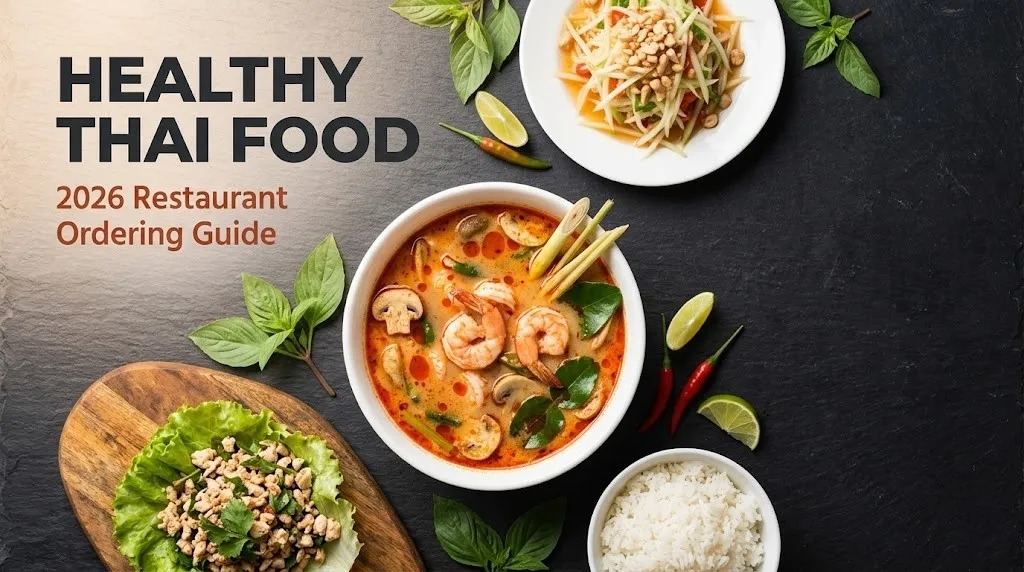
The nutritional strengths of Thai cuisine are real. Fresh herbs like lemongrass, Thai basil, cilantro, and mint appear in nearly every dish, contributing antioxidants and phytochemicals without calories. Galangal, a rhizome related to ginger, contains compounds that research in the Journal of Ethnopharmacology suggests have anti-inflammatory properties. Chili peppers provide capsaicin, which a 2022 meta-analysis in Nutrients associated with modest increases in metabolic rate and fat oxidation.
The weaknesses come from adaptation and execution. American Thai restaurants often add more sugar to balance flavors for Western palates. Fish sauce and soy sauce concentrate sodium to levels that can exceed 2,000 milligrams in a single dish. Coconut milk, while containing medium-chain triglycerides that some research suggests are metabolized differently than other saturated fats, is still predominantly saturated fat. The American Heart Association continues to recommend limiting saturated fat intake regardless of the source.
Here is how different Thai dish categories fall on the health spectrum:
| Healthier End | Middle Ground | Less Healthy End |
|---|---|---|
| Tom Yum soup (broth-based) | Green curry with extra vegetables | Massaman curry (heaviest coconut milk) |
| Som Tam (green papaya salad) | Pad Kra Pow (basil stir fry) | Pad Thai (sugar and oil-heavy noodles) |
| Larb (minced meat salad) | Tom Kha Gai (coconut soup, moderate) | Pad See Ew (wide noodles, heavy sauce) |
| Yum Neua (grilled beef salad) | Chicken satay (grilled, watch sauce) | Fried spring rolls, crab rangoon |
| Steamed fish with lime and chili | Panang curry (medium coconut milk) | Fried rice (oil-heavy preparation) |
Key Takeaway: Thai food spans the entire spectrum from genuinely healthy to indulgent. The decision framework in the sections that follow helps you pick the right end of that spectrum regardless of what is on the menu.
What Makes Thai Food Healthy
Thai food is healthy when it features lean proteins, abundant vegetables and fresh herbs, broth-based preparations instead of coconut milk or heavy oil, and traditional seasonings used in balance rather than in the sugar-heavy concentrations common in Americanized versions.
The healthiest Thai dishes share four characteristics. Learn these, and you can evaluate any dish on any menu without memorizing a list.
Broth-based rather than coconut milk-based. Soups like Tom Yum use a clear, spicy-sour broth that contributes roughly 50 to 80 calories per cup. Coconut milk soups like Tom Kha use a base that contributes 200 to 300 calories per cup from saturated fat. Both are traditional. One is significantly lighter.
Abundant non-starchy vegetables. The best Thai dishes are vegetable-forward by design. Som Tam is primarily shredded green papaya. Pad Kra Pow should be mostly green beans, bell peppers, onions, and Thai basil with protein as a component, not the entire dish. A plate that is half vegetables with protein and a reasonable amount of rice matches the USDA Dietary Guidelines’ healthy plate model.
Lean protein prepared with high heat and minimal oil. Grilled, steamed, or quickly stir-fried proteins like chicken breast, shrimp, or tofu deliver the satiety and amino acids of a complete meal without the calorie load of breaded and fried options. Grilled satay without excessive peanut sauce is a strong choice. Steamed fish with lime and chili is arguably the single healthiest Thai entree.
Flavor from herbs and spices rather than sugar and oil. Traditional Thai cooking achieves its layered flavors through aromatics and spices, not through added sugar. The sweet component should come from palm sugar used sparingly, not from tablespoons of refined sugar added to every sauce. The difference between a traditional and Americanized version of the same dish often comes down to sugar volume.
The nutrition research on specific Thai ingredients supports their health value. Capsaicin from chili peppers has been studied for its thermogenic effect. A 2021 study in the journal Appetite found that capsaicin consumption modestly increased energy expenditure and reduced subsequent calorie intake. Lemongrass contains citral, a compound with demonstrated antimicrobial activity in laboratory studies. Galangal contains gingerol-related compounds that inhibit inflammatory pathways in cell models.
These effects are real but modest. No single ingredient transforms a 1,200-calorie pad thai into health food. The overall composition of the plate matters more than any individual herb.
Healthiest Thai Food Dishes to Order
The healthiest Thai dishes to order are Tom Yum Goong (spicy shrimp soup), Som Tam (green papaya salad), Larb Gai (minced chicken salad), Yum Neua (grilled beef salad), and Pad Kra Pow (Thai basil stir fry) with lean protein and light rice on the side.
These five dishes represent the best of Thai cooking from a nutritional perspective. They are vegetable-forward or broth-based, use lean proteins, rely on herbs and spices for flavor rather than heavy sauces, and are difficult to make unhealthy unless a restaurant deliberately adds excessive oil or sugar.
Here are the top five with estimated nutritional profiles and what to look for:
| Dish | What It Is | Approximate Calories | Key Nutrients | What to Watch For |
|---|---|---|---|---|
| Tom Yum Goong | Spicy-sour shrimp soup with lemongrass, galangal, lime, chilies | 150-200 per bowl | Lean protein, vitamin C, capsaicin | Some versions add coconut milk; ask for “clear” |
| Som Tam | Shredded green papaya salad with lime, fish sauce, chilies, peanuts | 150-200 per serving | Fiber, vitamin C, vitamin A | Dressing can be high-sodium; request light dressing |
| Larb Gai | Minced chicken salad with lime, fish sauce, herbs, toasted rice powder | 200-250 per serving | Lean protein, iron, B vitamins | Some versions are oily; should be light and bright |
| Yum Neua | Grilled sliced beef salad with cucumber, tomato, herbs, lime dressing | 250-300 per serving | Protein, iron, zinc, vitamin C | Choose lean beef; dressing on the side |
| Pad Kra Pow | Stir-fried meat with Thai basil, chilies, garlic, green beans, bell pepper | 300-400 with light rice | Protein, fiber, capsaicin | Request less oil; specify “not too much sugar” |
Pad Kra Pow deserves special mention. It is not on most “healthy Thai” lists because the Americanized version can be oily and sweet. But the dish as traditionally prepared is a quick, high-heat stir-fry of ground or sliced meat with garlic, chilies, and a generous handful of holy basil or Thai basil, served over rice with a fried egg on top. Ask for “less oil, not too much sugar, extra vegetables” and you have a protein-rich, vegetable-forward meal.
Dietary Sensitivity Note: Several of these dishes contain fish sauce, which is made from fermented fish and is not vegetarian or vegan. Larb and Yum traditionally contain fish sauce and toasted rice powder, making them not strictly gluten-free. Ask for gluten-free soy sauce or coconut aminos as a substitute if needed.
Healthy Thai Soups
Tom Yum soup is the healthiest Thai soup because its clear, spicy-sour broth contains minimal calories and saturated fat while delivering lean protein, aromatic herbs with anti-inflammatory compounds, and significant volume for satiety at roughly 150 to 200 calories per generous bowl.
Thai soups fall into two categories: clear broth soups and coconut milk soups. The nutritional difference between them is substantial.
Tom Yum is the clear broth champion. The broth is made by simmering lemongrass, galangal, kaffir lime leaves, and chilies in water or light stock. No coconut milk in the traditional version. Shrimp or chicken provides lean protein. Mushrooms add bulk and umami. The entire bowl delivers intense flavor, satisfying volume, and protein for fewer calories than a single slice of cheese pizza.
Tom Kha Gai is the coconut milk soup made with chicken, galangal, and mushrooms. It is richer, creamier, and higher in calories, approximately 300 to 400 per bowl. The saturated fat from coconut milk is the primary calorie source. Tom Kha is not unhealthy. It is simply more calorie-dense. For someone on a low-carb diet, the fat content may fit their macros. For someone watching saturated fat, Tom Yum is the better choice.
Here is a comparison of common Thai soups:
| Soup | Base | Calories (bowl) | Saturated Fat | Protein |
|---|---|---|---|---|
| Tom Yum Goong (shrimp) | Clear broth | 150-200 | 1-2g | 15-20g |
| Tom Yum Gai (chicken) | Clear broth | 160-210 | 1-2g | 18-22g |
| Tom Kha Gai | Coconut milk | 300-400 | 15-20g | 20-25g |
| Gang Jued (clear vegetable soup) | Clear broth | 100-150 | 0-1g | 5-10g |
Gang Jued is worth knowing about even though it rarely makes “best of” lists. It is a humble clear soup with vegetables and sometimes ground pork or tofu. It is the lightest soup on a Thai menu and an excellent starter to fill stomach volume before richer dishes arrive.
Quick Tip:
- Order Tom Yum “clear” or “without coconut milk” to ensure the kitchen does not add coconut milk, which some Americanized restaurants do by default. If you want Tom Kha but lighter, ask for “light coconut milk” or “half coconut milk.”
Healthy Thai Salads
Thai salads like Som Tam (green papaya salad), Larb (minced meat salad), and Yum (mixed salads with protein) are among the healthiest dishes in any cuisine because they combine lean protein, raw or lightly cooked vegetables, and fresh herbs with a lime-based dressing that contains no oil or minimal oil.
Thai salads are categorically different from Western salads. They are not side dishes. They are main courses built around a protein and dressed assertively with lime juice, fish sauce, chilies, and sometimes a small amount of sugar. The dressing is a vinaigrette in principle but lighter, sharper, and more intensely flavored.
Som Tam is the most famous Thai salad: shredded unripe green papaya pounded in a mortar with garlic, chilies, fish sauce, lime juice, cherry tomatoes, long beans, and peanuts. The papaya contributes fiber, vitamin C, and a satisfying crunch. A full serving with peanuts sits around 150 to 200 calories.
Larb is the minced meat salad of Isan cuisine in northeastern Thailand. Ground chicken, pork, or beef is cooked and then tossed while warm with lime juice, fish sauce, ground dried chilies, shallots, mint, cilantro, and toasted rice powder. Served with raw vegetables and sticky rice. The protein is front and center. The herbs provide brightness. The rice powder adds a toasty crunch.
Yum Neua (beef salad) and Yum Woon Sen (glass noodle salad with seafood) follow the same template: a protein, fresh herbs, a lime-fish sauce dressing, and vegetables.
The nutritional advantage of Thai salads:
- Dressing based on lime juice and fish sauce rather than oil, reducing calorie density
- Fresh herbs (mint, cilantro, Thai basil) in quantities that provide meaningful phytonutrient content
- Protein-centric composition supports satiety
- No creamy elements, no cheese, minimal processed ingredients
Here is how common Thai salads compare nutritionally:
| Salad | Protein Source | Calories (full order) | Key Feature |
|---|---|---|---|
| Som Tam | Shrimp or none (traditional) | 150-200 | High fiber, vitamin C |
| Larb Gai | Minced chicken | 200-250 | High protein, low fat |
| Yum Neua | Grilled sliced beef | 250-300 | Iron-rich, satisfying |
| Yum Woon Sen | Shrimp and squid | 200-280 | Glass noodles add texture |
| Pla Goong | Grilled shrimp | 180-230 | Lean seafood, bright flavor |
Dietary Sensitivity Note: Most Thai salads contain fish sauce and dried shrimp or shrimp paste. Strict vegetarians and vegans should request “no fish sauce, use soy sauce” and confirm no shrimp paste in the dressing. Larb and Yum traditionally contain toasted rice powder, making them not gluten-free by default, though the amount of gluten is minimal and most people with gluten sensitivity tolerate it.
Key Takeaway: Thai salads are complete meals in a bowl: lean protein, fresh vegetables, and a lime-based dressing that adds flavor without the calories of oil-based dressings. A Thai salad plus a cup of Tom Yum soup is one of the healthiest restaurant meals available anywhere.
Healthy Thai Stir Fry Dishes
Healthy Thai stir fries feature lean protein quickly cooked with vegetables, garlic, chilies, and fresh herbs at high heat with minimal oil, making Pad Kra Pow (basil stir fry) and Pad Prik Khing (dry curry stir fry) the best choices when ordered with extra vegetables and sauce on the side.
Stir frying is a healthy cooking method when done properly. High heat and fast cooking preserve vegetable texture and nutrients. Minimal oil keeps calorie density low. The wok hei, the smoky flavor from a properly hot wok, adds depth without added fat.
The problem in many American Thai restaurants is oil volume. A properly executed Thai stir fry uses one to two tablespoons of oil for a full portion. Some restaurants use significantly more. The dish arrives glistening, almost pooling with oil. Asking for “less oil” is the most important modification you can make to a stir fry order.
Pad Kra Pow (also spelled Pad Krapow) is the stir fry to order. Ground or sliced meat stir-fried with garlic, Thai chilies, green beans or long beans, bell peppers, onions, and a generous amount of Thai holy basil or Thai basil. The sauce is a savory combination of fish sauce, soy sauce, and a small amount of sugar. Served over rice. Ask for light oil, extra vegetables, and sauce on the side. A properly prepared version with chicken sits around 300 to 400 calories plus rice.
Pad Prik Khing is a dry curry stir fry that uses curry paste without coconut milk. Green beans and protein are stir-fried with prik khing curry paste, which is thicker and spicier than the paste used in coconut milk curries. No coconut milk means significantly less saturated fat. The green beans add fiber and bulk.
Less healthy stir fries to approach carefully:
- Pad See Ew uses wide, flat rice noodles that absorb oil and sauce. A typical order can run 700 to 1,000 calories with more than 2,000 milligrams of sodium.
- Cashew chicken, while containing protein and vegetables, is often made with a sweet, oily sauce and generous portions of oil-roasted cashews that add 200-plus calories of fat.
- Pad Thai, addressed in detail in its own section, is a noodle dish, not a stir fry, and is often the highest-calorie item on a Thai menu.
Quick Tip:
- The words “pad” (stir-fried) and “kaeng” (curry) tell you the cooking method. Look for stir fries with vegetable names in the dish title (pad pak = stir-fried vegetables, pad kra pow = basil stir fry, pad prik khing = dry curry stir fry). Dishes named for their protein plus vegetables tend to be more vegetable-forward.
Are Thai Curries Healthy
Thai curries exist on a spectrum from moderately healthy to indulgent, with green curry and panang curry on the lighter end due to their higher proportion of herbs and spices to coconut milk, and massaman curry on the richer end due to its coconut cream, potatoes, and peanuts.
The coconut milk question is at the center of any discussion about Thai curry health. Coconut milk is approximately 17 to 24 percent fat, predominantly saturated fat. A cup of full-fat coconut milk contains roughly 450 calories and 40 grams of saturated fat. A typical curry portion uses one-third to one-half cup of coconut milk per serving.
The American Heart Association recommends limiting saturated fat to 5 to 6 percent of daily calories. For a 2,000-calorie diet, that is about 13 grams. A serving of Thai green curry can deliver 10 to 15 grams of saturated fat from coconut milk alone. That does not make it unhealthy. It makes it a food to eat with awareness rather than avoidance.
Here is how the major Thai curries compare:
| Curry | Coconut Milk Level | Saturated Fat (approx per serving) | Distinctive Ingredients |
|---|---|---|---|
| Green Curry | Moderate | 8-12g | Green chilies, Thai basil, bamboo shoots |
| Red Curry | Moderate | 10-14g | Dried red chilies, bamboo shoots, bell pepper |
| Panang Curry | Moderate-High | 12-16g | Thicker paste, lime leaves, peanuts |
| Massaman Curry | High | 16-22g | Potatoes, peanuts, cinnamon, cardamom |
| Yellow Curry | Moderate | 8-12g | Turmeric, potatoes, onions |
Green curry is generally the lightest option. The green chili paste is high in fresh herbs. The traditional vegetables are bamboo shoots, Thai eggplant, and bell peppers. Ask for extra vegetables and order with a half portion of rice.
Panang and massaman curries are the richest. Panang uses a thicker coconut cream base. Massaman is influenced by Indian and Malay cooking traditions and includes potatoes and peanuts in addition to coconut milk, making it the most calorie-dense Thai curry.
Strategies for making any Thai curry healthier:
- Request “extra vegetables, light coconut milk” or “half coconut milk, half broth”
- Choose lean proteins like chicken breast, shrimp, or tofu
- Eat with a smaller portion of rice; the curry itself is calorie-dense
- Share one curry order and add a Tom Yum soup or Thai salad to round out the meal
- Look for “jungle curry” (gaeng pa) on menus, it is a rare coconut-milk-free curry from northern Thailand that uses a spicy water-based broth
Dietary Sensitivity Note: Most Thai curry pastes contain shrimp paste. Vegetarians and people with shellfish allergies should confirm whether the restaurant’s curry paste is made with shrimp paste. Vegan curries are possible if the restaurant uses a shrimp-paste-free curry paste and replaces fish sauce with salt or soy sauce.
Is Pad Thai Healthy
Pad Thai is not a healthy choice by default because it is a noodle-heavy dish made with significant oil, sugar in the tamarind sauce, and large portions that can exceed 800 to 1,200 calories at many restaurants, but it can be made healthier with specific modifications.
Pad Thai is the most ordered Thai dish in America. It is also the most misunderstood from a nutritional perspective. The combination of rice noodles, peanuts, bean sprouts, egg, and a tamarind-based sauce sounds reasonable on paper. The execution at most restaurants turns it into one of the highest-calorie items on the menu.
The problems with restaurant pad thai:
- Oil volume: To prevent rice noodles from sticking to the wok, kitchens often use three to four tablespoons of oil for a single portion, adding 360 to 480 calories from oil alone.
- Sugar in the sauce: The tamarind-based sauce is balanced with sugar, sometimes palm sugar and sometimes refined white sugar. A typical pad thai sauce contains two to three tablespoons of sugar.
- Noodle portion: Restaurant pad thai often contains four to five cups of cooked rice noodles, roughly 600 to 800 calories of carbohydrates before adding any sauce, protein, or oil.
- Hidden sodium: Fish sauce, soy sauce, and sometimes additional salt contribute 1,500 to 2,500 milligrams of sodium per serving.
A typical restaurant portion of pad thai with chicken contains approximately:
| Nutrient | Restaurant Pad Thai (full order) |
|---|---|
| Calories | 800-1,200 |
| Carbohydrates | 100-150g |
| Protein | 25-35g |
| Total Fat | 30-50g |
| Sodium | 1,500-2,500mg |
| Added Sugars | 15-25g |
To make pad thai healthier when ordering out:
- Ask for “less oil” when stir-frying
- Request sauce on the side and use half
- Share one order between two people and add a Thai salad or Tom Yum soup
- Ask for extra bean sprouts and vegetables
- Choose shrimp or tofu for leaner protein
To make healthier pad thai at home, use one tablespoon of oil for the entire batch, two tablespoons of sugar in the sauce instead of a quarter cup, and bulk the dish with extra bean sprouts, shredded cabbage, and carrots. The calorie count drops to approximately 400 to 500 per serving with the same flavor profile.
Key Takeaway: Pad thai is a delicious occasional indulgence, not a health food. If you love it, eat it less often, share it, or learn to make a lighter version at home where you control the oil and sugar.
How to Order Healthy at a Thai Restaurant
Order healthy at a Thai restaurant by choosing broth-based soups and fresh salads over fried appetizers and heavy curries, requesting less oil and sauce on the side for stir-fries, eating rice as a side rather than the main event, and starting with a clear soup to fill stomach volume before richer dishes arrive.
These strategies work at any Thai restaurant, from a strip mall takeout counter to a high-end dining room. You do not need to memorize specific dishes. You need a decision framework.
Start with a broth-based soup. Tom Yum or a clear vegetable soup fills stomach volume for 100 to 200 calories. This reduces the amount of rice, noodles, or curry you eat in the main course without feeling deprived.
Choose a salad as your main or shared starter. Som Tam, Larb, or Yum Neua are complete protein-vegetable meals. A salad plus soup can be your entire order.
Apply the “half vegetables” rule. Whatever you order, ask for extra vegetables. Stir fries, curries, and noodle dishes can all accommodate more broccoli, bell peppers, green beans, bamboo shoots, and leafy greens. The vegetables displace some of the rice, noodles, or rich sauce.
Modify with specific requests, not general ones. “Make it healthy” is meaningless to a line cook. These requests are actionable:
- “Less oil, please”
- “Light on the fish sauce”
- “Sauce on the side”
- “Brown rice instead of white rice”
- “Extra vegetables”
- “No added sugar in the sauce”
Manage your rice portion. Jasmine rice served alongside Thai food is often a large mound, two to three cups cooked. That is 400 to 600 calories of refined carbohydrate. Take half the rice and leave the rest. Better yet, ask for a half portion of rice.
Here is a quick reference for common modifications by dish type:
| Dish Type | Healthier Order | Modifications to Request |
|---|---|---|
| Curry | Green curry with chicken or tofu | Extra vegetables, light coconut milk, half rice |
| Stir fry | Pad Kra Pow with shrimp | Less oil, extra vegetables, sauce on side |
| Noodle | Pad Thai | Less oil, extra bean sprouts, share or half portion |
| Soup | Tom Yum Goong | Ask for clear (no coconut milk) |
| Salad | Som Tam or Larb | Light dressing, extra herbs |
Quick Tip:
- The single most effective move at a Thai restaurant is to order one less dish than you think you need and add a soup. Two people sharing one curry, one salad, and two bowls of Tom Yum is a balanced, satisfying meal that costs less and delivers better nutrition than two individual entrees plus appetizers.
Low Carb Thai Food Options
Low carb Thai food focuses on soups, salads, and stir-fries without rice, noodles, or sugary sauces, with Tom Yum soup, Larb, Som Tam without added sugar, and stir-fried meat with vegetables being the best choices for keeping carbohydrates under 30 grams per meal.
Thai cuisine relies heavily on rice and noodles, which makes low-carb ordering challenging but not impossible. The strategy is to choose dishes that are naturally protein and vegetable-forward and simply omit the carbohydrate component.
Best low-carb Thai dishes:
- Tom Yum soup (without rice): 8 to 10 grams of net carbs per bowl from the vegetables and small amount of sugar in the broth.
- Larb (without sticky rice): 5 to 8 grams of net carbs. The small amount of sugar in the dressing accounts for most of the carbohydrates.
- Satay (without peanut sauce or with sauce on the side): 3 to 5 grams of net carbs per skewer. The peanut sauce contains the carbohydrates. Use it sparingly.
- Yum salads (beef, seafood, or chicken salads): 10 to 15 grams of net carbs from vegetables and dressing.
- Pad Kra Pow (without rice): 12 to 18 grams of net carbs from vegetables and sauce.
Dishes to avoid on a low-carb plan:
- All noodle dishes (pad thai, pad see ew, pad kee mao)
- All rice-based dishes (fried rice, rice served with curry)
- Curries eaten with rice (the coconut milk fat is fine for keto, but the rice makes it high-carb)
- Any dish described as “sweet,” “honey,” or “sweet and sour”
A satisfying low-carb Thai meal: Order Tom Yum Goong, a Larb Gai salad, and a grilled chicken satay with peanut sauce on the side. Total carbohydrates: approximately 20 to 25 grams. Protein: 50 to 60 grams. This is a full, satisfying meal that fits within low-carb parameters.
Dietary Sensitivity Note: For strict keto dieters, note that many Thai sauces contain small amounts of sugar. Request “no sugar added” to the sauce or dressing. Fish sauce and soy sauce are naturally very low in carbohydrates, so savory dishes without sweet elements are generally safe.
Gluten Free Thai Food Choices
Thai food is naturally one of the most gluten-free-friendly cuisines because traditional dishes rely on rice noodles, rice flour, and fish sauce rather than wheat, but soy sauce and oyster sauce are common hidden sources of gluten that require vigilance.
The foundation of Thai cuisine is rice, not wheat. Rice noodles are naturally gluten-free. Jasmine rice and sticky rice are gluten-free. Fish sauce, the foundational seasoning, is made from fermented fish and salt and contains no gluten. Fresh herbs, vegetables, meats, and coconut milk are naturally gluten-free.
The hidden gluten risks in Thai food:
- Soy sauce is traditionally brewed from wheat and soy. Most standard soy sauce contains gluten. Many Thai restaurants use soy sauce in stir-fries and marinades.
- Oyster sauce often contains wheat as a thickener.
- Hoisin sauce contains wheat.
- Fried foods share oil with wheat-containing items like egg rolls and fried wontons. Cross-contamination is likely.
- Imitation crab (surimi) sometimes contains wheat starch as a binder.
- Pre-made curry pastes may contain soy sauce or wheat-derived ingredients.
Safe gluten-free ordering phrases:
- “No soy sauce, use only fish sauce”
- “Is your oyster sauce gluten-free? If not, please omit”
- “Can you use tamari or gluten-free soy sauce?”
- “Please no fried shallots on top” (often dusted in wheat flour)
Naturally gluten-free Thai dishes (verify with the restaurant):
- Tom Yum soup (clear broth version)
- Tom Kha Gai (typically no soy sauce)
- Som Tam (fish sauce and lime dressing)
- Larb (traditionally no soy sauce, but verify)
- Grilled satay (verify marinade)
- Green or red curry with rice (verify curry paste)
- Steamed fish with lime and chili
- Fresh spring rolls with rice paper wrappers (verify dipping sauce)
The Academy of Nutrition and Dietetics advises individuals with celiac disease to communicate their needs clearly at restaurants and ask specific questions about ingredients rather than assuming a dish is safe because it “should” be. Thai cuisine is more accommodating than most, but soy sauce is ubiquitous and must be addressed directly.
Key Takeaway: Thai food is celiac-friendly at its core because it is built on rice and fish sauce, but soy sauce, oyster sauce, and cross-contamination in fryers are real risks. Communicate your needs specifically and avoid fried foods.
Vegan and Vegetarian Healthy Thai Food
Vegan and vegetarian Thai food is abundant because Buddhist culinary traditions have produced a wide range of plant-based dishes, but fish sauce and shrimp paste are fundamental to Thai cooking and must be specifically requested to be omitted for truly vegan meals.
Thai cuisine is one of the most naturally accommodating cuisines for plant-based eating. The Buddhist vegetarian tradition, called “jay” or “jeh” in Thai, has produced meatless versions of many classic dishes. Many Thai restaurants understand the concept of “jay” food even if the term is unfamiliar to American diners.
The key accommodation is fish sauce. Fish sauce is to Thai cooking what salt is to Western cooking. It is in almost everything. A vegan diner must explicitly request “no fish sauce” and “no shrimp paste.” The phrase “I am vegetarian” does not reliably communicate this because many people do not consider fish sauce a meat product.
Vegan-friendly Thai dishes with modifications:
- Som Tam (request no fish sauce, no dried shrimp, use soy sauce)
- Pad Pak Ruam (mixed vegetable stir fry, request no oyster sauce)
- Green or red curry with tofu and vegetables (request no fish sauce, confirm curry paste has no shrimp paste)
- Pad Thai with tofu (request no egg, no fish sauce, use soy sauce)
- Tom Yum with vegetables and tofu (request clear broth, no fish sauce)
- Fresh spring rolls with tofu (verify dipping sauce)
- Mango sticky rice (naturally vegan, coconut milk, mango, sticky rice, sugar)
Tofu is widely available in Thai restaurants. Ask for it steamed or lightly stir-fried rather than deep-fried, which is the default in many Americanized restaurants. Deep-fried tofu adds significant oil and calories without improving flavor.
The “jay” or “jeh” concept is useful to know. Jay food is Thai Buddhist vegetarian cuisine that excludes all animal products including fish sauce, eggs, and dairy. It also excludes garlic, onions, and strong spices in some interpretations. If a Thai restaurant has a separate jay menu, it is reliably vegan. If not, the term “gin jay” (I eat jay food) communicates your needs more precisely than “vegetarian” or “vegan.”
Dietary Sensitivity Note: Vegans should also confirm that curry pastes are made without shrimp paste. Most commercial Thai curry pastes contain shrimp paste. Some restaurants make their own paste and can adjust it. If shrimp paste is inevitable in the curry paste, choose stir-fried dishes with soy sauce instead.
Low Sodium Thai Food Strategies
Low sodium Thai food is achievable by requesting dishes made with less fish sauce and soy sauce, choosing fresh salads with lime-based dressings, ordering steamed rather than stir-fried preparations, and asking for all sauces on the side so you control the sodium dose.
Sodium is the single biggest nutritional challenge in Thai restaurant food. Fish sauce, soy sauce, oyster sauce, shrimp paste, and curry paste are all high in sodium. A single tablespoon of fish sauce contains approximately 1,200 to 1,400 milligrams of sodium. The American Heart Association recommends no more than 2,300 milligrams per day for adults, with an ideal target of 1,500 milligrams. A typical Thai restaurant meal can deliver 2,000 to 4,000 milligrams in a single sitting.
Low-sodium Thai ordering strategies:
- Order salads with dressing on the side. Lime juice provides acidity without sodium. You control the fish sauce.
- Choose steamed dishes over stir-fried. Steamed fish with lime, garlic, and chili is naturally low in sodium.
- Request “light fish sauce” or “less salty” on every dish.
- Avoid soups as a main if you are sodium-sensitive. Even clear broths are seasoned with fish sauce and can contain 800 to 1,500 milligrams of sodium per bowl.
- Coconut milk dishes (curries, Tom Kha) often have less sodium than clear broth dishes because the richness comes from fat, not salt. But the saturated fat increases.
- Avoid all fried appetizers, which are typically salted after frying.
The lowest-sodium Thai dishes:
- Steamed fish with lime and chili (request light fish sauce)
- Fresh spring rolls with dipping sauce on the side
- Som Tam with light dressing (request lime juice-forward, less fish sauce)
- Plain steamed vegetables and steamed tofu with sauce on the side
- Mango sticky rice (lowest-sodium dessert)
For home cooking, coconut aminos replace soy sauce and fish sauce at a fraction of the sodium. Coconut aminos contain approximately 90 milligrams of sodium per teaspoon compared to 290 milligrams for soy sauce and 400 milligrams for fish sauce. The flavor is slightly sweeter and less salty but works in most Thai recipes.
Quick Tip:
- The phrase “mai khem” (not salty) or simply “less salty, please” is the most important Thai food modification for sodium reduction. Pair it with sauce on the side, and you cut the sodium in most dishes by 30 to 50 percent without losing the flavor profile.
Thai Food for Diabetics and Blood Sugar
Diabetic-friendly Thai food emphasizes protein-rich, vegetable-heavy dishes with minimal rice and no sweet sauces, with Tom Yum soup, Larb, Yum salads, and stir-fried meat with vegetables being the best choices when rice portions are controlled or eliminated.
Blood sugar management after a Thai meal depends on three factors: total carbohydrate load, the glycemic impact of those carbohydrates, and what else is in the stomach at the same time. Thai food presents both challenges and opportunities.
The carbohydrate challenges:
- Jasmine rice is a high-glycemic-index rice that raises blood glucose quickly
- Rice noodles in pad thai and other noodle dishes have a similar glycemic impact
- Added sugar in sauces, even savory ones, contributes to the carbohydrate load
- Sweet chili sauce and hoisin-based sauces are essentially sugar syrup with seasonings
The blood-sugar-friendly advantages:
- Thai proteins are generally lean and high-quality (shrimp, chicken, pork, tofu)
- The fat from coconut milk, while saturated, slows gastric emptying and can blunt the glucose spike
- The vinegar and lime juice in Thai dressings may modestly reduce post-meal glucose response
- Chili peppers and their capsaicin content have been studied for modest effects on insulin sensitivity
The strategy for diabetes-friendly Thai ordering:
- Choose a protein and vegetable dish as the main, not a noodle or rice dish.
- Order a small portion of rice or omit it entirely.
- Avoid dishes described as “sweet,” “honey,” “sweet chili,” or “tamarind” (the tamarind paste in pad thai is mixed with significant sugar).
- Start the meal with a clear soup to slow the eating pace and increase satiety.
- Request no added sugar in savory dishes. This is a common and reasonable request.
Best dishes for blood sugar management:
| Dish | Estimated Carbs (without rice) | Notes |
|---|---|---|
| Tom Yum Goong | 8-12g | Clear broth, shrimp, mushrooms |
| Larb Gai | 5-10g | Minced chicken, herbs, lime |
| Yum Neua | 10-15g | Grilled beef, cucumber, tomato |
| Pad Kra Pow (no rice) | 12-18g | Basil stir fry with vegetables |
| Green curry (no rice) | 10-15g | Coconut milk, bamboo shoots, protein |
Dietary Sensitivity Note: People with diabetes should check their blood glucose 90 minutes after Thai meals to understand their individual response. The same dish can produce different glucose curves in different people. Jasmine rice, in particular, tends to produce a sharp glucose peak.
Healthy Thai Food Meal Prep and Recipes at Home
Cooking healthy Thai food at home gives complete control over oil, sugar, sodium, and portion sizes, and the core ingredients (fish sauce, curry paste, coconut milk, rice, fresh herbs) are shelf-stable or long-lasting enough to keep on hand for quick weeknight meals.
The single biggest difference between restaurant and home Thai food is oil volume. A home cook using one tablespoon of oil for a stir fry produces a dish with 120 calories from fat. The same dish at a restaurant may use four tablespoons, adding 480 calories of fat before any other ingredient is counted. Cooking at home is not about making Thai food bland. It is about making it the way it is made in Thailand, with balance rather than excess.
Essential pantry ingredients for healthy Thai home cooking:
- Fish sauce (nam pla): Buy a good brand like Red Boat or Megachef. It lasts indefinitely in the pantry.
- Soy sauce: Light soy sauce for seasoning, not dark soy sauce.
- Coconut milk: Canned, full-fat for flavor, light for calorie reduction. Aroy-D and Chaokoh are good brands.
- Curry paste: Maesri and Mae Ploy brands are widely available. Green, red, and panang cover most recipes.
- Jasmine rice: The traditional rice for Thai meals. Brown jasmine rice for more fiber.
- Rice noodles: For pad thai and other noodle dishes.
- Fresh aromatics: Garlic, shallots, ginger, lemongrass, Thai chilies. Buy as needed.
- Fresh herbs: Thai basil, cilantro, mint. The herbs make the dish.
- Limes: Essential. Bottled lime juice does not substitute.
Three healthy Thai recipes for home meal prep:
Larb Gai (Thai chicken salad) meal prep:
Cook 1 pound of ground chicken in a nonstick pan with minimal oil until just cooked through. Toss with the juice of 3 limes, 3 tablespoons fish sauce, 1 teaspoon sugar, toasted rice powder, sliced shallots, chopped mint, and cilantro. Divide into four containers with cucumber slices and lettuce cups. 220 calories, 25g protein per serving.
Tom Yum soup base for the week:
Simmer 4 cups chicken broth with 2 stalks lemongrass (bruised), 4 slices galangal, 4 kaffir lime leaves, and 3 smashed Thai chilies for 15 minutes. Strain and store the broth. When ready to eat, reheat the broth, add shrimp and mushrooms, cook 3 minutes, finish with lime juice and fish sauce. Approximately 150 calories per bowl.
Green curry with vegetables and tofu:
Sauté 2 tablespoons green curry paste in 1 tablespoon oil for 1 minute. Add 1 can light coconut milk, 1 cup vegetable broth, bamboo shoots, Thai eggplant or zucchini, and bell pepper. Simmer 10 minutes. Add cubed firm tofu and Thai basil. Serve with 1/2 cup jasmine rice per person. Approximately 350 calories per serving.
Quick Tip:
- Make a double batch of curry paste and freeze it in tablespoon-sized portions. Homemade curry paste has better flavor and less sodium than most commercial pastes. It freezes for up to 6 months.
Key Takeaway: Home-cooked Thai food with controlled oil, sugar, and sodium is as healthy as any cuisine in the world. Stock the pantry ingredients once, and you can make a healthy Thai meal in less time than delivery takes.
Frequently Asked Questions About Healthy Thai Food
Is Thai food good for weight loss?
Thai food can support weight loss when you choose broth-based soups, fresh salads with lean protein, and stir-fries with extra vegetables while limiting rice portions and avoiding fried foods and heavy noodle dishes.
A meal of Tom Yum soup plus Larb salad totals approximately 350 to 450 calories with 35 to 45 grams of protein, which supports satiety during a calorie deficit.
The key is skipping the large rice portion, avoiding heavy curries with full-fat coconut milk, and not ordering fried appetizers.
What is the lowest calorie Thai food dish?
Tom Yum Goong (spicy shrimp soup) is generally the lowest calorie Thai dish at 150 to 200 calories per bowl.
Som Tam (green papaya salad) is also very low at 150 to 200 calories per serving.
Clear broth soups and lime-dressed salads consistently have the lowest calorie density on a Thai menu.
Can I eat Thai food on a low carb diet?
Yes, you can eat Thai food on a low carb diet by choosing soups, salads, and stir-fried proteins without rice or noodles.
Tom Yum soup, Larb, Yum salads, and grilled satay with limited peanut sauce all fit within a low-carb framework.
Request no sugar added to sauces and skip the rice that normally accompanies curry and stir-fry dishes.
Is Thai food high in sodium?
Yes, Thai restaurant food is generally high in sodium due to fish sauce, soy sauce, oyster sauce, and shrimp paste in most dishes.
A typical restaurant entree can contain 1,500 to 3,000 milligrams of sodium, exceeding the American Heart Association’s daily limit of 2,300 milligrams.
Requesting “light fish sauce,” ordering sauce on the side, and choosing steamed dishes over stir-fried reduce sodium significantly.
Is coconut milk in Thai curry healthy?
Coconut milk in Thai curry is high in saturated fat but also contains medium-chain triglycerides that some research suggests are metabolized differently than other saturated fats.
A serving of Thai green curry contains 8 to 14 grams of saturated fat from coconut milk, which is near the American Heart Association’s daily limit.
Coconut milk is neither a health food nor unhealthy; it is best consumed in moderation, with lighter curries like green or yellow curry preferred over creamier panang or massaman.
Thai food is one of the great cuisines of the world, and it can be one of the healthiest ways to eat if you approach it with a little knowledge and a willingness to ask for what you want. The Thai kitchen already knows how to make food that is light, fresh, and balanced. The Americanized version just needs a nudge back in that direction.
Start with soup. Choose a salad as your main or share it. Order stir-fries with extra vegetables and less oil. Treat coconut milk curries as the rich, satisfying dishes they are and eat them with half the rice. Skip the fried appetizers. Ask for what you need without apology. Thai cooks respect diners who know how they want their food.
The best Thai meal is not the one with the fewest calories. It is the one where you taste every herb, feel the heat of the chilies, and leave the table satisfied rather than stuffed. Eat that way, and Thai food fits into a healthy eating pattern as well as any cuisine on earth.