To make purple food coloring, mix red and blue food dye together. The standard starting ratio is 2 parts red to 1 part blue for a true medium purple, with adjustments made from there depending on the shade you want.
Getting the shade exactly right matters more than people expect. A birthday cake with a grey-lavender instead of a rich violet, or a fondant that turns brown under heat, can ruin hours of work. Color consistency comes from understanding how dye type, base ratios, and the food you’re coloring all interact.
This guide covers every major purple shade, from pale lilac to deep grape, along with step-by-step mixing instructions for gel and liquid dyes, natural alternatives, troubleshooting fixes, and what to know before feeding purple-dyed foods to children.
How to Make Purple Food Coloring
Purple food coloring is made by combining red and blue food dye. No single dye in a standard food coloring set produces purple on its own. You build it by mixing two certified color additives: FD&C Red 40 (Allura Red AC) and FD&C Blue 1 (Brilliant Blue FCF).
These two dyes are the backbone of commercial purple food coloring. Brands like Wilton, AmeriColor, and Chefmaster all produce pre-mixed purple, but those products are simply formulated versions of this same red-blue combination.
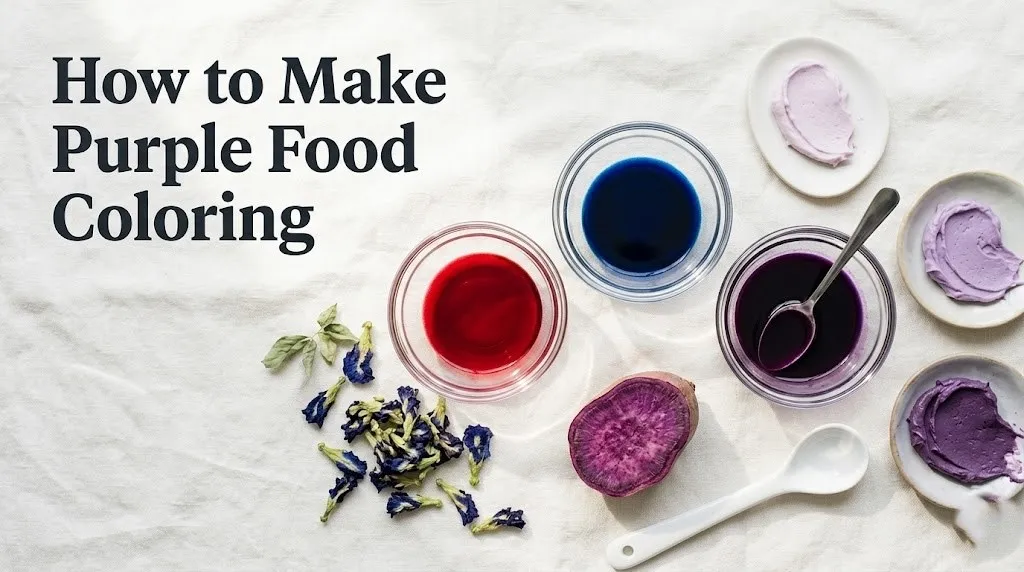
The starting ratio for a medium, true purple is 2 drops of red to 1 drop of blue. From there, you shift toward more red for warmer plum tones, or more blue for cooler violet tones. Small adjustments matter significantly because food dyes are highly concentrated pigments.
Key points about making purple food coloring include:
- Always start with a white or very pale base (white buttercream, white fondant, or clear liquid).
- Add dye gradually. One extra drop changes the shade noticeably in small batches.
- Mix thoroughly before evaluating color. Streaks of unincorporated dye will make the shade look darker or uneven than it actually is.
- Colors deepen as they sit. Mix, wait 5 minutes, then evaluate before adding more dye.
What Colors Make Purple Food Coloring
Red and blue are the two colors that make purple food coloring. This follows basic color theory: purple is a secondary color formed by mixing two primary colors, red and blue.
In food dye terms, the specific pigments involved are FD&C Red 40 and FD&C Blue 1. These are the most common certified color additives used in the United States for producing red and blue hues in food. The FDA certifies each batch of these dyes under 21 CFR Part 74 before they can be used commercially.
No other food-safe dye combination reliably produces a true purple without a secondary correction step. Pink mixed with blue gets close but typically reads as dusty mauve. Red mixed with violet (a pre-mixed color) can work, but the result depends entirely on how the violet was formulated.
| Base Colors Used | Resulting Hue | Notes |
|---|---|---|
| Red 40 + Blue 1 (2:1) | True medium purple | Standard starting point |
| Red 40 + Blue 1 (1:1) | Blue-purple / periwinkle | More blue-forward |
| Red 40 + Blue 1 (3:1) | Warm plum / grape | More red-forward |
| Pink + Blue | Dusty mauve | Less vivid, inconsistent |
| Red + Violet pre-mix | Variable purple | Depends on brand formulation |
For anyone using a brand’s “violet” pre-mix, check the ingredient list. Most contain a higher ratio of blue to red, making them a good starting point for cooler purple shades but not for warm berry tones.
What Two Colors Make Purple Food Coloring
The two colors that make purple food coloring are red and blue. This is the simplest and most reliable method, and it applies whether you’re using liquid dyes, gel concentrates, or powder colorants.
Red and blue are primary colors on the traditional color wheel. Combining them in equal parts theoretically produces pure purple. In practice, the ratio shifts based on the specific dye formulation, because FD&C Blue 1 is a more intense pigment than FD&C Red 40 at equivalent drop volumes.
That intensity gap is why most recipes call for more red than blue. If you start with a 1:1 ratio, you’ll almost always end up with a blue-purple or periwinkle rather than a balanced purple.
Quick Tip:
- Use 2 drops red to 1 drop blue as your baseline for a true purple.
- For every shade lighter, reduce both dyes proportionally rather than adding white to cancel out excess color.
- If your blue dye is significantly darker or more saturated than your red, try 3:1 red to blue before adjusting.
- Brands vary. AmeriColor Electric Purple is pre-mixed at approximately a 2:1 red-to-blue ratio.
Key Takeaway: Purple food coloring requires red and blue dye combined at roughly a 2:1 red-to-blue ratio. The exact shade shifts based on dye format, brand intensity, and how much time the color has had to develop in your base.
How to Make Purple With Food Coloring Step by Step
Making purple food coloring involves measuring your base, adding red dye first, then blue dye incrementally until you reach your target shade. The order of addition matters because blue overtakes red quickly.
To make purple food coloring from liquid or gel dye:
- Start with your base (white buttercream, white fondant, clear icing glaze, or a small bowl of water for testing).
- Add 2 drops of red food dye (FD&C Red 40) directly to the base.
- Stir or fold thoroughly until fully incorporated, at least 30 seconds.
- Add 1 drop of blue food dye (FD&C Blue 1).
- Stir again for 30 seconds. The color will bloom slightly as you mix.
- Wait 5 minutes before evaluating. Colors in frosting or fondant deepen on standing.
- Compare against your target shade. Add more red for warmth, more blue for coolness, in increments of half a drop if possible.
- For large batches, scale the ratio proportionally and premix dye in a small cup of water before adding to your base.
People new to food coloring often skip step 6. Adding more dye to a color that hasn’t fully developed is how you end up with an oversaturated, unrecoverable purple that can’t be lightened without adding more base.
How to Make Purple With Gel Food Coloring
Gel food coloring is the most precise and efficient format for making purple because it is highly concentrated, meaning you need far fewer drops and have much more control over shade intensity.
Gel dyes from brands like AmeriColor, Chefmaster, and Wilton Colour Right deliver pigment in a thickened base. One toothpick-tip of gel can be equivalent to 4 to 6 drops of liquid food coloring. This matters for purple especially, because blue gel concentrates are noticeably more intense than their liquid counterparts.
To mix purple with gel food coloring:
- Use a clean toothpick to collect a small amount of red gel dye (about the size of a pencil tip).
- Apply it to the base and knead or fold thoroughly.
- Use a separate, clean toothpick to collect half that amount of blue gel dye.
- Knead or fold again. Rest the mixture for 5 to 10 minutes.
- Evaluate under natural light. Artificial kitchen lighting can shift purple toward blue or grey.
- Adjust in micro-amounts. With gel, a single extra toothpick swipe of blue will shift the entire hue noticeably in a small batch.
| Gel Dye Ratio (Red : Blue) | Target Shade | Best Use |
|---|---|---|
| 3:1 | Deep plum / grape | Fondant, dark themes |
| 2:1 | True medium purple | Buttercream, macarons |
| 1.5:1 | Cool purple / wisteria | Floral designs |
| 1:1 | Periwinkle / blue-purple | Ombre effects |
Those with carmine-derived dyes in their collection should note: carmine (a natural red derived from cochineal insects) is not vegan or kosher-certified in many formulations. Check labels if dietary requirements are relevant.
How to Mix Purple Food Coloring Ratios
The ratio of red to blue food dye determines whether your purple reads as plum, grape, true purple, violet, or lilac. A working knowledge of these ratios gives you repeatable, predictable results across different batches.
The core principle is that blue is the dominant pigment at equal volumes. To achieve a balanced purple rather than a blue-toned result, red needs to lead. The specific numbers below apply to gel concentrates; liquid ratios will need adjustment because liquid dyes are less concentrated.
| Shade Target | Red Drops | Blue Drops | Character |
|---|---|---|---|
| Pale lavender | 1 | 0.5 | Soft, pastel, airy |
| Lilac | 2 | 1 | Cool-toned pink-purple |
| True purple | 4 | 2 | Balanced, vivid |
| Violet | 3 | 2 | Blue-leaning, floral |
| Plum | 5 | 2 | Warm, berry-toned |
| Grape | 6 | 2 | Deep, jewel-toned |
| Eggplant | 8 | 3 | Very dark, near-black purple |
These ratios assume a standard white buttercream base of approximately 240g (1 cup). For larger batches, scale proportionally and premix in a neutral liquid before incorporating.
A 2022 food science review in the journal Food Chemistry confirmed that color perception in food is affected by the fat content of the base. Higher-fat buttercreams may read slightly warmer than lower-fat frostings at identical dye ratios, because fat reflects light differently from water-based mediums.
Key Takeaway: Precise red-to-blue ratios are the single most important variable for consistent purple shades. More red gives you plum and grape; equal amounts or more blue gives you violet and periwinkle. Always let the color develop for 5 to 10 minutes before adjusting.
How to Make Light Purple Food Coloring
Light purple food coloring is made by using very small amounts of red and blue dye in a white or very pale base, keeping pigment concentration low. The key to a pastel purple is restraint, not dilution with more white after you’ve already added too much dye.
Pale purple shades, including lavender, pale wisteria, and blush-purple, require a white base with minimal dye. Adding even a half-drop too much will push you out of pastel territory quickly.
To make light purple food coloring:
- Start with a freshly prepared white base (white buttercream or white fondant works best).
- Add 1 drop of red food dye and mix thoroughly.
- Add half a drop of blue by dipping a toothpick into the dye and dragging the small amount into the base.
- Fold in and evaluate after 5 minutes of resting time.
- If deeper color is needed, add dye in increments of quarter-drops.
For the palest lavender effect, white gel food coloring can be added to your base first to increase opacity. This whitens any slight yellow tones in standard buttercream that would otherwise push your light purple toward grey.
People coloring white chocolate or candy melts should work at room temperature, not cold. Cold bases don’t accept dye evenly and produce a streaked, inconsistent light purple.
How to Make Dark Purple Food Coloring
Dark purple food coloring requires a higher total dye concentration, with red and blue in approximately a 3:1 ratio, built up in multiple layers rather than added all at once. Adding large amounts of dye in one step risks oversaturation and a bitter aftertaste in some bases.
Shades like deep grape, eggplant, and dark plum require patience. These are not achievable in a single mixing session for most base types.
To build deep purple food coloring:
- Begin with your base ratio of 3 parts red to 1 part blue.
- Mix thoroughly. Rest for 10 minutes.
- Evaluate the depth. It should be clearly purple but not yet at full target depth.
- Add additional red and blue dye in the 3:1 ratio as a pair, never just one at a time.
- Mix, rest, repeat in 15-minute cycles until you reach the desired depth.
- For very deep shades, refrigerating the base overnight deepens color further as dye continues to bond with the fat or sugar matrix.
According to testing data from pastry professionals at the International Baking Industry Exposition (IBIE), colors built up over multiple addition cycles are more stable and less prone to bleeding than colors achieved through single large additions.
One caution: dark purple frostings applied to cake layers can bleed onto lighter adjacent colors after 24 hours at room temperature. Refrigerate decorated cakes and allow them to come to temperature slowly before serving.
How to Make Lilac With Food Coloring
Lilac is a very soft, cool-toned pink-purple made with a tiny amount of blue food dye added to an already pale pink base. It sits closer to pink on the spectrum than to a true purple.
Lilac differs from lavender in warmth. Lavender reads grey-purple. Lilac reads pink-purple. The distinction matters for themed events, wedding cakes, and spring dessert designs where the specific tone carries visual meaning.
To mix lilac with food coloring:
- Prepare a white base. Add 1 drop of red and mix fully. You should have a very pale pink.
- To this, add no more than one-quarter drop of blue.
- Mix, rest for 5 minutes, and evaluate.
- Lilac should read pink at first glance with a subtle blue undertone. If it reads clearly purple, you have passed the lilac range.
| Tone | Red | Blue | Character |
|---|---|---|---|
| Baby pink | 1 drop | 0 | No purple |
| Lilac | 1 drop | 0.25 drops | Pink with purple whisper |
| Lavender | 1 drop | 0.5 drops | Cool grey-purple |
| Soft purple | 2 drops | 1 drop | Clearly purple |
Lilac shades are particularly sensitive to the yellow tone in standard buttercream. Using a pure white base or adding a single drop of white gel dye first prevents the lilac from reading muddy or beige.
Key Takeaway: Light purple shades require starting with a white base and building pigment slowly. Lilac is made by adding a tiny fraction of blue to a pale pink. The most common mistake is adding too much dye at once and losing the pastel tone permanently.
How to Make Violet With Food Coloring
Violet is a cool, blue-leaning purple made by using a red-to-blue ratio closer to 1.5:1, rather than the standard 2:1 for true purple. It reads distinctly different from grape or plum because the blue component dominates without fully taking over.
Violet sits on the color wheel between blue and purple. In food terms, it looks most like a wisteria flower or a deep iris bloom. It’s distinct from navy, which has no red component, and from true purple, which reads more balanced.
To mix violet with food coloring:
- Use a 3 drops red to 2 drops blue starting ratio.
- Mix and rest for 5 to 7 minutes.
- If the result reads too blue, add red in quarter-drop increments.
- If the result reads too warm or red, add blue in eighth-drop increments.
Gel food colors are strongly preferred for violet because the shade is difficult to control with liquid dye. Liquid blue dyes have a tendency to run slightly cooler and more dominant than expected in a water-based medium, making it easy to overshoot toward periwinkle.
AmeriColor Regal Purple gel is pre-formulated in the violet range, which makes it a useful reference point for comparing your hand-mixed results. One practical test: put a small dab of your mixed color next to a small dab of a pre-mixed violet. This shows you how much further to adjust.
How to Make Purple Food Coloring Naturally
Natural purple food coloring is made by extracting anthocyanin pigments from plant sources, primarily butterfly pea flowers (Clitoria ternatea), purple sweet potato (Ipomoea batatas), or blueberries. These dyes contain no synthetic additives.
Anthocyanins are a class of water-soluble flavonoid pigments responsible for the blue, purple, and red colors in many fruits and vegetables. The USDA National Nutrient Database identifies anthocyanins as antioxidant compounds present in concentrated form in purple-fleshed vegetables and certain flowers.
To make butterfly pea flower purple food coloring:
- Bring 240ml (1 cup) of water to a gentle simmer, below 90C (195F).
- Add 2 tablespoons of dried butterfly pea flowers.
- Simmer gently for 15 minutes. Do not boil aggressively.
- Remove from heat and steep for 10 additional minutes.
- Strain through a fine mesh sieve. Discard the spent flowers.
- Use the resulting blue-purple liquid as your natural dye.
- For a redder, more truly purple tone, add a few drops of lemon juice to shift the pH.
The pH sensitivity of butterfly pea flower dye is both its limitation and its feature. In alkaline environments (such as vanilla buttercream), it reads blue-purple. In acidic environments (cream cheese frosting, citrus glazes), it shifts toward pink-purple or magenta. This behavior is predictable once you understand it.
Natural Purple Food Coloring Substitutes
The most practical natural substitutes for synthetic purple food coloring are butterfly pea flower powder, purple sweet potato powder, blueberry reduction, red cabbage extract, and beet juice combined with grape juice. Each has different color intensity, stability, and flavor impact.
No natural substitute matches the pure, vivid intensity of synthetic FD&C dyes. That’s the trade-off. Natural dyes are generally more pH-sensitive, slightly less heat-stable, and may add faint flavor. In many baked goods, however, the flavor impact at typical use levels is barely detectable.
| Natural Source | Color Range | Stability | Flavor Impact | Best Use |
|---|---|---|---|---|
| Butterfly pea flower | Blue-purple to pink | Moderate | Minimal | Frostings, drinks |
| Purple sweet potato powder | True purple | Good | Mild, earthy | Cakes, cookie dough |
| Blueberry reduction | Blue-red purple | Low | Noticeable berry | Glazes, jam |
| Red cabbage extract | Pink-purple | Low | Mild | Cold preparations |
| Beet + grape juice | Warm purple | Low | Noticeable | Drinks, ice cream |
Purple sweet potato powder is increasingly available in health food stores and online specialty retailers. It produces a more stable, vivid purple than blueberry in most baked applications because of its higher anthocyanin density and relatively neutral flavor.
Vegans and those avoiding synthetic dyes should note that all of the above natural options are plant-derived. Carmine (a natural red dye from cochineal insects) is sometimes marketed as a “natural” alternative but is neither vegan nor suitable for those observing certain kosher or halal dietary standards.
Key Takeaway: Natural purple food coloring from butterfly pea flower or purple sweet potato powder is a reliable synthetic-free option. The color shifts with pH, which is a limitation in acidic foods but predictable once you learn the pattern.
Purple Food Coloring for Frosting and Fondant
Purple food coloring behaves differently in frosting versus fondant because fat content, sugar concentration, and the mechanical action of mixing all affect how pigment distributes and develops. Knowing the differences prevents wasted batches.
For buttercream frosting, use gel dyes. Liquid dyes add excess moisture, which can break the emulsion of a butter-based frosting. This is especially important in high-ratio recipes with low water tolerance. Gel concentrates incorporate without changing the frosting’s texture.
For fondant, knead dye in using gloves. Fondant’s dense sugar-and-glycerin matrix requires thorough mechanical mixing to distribute pigment evenly. Patchy purple fondant is almost always the result of under-kneading, not insufficient dye.
For royal icing, liquid or gel both work, but note that purple in royal icing often shifts toward blue-grey as it dries. Mix slightly warmer (more red) than your target shade to compensate for the drying shift.
Key preparation tips for each base:
- Buttercream: always use gel; add dye before whipping to final consistency
- Fondant: add dye to a small piece first, knead until uniform, then combine with the larger portion
- Royal icing: over-mix slightly warmer than your target; dried color will read 10 to 20% more blue
- Mirror glaze: dye in while slightly warm; colors intensify as glaze cools and sets
- White chocolate: use oil-based or powdered dye only; water-based dye will seize the chocolate
Why Does Purple Food Coloring Turn Grey or Brown
Purple food coloring turns grey or brown when the red and blue dyes are unbalanced, when the dye is exposed to heat or acidic environments, or when a non-white base is used. All three causes are fixable.
Think of it the way you’d think about paint mixing on a canvas. If the base already has a yellow tone, adding a purple glaze over it will muddy the result. A yellow-beige buttercream plus purple dye equals grey-brown, not purple. The solution is always a white base.
The most common causes of muddy or grey purple include:
- Yellow-toned base: Standard buttercream made with real butter has a yellow tint. It absorbs purple dye and shifts it toward brown. Use white shortening for part of the fat, or add a single drop of white gel dye first.
- Too much blue: Blue overpowers red in many liquid dye formulations, pushing the result toward grey-blue rather than purple.
- Acidic environment: Red 40 is pH-sensitive. In acidic bases (cream cheese frosting, citrus glazes, baked goods with vinegar or lemon), red dye fades faster than blue, shifting the final color toward blue-grey.
- Heat exposure: Baking with purple food coloring often produces a grey result because Red 40 fades under sustained oven heat while Blue 1 is more heat-stable. Use purple coloring in no-bake applications or after baking whenever possible.
- Cheap or expired dye: Older dyes and lower-quality formulations have uneven pigment distribution that produces grey streaks or muddy tones even at correct ratios.
Is Purple Food Coloring Safe for Kids and Sensitive Groups
Synthetic purple food coloring made from FD&C Red 40 and FD&C Blue 1 is FDA-approved for use in food in the United States, but specific populations, including children with attention-related sensitivities and individuals with aspirin sensitivity, should be aware of documented concerns. Natural alternatives are a straightforward option for those who prefer to avoid synthetic dyes entirely.
The FDA regulates certified color additives under 21 CFR Part 74, requiring batch-by-batch certification before commercial use. Both Red 40 (Allura Red AC) and Blue 1 (Brilliant Blue FCF) hold this certification. The European Food Safety Authority (EFSA) has its own review framework and has flagged certain dyes for further monitoring, though neither Red 40 nor Blue 1 carries a mandatory warning label in the EU at standard food use levels.
The American Academy of Pediatrics (AAP) has acknowledged research suggesting a possible association between synthetic food dye consumption and increased hyperactivity in some children with attention-deficit/hyperactivity disorder (ADHD). A study published in the Journal of Pediatrics noted that the evidence is not sufficient to establish causation but is strong enough to warrant caution in children with known attention sensitivities.
Regarding aspirin sensitivity: FD&C Red 40 is a sulfonated azo dye (though structurally different from tartrazine/Yellow 5, which has stronger documented aspirin cross-reactivity). Individuals with known aspirin or NSAID sensitivity who also show food dye reactions should discuss this pattern with a healthcare provider before routine exposure.
For children’s parties, school events, or baking for people with multiple sensitivities, butterfly pea flower powder or purple sweet potato powder are the most practical natural alternatives. They produce clear, vivid purples with no synthetic additives and are widely available as of 2026.
| Group | Synthetic Dye Status | Recommendation |
|---|---|---|
| General adult population | FDA approved, safe at food use levels | No restriction needed |
| Children without sensitivities | FDA approved | Moderate use; natural option available |
| Children with ADHD or attention issues | Caution advised per AAP | Consider natural alternatives |
| Aspirin-sensitive individuals | Potential cross-reactivity with azo dyes | Monitor and consider alternatives |
| Vegans | Synthetic dyes are vegan | Confirm carmine-free; avoid Red 4 |
| Halal/Kosher observers | Most FD&C dyes are compliant | Verify specific brand certification |
Key Takeaway: Synthetic purple food dye is FDA-approved and safe for most people, but the American Academy of Pediatrics advises caution in children with attention sensitivities. Natural alternatives from butterfly pea flower or purple sweet potato are a practical option for those who prefer to avoid synthetic dyes.
Frequently Asked Questions About Purple Food Coloring
What two colors make purple food coloring?
Red and blue food dye are the two colors that make purple food coloring.
Specifically, FD&C Red 40 and FD&C Blue 1 are the certified color additives used in standard food coloring sets.
A starting ratio of 2 drops red to 1 drop blue produces a true medium purple in most white bases.
Why did my purple food coloring turn grey?
Purple food coloring turns grey most often because the base has a yellow tone, too much blue was used, or heat degraded the red dye faster than the blue.
Using a white base and gel food coloring instead of liquid dye reduces all three risks.
If the result is still grey, add more red dye in small increments and avoid baking the colored mixture under sustained heat above 170C (340F).
Can I make purple food coloring without red dye?
You cannot produce a true purple without some form of red or red-adjacent pigment.
Without red, blue dye alone produces blue, not purple.
Natural alternatives like butterfly pea flower produce a blue-purple hue that shifts toward red-purple in acidic environments, making it a partial workaround for those avoiding synthetic red dye.
Is purple food coloring safe for children?
Synthetic purple food coloring made from Red 40 and Blue 1 is FDA-approved, but the American Academy of Pediatrics advises monitoring in children with attention sensitivities.
For children without documented sensitivities, food dye use at typical cooking quantities is considered safe by U.S. regulatory standards.
Natural options like purple sweet potato powder or butterfly pea flower provide a synthetic-free alternative that many parents prefer for children’s foods.
How do I make light purple or lilac with food coloring?
Light purple is made by using very small amounts of red and blue dye in a pure white base, starting with 1 drop of red and no more than one-quarter drop of blue.
Lilac reads pink-purple and requires even less blue than lavender.
Let the color develop for 5 minutes before adding more dye. Colors deepen as they sit, and adding excess dye to compensate for color that hasn’t yet developed is the most common mistake.
Closing
Red and blue dye, in a 2:1 ratio, are all you need to start. From there, every shade from pale lilac to deep eggplant is a matter of adjusting that ratio and building color gradually in a white base.
The single most avoidable mistake is rushing. Adding dye to a color that hasn’t finished developing and then overcorrecting with more dye is how most purple disasters happen. Mix, rest five minutes, then decide.
If you’re baking for children or anyone who prefers to avoid synthetic dyes, butterfly pea flower powder and purple sweet potato powder are genuinely good natural alternatives. They work, they’re predictable once you understand pH, and they produce colors worth being proud of.