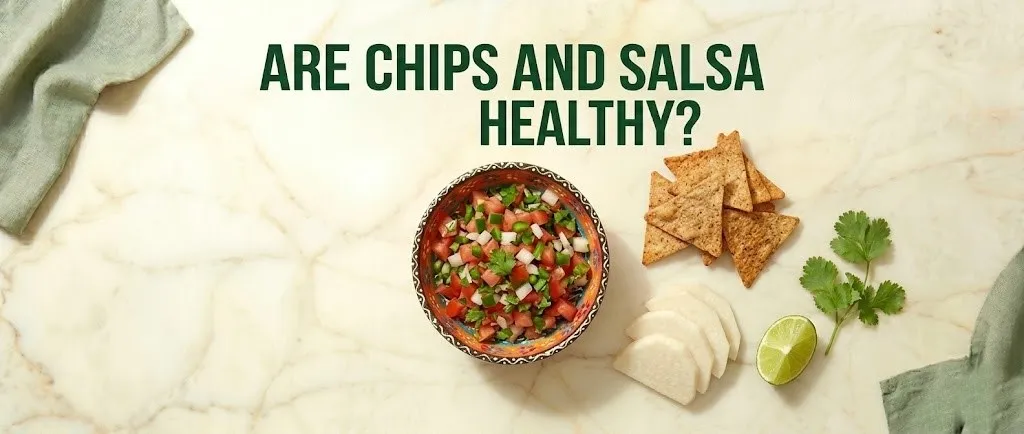
Chips and salsa can be a healthy snack when the chips are baked or made from whole-grain corn fried in a stable oil like avocado oil, the salsa is fresh and low in sodium, and the portion is controlled to roughly 12 chips and 2 tablespoons of salsa. The problem is that this idealized version is rarely what lands on the table. The restaurant version, a bottomless basket of fried corn triangles and a bowl of blended salsa, can deliver more than 1,000 calories before your entree arrives.
The salsa itself is almost always the healthiest component of the duo. A two-tablespoon serving of fresh tomato salsa contains roughly 10 calories, significant amounts of lycopene from cooked tomatoes, capsaicin from chili peppers, and small amounts of potassium and vitamin C. The salsa is not the dietary villain. The chips are the vehicle, and the vehicle is where the nutritional damage accumulates.
This guide breaks down the exact nutritional profile of this classic snack, explains the vast difference between the restaurant basket and the homemade version, and provides a tiered ranking of the healthiest store-bought chips and salsas. You will learn how to build a genuinely healthy version of the snack you have been eating since childhood.
are chips and salsa healthy
Chips and salsa are healthy in moderation when prepared with whole-food ingredients, but the standard store-bought or restaurant version is a high-calorie, high-sodium, low-satiety snack that can contribute to weight gain and elevated blood pressure if consumed mindlessly. The health verdict on this pairing is split right down the middle: the salsa is a nutrient-dense vegetable condiment. The chips are a processed, fried grain product. The final score depends on the ratio.
The nutritional profile of a standard serving illustrates the problem. A typical 1-ounce serving of tortilla chips (about 12 chips) contains 140 calories, 8 grams of fat, 16 grams of carbohydrates, and roughly 120 milligrams of sodium. The salsa adds roughly 10 calories and 150 milligrams of sodium per two tablespoons. The total snack clocks in at 150 calories and 270 milligrams of sodium. In isolation, this is a reasonable snack. The issue is the serving size. Most people eat two to three times this amount in a single sitting.
The American Heart Association recommends a daily sodium limit of 2,300 milligrams, with an ideal limit of 1,500 milligrams for most adults. A single restaurant-sized portion of chips and salsa can deliver 1,000 milligrams of sodium or more, consuming nearly half the daily recommendation before the meal has even started. The sodium is concentrated in both the salted chips and the salsa, which often contains added salt and sometimes sodium-heavy preservatives like sodium benzoate.
| Component | Healthy Version | Unhealthy Version |
|---|---|---|
| Chips | Baked, avocado oil, whole corn | Fried in soybean oil, heavily salted |
| Salsa | Fresh, low-sodium, chunky | Processed, high-sodium, blended |
| Portion | 12 chips, 2 tbsp salsa | Bottomless basket, multiple refills |
| Calories | 130 to 150 | 300 to 1,000+ |
| Sodium | 150 to 200 mg | 500 to 1,200 mg |
is chips and salsa healthy
Chips and salsa is healthy when the chips are made from stone-ground, organic corn masa baked or fried in non-inflammatory oil, and the salsa is a fresh, low-sodium pico de gallo rich in visible vegetable chunks. The question hinges on the ingredients and the processing. A chip fried in industrial soybean oil is fundamentally different from a chip baked from organic masa harina.
The type of oil used to fry the chip is the most important variable. Standard tortilla chips, including major brands like Tostitos, are fried in a blend of corn, canola, and soybean oils. These oils are high in omega-6 polyunsaturated fatty acids. When heated to frying temperatures, roughly 350°F, these unstable fatty acids can oxidize, forming lipid peroxides and aldehydes that promote systemic inflammation. A chip fried in avocado oil or coconut oil is more stable at high temperatures and does not produce these inflammatory byproducts.
The salsa is the nutritional redemption of the dish. A half-cup of fresh salsa provides roughly 25 calories, 2 grams of fiber, and 20 percent of the daily recommended intake of vitamin C. The tomatoes in salsa are rich in lycopene, a carotenoid antioxidant that becomes more bioavailable when tomatoes are cooked. The chili peppers provide capsaicin, which has been studied for its potential to modestly increase metabolic rate and promote satiety. The salsa is genuinely good for you. The chips are the variable you control.
- Healthy oil chips: Avocado oil, coconut oil, or baked.
- Unhealthy oil chips: Soybean, corn, canola oil blend.
- Healthy salsa: Chunky, fresh, low sodium.
- Unhealthy salsa: Blended, high sodium, preservatives.
Key Takeaway: The health of chips and salsa is determined by the frying oil and the portion size. The salsa is almost always the healthiest part of the plate.
is chips and salsa a healthy snack
Chips and salsa is a healthy snack when measured and paired with a source of protein or fat to improve satiety, but eaten alone from a large bag or basket, it is a low-satiety, high-glycemic snack that can drive overconsumption. The snack designation is important. A snack should be roughly 150 to 200 calories. A basket of chips and salsa at a restaurant functions as a pre-meal calorie load, not a snack.
The glycemic load of tortilla chips is significant. Corn masa has a high glycemic index, meaning it digests rapidly and spikes blood glucose. A serving of chips alone provides a quick burst of energy followed by a crash that triggers further hunger. This is the mechanism behind the “I can’t stop eating chips” phenomenon. The salsa provides fiber and a small amount of acidity that can modestly blunt the glycemic response, but not enough to offset a large chip volume.
The solution is to pair chips and salsa with a satiating companion. Adding a small serving of guacamole provides monounsaturated fat and fiber from the avocado, which slows gastric emptying and stabilizes blood sugar. Adding a Mexican-style bean dip provides protein and soluble fiber. The pairing transforms the snack from a simple carbohydrate bomb into a balanced mini-meal that holds you over until the next real meal.
- Snack serving: 12 chips, 2 tbsp salsa. Total: 150 calories.
- Restaurant basket: 40 chips, 6 tbsp salsa. Total: 500 to 600 calories.
- Balanced snack: Chips, salsa, and 2 tbsp guacamole. Total: 250 calories, better satiety.
are chips and salsa a healthy snack
Chips and salsa are a healthy snack when you choose baked or low-oil chips, a chunky, low-sodium salsa, and you measure the serving before you start eating. The plural “are” reflects the components. Both components must be healthy for the snack to earn the label.
The chip choice determines the fat quality. Siete Grain-Free Tortilla Chips, made from cassava flour and avocado oil, provide 7 grams of fat per serving, the majority of which is heart-healthy monounsaturated fat. Beanitos Black Bean Chips provide 4 grams of fiber and 4 grams of protein per serving, significantly more than the 1 gram of fiber and 2 grams of protein in standard Tostitos. The chip can contribute nutrition rather than just empty calories.
The salsa choice determines the sodium and sugar load. Many jarred salsas, particularly those labeled “medium” or “chunky,” contain added sugar, often in the form of high-fructose corn syrup or cane sugar. Check the ingredient label. A clean salsa lists tomatoes, onions, peppers, cilantro, lime juice, and salt. A processed salsa lists tomato puree, sugar, sodium benzoate, and natural flavors. The difference is nutritionally significant.
- Healthy chips: Siete, Beanitos, baked homemade.
- Unhealthy chips: Tostitos, Doritos, generic fried corn chips.
- Healthy salsa: Fresh pico de gallo, low-sodium jarred.
- Unhealthy salsa: Sweetened jarred salsa, queso dip.
is salsa and chips healthy
Salsa and chips are healthy when the salsa is the star and the chips are the supporting actor, used as a scoop for a vegetable-rich mixture rather than as a shovel for salt and oil. The phrasing “salsa and chips” subtly shifts the emphasis toward the salsa, which is where the nutritional power lies.
The nutritional density of salsa is often underestimated. A cup of fresh pico de gallo contains roughly 40 calories, 3 grams of fiber, and significant amounts of vitamin C, potassium, and lycopene. The onions and garlic provide prebiotic fibers that feed beneficial gut bacteria. The jalapeños provide capsaicin. The cilantro provides chlorophyll and a small amount of antioxidant flavonoids. Salsa is essentially a salad in liquid form.
The health risk of salsa is the sodium content. A half-cup of jarred salsa can contain 400 to 600 milligrams of sodium. This is not a problem in a single serving, but when chips are dipped generously and the salsa bowl is refilled, the sodium intake can exceed 1,000 milligrams from the salsa alone. Making fresh salsa at home allows you to control the salt. A homemade pico de gallo with a teaspoon of salt for an entire batch has significantly less sodium per serving than a commercial jarred product.
- Salsa benefits: Lycopene, capsaicin, fiber, low-calorie.
- Salsa risk: High sodium in commercial varieties.
- Salsa solution: Homemade pico de gallo with controlled salt.
Key Takeaway: The salsa is a nutrient-dense vegetable dish. Treat it as the main event, and use a small portion of chips as the edible utensil.
are salsa and chips healthy
Salsa and chips are healthy when the chip portion is strictly controlled and the salsa is fresh and vegetable-forward. The phrasing is identical in meaning to “are chips and salsa healthy” but emphasizes the salsa. The nutritional analysis does not change. The answer depends entirely on the chip-to-salsa ratio and the quality of the ingredients.
The psychological challenge of salsa and chips is the same as any dip-and-chip combination. The act of dipping is repetitive and nearly unconscious. The hand moves from chip to salsa to mouth in a rhythm that is hard to interrupt. This is why portioning is essential. Do not eat directly from the bag or the salsa jar. Plate your serving: 12 chips on a small plate, 2 tablespoons of salsa in a small ramekin. When the plate is empty, the snack is over.
The serving size for chips and salsa is the most violated guideline in American snacking. The standard 1-ounce serving of chips is a small pile that fits in the palm of a cupped hand. The standard 2-tablespoon serving of salsa is roughly the size of a golf ball. If you are eating from a restaurant basket, you have likely consumed four to five servings before your entree arrives. This is not a snack. It is a meal replacement that provides none of the satiety of a proper meal.
- Portion rule: Plate the serving. Do not eat from the bag or basket.
- Visual cue: 12 chips equals a cupped palm. 2 tablespoons equals a golf ball.
- Restaurant strategy: Ask the server to remove the basket after one serving.
are tortilla chips and salsa healthy
Tortilla chips and salsa are healthy when the tortilla chips are made from nixtamalized whole-grain corn fried in a stable oil, because the nixtamalization process increases the bioavailability of the corn’s niacin and calcium. The term “tortilla chips” specifies the type of chip and introduces the concept of corn quality.
Nixtamalization is the ancient Mesoamerican process of soaking corn in an alkaline lime solution before grinding it into masa. This process, which is thousands of years old, chemically alters the corn in several nutritionally important ways. It releases bound niacin (vitamin B3), making it available for absorption by the human digestive tract. It increases the calcium content of the corn because the lime water is calcium hydroxide. It reduces mycotoxins that can contaminate untreated corn. Corn chips made from true masa harina are nutritionally superior to those made from untreated cornmeal.
Many commercial tortilla chips are not made from nixtamalized corn. They are made from corn flour that has not undergone the lime treatment, which means the niacin remains bound and unavailable. The ingredient label should specify “stone-ground corn masa” or “nixtamalized corn.” If it says “corn flour,” the chip is missing this nutritional advantage. True tortilla chips are a cultural food with a nutritional foundation. Generic corn chips are a modern snack food without that foundation.
- Nixtamalized chips: Higher calcium, available niacin.
- Non-nixtamalized chips: Standard corn flour, lower nutrient bioavailability.
- Label check: Look for “masa harina” or “stone-ground corn” on the ingredient list.
is tortilla chips and salsa healthy
Tortilla chips and salsa is healthy when the chips are baked or air-fried and the salsa is homemade, reducing both the fat content and the sodium load to levels that fit within a balanced dietary pattern. The singular “is” treats the combination as a single dish, which is how most people consume it.
The air fryer has revolutionized the homemade tortilla chip. By cutting corn tortillas into wedges, lightly spraying them with avocado oil, and air-frying at 375°F for 6 to 8 minutes, you produce a chip that is crispy, golden, and contains a fraction of the fat of a deep-fried chip. The air-fried chip has roughly 5 grams of fat per serving compared to 8 grams in a standard fried chip. Over the course of a week of snacking, this difference adds up.
The homemade salsa advantage is even more dramatic. A batch of blender salsa made from canned fire-roasted tomatoes, fresh jalapeño, onion, garlic, cilantro, and lime juice contains zero added sugar, no preservatives, and a sodium level entirely within your control. A half-teaspoon of salt for an entire batch, roughly 2 cups of salsa, spreads the sodium across many servings. Each serving contains roughly 100 to 150 milligrams of sodium, compared to 300 to 400 in a commercial equivalent.
| Component | Restaurant/Store-Bought | Homemade Healthy |
|---|---|---|
| Chips (1 oz) | 140 cal, 8g fat, 120mg sodium | 110 cal, 5g fat, 80mg sodium |
| Salsa (2 tbsp) | 10 cal, 0g fat, 300mg sodium | 8 cal, 0g fat, 100mg sodium |
| Total | 150 cal, 8g fat, 420mg sodium | 118 cal, 5g fat, 180mg sodium |
chips and salsa healthy
Making chips and salsa healthy requires intentional choices about the chip base, the frying medium, the salsa ingredients, and the portion size. The healthiest version uses baked whole-grain corn tortillas or grain-free cassava chips, a chunky fresh salsa, and a measured serving size of roughly 150 calories total. The noun phrase “chips and salsa healthy” describes the goal: a snack that satisfies the craving without the metabolic consequences.
The chip base can be upgraded from corn to more nutrient-dense alternatives. Beanitos use black beans or pinto beans as the base, providing 4 grams of fiber and 4 grams of protein per serving. Siete uses cassava flour, which is grain-free and paleo-friendly, and fries in avocado oil. From the Ground Up uses cauliflower and other vegetables as the base, adding a serving of vegetables to a snack category that typically offers none.
The salsa can be upgraded by choosing varieties with visible vegetable chunks and short ingredient lists. Pico de gallo, the fresh, uncooked salsa made from chopped tomato, onion, cilantro, and jalapeño, is the healthiest commercially available option. It is essentially a fresh vegetable salad. Salsa verde, made from tomatillos, is another excellent choice. It is typically lower in sugar than red tomato salsas and has a bright, tangy flavor.
- Beanitos: Black bean base, 4g fiber, 4g protein.
- Siete: Cassava base, avocado oil, grain-free.
- From the Ground Up: Cauliflower base, vegetable serving.
- Pico de gallo: Fresh, uncooked, lowest sodium.
Key Takeaway: A healthy chips and salsa snack is built on a nutrient-dense chip base, a fresh chunky salsa, and a measured serving that fits in the palm of your hand.
how many calories in restaurant chips and salsa
A standard restaurant basket of chips and salsa, consumed at the average rate before the entree arrives, contains between 400 and 600 calories, and in some cases, with refills, can exceed 1,000 calories. The calorie count is determined by the number of chips consumed, the amount of oil absorbed during frying, and the volume of salsa eaten.
A single restaurant-style fried tortilla chip contains roughly 12 to 15 calories. A typical restaurant basket holds approximately 40 to 50 chips. If you eat the entire basket, you have consumed 480 to 750 calories from the chips alone. The salsa adds roughly 10 calories per tablespoon, and most people consume at least 4 to 6 tablespoons with a basket of chips, adding another 40 to 60 calories. The total is 500 to 800 calories before your entree.
The bottomless basket is the most dangerous nutritional format in the American restaurant. The server refills the basket without being asked. The chips are warm, salted, and engineered for hyperpalatability. The hand moves from basket to salsa to mouth in an automatic loop. There is no visual signal that the snack is over. The only way to control the calorie intake is to ask the server to remove the basket after one serving or to request that it not be brought at all.
- Single chip: 12 to 15 calories.
- Standard basket (40 chips): 480 to 600 calories.
- With salsa (4 tbsp): 520 to 640 calories.
- With refills (80 chips): 960 to 1,200 calories.
is salsa good for you
Salsa is good for you because it is a low-calorie, nutrient-dense condiment made primarily from vegetables, herbs, and spices that deliver fiber, vitamins, and bioactive plant compounds with documented health benefits. The tomato base provides lycopene, the onion and garlic provide allicin and quercetin, the peppers provide capsaicin, and the cilantro provides chlorophyll and flavonoids. Salsa is the healthiest component of the chips and salsa duo by a wide margin.
Lycopene, the red carotenoid pigment in tomatoes, is a potent antioxidant that has been associated with reduced risk of prostate cancer and cardiovascular disease in observational studies. Cooking tomatoes, as is done in many salsa recipes, increases the bioavailability of lycopene by breaking down the cell walls and making the pigment more accessible to the digestive system. A half-cup of cooked salsa provides more bioavailable lycopene than the same amount of raw tomato.
Capsaicin, the compound that gives chili peppers their heat, has thermogenic properties, meaning it slightly increases the body’s metabolic rate and calorie burn for a short period after consumption. The effect is modest, roughly a 5 to 10 percent increase in energy expenditure for an hour after eating. Capsaicin also activates TRPV1 receptors in the gut, which may promote satiety and reduce overall calorie intake at the subsequent meal.
- Lycopene: Antioxidant, increased bioavailability when cooked.
- Capsaicin: Thermogenic, modest metabolic boost, promotes satiety.
- Allicin and quercetin: Anti-inflammatory compounds from onion and garlic.
- Chlorophyll: Antioxidant from cilantro and tomatillos.
healthy alternative to tortilla chips
The healthiest alternatives to tortilla chips are raw jicama slices, bell pepper strips, cucumber rounds, baked whole-grain tortilla wedges, and grain-free cassava chips fried in avocado oil. Each of these alternatives provides the crunch and structural integrity needed for dipping while dramatically reducing or eliminating the fried fat and refined carbohydrates of standard chips.
Jicama is the most effective raw vegetable substitute for a tortilla chip. It is a root vegetable with a crisp, watery texture and a mild, slightly sweet flavor that does not compete with salsa. A cup of jicama slices contains roughly 45 calories and 6 grams of fiber. It is essentially a neutral-flavored, edible spoon. It works with any salsa, guacamole, or bean dip. The crunch is satisfying, and the water content dilutes the sodium concentration of the salsa as you eat.
Baked whole-grain tortilla wedges are the closest substitute in texture and flavor to a standard chip. Cut whole-grain or sprouted-grain tortillas into wedges, spray lightly with avocado oil, sprinkle with a small amount of sea salt, and bake at 375°F for 10 to 12 minutes. The result is a crispy, golden chip with the flavor of corn and the nutritional profile of a whole grain. The fiber in the whole grain modestly blunts the glycemic response.
- Jicama slices: 45 calories per cup, 6g fiber, neutral flavor.
- Bell pepper strips: 30 calories per cup, vitamin C, colorful.
- Baked whole-grain tortilla: Closest to original, higher fiber.
- Siete chips: Store-bought, cassava flour, avocado oil.
Key Takeaway: Jicama is the ultimate healthy chip alternative because it delivers crunch, fiber, and a neutral platform for salsa with a fraction of the calories.
healthy chips and salsa brands
The healthiest chips and salsa brands in 2026 are Siete, Xochitl, Late July, Beanitos, and Que Pasa for chips, and Stonewall Kitchen, Frontera, Newman’s Own, and Green Mountain Gringo for salsa. These brands were selected based on oil quality, ingredient transparency, fiber content, sodium levels, and the absence of artificial additives and added sugars.
Siete is the overall winner for chips. The brand uses cassava flour, avocado oil, and organic ingredients. Their sea salt tortilla chips contain 130 calories, 7 grams of fat from avocado oil, and 3 grams of fiber per serving. The ingredient list is short and pronounceable. Xochitl is a thin, crispy chip made from organic white corn, stone-ground in small batches, and fried in a blend of palm olein and corn oil. The palm olein is a more stable fat than standard vegetable oils, though it is not as ideal as avocado oil.
Frontera, founded by chef Rick Bayless, produces the best widely available grocery store salsa. Their salsas are made from recognizable ingredients with no added sugar, no preservatives, and a flavor profile that rivals restaurant salsa. Green Mountain Gringo is a close second, with exceptionally low sodium levels and a clean, simple ingredient list. Newman’s Own provides a reliable, widely distributed organic option.
| Category | Top Pick | Runner-Up |
|---|---|---|
| Chips (Grain-Free) | Siete (cassava, avocado oil) | Beanitos (bean base, high fiber) |
| Chips (Corn) | Xochitl (organic, stone-ground) | Que Pasa (organic, whole grain) |
| Salsa (Jarred) | Frontera (no sugar, restaurant quality) | Green Mountain Gringo (low sodium) |
| Salsa (Fresh) | Jack’s Cantina (refrigerated section) | Garden Fresh Gourmet |
Frequently Asked Questions About Chips and Salsa
Is chips and salsa good for weight loss?
Chips and salsa can fit into a weight loss plan when portioned strictly at 12 chips and 2 tablespoons of salsa.
The snack is low in satiety, meaning it does not fill you up, so it must be paired with a protein source or eaten as a controlled treat.
Uncontrolled restaurant baskets are a calorie surplus that works against weight loss.
Does salsa have too much sodium?
Standard jarred salsa can have high sodium, often 300 to 400 milligrams per 2-tablespoon serving.
Fresh pico de gallo or low-sodium brands reduce the sodium to 100 to 150 milligrams per serving.
The sodium in salsa contributes to the overall daily limit and must be monitored if you have hypertension.
Are blue corn chips healthier than white?
Blue corn chips are marginally healthier than white corn chips because they contain anthocyanins, the same antioxidant pigments found in blueberries.
The calorie and fat content are nearly identical.
The nutritional advantage is small but real, and blue corn is often processed less heavily than white commodity corn.
Can I eat chips and salsa every day?
You can eat a controlled portion of chips and salsa daily if the rest of your diet is balanced and you have no sodium restrictions.
The key is strict portion control: 12 chips and 2 tablespoons of salsa.
Daily consumption of restaurant-style baskets will exceed healthy sodium and calorie limits.
Is pico de gallo healthier than blended salsa?
Pico de gallo is generally healthier than blended salsa because it contains fresh, uncooked vegetables with intact fiber and no added sugar.
Blended salsas are often cooked, which increases lycopene bioavailability but can also concentrate sodium and include added sugars.
Both are healthy. Pico de gallo is the freshest, least processed option.
The chips and salsa ritual is worth preserving. It is one of the few American snacking habits rooted in real food. The salsa is a vegetable-based condiment with a legitimate nutritional profile. The chips are the variable that determines whether the ritual is a healthy habit or a calorie trap.
Make your own salsa this week. A can of fire-roasted tomatoes, half an onion, a jalapeño, a handful of cilantro, and a squeeze of lime. Five minutes. You have a salsa with zero added sugar, controlled sodium, and more flavor than anything in a jar. Buy a bag of Siete chips or bake your own tortilla wedges. Plate 12 chips. Plate 2 tablespoons of salsa. Eat them slowly, with attention.
The chips and salsa ritual, done right, is a vegetable delivery system. Done wrong, it is a fried corn delivery system. The difference is the oil, the portion, and the salsa. Control those three variables, and your snack is genuinely healthy.