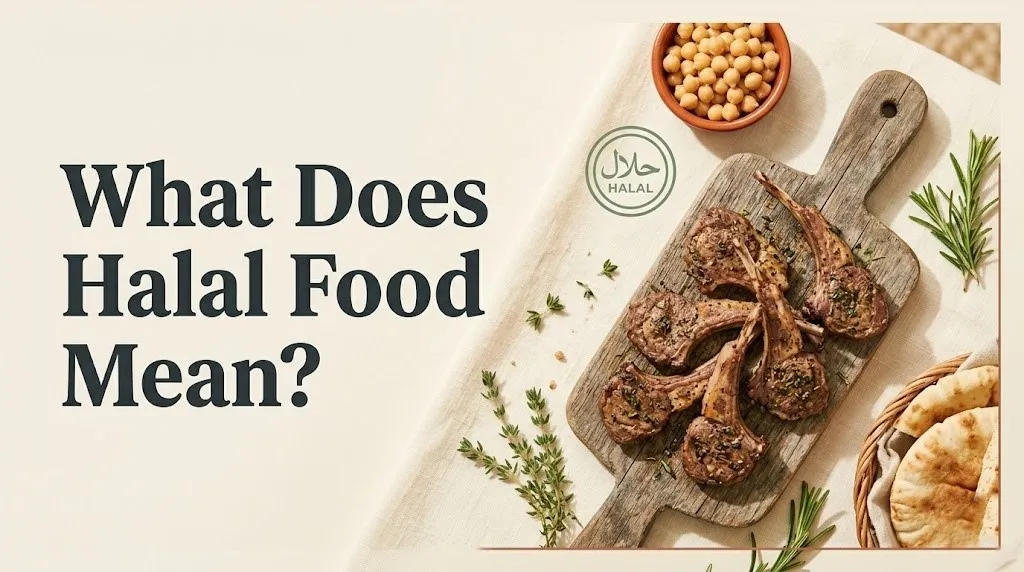
Halal food refers to any food that is permissible under Islamic dietary law, as defined by the Quran and interpreted by Islamic scholars. If a food meets these requirements, covering what it is, how it was raised, slaughtered, processed, and handled, it qualifies as halal.
This is not a niche concern. The global halal food market was valued at over $2.4 trillion USD in 2023, according to the State of the Global Islamic Economy Report, and it continues to grow as Muslim populations expand and non-Muslim consumers increasingly seek halal-certified products for their own reasons. Roughly 1.8 billion Muslims worldwide follow these dietary guidelines, making halal one of the largest food compliance frameworks on earth.
This guide covers everything from the basic definition to the certification labels in your grocery store, the food science behind halal slaughter, how halal interacts with vegan, kosher, and allergen-free diets, and how to find halal food practically wherever you are.
What Does Halal Food Mean?
Halal food means any food or drink that is permitted for consumption according to Islamic law, specifically as outlined in the Quran and elaborated through hadith (the recorded sayings of the Prophet Muhammad). The Arabic word halal (حلال) translates literally to “permissible” or “lawful.”
Think of it less like a single rule and more like a complete framework. It governs what the food is, where it comes from, how the animal was raised and slaughtered, what ingredients were used in processing, and how the food was handled throughout the supply chain.
For practical purposes, halal covers three main areas:
- What types of food and drink are allowed
- How permitted animals must be slaughtered
- How food must be prepared and handled to avoid contamination from prohibited substances
Halal stands in contrast to haram (حرام), meaning “forbidden” or “unlawful.” Between these two categories sits a third concept: mashbooh (مشبوه), meaning “doubtful” or “suspect,” which refers to foods where the halal status is unclear and requires further investigation before consumption.
| Term | Arabic | Meaning | Practical Use |
|---|---|---|---|
| Halal | حلال | Permissible | Safe to eat under Islamic law |
| Haram | حرام | Forbidden | Must not be consumed |
| Mashbooh | مشبوه | Doubtful | Requires verification before eating |
| Makruh | مكروه | Disliked | Not forbidden but discouraged |
People with dietary restrictions beyond religious ones, including those managing food allergies, gluten intolerance, or specific medical diets, should note that halal certification addresses religious compliance only. It does not automatically address common allergens or medical dietary needs.
What Foods Are Considered Halal?
Most whole, unprocessed foods are halal by default. The framework is inclusive: far more foods are permitted than are prohibited.
Foods that are halal include:
- All fruits and vegetables in their natural state
- Grains, legumes, nuts, and seeds
- Dairy products (milk, cheese, yogurt) not produced with rennet derived from non-halal slaughtered animals
- Eggs from halal-permissible birds
- Fish with fins and scales
- Meat from halal-permissible animals, slaughtered according to Islamic law
- Most plant-based oils and fats
- Water, fruit juices, and non-alcoholic beverages
The halal framework becomes most complex when applied to processed and packaged foods. Ingredients derived from animal sources, including gelatin (a protein extracted from animal collagen, often from porcine or bovine sources), lard (rendered pork fat), rennet (an enzyme used in cheesemaking that may come from non-halal animal sources), and certain food colorings like carmine (E120, derived from Dactylopius coccus, a scale insect), can make otherwise simple products non-compliant.
Quick Tip:
- When buying packaged food without a halal label, check the ingredient list for gelatin, lard, rennet, carmine, E120, and any alcohol-based flavorings.
- Many plant-based and vegan products are inherently halal for ingredients, though they may not carry official certification.
- Bread, pasta, and most grain products are halal unless animal-derived additives are present.
Vegans and vegetarians checking halal food lists will find significant overlap with plant-based diets, but the two systems are not identical. Some animal products are halal; veganism excludes all of them.
What Is Haram Food?
Haram food is any food explicitly forbidden under Islamic dietary law. The prohibitions are specific and grounded in Quranic text.
The core haram categories include:
- Pork and all pork-derived products: including lard, pork gelatin, pork-based flavorings, and any product made using pork fat
- Alcohol and intoxicants: all forms of ethyl alcohol (ethanol) and substances that cause intoxication
- Blood: including blood products and blood-based foods such as blood sausage or black pudding
- Animals that died without proper slaughter: including animals that died of disease, accidents, or natural causes
- Carnivorous animals and birds of prey: animals that hunt and kill using claws or fangs
- Insects: with most schools of Islamic jurisprudence prohibiting insect consumption, which affects products containing carmine (E120)
- Reptiles and amphibians: including frogs and crocodiles under most scholarly interpretations
According to the Codex Alimentarius Commission, which developed international halal food standards in Guidelines CAC/GL 24-1997, a halal food must not contain or come into contact with any material that is considered haram under Islamic law. The same standard requires that halal foods be prepared, processed, and stored in clean conditions that prevent contamination.
| Haram Category | Common Products Affected |
|---|---|
| Pork and derivatives | Gelatin, lard, bacon, ham, pork sausage, some gummies and marshmallows |
| Alcohol | Wine, beer, spirits, some vanilla extracts, some food flavorings |
| Blood | Black pudding, blood sausage, some traditional sauces |
| Non-halal slaughter | Conventional supermarket meat (without halal cert) |
| Carmine (E120) | Some red candies, yogurts, juice drinks, lipstick-adjacent food colorings |
| Carnivorous animals | Lion, eagle, wolf (not commonly sold commercially) |
People managing gluten intolerance alongside halal dietary requirements should note these are entirely separate frameworks. Haram foods and gluten-containing foods have essentially no overlap. Gluten-free status must be confirmed independently.
Halal vs Haram Food List: A Side-by-Side Guide
Understanding halal and haram is easier when seen as a structured comparison rather than a vague set of rules.
| Food Category | Halal Status | Key Condition |
|---|---|---|
| Beef (cattle) | Halal | Must be slaughtered by Islamic method |
| Lamb and goat | Halal | Must be slaughtered by Islamic method |
| Chicken and turkey | Halal | Must be slaughtered by Islamic method |
| Camel | Halal | Must be slaughtered by Islamic method |
| Pork and pig products | Haram | Unconditionally forbidden |
| Wild game (deer, rabbit) | Halal | Must be slaughtered or hunted per Islamic rules |
| Finned fish | Halal (majority opinion) | No slaughter requirement for most fish |
| Shellfish (shrimp, crab) | Disputed | Permitted by some schools, not others |
| Alcohol-based drinks | Haram | Unconditionally forbidden |
| Fresh fruit and vegetables | Halal | No conditions unless processed with haram additives |
| Eggs | Halal | From halal-permissible birds |
| Dairy (milk, butter, yogurt) | Halal | Unless processed with non-halal enzymes or additives |
| Gelatin (pork-derived) | Haram | Must be from halal-slaughtered bovine or fish source |
| Bread and pasta | Usually Halal | Check for lard or animal-derived L-cysteine (E920) |
The breadth of this list explains why halal certification on packaged food matters so much. A plain chicken breast from a halal-certified butcher is straightforward. A chicken-flavored instant noodle packet with 40 ingredients is far more complex.
Key Takeaway: Halal food covers far more than meat. Processed and packaged foods can contain hidden haram ingredients like pork gelatin, alcohol-based flavorings, or carmine, which means reading ingredient labels carefully is as important as buying certified products.
What Animals Are Halal to Eat?
Animals permissible for consumption under Islamic law fall into several clear categories, each with specific conditions.
Permitted animals include:
- Cattle (Bos taurus): beef, veal
- Sheep and goats (Ovis aries, Capra aegagrus hircus): lamb, mutton, goat meat
- Poultry: chicken (Gallus gallus domesticus), turkey, duck (where they do not hunt with talons)
- Camel (Camelus dromedarius, Camelus bactrianus): consumed in parts of the Middle East and North Africa
- Wild herbivores: deer, rabbit, antelope, where lawfully hunted
- Fish with fins and scales: the majority of fish species fall within this definition
Animals that are unconditionally forbidden include:
- Pigs in all forms
- Carnivorous animals that use teeth or claws to prey on other animals: lions, tigers, wolves, bears
- Birds of prey: eagles, hawks, falcons, vultures
- Donkeys and mules: specifically prohibited by hadith
- Amphibians and reptiles: frogs, crocodiles, most snakes under the majority scholarly position
For fish and marine life, all four major Sunni schools of Islamic jurisprudence (Hanafi, Maliki, Shafi’i, Hanbali) agree that finned fish are halal. Where they differ is on shellfish and other marine creatures, making seafood the most debated category in halal food law.
People with shellfish allergies find natural alignment with strict halal avoidance of crustaceans, though this is dietary coincidence rather than shared reasoning. Allergen labeling must still be confirmed separately, as halal certification does not cover allergy safety.
Is Seafood Halal?
Most seafood is halal, but the answer depends significantly on which school of Islamic legal thought a person follows.
Finned fish with scales are halal under all four major Sunni schools of thought. This includes salmon, tuna, cod, tilapia, sardines, and the vast majority of commonly consumed fish. No special slaughter method is required for fish.
Shellfish and crustaceans are where the disagreement begins:
| Seafood Type | Hanafi School | Maliki School | Shafi’i School | Hanbali School |
|---|---|---|---|---|
| Finned fish | Halal | Halal | Halal | Halal |
| Shrimp/prawns | Makruh/Disputed | Halal | Halal | Halal |
| Crab and lobster | Haram | Halal | Halal | Halal |
| Oysters and clams | Haram | Halal | Halal | Halal |
| Squid and octopus | Disputed | Halal | Halal | Halal |
The Hanafi school takes the most restrictive position on marine creatures, permitting only finned fish. The other three major schools generally permit all sea creatures on the basis of a Quranic verse (5:96) that states all creatures of the sea are made lawful as food.
For consumers who follow the Hanafi tradition (common in South Asia, Turkey, Central Asia, and parts of the Arab world), this distinction matters when ordering at seafood restaurants or buying packaged seafood products.
People with shellfish allergies should note that halal certification does not function as allergen verification. If shrimp or crab is relevant to your allergy, the FDA requires separate allergen labeling on packaged food regardless of halal status.
What Is the Halal Slaughter Process?
The halal slaughter method is called dhabiha (also spelled zabiha), and it is one of the most specific and regulated elements of Islamic dietary law.
The dhabiha process requires:
- The animal must be alive and healthy at the time of slaughter. Diseased or already-dead animals cannot be made halal.
- The person performing the slaughter must be a Muslim (or, under some scholarly opinions, a Christian or Jewish person of faith, given the People of the Book provision in the Quran).
- The slaughterer must say Bismillah (“In the name of God”) before or at the moment of slaughter. This invocation, also called tasmiyah, is a required condition under most scholarly interpretations.
- The cut must be swift and made with a sharp blade to the jugular vein, carotid artery, and windpipe. The cut severs blood flow to the brain rapidly.
- The spinal cord must not be severed before the animal’s vital functions cease. The heart must pump blood out of the body.
- The blood must be drained as completely as possible. Blood is haram, and thorough drainage is a requirement of the process.
- No other animal may witness the slaughter. Minimizing animal distress during the process is considered a religious obligation.
The debate over pre-slaughter stunning is ongoing within Islamic scholarship. Stunning renders the animal unconscious before the cut. Many halal certification bodies, including the Halal Food Authority (HFA) in the UK and JAKIM in Malaysia, permit stunning provided the animal is still alive when the cut is made. Some scholars and certifiers prohibit it entirely.
Individuals with cardiovascular conditions who follow AHA guidance to limit red meat should note that halal certification does not change the underlying nutritional profile of red meat. The AHA’s recommendation to limit processed and unprocessed red meat applies to halal meat equally.
Does Halal Food Have to Be Free of Alcohol?
Alcohol is prohibited in halal food, but the way this is applied to cooking and ingredients is more specific than most people assume.
Ethanol (ethyl alcohol) consumed as an intoxicant is unconditionally haram. This covers beer, wine, spirits, and any beverage with significant alcohol content. It also extends to cooking wine used in food preparation and certain food additives where alcohol serves as a solvent.
Where it becomes nuanced:
- Vanilla extract: Standard vanilla extract contains approximately 35% ethyl alcohol by volume. Most halal certification bodies consider alcohol-based vanilla extract non-compliant. Pure vanilla powder, vanilla paste, or water-based vanilla flavoring are compliant alternatives.
- Alcohol in flavor carriers: Many food flavorings and artificial flavor compounds use ethanol as a solvent. Halal-certified versions use alternative carriers or purified plant-based substitutes.
- Fermentation byproducts: Small amounts of ethanol produced naturally during fermentation in bread, yogurt, and vinegar are generally considered permissible. The majority scholarly position allows vinegar despite its origins in alcoholic fermentation because the final product is chemically different and non-intoxicating.
- Non-drinkable alcohols: Alcohols like cetyl alcohol (used in cosmetics) and isopropyl alcohol are not the same compound as ethanol and are treated separately in halal standards for personal care products.
Quick Tip:
- Look for “halal vanilla” or “vanilla powder” as substitutes in baking when cooking for halal-observant guests.
- Most mainstream soy sauce contains trace alcohol from fermentation; tamari or specifically halal-certified soy sauce is the alternative.
- Kombucha’s alcohol content can exceed 0.5% ABV in some commercial varieties, making it a category to verify before assuming it is halal.
Key Takeaway: Alcohol prohibition in halal food goes well beyond the obvious. Hidden alcohol in flavor extracts, soy sauce, and fermented condiments means checking ingredient sourcing matters as much as avoiding obvious alcoholic beverages.
How Does Halal Food Processing Work?
Halal food processing extends the requirements of dhabiha slaughter into the entire manufacturing and supply chain. A food item does not become halal simply because its main ingredient is halal. How it was processed matters equally.
Cross-contamination is the primary concern in halal food processing. If halal meat is processed on equipment that also handles pork products, the halal status of the meat is compromised. The same applies to shared fryers, shared cutting boards, shared storage, and shared transport.
Halal processing requirements include:
- Equipment used for halal food must be cleaned and purged of haram substances before use
- Storage and transport facilities must be segregated, or thoroughly cleaned between halal and non-halal products
- All additives, flavoring agents, preservatives, and processing aids must be halal-compliant
- No alcohol-based processing aids or haram-derived enzymes may be used
- Workers handling halal food in certified facilities must follow hygiene protocols consistent with halal standards
The Codex Alimentarius Commission, through its halal food guidelines (CAC/GL 24-1997), defines halal food processing requirements for international trade, covering everything from farm inputs to final packaging.
| Processing Stage | Key Halal Requirement |
|---|---|
| Raw ingredient sourcing | No haram-derived inputs or cross-contamination |
| Slaughter facility | Certified dhabiha process, segregated from non-halal lines |
| Processing plant | Dedicated or purified equipment; no haram additives |
| Packaging | No gelatin-based coatings or alcohol-based inks without halal alternatives |
| Storage and transport | Segregated from pork, alcohol, and non-halal items |
| Retail | Stored and displayed separately from non-halal products in compliant stores |
For people managing food allergies in addition to halal requirements, it is worth noting that halal processing standards address religious contamination but not allergenic cross-contact. A facility may be halal-certified while still processing major allergens like peanuts, tree nuts, or gluten. Allergen disclosure requirements from the FDA or EFSA must be checked separately.
Is Halal Food Healthier Than Regular Food?
Halal food is not categorically healthier than conventionally produced food, but specific aspects of halal practices may offer measurable differences in certain contexts.
The most frequently cited potential advantage is blood drainage. Because dhabiha slaughter requires thorough drainage of blood from the carcass, some food scientists have examined whether this affects meat quality. Blood is a growth medium for bacteria. More complete drainage, in theory, could reduce the available substrate for microbial growth post-slaughter.
A study published in the Journal of Food Science (2015, Farouk et al.) examined differences between halal and conventional slaughter and found that blood drainage levels varied between methods, with some evidence of lower residual blood volume in properly executed dhabiha. However, the researchers noted that stunning method, animal species, and facility hygiene had greater overall impact on meat quality and microbial safety than slaughter method alone.
Nutritionally, halal meat from the same animal species, breed, and cut is essentially identical to its conventionally slaughtered counterpart. Per 100g of cooked halal beef (80% lean ground beef):
| Nutrient | Amount per 100g |
|---|---|
| Calories | Approximately 215 kcal |
| Protein | 17g |
| Total fat | 15g |
| Saturated fat | 5.9g |
| Iron (heme) | 2.6mg |
| Zinc | 4.5mg |
| Vitamin B12 | 2.4mcg |
| Sodium | 75mg |
Harvard T.H. Chan School of Public Health research on red meat consumption notes that regular consumption of unprocessed red meat is associated with modestly higher cardiovascular disease risk, while processed red meat carries higher associated risk. This finding applies to halal red meat as it does to any other. Halal certification does not change the intrinsic nutritional composition of red meat.
Halal Meat vs Regular Meat: What’s the Difference?
The differences between halal and conventionally slaughtered meat come down to four specific factors: the slaughter method, the blood drainage, the invocation requirement, and the supply chain oversight.
What is the same: the cut of meat, its protein content, fat composition, vitamin and mineral profile, caloric value, and food safety standards applied by regulatory agencies like the USDA Food Safety and Inspection Service (FSIS).
What differs:
- Slaughter method: Dhabiha versus captive bolt stunning followed by exsanguination (conventional Western method)
- Invocation: Halal requires tasmiyah (saying Bismillah) at slaughter; conventional slaughter has no religious invocation requirement
- Blood drainage: Halal protocol requires active drainage; conventional slaughter may allow faster processing with less complete drainage in some facilities
- Oversight: Halal certification requires third-party auditing of the supply chain; conventional meat inspection by USDA/FSIS focuses on food safety and animal welfare compliance, not religious compliance
| Factor | Halal Meat | Conventionally Slaughtered Meat |
|---|---|---|
| Slaughter method | Dhabiha (knife cut without pre-stunning or with permitted stunning) | Captive bolt stunning then exsanguination |
| Religious invocation | Required | Not required |
| Blood drainage | Required; maximized by protocol | Standard; varies by facility |
| Third-party certification | Required for halal label | Not required (USDA inspection is safety-focused) |
| Nutritional profile | Identical for same cut and species | Identical for same cut and species |
| USDA safety inspection | Required in the US | Required in the US |
| Cost | Often slightly higher due to certification overhead | Generally standard market price |
People eating halal meat for religious reasons can be confident that USDA or EFSA safety inspections still apply alongside halal certification in regulated markets. The two systems coexist and are not substitutes for each other.
Key Takeaway: Halal and conventional meat from the same animal and cut are nutritionally identical. The real differences lie in slaughter method, blood drainage protocol, religious compliance oversight, and supply chain certification, not in macros, vitamins, or minerals.
Halal Food and Food Safety
Halal certification and food safety regulation are parallel systems. They operate alongside each other but address completely different concerns.
Halal certification, whether from IFANCA, the Halal Food Authority (HFA), JAKIM, or another recognized body, verifies that a food meets Islamic dietary law requirements. It does not test for pathogens, pesticide residues, heavy metals, or allergen cross-contact.
Food safety in the United States is governed primarily by the USDA Food Safety and Inspection Service (FSIS) for meat, poultry, and eggs, and the FDA for all other food categories. These agencies mandate inspection, testing, and labeling requirements that apply to all food sold commercially, including halal products.
This means a halal-certified product sold in the US must meet both halal standards and USDA/FDA safety standards. Neither system overrides the other.
Key food safety points for halal consumers:
- Halal certification does not guarantee pathogen-free meat. Standard safe food handling applies: refrigerate raw meat below 40°F (4°C), cook beef to an internal temperature of 145°F (63°C) and ground beef to 160°F (71°C), per USDA guidance.
- Cross-contamination at home is a food safety risk regardless of certification status. Use separate cutting boards for raw meat and produce.
- When buying halal meat from small, local butchers without a large certification body’s stamp, ask directly about their slaughter source, certification documentation, and storage practices.
- Halal labels do not speak to freshness. Check sell-by and use-by dates as you would with any perishable.
People managing medically required low-sodium, diabetic-friendly, or cardiac diets should evaluate halal food using standard nutritional criteria for their condition, not assume that halal status confers any specific health benefit or dietary compliance automatically.
How Halal Certification and Labeling Works
A halal certification label is a third-party verification that a food or product was produced in compliance with Islamic dietary law. The label does not originate from a government body in most countries; it comes from recognized private or semi-governmental Islamic certification organizations.
Major halal certification bodies recognized internationally:
| Certifying Body | Country/Region | Notable Scope |
|---|---|---|
| IFANCA (Islamic Food and Nutrition Council of America) | United States | Widely accepted in North America and parts of the Middle East |
| Halal Food Authority (HFA) | United Kingdom | Primary UK certifier; accepted in many Muslim-majority markets |
| JAKIM (Dept. of Islamic Development Malaysia) | Malaysia | Government-backed; one of the most stringent globally |
| Majelis Ulama Indonesia (MUI) | Indonesia | Required for products sold in Indonesia |
| ISNA Halal Certification (Canada) | Canada | Recognized across North America |
| ESMA (Emirates Authority for Standardization) | UAE | Governs halal standards for UAE imports and exports |
What the certification process involves:
- The manufacturer submits an application with a full ingredient and process disclosure.
- The certifying body reviews all ingredients, processing aids, and facility practices.
- A site audit is conducted to verify handling, equipment, and cross-contamination controls.
- Certification is granted for a set period, typically one year.
- Renewal requires re-audit and ongoing compliance documentation.
When reading a halal label, look for the name of the certifying body alongside the halal symbol. A generic crescent moon symbol without a named certifying organization is not a recognized certification. Different Muslim-majority export markets may require specific certifiers; JAKIM certification, for example, is required for products entering Malaysia.
How to Find Halal Food at Restaurants and Stores
Finding halal food has become substantially easier in the past decade, but it requires knowing where to look and what questions to ask.
At grocery stores:
- Look for products carrying a recognized halal certification logo with a named certifying body.
- In stores without a dedicated halal section, frozen halal meat is often stocked near specialty or ethnic food sections.
- Dedicated halal butcher shops typically offer a wider selection of fresh halal meat and poultry than mainstream supermarkets.
- Many products that are inherently halal (fresh produce, plain dairy, eggs, most grains) may not carry a halal label simply because certification was not sought, not because they are non-compliant.
At restaurants:
- Ask specifically whether the meat is halal-certified, and from which certifying body. “We use halal meat” without a named supplier or certifier is not a verifiable claim.
- Cross-contamination in restaurant kitchens is a real concern. A halal-certified meat can lose its compliant status if cooked in a pan that was used for pork, or fried in oil that was used for non-halal items.
- Some restaurants offer halal options on specific menu items only. Verify each item independently, not the restaurant as a whole.
- Menu items and supplier certifications change. What was halal-certified six months ago may no longer carry that status. Verify current certification directly with the restaurant.
Quick Tip:
- In cities with large Muslim communities, neighborhood halal grocery stores often carry a wider and fresher selection than mainstream chains.
- Apps like Zabihah.com (directory only; no endorsement implied) aggregate user-reported halal restaurant listings, but direct verification with the restaurant remains the most reliable method.
- When traveling internationally, look for local certification logos (MUI in Indonesia, JAKIM in Malaysia, HFA in the UK) rather than expecting to find familiar North American certifiers.
Can Vegetarians, Vegans, and People with Allergies Eat Halal Food?
Halal dietary requirements and plant-based diets have significant natural overlap, but they are not the same system.
For vegetarians: All plant foods are inherently halal by nature, assuming no haram-derived additives are present. A vegetarian who avoids meat for ethical reasons and a Muslim who avoids pork and non-halal meat for religious reasons will find their grocery lists look similar in the produce and grain aisles, but diverge in the protein aisle.
For vegans: The same applies. A product that is certified vegan (no animal products whatsoever) is almost certainly halal for ingredients, though cross-contamination at a facility that also handles meat could theoretically affect strict halal compliance depending on the certifier’s standards.
For people with food allergies: Halal certification and allergen labeling are entirely separate systems. A halal-certified product may contain any of the FDA’s top nine allergens: milk, eggs, fish, shellfish, tree nuts, peanuts, wheat, soybeans, and sesame. Halal status gives no information about allergen safety. Always read the allergen statement on packaged food independently of the halal label.
| Dietary System | What It Covers | What It Does NOT Cover |
|---|---|---|
| Halal | Islamic dietary law compliance | Allergens, gluten, vegan status, calories |
| Vegan | Absence of all animal products | Halal slaughter, alcohol, religious compliance |
| Gluten-free | Absence of gluten-containing grains | Halal status, allergens beyond gluten |
| Kosher | Jewish dietary law compliance | Halal slaughter method, all halal requirements |
| Allergen labeling (FDA) | Top 9 allergens declared | Religious dietary compliance of any kind |
People managing celiac disease or non-celiac gluten sensitivity alongside halal dietary requirements must verify gluten-free status and halal status separately. Halal-certified grain products may still contain wheat gluten or be subject to cross-contact in processing.
Key Takeaway: Halal, vegan, gluten-free, and allergen-free are four distinct labeling and compliance systems. Each answers a different question about the food. Assume nothing transfers between them without reading both labels carefully.
Is Kosher Food the Same as Halal Food?
Kosher and halal food laws share significant philosophical common ground but are not interchangeable dietary systems.
Both originate from Abrahamic religious traditions. Both prohibit pork and pork derivatives. Both require specific slaughter methods performed by trained, observant individuals. Both restrict certain combinations of foods or require ingredient-level scrutiny of processed products. That is where the direct overlap ends.
Key differences:
| Factor | Halal | Kosher |
|---|---|---|
| Prohibited meat | Pork, carnivores, birds of prey, non-halal slaughtered animals | Pork, shellfish, certain birds, non-kosher slaughtered animals |
| Slaughter method | Dhabiha; tasmiyah required | Shechita; different ritual requirements |
| Religious invocation | Bismillah required at slaughter | No equivalent invocation requirement |
| Meat and dairy | No restriction on combining | May not be combined in the same meal (no cheeseburger) |
| Alcohol | Prohibited entirely | Kosher wine and grape products required; alcohol not broadly prohibited |
| Shellfish | Permitted by some halal schools | Prohibited under kosher law |
| Gelatin | Must be from halal-slaughtered animal or fish | Must be from kosher-slaughtered animal or fish |
| Certifying authority | Islamic scholars and certification bodies | Rabbinical supervision |
Alcohol is the most significant divergence in practice. Kosher wine is permitted under Jewish dietary law. Alcohol is unconditionally prohibited in halal law. This means that kosher-certified products containing wine, grape-derived alcohol, or alcohol-based flavor carriers are not halal, even if every other ingredient qualifies.
Many Muslim scholars and halal certification bodies do not accept kosher certification as a substitute for halal certification, precisely because of differences in slaughter method and alcohol handling. A blanket assumption that “kosher equals halal” is not accurate and can lead to unintentional consumption of haram products.
Frequently Asked Questions About Halal Food
What does halal mean in simple terms?
Halal means “permissible” in Arabic, and in food, it refers to anything that is allowed for a Muslim to eat under Islamic dietary law.
A food is halal if it comes from a permitted animal, was slaughtered using the correct Islamic method, and contains no prohibited ingredients like pork, alcohol, or blood.
The opposite of halal is haram, meaning “forbidden.”
Can non-Muslims eat halal food?
Yes. Non-Muslims can eat halal food without any concern.
Halal food is produced to a specific standard of religious compliance, but nothing about the food itself is restricted to Muslim consumers.
Many people choose halal food for reasons unrelated to religion, including a preference for specific animal handling practices or simply because it is the most available meat option in their area.
Is all seafood considered halal?
Finned fish with scales are halal under all four major Sunni schools of Islamic jurisprudence.
Shellfish and crustaceans like shrimp, crab, and lobster are permitted by the Maliki, Shafi’i, and Hanbali schools but restricted or prohibited by the Hanafi school.
If you follow the Hanafi tradition, which is common in South Asia, Turkey, and Central Asia, you would avoid shellfish; under other scholarly traditions, all sea creatures are generally permitted.
How do I know if a product is halal certified?
A genuine halal certification displays the name or logo of a recognized certifying body, such as IFANCA, HFA, JAKIM, or MUI.
A generic crescent moon without a named certifying organization is not a verified certification and should not be relied upon.
When in doubt, contact the manufacturer directly and ask for their current certification documentation and the name of their certifying body.
Is halal food the same as kosher food?
Halal and kosher share some common prohibitions, including pork, but they are not the same system and are not interchangeable.
The most important difference is alcohol: kosher law permits wine and grape products, while halal law prohibits all alcohol.
A product carrying only a kosher certification is not automatically halal, particularly if it contains wine, grape derivatives, or alcohol-based flavorings.
Closing
Halal food is a complete dietary framework rooted in Islamic law, covering what you eat, how animals are raised and slaughtered, and how food is processed all the way to your plate. Understanding it properly means looking beyond meat to packaged ingredients, food additives, alcohol-based flavorings, and supply chain practices.
Whether you are buying for religious compliance, cooking for halal-observant guests, or simply trying to understand what a label means, the practical starting point is the same: look for a named certifying body on the label, read ingredient lists for hidden haram derivatives, and ask restaurants direct questions about their specific sourcing.
The more you know about what goes into halal certification, the easier the choices become.