
Reheating food in the oven means setting the temperature between 300°F and 375°F (149°C to 190°C) depending on the food type, then warming it until it reaches a safe internal temperature of 165°F (73.9°C). This method preserves texture better than a microwave and gives you far more control over the final result.
The stakes are real. According to the USDA Food Safety and Inspection Service (FSIS), an estimated 48 million Americans experience a foodborne illness every year, and improper reheating of leftovers is one of the leading contributing factors. Getting the temperature and technique right is not just about taste.
This guide covers every core reheating question: the right oven temperatures, safe internal targets, timing by food type, moisture management, and specific instructions for chicken, pizza, casserole, rice, pasta, and frozen food. You’ll also find a food-by-food quick reference table and answers to the most common reheating questions.
How to Reheat Food in Oven
Reheating food in the oven requires three things: the correct oven temperature for your food type, the right moisture management technique, and a food thermometer to confirm the food is safe before serving.
Start by preheating the oven fully before the food goes in. Placing cold leftovers into a cold oven and heating them together produces uneven results. The outside edges cook faster than the center, which means the exterior dries out before the interior reaches a safe temperature.
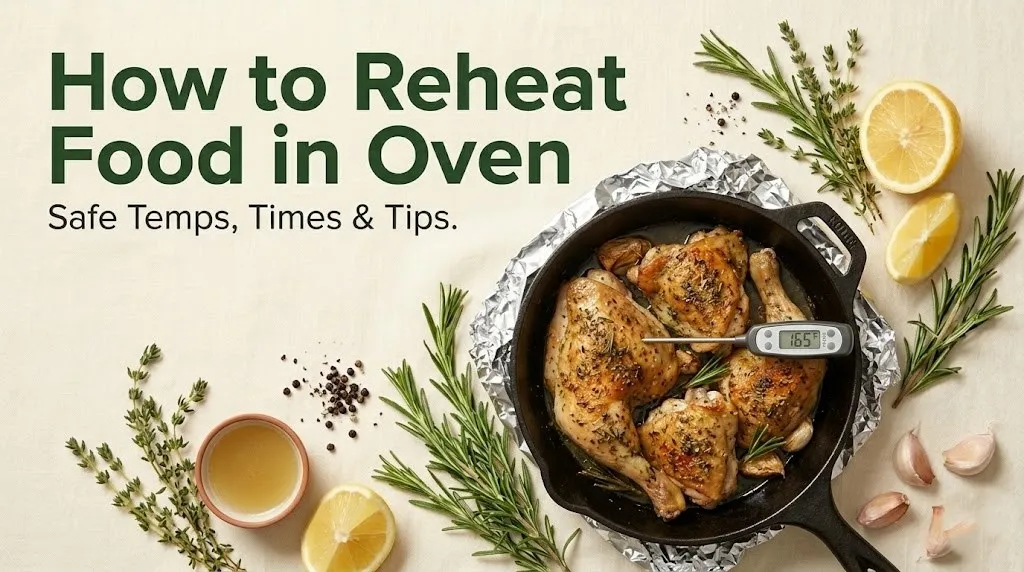
Most leftovers reheat well at 325°F (163°C). Denser foods like whole roasted chicken or thick casseroles benefit from a slightly lower temperature of 300°F (149°C) with a longer time. Thin, crispy items like pizza or flatbread do better at 375°F to 400°F (190°C to 204°C) for a shorter window.
The non-negotiable step is checking the internal temperature. A standard instant-read food thermometer should read 165°F (73.9°C) at the thickest part of any reheated protein or mixed dish before you pull it out. Oven temperature tells you how fast heat is being applied. Internal temperature tells you whether the food is actually safe.
Quick Tip:
- Always preheat the oven before adding food.
- Use a rimmed baking sheet or an oven-safe dish with a lid.
- Keep a food thermometer in the kitchen drawer. It costs about $10 and removes all guesswork.
Can You Reheat Food in the Oven?
Yes, you can reheat virtually any cooked food in the oven, and for most food categories it produces better results than a microwave. The oven uses dry, ambient heat that re-crisps exteriors, heats food evenly, and preserves structure in a way a microwave simply cannot.
The foods that reheat best in an oven include roasted meats, casseroles, baked pasta, pizza, roasted vegetables, bread-based dishes, stuffed peppers, and most protein-based leftovers. The foods that require the most care in an oven are rice (due to drying), delicate fish, and egg-based dishes, which can overcook quickly at high heat.
There are a few food categories where the oven is not the best primary method. Soups, stews, and sauces reheat more efficiently on the stovetop. Thin sliced proteins like deli meat warm faster under a broiler. The oven is the right tool for the vast majority of solid leftovers, but it is worth matching the method to the food.
| Food Type | Oven Suitable? | Best Alternative if Not |
|---|---|---|
| Roasted chicken | Yes | N/A |
| Casserole | Yes | N/A |
| Pizza | Yes | Skillet on stovetop |
| Pasta with sauce | Yes | Stovetop with added liquid |
| Rice | Yes (with moisture) | Stovetop or microwave |
| Soup or stew | Not ideal | Stovetop |
| Deli meat | Not ideal | Broiler or stovetop |
| Seafood | Yes (with care) | Stovetop at low heat |
Is It Safe to Reheat Food in the Oven?
Reheating food in the oven is safe when the food reaches an internal temperature of 165°F (73.9°C) throughout, not just at the surface. The oven temperature is just the delivery mechanism. Internal temperature is the actual safety measure.
The USDA FSIS defines the temperature danger zone as 40°F to 140°F (4°C to 60°C). Bacteria that cause foodborne illness multiply most rapidly within this range. When you reheat food in the oven, your goal is to move it through that danger zone quickly and push the internal temperature above 140°F with enough time to reach the 165°F target.
Food safety also depends on what happened before reheating. Leftovers stored correctly in the refrigerator at or below 40°F (4°C) are generally safe to reheat within 3 to 4 days, according to USDA FSIS guidance. Food left at room temperature for more than 2 hours (or 1 hour if the ambient temperature exceeds 90°F) should not be reheated. It should be discarded.
Immunocompromised individuals, pregnant people, young children, and adults over 65 face a higher risk from foodborne illness. For these groups, using a food thermometer every single time is not optional.
Key safety principles:
- Reheat only food that has been stored at or below 40°F (4°C).
- Discard leftovers older than 4 days in the refrigerator.
- Never reheat food that has been left at room temperature for more than 2 hours.
- Confirm 165°F (73.9°C) at the thickest point before serving.
Key Takeaway: The oven is one of the best tools for reheating most solid foods, but internal temperature is what determines safety, and the USDA’s 165°F target is the only number that actually matters.
What Temperature to Reheat Food in Oven
The right oven temperature for reheating food depends on the food’s density, moisture content, and original cooking method. Most leftovers do best between 300°F and 375°F (149°C to 190°C).
Think of it like this: reheating dense food at too high a temperature is like trying to thaw ice by blasting it with a hair dryer. The outside scorches before the inside even registers the heat.
Low and slow reheating at 300°F to 325°F is the right approach for thick cuts of meat, layered casseroles, stuffed dishes, and anything with a creamy or cheese-based topping. The slower heat moves inward more evenly, keeping moisture intact while bringing the center up to temperature.
Higher temperatures between 375°F and 425°F are appropriate for foods that benefit from crisping. Pizza, roasted vegetables, breaded chicken, and flatbreads all respond well to a hotter oven for a shorter time. The goal there is to restore the contrast between a crispy exterior and a warm interior.
| Food Category | Oven Temperature | Target Internal Temp |
|---|---|---|
| Thick roasted meat (chicken, pork, beef) | 300°F to 325°F | 165°F (73.9°C) |
| Casserole or baked pasta | 325°F to 350°F | 165°F (73.9°C) |
| Pizza or flatbread | 375°F to 400°F | Hot throughout |
| Roasted vegetables | 375°F to 400°F | Hot throughout |
| Breaded or fried foods | 400°F to 425°F | Hot throughout |
| Rice or grain dishes | 300°F to 325°F | 165°F (73.9°C) |
| Fish and seafood | 275°F to 300°F | 145°F (62.8°C) |
| Egg-based dishes (quiche, frittata) | 300°F to 325°F | 165°F (73.9°C) |
What Oven Temp to Reheat Food
325°F (163°C) is the single most versatile oven temperature for reheating most leftovers. It is warm enough to push food through the danger zone efficiently, but gentle enough to prevent the exterior from drying out before the center heats through.
For foods that originally had a crispy or browned exterior, like roasted potatoes, battered fish, or fried chicken, use 400°F to 425°F (204°C to 218°C) and shorten the reheat window to 10 to 15 minutes. The high heat restores crispness that a lower temperature cannot.
A convection oven setting reduces reheating time by approximately 20 to 25 percent compared to a conventional oven at the same temperature, because the fan circulates hot air more actively around the food. If you use convection mode, reduce the set temperature by 25°F (about 14°C) from any guideline to account for the increased airflow efficiency.
Quick Tip:
- Default to 325°F when in doubt about which temperature to use.
- Use 400°F+ only for foods that originally had a crispy coating or crust.
- Drop temperature by 25°F when using convection mode.
- Always use an oven thermometer. Many ovens run 15 to 25 degrees hotter or cooler than their dial setting.
How Long to Reheat Food in Oven
Reheat time in the oven depends on four variables: starting temperature of the food (fridge cold vs. room temperature), food thickness and density, oven temperature, and whether the dish is covered or uncovered. A thin slice of pizza at 400°F takes about 8 to 10 minutes. A large layered lasagna at 325°F can take 45 to 60 minutes.
The most reliable approach is to set a timer and check internal temperature at the halfway point. For large dishes, rotate or stir mid-reheat if possible. This prevents hot and cold spots from forming, which is exactly what leads to food that’s steaming on the outside but still cold in the center.
According to the FDA Food Code, the time required to move food safely through the danger zone during reheating is as important as the final temperature. Faster passage through the 40°F to 140°F range reduces the window for bacterial growth.
| Food | Oven Temp | Approx. Reheat Time | Notes |
|---|---|---|---|
| Roasted chicken pieces | 325°F | 20 to 30 min | Covered with foil |
| Lasagna or casserole (cold) | 325°F | 45 to 60 min | Covered until last 10 min |
| Pizza slice | 400°F | 8 to 12 min | Uncovered on rack |
| Stuffed pepper | 325°F | 25 to 35 min | Covered |
| Roasted vegetables | 400°F | 10 to 15 min | Uncovered, spread single layer |
| Rice (½ cup with liquid added) | 300°F | 15 to 20 min | Covered tightly |
| Pasta with sauce | 350°F | 20 to 25 min | Covered, liquid added |
| Whole roasted fish | 275°F | 15 to 20 min | Covered lightly |
Key Takeaway: Reheat time and temperature work together, and an internal temperature check at the halfway point is the most reliable way to avoid both underdone food and dried-out leftovers.
How to Heat Up Food in the Oven
Heating food in the oven correctly means starting with a preheated oven, choosing the right vessel, managing moisture, and confirming doneness with a thermometer.
To reheat food in the oven properly, follow these steps:
- Preheat the oven to the temperature appropriate for your food type (see the table above).
- Remove food from the refrigerator and let it sit at room temperature for no more than 15 to 20 minutes to reduce the cold start. Do not leave food out longer than this.
- Place food in an oven-safe dish. For moist foods, use a dish with a lid. For crispy foods, use an open baking sheet or wire rack set over a sheet pan.
- Add a splash of liquid (1 to 3 tablespoons of broth, water, or sauce) to moist dishes before covering. This creates steam that prevents drying.
- Cover tightly with a lid or aluminum foil, pressing down along the edges to trap steam.
- Place in the preheated oven. Start checking internal temperature at the halfway mark.
- For foods that need a crispy top or crust, remove the foil or lid for the final 8 to 10 minutes of reheating.
- Use an instant-read thermometer to confirm 165°F (73.9°C) at the thickest or densest point.
- Let the food rest for 2 to 3 minutes before serving. This allows heat to equalize throughout the dish.
People following low-sodium diets should choose low-sodium broth when adding liquid to prevent moisture loss during reheating.
How to Warm Up Food in Oven
Warming food in the oven differs slightly from reheating it at full cooking temperature. Warming means bringing food that is already fully cooked to a serving-ready temperature without further cooking it, typically for food that has cooled to room temperature or been made in advance for a gathering.
For warming rather than reheating, set the oven to 200°F to 250°F (93°C to 121°C). This is below the threshold that would continue cooking delicate foods like fish, scrambled eggs, or thin cuts of meat, but it is warm enough to bring food to a pleasant serving temperature over 20 to 30 minutes.
This low-temperature approach is common in professional kitchens. Dishes prepared during prep work are held in a low oven until service. The risk at this temperature is holding time: the USDA recommends never holding food below 140°F for extended periods. If you’re warming food for a party or family gathering, check with a thermometer every 30 minutes and serve within 2 hours of placing in the warm oven.
| Warming Scenario | Oven Temp | Time | Notes |
|---|---|---|---|
| Dinner rolls or bread | 200°F | 10 to 15 min | Wrapped in foil |
| Carved turkey or chicken | 225°F | 20 to 30 min | Covered with broth added |
| Plated meal held for late arrival | 225°F | Up to 30 min | Covered tightly |
| Side dishes (mashed potatoes, stuffing) | 250°F | 20 to 25 min | Covered with liquid added |
How to Reheat Food in Oven Without Drying It Out
The key to reheating food without drying it out is controlling moisture. Every oven is an environment of dry, moving heat. Without deliberate moisture management, that heat pulls water out of food and leaves it tough, rubbery, or cardboard-dry.
The most effective tool is a tight-fitting lid or aluminum foil. Covering the dish traps the steam that rises from the food’s natural moisture and recirculates it. This creates a mini steaming environment inside your baking dish, which keeps proteins tender and sauces fluid.
For foods that have already lost visible moisture during storage, add liquid before covering. 1 to 2 tablespoons of broth, water, or reserved cooking sauce per cup of food is a reliable starting point. This is especially important for rice, pasta, and shredded or sliced meats. Think of it the same way you’d add water to a pot of oatmeal that has thickened overnight: you’re not changing the dish, you’re restoring what evaporation took away.
Avoid reheating at temperatures above 375°F for moist dishes. High heat accelerates moisture loss faster than the trapped steam can compensate.
Key moisture management rules:
- Always cover moist dishes with a lid or foil during the majority of reheating time.
- Add 1 to 2 tablespoons of liquid per cup of dense or starchy food before covering.
- Uncover only during the final 8 to 10 minutes if you want a browned or crisped top.
- Reheat at 325°F or lower for dishes where texture and juiciness matter most.
- Avoid placing cold food directly from the refrigerator onto a dry, uncovered baking sheet at high heat.
Key Takeaway: The difference between dry, rubbery reheated food and something that actually tastes good is almost always moisture management: a tight cover, a splash of liquid, and a moderate oven temperature.
How to Reheat Chicken in the Oven
Reheat chicken in the oven at 325°F (163°C) with foil cover and a small amount of liquid added until the internal temperature reaches 165°F (73.9°C). This is the USDA’s recommended safe internal temperature for all poultry, including leftovers.
Chicken dries out faster than almost any other protein when reheated improperly. The muscle fibers in cooked chicken begin to tighten and expel moisture at temperatures above 165°F. The goal is to bring the meat to exactly that threshold quickly and pull it out, rather than letting it push further.
For bone-in pieces like thighs, drumsticks, or a half breast, place them in a baking dish, add 2 to 3 tablespoons of chicken broth or water, and cover tightly with foil. Reheat at 325°F for 20 to 30 minutes, checking internal temperature at the 20-minute mark. For boneless, skinless chicken breast, reduce time to 15 to 20 minutes at the same temperature, as the thinner protein heats faster.
If you want to restore crispy skin on roasted chicken pieces, uncover for the final 5 to 8 minutes and increase the oven to 400°F. This is a two-phase approach: low and moist first, then high and dry briefly at the end.
People avoiding added sodium should use plain water instead of broth when adding reheating liquid to chicken dishes.
| Chicken Cut | Oven Temp | Time | Cover? | Liquid Added |
|---|---|---|---|---|
| Bone-in thigh or drumstick | 325°F | 25 to 30 min | Yes (foil) | 2 to 3 tbsp broth |
| Boneless breast | 325°F | 15 to 20 min | Yes (foil) | 1 to 2 tbsp broth |
| Whole roasted chicken | 300°F | 35 to 45 min | Yes (foil) | 3 to 4 tbsp broth |
| Fried chicken | 400°F | 15 to 20 min | No | None |
How to Reheat Pizza in the Oven
Reheat pizza in the oven at 375°F to 400°F (190°C to 204°C) on a preheated baking sheet or pizza stone for 8 to 12 minutes for the best combination of crispy crust and melted cheese. This is one of the few reheating scenarios where covering the food actually works against you.
The biggest mistake people make when reheating pizza is using too low a temperature. At 300°F or below, the crust absorbs ambient moisture and goes soft and chewy before the cheese has time to melt properly. At 375°F and above, the underside of the crust crisps up quickly while the cheese melts through the heat radiating down from the oven walls.
Placing pizza directly on the oven rack is effective for very thin crust but risks toppings falling through. A better approach for most pizza styles is to preheat a baking sheet in the oven for 5 minutes, then place the pizza slices directly onto the hot sheet. The immediate contact with hot metal starts crisping the base right away.
For deep-dish or thick-crust pizza with substantial toppings, reduce the temperature to 350°F and extend the time to 15 to 18 minutes. Cover loosely with foil for the first 10 minutes to allow the center to heat through, then uncover for the final 5 to 8 minutes to crisp the crust.
Individuals with gluten sensitivity should note that gluten-free pizza crusts often reheat faster and may need a shorter window at these temperatures to avoid over-crisping the edges.
How to Reheat Casserole in the Oven
Reheat casserole in the oven at 325°F to 350°F (163°C to 177°C), covered, for 30 to 50 minutes, removing the cover for the final 10 minutes if a browned top is desired. Casseroles are dense, layered dishes that require patient, lower-temperature reheating.
The layered structure of a casserole means heat travels slowly from the edges and bottom toward the center. If you set the oven too hot, the edges boil and bubble while the middle remains cold. A moderate 325°F to 350°F oven lets heat penetrate evenly without overcooking the perimeter.
Adding 3 to 4 tablespoons of liquid (broth, milk, cream, water, or tomato sauce depending on the dish type) before covering is particularly important for casseroles that include pasta, rice, or breadcrumb toppings. These starch components absorb moisture aggressively in storage and will emerge dry and crumbly without it.
According to the Academy of Nutrition and Dietetics, casseroles stored in the refrigerator for up to 3 to 4 days are safe for reheating. Casseroles that contain meat, poultry, or eggs must reach 165°F (73.9°C) throughout before serving. Those that contain only vegetables or cheese can be considered safe when they are steaming throughout and have reached at least 165°F.
Casseroles made with dairy-based sauces (béchamel, cream sauce, cheese sauce) should never be reheated at high temperatures, as the emulsion in those sauces can break and turn grainy. Low and slow is the right approach without exception for cream-based dishes.
Key Takeaway: Casseroles and dense layered dishes need patience: a covered dish, a splash of added liquid, 325°F to 350°F, and a thermometer check at the center before serving.
How to Reheat Rice in the Oven
Reheat rice in the oven at 300°F to 325°F (149°C to 163°C) with added liquid and a tight foil cover until the rice reaches 165°F (73.9°C) internally and is steaming throughout. Rice is one of the foods that requires the most specific food safety attention when reheating.
Cooked rice can harbor Bacillus cereus, a spore-forming bacterium that survives standard cooking temperatures. When cooked rice is left at room temperature, these spores can germinate and produce heat-resistant toxins. The CDC notes that Bacillus cereus is one of the more common causes of food poisoning linked to rice-based dishes.
Rice reheated in the oven without moisture becomes dry and hard, with a chalky texture that signals the starch granules have retrograded. To reverse this, add 1 tablespoon of water per cup of cooked rice, stir briefly to distribute, then cover the dish tightly with foil before placing in the oven.
Rice stored in the refrigerator at or below 40°F (4°C) should be reheated within 1 to 2 days of cooking for both quality and safety. Do not reheat rice that has been stored for more than 3 to 4 days or that was left at room temperature for more than 1 to 2 hours.
People following a low-glycemic eating pattern should note that cooled and reheated rice has a modestly lower glycemic response than freshly cooked hot rice, due to the formation of resistant starch during cooling, as noted in research published in the journal Asia Pacific Journal of Clinical Nutrition.
| Rice Type | Added Liquid | Oven Temp | Time | Cover |
|---|---|---|---|---|
| White rice (1 cup) | 1 tbsp water | 300°F | 15 to 20 min | Tight foil |
| Brown rice (1 cup) | 2 tbsp water | 300°F | 20 to 25 min | Tight foil |
| Fried rice (1 cup) | 1 tbsp broth | 325°F | 15 to 20 min | Tight foil |
| Rice pilaf (1 cup) | 1 to 2 tbsp broth | 300°F | 15 to 20 min | Tight foil |
How to Reheat Pasta in the Oven
Reheat pasta in the oven at 350°F (177°C) in a covered, oven-safe dish with 2 to 4 tablespoons of sauce or water added per cup of pasta, for 20 to 30 minutes until heated through. Pasta is the most prone to drying out of any starchy food in an oven reheat.
Pasta continues to absorb liquid in storage. By the time leftover pasta comes out of the refrigerator, the starch has soaked up much of the original sauce. Without restoring some of that liquid before reheating, you’ll get a clumped, dry, and stuck mass even from a good sauce-heavy dish.
The best approach for pasta with tomato-based sauce is to add 2 to 3 tablespoons of water or additional tomato sauce per portion and stir before covering. For cream or cheese-based pasta like carbonara, macaroni and cheese, or Alfredo, use 1 to 2 tablespoons of milk or cream instead of water to maintain the richness of the sauce without breaking it.
Baked pasta dishes like lasagna, ziti, or pasta gratin reheat slightly differently than loose pasta. They are dense and layered, so they follow the casserole approach: 325°F to 350°F, covered, for 30 to 45 minutes, with a foil removal in the last 8 to 10 minutes if a browned top is desirable.
Individuals following gluten-free eating patterns should ensure the pasta dish they are reheating was prepared in cookware and with utensils free from cross-contact with gluten-containing ingredients, as heat does not eliminate gluten.
Key Takeaway: Pasta always needs added liquid before reheating in the oven; without it, the starch keeps absorbing and the dish dries out regardless of how carefully you set the temperature.
Reheating Food from Frozen in the Oven
Reheating food from frozen in the oven requires either full thawing in the refrigerator first or an adjusted oven approach starting at a lower temperature, then finishing at the target heat. Never reheat frozen food at a high temperature expecting the center to catch up to the exterior.
The USDA FSIS recommends thawing food in the refrigerator as the safest method before reheating. For most leftovers, overnight refrigerator thawing is sufficient. The food can then be reheated using standard temperature and timing guidelines as if it were fresh from the fridge.
When reheating directly from frozen in the oven, start at a low temperature of 250°F to 300°F (121°C to 149°C) for the first 30 to 40 minutes to begin thawing and warming the center. Then increase the temperature to the appropriate reheating range for the final phase. This two-stage approach prevents the surface from burning while the frozen core remains cold.
Casseroles, soups in oven-safe containers, rice dishes, and baked pasta all reheat from frozen reasonably well with this method. Whole roasted meats, however, benefit far more from refrigerator thawing first. The density of a large roast means the two-stage oven approach adds significant time and requires careful monitoring.
Always add extra liquid when reheating any starchy dish from frozen. Freezing accelerates moisture loss in grains and pasta significantly compared to refrigerator storage.
| Food | Start Temp | Start Time | Increase To | Final Time | Final Temp Target |
|---|---|---|---|---|---|
| Casserole (frozen) | 275°F | 40 min | 350°F | 30 to 40 min | 165°F |
| Baked pasta (frozen) | 275°F | 35 min | 350°F | 25 to 30 min | 165°F |
| Rice dish (frozen) | 275°F | 20 min | 325°F | 15 to 20 min | 165°F |
| Stuffed peppers (frozen) | 300°F | 30 min | 350°F | 20 to 25 min | 165°F |
Frequently Asked Questions About Reheating Food in the Oven
What temperature should I reheat food in the oven?
Most leftovers reheat well at 325°F (163°C), with crispy foods doing better at 375°F to 400°F.
The safe internal temperature target for all reheated food containing meat, poultry, or eggs is 165°F (73.9°C), per USDA FSIS guidance.
Use an instant-read thermometer to confirm the center reaches that temperature before serving.
How long does it take to reheat food in the oven?
Reheat time ranges from 8 to 10 minutes for thin foods like pizza slices at 400°F to 45 to 60 minutes for large, dense dishes like lasagna at 325°F.
Food thickness, starting temperature, and whether the dish is covered or uncovered all affect timing.
Check internal temperature at the halfway mark rather than relying on time alone.
Is it safe to reheat food more than once?
Reheating food more than once is generally not recommended, as each heat and cool cycle increases the window for bacterial growth.
The USDA FSIS advises reheating only the portion you plan to eat rather than reheating the entire batch repeatedly.
Divide large quantities of leftovers into smaller containers before refrigerating so you can reheat individual portions without cycling the whole dish through temperature changes multiple times.
Should I cover food when reheating in the oven?
Cover moist dishes like casseroles, pasta, chicken, and rice during most of the reheating time to trap steam and prevent drying.
Remove the cover for the final 8 to 10 minutes if you want a browned or crispy top.
Crispy foods like pizza and fried items should not be covered at all, as trapped steam will soften the crust and coating.
What is the best oven setting for reheating leftovers?
The conventional bake setting at 325°F (163°C) is the best all-purpose setting for most leftovers.
If your oven has a convection setting, reduce the temperature by 25°F and expect reheating to take approximately 20 percent less time.
Avoid the broil setting for reheating most foods, as it delivers intense top-down heat that browns the surface before the center warms through.
Final Thoughts
Reheating food in the oven comes down to three things: the right temperature for your food type, deliberate moisture management, and a thermometer to confirm safety. Most leftovers do best at 325°F, covered, with a splash of liquid added before they go in.
The USDA’s 165°F internal temperature target is not a guideline. It’s the threshold between food that’s safe to eat and food that carries real risk, particularly for anyone with a compromised immune system, young children, or older adults in the household.
Get an instant-read thermometer if you don’t have one. Use it every time. That single habit closes the gap between good reheating intentions and actually safe, well-textured leftovers.