Healthy ramen noodles exist, and building a genuinely nutritious ramen bowl is entirely achievable, whether you’re starting from a packet or cooking from scratch. The key is understanding which part of the bowl is doing the nutritional damage and which part you can keep exactly as it is.
Standard instant ramen’s reputation as a nutritional problem is largely earned by one thing: the seasoning packet. According to the American Heart Association (AHA), adults should consume no more than 2,300 milligrams of sodium per day, with an ideal target of 1,500 milligrams for people managing blood pressure. A single standard instant ramen packet delivers 1,500 to 1,800 milligrams of sodium before you add a single topping.
This guide covers everything: actual nutrition data by noodle type and broth style, what the research says about MSG, which brands deliver the best nutritional profile, how to build a high-protein ramen bowl, and a full recipe with real measurements and a calorie breakdown.
Are Ramen Noodles Healthy?
Ramen noodles can be a healthy meal when the noodle type, broth, and toppings are chosen intentionally, but standard instant ramen eaten as packaged is high in refined carbohydrates, sodium, and fat with limited fiber and protein.
The noodle itself is not the main nutritional issue. Traditional ramen noodles are made from wheat flour (Triticum aestivum) mixed with kansui, an alkaline salt solution that gives them their characteristic springiness and yellow color. A 100g portion of cooked plain ramen noodles contains approximately 130 to 150 calories, 25 to 28g of carbohydrates, 5 to 6g of protein, and less than 2g of fat. That’s a reasonable pasta-equivalent base for a meal.
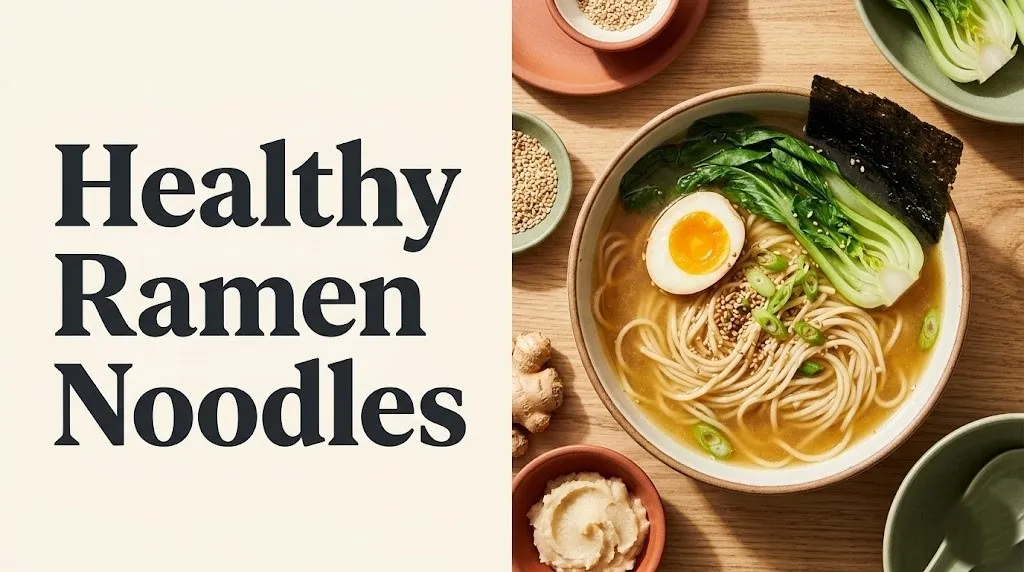
The problem is what typically accompanies the noodles. Pre-fried instant noodles add 14 to 16 grams of fat per package during the flash-frying process used to dehydrate them. The seasoning packet adds 1,500 to 1,800mg of sodium. Together, these transform a moderate carbohydrate noodle into a high-sodium, high-fat meal with minimal fiber.
Restaurant ramen tells a different story in some ways and a similar one in others. The broth at a good ramen shop is made from real ingredients: pork bones, chicken carcasses, kelp, and dried fish. The protein content is higher. But the sodium in a full bowl of restaurant tonkotsu ramen can reach 2,000 to 3,000 milligrams, which covers an entire day’s recommended intake in one meal.
People with celiac disease or non-celiac gluten sensitivity should note that standard ramen noodles are made from wheat flour and are not gluten-free. Gluten-free alternatives are covered later in this guide.
Ramen Noodles Nutrition Facts
Ramen noodles nutrition varies dramatically based on whether you’re eating dried instant noodles, fresh ramen, or a noodle alternative like brown rice or buckwheat.
The most complete way to understand ramen’s nutritional profile is to separate the noodle from the broth and toppings, because these are three distinct nutritional contributors. Most calorie estimates for ramen combine all components, which makes comparison between types difficult.
| Component | Standard Amount | Calories | Protein (g) | Sodium (mg) | Fiber (g) |
|---|---|---|---|---|---|
| Instant noodle block (pre-fried) | 85g dry (1 pkg) | 370 to 400 | 8 to 10 | 0 to 50 | 1 to 2 |
| Instant seasoning packet | 1 packet | 10 to 30 | 0 | 1,500 to 1,800 | 0 |
| Fresh wheat ramen (cooked) | 100g | 130 to 150 | 5 to 6 | 10 to 30 | 1 |
| Brown rice ramen (cooked) | 100g | 110 to 130 | 2 to 3 | 5 to 15 | 1 to 2 |
| Shirataki/konjac noodles (cooked) | 100g | 5 to 10 | 0 | 5 to 15 | 2 to 3 |
| Soba noodles (cooked) | 100g | 99 to 115 | 5 to 6 | 60 to 100 | 1 to 2 |
According to USDA FoodData Central, enriched instant ramen provides iron (approximately 10 to 15% of the daily value per serving from enrichment) and folate (vitamin B9) (approximately 10% DV from enrichment). These are not naturally occurring in refined wheat at meaningful levels but are added back after processing.
People with iron-deficiency anemia who rely on enriched instant ramen as a dietary iron source should note that non-heme iron from fortified grains has lower bioavailability than heme iron from animal sources. Pairing with a source of vitamin C (ascorbic acid), like a squeeze of lime or a serving of bok choy, can improve non-heme iron absorption.
Instant Ramen Calories and Sodium
A full serving of instant ramen with the seasoning packet contains approximately 380 to 430 calories and 1,500 to 1,800 milligrams of sodium, placing it among the highest-sodium single-serving foods in any grocery store.
The calorie number alone is not alarming. For most adults eating a 2,000-calorie diet, 380 to 430 calories for a meal is within a normal range. The sodium number is the real concern. Using the full seasoning packet with one serving delivers 65 to 78% of the AHA’s recommended daily sodium maximum in one sitting.
The fat in pre-fried instant ramen noodles comes from the palm oil used during flash-frying. Palm oil (Elaeis guineensis) is high in saturated fat, containing approximately 50% saturated fatty acids by weight. A standard instant ramen package provides approximately 6 to 7 grams of saturated fat from the noodle frying process, representing roughly 30 to 35% of the AHA’s recommended daily saturated fat limit.
One practical adjustment changes the sodium picture immediately: using half the seasoning packet cuts sodium to 750 to 900 milligrams per serving. Supplementing the reduced seasoning with fresh aromatics (ginger, garlic, a splash of low-sodium soy sauce) maintains flavor complexity while keeping sodium in a more manageable range.
People managing chronic kidney disease require specific dietary sodium and potassium limits set by their nephrologist. Standard instant ramen is generally not recommended as a regular food in this context because of its very high sodium concentration and the difficulty of accurately limiting intake from a pre-mixed packet.
Key Takeaway: The instant ramen noodle block itself is a moderate-calorie, moderate-carb food. The seasoning packet is what makes standard instant ramen a high-sodium meal. Discard or halve the packet and the nutritional calculation changes immediately.
Types of Ramen Noodles Compared
Ramen noodle types differ by base ingredient, processing method, fiber content, and allergen profile, making the choice of noodle one of the most meaningful nutritional decisions in building a healthier bowl.
Standard wheat ramen noodles come in two primary forms: pre-fried dried noodles (used in most instant ramen) and fresh or air-dried wheat noodles (used in restaurant ramen and some premium retail products). Pre-fried noodles carry additional fat from the frying process. Air-dried and fresh noodles do not, making them the lower-fat base option when starting from scratch.
Beyond wheat, several alternative noodle bases now carry ramen-style marketing. Here is how the main types compare on the nutritional variables that matter most:
| Noodle Type | Base Ingredient | Gluten-Free | Calories (100g cooked) | Fiber (g) | Protein (g) |
|---|---|---|---|---|---|
| Standard instant (pre-fried) | Wheat + palm oil | No | 145 to 160 | 1 | 4 to 5 |
| Fresh wheat ramen | Wheat + kansui | No | 130 to 150 | 1 | 5 to 6 |
| Brown rice ramen | Brown rice | Yes | 110 to 130 | 1 to 2 | 2 to 3 |
| Soba (100% buckwheat) | Buckwheat (Fagopyrum esculentum) | Yes* | 99 to 115 | 2 | 5 to 6 |
| Shirataki/konjac | Konjac (Amorphophallus konjac) | Yes | 5 to 10 | 2 to 3 | 0 |
| Edamame or black bean noodles | Legume flour | Yes | 180 to 220 | 8 to 12 | 20 to 25 |
*Note: Many commercial soba products contain wheat mixed with buckwheat. Check the label for 100% buckwheat to confirm gluten-free status.
People with soy allergies should check labels on edamame and black bean noodle products, as some are produced on shared equipment with soy-containing foods.
Healthiest Ramen Noodle Brands
The healthiest ramen noodle brands are those that use air-dried or baked noodles rather than pre-fried ones, include whole grain or alternative flour bases, and offer seasoning packets with significantly reduced sodium compared to standard options.
Several brands have positioned their products in the better-for-you ramen category. When evaluating any brand, the three numbers worth checking on the nutrition label are: sodium per serving (target below 600mg per serving for the full product), fat content (particularly saturated fat from pre-frying), and fiber (ideally above 2g per serving).
Key things to look for on ramen labels:
- “Air-dried” or “baked” noodles: indicates no frying; substantially lower fat than standard instant
- “Less sodium” or “reduced sodium”: packaging must contain at least 25% less sodium than the standard version under FDA labeling rules
- Whole grain flour as first ingredient: associated with higher fiber content than refined wheat
- Seasoning packet sold separately or omitted: allows full control over sodium addition
- Short ingredient list in the seasoning: fewer additives and lower sodium from simpler formulas
Brands worth evaluating in the US market as of 2026 include Lotus Foods (brown rice ramen, air-dried, gluten-free options), Nongshim Soon Veggie (lower-sodium vegetable broth option), and Koyo (organic ramen with lower-sodium seasoning). Nutritional formulations change, so confirm current sodium and fat data against the nutrition facts panel on the specific product you’re purchasing.
People with wheat allergies should verify that brown rice ramen brands are produced in dedicated gluten-free facilities, as cross-contamination risk varies by manufacturer.
Is MSG in Ramen Safe?
Monosodium glutamate (MSG), the sodium salt of glutamic acid, is safe for the general population according to the US Food and Drug Administration (FDA), which has classified MSG as Generally Recognized as Safe (GRAS) since 1958, a classification it has reaffirmed in subsequent reviews.
MSG is used in ramen seasoning packets as a flavor enhancer because glutamate is the amino acid responsible for umami, the savory taste sensation. MSG provides approximately 12% sodium by weight, compared to table salt (sodium chloride, NaCl) at 39% sodium by weight. This means MSG actually delivers less sodium per gram of equivalent flavor enhancement than table salt, according to data reviewed by the NIH.
The widely repeated claim that MSG causes headaches, flushing, or sweating (“Chinese Restaurant Syndrome”) has not been supported by controlled, double-blind clinical research. A review published in the Journal of Nutrition found that when MSG is consumed at typical dietary levels without prior knowledge of exposure, self-reported sensitivity symptoms do not occur at rates above placebo. The FDA notes that while some people may report sensitivity to very large doses of MSG (3 or more grams consumed without food), the amounts used in ramen seasoning packets are typically 0.5 to 1 gram per serving.
People who have independently confirmed MSG sensitivity through an elimination and reintroduction protocol supervised by an allergist should still avoid MSG-containing seasoning. But the population-wide assumption that MSG in ramen is a health concern is not supported by current clinical evidence.
Key Takeaway: MSG in ramen is FDA-classified as safe at typical dietary levels, and the controlled research does not support the widely repeated claim that it causes headaches. The real sodium concern in ramen comes from total packet sodium, not MSG specifically.
Best Broth for Healthy Ramen
The healthiest ramen broth is a shio (salt-based) or low-sodium miso broth, as both can be prepared with lower sodium than tonkotsu or standard shoyu broths while still delivering the layered savory flavor that makes ramen satisfying.
Broth style is the single largest nutritional variable in a restaurant or homemade ramen bowl after the noodle itself. The four main Japanese ramen broth styles vary considerably in their sodium, calorie, and fat profiles:
| Broth Type | Base | Approx. Sodium per Bowl (restaurant) | Approx. Calories (broth only) | Fat |
|---|---|---|---|---|
| Tonkotsu | Pork bone | 1,800 to 2,800mg | 200 to 350 | High (collagen-rich, fatty) |
| Shoyu | Soy sauce + chicken or dashi | 1,500 to 2,200mg | 80 to 150 | Low to moderate |
| Miso | Fermented soybean paste + dashi | 1,400 to 2,000mg | 100 to 180 | Low to moderate |
| Shio | Salt + chicken or seafood dashi | 1,200 to 1,800mg | 50 to 100 | Low |
Homemade versions of all four can be made with significantly less sodium than restaurant preparations by controlling the amount of soy sauce, miso paste, and added salt used during cooking.
Bone broth as a base delivers collagen peptides (hydrolyzed protein from simmered connective tissue), which have been studied in preliminary research for potential effects on joint health and skin elasticity. The evidence for specific health outcomes from dietary collagen is still developing and not yet considered conclusive by the Academy of Nutrition and Dietetics.
People following a vegan diet cannot use bone broth, tonkotsu, or chicken-based dashi. A kombu (dried kelp, Saccharina japonica) and dried shiitake mushroom (Lentinula edodes) dashi provides umami depth with zero animal products and meaningful amounts of iodine from the kombu.
Is Miso Ramen Healthy?
Miso ramen is one of the more nutritionally favorable ramen styles because miso paste (fermented soybean paste produced using Aspergillus oryzae) contributes protein, iron, and live probiotic cultures to the broth base.
Miso paste contains live bacterial cultures from the fermentation process, primarily Lactobacillus and Tetragenococcus species. These are the same culture types found in yogurt and other fermented foods. The caveat is temperature: adding miso paste to actively boiling broth destroys the live cultures before consumption. To preserve them, stir miso paste into broth that has been removed from direct heat and cooled to below 70°C (158°F).
Research published in the British Journal of Nutrition found that regular miso consumption in Japanese cohort studies was associated with lower rates of certain cardiovascular outcomes, though the authors noted this association exists within a broader dietary pattern and cannot be attributed to miso alone. The high sodium content of miso ramen (1,400 to 2,000mg per restaurant bowl) is a counterpoint worth acknowledging.
A 2-tablespoon serving of white miso paste (shiro miso) contains approximately 70 to 80 calories, 4 to 5 grams of protein, 4 to 5 grams of fat, and 1,000 to 1,200 milligrams of sodium. Using white miso (lower sodium) rather than red miso (higher sodium, longer-fermented) reduces the sodium contribution to the broth noticeably.
People with soy allergies cannot eat standard miso paste, as it is made from soybeans. Chickpea miso (miso made from chickpeas rather than soybeans) is a soy-free alternative available from specialty producers.
Healthy Ramen Toppings
The healthiest ramen toppings are protein sources and non-starchy vegetables, which transform a noodle-heavy bowl into a balanced meal with adequate protein, fiber, vitamins, and minerals.
Think of ramen toppings the way you’d think of loading a blank canvas. The noodle and broth provide carbohydrates and liquid volume. Toppings are where you add protein to support satiety, vegetables to add fiber and micronutrients, and healthy fats to slow digestion. A bowl without meaningful toppings is a high-carbohydrate, low-protein meal. A well-topped bowl is a complete one.
High-protein toppings and their approximate protein contributions per standard ramen portion:
- Soft-boiled egg (ajitsuke tamago), 1 large: 6 grams of protein, 70 calories, 5g fat
- Firm tofu, 100g: 8 to 9 grams of protein, 76 calories, 4g fat (vegan, soy allergen note)
- Edamame (Glycine max), half cup shelled: 9 grams of protein, 95 calories, 4g fat
- Chashu pork (braised pork belly), 60g: 12 to 14 grams of protein, 180 to 220 calories, 12 to 16g fat (higher saturated fat)
- Shredded chicken breast, 80g: 22 to 24 grams of protein, 100 to 120 calories, 2g fat
Vegetable toppings with the highest micronutrient density per calorie include bok choy (Brassica rapa subsp. chinensis), bean sprouts (Vigna radiata), spinach (Spinacia oleracea), corn kernels, and sliced shiitake mushrooms (Lentinula edodes). These add vitamin C (ascorbic acid), folate, iron, potassium, and beta-glucan (from mushrooms) at minimal caloric cost.
People with egg allergies should avoid the traditional soft-boiled egg topping and substitute with an additional protein source like tofu or edamame.
Key Takeaway: Toppings are the fastest way to turn ramen into a nutritionally complete meal. Adding one protein source (egg, tofu, chicken) and two non-starchy vegetables per bowl fundamentally changes the macronutrient and micronutrient profile of what you’re eating.
Low Sodium Ramen Noodles
Low-sodium ramen noodles are products that contain 25% less sodium than the standard version of the same product, as defined by FDA food labeling regulations, or homemade ramen preparations where sodium is controlled precisely at the broth stage.
The FDA’s “reduced sodium” labeling standard requires that a product contain at least 25% less sodium per serving than the reference food. For standard instant ramen at 1,500 to 1,800mg sodium per serving, this means a “reduced sodium” version must contain 1,125 to 1,350mg sodium or less per serving. That’s still a substantial sodium load, though meaningfully lower than the standard.
Genuinely low-sodium ramen (below 600mg per serving) generally requires one of three approaches:
- Purchasing a ramen product with a separate seasoning packet and using one-third to one-half of the packet
- Buying plain air-dried noodles and building broth from scratch with controlled salt addition
- Using a commercial low-sodium broth (below 140mg per cup is the FDA’s “low sodium” threshold) as the base
Quick Tip:
- Check the “sodium per serving” line, not just the front-of-package claim, when comparing brands.
- Homemade dashi made from kombu and dried bonito (Katsuwonus pelamis) flakes delivers deep umami at approximately 70 to 100mg sodium per cup before any salt is added.
- Potassium chloride used as a partial salt substitute is an option for some reduced-sodium broths; note that people with chronic kidney disease or those on certain blood pressure medications (ACE inhibitors, potassium-sparing diuretics) may need to limit potassium intake specifically, so checking with the prescribing physician before using potassium-based salt substitutes is warranted.
High Protein Ramen Noodles
High-protein ramen noodles are products that use legume flour bases (such as edamame, black bean, or chickpea) or are paired with substantial protein toppings to bring the bowl’s total protein to 25 to 35 grams per serving, which is consistent with Academy of Nutrition and Dietetics guidance on protein distribution across meals.
Standard wheat ramen noodles provide only 8 to 10 grams of protein per full package, and most of that protein comes from the wheat flour itself, which is an incomplete protein source (low in the essential amino acids lysine and methionine). This is why toppings are nutritionally necessary rather than optional in a well-constructed ramen bowl.
Edamame noodles and black bean noodles change this base significantly. Per 100g dry, edamame pasta-style noodles deliver approximately 24 to 26 grams of protein, compared to standard wheat ramen at approximately 10 to 12 grams per 100g dry. The protein in legume-based noodles is also more nutritionally complete, as soy protein (Glycine max) is one of the few plant proteins considered a complete amino acid source by the Academy of Nutrition and Dietetics.
For people building a high-protein ramen bowl from wheat noodles rather than legume-based alternatives, the protein goal is met through topping strategy rather than noodle choice. Combining one large soft-boiled egg (6g protein) with 80g of grilled chicken breast (22g protein) or 100g of firm tofu (9g protein) brings the bowl’s total protein to a range consistent with a protein-adequate meal.
People following a plant-based or vegan diet can reach 25 to 30 grams of protein per ramen bowl by combining edamame noodles with tofu and edamame toppings without any animal products.
Is Ramen Good for Weight Loss?
Ramen can be part of a weight-management eating pattern when prepared with a low-calorie broth, controlled noodle portions, and protein-forward toppings, but standard instant ramen eaten as packaged is not well-suited to weight loss due to its low satiety, low fiber, and high sodium content.
Sodium causes temporary water retention. Eating a high-sodium meal like standard instant ramen often produces a noticeable scale increase the following day from retained fluid, not fat gain. The USDA Dietary Guidelines for Americans 2020-2025 note that sodium intake above 2,300mg per day is associated with fluid retention and elevated blood pressure in sodium-sensitive individuals.
From a calorie standpoint, a full bowl of ramen built at home with 100g cooked noodles, a low-sodium miso broth (approximately 80 calories), one soft-boiled egg, and a generous serving of bok choy and bean sprouts totals approximately 380 to 450 calories. This is a calorie-appropriate meal that provides fiber, protein, and volume, all factors associated with meal satiety.
The satiety limitation of noodle-dominant ramen without protein and vegetable toppings is real. A bowl of instant ramen noodles in broth without toppings delivers calories primarily from refined carbohydrates, which digest quickly and don’t keep people full for long. Adding 25 to 30 grams of protein to the same bowl substantially extends the time before hunger returns, according to research on protein and satiety reviewed in the American Journal of Clinical Nutrition.
People tracking calories for weight management should weigh noodles dry before cooking rather than estimating cooked portions. A 100g dry serving of ramen noodles yields approximately 200 to 220g cooked, which looks like a much larger volume and can make cooked-weight estimation unreliable.
Key Takeaway: Ramen can work in a weight-management plan with two conditions: controlling the noodle portion to one serving (85 to 100g dry) and adding protein and vegetables that extend satiety well beyond what noodles alone provide.
Ramen Noodles and Blood Pressure
Regular consumption of standard instant ramen is associated with higher dietary sodium intake, which the American Heart Association (AHA) identifies as a primary dietary risk factor for hypertension in sodium-sensitive individuals.
A study published in the Journal of Nutrition examining dietary patterns in South Korea, where instant ramen consumption is among the highest in the world, found that frequent instant ramen intake (two or more times per week) was associated with higher cardiometabolic risk markers in women, independent of overall dietary quality. The authors attributed this primarily to sodium and the refined carbohydrate and saturated fat profile of pre-fried noodles.
The AHA recommends a daily sodium limit of 2,300 milligrams for most adults and 1,500 milligrams for people already managing hypertension. One standard instant ramen package with the full seasoning packet sits at 1,500 to 1,800 milligrams of sodium, which means it accounts for between 65% and 100% of either limit before any other food is eaten that day.
Practical approaches for people who want to continue eating ramen while managing blood pressure include:
- Using one-quarter to one-half of the seasoning packet and supplementing with fresh aromatics
- Choosing low-sodium broth products (below 140mg sodium per cup as the base)
- Limiting restaurant ramen to once per week and choosing shio or miso broth over tonkotsu
- Not drinking the full broth at a restaurant, since most of the sodium in a ramen bowl is in the liquid
People prescribed sodium-restricted diets by a physician managing active hypertension, heart failure, or kidney disease should treat any restaurant ramen as a high-sodium food environment and discuss with their prescribing provider what their specific per-meal sodium limit should be.
Gluten-Free and Vegan Ramen Options
Gluten-free ramen noodles are made from brown rice, buckwheat, shirataki/konjac, or legume flours rather than wheat, while vegan ramen requires replacing both egg-containing noodles and animal-based broths with plant-derived alternatives.
Most commercially available ramen noodles contain wheat flour. People with celiac disease need to confirm that the product is labeled gluten-free and manufactured in a dedicated gluten-free facility, not merely made with gluten-free ingredients in a shared facility. Cross-contamination risk in shared facilities is real for people with celiac disease and can trigger intestinal damage even from trace gluten exposure.
100% buckwheat soba noodles (Fagopyrum esculentum) are naturally gluten-free and provide approximately 2 grams of dietary fiber per 100g cooked serving, higher than most wheat ramen. They work well in ramen-style bowls with miso or shio broth. However, most grocery store soba is a wheat-buckwheat blend. Look specifically for “100% buckwheat” on the label.
For vegans, the standard ramen bowl requires three substitutions:
- Replace egg noodles with plain wheat noodles (without egg), brown rice noodles, or soba
- Replace animal-based broth (tonkotsu, chicken dashi) with kombu-shiitake dashi or commercial vegetable broth
- Replace egg and meat toppings with tofu, edamame, and vegetable-based toppings
Nori (dried seaweed, Pyropia yezoensis) is a traditional ramen topping that is both vegan and gluten-free. It provides iodine, a mineral many people on plant-based diets fail to get adequately, along with small amounts of vitamin B12 in some seaweed varieties (though not at reliably supplemental levels; vegans should rely on fortified foods or supplements for B12 based on NIH guidance).
How to Make Ramen Healthier at Home
Making ramen healthier at home centers on four changes: replacing pre-fried noodles with air-dried or alternative noodles, building or buying a lower-sodium broth, adding meaningful protein, and filling half the bowl with non-starchy vegetables.
The most impactful single change for most people is the broth. A homemade or commercial low-sodium broth can reduce per-serving sodium from 1,500mg to 300 to 500mg while keeping the bowl flavorful through aromatics, miso, and fresh ingredients.
| Standard Instant Ramen Component | Healthier Replacement | Nutritional Gain |
|---|---|---|
| Pre-fried wheat noodle block | Air-dried wheat or brown rice noodle | Reduces fat by 10 to 14g per serving |
| Full seasoning packet (1,800mg Na) | Half packet + fresh ginger, garlic, low-Na soy | Reduces sodium by 700 to 900mg |
| No protein | 1 soft-boiled egg + 80g chicken | Adds 28 to 30g protein |
| No vegetables | Bok choy, bean sprouts, spinach | Adds 3 to 5g fiber, vitamins C and K |
| High-fat pork belly chashu | Lean chicken breast or firm tofu | Reduces saturated fat by 8 to 12g |
| No garnish | Sesame seeds, scallions, lime | Adds flavor with minimal calories |
Additional practical modifications worth making:
- Cook noodles separately from the broth, then combine just before serving. This keeps noodles from absorbing excess broth sodium as they sit.
- Use white miso paste rather than red miso to reduce sodium by approximately 20 to 25% per tablespoon while keeping probiotic culture content.
- Add fresh lime juice to the finished bowl. Acidity brightens flavor in a way that makes a lower-sodium broth taste more complete.
- Include sesame oil (Sesamum indicum) as a finishing drizzle: half a teaspoon adds rich flavor with 20 calories and primarily unsaturated fat.
People with soy allergies should replace soy-containing components (miso paste, soy sauce/shoyu, edamame, tofu) with soy-free alternatives: coconut aminos as a soy sauce substitute, chickpea miso for miso paste, and pumpkin seeds or hemp hearts as a protein-rich topping.
Healthy Ramen Recipe
This healthy ramen recipe builds a complete bowl from a low-sodium miso broth base, air-dried noodles, a soft-boiled egg, and a generous vegetable topping, delivering approximately 380 to 450 calories and 28 to 32 grams of protein per serving.
Yield: 2 servings
Prep time: 15 minutes
Cook time: 20 minutes
Calories per serving: approximately 380 to 450
Ingredients:
- 160g dry air-dried ramen noodles (or brown rice ramen for gluten-free)
- 800ml low-sodium chicken or vegetable broth (target below 140mg sodium per cup)
- 2 tablespoons white miso paste (shiro miso)
- 1 tablespoon low-sodium soy sauce (or coconut aminos for soy-free)
- 1 teaspoon fresh ginger, grated (approximately 5g)
- 2 garlic cloves, minced (approximately 6g)
- 1 teaspoon sesame oil (Sesamum indicum)
- 2 large eggs
- 160g firm tofu, cubed (or 120g shredded cooked chicken breast)
- 150g bok choy (Brassica rapa subsp. chinensis), halved
- 100g bean sprouts (Vigna radiata)
- 2 sheets nori (Pyropia yezoensis)
- 2 teaspoons sesame seeds
- 2 scallions, thinly sliced
Instructions:
- Bring a small saucepan of water to a rolling boil. Lower the eggs gently with a spoon. Cook for 6 minutes 30 seconds exactly. Transfer immediately to a bowl of ice water and cool for 5 minutes. Peel and halve lengthwise. Set aside.
- In a large pot over medium heat, warm the sesame oil for 30 seconds. Add the minced garlic and grated ginger. Cook for 1 to 2 minutes, stirring constantly, until fragrant but not browned.
- Pour in the 800ml low-sodium broth. Raise heat to medium-high and bring to a gentle simmer. Do not boil.
- Add the soy sauce (or coconut aminos). Taste the broth and adjust seasoning. Keep the broth at a low simmer.
- Cook the noodles in a separate pot of boiling unsalted water according to package directions (typically 3 to 4 minutes for dried noodles). Drain and divide between two bowls.
- Add the bok choy and tofu (or chicken) to the simmering broth. Cook for 2 to 3 minutes until the bok choy is just wilted and the tofu is warmed through.
- Remove the pot from direct heat. Whisk in the 2 tablespoons of white miso paste until fully dissolved. Do not return to the boil after adding miso, as high heat destroys the live cultures.
- Ladle the broth and vegetables over the noodles. Top each bowl with one halved soft-boiled egg, 50g bean sprouts, a sheet of nori, a scallion, and 1 teaspoon sesame seeds. Serve immediately.
| Per Serving (with tofu) | Amount |
|---|---|
| Calories | 380 to 420 |
| Protein | 22 to 26g |
| Carbohydrates | 45 to 52g |
| Dietary fiber | 4 to 6g |
| Fat | 10 to 14g |
| Saturated fat | 1.5 to 2.5g |
| Sodium | 480 to 580mg |
Using chicken breast instead of tofu increases protein to approximately 32 to 36 grams per serving and reduces fat slightly. People with egg allergies should omit the soft-boiled egg and add an extra 50g of edamame or tofu to maintain the protein contribution.
Key Takeaway: A homemade healthy ramen bowl with controlled broth, air-dried noodles, a protein topping, and fresh vegetables delivers under 500mg sodium and over 25g protein per serving, which is a fundamentally different nutritional product from standard instant ramen eaten as packaged.
Frequently Asked Questions About Healthy Ramen Noodles
Are ramen noodles actually healthy?
Ramen noodles can be a healthy meal when the base is low-sodium broth, the noodles are air-dried or whole grain, and the bowl includes a protein source and non-starchy vegetables.
Standard instant ramen eaten as packaged is high in sodium (1,500 to 1,800mg per serving), refined carbohydrates, and saturated fat from pre-fried noodles, with minimal fiber or protein.
The noodle itself is not the problem; the seasoning packet and frying process are what make standard instant ramen a poor regular choice for most people.
What is the healthiest ramen noodle brand to buy?
The healthiest ramen noodle products use air-dried or baked noodles rather than pre-fried ones, contain whole grain or alternative flour bases, and offer seasoning with under 600mg sodium per full serving.
Brands using brown rice noodles or buckwheat, sold without pre-frying, consistently outperform standard instant ramen on fat, fiber, and sodium measures.
Confirm current nutrition data on the product’s nutrition facts panel before buying, as formulations change and front-of-package claims don’t always reflect the full nutritional picture.
How do you make instant ramen healthier?
The fastest improvement is using only half the seasoning packet, which cuts sodium by 700 to 900mg per serving, and adding one protein topping and at least one non-starchy vegetable.
Adding a soft-boiled egg brings 6 grams of protein; adding bok choy or spinach adds fiber, iron, and vitamin C with minimal calories.
Cooking noodles in unsalted water separately from the broth prevents the noodles from absorbing additional sodium as they sit.
Is ramen high in calories?
A standard instant ramen package contains approximately 380 to 430 calories, which is within a normal meal calorie range for most adults.
The calorie concern with ramen is less about the total and more about the source: most of those calories come from refined carbohydrates and fat from pre-frying, with very little protein or fiber.
A homemade ramen bowl built with a low-sodium broth, one serving of noodles, an egg, and vegetables stays in the 380 to 450 calorie range while delivering substantially more protein and fiber per calorie.
Can you eat ramen on a diet?
Ramen can fit into a calorie-controlled diet when portion size is managed and protein and vegetable toppings are included to extend satiety.
The sodium content of standard instant ramen causes temporary water retention that can appear as weight gain on the scale the day after eating, though this is fluid, not fat.
Building a ramen bowl at home with a low-sodium broth, 100g of cooked noodles, and 25 to 30 grams of protein from eggs, chicken, or tofu creates a filling meal in the 380 to 450 calorie range that supports rather than undermines weight management goals.
Ramen Done Right Is Worth Eating
A bowl of ramen built from the right components is a legitimate, satisfying meal. The noodles themselves are a neutral carbohydrate base. The broth can be low-sodium and genuinely flavored. The toppings can deliver more protein and fiber than most people expect from a noodle soup.
The practical path is clear. Skip the pre-fried instant block when you can and use air-dried noodles instead. Use half the seasoning packet or skip it entirely for homemade broth. Add a protein source every single time. Build in two vegetable toppings before you consider the bowl done.
Ramen’s reputation as a nutritional problem is largely a product of how instant ramen is typically eaten, not what the dish itself has to be.