
Naan bread can be part of a healthy diet, but whether it’s a good regular choice depends heavily on portion size, preparation method, and your specific dietary goals. Made from refined wheat flour as a base, standard naan is higher in carbohydrates and lower in fiber than many people expect.
The USDA Dietary Guidelines for Americans 2020-2025 recommend that at least half of all grain servings come from whole grains. Most traditional naan is made from maida, a finely milled refined flour that does not meet that threshold. That distinction matters more than most takeout menus let on.
This guide covers naan’s full nutritional profile, how it compares to roti, chapati, and white bread, who should watch their intake, and how to make a significantly better version at home. By the end, you’ll have a clear, practical picture rather than a vague verdict.
Is Naan Bread Healthy?
Naan bread is not unhealthy in the way that ultra-processed snack foods are, but it is not a nutritionally dense food either, and eating it frequently in large portions adds up quickly.
A single medium piece of naan (approximately 90 grams) contains roughly 262 calories, 45 grams of carbohydrates, and only about 1.8 grams of dietary fiber. That fiber figure is the real issue. Low fiber means faster digestion, a sharper blood glucose rise, and less satiety per calorie compared to a whole grain alternative.
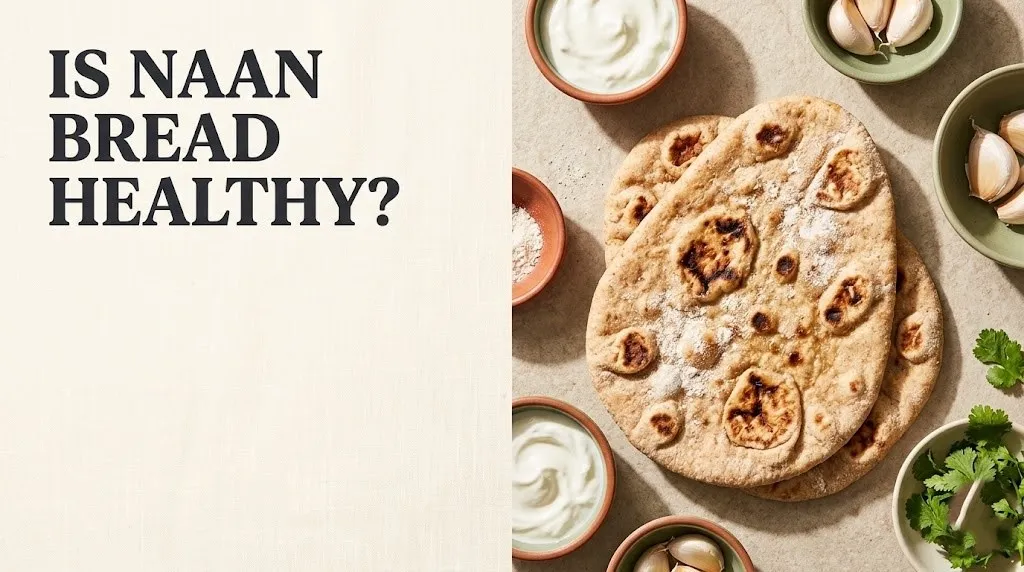
Restaurant naan often arrives brushed with butter or ghee and sometimes topped with garlic and oil. That preparation can push a single piece well past 300 to 350 calories before you’ve ordered your main dish. The base bread is one thing. What gets added to it in a restaurant kitchen is another matter entirely.
For most healthy adults eating a varied diet, naan as an occasional meal component is perfectly fine. Eating two or three large restaurant-style pieces regularly is a different story, particularly if managing weight, blood sugar, or sodium intake.
| Naan Health Factor | Assessment |
|---|---|
| Macronutrient balance | Moderate protein, high carbs, low fiber |
| Preparation impact | Restaurant versions add significant fat and calories |
| Frequency recommendation | Occasional, not daily, for most adults |
| Best option | Whole wheat naan with no added butter |
What Is Naan Bread Made Of?
Naan is a leavened flatbread originating in South Asian and Central Asian cuisines, traditionally made with maida (refined wheat flour, derived from Triticum aestivum), yogurt, water, salt, and a leavening agent such as active dry yeast or baking powder.
The yogurt does two things: it adds a slight tang and it activates the leavening process through its natural acidity. That’s what gives naan its characteristic soft, chewy texture and slight puff. Classically, naan is slapped against the walls of a tandoor oven, a cylindrical clay oven that reaches temperatures around 480 degrees Celsius (900 degrees Fahrenheit).
Modern restaurant and grocery store versions often skip the tandoor in favor of a gas-fired griddle or conveyor oven. The result is still a recognizable product, but the texture and char are different. Homemade recipes frequently add a small amount of oil or butter directly into the dough, which increases the fat content before any finishing touches.
Key ingredients in traditional naan:
- Maida (refined white wheat flour): the primary carbohydrate source
- Plain yogurt (full-fat or low-fat): provides dairy protein, fat, and calcium
- Active dry yeast or baking powder: leavening agent
- Salt: flavor and dough structure
- Water: hydration
- Butter or ghee: applied after baking in most restaurant versions
People following a dairy-free diet should note that standard naan contains yogurt and is often finished with butter. Neither ingredient is optional in traditional preparation.
Naan Bread Nutrition Facts
One medium piece of plain naan bread (approximately 90 grams, which is a realistic single restaurant serving) contains the following, according to USDA FoodData Central data:
| Nutrient | Amount per 90g Serving |
|---|---|
| Calories | 262 kcal |
| Total Carbohydrates | 44.9g |
| Dietary Fiber | 1.8g |
| Total Sugars | 3.4g |
| Protein | 8.7g |
| Total Fat | 5.1g |
| Saturated Fat | 1.1g |
| Sodium | 418mg |
| Calcium | 72mg |
| Iron | 2.6mg |
| Folate | 110mcg |
The folate figure is worth noting. It comes primarily from enriched flour, which by law in the United States must be fortified with folic acid. The iron content (approximately 14% of the daily value for adults) is a meaningful contribution for people who rely on plant-forward diets and need non-heme iron sources.
The sodium content at 418mg per 90g piece deserves attention. The American Heart Association recommends no more than 2,300mg of sodium per day for most adults, with an ideal target of 1,500mg for those managing blood pressure. A single piece of naan accounts for roughly 18 to 28% of that daily range before any other food is eaten.
People on a low-sodium diet, including those managing hypertension or heart disease, should factor this into their daily calculations rather than treating naan as a neutral carbohydrate.
Naan Bread Calories
A standard single piece of naan contains approximately 262 calories, but that number changes significantly based on size and preparation.
Restaurant naan portions vary widely. A small piece from a neighborhood Indian restaurant might weigh 60 grams and contain around 175 calories. A large piece from a chain restaurant can weigh 130 grams or more and contain 370 to 420 calories before any butter or oil is added. This is a meaningful range, and it’s the primary reason nutrition data for naan is so inconsistent across sources.
Think of it the way you’d think about a bagel: a standard bagel listed at 270 calories at a coffee shop is a very different food from a deli bagel that weighs twice as much. The food is the same; the serving is not.
| Naan Type | Approximate Weight | Approximate Calories |
|---|---|---|
| Small homemade (no butter) | 60g | 175 kcal |
| Medium restaurant plain | 90g | 262 kcal |
| Large restaurant plain | 130g | 370 kcal |
| Garlic butter restaurant naan | 130g + topping | 420 to 460 kcal |
| Store-bought (one piece, packaged) | 75g to 85g | 210 to 250 kcal |
If you’re tracking calories, always check the weight of what you’re eating rather than relying on “one piece” as a unit of measurement.
Key Takeaway: Naan’s nutritional profile is moderate in protein but low in fiber and fairly high in sodium. Restaurant portions are often much larger than the serving sizes used in standard nutrition databases, so a single “piece” can contain anywhere from 175 to 460 calories depending on size and preparation.
Is Naan Bread High in Carbs?
Yes, naan bread is high in carbohydrates. A standard 90-gram serving contains approximately 45 grams of total carbohydrates, almost all from the refined wheat flour base.
To put that in context: the Academy of Nutrition and Dietetics notes that most adults need 225 to 325 grams of carbohydrates per day on a standard 2,000-calorie diet. One medium piece of naan covers roughly 14 to 20% of that full daily carbohydrate budget. Add a curry dish with a rice component and you’ve consumed the majority of your carb allocation in one meal.
The carbohydrate quality is the bigger concern. Because naan is made from maida (refined flour), it lacks the bran and germ components present in whole wheat. That means fewer vitamins, significantly less fiber, and a faster-digesting starch that enters the bloodstream more rapidly than whole grain carbohydrates do.
For people following a low-carbohydrate diet, standard naan is not a practical fit. A single piece exceeds the daily carbohydrate limit on a strict ketogenic protocol (typically 20 to 50g per day). For general healthy eating without specific carbohydrate restrictions, naan is a manageable carbohydrate source if portion size is controlled and fiber is supplied elsewhere in the meal.
Quick Tip:
- Pair naan with a high-fiber dish (lentil dal, vegetable curry with legumes) to slow overall digestion and reduce the glycemic impact of the meal
- Request half a piece at a restaurant rather than a full serving to cut carbs and calories in half without giving up the experience
- Whole wheat naan cuts the effective glycemic load without eliminating naan from your plate
Naan Bread Glycemic Index and Blood Sugar
The glycemic index (GI) of plain white naan is approximately 71, which places it in the high-glycemic category, according to data referenced by the Harvard T.H. Chan School of Public Health.
For context: foods with a GI below 55 are considered low-glycemic, 56 to 69 are medium, and 70 or above are high. White bread sits at approximately 73, making plain naan very similar in its effect on blood glucose. Both are refined grain products, and their GI scores reflect that.
Glycemic index alone doesn’t tell the complete story, though. Glycemic load (GL) accounts for both the GI and the actual amount of carbohydrate in a serving. A typical medium naan portion carries a glycemic load of approximately 28 to 32, which is high by most standards. For comparison, a cup of cooked white rice has a GL of approximately 23.
What this means practically: eating naan on an empty stomach produces a sharper, faster blood glucose rise than eating the same naan alongside protein, fat, and vegetables. A meal of naan with chicken tikka, a yogurt-based raita, and a vegetable dish will have a meaningfully lower blood glucose impact than naan eaten alone as a snack. The Academy of Nutrition and Dietetics emphasizes that the glycemic response of a meal reflects the full combination of foods, not individual items in isolation.
People managing insulin sensitivity should be aware of naan’s high GI, but the broader meal context matters as much as the bread itself.
Is Naan Bread Healthier Than Regular White Bread?
Naan bread and white sandwich bread are nutritionally very close. Neither is a clear winner for overall health.
| Nutritional Factor | Naan (90g) | White Sandwich Bread (90g, ~3 slices) |
|---|---|---|
| Calories | 262 kcal | 240 kcal |
| Total Carbohydrates | 44.9g | 45g |
| Dietary Fiber | 1.8g | 2.4g |
| Protein | 8.7g | 7.8g |
| Total Fat | 5.1g | 3.3g |
| Sodium | 418mg | 480mg |
| Glycemic Index | ~71 | ~73 |
On a gram-for-gram basis, naan offers slightly more protein and slightly less sodium than white sandwich bread, but also slightly more fat. The fiber content is lower in naan. The glycemic index is nearly identical. Calling one healthier than the other without specifying preparation method and serving size is not a meaningful distinction.
Where naan has a real disadvantage is in restaurant settings. White bread comes to the table as a fixed unit. Restaurant naan arrives brushed with ghee, often larger than a standard serving, and frequently accompanied by oil-based sauces. The environmental eating context often leads to consuming more naan than you would if measuring it at home.
For people who need a meaningful upgrade from white bread, whole wheat naan or whole grain pita are genuinely better choices, not because naan is particularly bad, but because those alternatives offer more fiber in a similar serving size.
Key Takeaway: Naan and white sandwich bread are nutritionally almost interchangeable on a gram-for-gram comparison. The real difference shows up in restaurant portion sizes and added fats, where naan frequently arrives in a significantly larger, higher-calorie form than most people account for.
Naan vs. Roti: Which Is Healthier?
Roti is generally healthier than naan for everyday eating, primarily because it’s made from whole wheat flour and contains no added fat or leavening agents.
| Nutritional Factor | Naan (90g) | Roti/Chapati (90g, ~3 medium pieces) |
|---|---|---|
| Calories | 262 kcal | 200 kcal |
| Total Carbohydrates | 44.9g | 41.5g |
| Dietary Fiber | 1.8g | 5.8g |
| Protein | 8.7g | 7.6g |
| Total Fat | 5.1g | 2.2g |
| Sodium | 418mg | 210mg |
| Glycemic Index | ~71 | ~62 |
The fiber gap is the most nutritionally meaningful difference. Roti made from atta (whole wheat flour) provides more than three times the dietary fiber per equivalent serving. Fiber supports digestive regularity, slows the absorption of sugar from carbohydrates, and contributes to satiety. The USDA Dietary Guidelines for Americans 2020-2025 recommend 28 grams of fiber per day for adult women and 34 grams for adult men. Roti supports that target considerably better than naan.
Roti is also lower in sodium, which matters for cardiovascular health. The American Heart Association’s recommended daily sodium ceiling of 2,300mg is easier to stay under when your bread contributes 210mg per serving rather than 418mg.
For people eating South Asian food at home regularly, swapping naan for roti on most days while keeping naan as an occasional choice is a straightforward way to improve fiber intake and reduce sodium without abandoning the food culture.
Is Roti Healthy?
Roti is a genuinely healthy everyday flatbread. Made from stone-ground whole wheat flour (atta), water, and a small amount of salt, it fits naturally into a balanced diet.
A standard-sized roti (approximately 30 grams, one piece) contains roughly 67 calories, 14g carbohydrates, 1.9g fiber, and 2.5g protein. Three rotis, a reasonable serving at a meal, provide approximately 5.8g dietary fiber, a meaningful contribution toward daily fiber targets.
The whole wheat base of roti means it retains the bran and germ layers of the wheat kernel. Those components contain B vitamins (including thiamine, riboflavin, and niacin), magnesium, phosphorus, and naturally occurring fiber. Harvard T.H. Chan School of Public Health research consistently shows that diets higher in whole grain foods are associated with reduced risk of cardiovascular disease and type 2 diabetes compared to diets built on refined grains.
Roti is naturally vegan, dairy-free, and egg-free, making it suitable for a wide range of dietary patterns. People with celiac disease or non-celiac wheat sensitivity cannot eat roti, since it is a wheat-based food and contains gluten. For those who can tolerate wheat, roti is one of the more nutritionally sound everyday carbohydrate sources available.
Quick Tip:
- Roti made with a small amount of added ghee (as is traditional in some households) adds approximately 40 calories and 4.5g fat per teaspoon of ghee applied
- Jowar (sorghum) roti or bajra (pearl millet) roti are naturally gluten-free alternatives with similar fiber content
- Storing roti in a damp cloth or sealed container prevents drying and maintains texture for up to 24 hours
Is Garlic Naan Healthy?
Garlic naan is less healthy than plain naan, primarily because of the additional fat and sodium added during preparation.
Standard restaurant garlic naan is made by spreading the base naan dough with a mixture of minced garlic, butter or ghee, and often fresh cilantro, then baking or griddling the bread. A typical restaurant portion of garlic naan can contain 350 to 460 calories and up to 15 grams of fat per piece, compared to roughly 262 calories and 5 grams of fat for an equivalent plain naan.
The garlic itself is not the problem. Garlic (Allium sativum) contains allicin and other organosulfur compounds that research has associated with anti-inflammatory properties and modest blood pressure benefits, according to studies published in the Journal of Nutrition. The issue is the delivery vehicle: the large quantity of butter or ghee used to carry the garlic flavor adds significant saturated fat per serving.
Ghee is approximately 62% saturated fatty acids. The American Heart Association recommends limiting saturated fat to no more than 6% of total daily caloric intake for people managing heart disease risk. For a person eating 2,000 calories per day, that’s roughly 13 grams of saturated fat. A heavily buttered restaurant garlic naan can deliver 6 to 8 grams of saturated fat in a single serving.
If garlic naan is your preference, making it at home with a minimal amount of olive oil rather than butter, and using a smaller portion size, is a meaningful way to keep the flavor without the saturated fat load.
Key Takeaway: The naan-vs-roti comparison is not close. Roti made from whole wheat atta provides three times the fiber, half the sodium, and fewer total calories per equivalent serving. For people eating South Asian flatbreads regularly, roti is the nutritionally stronger everyday choice.
Whole Wheat Naan: Is It a Better Option?
Whole wheat naan is meaningfully better than standard naan from a nutritional standpoint, and it’s worth seeking out or making at home.
Replacing maida (refined wheat flour) with atta (whole wheat flour) in naan dough increases the fiber content from approximately 1.8 grams to 4 to 5 grams per 90-gram serving. It also lowers the glycemic index from approximately 71 to around 58 to 62, shifting the bread from the high-glycemic category into the medium range. That is a meaningful blood glucose benefit for anyone managing energy levels, appetite, or insulin response across the day.
The texture changes slightly. Whole wheat naan is denser and less pillowy than the refined flour version. The dough benefits from longer resting time (at least 45 to 60 minutes) to allow gluten to develop properly. Many people who try a well-made whole wheat naan find the slightly earthier flavor an improvement rather than a compromise.
Whole wheat naan is not widely available at most restaurants. Some South Asian grocery stores carry packaged whole wheat naan as an alternative to standard varieties. Reading the ingredient label matters: some products labeled “whole wheat” contain a blend of whole wheat and refined flour, which reduces the fiber benefit. Look for whole wheat flour listed as the first ingredient.
| Comparison | Standard Naan (90g) | Whole Wheat Naan (90g) |
|---|---|---|
| Calories | 262 kcal | 245 kcal |
| Dietary Fiber | 1.8g | 4.5g |
| Glycemic Index | ~71 | ~60 |
| Protein | 8.7g | 9.2g |
| Saturated Fat | 1.1g | 1.0g |
Is Naan Bread Good for Diabetics?
People with type 2 diabetes or prediabetes need to approach standard naan with caution, though it is not an absolute exclusion from a diabetic eating plan.
The American Diabetes Association (ADA) emphasizes total carbohydrate management over rigid food elimination. A single medium naan contains 45 grams of carbohydrates, which is at or near the upper limit of what many carbohydrate-management plans allow for a single meal. The high glycemic index (approximately 71) means those carbohydrates are absorbed relatively quickly, producing a faster and higher blood glucose peak than a whole grain alternative would.
Portion control is the most practical lever. Half a piece of plain naan (approximately 130 calories, 22g carbohydrates) paired with a high-protein, high-fiber dish produces a very different glycemic response than a full piece eaten alone. A study published in the American Journal of Clinical Nutrition found that pairing high-GI foods with protein and fiber sources within the same meal substantially reduces the overall glycemic impact compared to eating the high-GI food in isolation.
Whole wheat naan is a better option for people with diabetes who want to include naan in their eating pattern. Its lower glycemic index and higher fiber content slow glucose absorption and reduce the peak blood sugar response. If you are managing diabetes with medication or insulin, the carbohydrate content of any bread needs to be factored into your total meal count. A registered dietitian who specializes in diabetes nutrition can help you determine the right portion size for your specific management plan.
Is Naan Good for Weight Loss?
Standard naan is not an ideal food for weight loss, but it does not need to be avoided entirely by anyone trying to reduce their body weight.
Weight management comes down to total caloric intake relative to energy expenditure. Naan is a calorie-dense food with limited satiety. The low fiber content (approximately 1.8g per 90g serving) means it doesn’t fill you up for long. Eating one large restaurant naan adds 300 to 460 calories before any curry, rice, or accompaniment is considered. That caloric load from bread alone represents a significant portion of a moderate calorie target.
Think of it the way you’d think about a dinner roll: one is fine and barely registers in a day’s eating. Three of them before the main course arrives is a different calculation entirely.
For people in a calorie deficit, the practical strategies are:
- Limit to one small piece (60g) of plain naan per meal
- Choose whole wheat naan when available for the additional fiber and satiety
- Skip added butter or ghee at the table
- Balance the meal with a high-protein main dish (grilled chicken, lentils, chickpeas) and a vegetable-forward side to increase satiety without excessive calories
A diet that includes occasional naan alongside a calorie-appropriate, high-protein, high-fiber eating pattern is entirely compatible with weight loss. Naan becomes a problem for weight management when it’s consumed in large quantities regularly as a primary carbohydrate source.
Key Takeaway: People with diabetes or those managing weight should not view naan as strictly off-limits, but portion size is everything. Half a plain piece paired with protein and fiber-rich dishes is manageable. A full large restaurant portion of garlic naan before the main course is a meaningful caloric event.
Is Naan Vegan and Gluten Free?
Standard naan is not vegan and is not gluten free. Both are important points for people with specific dietary requirements.
Vegan status: Traditional naan contains dairy yogurt in the dough and is finished with butter or ghee, both of which are animal-derived products. This makes standard naan unsuitable for people following a strict vegan diet. Dairy-free versions are possible using unsweetened plant-based yogurt (coconut yogurt or oat-based yogurt work reasonably well) and finishing with olive oil or vegan margarine instead of butter. The texture changes slightly, but the result is acceptable for most palates.
Gluten-free status: Naan is made primarily from wheat flour, which contains gluten. It is not suitable for anyone with celiac disease (an autoimmune condition triggered by gluten) or confirmed non-celiac wheat sensitivity. There are gluten-free naan recipes that use a blend of rice flour, tapioca starch, and xanthan gum to approximate the texture, but these are specialty products. Most restaurant naan cannot be assumed to be gluten-free even if a gluten-free version is offered, as cross-contamination in a kitchen handling wheat flour is a real risk.
Egg-free status: Many traditional naan recipes do not include eggs. Some commercial or restaurant versions add a small amount of egg for texture. If egg allergy is a concern, verifying the specific recipe with the restaurant or reading the ingredient label on packaged products is the appropriate step.
| Dietary Category | Standard Naan | Dairy-Free Naan | Gluten-Free Naan |
|---|---|---|---|
| Vegan | No | Yes | Yes (if dairy-free) |
| Gluten-free | No | No | Yes |
| Egg-free | Usually yes | Usually yes | Usually yes |
| Suitable for celiac disease | No | No | Only if certified GF |
How to Make Naan Healthier at Home
Making naan at home gives you complete control over ingredients, portion size, and preparation method, making it possible to create a version that’s genuinely better for you.
The most impactful change is using whole wheat flour (atta) instead of refined maida. The second is controlling or eliminating the finishing butter. Together, these two changes can lower the calorie count by approximately 60 to 80 calories per piece and more than double the fiber content.
Whole Wheat Naan Recipe (makes 6 pieces):
- Combine 2 cups (240g) whole wheat flour, 1 teaspoon active dry yeast, and 1 teaspoon salt in a large bowl. Mix until evenly distributed.
- Add 150ml lukewarm water and 3 tablespoons (45g) plain low-fat yogurt. Stir to bring the dough together.
- Knead the dough on a lightly floured surface for 8 to 10 minutes until smooth and slightly elastic. The dough should be soft but not sticky.
- Place dough in a lightly oiled bowl, cover with a clean kitchen towel, and rest for 60 minutes at room temperature. This resting period is not optional; it develops gluten structure and allows the yeast to activate fully.
- Divide dough into 6 equal portions (approximately 75g each). Roll each piece into an oval approximately 6 inches long and 4mm thick.
- Heat a cast iron skillet or heavy-bottomed pan over high heat until very hot. Place one naan in the dry pan.
- Cook for 2 to 3 minutes until bubbles form and the underside shows char marks. Flip and cook for 1 to 2 minutes on the second side.
- Remove from heat and brush lightly with 1/4 teaspoon olive oil per piece instead of butter. Serve immediately.
Approximate nutrition per piece (whole wheat, olive oil finish): 195 calories, 38g carbohydrates, 4.5g fiber, 7g protein, 2.5g fat, 195mg sodium.
This version delivers 2.5 times the fiber and 53% less sodium than a standard restaurant garlic naan, while still producing a genuinely satisfying flatbread.
Key Takeaway: Homemade whole wheat naan made with minimal oil and no finishing butter is a substantially better nutritional product than restaurant naan. The process takes about 90 minutes including rest time, but the result is a high-fiber, lower-sodium flatbread you can eat without the caloric math becoming a problem.
Frequently Asked Questions About Naan Bread
Is naan bread healthy to eat every day?
Eating standard naan bread every day is not ideal for most people, primarily because of its low fiber content, high refined carbohydrate load, and moderate sodium per serving.
For daily flatbread consumption, whole wheat roti or whole wheat naan are nutritionally stronger choices.
If naan is a regular part of your cultural diet, using whole wheat flour, controlling portion size, and minimizing added butter are the most practical adjustments.
How many calories are in one piece of naan bread?
One medium piece of plain naan (approximately 90 grams) contains roughly 262 calories, according to USDA FoodData Central.
Restaurant naan portions are often larger, running 130 grams or more and reaching 370 to 460 calories when finished with butter or ghee.
Store-bought packaged naan typically weighs 75 to 85 grams per piece and contains approximately 210 to 250 calories.
Is naan bread or roti better for weight loss?
Roti is generally a better choice for weight loss because it provides significantly more fiber, fewer calories, and less sodium per equivalent serving.
The higher fiber content of whole wheat roti (approximately 5.8g per 90g serving versus 1.8g for naan) slows digestion and increases the feeling of fullness, helping reduce overall calorie intake.
For people who prefer naan, a small portion of plain whole wheat naan with no added butter is a workable substitute.
Can diabetics eat naan bread?
People with type 2 diabetes can eat naan bread in small portions as part of a carefully managed meal, but it should not be a staple food due to its high glycemic index of approximately 71 and 45 grams of carbohydrates per medium serving.
Choosing whole wheat naan, keeping the portion to half a piece, and pairing it with protein and fiber-rich foods can substantially reduce the blood glucose impact.
Anyone managing diabetes with medication or insulin therapy should work with a registered dietitian to determine a safe and appropriate carbohydrate budget per meal.
Is store-bought naan bread healthy?
Store-bought naan bread is a convenient option, but most commercial varieties are made from refined flour and contain added preservatives, stabilizers, and higher sodium levels than homemade versions.
A standard packaged naan piece (approximately 80 grams) typically contains 215 to 250 calories, 420 to 480mg sodium, and 1.5 to 2g fiber.
Reading the ingredient label and choosing a brand with whole wheat flour listed first, and the shortest possible ingredient list, produces the best nutritional outcome from store-bought options.
The Bottom Line on Naan
Naan is a flavorful bread with a real place in a balanced diet, but it earns that place through moderation and smart preparation choices. Standard restaurant naan is refined, low in fiber, and higher in sodium and calories than most people estimate. That does not make it harmful, it makes it a food to eat with some awareness rather than without thinking.
The single most useful change you can make is choosing or making whole wheat naan when possible. The fiber difference alone changes how the bread behaves in your body and how long it keeps you satisfied.
For everyday eating, roti is the stronger nutritional choice. Save the buttery restaurant naan for the occasion it was designed for: a good meal you’re genuinely enjoying.