Yes, you can grind coffee beans in a food processor, and with the right pulse technique, you’ll get a usable coarse grind for certain brew methods. It won’t replace a dedicated grinder, but it’s a genuinely workable solution when one isn’t available.
The grind you get matters more than most people realize. According to the Specialty Coffee Association, grind particle uniformity directly affects extraction rate, which controls whether your cup tastes balanced, bitter, or thin. A food processor produces mixed particle sizes, so knowing which brews tolerate that matters.
This guide covers exactly how to do it, what results to expect, which brew methods work best, how blade heat affects your coffee’s flavor, and when the workaround stops being worth it.
Can You Grind Coffee Beans in a Food Processor?
You can grind coffee beans in a food processor, and the result is drinkable coffee when you use the right technique and the right brewing method afterward.
The food processor works because its S-blade (the standard stainless steel curved blade in most machines) can fracture roasted coffee beans (the roasted seeds of Coffea arabica or Coffea canephora) through repeated impact. The beans are brittle enough after roasting that the blade breaks them down without excessive force.
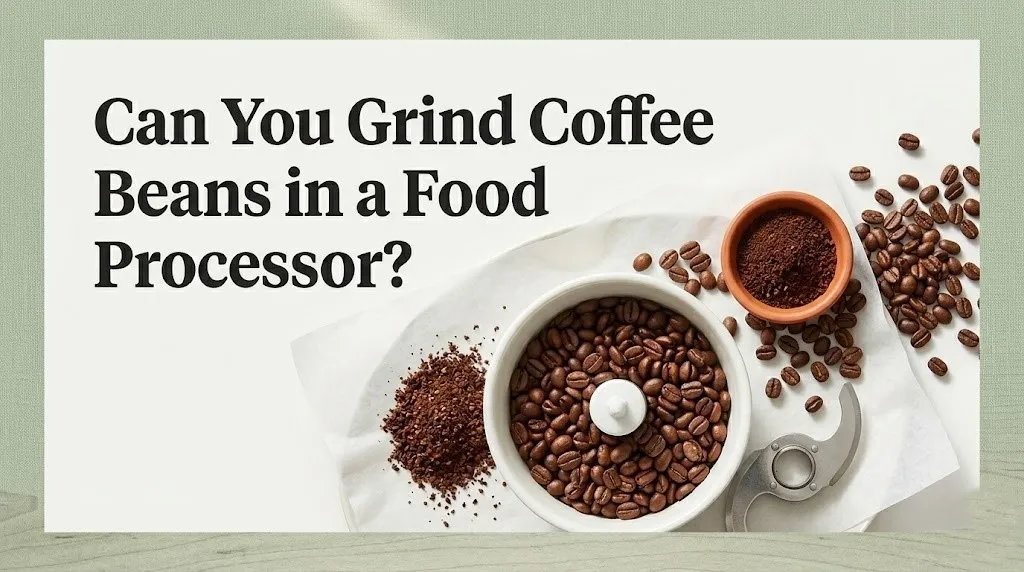
The honest caveat: a food processor is a chopping tool, not a grinding tool. It doesn’t mill coffee the way a dedicated grinder does. What you get is a wide range of particle sizes in the same batch: some chunks, some medium grounds, some fine powder. That mix creates uneven extraction in your cup.
What you should know before starting:
- Coarse, uneven grinds are the typical food processor output
- Some brew methods handle that unevenness better than others (covered in a later section)
- Short pulse bursts outperform continuous running for grind control
- Bowl size matters: a smaller 3-cup processor overfills easily; a 7-cup or larger bowl gives beans room to move and break more evenly
Can a Food Processor Grind Coffee Beans Properly?
A food processor can grind coffee beans functionally but not optimally. “Properly” depends entirely on your brewing method and your tolerance for flavor variation.
For a dedicated coffee drinker who brews pour-over or espresso, a food processor produces coffee that will taste noticeably flat or inconsistent. The mix of coarse and fine particles means some coffee over-extracts (turning bitter) while underextracted coarse pieces taste weak and sour, all in the same cup.
For someone making a French press, cold brew, or basic drip coffee who needs coffee this morning and has no other option, the food processor delivers a workable result. The National Coffee Association notes that coarser grinds are more forgiving in immersion-style brewing, which is exactly the category where food-processor coffee performs best.
| Suitability | Food Processor Result |
|---|---|
| French press | Acceptable to good |
| Cold brew | Acceptable |
| Basic drip machine | Passable |
| Pour over | Poor |
| AeroPress | Marginal |
| Espresso machine | Not suitable |
What Grind Size Does a Food Processor Produce?
A food processor typically produces a coarse to medium-coarse grind with significant variation in particle size within the same batch.
Grind size in coffee is measured by particle diameter. The Specialty Coffee Association defines a coarse grind at roughly 800 to 1000 microns, a medium grind at 500 to 700 microns, and fine grinds below 300 microns. A food processor batch will contain particles across most of that range simultaneously.
The reason: the S-blade doesn’t mill beans between two surfaces the way a burr grinder does. It chops them. Beans near the blade get cut repeatedly. Beans further from the blade get fewer impacts. That geometry creates the wide particle distribution that defines food-processor-ground coffee.
Quick Tip:
- Use small batches (2 to 4 tablespoons of whole beans) to improve consistency
- A wider, shallower bowl gives better blade contact than a tall, narrow one
- Pulse in 1-second bursts and shake the bowl between pulses to redistribute beans
Key Takeaway: A food processor does grind coffee beans, but it produces a coarse, uneven grind that works best in immersion brews like French press and cold brew, not for pour-over or espresso.
Does Coffee Grind Consistency Matter for Flavor?
Grind consistency matters enormously for coffee flavor, and it’s the main limitation of using a food processor.
Here’s the practical explanation. When hot water contacts coffee grounds, it dissolves soluble compounds (acids, sugars, oils, bitter compounds) at a rate controlled by the particle’s surface area. A fine particle extracts fully in seconds. A coarse chunk may still be underextracted after several minutes. When both are in the same brew, the fine particles over-extract and turn bitter while the coarse ones under-extract and taste sour or thin.
A study published in the Journal of Food Science found that grind particle uniformity was one of the strongest predictors of sensory quality scores in brewed coffee. Batches with wide particle distribution scored lower on overall flavor balance, bitterness control, and aroma intensity compared to uniformly ground samples.
Think of it like cooking pasta: if half the pot is spaghetti and half is lasagna sheets, they won’t finish cooking at the same time no matter how carefully you watch the pot. Grind consistency works the same way.
| Grind Type | Particle Uniformity | Flavor Outcome |
|---|---|---|
| Burr grinder (flat or conical) | High | Balanced extraction, full aroma |
| Blade grinder | Low to moderate | Inconsistent; some bitterness |
| Food processor | Low | Wide range; bittersweet mix likely |
| Mortar and pestle | Moderate with effort | Better than food processor with patience |
How to Grind Coffee Beans in a Food Processor
Grinding coffee beans in a food processor works best with short, controlled pulses rather than continuous running.
To grind coffee beans in a food processor properly:
- Start with whole roasted coffee beans at room temperature. Cold beans from the freezer produce excessive condensation, which clogs the blade and introduces moisture.
- Measure 2 to 4 tablespoons of whole beans per session. Overcrowding the bowl reduces blade contact and increases the coarse-to-fine ratio.
- Secure the lid firmly. Coffee beans are dense and can dislodge a loosely fitted lid at blade speed.
- Pulse in 1-second bursts for the first 10 seconds. Do not hold the processor on continuous run.
- Stop and shake or tap the bowl to redistribute beans. This moves larger chunks back toward the blade.
- Pulse for another 10 to 15 seconds in 1-second bursts, checking texture after each few pulses.
- Stop when the majority of grounds resemble coarse sea salt in size. That’s your usable window for French press or drip.
- Pour grounds immediately into your brew device. Do not store food-processor-ground coffee; the larger surface area oxidizes flavor rapidly.
Safety note: Always allow the blade to stop completely before removing the lid or touching the bowl contents.
How Long to Pulse Coffee Beans in a Food Processor
Total active grinding time in a food processor should run between 20 and 30 seconds of actual blade contact time, spread across multiple short pulses.
That 20-to-30-second figure is cumulative pulse time, not a single continuous run. Running the processor continuously for 30 seconds generates significantly more blade friction heat, which degrades the volatile aromatic compounds responsible for coffee’s smell and flavor complexity.
The National Coffee Association recommends grinding only what you’ll brew immediately, regardless of method. With a food processor, that advice is especially relevant because the uneven particle sizes mean any storage time accelerates staling compared to uniform burr-ground coffee.
Quick Tip:
- Stop early if you see a powder layer forming at the bottom of the bowl. That fine layer will over-extract in any brew.
- A 7-cup or larger food processor handles coffee better than a small 3-cup unit because the extra bowl space lets beans circulate rather than sit on top of the blade.
- Grinding dark roast beans takes slightly less time than light roasts. Darker roasts are more brittle and fracture faster.
Key Takeaway: Pulse your food processor in 1-second bursts for a cumulative 20 to 30 seconds total, shaking the bowl between pulses, and stop when grounds reach a coarse sea-salt texture.
Does Grinding Coffee in a Food Processor Affect Flavor?
Grinding coffee in a food processor does affect flavor, primarily through two mechanisms: grind inconsistency (which causes uneven extraction) and blade friction heat (which degrades aromatic compounds).
The extraction issue is covered in the grind consistency section. The heat issue deserves its own explanation. Coffee’s flavor is largely carried by volatile aromatic compounds, which are heat-sensitive organic molecules released during roasting and preserved inside the bean’s cellular structure until grinding. When blade friction raises the temperature of grounds during processing, those compounds begin to dissipate before the coffee even reaches your cup.
Research published in Food Quality and Preference identified blade temperature as a factor in sensory quality of ground coffee, with higher-temperature grinding correlating with reduced aromatic intensity. Pulse-based grinding limits heat buildup compared to continuous processing.
The coffee oils (diterpenes, primarily cafestol and kahweol) also oxidize faster when exposed to air across a larger surface area. Uneven grinds have more total exposed surface area per gram than uniform grinds, which is why food-processor-ground coffee should always be used immediately.
| Flavor Factor | Burr Grinder | Food Processor |
|---|---|---|
| Grind uniformity | High | Low |
| Blade heat generated | Minimal | Moderate to high (continuous run) |
| Aromatic compound retention | High | Reduced with long runs |
| Recommended brew delay | Up to 15 minutes | Brew immediately |
Food Processor vs Coffee Grinder: Which Is Better?
A dedicated coffee grinder outperforms a food processor in every measurable aspect of grind quality, and the gap is largest if you’re comparing a food processor to a burr grinder specifically.
The difference comes down to mechanism. A burr grinder (whether conical burr or flat burr) mills beans between two abrasive surfaces set at a fixed distance. That distance controls particle size, and because every bean passes through the same gap, particle uniformity is high. A food processor uses impact and chopping with no fixed gap, so particle size is random.
Even an inexpensive blade grinder (the circular-blade countertop coffee grinder sold for $15 to $30) outperforms most food processors for coffee because the blade is closer to the beans, the bowl is smaller and keeps beans near the blade, and the device runs at coffee-appropriate speeds. Neither blade grinders nor food processors approach the quality of a burr grinder, but blade grinders are a step above food processors specifically for coffee.
A food processor does have one advantage: if you already own one, the cost is zero. As a one-time or occasional workaround, it is entirely reasonable.
Can You Use a Food Processor to Grind Coffee for French Press?
A food processor is one of the better emergency alternatives for French press coffee specifically because French press brewing is more tolerant of grind inconsistency than other methods.
French press uses immersion brewing: grounds steep in hot water for 3 to 5 minutes, and the metal mesh plunger separates them from the liquid. This method extracts coffee across a longer contact time than drip or pour over, which means coarser, uneven particles have more time to contribute flavor. The result is more balanced than you’d get in a drip machine.
The trade-off: French press does not filter out coffee oils or fine particles. Food-processor-ground coffee produces more coffee fines (very small particles) than a burr grinder does. Those fines pass through the metal mesh filter and end up in your cup, creating a slightly gritty texture and potentially more bitterness from over-extraction of the fine particle layer.
Quick Tip:
- After pressing the plunger, let the cup sit for 30 seconds before drinking. Fines settle slightly.
- Use water around 195°F (90.5°C), not a full rolling boil. Lower temperatures reduce bitterness from over-extracted fines.
- A 4-minute steep (rather than the standard 4-to-5-minute range) reduces the time fines spend extracting.
Key Takeaway: French press is the most forgiving brew method for food-processor-ground coffee because immersion brewing handles coarse, uneven particles better than drip or pour-over methods.
Best Brew Methods for Food Processor Ground Coffee
The best brew methods for food-processor-ground coffee are French press, cold brew, and basic auto-drip. Methods that require precise grind size (pour over, espresso, AeroPress with fine settings) are not good matches.
Here’s why cold brew works surprisingly well with uneven grinds: cold brew uses a 12-to-24-hour steep in cold water, which extracts coffee solubles slowly regardless of particle size. The extended contact time compensates for the inconsistency that would ruin a 3-minute pour-over. The result is a concentrate that’s genuinely good even from imprecisely ground beans.
Auto-drip machines are middle ground. Most home drip machines use a medium-coarse grind, which roughly aligns with what a food processor produces on a well-executed pulse session. The risk is that fines can clog the paper filter or cause over-extraction in certain machine types.
| Brew Method | Food Processor Grind Suitability | Notes |
|---|---|---|
| Cold brew (12-24 hrs) | Good | Long steep compensates for inconsistency |
| French press | Good | Metal filter; brew immediately |
| Auto-drip | Acceptable | Watch for filter clogging from fines |
| Pour over (V60, Chemex) | Poor | Requires consistent medium grind |
| AeroPress | Marginal | Works better with coarse-grind recipe |
| Espresso | Not suitable | Requires precise, uniform fine grind |
| Moka pot | Not suitable | Similar fine-grind requirement to espresso |
Food Processor Blade Heat and Coffee Quality
Blade friction heat is a real quality concern when grinding coffee in a food processor, and it’s the primary reason pulse technique matters more than total grinding time.
When a food processor runs continuously, the S-blade spins at roughly 1,700 to 1,800 RPM in most home models. That sustained rotation generates heat through friction between the blade and the coffee grounds. Roasted coffee’s volatile aromatic compounds begin to dissipate at temperatures above 40°C (104°F), according to research on coffee volatile chemistry published in the Journal of Agricultural and Food Chemistry.
The solution is pulsing. Each 1-second pulse followed by a rest period allows heat to dissipate from both the grounds and the blade. That’s why the pulse method produces noticeably better-smelling and better-tasting coffee than running the processor on a continuous 30-second cycle.
Dark roast beans are slightly more forgiving here because their aromatic compounds have already been significantly transformed by the high roasting temperatures (typically 200°C to 230°C during the roasting process). Light roast beans retain more of their delicate volatile aromatics and are more sensitive to post-roast heat exposure during grinding.
Key finding: According to research in Food Quality and Preference, sensory panelists consistently rated blade-ground coffee lower on aroma and flavor brightness compared to burr-ground coffee at the same roast level.
Key Takeaway: Keep food processor runs to short 1-second pulses with rests between them to protect volatile aromatic compounds; continuous running generates heat that noticeably flattens coffee flavor.
Can You Use a Food Processor Instead of a Burr Grinder?
A food processor is not a substitute for a burr grinder if coffee quality is a priority. It works as an emergency alternative, but the gap in output quality is real and consistent.
Burr grinders, whether flat-burr models (like most commercial espresso grinders) or conical-burr designs (common in home grinders), mill coffee at a controlled, repeatable particle size. That precision is the foundation of consistent extraction. According to the Specialty Coffee Association’s brewing standards, optimal extraction yield falls between 18% and 22% of the coffee’s soluble mass, and achieving that range requires uniform particle distribution.
A food processor cannot produce that uniformity because its chopping mechanism has no fixed gap to control particle size. You can minimize the inconsistency with careful pulsing and small batch sizes, but you cannot eliminate it.
For people who drink coffee daily and care about cup quality, a burr grinder is a worthwhile investment. Entry-level conical burr grinders from reputable brands are available for $30 to $60 and produce dramatically more consistent results than any food processor.
| Feature | Food Processor | Blade Grinder | Entry Burr Grinder |
|---|---|---|---|
| Grind uniformity | Low | Low to moderate | High |
| Cost to use for coffee | $0 (already owned) | $15 to $30 | $30 to $60 |
| Brew methods supported | French press, cold brew | Most except espresso | All methods |
| Heat generation | Moderate to high | Moderate | Minimal |
| Grind size control | None | None | Precise (adjustable) |
How to Get a Coarser Grind from a Food Processor
Getting a coarser, more consistent grind from a food processor requires three specific adjustments: smaller batch sizes, shorter pulses, and early stopping before fine particles accumulate.
The single most effective technique is stopping earlier than you think you need to. Most people run the food processor until the grounds look uniformly brown and powdery, which is too far. At that point, the bottom layer of grounds is already approaching fine or medium-fine territory while the top layer is still coarse. The ideal stopping point is when the grounds look heterogeneous but mostly coarse, resembling raw sugar or coarse sea salt with some larger irregular pieces.
Batch size directly affects outcome. Grinding more than 4 tablespoons (approximately 24g) of whole beans in a standard 7-cup food processor reduces circulation in the bowl. Beans pile up and don’t get consistent blade contact. Two separate small batches produce better results than one large batch.
To maximize coarseness:
- Add no more than 2 to 3 tablespoons of beans per batch.
- Pulse for exactly 1 second, then pause for 2 seconds.
- After every 5 pulses, remove the lid and tilt the bowl to redistribute beans.
- Stop as soon as the majority of grounds reach a coarse texture.
- Sift out any obvious fines before brewing if texture consistency matters to you.
Is Food Processor Ground Coffee Any Good?
Food-processor-ground coffee is genuinely good enough for a functional, enjoyable cup, provided you use it immediately, choose the right brew method, and keep expectations calibrated to the method’s limitations.
Taste is subjective, but grind physics is not. A food processor will not produce the clean, bright, aromatic cup that a burr grinder delivers. For French press or cold brew, the difference is smaller and may not matter to many drinkers. For pour over or espresso, the difference is stark and the food processor result is not a reasonable substitute.
Harvard T.H. Chan School of Public Health notes that coffee brewed by any method delivers the same primary bioactive compounds (caffeine, chlorogenic acids) that are associated with its documented health effects. Grind quality affects flavor, not the core nutritional composition of the brewed beverage. So if you’re grinding coffee in a food processor for health reasons, the method won’t change coffee’s nutritional profile in any meaningful way.
What matters most:
- Freshness: Grind immediately before brewing. Don’t store food-processor-ground coffee.
- Brew method: Match to French press, cold brew, or basic drip.
- Technique: Pulse-based, small batches, stop early.
Key Takeaway: Food-processor-ground coffee is good enough for French press and cold brew if used immediately; it won’t match a burr grinder for aroma or clarity but is a fully workable emergency option.
How to Grind Coffee Beans Without a Grinder
Several practical methods can grind coffee beans without any dedicated grinder, and a food processor is one of the most efficient among them.
Other workable methods, ranked roughly from most to least effective for flavor outcome:
- Mortar and pestle: A large, heavy mortar and pestle (ideally stone or ceramic) produces the most controllable coarse grind of any improvised method. It takes 3 to 5 minutes of active grinding per 2-tablespoon serving. Best for Turkish coffee or French press.
- Rolling pin or heavy pan: Place beans in a sealed ziplock bag and crush them with a rolling pin or the bottom of a cast iron skillet. Produces an uneven, chunky grind suitable only for cold brew.
- Hammer or meat mallet: Same bag technique as the rolling pin. Produces a coarser, even more inconsistent result. Suitable for cold brew only.
- Manual hand grinder: A manual burr grinder ($20 to $40) is the best non-electric option and produces results nearly equivalent to an electric burr grinder. Takes about 1 to 2 minutes per cup.
- Food processor: Faster than mortar and pestle, more controlled than a rolling pin. Best all-purpose improvised method for someone who needs multiple servings quickly.
| Method | Speed | Grind Quality | Best Brew Match |
|---|---|---|---|
| Mortar and pestle | Slow (5 min/serving) | Moderate | Turkish, French press |
| Rolling pin | Moderate | Low | Cold brew |
| Food processor | Fast (1 min) | Low to moderate | French press, cold brew |
| Manual hand grinder | Moderate (2 min/cup) | High | All methods |
| Blade grinder | Fast (30 sec) | Low to moderate | Drip, French press |
When to Upgrade from a Food Processor to a Real Coffee Grinder
The right time to upgrade from a food processor to a dedicated coffee grinder is when you brew coffee daily, care about flavor consistency, or want to explore brew methods beyond French press and drip.
If you’re grinding coffee in a food processor once a month during a power outage or a hotel stay, the workaround makes complete sense. There’s no reason to buy a grinder for that scenario. But if you’re grinding every morning, the cumulative flavor difference between food-processor coffee and burr-ground coffee is noticeable enough that a grinder pays for itself in satisfaction quickly.
A manual conical burr grinder at $25 to $40 is the most affordable genuine upgrade. It produces consistent particle size across all grind settings, generates no heat, and works without electricity. For people who brew one to two cups per day, it’s a reasonable entry point.
For those who want electric convenience:
- Entry-level electric burr grinder ($40 to $70): Produces consistent medium and coarse grinds. Suitable for drip, French press, and cold brew.
- Mid-range electric burr grinder ($100 to $180): Handles drip through pour over with reliable consistency. Good for daily home use.
- High-end burr grinder ($200+): Espresso-capable with very fine grind adjustment. For serious home brewers.
The National Coffee Association recommends grinding beans immediately before brewing, regardless of grinder type, to preserve freshness. Upgrading your grinder is most valuable when paired with buying whole beans and grinding to order.
Key Takeaway: If you brew coffee daily and want consistent flavor, a $25 to $40 manual burr grinder is the most practical upgrade from a food processor, delivering dramatically better grind uniformity at a low entry cost.
Frequently Asked Questions About Grinding Coffee Beans in a Food Processor
Can you grind coffee beans in a food processor without ruining them?
You can grind coffee beans in a food processor without ruining them if you use short 1-second pulses and small batch sizes.
The main risks are blade heat (which degrades aromatic compounds) and over-processing (which creates too many fine particles).
Stopping early and brewing immediately gives you the best possible result from the method.
What grind size does a food processor produce?
A food processor typically produces a coarse to medium-coarse grind with significant variation in particle size within the same batch.
Particles range from very coarse chunks to fine powder in the same bowl.
Using smaller batches and shorter pulses keeps the result closer to a usable coarse grind.
Which coffee brewing method works best with food processor ground coffee?
French press and cold brew work best with food-processor-ground coffee because both methods are tolerant of coarse, uneven grinds.
French press uses a long immersion steep, and cold brew uses an even longer cold-water extraction, both of which compensate for particle inconsistency.
Pour over, espresso, and moka pot are not suitable matches for food-processor-ground coffee.
How many seconds should I pulse coffee beans in a food processor?
Pulse in 1-second bursts for a cumulative total of 20 to 30 seconds of blade contact time, spread across multiple pulses with rest periods in between.
Running the processor continuously generates blade heat that damages the coffee’s volatile aromatic compounds.
Pause and shake the bowl every 5 pulses to redistribute beans and check grind texture.
Is a food processor a good permanent substitute for a coffee grinder?
A food processor is not a good permanent substitute for a coffee grinder if you brew coffee regularly and want consistent flavor.
Burr grinders produce uniform particle sizes that food processors cannot match, and that uniformity directly affects extraction balance and cup quality.
For daily brewing, a $25 to $40 manual burr grinder is a practical, low-cost upgrade that makes a genuine, noticeable difference.
Getting the Most Out of What You Have
A food processor can grind coffee beans, and with the right pulse technique, the result is genuinely drinkable for French press or cold brew. Knowing the method’s limits means you can work within them instead of being frustrated by them.
Brew the coffee immediately after grinding. Match it to an immersion method. Keep your pulse sessions short and your batches small.
When you’re ready to move past the workaround, a manual burr grinder is the most affordable path to a genuinely better cup. Until then, the food processor gets the job done.