
Greek food is Mediterranean, but that does not mean Mediterranean food is Greek. Greece sits at the heart of the Mediterranean world, and Greek cuisine is one of the oldest, most influential regional expressions of a broader culinary tradition shared across more than a dozen countries.
That distinction matters, especially if you are trying to eat with your health in mind. The Mediterranean diet is a formally defined, research-backed dietary pattern. The American Heart Association and the USDA Dietary Guidelines for Americans both recognize it as one of the healthiest overall eating patterns studied in humans. Greek food aligns with it closely, but the two are not identical.
This guide covers exactly what makes Greek cuisine Mediterranean, where it differs from the broader dietary pattern, which Greek dishes deliver the strongest nutritional profile, and how to eat Greek food in a way that supports your health goals. You will also find a section-by-section breakdown of the key ingredients, nutrients, and research behind both.
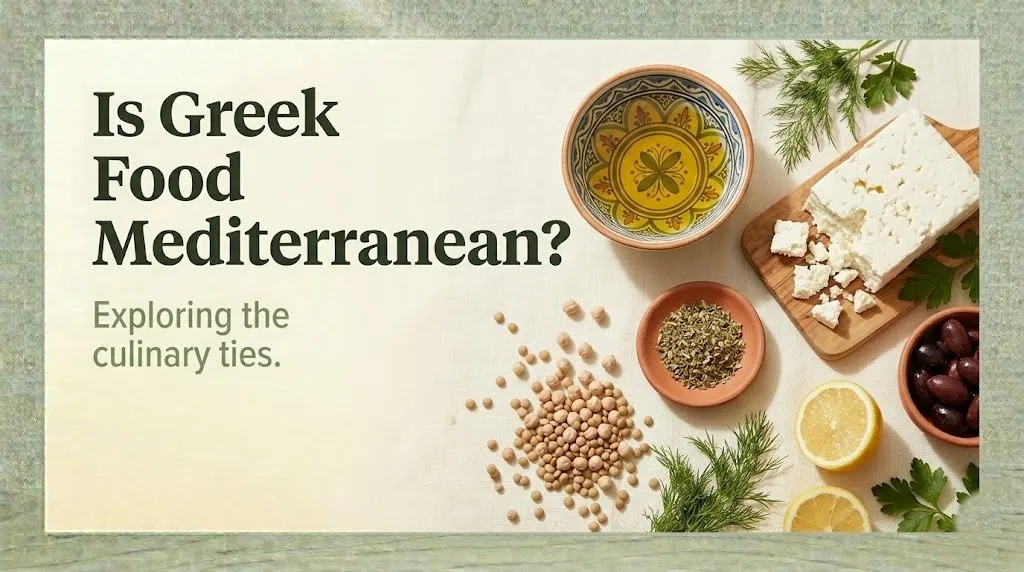
Is Greek Food Mediterranean?
Yes, Greek food is Mediterranean. Greece is a Mediterranean country, and Greek cuisine draws heavily on the same core ingredients that define Mediterranean eating across Southern Europe and the Middle East: olive oil, legumes, vegetables, whole grains, fish, and fresh herbs.
That said, “Mediterranean food” is not a single cuisine. It is an umbrella term covering the food traditions of more than 20 countries bordering the Mediterranean Sea, including Spain, Italy, Morocco, Turkey, Lebanon, and Egypt. Each has its own regional identity. Greek food is one distinct expression within that larger group.
Think of it the way you might think of European classical music. Beethoven and Vivaldi are both European classical composers, but their styles are unmistakably different. Greek food and Lebanese food are both Mediterranean, but you would not confuse a plate of spanakopita (spinach and feta phyllo pastry) with a plate of kibbeh.
The ingredients overlap significantly. The flavors, techniques, and cultural context differ in meaningful ways.
| Feature | Greek Cuisine | Mediterranean Food (Broad) |
|---|---|---|
| Core fat source | Extra-virgin olive oil | Extra-virgin olive oil |
| Primary protein | Lamb, chicken, fish, legumes | Fish, legumes, poultry, varies by region |
| Signature spices | Oregano, lemon, garlic | Varies: cumin, coriander, za’atar, saffron |
| Bread type | Pita, country bread (horiatiko) | Varies: flatbreads, sourdough, semolina |
| Dairy | Feta, yogurt, halloumi | Varies: ricotta, labneh, aged cheeses |
| Legume use | Chickpeas, lentils, fava beans | Chickpeas, lentils, cannellini, ful medames |
What Is the Mediterranean Diet?
The Mediterranean diet is a dietary pattern, not a cuisine. It describes a way of eating associated with the traditional food habits of populations living around the Mediterranean Sea in the mid-20th century, particularly in Greece, Southern Italy, and Spain.
The pattern was formally described in research by physiologist Ancel Keys in the 1960s. Decades of subsequent study confirmed its health associations. The landmark PREDIMED trial (Prevención con Dieta Mediterránea), published in the New England Journal of Medicine in 2013 and updated in 2018, found that people assigned to a Mediterranean diet supplemented with extra-virgin olive oil or mixed nuts had a meaningfully lower rate of major cardiovascular events compared to those on a control low-fat diet.
The American Heart Association and the USDA Dietary Guidelines for Americans (2020-2025) both name the Mediterranean dietary pattern as a healthy eating model. The World Health Organization recognized the Mediterranean diet as a UNESCO Intangible Cultural Heritage element in 2013.
Key features of the Mediterranean dietary pattern include:
- High intake of vegetables, fruits, whole grains, legumes, nuts, and seeds
- Extra-virgin olive oil as the primary added fat
- Moderate consumption of fish and seafood (at least twice weekly)
- Low to moderate intake of poultry, eggs, and dairy
- Minimal red meat consumption
- Low intake of ultra-processed foods, added sugars, and refined grains
- Optional moderate red wine with meals, in cultural and social context
People following the Mediterranean diet for health reasons are working with a defined framework. Greek food fits within that framework well, but not every Greek dish qualifies by every measure.
What Is Traditional Greek Food?
Traditional Greek food is the cooking of mainland Greece and its islands, shaped by geography, climate, Orthodox Christian fasting traditions, and centuries of trade and cultural exchange. It is one of the oldest continuously practiced food cultures in the world.
Greek cooking is built on seasonal vegetables, olive oil, legumes, lamb, goat, fresh and cured fish, yogurt, feta cheese, honey, and herbs like dried oregano (Origanum vulgare), fresh dill, and flat-leaf parsley. Lemon is used the way many other cuisines use vinegar: as a finishing acid on everything from grilled fish to braised lamb.
The Orthodox Christian fasting calendar has had a lasting influence on Greek food. Fasting periods, which traditionally exclude meat, dairy, eggs, fish (in stricter periods), and olive oil, gave rise to a rich tradition of plant-based Greek dishes that remain central to the cuisine. Fasolada (white bean soup), gigantes (giant baked beans), revithia (braised chickpeas with herbs), and horta (boiled wild greens dressed with olive oil and lemon) all come from this fasting tradition.
Meat, especially lamb, plays a prominent role in celebratory Greek cooking. Slow-roasted leg of lamb, whole-spit-roasted lamb for Easter, and grilled lamb chops (paidakia) are beloved but traditionally reserved for feasts and weekends rather than daily eating. This distinction is easy to miss if your only exposure to Greek food is a restaurant menu.
Key Takeaway: Greek food is one specific regional expression of Mediterranean cuisine. The Mediterranean diet is a defined dietary pattern. They overlap significantly, but they are not the same thing.
Is Greek Food Considered Mediterranean?
Greek food is widely and correctly considered Mediterranean. Nutrition researchers, the Academy of Nutrition and Dietetics, and dietary guideline bodies all include traditional Greek cuisine as a core example of Mediterranean-style eating.
The reason is straightforward. Traditional Greek cooking uses the same foundational ingredients that researchers identified as driving the health benefits of the Mediterranean dietary pattern: extra-virgin olive oil as the primary fat, legumes as a protein and fiber staple, an abundance of vegetables and herbs, whole grain breads, and regular fish and seafood consumption.
Where Greek food earns its Mediterranean classification most clearly is in everyday cooking, not the celebration dishes. A standard Greek weekday lunch might include a bowl of lentil soup, a piece of crusty bread, some olives, and a small Greek salad dressed with olive oil and oregano. That meal is as textbook-Mediterranean as it gets.
The celebration dishes tell a different story. Moussaka (layered eggplant, ground meat, and béchamel sauce), pastitsio (pasta baked with meat and cream sauce), and baklava (phyllo layered with butter, honey, and nuts) are all Greek, all beloved, and none of them would appear on a strict Mediterranean diet food list. They are rich, festive, and occasional by Greek culinary tradition. Understanding that distinction is the key to using Greek food wisely within a health-conscious eating framework.
Is There a Difference Between Greek and Mediterranean Food?
There is a real difference between Greek food as a cuisine and “Mediterranean food” as both a culinary category and a dietary pattern. Understanding the difference helps you make better choices whether you are cooking at home, ordering at a restaurant, or following a specific eating plan.
As a culinary category, “Mediterranean food” spans the cooking of countries from Portugal to Lebanon, from Morocco to Greece. It includes Turkish mezze, Spanish tapas, Moroccan tagines, Italian pasta, Lebanese fattoush, and Greek horiatiki salad. The shared thread is geography and some overlapping ingredients. The cuisines themselves are distinct.
As a dietary pattern, the Mediterranean diet is a structured set of eating habits, not tied to any one country’s food. You could technically follow the Mediterranean diet while eating primarily Italian, Spanish, or Greek food, as long as you emphasize the core principles: mostly plants, olive oil as your fat, fish and legumes as your main proteins, and minimal ultra-processed food.
The confusion often arises in restaurants. Many “Mediterranean restaurants” in the United States serve a hybrid of Greek, Lebanese, Turkish, and Israeli food, mixing cuisines under one roof. That is a business model, not a culinary tradition. Real Greek food has a specific identity.
| Category | What It Covers |
|---|---|
| Greek cuisine | Food from Greece: specific dishes, techniques, and regional ingredients |
| Mediterranean cuisine (broad) | Food from 20+ countries along the Mediterranean Sea |
| Mediterranean diet | A defined dietary pattern based on eating habits from Mediterranean populations |
| “Mediterranean food” (in restaurants) | Often a commercial mix of Greek, Lebanese, Turkish, and Israeli dishes |
What Are the Main Ingredients in Greek Cooking?
Greek cooking is defined by a relatively compact set of core ingredients that appear across nearly every region and meal type. This consistency is part of what makes Greek food so nutritionally coherent.
The foundational ingredients include:
- Extra-virgin olive oil (EVOO): Used for cooking, dressing, finishing, and preserving. Greece has one of the highest per-capita olive oil consumption rates in the world, according to the International Olive Council.
- Lemon (Citrus limon): Used as a primary acid and flavor agent. Rich in vitamin C (ascorbic acid) and used in the classic avgolemono (egg-lemon) sauce.
- Garlic (Allium sativum): Used in marinades, dips, and braises. Contains allicin, a sulfur compound associated with antimicrobial and cardiovascular effects in research.
- Dried oregano (Origanum vulgare): The defining herb of Greek cooking. Contains rosmarinic acid, a polyphenol with antioxidant properties studied in food science research.
- Feta cheese (Feta PDO): A protected designation of origin sheep’s milk cheese (minimum 70% sheep’s milk). Per 1 oz (28g) serving: approximately 75 calories, 4g protein, 6g fat, and 300mg sodium.
- Chickpeas (Cicer arietinum), lentils (Lens culinaris), and fava beans (Vicia faba): The primary plant protein and fiber sources in everyday Greek cooking.
- Lamb and goat: The traditional red meats of Greece, more common in rural and island cooking than beef.
- Fresh and cured fish: Particularly sardines, anchovies, sea bream (tsipoura), and octopus.
- Seasonal vegetables: Tomatoes, eggplant (aubergine), zucchini, peppers, cucumbers, and wild greens (horta).
- Greek yogurt (strained yogurt): Higher in protein and lower in lactose than unstrained yogurt. Used in tzatziki, desserts, and as a condiment.
One group to be aware of: people with dairy allergies or lactose sensitivity should note that feta and yogurt appear throughout Greek cooking. Many dishes can be prepared without them, but it is worth asking specifically when ordering out.
Key Takeaway: The ingredients that make Greek food Mediterranean are the same ones research consistently links to the Mediterranean diet’s health benefits: extra-virgin olive oil, legumes, seasonal vegetables, fish, and fresh herbs.
How Does Greek Food Fit Into the Mediterranean Diet?
Greek food fits within the Mediterranean diet more naturally than almost any other regional cuisine. The traditional Greek daily eating pattern from rural communities in mid-20th century Crete was actually one of the primary models researchers used when defining the Mediterranean diet in the first place.
The Cretan diet of the 1960s, documented by Ancel Keys and his colleagues in the Seven Countries Study, showed populations on the island of Crete had remarkably low rates of coronary heart disease despite eating a diet relatively high in fat. The reason was the type of fat: predominantly monounsaturated fat from olive oil rather than saturated fat from animal products.
That historical Greek eating pattern aligned almost perfectly with what we now call the Mediterranean diet:
- Vegetables at most meals
- Legumes several times per week
- Fish at least twice per week
- Olive oil as the primary fat
- Red meat only occasionally
- Wine in moderation with food, in social context
- Sweets and pastries reserved for celebrations
The challenge with modern Greek restaurant food is that it emphasizes the celebration dishes rather than the everyday ones. A Greek family eating at home on a Tuesday is far more likely to be eating fasolada (bean soup) or baked cod with tomatoes and capers than lamb souvlaki. The restaurant experience gives a skewed picture of how Greek food actually functions day to day.
Greek Food Nutrition Facts and Health Benefits
Greek food, at its core, delivers a nutritional profile that aligns well with research-backed healthy eating guidelines. The specific benefits depend on which dishes you eat regularly and how they are prepared.
A study published in the journal Nutrients found that adherence to a traditional Mediterranean dietary pattern, including the types of dishes central to Greek cuisine, was associated with lower markers of systemic inflammation. The anti-inflammatory effect is thought to come from the combination of polyphenols from olive oil and vegetables, omega-3 fatty acids from fish, and dietary fiber from legumes and whole grains.
Key nutrients well-represented in a traditional Greek diet:
| Nutrient | Primary Greek Food Sources | Function |
|---|---|---|
| Monounsaturated fatty acids (oleic acid) | Extra-virgin olive oil | Supports healthy LDL cholesterol levels |
| Omega-3 fatty acids (EPA, DHA) | Sardines, anchovies, grilled fish | Cardiovascular and neurological support |
| Dietary fiber | Chickpeas, lentils, fava beans, vegetables | Blood glucose regulation, digestive health |
| Vitamin C (ascorbic acid) | Tomatoes, peppers, lemon | Immune function, collagen synthesis |
| Calcium | Feta cheese, Greek yogurt | Bone density, nerve and muscle function |
| Folate | Chickpeas, lentils, leafy greens | Cell division, particularly important in pregnancy |
| Potassium | Tomatoes, beans, eggplant | Blood pressure regulation |
| Polyphenols | Olive oil, olives, red wine, herbs | Antioxidant activity, anti-inflammatory pathways |
One honest note: Greek food can be high in sodium, particularly in dishes featuring feta, olives, capers, and preserved anchovies. People managing hypertension or on a sodium-restricted diet should be mindful of portion sizes of these ingredients. A single serving of feta on a Greek salad adds approximately 300-400mg of sodium, which is meaningful within a daily target of 2,300mg as recommended by the USDA Dietary Guidelines.
The Role of Olive Oil in Greek and Mediterranean Cooking
Extra-virgin olive oil is the defining ingredient of both Greek cuisine and the Mediterranean dietary pattern. No other single ingredient is more central to both.
Greece consistently ranks among the world’s highest per-capita consumers of olive oil, according to the International Olive Council. Traditional Greek cooking uses olive oil not just for sauteing but for baking, roasting, dressing, marinating, and finishing dishes. It is the functional fat for nearly every cooking application.
The nutritional case for extra-virgin olive oil is among the strongest in food science. EVOO is approximately 73% monounsaturated fatty acids (oleic acid) by composition, with the remainder split between polyunsaturated and saturated fats. It also contains vitamin E (alpha-tocopherol) and a range of polyphenols, including oleocanthal, which has shown anti-inflammatory properties in laboratory research.
The PREDIMED trial found that participants who supplemented their Mediterranean diet with at least 4 tablespoons of extra-virgin olive oil daily had a 30% lower relative risk of major cardiovascular events compared to those on a low-fat control diet. This is one of the most-cited dietary intervention results in cardiovascular nutrition research.
One caloric reality to keep in mind: olive oil is energy-dense at approximately 120 calories per tablespoon. The Mediterranean diet does not treat olive oil as a “free” food. Traditional Greek cooking uses it generously but purposefully, not by saturating every dish beyond recognition. People tracking calorie intake should measure rather than estimate.
The key distinction is this: refined olive oil and extra-virgin olive oil (EVOO) are different products. Refined olive oil has been processed to remove defects and has a much lower polyphenol content. For maximum nutritional value, choose cold-pressed EVOO with a harvest date on the label.
Key Takeaway: Extra-virgin olive oil is not a supporting ingredient in Greek food. It is the nutritional backbone of both Greek cuisine and the Mediterranean diet, and the research behind its benefits is among the strongest in dietary science.
Legumes and Vegetables in Greek Cuisine
Legumes are the quiet workhorses of traditional Greek cooking. They appear throughout the cuisine in soups, stews, salads, dips, and baked dishes, providing plant-based protein, dietary fiber, and a dense micronutrient profile that makes them one of the most valuable food groups in the Mediterranean dietary pattern.
The most commonly used legumes in Greek cooking include chickpeas (revithia), lentils (fakes), giant white beans (gigantes), black-eyed peas (mavromatiká), and split yellow peas (fava, not to be confused with the fava bean). Per half-cup cooked serving of lentils: approximately 115 calories, 9g protein, 0.4g fat, 20g carbohydrate, and 8g dietary fiber, making them one of the most fiber-dense common foods.
According to the Harvard T.H. Chan School of Public Health, regular legume consumption is associated with lower LDL cholesterol levels, improved blood glucose control, and reduced risk of cardiovascular disease. The combination of soluble fiber and plant protein appears to drive these effects.
Think of legumes like a slow-release fuel canister for your blood sugar. The fiber slows digestion, the protein adds satiety, and the whole package lands lower on the glycemic index than most refined carbohydrates.
Vegetables are equally central. A traditional Greek meal almost always includes a generous serving of seasonal vegetables, either raw in salads, roasted, sauteed in olive oil, or slow-braised into dishes like briam (Greek ratatouille). The horiatiki salad (Greek salad) combines tomatoes, cucumber, green pepper, red onion, olives, and feta, delivering vitamin C, vitamin K, potassium, and lycopene (the carotenoid in tomatoes) in one plate.
People following vegan or plant-based diets will find that much of traditional Greek cooking is already plant-forward. Many fasting dishes contain no animal products. However, checking with the cook or server about whether dishes contain butter, eggs, or broth is always worth doing, as these can appear even in nominally vegetarian preparations.
Greek Food and Heart Health
Greek food, when eaten in its traditional daily form rather than its celebratory form, is one of the most heart-protective dietary patterns studied in clinical research. The association is not accidental.
The PREDIMED trial, published and updated in the New England Journal of Medicine (2013, 2018), remains the largest randomized controlled trial of the Mediterranean dietary pattern. Participants who followed a Mediterranean diet supplemented with extra-virgin olive oil had a 31% relative risk reduction in major cardiovascular events (heart attack, stroke, or cardiovascular death) compared to those following a control diet. Greek-style eating, with its emphasis on olive oil, fish, legumes, and vegetables, closely mirrors the dietary pattern used in that trial.
The American Heart Association recommends a Mediterranean-style eating pattern as a heart-healthy dietary option, citing its effects on LDL cholesterol reduction, blood pressure management, and reduction in arterial inflammation markers.
Specific Greek foods with documented cardiovascular relevance include:
- Extra-virgin olive oil: Oleic acid and oleocanthal associated with reduced LDL oxidation
- Oily fish (sardines, anchovies): Rich in EPA and DHA, omega-3 fatty acids that reduce triglyceride levels
- Legumes: Soluble fiber content associated with lower LDL cholesterol
- Walnuts and almonds: Used in both Greek cooking and Mediterranean diet protocols; rich in alpha-linolenic acid (ALA)
- Garlic: Allicin content associated with modest blood pressure reduction in research
One practical note for people managing heart health: the sodium content of feta cheese, olives, and capers can add up quickly in Greek cooking. People with hypertension or heart failure who need strict sodium control should discuss appropriate portion sizes with their cardiologist or registered dietitian, as this is an area where individual medical context matters significantly.
Key Takeaway: The heart-health benefits associated with the Mediterranean diet are well-documented, and traditional Greek food is one of the clearest real-world expressions of that dietary pattern, particularly when built around olive oil, fish, legumes, and vegetables.
Which Greek Dishes Are Most Mediterranean?
Not every Greek dish aligns equally well with Mediterranean dietary principles. Understanding which ones do, and which are more celebratory by nature, helps you eat Greek food with intention.
Most aligned with Mediterranean dietary guidelines:
| Greek Dish | Why It’s a Strong Mediterranean Choice |
|---|---|
| Fasolada (white bean soup) | High fiber, plant protein, olive oil-based, no refined ingredients |
| Horiatiki salad (Greek salad) | Abundant vegetables, olive oil dressing, moderate feta |
| Psarosoupa (fish soup) | Lean protein, omega-3s from whole fish, minimal saturated fat |
| Revithia (braised chickpeas) | High fiber, folate, plant protein, olive oil-dressed |
| Grilled sardines or anchovies | Omega-3 fatty acids (EPA, DHA), low in saturated fat |
| Horta (boiled wild greens with olive oil and lemon) | Nutrient-dense, vitamin K, folate, minimal calories |
| Baked cod with tomatoes and capers (bakaliáros) | Lean protein, lycopene from tomatoes, minimal added fat |
| Gigantes plaki (baked giant beans) | High fiber, plant protein, tomato-based sauce |
Best enjoyed occasionally:
- Moussaka: Contains béchamel (butter, full-fat milk, flour), which adds saturated fat and refined carbohydrates
- Spanakopita: Phyllo pastry made with butter or margarine; nutritious filling but higher in fat and refined flour
- Pastitsio: Pasta baked with ground meat and cream sauce; a comfort food, not a daily staple
- Baklava: High in added sugar, butter, and refined phyllo; delicious, but not aligned with Mediterranean dietary principles
- Souvlaki with pita and full toppings: Can be a reasonable choice if portion-controlled; becomes calorie-dense with generous tzatziki, fries, and pita
This is not about labeling any Greek dish as “bad.” It is about understanding context. Traditional Greek families have always eaten moussaka at celebrations and fasolada on weeknights. The distinction is built into the cuisine itself.
Greek Food for People With Specific Dietary Needs
Greek food is one of the more adaptable regional cuisines for people with specific dietary requirements, but some ingredients require attention.
For people with dairy allergies or lactose sensitivity: Feta cheese and Greek yogurt are prominent in Greek cooking. Many dishes can be prepared without them. The dairy-free Greek dishes include nearly all the legume-based soups and stews, grilled fish and seafood preparations, most vegetable dishes dressed with olive oil, and many salads. Confirm preparation methods when ordering, as butter sometimes replaces olive oil in certain preparations.
For people following a gluten-free diet: Many traditional Greek dishes are naturally gluten-free, including grilled meats and fish, legume soups, vegetable dishes, Greek salad, and rice-based dishes. Spanakopita and tiropita (cheese pie) use phyllo pastry, which contains gluten. Pita bread is wheat-based. Always confirm with the kitchen, as cross-contamination is a real risk in busy restaurant settings.
For people managing type 2 diabetes or blood sugar: Greek food’s emphasis on legumes, vegetables, olive oil, and lean protein makes it compatible with blood sugar management. The Academy of Nutrition and Dietetics recognizes the Mediterranean dietary pattern as a suitable framework for people with type 2 diabetes. The high-fiber legume dishes and non-starchy vegetable preparations are particularly useful. Dishes with refined phyllo pastry, white rice, or pita in large portions require portion awareness.
For people eating halal: Much of Greek food involves lamb and chicken, which can be sourced halal. Pork appears in some preparations (particularly in dishes like loukaniko sausage). Confirm with the restaurant regarding sourcing and preparation.
For people eating kosher: Greek food that mixes meat and dairy (such as moussaka, which combines meat with béchamel) does not meet traditional kosher requirements. Plant-based Greek dishes are widely available.
Is Greek Food Good for Weight Management?
Greek food can be a practical and sustainable choice for people managing their weight, but the answer depends heavily on which dishes are eaten regularly and in what portions.
The Mediterranean dietary pattern has been studied for weight management with generally positive outcomes. A review published in the American Journal of Clinical Nutrition found that adherence to the Mediterranean dietary pattern was associated with lower body mass index and smaller waist circumference across multiple population studies, though the effect sizes varied and the relationship is not straightforwardly causal.
The reasons Greek-style eating tends to support weight management are structural rather than magical:
- High dietary fiber from legumes and vegetables increases satiety without adding significant calories
- Protein from fish and legumes is more satiating per calorie than many refined carbohydrate foods
- Olive oil contributes to meal satisfaction and slows gastric emptying, reducing post-meal hunger signals
- Whole food ingredients with minimal processing tend to be lower in added sugars and refined starches
- Traditional Greek portion culture emphasizes shared plates and seasonal eating rather than large single-serving meals
The caloric reality is also honest: olive oil is calorie-dense, feta cheese adds up, and baklava is a high-sugar, high-fat dessert that tastes as good as it sounds. Greek food done well supports weight management. Greek food done as an all-day parade of mezze platters, pita, and honey-soaked pastries does not.
A practical framework for Greek food and weight management:
- Build meals around legume soups, grilled fish, or vegetable dishes as the primary plate
- Use feta and olives as condiments rather than main components
- Treat pita, rice, and pastries as side elements rather than the center
- Dress salads with olive oil in measured amounts rather than by feel
- Reserve fried preparations (calamari, loukoumades) for occasional meals
Frequently Asked Questions About Greek and Mediterranean Food
Is Greek food the same as Mediterranean food?
Greek food is a type of Mediterranean food, but the two are not the same thing.
Mediterranean food covers the cuisines of more than 20 countries, including Spain, Italy, Morocco, Turkey, and Lebanon.
Greek cuisine is one specific regional expression within that broader tradition, with its own distinct dishes, ingredients, and culinary identity.
Can you eat Greek food on the Mediterranean diet?
Yes, many traditional Greek dishes align directly with Mediterranean diet guidelines.
Dishes like fasolada (white bean soup), grilled fish, horiatiki salad, and braised chickpeas are textbook examples of Mediterranean diet eating.
Richer celebration dishes like moussaka and baklava are better treated as occasional choices rather than daily staples within a Mediterranean diet framework.
What makes Greek food different from other Mediterranean cuisines?
Greek food is distinguished by its specific use of feta cheese, dried oregano, lemon, lamb, and dishes rooted in the Orthodox Christian fasting tradition.
Other Mediterranean cuisines use different signature spices, dairy, proteins, and cooking techniques.
Turkish cuisine emphasizes yogurt-based sauces and spices like sumac. Lebanese cuisine uses more tahini, za’atar, and pomegranate. Spanish cuisine centers on saffron, paprika, and pork in ways Greek cooking does not.
Is Greek food healthy to eat every day?
Traditional, everyday Greek food is genuinely health-supportive when built around legumes, vegetables, fish, and olive oil.
The USDA Dietary Guidelines and the American Heart Association both recognize the Mediterranean dietary pattern, which traditional Greek eating closely mirrors, as a healthy overall approach.
The concern with daily Greek food is not the cuisine itself but which dishes are eaten daily. Everyday lentil soup and grilled fish: excellent. Daily moussaka and baklava: less so.
What is the most nutritious Greek dish?
Fasolada, the traditional Greek white bean soup, is among the most nutritionally dense everyday Greek dishes.
It delivers high dietary fiber, plant protein, folate, potassium, and vitamin B6 in a low-saturated-fat, olive oil-based preparation.
Grilled oily fish like sardines or anchovies comes a close second, adding omega-3 fatty acids (EPA and DHA) that are harder to find in plant-based options.
Greek food and the Mediterranean diet are deeply connected, but they are not interchangeable labels. Greece gave the world some of the clearest everyday examples of Mediterranean-style eating, particularly in the legume soups, grilled fish, and vegetable dishes that made up the traditional daily diet of Greek families for generations.
The most useful takeaway is this: if you want to eat Greek food in a genuinely health-supportive way, look past the restaurant menu centerpieces and toward the everyday dishes. Fasolada, horta, revithia, and grilled sardines are as Mediterranean as it gets.
Build your Greek meals around those dishes, use olive oil purposefully, and save the spanakopita and baklava for the occasions they were always intended for.