For most cats, wet food is the better primary diet choice, largely because it delivers the hydration that cats don’t naturally seek from a water bowl. That said, whether wet or dry food is better for your cat depends on their age, health status, lifestyle, and what you can realistically feed them every day.
Cats are obligate carnivores, a biological classification with real nutritional consequences. According to the Cornell Feline Health Center, cats have evolved with a low thirst drive because their ancestral prey diet supplied most of their daily water needs. When that moisture source disappears from the bowl, chronic low-level dehydration becomes a serious concern.
This guide covers the full nutritional comparison between wet and dry cat food, the biological reasons behind the hydration debate, life-stage feeding differences, the truth about dry food and dental health, how to mix both types effectively, and exactly what to look for on a cat food label.
Is Wet or Dry Food Better for Cats
Wet food is generally considered the better option for most cats’ long-term health, primarily because of its high moisture content and protein profile. Dry food can absolutely be part of a healthy feeding routine, but it shouldn’t be the default choice without accounting for your cat’s water intake.
The core issue comes down to biology. Cats evolved as desert hunters whose moisture needs were met almost entirely through prey. A mouse is roughly 70% water. Wet cat food closely mirrors that, running between 75% and 82% moisture by weight. Standard dry kibble sits at about 6% to 10% moisture.
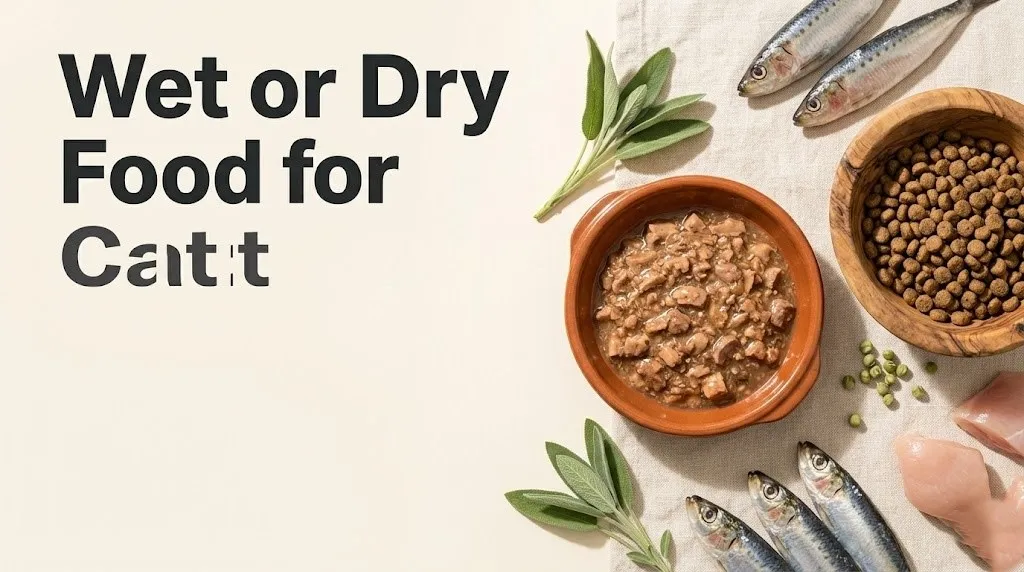
The practical gap between those numbers is large. A cat eating only dry food needs to compensate by drinking substantially more water than most cats willingly do. That compensation often doesn’t happen. Over time, consistently low water intake contributes to the development of feline lower urinary tract disease (FLUTD) and chronic kidney disease (CKD), two of the most common health problems in domestic cats.
That doesn’t mean dry food is harmful in all circumstances. Many cats thrive on mixed diets, and some individual cats do well on dry food when fresh water is always available and intake is monitored. But the default choice, if you’re deciding from scratch and your cat has no special constraints, leans toward wet food for most adult cats.
Breed, age, and current health status all affect what the right choice looks like. A cat with a history of urinary crystals needs different feeding guidance than a healthy, active young adult cat. When your cat has any ongoing health condition, a veterinarian or board-certified veterinary nutritionist should guide the decision.
Why Is Wet Food Better for Cats
Wet food is better for cats primarily because it addresses their chronically low thirst drive by delivering water directly through food. This single factor has downstream effects on urinary health, kidney function, and long-term organ health.
Think of your cat’s hydration system like a slow-drip irrigation line versus a sprinkler. A dry-food cat depends on that sprinkler (the water bowl) firing at the right time, in the right amount, every single day. A wet-food cat has constant moisture moving through the system automatically.
The hydration benefit is the most documented advantage of wet food, but it’s not the only one. Wet food also tends to be higher in animal-source protein, lower in carbohydrates, and more digestible for cats. The Association of American Feed Control Officials (AAFCO) sets minimum nutrient profiles for cat food. Wet cat food formulas frequently exceed the minimum protein threshold because meat, poultry, and fish are their primary ingredients, and those ingredients carry high moisture alongside their protein content.
Caloric density is another practical advantage. Wet food is significantly lower in calories per gram as fed, which makes it easier to manage portions for cats prone to overeating or weight gain. A 3.5-ounce (approximately 99g) can of wet food typically delivers around 80 to 110 calories, while the same weight of dry food delivers closer to 370 to 450 calories.
Key reasons wet food supports feline health include:
- Higher moisture content (75 to 82%) mirrors prey-animal water content
- Lower carbohydrate content, which aligns better with a carnivore’s metabolic capacity
- Higher palatability for cats with reduced appetite or dental sensitivity
- Easier for senior cats and cats with dental pain to eat comfortably
- More volume per calorie, supporting satiety without excess caloric intake
Cats with diagnosed kidney disease, urinary tract conditions, or diabetes often receive a specific recommendation for wet food from their veterinarian. In those cases, the hydration benefit directly supports treatment goals.
Is Dry Cat Food Better Than Wet
Dry cat food is not better than wet food for most cats on a whole-diet basis, but it has genuine practical advantages that make it the right choice or a useful component for many households. The question isn’t whether dry food is good or bad. It’s whether it meets your cat’s specific needs.
Dry food is calorie-dense, shelf-stable, and cost-effective. A bag of quality dry kibble costs considerably less per serving than an equivalent nutritional profile from canned food. That cost gap is real and matters for households with multiple cats.
Dry food is also convenient for free-choice feeding, where food is left available throughout the day. Wet food cannot be left out safely at room temperature for more than 2 hours without risking bacterial growth, according to FDA food safety guidelines for pet food. Dry food stays fresh in a sealed bowl much longer.
| Feature | Wet Food | Dry Food |
|---|---|---|
| Moisture content | 75 to 82% | 6 to 10% |
| Calories per 100g (as fed) | 70 to 120 kcal | 300 to 500 kcal |
| Protein (typical) | Higher animal-source % | Variable; may include plant proteins |
| Carbohydrates | Lower (5 to 10% dry matter) | Higher (25 to 40% dry matter) |
| Cost per serving | Higher | Lower |
| Shelf life (open) | 2 to 4 hours at room temperature | Days to weeks in sealed container |
| Feeding method | Meal-based only | Meal or free-choice |
| Palatability | Higher for most cats | Lower; depends on texture preference |
Dry food works well as part of a mixed feeding strategy. It’s less suitable as the sole food source for cats with urinary issues, kidney disease, or any condition where hydration is a medical concern.
Do Cats Need Dry Food
Cats do not need dry food as a dietary requirement. There is no nutrient in dry cat food that cannot be provided through a high-quality wet food diet. The question of whether to include dry food is about practicality, cost, and individual preference, not biological necessity.
Some veterinary professionals suggest that dry food can provide mental stimulation through kibble texture and chewing, and that puzzle feeders filled with dry food offer enrichment for indoor cats. These are valid quality-of-life arguments, not nutritional ones.
Cats do need a complete and balanced diet meeting AAFCO nutrient profiles for their life stage. That standard can be met by wet food alone, dry food alone, or a combination. What matters is the nutritional content of what’s in the bowl, not the texture it comes in.
Dry food does carry one real risk worth naming: it makes water intake harder to monitor. A cat eating wet food gets most of its daily hydration automatically. A cat on dry food needs to drink actively and regularly. Many cats don’t do this reliably, especially as they age or if their water bowl isn’t optimally placed or kept fresh.
Quick Tip:
- Place water bowls in multiple locations, away from food bowls and litter boxes
- Consider a running water fountain; research from the Journal of Feline Medicine and Surgery suggests many cats prefer moving water sources
- Monitor urine output and litter box clumping; decreased output is an early dehydration signal
Key Takeaway: Wet food is generally the better primary diet for most cats because it mirrors their natural hydration intake, but dry food can play a useful supporting role when a cat’s overall water intake is adequate and monitored.
Is Wet Cat Food Good for Cats
Wet cat food is good for cats when it meets AAFCO nutritional standards for the cat’s life stage and is made with quality animal-source proteins. Not all wet food is equally nutritious. The label matters as much as the format.
High-quality wet cat food provides complete nutrition, high palatability, and moisture that supports kidney and urinary tract function. It’s the format that most closely resembles the whole-prey diet cats evolved to eat. A mouse isn’t just protein and fat: it’s also about 70% water, connective tissue, and organ meat. Canned cat food approximates that profile better than kibble does.
The concern some owners raise about wet food is mess, spoilage, and cost. All three are real. An open can must be refrigerated and used within 24 to 48 hours. Uneaten wet food at room temperature should be discarded after 2 hours. For working owners who aren’t home at midday, scheduling two wet meals per day (morning and evening) is straightforward and practical.
Wet food is particularly beneficial for:
- Cats with a history of urinary crystals or FLUTD
- Cats with chronic kidney disease (CKD) requiring diluted urine
- Senior cats with reduced thirst drive
- Cats recovering from illness with suppressed appetite
- Overweight cats where portion control and satiety matter
- Cats with dental pain who struggle to crunch kibble
Cats with specific food allergies or intolerances should have wet food ingredients checked carefully. Common protein allergens in cat food include chicken, beef, dairy, and fish. An allergic reaction to a protein source doesn’t improve just because the food is wet format.
Wet vs Dry Cat Food Nutrition Comparison
Comparing wet and dry cat food nutritionally requires converting both to a dry-matter basis, because the high moisture content in wet food skews the numbers when compared as-fed. On a dry-matter basis, many wet and dry foods are more comparable in protein than the raw percentages suggest.
Here’s how to think about it: a can of wet food might list 10% crude protein on the label. Adjust for the 78% moisture, and the dry-matter protein is closer to 45 to 50%, which is high. Dry food listing 30% crude protein contains only about 6 to 10% moisture, so its dry-matter protein is roughly 32 to 34%. Wet food typically wins on dry-matter protein, especially when the primary ingredients are whole meats rather than rendered meals.
| Nutrient | Wet Food (dry matter basis) | Dry Food (dry matter basis) | AAFCO Adult Minimum |
|---|---|---|---|
| Crude protein | 40 to 55% | 30 to 40% | 26% |
| Crude fat | 15 to 25% | 10 to 20% | 9% |
| Carbohydrates | 5 to 15% | 25 to 45% | No minimum set |
| Taurine | 0.2%+ | 0.1%+ | 0.1% (extruded) |
| Moisture (as fed) | 75 to 82% | 6 to 10% | Not specified |
| Caloric density (as fed) | 70 to 120 kcal/100g | 300 to 500 kcal/100g | N/A |
The carbohydrate column deserves attention. Cats have a limited ability to digest and metabolize carbohydrates. Their liver enzymes are constitutively active for amino acid catabolism and remain so regardless of dietary carbohydrate intake. According to research published in the Journal of Nutritional Science, feeding cats diets high in carbohydrates does not result in the same metabolic adaptation seen in omnivores. High-carbohydrate diets in cats have been associated with elevated postprandial blood glucose and increased risk of obesity.
Taurine is the nutrient that warrants the closest attention on any cat food label. It’s an essential amino sulfonic acid in cats. Unlike most mammals, cats cannot synthesize adequate taurine from cysteine and methionine precursors. Dietary deficiency causes dilated cardiomyopathy (DCM) and central retinal degeneration. AAFCO mandates minimum taurine levels in both wet and dry formulations.
Should You Feed Cats Wet and Dry Food
Feeding cats both wet and dry food is a widely practiced and nutritionally sound approach, provided that total daily calorie intake is calculated across both foods and portions are adjusted accordingly. The combination strategy captures the benefits of both formats.
Many cat owners default to leaving dry food out all day and offering wet food once daily as a supplement. This can work, but it requires portion discipline. Dry food is calorie-dense. An unlimited dry food bowl combined with a full daily wet food portion leads to overfeeding quickly.
The right approach is to calculate your cat’s daily caloric requirement first, then split that across wet and dry servings. A rough starting point: a typical adult neutered cat weighing 4 to 5 kg (approximately 9 to 11 lbs) with an indoor sedentary lifestyle needs around 180 to 240 calories per day. Your veterinarian can give you the specific target for your cat’s body weight and condition score.
To set up a mixed feeding routine:
- Ask your vet for a daily calorie target based on your cat’s weight and body condition score.
- Decide on the wet-to-dry calorie split. A common approach is 60 to 70% of calories from wet food, 30 to 40% from dry.
- Check the caloric content on each food’s label (listed as kcal/kg or kcal/can).
- Calculate the gram or can measurement for each meal.
- Feed wet food at scheduled meal times (morning and evening).
- Offer measured dry food in a puzzle feeder or timed dispenser.
- Adjust portions at the 4-week mark based on weight and body condition.
Cats who graze freely on dry food and then receive unlimited wet food will frequently gain weight. Portion control applies to both formats simultaneously.
Key Takeaway: The combination of wet and dry food works well for most cats, but only when total daily calories are tracked across both types and portions are adjusted to prevent overfeeding.
How Much Wet Food Should I Feed My Cat
The correct daily wet food amount for a cat depends on the food’s caloric density, the cat’s body weight, activity level, reproductive status, and life stage. There is no one-size answer. Most standard adult cats eating wet food as their primary diet need roughly 2 to 3 standard 3.5-ounce (99g) cans per day, but this varies substantially.
A helpful starting framework: most complete adult maintenance wet foods run about 80 to 110 calories per 3.5-ounce can. An indoor adult cat typically needs 180 to 240 calories per day. That means roughly 2 cans per day for most indoor adult cats, split into two meals. A more active outdoor cat, or a larger breed like a Maine Coon, may need closer to 3 to 4 cans daily.
| Cat Type | Approx. Daily Caloric Need | Approximate Wet Food Amount |
|---|---|---|
| Kitten (under 1 year) | 200 to 300 kcal | 2.5 to 3.5 cans (80 kcal each) |
| Adult indoor cat (4 to 5 kg) | 180 to 240 kcal | 2 to 2.5 cans |
| Adult outdoor/active cat (4 to 5 kg) | 230 to 290 kcal | 2.5 to 3 cans |
| Senior cat (7+ years, less active) | 160 to 200 kcal | 1.5 to 2.5 cans |
| Overweight cat (vet-directed weight loss) | Vet-specific | Vet-specific |
| Cat with CKD or urinary disease | Vet-specific | Vet-specific |
These are starting estimates. The actual amount to feed your individual cat should be confirmed with a veterinarian, particularly for cats that are overweight, underweight, pregnant, nursing, or managing a chronic condition. Caloric requirements shift with age, hormonal changes, and illness.
Cat Food for Kittens vs Adult Cats
Kittens need a different nutritional profile than adult cats, and feeding an adult formula to a kitten, or vice versa, creates real gaps. Kittens are in rapid growth, requiring higher protein, higher fat, and higher levels of specific nutrients including taurine, DHA (docosahexaenoic acid), and arachidonic acid relative to body weight.
AAFCO recognizes two primary life stage categories for cat food: growth and reproduction (covering kittens and pregnant or nursing cats) and adult maintenance. Some foods carry an “all life stages” statement, meaning they meet the higher growth requirements and are suitable from kittenhood through adulthood.
Key nutritional differences between kitten and adult formulas include:
- Protein: Kittens need a higher protein percentage for muscle and organ development
- DHA and EPA: Omega-3 fatty acids support neurological development; look for these in kitten wet food specifically
- Taurine: Required at higher absolute amounts due to faster metabolic rate
- Calories: Kittens need more calories per kilogram of body weight than adult cats
- Phosphorus and calcium: Higher in kitten food to support bone development
Wet food is generally preferred for kittens because it’s easier to eat before full adult dentition develops, higher in protein, and supports the hydration needs of a small, rapidly growing body. By 12 months of age for most breeds (or up to 18 months for large breeds like Maine Coon), kittens can transition to an adult maintenance formula.
Best Cat Food for Senior Cats
Senior cats, generally defined as cats aged 7 years and older, have changing nutritional needs that make food selection particularly important. Wet food becomes even more important at this stage because kidney function naturally declines with age and maintaining hydration actively supports kidney health.
Protein is a point of ongoing debate in senior cat nutrition. Some older guidance suggested reducing protein for senior cats to protect kidney function. The current consensus from veterinary nutritionists is more nuanced. According to the American College of Veterinary Internal Medicine (ACVI), healthy senior cats actually benefit from maintained or increased high-quality protein intake to counter age-related muscle loss (sarcopenia). Reducing protein is appropriate only for cats with diagnosed, significant kidney disease, and only under veterinary direction.
Senior-specific cat food formulas often include:
- Higher moisture content in wet formulas
- Highly digestible protein sources (chicken, turkey, fish over plant-based meals)
- Joint-support ingredients like glucosamine and chondroitin in some specialty lines
- Reduced phosphorus in kidney-support formulas (prescription required)
- Added omega-3 fatty acids (EPA and DHA) for inflammation management
- Reduced caloric density for less active senior cats
The single most important feeding change for a senior cat is increasing wet food proportion. Many health problems that emerge in cats over age 10 are directly or indirectly connected to chronic dehydration. A senior cat that has eaten dry food its whole life can be transitioned to wet food gradually (see the transition section below).
Key Takeaway: Senior cats benefit most from high-moisture wet food and high-quality animal protein, with any specific dietary restrictions for kidney or other organ disease managed individually with veterinary guidance.
Cat Food for Cats with Kidney Disease or Urinary Issues
Cats with chronic kidney disease (CKD) or a history of urinary tract problems have specific dietary needs that go beyond the standard wet-vs-dry debate. For these cats, wet food is the clinical default, and specific nutrient levels become medically relevant.
Feline lower urinary tract disease (FLUTD) is an umbrella term covering conditions including urinary crystals (struvite or calcium oxalate), bladder inflammation (idiopathic cystitis), and urethral blockages. Wet food directly supports FLUTD management by increasing urine volume and diluting urine, which reduces the concentration of minerals that form crystals.
For cats with CKD, the dietary priorities shift to:
- Phosphorus restriction: Excess dietary phosphorus accelerates kidney damage in cats with impaired filtration; prescription renal diets have controlled phosphorus levels
- High moisture: Supports remaining kidney function and reduces the workload of concentrating urine
- Appropriate protein: Enough to prevent muscle wasting, but adjusted based on the CKD stage; this must be individualized by a veterinarian
- Potassium supplementation: Some CKD cats become potassium-depleted; prescription food or supplements address this
Over-the-counter wet foods are not designed to meet the specific mineral ratios required for CKD management. If your cat has been diagnosed with CKD or recurrent urinary tract issues, a veterinarian or board-certified veterinary nutritionist is the right professional to direct their diet. Self-managing a CKD diet with general-purpose wet food can inadvertently worsen the condition.
Can Cats Live on Dry Food Alone
Cats can survive on dry food alone if the diet meets AAFCO complete and balanced standards and the cat maintains adequate water intake consistently throughout its life. “Survive” and “thrive” are different benchmarks, and the gap between them matters here.
The research suggests cats fed exclusively dry food over many years face a higher risk of urinary tract issues and kidney disease compared to cats whose diets include significant wet food. This isn’t a universal outcome. Some cats eat dry food their entire lives without developing urinary or kidney problems. But the population-level risk is real and documented in veterinary epidemiological literature.
Two conditions make dry-food-only diets more viable:
- The cat drinks substantially more water than average. Using water fountains, placing multiple fresh-water sources around the home, and monitoring urine output helps. Some cats adapt well; others never drink enough.
- The cat is young, healthy, and at low baseline risk. A young adult cat with no urinary history, no predisposing breed characteristics, and an active lifestyle handles dry food better than an older, sedentary, or previously affected cat.
The answer isn’t that dry food is dangerous. It’s that dry-food-only diets require active management of water intake, which most owners don’t monitor consistently. Wet food removes that monitoring requirement by building hydration directly into every meal.
Does Dry Cat Food Clean Cats’ Teeth
Standard dry cat food does not meaningfully clean cats’ teeth. This is one of the most persistent myths in pet nutrition, and the evidence does not support it for regular kibble. The claim has been applied broadly to all dry food, when in reality it applies only to specific dental diet formulations tested under controlled conditions.
The theory is that dry kibble’s crunching action scrapes tartar from tooth surfaces. In practice, most cats bite through kibble rather than chewing it with full tooth surface contact. The kibble shatters above the gum line before it reaches the areas where tartar accumulates.
The Veterinary Oral Health Council (VOHC) maintains a list of pet food products that have demonstrated evidence of reducing plaque or tartar in controlled trials. Only a small number of specialty dental dry diets and dental treats carry the VOHC seal. Standard kibble does not.
For meaningful dental health in cats:
- Use VOHC-accepted dental diets or treats if dental health is a priority
- Brush your cat’s teeth with veterinary-approved enzymatic toothpaste; this is the most effective at-home dental intervention
- Schedule regular professional dental cleanings with your veterinarian
- Look for the VOHC seal specifically; general “dental health” marketing language on packaging is not a substitute for that certification
Cats on wet food can absolutely maintain excellent dental health with regular dental care. Dental disease in cats is a management issue requiring active intervention, not one that resolves passively through food texture.
Key Takeaway: The dry food dental benefit is a myth for standard kibble; only diets carrying the VOHC seal have demonstrated tartar-reducing evidence, and regular veterinary dental care matters far more than food texture.
How to Transition Between Cat Food Types
Transitioning a cat between food types too quickly causes digestive upset, including loose stools, vomiting, or outright food refusal. Cats are creatures of texture habit; many imprint on specific food textures during kittenhood and resist changes as adults. A gradual transition over 7 to 14 days is the standard approach.
To transition from dry food to wet food (or reverse):
- Days 1 to 2: Serve 90% original food, 10% new food mixed together.
- Days 3 to 4: Shift to 75% original food, 25% new food.
- Days 5 to 6: Move to 50/50.
- Days 7 to 8: Switch to 25% original food, 75% new food.
- Days 9 to 10: Serve new food exclusively, or at the target ratio.
- If the cat refuses at any stage: pause and extend that ratio for 2 to 3 more days before moving forward.
Some cats, particularly those fed dry food for many years, require an even slower transition. Warming wet food slightly (to approximately body temperature, around 37°C / 98.6°F) increases palatability for reluctant cats by releasing aroma compounds.
Texture-averse cats who refuse wet food outright can sometimes be won over by starting with a wet-dry mixture mashed together, then gradually adjusting the consistency. Pate-style wet food is often better accepted than chunky or shredded varieties by cats new to wet food, because the texture is more uniform and less unfamiliar.
How to Read Cat Food Labels and AAFCO Standards
The most important sentence on a cat food label is the nutritional adequacy statement, typically located near the guaranteed analysis panel. This statement tells you whether the food meets AAFCO standards and for which life stage.
AAFCO (the Association of American Feed Control Officials) sets nutrient profiles that serve as the regulatory baseline for cat food sold in the United States. A food labeled “complete and balanced for adult maintenance” means it meets AAFCO’s minimum nutrient requirements for adult cats. A food labeled “for supplemental feeding only” or “intended for intermittent use” is not nutritionally complete and should not be a cat’s sole diet.
Key label components to check:
- Nutritional adequacy statement: Look for “complete and balanced” and the correct life stage (growth, adult maintenance, or all life stages)
- Guaranteed analysis: Shows minimum crude protein, minimum crude fat, maximum crude fiber, and maximum moisture percentages; note that these are as-fed minimums, not dry-matter values
- Ingredient list: Ingredients are listed by weight before processing; a named meat protein (chicken, salmon, turkey) should ideally appear first
- Caloric statement: Required on all cat food since 2016; listed as kcal/kg and per serving; use this to calculate actual feeding amounts
| Label Term | What It Actually Means |
|---|---|
| “Complete and balanced” | Meets AAFCO minimum nutrient profile |
| “Natural” | No artificial additives per AAFCO definition; does not mean organic |
| “Grain-free” | No grains; may still contain high carbohydrates from legumes or potato |
| “With chicken” | Contains at least 3% chicken |
| “Chicken flavor” | Contains detectable chicken flavor; no minimum percentage required |
| “Chicken dinner/formula/platter” | Contains at least 25% chicken |
| “Chicken cat food” | Contains at least 95% chicken (excluding water) |
What to Look for in High-Quality Cat Food Ingredients
High-quality cat food starts with a named animal protein as the first ingredient. The difference between “chicken,” “chicken meal,” and “poultry by-product meal” matters, and understanding each term helps you evaluate what you’re buying.
Named whole proteins (chicken, salmon, beef, turkey) listed first indicate the primary ingredient before processing. Because raw meat contains substantial water, the protein percentage shifts after cooking. Named meat meals (chicken meal, salmon meal) are concentrated protein sources with moisture already removed; they’re not inferior to whole meat and often deliver a higher dry-matter protein percentage.
By-products are organ meats, blood, bone, and other non-muscle tissue. In cats, organ meats carry high nutritional value. The term “by-products” isn’t inherently low quality. The quality concern is with unnamed by-products (listed as “poultry by-product” without specifying the animal), which provide less ingredient traceability.
Ingredients to approach with caution in cat food:
- Corn syrup or sugar: Adds carbohydrates with no nutritional benefit for obligate carnivores
- Artificial colors (Red 40, Yellow 5): No nutritional value; cats don’t see color the way humans do
- Carrageenan: A thickening agent derived from seaweed found in some wet food; research on its safety in cats is ongoing and debated
- BHA and BHT: Synthetic antioxidant preservatives; more common in dry food; natural alternatives include mixed tocopherols (vitamin E) and rosemary extract
- Unnamed protein sources: “Animal digest,” “meat and bone meal,” and “animal fat” without species identification offer no ingredient traceability
For cats with specific health conditions, ingredient evaluation becomes even more important. A cat with a food allergy or intolerance needs protein sources confirmed with a veterinarian-directed elimination diet before concluding which ingredient is the problem.
Key Takeaway: The first ingredient on a cat food label tells you the most about its quality; named animal proteins or named meat meals indicate better ingredient transparency than unnamed by-products or plant-based fillers.
Frequently Asked Questions About Wet and Dry Cat Food
Is it OK to feed my cat both wet and dry food every day?
Yes, feeding a combination of wet and dry food daily is nutritionally sound and widely recommended by veterinary nutritionists.
The key is tracking total daily calories across both foods and adjusting portions so the combined intake matches your cat’s individual caloric need.
Splitting roughly 60 to 70% of calories from wet food and 30 to 40% from dry food is a reasonable starting framework for most healthy adult cats.
How much wet food does a cat need per day?
Most average indoor adult cats (4 to 5 kg, approximately 9 to 11 lbs) need about 2 to 2.5 standard 3.5-ounce cans of complete wet food per day, assuming roughly 80 to 100 calories per can.
Actual needs vary based on body weight, activity level, age, and whether dry food is also being offered.
A veterinarian can give you a precise daily calorie target, which is the most reliable basis for calculating serving size.
Can cats drink enough water on a dry food diet?
Some cats do drink enough water to compensate for dry food’s low moisture content, but many don’t do so consistently. Cats have a relatively low thirst drive compared to most mammals, which makes voluntary drinking an unreliable primary hydration source. Using multiple water stations, running water fountains, and monitoring urine output helps identify whether a specific cat is maintaining adequate hydration on a dry-only diet.
Is grain-free cat food better than regular cat food?
Grain-free cat food is not inherently better or worse than grain-containing food for most cats. Cats have limited carbohydrate processing capacity, but the relevant concern is total carbohydrate and starch content, not whether the source is grain or legume. Some grain-free formulas replace grains with peas, lentils, or potatoes, which can still deliver high carbohydrate loads. Evaluate total carbohydrate content and ingredient quality rather than treating “grain-free” as a quality marker.
At what age should I switch my cat from kitten to adult food?
Most cats can transition from kitten to adult food at 12 months of age. Large breeds like Maine Coon and Ragdoll continue growing until 18 months and benefit from staying on kitten or all-life-stages food through that period. Your veterinarian can assess your cat’s body condition and growth progress to confirm the right timing for your individual cat.
The Bottom Line
Wet food is the stronger choice for most cats as a primary diet, largely because it delivers hydration automatically without requiring your cat to compensate through voluntary drinking. That advantage compounds over a cat’s lifetime, particularly once they pass seven years of age and kidney function begins naturally declining.
Dry food isn’t the enemy. It’s practical, cost-effective, and works well as part of a mixed strategy when portions are controlled and total calories are tracked. The cats most at risk from dry-food-only diets are those that never drink enough water consistently, and most cats fall into that category.
Whatever combination you choose, focus on the AAFCO nutritional adequacy statement, named animal proteins near the top of the ingredient list, and a feeding amount matched to your individual cat’s weight and condition. When your cat has a health condition, those feeding decisions belong in a conversation with a veterinarian, where your cat’s specific bloodwork, weight history, and health status can shape the recommendation.