The best wet cat food is high in named animal protein, contains essential taurine, and delivers a moisture content of 75 to 82 percent per serving. Not every product on the shelf meets that standard, and the label tells you everything if you know what to read.
Cats are obligate carnivores, meaning they have no metabolic pathway to produce certain nutrients independently. According to the National Research Council’s Nutrient Requirements of Cats, felines require preformed taurine, arachidonic acid, and vitamin A directly from animal tissue because their bodies cannot synthesize adequate quantities from plant sources.
This guide covers every meaningful question a cat owner has when buying wet food: what brands deliver real nutritional value, what labels mean, what to avoid, how much to feed, and how to switch without disrupting your cat’s digestion. A veterinarian should always be your first resource for a cat with an existing health condition.
What Is the Best Wet Cat Food?
The best wet cat food overall is one that carries an AAFCO (Association of American Feed Control Officials) complete and balanced statement, lists a named animal protein as the first ingredient, and has a moisture content at or above 75 percent.
No single brand is universally best for every cat. A healthy two-year-old indoor cat has different protein and caloric needs than a fourteen-year-old cat with early kidney disease. That said, several brands consistently meet the core nutritional standards that feline medicine recognizes.
Purina Pro Plan, Hill’s Science Diet, and Royal Canin are the three brands most frequently cited in veterinary nutrition literature because all three employ board-certified veterinary nutritionists and conduct AAFCO feeding trials rather than relying solely on nutrient calculation. That distinction matters more than most buyers realize.
The World Small Animal Veterinary Association (WSAVA) recommends choosing pet foods from manufacturers that employ a full-time veterinary nutritionist and have published peer-reviewed research. Fancy Feast Classic pates and Wellness CORE also perform well nutritionally at their respective price points, though fewer feeding trials are on record for these brands.
Quick Tip:
- Check the label for “Animal feeding tests using AAFCO procedures” rather than just “formulated to meet AAFCO standards.” The feeding test statement indicates real-world digestibility data.
- A named protein (chicken, salmon, beef) as the first ingredient is a better sign than “meat by-products” or unnamed “poultry meal” in position one.
- If your cat has any diagnosed condition, a specific therapeutic wet food line may be necessary.
What Is the Best Wet Food for Cats Overall?
The best wet food for cats overall combines high animal-derived protein, sufficient named fat sources, added taurine, and a complete micronutrient profile verified by AAFCO or a feeding trial.
Think of reading a cat food label the way you’d read a restaurant menu written in a foreign language. The ingredients list is ordered by weight before cooking. A heavy item like fresh chicken sits high on the list because raw meat contains a lot of water. Once you account for that moisture, the actual protein contribution may shift. This is why dry matter analysis, not the as-fed percentage, gives a more honest comparison across products.
Pate-style wet foods typically have the most consistent ingredient distribution and are easiest to analyze nutritionally. Shredded, flaked, and “in gravy” formats often have lower actual protein content because the gravy adds volume without adding protein proportionally.
| Wet Food Format | Moisture Typical Range | Protein (As-Fed Typical) | Notes |
|---|---|---|---|
| Pate | 78-82% | 8-12% | Most consistent; easiest to dose |
| Shreds in gravy | 82-86% | 6-9% | Gravy dilutes protein density |
| Flaked | 80-84% | 7-10% | Often fish-based; higher omega-3 |
| Minced | 78-82% | 8-11% | Texture preferred by some seniors |
| Chunks in broth | 84-88% | 5-8% | Highest moisture; lowest protein density |
Cats with dental sensitivities or flat-faced anatomy (Persians, Exotic Shorthairs) often do better with pate or minced formats.
What Is the Best Canned Cat Food to Buy?
The best canned cat food to buy is one that lists a named animal protein first, carries an AAFCO complete and balanced guarantee for the appropriate life stage, and contains no artificial preservatives like BHA (butylated hydroxyanisole) or BHT (butylated hydroxytoluene).
The can itself offers a practical preservation advantage. Canned food uses heat sterilization rather than added chemical preservatives, which is why most high-quality wet foods rely on the can’s seal for shelf stability. Once opened, wet food is perishable and must be covered and refrigerated, with leftovers discarded within 48 hours.
| Brand | AAFCO Claim | Feeding Trials on Record | Named Protein First | Taurine Added |
|---|---|---|---|---|
| Purina Pro Plan | Complete and balanced | Yes | Yes | Yes |
| Hill’s Science Diet | Complete and balanced | Yes | Yes | Yes |
| Royal Canin | Complete and balanced | Yes | Yes | Yes |
| Fancy Feast Classic | Complete and balanced | Formulation-based | Yes | Yes |
| Wellness CORE | Complete and balanced | Formulation-based | Yes | Yes |
| Tiki Cat | Complete and balanced | Formulation-based | Yes | Yes |
| Weruva | Complete and balanced | Formulation-based | Yes | Yes |
Cats with confirmed protein allergies may need a hydrolyzed protein formula or a novel protein option. These specialized canned foods tend to have shorter ingredient lists and are often available only through veterinary channels.
Key Takeaway: The most reliable canned cat foods list a named animal protein first, carry AAFCO complete and balanced status verified by feeding trials, and use the can itself rather than chemical additives for preservation.
Is Wet Cat Food Better Than Dry Cat Food?
Wet cat food provides dramatically higher moisture content than dry food, which is a real functional advantage for cats because they have a naturally low thirst drive.
A cat eating only dry kibble typically consumes significantly less water per day than one on wet food. According to research published in the Journal of Feline Medicine and Surgery, cats on wet-food diets consistently show higher urine volume and lower urine specific gravity, both of which reduce the risk of crystal and stone formation in the urinary tract.
Dry food has practical advantages: cost, shelf stability, and dental abrasion (though the dental benefit of kibble is frequently overstated by manufacturers and is not supported strongly by the American Veterinary Dental College). Wet food is more expensive per calorie, needs refrigeration after opening, and can be less convenient for free-feeding schedules.
| Factor | Wet Cat Food | Dry Cat Food |
|---|---|---|
| Moisture content | 75-85% | 6-10% |
| Protein content (dry matter) | 40-55% | 25-35% |
| Caloric density (per gram) | Lower | Higher |
| Cost per day | Higher | Lower |
| Shelf life (open) | 24-48 hours refrigerated | Weeks in sealed container |
| Urinary health support | Stronger evidence | Weaker evidence |
| Dental benefit | Minimal | Minimal (overstated) |
Many veterinary nutritionists recommend a combination: wet food as the primary diet with a small amount of dry as a supplementary texture or enrichment item. The ratio depends on the individual cat’s health status, caloric needs, and eating behavior.
What to Look for in Wet Cat Food Ingredients
A quality wet cat food ingredient list starts with a named animal protein, followed by water, a named fat source, and then supporting ingredients like vitamins and minerals.
The ingredient order tells you what is present by weight before processing. Fresh chicken or fresh salmon sits high because raw meat is mostly water. After cooking, the actual contribution from that ingredient is lower. This does not make fresh-meat-first formulas inferior; it simply means the second and third ingredients matter just as much.
Key ingredients to look for include:
- Named animal protein first: chicken, turkey, salmon, beef, tuna, rabbit, duck
- Named organ meat: chicken liver, beef liver (adds bioavailable vitamin A and iron)
- Fish oil or named fat: salmon oil, chicken fat (source of arachidonic acid and EPA/DHA)
- Taurine: listed as an added supplement, essential for cardiac and retinal function in cats
- Vitamin E and vitamin C: as natural preservatives (mixed tocopherols, ascorbic acid)
- Chelated minerals: zinc proteinate, iron proteinate (more bioavailable than oxide forms)
According to the National Research Council, adult cats require a minimum of 0.1 percent taurine on a dry matter basis in their diet. Any complete and balanced wet food must meet this threshold.
Cats with known protein sensitivities benefit from limited ingredient wet foods that contain one animal protein source and avoid common allergens like chicken, beef, and dairy.
What Does AAFCO Complete and Balanced Mean for Cat Food?
The AAFCO complete and balanced statement on a cat food label means the product meets the minimum nutritional standards set by the Association of American Feed Control Officials for the life stage listed.
AAFCO sets two types of profiles: one for growth and reproduction (kittens and pregnant or nursing cats) and one for adult maintenance. Some products are labeled “all life stages,” which means they meet the higher growth and reproduction standard. That is not always ideal for senior cats, who may need lower phosphorus and different caloric density.
There are two ways a brand can earn the AAFCO statement. The first is by formulating the recipe to meet the published nutrient minimums on paper. The second is by conducting an actual AAFCO feeding trial, where real cats consume the food for a defined period and bloodwork and body condition are monitored. The feeding trial version is the more rigorous standard.
The label phrase “formulated to meet the AAFCO nutrient profile” does not mean the food was tested on cats. The phrase “animal feeding tests using AAFCO procedures substantiate” means it was.
Quick Tip:
- Look for the life stage statement: “adult maintenance,” “growth,” “all life stages,” or “senior” (though AAFCO does not currently define a senior-specific nutrient profile).
- Feeding trial language on the label is always preferred over formulation-only language.
- An AAFCO statement is the minimum bar. It does not speak to ingredient quality, sourcing, or palatability.
Key Takeaway: AAFCO complete and balanced is the floor, not the ceiling. Feeding trial verification, named protein sources, and a reputable manufacturer with a veterinary nutritionist on staff all push quality higher than the minimum label requirement.
Best Wet Cat Food for Indoor Cats
The best wet cat food for indoor cats tends to be moderate in calories and high in animal protein, since indoor cats burn fewer calories than outdoor cats but still require the same protein-driven metabolic support.
Indoor cats face two specific risks that diet can address directly: weight gain from lower activity levels and hairball accumulation from grooming. A wet food diet supports both: high moisture content aids digestive transit, and a calorie-appropriate serving size prevents creeping weight gain that is common in neutered indoor cats.
Purina Pro Plan Complete Essentials and Hill’s Science Diet Adult Indoor wet formulas are specifically designed with these factors in mind, offering adjusted caloric density and added fiber to support hairball management. Both carry AAFCO complete and balanced status with feeding trial verification.
| Feature | Why It Matters for Indoor Cats |
|---|---|
| Calorie-controlled serving | Lower activity means lower caloric need |
| High moisture (78%+) | Supports digestive motility and urinary health |
| High protein (40%+ dry matter) | Maintains lean muscle mass despite lower activity |
| Added fiber (psyllium, beet pulp) | Supports hairball passage |
| Moderate fat content | Prevents excess weight gain |
Neutered male cats are particularly susceptible to urinary crystal formation and weight gain simultaneously. A wet food designed for indoor cats addresses both concerns without requiring two separate formulas.
Best Wet Cat Food for Kittens
The best wet cat food for kittens carries an AAFCO growth and reproduction statement, contains a high-quality animal protein source, and includes DHA (docosahexaenoic acid) for neurological and retinal development.
Kittens from weaning (approximately 4 weeks old) through 12 months require significantly higher protein, fat, and caloric density than adult cats. The AAFCO growth profile specifies higher minimums for calcium, phosphorus, sodium, and DHA compared to the adult maintenance profile.
According to the Tufts University Cummings Veterinary Medical Center, kittens need roughly twice the caloric density of adult cats per unit of body weight during active growth phases. This is why adult formulas should not be used as a primary diet for kittens unless the label states “all life stages.”
Key nutrients to verify in kitten wet food:
- Crude protein: Minimum 22.5% on a dry matter basis (AAFCO growth standard)
- Crude fat: Minimum 8.5% dry matter
- DHA: Listed in ingredients (often from fish oil or algae oil)
- Calcium and phosphorus: At a ratio between 1:1 and 2:1 (critical for bone development)
- Taurine: Minimum 0.1% dry matter
Breeds with known genetic predispositions to dilated cardiomyopathy (Maine Coons, Ragdolls, Persians) warrant particular attention to taurine levels in the kitten diet. A veterinarian familiar with the breed should confirm the specific dietary approach.
Best Wet Cat Food for Senior Cats
The best wet cat food for senior cats is typically moderate in phosphorus, high in bioavailable protein, and calorie-dense enough to maintain body condition in cats that may eat less reliably with age.
Cats are generally considered senior at age 11 and geriatric at age 15, according to the American Association of Feline Practitioners (AAFP). The metabolic changes at this stage are real: kidney filtration efficiency often declines, muscle mass decreases even with adequate protein intake, and appetite can become unreliable.
Phosphorus restriction is a key dietary consideration in older cats because the kidneys process and excrete phosphorus. As kidney function declines with age, excess dietary phosphorus can accelerate the progression of kidney damage. Senior-appropriate wet foods typically keep phosphorus below 0.5 percent on a dry matter basis, compared to the standard adult range of 0.6 to 1.0 percent.
| Nutrient | Standard Adult Wet Food | Senior-Appropriate Wet Food |
|---|---|---|
| Protein (dry matter) | 40-55% | 40-50% (highly digestible source) |
| Phosphorus (dry matter) | 0.6-1.0% | 0.3-0.5% |
| Sodium (dry matter) | 0.3-0.5% | 0.2-0.35% |
| Moisture content | 75-82% | 78-85% (higher preferred) |
| Caloric density | Standard | Slightly higher per oz preferred |
Cats already diagnosed with chronic kidney disease require a therapeutic renal diet, not simply a “senior” formula. A veterinarian should determine the appropriate phosphorus threshold based on bloodwork, not label shopping.
Key Takeaway: Senior cats need highly digestible protein, phosphorus awareness, and higher moisture content. A diagnosed condition like CKD requires veterinary dietary guidance beyond what any over-the-counter senior formula provides.
Best Wet Cat Food for Sensitive Stomachs
The best wet cat food for cats with sensitive stomachs typically has a limited ingredient list, a single named animal protein source, no artificial additives, and highly digestible protein sources like chicken or turkey.
Digestive sensitivity in cats shows up as intermittent vomiting, soft or inconsistent stools, or visible unease after eating. These signs can result from protein intolerance, sensitivity to specific additives, rapid food transitions, or an underlying gastrointestinal condition. A wet food designed for sensitive stomachs addresses the diet variable, but a veterinarian should rule out inflammatory bowel disease (IBD) or parasites before assuming the issue is purely dietary.
Hill’s Science Diet Sensitive Stomach and Skin (wet formula) and Royal Canin Digestive Care wet food use highly digestible proteins and prebiotic fiber to support consistent stool quality. Both carry AAFCO complete and balanced status with feeding trial verification.
Key markers of a sensitive-stomach-appropriate wet food:
- Single animal protein source: chicken, turkey, or duck (not a protein blend)
- No artificial colors, flavors, or preservatives
- No carrageenan (a seaweed-derived thickener linked to gastrointestinal inflammation in some research, though evidence in cats specifically is still under review)
- Prebiotics or fermentable fiber (fructooligosaccharides, chicory root) to support a stable gut microbiome
- Short, readable ingredient list with recognizable items
Cats with confirmed food allergies need a hydrolyzed protein formula or a novel protein (rabbit, venison, kangaroo) that the immune system has not been previously exposed to. These should be sourced carefully, as cross-contamination during manufacturing can compromise their effectiveness.
Best Wet Cat Food for Urinary Health
The best wet cat food for urinary health is high in moisture content, moderate in magnesium and phosphorus, and formulated to produce slightly acidified urine that discourages struvite crystal formation.
Feline lower urinary tract disease (FLUTD) is one of the most common conditions in domestic cats, particularly in middle-aged, neutered, indoor males. Diet plays a direct role. A study in the Journal of Veterinary Internal Medicine found that cats on wet-food-only diets produce urine with a lower specific gravity, which dilutes mineral concentrations and reduces crystal precipitation risk.
Magnesium is the primary mineral associated with struvite (magnesium ammonium phosphate) crystal formation. Wet foods formulated for urinary health typically keep magnesium below 0.02 percent on an as-fed basis. Urine pH matters too: struvite crystals form in alkaline urine (pH above 6.8), while calcium oxalate crystals form in acidic urine (pH below 6.0). Balanced urinary formulas aim for a target urine pH of 6.2 to 6.5.
| Mineral | Standard Adult Wet Food | Urinary Support Formula |
|---|---|---|
| Magnesium (dry matter) | 0.04-0.08% | 0.02-0.04% |
| Phosphorus (dry matter) | 0.6-1.0% | 0.4-0.7% |
| Sodium (dry matter) | 0.3-0.5% | 0.3-0.6% (slightly higher promotes drinking) |
| Moisture content | 75-82% | 80-85% |
Hill’s Prescription Diet c/d Multicare and Royal Canin Urinary SO are the two most studied therapeutic wet food options for FLUTD management and require veterinary guidance for use, especially in cats that have had urinary blockages.
Best Wet Cat Food for Weight Management
The best wet cat food for weight management is calorie-restricted, high in protein to preserve lean muscle mass during weight loss, and high in moisture to create satiety without excess caloric intake.
Feline obesity is a widespread problem. According to a survey by the Association for Pet Obesity Prevention, an estimated 61 percent of cats in the United States were overweight or obese in recent years. Excess body weight in cats is directly associated with increased risk of type 2 diabetes, hepatic lipidosis (fatty liver disease), osteoarthritis, and a shortened lifespan.
Wet food supports weight management in a practical way that dry food cannot replicate: the high water content adds physical volume to each meal without adding calories. A cat eating a wet food diet feels fuller per calorie consumed. Think of it the way a large bowl of vegetable soup satisfies more hunger than the same calories in crackers.
Key criteria for a weight-management wet food:
- Caloric content below 80 kcal per 3 oz serving
- Protein at or above 40 percent on a dry matter basis (to protect muscle during calorie restriction)
- Fat below 20 percent dry matter
- No added sugars or starchy fillers (tapioca, potato, corn syrup) that contribute carbohydrate calories
- Moderate fiber to promote satiety
Hill’s Prescription Diet w/d and Purina Pro Plan Weight Management wet formulas both carry documented caloric and protein profiles appropriate for supervised weight loss. Any cat losing more than 0.5 percent of body weight per week should be monitored for hepatic lipidosis, which develops rapidly in cats that lose weight too quickly.
Key Takeaway: Wet food is better than dry for weight management because water volume increases satiety without increasing calories. A protein-forward, calorie-controlled wet formula protects muscle while supporting fat loss.
What Ingredients to Avoid in Wet Cat Food
The ingredients most worth avoiding in wet cat food are artificial preservatives, unspecified protein sources, carrageenan, excessive thickeners, and added sugars.
This is not about achieving a perfectly clean label. It is about eliminating ingredients that either carry meaningful risk or signal low-quality manufacturing decisions.
Ingredients to avoid or approach cautiously:
- BHA (butylated hydroxyanisole) and BHT (butylated hydroxytoluene): Synthetic antioxidant preservatives. The National Toxicology Program has classified BHA as reasonably anticipated to be a human carcinogen. While feline data is limited, there is no nutritional reason to choose a product with these when alternatives exist.
- Ethoxyquin: A synthetic preservative occasionally found in fish-based foods. Banned in human food in many jurisdictions. Avoid it where possible.
- Carrageenan: A seaweed-derived thickener used to bind pate textures. Some research suggests carrageenan can promote gastrointestinal inflammation, though the evidence in cats specifically is not yet definitive. Cats with sensitive stomachs may benefit from carrageenan-free options.
- Artificial colors (Red 40, Yellow 5, Blue 2): Added solely for visual appeal to the owner. Cats are dichromats and do not perceive these colors. There is no nutritional justification for including them.
- “Meat by-products” or “animal digest” without a named species: These catch-all terms indicate that the protein source is unspecified and variable in quality.
- Added sugars or sweeteners (corn syrup, sucrose, fructose): Cats lack functional sweet taste receptors and derive no palatability benefit from sugar. Its presence serves no nutritional purpose.
- Excessive starch fillers (potato, tapioca, corn starch): Particularly in “grain-free” formulas. Cats have a limited ability to digest carbohydrates efficiently and do not require dietary starch.
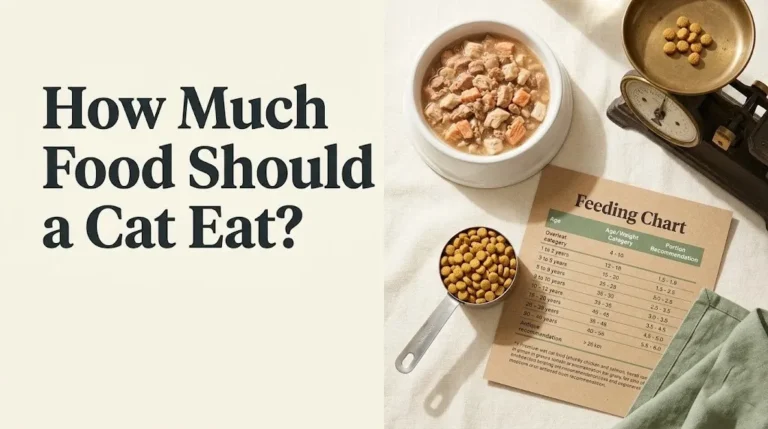
How Much Wet Cat Food Should I Feed My Cat?
Most adult cats need between 3 and 5.5 ounces of wet food per day, divided into two meals, though the correct amount depends on the cat’s weight, age, activity level, and whether dry food is also being fed.
A standard 10-pound adult cat in moderate body condition typically needs approximately 200 to 250 kilocalories per day from food. Wet food averages 25 to 40 kcal per ounce depending on the formula, meaning a standard 5.5 oz can delivers roughly 140 to 200 kcal. That may be close to a full day’s intake for a sedentary indoor cat, or just one meal for an active outdoor cat.
Feeding guidelines printed on wet food cans are always calculated for an average cat as a starting point. They are not precise prescriptions.
| Cat Profile | Approximate Daily Wet Food Need |
|---|---|
| 8 lb sedentary indoor adult | 3.5-4.5 oz/day (two meals) |
| 10 lb moderately active adult | 4.5-5.5 oz/day (two meals) |
| 12 lb active adult or outdoor cat | 5.5-7 oz/day (two or three meals) |
| Kitten under 6 months | Feed to appetite; 3-4 small meals daily |
| Senior cat over 11 years | Varies; monitor body condition score monthly |
| Cat on weight-loss plan | 10-20% below calculated maintenance; vet guidance needed |
Body condition scoring, not just weight, is the most reliable guide. A veterinarian or vet tech can teach you to assess your cat’s body condition score on a 9-point scale developed by the WSAVA. Aim for a score of 4 to 5 out of 9 for adult cats.
Best Affordable Wet Cat Food Brands
The best affordable wet cat food brands deliver an AAFCO complete and balanced guarantee, named animal protein as the first ingredient, and acceptable nutritional profiles without the marketing premiums of specialty brands.
Budget does not have to mean nutritionally inferior. Fancy Feast Classic pates (not the gravy varieties) are a frequently cited example in the veterinary nutrition community: they list chicken, turkey, or beef as the first ingredient, contain added taurine, and carry AAFCO complete and balanced status. The classic pate line typically costs under $0.40 per ounce at most retailers.
Friskies Classic Pates and 9Lives Plus Care also meet AAFCO standards at low price points, though neither brand conducts the AAFCO feeding trials that Purina Pro Plan does. They represent a reasonable budget option for a healthy adult cat with no diagnosed conditions.
| Brand | Approx. Cost Per Oz | AAFCO Status | Feeding Trial | Named Protein First |
|---|---|---|---|---|
| Purina Pro Plan | $0.55-0.75 | Complete and balanced | Yes | Yes |
| Hill’s Science Diet | $0.65-0.85 | Complete and balanced | Yes | Yes |
| Fancy Feast Classic | $0.30-0.40 | Complete and balanced | Formulation | Yes |
| Friskies Classic Pate | $0.20-0.30 | Complete and balanced | Formulation | Varies |
| 9Lives Plus Care | $0.18-0.28 | Complete and balanced | Formulation | Varies |
| Wellness CORE | $0.60-0.85 | Complete and balanced | Formulation | Yes |
| Weruva | $0.80-1.20 | Complete and balanced | Formulation | Yes |
Cost-per-ounce is the honest comparison metric. A 5.5 oz can at $2.20 costs the same per ounce as a 12.5 oz can at $5.00. Always calculate by the ounce, not the can.
Key Takeaway: Fancy Feast Classic pates represent a rare example of an affordable wet food with a nutritionally credible ingredient list. Budget options can work well for healthy adult cats. Cats with health conditions should not be fed on budget alone.
How to Transition a Cat from Dry to Wet Food
Transitioning a cat from dry to wet food should happen gradually over 7 to 14 days, mixing increasing proportions of wet food with decreasing portions of dry food to allow the digestive system to adapt.
Cats are creatures of strong dietary habit, known in behavioral research as “dietary imprinting.” A cat raised exclusively on dry kibble may reject wet food initially not because of dislike but because it does not recognize it as food. Patience and gradual introduction are more effective than an abrupt switch.
To transition a cat from dry to wet food:
- Days 1 to 3: Mix approximately 25 percent wet food with 75 percent of the usual dry food amount by caloric content. Serve at the cat’s usual meal time.
- Days 4 to 6: Increase to 50 percent wet / 50 percent dry. Watch for any loose stools or vomiting. If these occur, slow the transition down by going back one step.
- Days 7 to 9: Increase to 75 percent wet / 25 percent dry. Most cats accept the texture shift by this point.
- Days 10 to 14: Move to 100 percent wet food if that is your goal. Alternatively, settle at a ratio that works for your cat and your budget.
- Ongoing: Monitor body condition score, stool consistency, and water intake for the first 4 weeks after the full transition. Adjust portion sizes based on body condition, not just the can’s guidelines.
Some cats take longer than two weeks. A cat refusing wet food entirely after two weeks can sometimes be encouraged by warming the food to approximately 98°F (37°C) to release aroma, or by trying a different protein or texture format. Cats with diabetes, kidney disease, or IBD should have any dietary transition supervised by a veterinarian.
Frequently Asked Questions About Wet Cat Food
What wet cat food do vets recommend most?
Veterinary nutritionists most frequently recommend Purina Pro Plan, Hill’s Science Diet, and Royal Canin because all three employ board-certified veterinary nutritionists and conduct AAFCO feeding trials.
These brands have published peer-reviewed research on their formulas and meet the WSAVA criteria for manufacturer transparency.
A cat with a specific health condition may need a therapeutic diet from these same manufacturers or a specialized brand recommended by a veterinarian after examination and bloodwork.
Is it OK to feed my cat wet food every day?
Yes, feeding wet food every day is generally appropriate and often recommended by veterinary nutritionists for most adult cats.
The high moisture content in wet food supports urinary health and suits cats’ naturally low thirst drive.
The only exception is cats requiring a specific dry therapeutic formula for a diagnosed condition, where the attending veterinarian has explicitly recommended dry food as the primary format.
How long can wet cat food sit out before it goes bad?
Wet cat food should not sit out at room temperature for more than 4 hours, according to standard food safety principles applied to pet foods.
After 4 hours, bacterial growth accelerates, particularly in warm environments, and the food becomes a potential source of gastrointestinal upset.
Uneaten wet food should be covered and refrigerated within that window and used within 48 hours of opening.
What is the healthiest wet cat food ingredient list?
The healthiest wet cat food ingredient list begins with a named animal protein (chicken, salmon, beef, turkey), followed by water, a named fat source, added taurine, and then vitamins and chelated minerals.
There should be no artificial preservatives (BHA, BHT, ethoxyquin), no added sugars, no artificial colors, and no unspecified “meat” or “animal” ingredients without a named species.
A short, readable list with recognizable items is a better signal of quality than a long list of isolated nutrient supplements compensating for low-quality base ingredients.
Can I mix wet and dry cat food?
Yes, mixing wet and dry cat food is a common and nutritionally appropriate feeding strategy.
The wet food contributes moisture and palatability; the dry food can extend the feeding period and provide some dental abrasion benefit.
The key is to calculate total daily calories from both sources combined, not just feed each at its own recommended amount, which would result in overfeeding.
Choosing the best wet cat food comes down to three things: a named animal protein as the first ingredient, an AAFCO complete and balanced statement verified by feeding trials, and a moisture content that suits your cat’s hydration and health needs.
Start with the label rather than the marketing. Feeding trial verification, named protein sources, and brands that employ veterinary nutritionists separate genuinely good products from beautifully packaged ones.
If your cat has a diagnosed condition, any wet food decision should be confirmed with a veterinarian who knows your cat’s bloodwork and medical history.