A cat throwing up food is usually reacting to eating too fast, a sudden diet change, or a food sensitivity, but repeated vomiting can signal an underlying health condition that needs veterinary diagnosis and a structured feeding plan to resolve.
Cleaning up cat vomit is an unfortunate part of pet ownership. Finding it once every few weeks is not unusual. Finding it multiple times a week, seeing your cat vomit immediately after meals, or watching your cat lose weight despite eating normally is a signal that something needs to change, and simply switching food brands without a plan rarely fixes it.
The American Association of Feline Practitioners notes that chronic vomiting, defined as vomiting more than once per week or persisting for more than three weeks, is never normal in cats and warrants investigation. This article walks you through the most common causes, how to tell vomiting from regurgitation, what you can fix at home with feeding changes, and when you need to call your veterinarian. It covers what to feed, how to feed it, and how to track your cat’s response so you and your vet have clear data to work from.
Why Is My Cat Throwing Up Food
Cats throw up food for reasons ranging from benign eating habits to serious medical conditions, with the most common causes being eating too fast, food allergies or intolerances, hairballs, sudden diet changes, and underlying gastrointestinal or systemic diseases.
The question is urgent when you are on your knees wiping up partially digested kibble for the third time this week. The answer depends on the pattern. A cat who vomits immediately after eating and the food looks exactly like it did in the bowl is likely regurgitating from eating too fast. A cat who vomits partially digested food hours after eating and is losing weight needs a different investigation.
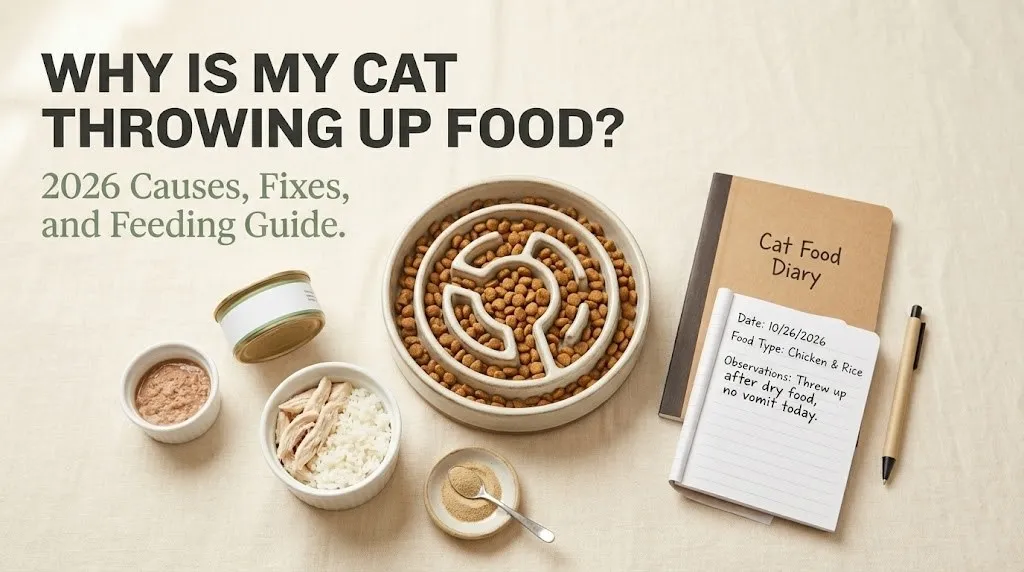
Here are the most common causes ranked by how frequently they appear in veterinary practice:
| Cause | Typical Vomit Appearance | Pattern |
|---|---|---|
| Eating too fast (gorging) | Undigested food, tubular shape, minutes after eating | Immediate after meals |
| Food allergy or intolerance | Partially digested food, hours after eating | Chronic, intermittent |
| Hairballs | Cylindrical wad of fur with small amount of fluid | Every 1-4 weeks |
| Sudden diet change | Undigested or partially digested | Starts within days of new food |
| Inflammatory bowel disease | Variable, often with bile | Chronic, progressive |
| Chronic kidney disease | Clear or foamy liquid, often on empty stomach | Worse in morning |
| Hyperthyroidism | Food mixed with digestive fluids | Increased appetite but vomiting |
| Pancreatitis | Yellow bile, frothy, food mixed with fluid | Acute onset, painful |
| Intestinal parasites | Food mixed with mucus, possibly worms visible | Intermittent |
A cat who vomits once and then acts completely normal, eating, playing, using the litter box, may have simply eaten too fast or had a minor dietary indiscretion. A cat who vomits repeatedly, cannot keep water down, is lethargic, hiding, or has stopped eating needs veterinary attention within hours.
Breed, age, and health status matter. Siamese cats and related breeds have a higher genetic predisposition to food allergies and inflammatory bowel disease. Senior cats over age 10 are more likely to have hyperthyroidism or chronic kidney disease as an underlying cause. Long-haired breeds like Persians and Maine Coons are more prone to hairball-related vomiting. A young, otherwise healthy cat with sudden vomiting is more likely to have eaten something inappropriate or have parasites.
Key Takeaway: Occasional vomiting in an otherwise healthy cat is usually behavioral or dietary. Vomiting more than once a week, vomiting that prevents keeping food down, or vomiting with weight loss requires a veterinary visit.
Cat Vomiting vs Regurgitation
Vomiting involves active abdominal heaving and produces partially digested food mixed with bile, while regurgitation is a passive event where undigested food is expelled in a tubular shape minutes after eating with no warning signs or abdominal effort.
Knowing the difference between vomiting and regurgitation narrows down the possible causes and saves you and your veterinarian time. The two processes look different, feel different to the cat, and point toward different problems.
Vomiting is an active process. The cat becomes restless, may drool or lick its lips, and then heaves several times with strong abdominal contractions before expelling stomach contents. The material is partially digested, mixed with yellow or green bile, and has a sour odor. Vomiting originates in the stomach or upper small intestine and is controlled by the vomiting center in the brainstem. Causes include stomach irritation, systemic illness, toxins, and motion sickness.
Regurgitation is a passive process. The cat lowers its head, and food slides back up the esophagus and out the mouth with no warning and no abdominal effort. The material is undigested, often still in the shape of the esophagus, covered in mucus, and has no bile or sour odor. Regurgitation originates in the esophagus and is caused by eating too fast, esophageal narrowing or inflammation, or a condition called megaesophagus where the esophageal muscles do not move food properly.
Here is the direct comparison:
| Feature | Vomiting | Regurgitation |
|---|---|---|
| Warning signs | Nausea, drooling, lip licking, restlessness | None |
| Abdominal effort | Strong heaving and contractions | None |
| Timing | Minutes to hours after eating | Minutes after eating |
| Food appearance | Partially digested, mixed with bile | Undigested, tubular, may have mucus |
| Odor | Sour, stomach acid smell | Mild, food-like |
| Cat’s demeanor | Seems uncomfortable before | Acts normal before and after |
| Primary causes | Stomach/intestine irritation, illness | Eating too fast, esophageal issues |
If your cat is regurgitating rather than vomiting, the fix is often behavioral. Smaller, more frequent meals. A slow feeder bowl. Elevating the food dish. If regurgitation persists despite these changes, esophageal disease needs to be ruled out by a veterinarian.
Quick Tip:
- Record a video of the episode on your phone. Your veterinarian can distinguish vomiting from regurgitation in seconds from a video, but your verbal description may be ambiguous. This single piece of data often shortens the diagnostic process.
Why Does My Cat Throw Up Right After Eating
A cat who vomits undigested food immediately after eating is most likely eating too fast, a behavior called gorging or bolting that is especially common in multi-cat households where competition for food triggers rapid consumption.
Cats who bolt their food swallow air along with kibble. The stomach distends rapidly. The stretch receptors in the stomach wall send signals back to the brainstem that trigger the vomiting reflex. The food comes back up within minutes, looking almost exactly as it did in the bowl. The cat often tries to eat it again immediately, which is a distinctive feature of regurgitation from rapid eating rather than illness-related vomiting.
Multi-cat households are the most common setting for this problem. Even cats who get along well may feel an instinctive pressure to eat quickly before another cat finishes their own meal and investigates the neighbor’s bowl. The competition does not have to be aggressive. The mere presence of another cat within sight during meals can trigger faster eating.
Dry kibble is more commonly associated with post-eating regurgitation than wet food. Dry food expands when it absorbs liquid in the stomach. A cat who swallows a mouthful of dry kibble whole, without crunching it, may find that the food swells significantly in the stomach, triggering distension and regurgitation.
The fix for immediate post-eating vomiting is usually straightforward:
- Feed smaller meals more frequently. Instead of two large meals, offer four to five small meals throughout the day. Automatic timed feeders make this practical even for people who work outside the home.
- Use a slow feeder bowl or puzzle feeder. These devices have ridges, mazes, or compartments that force the cat to eat around obstacles. This slows consumption from seconds to minutes and reduces air swallowing.
- Feed cats in separate rooms if competition is driving the behavior. A closed door removes the visual trigger of another cat.
- Slightly elevate the food bowl so the cat does not have to crouch low to eat. This reduces the angle between the mouth and the stomach.
- Moisten dry food with warm water and let it sit for five minutes before serving. Pre-expanded kibble does not swell further in the stomach.
Key Takeaway: A cat who vomits whole food right after meals and then acts completely normal usually just needs slower eating, not a medical workup. Start with a slow feeder bowl before making dietary changes.
Eating Too Fast Causing Cat Vomiting
Eating too fast is the single most common cause of food-related vomiting in otherwise healthy cats, and it is solved with feeding strategy changes rather than medical treatment or expensive food trials.
Cats did not evolve to eat from a bowl filled with a day’s worth of calories. Their wild ancestors ate multiple small prey animals throughout the day, chewing through fur, bone, and tissue in a process that took time. A bowl of kibble can be consumed in under 60 seconds. The cat’s digestive system, designed for small, frequent, time-consuming meals, receives a large volume of dry, unchewed food all at once.
Wet food slows some cats down because it requires lapping rather than scooping, but determined eaters can finish a can of pate in under a minute. The speed, not the food type, is the primary problem.
Slow feeder bowls are the most effective single intervention. A 2022 study in the Journal of Feline Medicine and Surgery found that puzzle feeders and slow feeder bowls increased meal duration from an average of 40 seconds to over 5 minutes in domestic cats. The study also noted reduced vomiting frequency in cats who previously regurgitated meals.
Types of slow feeders ranked by effectiveness:
- Maze-style slow feeders with deep ridges force the cat to extract food with a paw or work it around corners with the tongue. Most effective, most frustrating for the cat initially.
- Timed automatic feeders that dispense small amounts on a schedule eliminate the competition trigger and prevent gorging even when the owner is not home.
- Food-dispensing balls and puzzles combine feeding with enrichment. The cat bats the toy around and kibble falls out a few pieces at a time.
- Lick mats for wet food spread pate or minced food into a textured silicone mat that the cat must lick clean over 10 to 15 minutes.
If a slow feeder does not solve the problem, the cause is likely not eating speed. Move on to investigating food sensitivities, esophageal issues, or underlying medical causes.
Dietary Sensitivity Note: In multi-cat households, a slow feeder for one cat does not help if another cat eats from the same bowl. Feed cats in separate rooms or use microchip-activated feeders that only open for the designated cat.
Cat Food Allergies and Vomiting
Food allergies cause chronic vomiting in cats when the immune system reacts to a specific protein source, most commonly beef, fish, chicken, or dairy, and the solution is identifying and eliminating the trigger protein through a strict elimination diet trial.
Food allergies in cats are less common than pet food marketing suggests, but they are real. The Cornell Feline Health Center estimates that food allergies account for approximately 10 to 15 percent of allergic skin and gastrointestinal conditions in cats. The symptoms are typically a combination of skin problems (itching, overgrooming, skin lesions) and digestive problems (vomiting, diarrhea, frequent hairballs).
A cat is not born with food allergies. They develop over time with repeated exposure to a protein. The most common allergens are the proteins cats eat most frequently. Beef, fish, chicken, and dairy top the list. This is why switching from a chicken-based food to a salmon-based food may help temporarily but often results in the cat developing a new allergy to fish protein within months.
Here is how food allergies present compared to other causes of vomiting:
| Feature | Food Allergy | Food Intolerance | Inflammatory Bowel Disease |
|---|---|---|---|
| Onset | Gradual, after months or years on same food | Variable | Gradual, progressive |
| Skin symptoms | Often present (itching, overgrooming) | Rare | Sometimes present |
| Vomiting pattern | Intermittent, often hours after eating | Dose-dependent, worse with more of trigger food | Chronic, can be daily |
| Response to fasting | Improves with complete food withholding | Improves when trigger food removed | May persist even when not eating |
| Diagnosis | Elimination diet trial (8-12 weeks) | Elimination and rechallenge | Biopsy required |
The only valid diagnostic test for food allergies is a strict elimination diet trial lasting 8 to 12 weeks. Blood tests and saliva tests marketed for food allergy diagnosis are not considered reliable by board-certified veterinary nutritionists. During the trial, the cat eats only a single novel protein (a protein it has never eaten before, such as rabbit, venison, or duck) or a hydrolyzed protein diet (prescription food where proteins are broken into fragments too small to trigger an immune response). Nothing else passes the cat’s lips, no treats, no flavored medications, no table scraps.
If the vomiting resolves during the trial and returns when the original food is reintroduced, the diagnosis is confirmed. A veterinarian must supervise this process. Do not attempt a nutritionally incomplete homemade elimination diet without guidance from a veterinary nutritionist.
Dry Food vs Wet Food and Cat Vomiting
Dry cat food is more commonly associated with regurgitation from eating too fast and from kibble expanding in the stomach, while wet food is more commonly associated with vomiting from food sensitivity or digestive disease, but neither type inherently causes or prevents vomiting.
The dry versus wet food debate is one of the most persistent arguments in cat nutrition. For vomiting specifically, each type has different mechanisms that can trigger episodes in susceptible cats.
Dry food risks for vomiting:
- Rapid consumption because kibble is easy to scoop and swallow without chewing
- Expansion in the stomach as dry food absorbs liquid, causing distension and regurgitation
- Lower moisture content (approximately 10 percent vs 78 percent in wet food) contributes to chronic mild dehydration, which can concentrate stomach acid and irritate the gastric lining
- Higher carbohydrate content compared to wet food, which some cats digest less efficiently
Wet food risks for vomiting:
- Some cats eat wet food nearly as fast as dry food, especially pate textures
- Spoils quickly at room temperature; a cat who grazes on wet food left out for hours risks bacterial overgrowth and foodborne vomiting
- Fish-based wet foods are a common allergen trigger
- Higher fat content in some wet foods can trigger pancreatitis flare-ups in susceptible cats
The moisture difference matters for cats with chronic vomiting. Cats evolved as desert animals with a low thirst drive. They are designed to get most of their water from food. A cat eating only dry food lives in a state of mild chronic dehydration unless it drinks significant amounts of water from a bowl or fountain. Dehydrated stomach lining is more susceptible to irritation. Switching a chronically vomiting cat from dry to wet food or adding water to dry food improves hydration status and may reduce vomiting frequency.
For the specific problem of post-eating regurgitation, food type matters less than eating speed. A cat who bolts dry food will also bolt wet food. The slow feeder or puzzle feeder is the intervention, not switching from dry to wet.
Dietary Sensitivity Note: Cats with chronic kidney disease benefit from the higher moisture content of wet food. Cats with dental disease may find wet food easier to eat. These health conditions often coexist with vomiting in senior cats. A veterinarian can help determine whether wet or dry food is more appropriate for a specific cat’s overall health picture.
Key Takeaway: Dry food is more likely to cause regurgitation from speed and expansion. Wet food supports hydration. The best food for a vomiting cat is one eaten slowly, tolerated well, and part of a nutritionally complete diet appropriate for the cat’s life stage and health status.
Why Does My Cat Vomit Undigested Food Hours After Eating
Vomiting undigested or partially digested food hours after a meal suggests delayed stomach emptying, food sensitivity, or mild gastric irritation rather than the immediate regurgitation seen with eating too fast.
When food sits in a healthy cat’s stomach, it mixes with stomach acid and digestive enzymes and begins breaking down within 30 to 60 minutes. Food that comes up one to four hours after eating and is still recognizable, though partially broken down, indicates that the stomach did not process and pass the meal normally.
Delayed gastric emptying has several causes. Hairballs in the stomach can partially obstruct the outlet, causing food to sit and eventually come back up. Inflammatory bowel disease thickens the stomach and intestinal walls, slowing motility. Foreign bodies like string, fabric, or hair ties can create partial blockages that delay stomach emptying without causing complete obstruction. Chronic kidney disease causes uremic toxins to build up in the blood, which irritates the stomach lining and slows gastric emptying.
The distinction between vomiting hours after eating and regurgitating immediately after eating is important for your veterinarian. A cat who regurgitates whole food within minutes of meals and is otherwise thriving probably has a behavioral or esophageal issue. A cat who vomits partially digested food hours later, especially if this is happening more than once a week, needs medical investigation.
Steps to take while working with your veterinarian:
- Note the exact timing between meals and vomiting episodes. A food diary helps establish patterns.
- Feed the last meal of the day later in the evening. Some cats vomit overnight because their stomach is empty for too long, and acid builds up.
- Try smaller, more frequent meals rather than two large meals. A stomach that receives small amounts throughout the day empties more efficiently than one that receives a large volume twice daily.
- Slightly warm wet food to body temperature before serving. Cold food can slow gastric emptying.
Dietary Sensitivity Note: If your veterinarian diagnoses delayed gastric emptying, they may recommend a low-fat, highly digestible therapeutic diet. Fat slows stomach emptying. A low-fat diet moves through the stomach faster and reduces the chance of vomiting hours later.
Cat Can’t Keep Food or Water Down
A cat who cannot keep any food or water down for more than 12 hours needs emergency veterinary care because repeated vomiting prevents hydration and can signal a serious condition like an intestinal blockage, severe pancreatitis, or toxin ingestion.
This is the point where home management stops and professional care becomes non-negotiable. A cat who vomits every meal and every drink of water is losing fluids faster than they can be replaced. Cats dehydrate quickly. A cat who has not kept water down for 12 hours is already dehydrated. A cat who has not kept water down for 24 hours may be in a crisis.
Warning signs that require an emergency vet visit:
- Vomiting all food and water for more than 12 hours
- Vomit containing blood (red streaks or coffee-ground appearance)
- Lethargy, hiding, or collapse
- Abdominal pain (crying when picked up, hunched posture, resisting touch to the belly)
- Vomiting along with constipation or straining in the litter box (possible blockage)
- Known or suspected ingestion of string, thread, ribbon, or toxic foods (onions, garlic, lilies)
- Pale or yellow gums (check by gently lifting the lip)
- Dehydration signs: skin tent test (pinch the skin between the shoulder blades; it should snap back immediately; if it stays tented, the cat is dehydrated)
Intestinal blockage is the most urgent concern. Cats swallow non-food items with alarming frequency. String, thread, hair ties, rubber bands, and pieces of toys can lodge in the intestine and create a partial or complete obstruction. Food and water cannot pass. The body’s only option is to send it back up. Surgery is often required.
Toxin ingestion is another emergency. Common household foods toxic to cats include onions, garlic, chives, chocolate, grapes, raisins, and anything containing xylitol. Lilies are catastrophically toxic to cats; even a small amount of pollen can cause acute kidney failure. A cat vomiting after suspected lily exposure needs emergency treatment immediately, not in the morning.
Do not give over-the-counter human anti-nausea medications to a cat without explicit veterinary instruction. Many are toxic. Do not withhold water hoping the vomiting will stop. A cat who cannot keep water down is already in a dangerous spiral and needs IV or subcutaneous fluids from a veterinarian.
When to See a Vet for Cat Vomiting
A single episode of vomiting in an otherwise normal cat can be monitored at home, but vomiting that occurs more than once a week, persists for more than three weeks, prevents keeping food or water down, or is accompanied by weight loss, lethargy, or other symptoms requires a veterinary visit.
The decision to go to the vet is stressful because you do not want to overreact and spend hundreds of dollars on a cat who ate too fast, and you do not want to underreact and miss something serious. This decision framework helps sort urgency levels.
Immediate emergency vet: Cat cannot keep water down for 12 hours, blood in vomit, known toxin ingestion, severe lethargy or collapse, abdominal distension or pain, pale gums, suspected blockage.
Vet visit within 24 to 48 hours: Vomiting more than twice in one week, vomiting persisting for more than three weeks, weight loss, increased thirst or urination (possible kidney disease or hyperthyroidism), change in appetite, vomiting accompanied by diarrhea, senior cat with new onset vomiting.
Monitor at home: Single vomiting episode, cat acts normal immediately after, eating and drinking normally, no other symptoms, suspected cause is eating too fast (undigested food, right after meal, cat tries to eat it again).
Chronic vomiting in senior cats deserves particular attention. Hyperthyroidism and chronic kidney disease are common in cats over age 10 and often present with vomiting as an early sign. A senior cat who has always been a “pukey cat” should not be dismissed as normal. The American Association of Feline Practitioners recommends senior cats (age 10 and older) receive blood work every 6 to 12 months, and unexplained vomiting is a reason to move that timeline up.
What to bring to the vet appointment:
- A detailed food diary covering at least one week (what was eaten, when, when vomiting occurred)
- Photos or videos of vomit episodes
- A sample of fresh vomit in a sealed bag if possible
- The packaging or ingredient list from all foods, treats, and supplements the cat eats
- A list of any medications, including flea and tick preventatives
Key Takeaway: The threshold for a vet visit is vomiting more than once a week or any vomiting with other symptoms. A single episode in a happy, hungry cat is usually benign. Trust your gut. You know your cat better than any checklist.
How to Stop a Cat From Throwing Up After Eating
Stop a cat from throwing up after eating by first using a slow feeder to rule out eating speed, then feeding smaller and more frequent meals, switching to a highly digestible food, and keeping a food diary to identify patterns and triggers.
This is the practical, step-by-step protocol to work through before assuming a medical problem. Most cats who vomit after eating do so because of eating speed, meal size, or food sensitivity. These are fixable at home.
Step 1: Change how you feed, not what you feed.
Use a slow feeder bowl or puzzle feeder immediately. This costs under 15 dollars and often solves the problem within one meal. If the cat vomits only after dry food, try the slow feeder with dry food. If vomiting occurs with wet food, spread it on a lick mat. Give this intervention three to four days. If vomiting stops, the problem was eating speed.
Step 2: Change meal frequency and size.
If the slow feeder does not eliminate vomiting, keep it but also split the daily food allotment into four to five small meals instead of two large ones. A cat’s stomach is roughly the size of a ping pong ball. A half-cup of kibble in a single meal stretches it past comfort.
Step 3: Evaluate the food itself.
If vomiting persists through steps 1 and 2, the food may be the trigger. Start a food diary. Record the brand, protein source, when the cat eats, and when vomiting occurs. Look for patterns. Does vomiting happen within an hour of every chicken-based meal but not fish-based? Does a specific brand consistently cause problems regardless of flavor?
Step 4: Try a limited ingredient diet or highly digestible food.
If patterns are unclear, switch to a food with a single protein source the cat has never eaten before (novel protein) or a veterinary therapeutic gastrointestinal diet designed for easy digestibility. Make this transition over 7 to 10 days to avoid a food change itself triggering vomiting.
Step 5: Add a probiotic.
Feline-specific probiotics like FortiFlora contain beneficial bacteria that support gut health and may reduce vomiting in cats with mild gastrointestinal imbalances. Sprinkle on food once daily.
Step 6: Vet visit.
If vomiting persists through all five steps over a 2 to 3-week period, schedule a veterinary appointment. Bring the food diary. The data you have collected will accelerate the diagnostic process significantly.
Quick Tip:
- Do not change multiple variables at once. If you switch to a slow feeder, a new food, and add a probiotic all on the same day and the vomiting stops, you will not know which intervention worked and will not know what to do if vomiting returns.
Best Food for Cats That Vomit Frequently
The best food for a cat that vomits frequently is a highly digestible, limited ingredient diet with a single novel animal protein or a veterinary therapeutic gastrointestinal formula, fed in small, frequent meals at a consistency the cat tolerates well.
There is no single best food for all vomiting cats because the underlying cause differs. A cat with food allergies needs a novel protein or hydrolyzed protein diet. A cat with inflammatory bowel disease needs a highly digestible, often prescription, gastrointestinal diet. A cat with kidney disease needs a therapeutic renal diet that reduces phosphorus and protein load. A cat who eats too fast needs a slow feeder, not a food change.
That said, several characteristics make a food more suitable for a vomiting-prone cat:
High digestibility: Foods with protein sources that are highly bioavailable and carbohydrates that are easily broken down produce less gastric residue and empty from the stomach faster. Look for foods where the first ingredients are named animal proteins (chicken, turkey, salmon) rather than meat by-products or plant proteins.
Low to moderate fat: Fat delays gastric emptying. A food with 10 to 15 percent fat on a dry matter basis (check the guaranteed analysis and convert) empties faster than a high-fat food with 20 percent or more. Cats with pancreatitis especially need fat restriction.
Limited ingredients: Fewer ingredients mean fewer potential triggers. A food with one protein source and one carbohydrate source is easier to troubleshoot than a food with a long ingredient list. If vomiting stops on a limited ingredient diet, you have clear information about what works.
Moisture content: Wet food supports hydration, which protects the stomach lining and aids digestion. If the cat will only eat dry food, add warm water and let it soak for five minutes before serving.
Here is a framework for choosing a food based on the suspected cause:
| Suspected Cause | Food Type to Try | Example Characteristics |
|---|---|---|
| Food allergy | Novel protein (rabbit, venison, duck) or hydrolyzed protein | Single protein source cat has never eaten |
| Eating too fast | No food change needed | Keep current food, use slow feeder |
| Inflammatory bowel disease | Veterinary GI therapeutic diet | Highly digestible, often prescription |
| Kidney disease | Veterinary renal therapeutic diet | Reduced phosphorus, controlled protein |
| Pancreatitis | Low-fat veterinary diet | Less than 15% fat on dry matter basis |
| General sensitivity | Limited ingredient, highly digestible | One protein, one carb, no fillers |
A board-certified veterinary nutritionist is the best resource for cats with complex or chronic vomiting that has not responded to basic food changes. Your regular veterinarian can provide a referral. Do not formulate a homemade diet without professional guidance. Nutritional deficiencies develop over months and can be severe before symptoms appear.
Bland Diet for Vomiting Cat
A bland diet for a vomiting cat consists of a simple, highly digestible protein and carbohydrate fed in small amounts for 24 to 48 hours to rest the digestive system, with boiled skinless chicken breast and plain white rice being the most commonly recommended combination.
A bland diet is a short-term intervention, not a long-term feeding solution. It is nutritionally incomplete and should only be fed for 24 to 48 hours without veterinary supervision. Its purpose is to give the stomach and intestines a break while still providing calories and hydration.
The standard homemade bland diet recipe:
- 1 part boiled, skinless, boneless chicken breast, shredded finely
- 2 parts plain white rice, cooked until very soft
- No salt, no oil, no seasonings
To prepare:
- Boil the chicken breast in plain water until fully cooked (internal temperature of 165 degrees Fahrenheit).
- Remove the chicken and cook the rice in the same water to capture flavor.
- Shred the chicken into very fine pieces. Cats with upset stomachs may struggle with large chunks.
- Mix one part chicken with two parts rice by volume.
- Serve at room temperature or slightly warm. Cold food can worsen gastric irritation.
Feed small amounts frequently. Start with a tablespoon of the bland mixture. If the cat keeps it down for two hours, offer another tablespoon. If that stays down, offer a slightly larger amount two to three hours later. The goal is small, frequent feedings that do not overfill the stomach.
Alternatives to chicken and rice for cats with known chicken allergies:
- Boiled white fish (cod, tilapia) with rice
- Plain pureed pumpkin (not pumpkin pie filling) can be added for fiber
- Commercially prepared veterinary bland diets (Hills i/d, Royal Canin Gastrointestinal) are nutritionally complete and preferable if the cat will eat them
A cat who cannot keep a bland diet down, or who continues vomiting after 24 hours on a bland diet, needs to see a veterinarian. Do not continue a bland diet beyond 48 hours without professional guidance. Cats require specific amino acids like taurine that are present in complete cat foods but not in simple chicken and rice.
Dietary Sensitivity Note: Never feed a cat onions, garlic, chives, or seasoned chicken. These are toxic to cats. The bland diet must be completely unseasoned. Never add butter, oil, or salt.
How to Transition Cat Food Without Vomiting
Transition a cat to a new food over 7 to 10 days by gradually increasing the proportion of new food while decreasing the old, starting with 10 percent new food on days 1 to 3 and reaching 100 percent new food by day 10, with slower transitions for cats with known digestive sensitivity.
Sudden food changes are one of the most common triggers for vomiting and diarrhea in cats. The digestive system adapts to the specific protein, fat, carbohydrate, and fiber profile of a consistent food. The bacterial populations in the gut shift to match the substrates they receive. A sudden switch overwhelms this adaptation.
The standard 7 to 10-day transition schedule:
| Days | Old Food | New Food |
|---|---|---|
| 1-3 | 90% | 10% |
| 4-5 | 75% | 25% |
| 6-7 | 50% | 50% |
| 8-9 | 25% | 75% |
| 10 | 0% | 100% |
Cats with known food sensitivities or a history of vomiting during previous transitions should extend this timeline. A 14 to 21-day transition with smaller increments (5 percent new food increases every 2 to 3 days) may be necessary.
If vomiting occurs during the transition:
- Drop back to the previous ratio that was tolerated for two to three days before attempting to increase again.
- If vomiting recurs at the same transition point, the new food may not agree with the cat regardless of transition speed.
- Transitioning from dry to wet food or vice versa is a bigger digestive adjustment than switching within the same food type. Extend the timeline.
- Adding a feline probiotic during a food transition supports the gut microbiome shift and may reduce vomiting.
Cats who vomit during every food transition regardless of the food type or transition speed may have an underlying condition like inflammatory bowel disease that requires veterinary diagnosis and management before dietary changes can be successful.
Dietary Sensitivity Note: For cats with diagnosed food allergies transitioning to a novel protein or hydrolyzed diet, the transition must be even more gradual because the new food is the diagnostic tool. Vomiting during the transition confuses the clinical picture. Work with your veterinarian on the transition timeline.
Cat Vomiting Yellow Bile After Eating
A cat vomiting yellow bile after eating has an empty stomach that filled with bile during the fasting period, and the food triggered a vomiting reflex before the bile could be reabsorbed, often signaling that the cat needs more frequent meals or has an underlying condition causing excess bile production.
Yellow bile vomiting is most common in cats fed once or twice daily. During the long gap between meals, the stomach empties completely. Bile from the small intestine can reflux into the empty stomach, where it irritates the gastric lining because there is no food to buffer it. When the cat finally eats, the stomach contracts to process the food, and the bile comes up along with it.
The fix may be as simple as adding a small meal before bed. Cats are naturally crepuscular, active at dawn and dusk. Their digestive system is designed for multiple small meals throughout a 24-hour cycle. A cat who eats dinner at 6 PM and does not eat again until 7 AM has a 13-hour fasting window. Bile builds up. Morning vomiting of yellow foam or bile with some food is the result.
To reduce bile vomiting:
- Add a small meal or snack right before bed (even a tablespoon of wet food or a few pieces of kibble)
- Use an automatic timed feeder to dispense a small amount of food in the middle of the night
- Feed a minimum of three meals per day instead of two
- Feed a small amount first thing in the morning to buffer stomach acid before the main breakfast
If these feeding frequency changes do not reduce bile vomiting within a week, the problem may be excess bile production or poor gastric motility rather than an empty stomach. Conditions that increase bile vomiting include inflammatory bowel disease, pancreatitis, and liver disease. A cat who vomits yellow bile more than once a week despite frequent small meals needs blood work and possibly abdominal imaging.
Dietary Sensitivity Note: Cats with bile vomiting should not be fasted for veterinary procedures without discussing the vomiting history with the veterinarian first. Extended fasting can worsen the cycle of bile reflux and vomiting in these cats.
Key Takeaway: Yellow bile vomiting in the morning or right before a meal often responds to adding a bedtime snack. If more frequent meals do not stop the bile vomiting, veterinary diagnostics are the next step.
Cat Vomiting Food Diary and Trigger Tracking
A food diary that records everything the cat eats, the time of each meal, and every vomiting episode with vomit description helps identify patterns and triggers that are invisible in day-to-day memory and accelerates veterinary diagnosis.
The food diary is the most powerful diagnostic tool you have at home. A cat who vomits sporadically may seem to do so randomly. Writing down every data point reveals patterns: vomiting always within an hour of the chicken-based dry food but never the fish-based wet food. Vomiting only on weekdays when meals are more rushed. Vomiting only after the evening meal when a specific treat was given.
Here is what to track in a cat vomiting food diary:
| Data Point | What to Record |
|---|---|
| Date and time | When the cat ate and when vomiting occurred |
| Food offered | Brand, flavor, protein source, wet or dry |
| Amount eaten | Approximate volume (ate all, ate half, nibbled) |
| Vomit description | Undigested or digested, color, presence of bile, hair, or foreign material |
| Time from eating to vomiting | Immediately, within 30 minutes, 1-2 hours, several hours |
| Cat’s behavior before | Normal, restless, drooling, lip licking |
| Cat’s behavior after | Normal, hungry, lethargic, hiding |
| Other notes | Stressors, visitors, weather, other pets, medication given |
A one-week diary is the minimum. Two weeks is better. A month of data gives your veterinarian a clear picture of frequency, patterns, and triggers that a verbal history cannot provide.
The diary also tracks whether the cat is keeping enough food down to maintain weight. If the cat vomits once a week but eats well otherwise and weight is stable, the urgency is lower than a cat who vomits every other day and is losing weight despite eating.
Use a notebook, a notes app on your phone, or a printed template. The format matters less than consistency. Record every meal and every vomit episode without skipping. Memory fails. Data does not.
Dietary Sensitivity Note: When you bring the food diary to a veterinary appointment, also bring photos of the ingredient panels from every food, treat, and supplement the cat receives. A cat with suspected food allergies needs a complete inventory of every protein and ingredient consumed.
Frequently Asked Questions About Cats Throwing Up Food
Should I feed my cat after vomiting?
Wait 2 to 4 hours after a vomiting episode before offering food to let the stomach settle.
Then offer a small amount of bland food, about a tablespoon, and see if the cat keeps it down.
If the cat can keep small amounts down, gradually return to normal feeding over 24 hours. If vomiting recurs, contact your veterinarian.
How do I know if my cat is vomiting or regurgitating?
Vomiting involves active heaving, abdominal contractions, and partially digested food mixed with bile.
Regurgitation is passive, with no warning, and produces undigested food in a tubular shape minutes after eating with no bile present.
Recording a video of the episode helps your veterinarian distinguish between the two immediately.
Can switching cat food cause vomiting?
Yes, sudden food changes commonly cause vomiting and diarrhea because the digestive system needs time to adapt to new protein, fat, and fiber profiles.
Always transition to a new food over 7 to 10 days by gradually increasing the proportion of new food.
If vomiting occurs at any point, slow the transition and give the cat’s digestive system more time to adjust.
What is the best food for a cat that vomits often?
The best food depends on the underlying cause of vomiting.
A highly digestible, limited ingredient diet with a single novel protein works for food sensitivities.
A veterinary therapeutic gastrointestinal diet is appropriate for inflammatory bowel disease. A cat who eats too fast may not need a food change at all, just a slow feeder bowl.
When is cat vomiting an emergency?
Cat vomiting is an emergency when the cat cannot keep water down for more than 12 hours, vomit contains blood, the cat is lethargic or in visible pain, or you suspect toxin ingestion or intestinal blockage.
Repeated vomiting with dehydration, pale gums, or collapse requires immediate veterinary care.
A single vomiting episode in an otherwise normal cat can be monitored at home.
A cat throwing up food occasionally is usually not a crisis. A cat throwing up food repeatedly is a problem you can solve, but you need a system. Start with the simplest fix: a slow feeder bowl and smaller, more frequent meals. If that does not work, start a food diary and look for patterns. If patterns point to a specific food or protein, try a limited ingredient diet with a novel protein. If none of this reduces the vomiting within two to three weeks, your veterinarian needs to see the cat and see your food diary.
Cats are masters at hiding illness, and vomiting is one of the few visible signals they cannot conceal. A cat who vomits once a month is probably fine. A cat who vomits twice a week is telling you something. Listen to that signal early, before weight loss and dehydration complicate the picture, and you will have a healthier cat and a less expensive veterinary journey.