
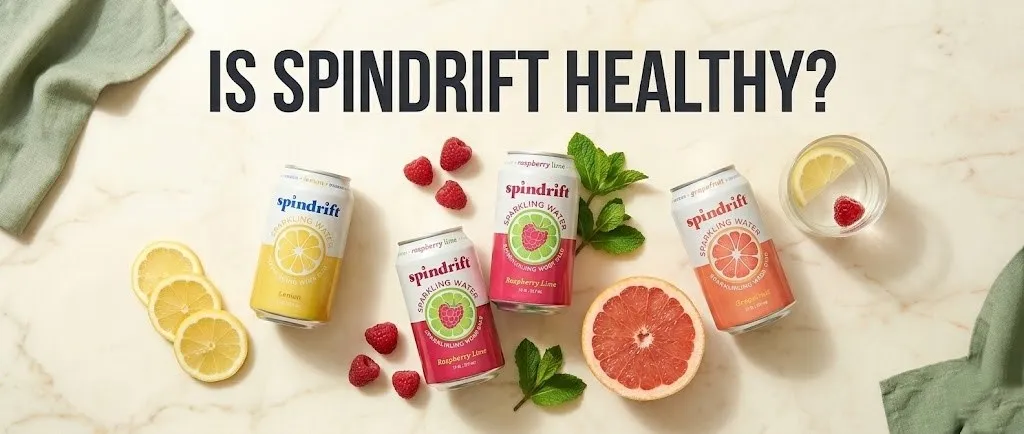
Spindrift is a healthy choice for a flavored sparkling water because it uses real squeezed fruit juice and fruit purée instead of the synthetic “natural flavors” that dominate the rest of the sparkling water aisle. A can of Spindrift Lemon contains carbonated water, lemon juice, and nothing else. The absence of artificial sweeteners, preservatives, and vague natural flavor compounds places it at the top of the sparkling water hierarchy, closer to homemade spa water than to a laboratory-formulated soda alternative.
The nutritional difference between Spindrift and other sparkling waters is small on a spreadsheet but massive in principle. A can of Spindrift contains roughly 3 to 15 calories and 0 to 3 grams of naturally occurring sugar from fruit. A can of a standard “naturally flavored” sparkling water contains zero calories and zero sugar because it uses isolated aroma compounds with no nutritional substance. Spindrift’s argument is that real food ingredients, even in tiny amounts, matter.
This guide examines the full nutritional picture of Spindrift in 2026. We will dissect the sugar content, the specific impact on dental enamel, the metabolic response to the real fruit juice, and how it stacks up against LaCroix, diet soda, and plain water. You will leave knowing whether Spindrift belongs in your daily hydration routine or if it is an occasional treat dressed up as wellness.
is spindrift healthy
Spindrift is healthy in the context of flavored beverages, offering hydration with a negligible calorie load and genuine fruit ingredients, but it is not a health product. It is a better version of a treat. The real fruit juice sets it apart from the competition, but it also introduces small amounts of sugar and fruit acids that plain water and artificially flavored seltzers avoid.
The health advantage of Spindrift is ingredient transparency. The label on a Raspberry Lime Spindrift lists carbonated water, raspberry purée, lime juice. There are three ingredients, all of which you can buy in a grocery store. This is in stark contrast to a standard “natural flavor” seltzer, where the flavor may be derived from natural sources but undergoes chemical processing to isolate specific aroma compounds. Spindrift’s ingredient list reflects a food philosophy, not just a nutritional profile.
The health disadvantage is the acidity. The addition of citrus juice drops the pH of the beverage. Any beverage with a pH below 5.5 can begin to erode dental enamel. Spindrift’s lemon and grapefruit flavors are the most acidic. This does not make Spindrift worse than soda or fruit juice. It just means Spindrift shares a category with all acidic beverages, including plain sparkling water, and should be consumed with the same awareness of dental health.
| Health Attribute | Spindrift Status |
|---|---|
| Calories | Very low (3 to 15 per can) |
| Added Sugar | Zero (FDA regulated) |
| Artificial Sweeteners | Zero |
| Artificial Flavors | Zero |
| Acidity | Present (citrus acid) |
| Nutrient Contribution | Trace vitamin C and polyphenols |
are spindrifts healthy
Spindrifts are a healthy replacement for soda and sugary juice drinks, but they are not a nutritional supplement and should not replace plain water or whole fruits in your diet. The plural “spindrifts” reflects how people actually consume them, multiple cans per day, stacked in the fridge. The question is whether a multi-can Spindrift habit remains healthy.
Drinking three or four Spindrifts a day is significantly healthier than drinking three or four sodas. It is slightly more acidic than drinking three or four glasses of plain water. The cumulative effect of the acid on dental enamel is the primary concern with high-volume consumption. The sugar content, even at 3 grams per can, adds up to 9 to 12 grams of sugar across four cans, which is still less than a single can of Coke at 39 grams.
The fruit purée in Spindrift provides a psychological benefit that has real dietary consequences. The subtle flavor and color of real raspberry purée satisfies the sensory craving for fruit that might otherwise send someone to a high-sugar smoothie or a pastry. Spindrift is a harm-reduction tool. If it replaces worse choices, the health verdict is overwhelmingly positive, even with the dental caveat.
- Replaces soda: Positive net health effect.
- Replaces plain water: Negative net effect due to acidity.
- Consumed with meals: Low risk, saliva neutralizes acid.
- Consumed as all-day sipping: Higher dental erosion risk.
Key Takeaway: A daily Spindrift habit is healthy if it replaces soda. It is a minor risk if it replaces plain water.
is spindrift sparkling water healthy
Spindrift sparkling water is healthy compared to other flavored beverages because its primary ingredient is carbonated water and its only flavoring agents are real, unprocessed fruit juices and purées. The sparkling water category is generally considered healthy because it offers sugar-free hydration without artificial sweeteners. Spindrift advances this category by replacing synthetic “natural flavors” with actual food.
The inclusion of real fruit means Spindrift contains compounds absent from other sparkling waters. Citrus-based Spindrift flavors contain hesperidin and naringenin, flavonoids found in orange and grapefruit juice. These compounds have documented anti-inflammatory and vascular-protective effects in clinical research. The amount in a can of Spindrift is small, likely a few milligrams at most, but it is not zero. A can of LaCroix contains exactly zero milligrams of these compounds because they are not present in the isolated aroma chemicals used for flavoring.
Carbonation itself is not a health concern for most people. The carbon dioxide dissolved in water forms carbonic acid, which is a weak acid that the body readily buffers. The carbonation does not leach calcium from bones or cause kidney stones, two persistent myths that research from the Harvard T.H. Chan School of Public Health has repeatedly debunked. The only verified health consideration with carbonated water is the direct contact with dental enamel, which applies to all sparkling beverages, not just Spindrift.
- Carbonated water: Safe, no bone or kidney effects.
- Real fruit juice: Provides trace phytonutrients.
- Natural flavors: Zero, and this is the point.
- Dental risk: Present, as with all carbonated drinks.
is spindrift good for you
Spindrift is good for you in the sense that it moves your beverage choices closer to whole foods and further from synthetic, ultra-processed drinks. Whether it is “good for you” as a standalone product depends on your baseline. For someone currently drinking Mountain Dew, Spindrift is dramatically good for them. For someone drinking only spring water and herbal tea, Spindrift is a small step backward from perfect.
The concept of “good for you” in beverages is often confused with “contains nutrients.” Spindrift does not contain a clinically meaningful amount of any vitamin. The vitamin C in the lemon juice is a bonus, but at roughly 1 to 2 percent of the daily value per can, it is not a reason to drink Spindrift. The “good” in Spindrift is the absence of harm. It is a beverage that does not add artificial chemicals, synthetic sweeteners, or meaningful calories to your diet.
The psychological dimension of Spindrift being “good for you” should not be dismissed. Having a flavorful, cold, carbonated beverage that feels like a treat and is made from recognizable ingredients reinforces a positive food identity. It allows a health-conscious person to participate in the ritual of cracking open a cold can without the cognitive dissonance of drinking something that lists “aspartame” or “high fructose corn syrup.” That behavioral reinforcement has value beyond the nutritional spreadsheet.
- Good because: Ingredient quality, zero artificial additives, replaces worse beverages.
- Not good because: Acidity, trace sugar, not a significant nutrient source.
- Verdict: A net positive dietary choice for most people.
Key Takeaway: Spindrift is “good for you” in the same way that a well-made vinaigrette is good for you. It is a real food product that upgrades your diet without pretending to be medicine.
spindrift sugar content
Spindrift contains 0 to 3 grams of naturally occurring sugar per 12-ounce can, depending on the flavor, with all of it coming exclusively from the real fruit juice and purée used for flavoring. There is zero added sugar in any Spindrift product. This puts Spindrift in the unique position of having a perceptible sweetness that registers on the palate without crossing the FDA threshold for “added sugar.”
The distinction between added sugar and the naturally occurring sugar in Spindrift is legally defined and nutritionally important. The FDA defines added sugars as sugars added during processing, including concentrated fruit juice. Spindrift uses unconcentrated juice and purée, which fall under the naturally occurring sugar category. This allows the label to show “0g Added Sugar” while still containing 1 to 3 grams of total sugar. This is not a labeling loophole. It is an accurate reflection of the fact that the sugar in a Spindrift is structurally identical to the sugar inside a fresh lemon.
To put these 3 grams in context, the American Heart Association recommends a daily limit of 25 grams of added sugar for women and 36 grams for men. A can of Spindrift contributes zero grams toward that added sugar limit. A single apple contains 19 grams of naturally occurring sugar. The sugar in a Spindrift is a rounding error in the daily sugar budget. It is the sugar equivalent of two raspberries.
| Spindrift Flavor | Calories | Total Sugar | Added Sugar |
|---|---|---|---|
| Lemon | 3 | 0g | 0g |
| Grapefruit | 10 | 2g | 0g |
| Raspberry Lime | 9 | 2g | 0g |
| Pineapple | 15 | 3g | 0g |
| Half Tea & Half Lemon | 5 | 1g | 0g |
spindrift sparkling water nutrition facts
Spindrift Sparkling Water contains 0 to 15 calories, 0 to 3 grams of total carbohydrate from naturally occurring sugars, 0 grams of fat, 0 grams of protein, and 0 to 5 milligrams of sodium per 12-ounce can. It provides negligible amounts of potassium and vitamin C from the real fruit juice.
The nutritional profile of Spindrift is almost entirely blank, and that is the point. The beverage category has spent decades convincing people that drinks should provide energy, stimulation, or a pharmacological dose of nutrients. Spindrift is part of the counter-movement that treats beverages as hydration with flavor. Its nutritional insignificance is its greatest asset. You drink it because you are thirsty and want something that tastes like fruit, not because you need calories.
The trace micronutrients deserve a mention because they are unique in the sparkling water category. A can of Spindrift Grapefruit contains approximately 2 percent of the daily value for vitamin C. This is not a meaningful contribution to your daily needs, but it is a measurable presence of a real vitamin from a real food source. Standard sparkling waters with “natural flavors” contain zero measurable vitamins. The vitamin C in Spindrift is a fingerprint proving that real fruit was involved in the production process.
- Calories: 0 to 15 (negligible in a standard 2,000-calorie diet).
- Sodium: 0 to 5 mg (low-sodium diet compatible).
- Vitamin C: 0 to 2 percent DV (trace, not a primary source).
- Potassium: 0 to 2 percent DV (trace, from fruit purée).
spindrift vs lacroix health
Spindrift is nutritionally superior to LaCroix because it uses real fruit instead of natural flavor compounds, providing a cleaner ingredient label and trace micronutrients, while LaCroix offers a true zero-calorie, zero-sugar option. The choice between the two depends on whether you prioritize ingredient minimalism or nutritional minimalism.
LaCroix and other “essenced” sparkling waters contain carbonated water and “natural flavors.” The term “natural flavor” is FDA-regulated and means the flavor compounds must derive from a natural source like a plant or animal. However, these compounds are extracted, isolated, and combined using chemical processes that bear little resemblance to the original food. LaCroix tastes like grapefruit because isolated grapefruit aroma compounds are added to water. Spindrift tastes like grapefruit because grapefruit juice is added to water.
The health argument for Spindrift over LaCroix is the elimination of processing unknowns. A 2023 study in the journal Food Chemistry found that some natural flavor mixtures contain solvents and preservatives that are not required to be listed on the ingredient panel because they are considered “incidental additives.” Spindrift’s ingredient list has no room for incidental additives. What you see is what you drink.
| Comparison | Spindrift | LaCroix |
|---|---|---|
| Flavor Source | Squeezed fruit juice/purée | “Natural flavors” (isolated compounds) |
| Sugar | 0 to 3g naturally occurring | 0g |
| Ingredients per Can | 2 to 4 | 2 (water, natural flavor) |
| Trace Nutrients | Yes (Vitamin C, potassium) | None |
| pH (approximate) | 3.5 to 4.5 (more acidic) | 4.0 to 5.0 |
Key Takeaway: Spindrift wins on ingredient quality and transparency. LaCroix wins on being a true zero-sugar, zero-calorie option with slightly lower acidity.
is spindrift better than soda
Spindrift is unquestionably better than soda from a nutritional standpoint, containing roughly 3 grams of naturally occurring sugar compared to the 39 grams of added sugar in a can of Coke, no artificial coloring, and no phosphoric acid. If everyone who drank soda switched to Spindrift, the public health impact on obesity and type 2 diabetes would be profound.
The sugar difference alone tells the story. A single can of Coca-Cola delivers 39 grams of sugar, all of it added, in the form of high-fructose corn syrup or sucrose. That is 10 teaspoons of sugar in 12 ounces of liquid, exceeding the American Heart Association’s entire daily added sugar recommendation for women. A Spindrift delivers 0 to 3 grams. The sugar load is not just lower. It is in a different universe.
Soda also contains phosphoric acid, a strong acid that gives cola its distinctive bite and has been linked to reduced bone density in epidemiological studies when consumed in high volumes over decades. Spindrift contains only the natural fruit acids, citric and malic, from the fruit juice. These are weaker acids and are not associated with the same systemic effects. Dentally, both beverages are acidic and pose an erosion risk, but the absence of sugar in Spindrift means it does not feed the oral bacteria that produce additional acid and cause cavities.
- Added sugar: Spindrift 0g, Soda 39g.
- Phosphoric acid: Spindrift none, Soda present.
- Artificial ingredients: Spindrift none, Soda often present.
- Hydration: Both hydrate, but Spindrift without the metabolic harm.
is spindrift bad for your teeth
Spindrift is mildly erosive to dental enamel due to its citric acid content, but it is less harmful to teeth than soda, fruit juice, or even some commercial kombuchas. The risk of dental erosion from any beverage is determined by its pH, its titratable acidity, and how it is consumed. Spindrift’s pH ranges from roughly 3.5 for the citrus flavors to 4.5 for the berry flavors.
The critical threshold for enamel dissolution is a pH of 5.5. Any beverage below this threshold has the potential to soften and erode enamel over time. Spindrift’s citrus flavors sit well below this threshold. The American Dental Association notes that the frequency and duration of acid exposure matter more than the absolute pH. Sipping a Spindrift slowly over two hours is far more damaging than drinking it with a meal in 20 minutes. The continuous acid bath does not give saliva a chance to neutralize the pH and remineralize the enamel.
Protective strategies effectively mitigate the risk. Drinking Spindrift through a straw directs the liquid past the teeth. Rinsing the mouth with plain water after finishing a can neutralizes residual acidity. Waiting at least 30 minutes before brushing teeth prevents the mechanical abrasion of acid-softened enamel. These strategies apply to all acidic beverages and make Spindrift a dental-safe choice for most people.
- Drink with meals: Saliva production increases and buffers acid.
- Use a straw: Minimizes contact with teeth.
- Rinse with water: Neutralizes pH after drinking.
- Avoid sipping all day: Continuous exposure is the highest risk behavior.
Key Takeaway: Spindrift is acidic enough to erode enamel if consumed irresponsibly, but smart consumption habits eliminate the meaningful dental risk.
can kids drink spindrift
Kids can drink Spindrift in moderation as a healthier alternative to sugary juice boxes, sodas, and sports drinks. The absence of added sugar, artificial sweeteners, and synthetic dyes makes it one of the better packaged beverage options for children who have moved beyond breast milk or formula and who refuse plain water.
The primary consideration for children is not the sugar. It is the acidity and the developing dentition. Primary teeth have thinner enamel than permanent teeth and are more susceptible to acid erosion. A young child who sips on a Spindrift throughout the day in a sippy cup faces the same constant acid exposure risk as an adult, with more vulnerable teeth. Parents should offer Spindrift in an open cup or a straw cup at mealtimes, not as an all-day beverage in a bottle or sippy cup.
The second consideration is the establishment of taste preferences. Spindrift has a subtle, slightly bitter fruit taste. It is not sweet. A child raised on apple juice may reject Spindrift as “not good.” A child raised on Spindrift will have a normalized palate for low-sweetness beverages. This is a significant long-term advantage for establishing healthy dietary patterns. Offering unsweetened, real-fruit flavored water in early childhood shapes flavor expectations for life.
- Safe for toddlers and up: In open cups, at mealtime, not for all-day sipping.
- Better than: Juice boxes, chocolate milk, soda, sports drinks.
- Worse than: Plain water, plain milk.
- Flavor training benefit: Normalizes low-sugar taste preferences.
spindrift healthy flavors
The healthiest Spindrift flavors are the ones with the lowest sugar content, which include Lemon, Lime, and Half Tea & Half Lemon, each containing 0 to 1 gram of sugar per can. The berry and tropical flavors, like Pineapple and Mango Orange, contain slightly more sugar at 3 grams per can due to the higher purée content required to achieve their flavor profile.
The difference between the lowest and highest sugar Spindrift flavors is 3 grams. This is a functionally irrelevant difference for the vast majority of people. Choosing Lemon over Pineapple to save 3 grams of sugar is the nutritional equivalent of walking an extra 50 steps to burn off the calories. The flavor choice should be driven by taste preference, not sugar anxiety.
The flavor that deserves special mention is the Half Tea & Half Lemon. It combines carbonated water, brewed black tea, and lemon juice. The black tea contributes a small amount of caffeine, roughly 30 to 40 milligrams per can, which is about half the caffeine of a cup of coffee. It also contributes tea polyphenols, including theaflavins and catechins, which have documented antioxidant properties. This flavor has a functional nutritional profile beyond simple hydration.
- Zero to 1g Sugar: Lemon, Lime, Half Tea & Half Lemon.
- 2g Sugar: Grapefruit, Raspberry Lime, Cranberry Raspberry.
- 3g Sugar: Pineapple, Mango Orange, Strawberry Lemonade.
is spindrift whole30
Spindrift is Whole30 compliant. The official Whole30 program rules for 2026 state that fruit juice is allowed as a standalone beverage or as an ingredient in sparkling water, provided no sugar or sweeteners are added. Spindrift meets this exact standard. The fruit juice in Spindrift serves as flavoring, not as a sweetener.
The Whole30 program prohibits added sugars, artificial sweeteners, and natural flavors. Spindrift contains none of these. The program does not restrict naturally occurring sugars from whole fruit or fruit juice used as a flavoring agent. This means Spindrift is permitted during a Whole30 round, with the standard Whole30 caution against using any food or beverage as a crutch for sugar cravings. If you are drinking six Pineapple Spindrifts a day to satisfy a sugar craving, the beverage is technically compliant but violating the spirit of the program.
Spindrift also complies with paleo, keto, and Mediterranean dietary patterns. The paleo framework permits fruit juice as a whole-food ingredient. The keto framework allows the 2 to 3 grams of carbohydrate per can. The Mediterranean diet has no specific restrictions on sparkling water. Spindrift is one of the few packaged beverages that fits into nearly every popular dietary framework without modification.
- Whole30: Compliant, fruit juice as flavoring is allowed.
- Paleo: Compliant, no grains, dairy, or refined sugar.
- Keto: Compliant, 2 to 3g net carbs per can.
- Mediterranean: Compliant, no restrictions on carbonated water.
Key Takeaway: Spindrift is a rare packaged beverage that sits comfortably inside Whole30, paleo, keto, and Mediterranean dietary protocols simultaneously.
Frequently Asked Questions About Spindrift
Will Spindrift break a fast?
Spindrift will not break a fast for the purposes of autophagy or fat burning, as the 3 to 15 calories are well below the threshold.
However, the fruit juice triggers a cephalic phase insulin response in some individuals, a small insulin release from the taste of sweetness.
For strict metabolic fasting, plain water is the only zero-risk option.
Does Spindrift count as water intake?
Spindrift counts fully toward daily hydration goals because it is primarily water with dissolved carbon dioxide and trace fruit solids.
The mild diuretic effect of carbonation is negligible compared to the volume of water consumed.
It hydrates as effectively as plain water for the purposes of fluid balance.
Is Spindrift better for you than diet soda?
Spindrift is better for you than diet soda because it contains no artificial sweeteners, no phosphoric acid, and no synthetic coloring agents.
Diet sodas are associated with altered gut microbiome composition in some studies.
Spindrift’s ingredient list is simpler, and its health unknowns are fewer.
Is Spindrift okay for people with diabetes?
Spindrift is an excellent beverage choice for people with diabetes because it contains zero added sugar and at most 3 grams of naturally occurring carbohydrate per can.
This small amount of sugar has a negligible effect on blood glucose levels.
It provides a flavorful, carbonated alternative without spiking insulin.
Does Spindrift cause bloating?
Spindrift can cause temporary bloating due to the carbon dioxide gas released in the stomach, which is a mechanical effect, not an inflammatory one.
This bloating resolves as the gas is either absorbed or expelled.
Individuals with irritable bowel syndrome may be more sensitive to carbonation and should test their tolerance with a single can.
Spindrift is as honest as a packaged beverage can be. It is water, bubbles, and fruit. It does not claim to cure anything, clean anything, or replace anything. What it does is occupy the space between plain water and sugary drinks with an ingredient list you can read aloud at the dinner table without sounding like a chemist.
If you currently drink soda, diet soda, or sugary juice, switching to Spindrift is one of the most impactful health upgrades you can make in a single decision. If you currently drink only plain water and tea, Spindrift is an acidic occasional treat, not an upgrade.
The verdict in 2026 is the same as it was when Spindrift launched: it is the best of the sparkling waters, not a replacement for water, and entirely safe when consumed with the same awareness you would give to any fruit-based beverage. Keep a case in the fridge. Just do not forget to drink plain water too.