A heart healthy cereal is a breakfast grain product that contains at least 5 grams of dietary fiber per serving, less than 2 grams of saturated fat, and no more than 5 grams of added sugar, with whole grain oats, barley, or wheat listed as the first ingredient. The American Heart Association (AHA) certifies cereals that meet these specific thresholds with its Heart-Check mark. If the box has that red and white checkmark, the cereal has passed a rigorous nutritional audit. If it does not, the front-of-box claims are marketing.
The mechanism by which a cereal improves heart health is specific and measurable. The soluble fiber in oats and barley, a compound called beta-glucan, forms a gel in the small intestine that traps cholesterol-rich bile acids. These trapped acids are excreted in stool rather than reabsorbed into the bloodstream. The liver must then draw cholesterol from the blood to manufacture new bile acids, directly lowering LDL cholesterol. The FDA allows a specific health claim on oat products stating that 3 grams of beta-glucan per day may reduce the risk of coronary heart disease.
This guide audits the specific brands that deliver on this promise, explains the difference between soluble and insoluble fiber, and provides a homemade recipe that avoids the heavy metal and pesticide residues found in some commercial products. You will learn exactly which box to buy and which to leave on the shelf.
heart healthy cereal
A heart healthy cereal is defined by three non-negotiable numbers on the nutrition facts panel: at least 5 grams of fiber, less than 2 grams of saturated fat, and less than 5 grams of added sugar per standard serving. The first ingredient must be a whole grain. Any cereal that fails one of these four tests is not heart healthy, regardless of what the front of the box promises.
The fiber requirement is the most important and the most frequently failed. Fiber reduces LDL cholesterol, slows the absorption of sugar into the bloodstream, and promotes a healthy gut microbiome. The AHA recommends a total daily fiber intake of 25 to 30 grams. A cereal with 5 grams of fiber per serving provides roughly 20 percent of this requirement in a single bowl. A cereal with 1 gram of fiber provides essentially nothing.
The saturated fat and added sugar limits are equally critical. Saturated fat raises LDL cholesterol directly. The AHA recommends limiting saturated fat to 5 to 6 percent of total daily calories, roughly 13 grams per day. A cereal with 3 grams of saturated fat per serving is a significant contributor to this limit. Added sugar contributes to inflammation, obesity, and elevated triglycerides.
| Nutrient | Heart Healthy Target | Why It Matters |
|---|---|---|
| Fiber | 5+ grams per serving | Traps cholesterol-rich bile acids |
| Saturated Fat | Under 2 grams per serving | Raises LDL cholesterol |
| Added Sugar | Under 5 grams per serving | Drives inflammation and triglycerides |
| First Ingredient | Whole grain | Indicates minimal processing |
heart healthy cereals
Heart healthy cereals are a category of breakfast products that include oatmeal, bran flakes, shredded wheat, and barley-based cereals, all of which meet the fiber, fat, and sugar benchmarks. The plural “cereals” refers to the range of acceptable options on the market.
Oatmeal is the gold standard. A half-cup serving of dry old-fashioned rolled oats contains 4 grams of fiber, roughly half of it soluble beta-glucan, and 0 grams of added sugar. The processing matters. Steel-cut oats and rolled oats are whole grain. Instant oatmeal packets are often loaded with added sugar and sodium. A packet of flavored instant oatmeal can contain 12 grams of added sugar, more than double the heart healthy limit.
Bran flakes and shredded wheat are the best options in the boxed cereal aisle. Post Shredded Wheat contains exactly one ingredient: whole grain wheat. It has 6 grams of fiber and 0 grams of sugar per serving. Kellogg’s All-Bran contains 10 grams of fiber per serving but also contains added sugar and malt flavoring. It falls just within the heart healthy limit if the serving size is strictly observed.
- Oatmeal: The gold standard. Choose plain, not flavored.
- Shredded Wheat: One ingredient, 6g fiber, no sugar.
- Bran Flakes: High fiber, watch the added sugar.
- Barley Cereal: Excellent for cholesterol, less common in the U.S.
Key Takeaway: The healthiest cereals are the ones with the shortest ingredient lists. Shredded wheat and plain oatmeal are the two best options in any grocery store.
best cereal for heart health
The best cereal for heart health is steel-cut oatmeal, followed closely by plain Cheerios and Post Grape-Nuts. These three cereals deliver the highest fiber-to-sugar ratio and have the strongest clinical evidence for lowering cholesterol.
Steel-cut oatmeal is the least processed form of oats. It has a glycemic index of roughly 42, compared to 66 for instant oatmeal. The slower digestion means a slower release of glucose into the bloodstream, which reduces the insulin spike that can contribute to arterial inflammation. A 2016 meta-analysis of 58 clinical trials, published in the British Journal of Nutrition, found that oat beta-glucan reduced LDL cholesterol by an average of 4.2 percent at a dose of 3.5 grams per day.
Cheerios are made from whole grain oats and contain 1 gram of soluble fiber per serving. The AHA Heart-Check mark on the Cheerios box is legitimate. The cereal meets the nutritional standards. However, Cheerios are not the best cereal for heart health because the fiber content is relatively modest compared to oatmeal or bran. They are a good choice. They are not the best choice.
- Steel-Cut Oatmeal: The best option. Low GI, high soluble fiber.
- Cheerios: Good, not great. Modest fiber, widely available.
- Grape-Nuts: Excellent fiber, dense texture, no added sugar.
cholesterol lowering cereal
A cholesterol lowering cereal is one that delivers at least 3 grams of soluble fiber per serving from oats, barley, or psyllium husk, the specific types of fiber that bind to bile acids and remove cholesterol from the body. Insoluble fiber, like that in wheat bran, is excellent for digestion but does not lower cholesterol.
The bile acid binding mechanism is a precise piece of human physiology. The liver produces bile acids from cholesterol and secretes them into the small intestine to help digest fats. Normally, these bile acids are reabsorbed at the end of the small intestine and recycled back to the liver. Soluble fiber interrupts this recycling. It forms a viscous gel that traps the bile acids and prevents their reabsorption. The trapped acids are excreted. The liver must then pull LDL cholesterol from the bloodstream to make new bile acids.
Clinical trials have demonstrated this effect repeatedly. A 2018 study in the American Journal of Clinical Nutrition found that a daily dose of 7 grams of psyllium fiber, roughly two tablespoons, reduced LDL cholesterol by 7 percent over eight weeks. Psyllium is the active ingredient in Metamucil, but it can also be stirred into oatmeal or added to homemade granola.
- Oat beta-glucan: 3g per day lowers LDL.
- Barley beta-glucan: Similar mechanism, slightly less potent.
- Psyllium husk: 7g per day lowers LDL by 7 percent.
Key Takeaway: To lower cholesterol, you need soluble fiber. Oats, barley, and psyllium are the three sources. Wheat bran is not.
high fiber cereal for heart
A high fiber cereal for heart health contains at least 8 grams of total fiber per serving, with a minimum of 2 grams coming from soluble fiber. The difference between total fiber and soluble fiber is the key to understanding which high-fiber cereals actually support heart health.
The total fiber content on the nutrition facts panel is the sum of soluble and insoluble fiber. Both are beneficial, but only soluble fiber lowers cholesterol. A cereal with 10 grams of fiber from wheat bran is excellent for digestion and does little for cholesterol. A cereal with 4 grams of fiber from oat bran actively reduces LDL.
Kellogg’s All-Bran contains 10 grams of total fiber per serving, but the majority is insoluble wheat bran fiber. It is a high-fiber cereal that is moderately heart healthy. Quaker Oat Bran contains 6 grams of total fiber per serving, with roughly half being soluble beta-glucan. It is a high-fiber cereal that is highly heart healthy. The type of fiber matters more than the total grams.
- All-Bran: 10g total fiber, mostly insoluble.
- Oat Bran: 6g total fiber, high soluble.
- Better choice for cholesterol: Oat Bran.
heart healthy cereal brands
The top heart healthy cereal brands in 2026 are Quaker Oats, Post Shredded Wheat, Kashi, Nature’s Path, and Bob’s Red Mill. These brands were selected based on ingredient transparency, fiber content, added sugar levels, and third-party certifications.
Quaker Oats remains the most accessible and well-researched heart healthy cereal. Their Old Fashioned Rolled Oats are a whole grain product with zero added sugar. Quaker also offers an Oat Bran hot cereal that is particularly effective for cholesterol lowering due to its concentrated beta-glucan content. The AHA Heart-Check mark appears on multiple Quaker products.
Kashi and Nature’s Path are the leaders in the organic cereal category. Organic certification is relevant for heart health because it prohibits the use of glyphosate, a herbicide that has been detected in conventional oat products and is classified as a probable human carcinogen by the International Agency for Research on Cancer. Choosing organic oats eliminates this exposure.
| Brand | Top Heart-Healthy Product | Fiber (per serving) | Added Sugar |
|---|---|---|---|
| Quaker Oats | Old Fashioned Rolled Oats | 4g | 0g |
| Post | Shredded Wheat | 6g | 0g |
| Kashi | GO Lean Crunch | 8g | 6g (borderline) |
| Nature’s Path | Organic Oat Bran Flakes | 5g | 3g |
| Bob’s Red Mill | Steel Cut Oats | 4g | 0g |
heart healthy breakfast cereals 2026
The heart healthy breakfast cereal market in 2026 is defined by two trends: the rise of sprouted grain cereals and the proliferation of “protein” cereals that often disguise high saturated fat content with a health halo. Consumers must navigate these trends carefully.
Sprouted grain cereals, made from grains that have been allowed to germinate before being dried and processed, offer increased bioavailability of minerals like magnesium and zinc. Magnesium is particularly important for heart health because it supports normal cardiac rhythm and blood pressure regulation. Ezekiel 4:9 Sprouted Grain Cereal is the market leader in this category.
Protein cereals are a 2026 trend to approach with skepticism. Brands like Magic Spoon and Catalina Crunch market themselves as high-protein, low-carb alternatives. However, many use milk protein isolates and coconut oil, which are not inherently unhealthy, but they often contain 3 to 5 grams of saturated fat per serving, disqualifying them from the heart healthy category. High protein does not equal heart healthy.
- Sprouted grain cereals: Better mineral absorption.
- Protein cereals: Often high in saturated fat, check the label.
- 2026 trend: “Gut health” cereals with probiotics are not necessarily heart healthy.
heart healthy cereal recipe
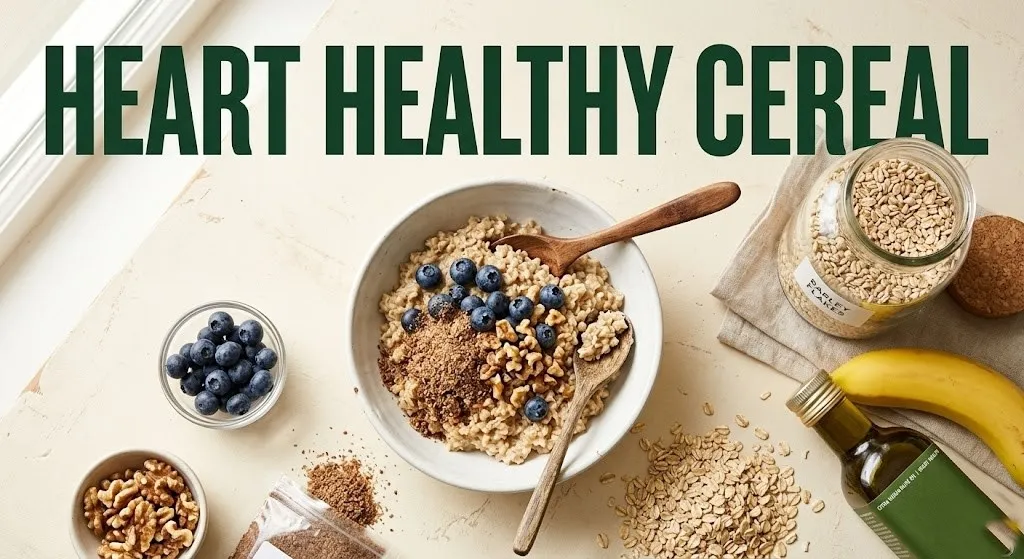
The ultimate heart healthy cereal recipe is a homemade oat and barley granola baked at a low temperature with unsaturated oil, sweetened with mashed banana, and mixed with ground flaxseed and chopped walnuts. This recipe avoids the added sugar and sodium of commercial granolas while delivering 5 grams of soluble fiber per serving.
The ingredients work together to optimize heart health. Oats and barley provide beta-glucan. Flaxseed provides alpha-linolenic acid (ALA), a plant-based omega-3 fatty acid that reduces inflammation. Walnuts provide additional ALA and magnesium. The banana provides natural sweetness and potassium, which supports healthy blood pressure. The olive oil provides monounsaturated fat.
The granola is baked at 300°F, a low temperature that preserves the omega-3 fatty acids in the flaxseed and walnuts from oxidation. High-temperature baking destroys these delicate fats. The granola is stirred every 10 minutes to ensure even browning without burning.
- Preheat oven to 300°F. Line a baking sheet with parchment paper.
- Combine 2 cups rolled oats, 1/2 cup barley flakes, 1/4 cup ground flaxseed, and 1/2 cup chopped walnuts.
- Mash 1 ripe banana. Mix with 2 tbsp olive oil and 1 tsp cinnamon.
- Combine wet and dry ingredients. Spread on the baking sheet.
- Bake for 25 to 30 minutes, stirring every 10 minutes, until golden and dry.
Key Takeaway: Homemade granola is the safest and most effective heart healthy cereal because you control the oil, the sugar, and the fiber sources.
Frequently Asked Questions About Heart Healthy Cereal
Is oatmeal the best cereal for your heart?
Oatmeal is the best cereal for your heart because it contains beta-glucan, a soluble fiber that directly lowers LDL cholesterol.
Steel-cut or rolled oats are the most effective forms.
Instant oatmeal packets often contain added sugar that undermines the heart health benefit.
Are Cheerios really heart healthy?
Plain Cheerios are heart healthy and carry the American Heart Association’s Heart-Check certification.
They contain 1 gram of soluble fiber per serving from whole grain oats.
However, they are not as effective for cholesterol lowering as oatmeal or oat bran.
What cereal cleans your arteries?
No cereal “cleans” arteries in the literal sense.
Oatmeal, barley, and psyllium-based cereals can slow the progression of atherosclerosis by lowering LDL cholesterol.
The term “clean arteries” is marketing, not medical science.
Can I eat cereal if I have high blood pressure?
You can eat cereal if you have high blood pressure, provided it is low in sodium.
Choose cereals with less than 140 milligrams of sodium per serving.
Avoid instant oatmeal packets and many boxed cereals, which are surprisingly high in salt.
Is granola heart healthy?
Store-bought granola is rarely heart healthy due to high levels of added sugar and saturated fat from coconut oil.
Homemade granola baked with olive oil and naturally sweetened can be heart healthy.
Always check the label. Most granola fails the heart healthy criteria.
The cereal aisle is a minefield of misleading marketing. Red hearts on the box mean nothing. The nutrition facts panel and the ingredient list tell the truth. A heart healthy cereal has a short ingredient list, at least 5 grams of fiber, negligible saturated fat, and almost no added sugar.
Buy the plain oatmeal. Buy the shredded wheat. If you want granola, make it yourself at 300°F with olive oil and mashed banana. Your LDL cholesterol will respond to these choices within weeks.
The most heart healthy breakfast in 2026 is a bowl of steel-cut oats with a tablespoon of ground flaxseed and a handful of blueberries. It is not flashy. It has no mascot. It has no jingle. It just works.