A healthy quesadilla is one made with a whole-grain or high-fiber tortilla, a lean protein like chicken or black beans, a restrained amount of full-flavor cheese, and a generous portion of vegetables, toasted in a dry skillet rather than fried in oil. You get the same crispy exterior and melty interior you crave, built on ingredients that support your goals instead of working against them.
A standard restaurant chicken and cheese quesadilla, the kind served with sour cream and guacamole on the side, delivers roughly 650 to 850 calories, 35 to 45 grams of fat, and 1,200 to 1,800 milligrams of sodium. The American Heart Association’s ideal daily sodium limit is 1,500 milligrams. A single restaurant quesadilla can consume your entire sodium budget in one meal. The homemade version cuts the calories by roughly 40 percent, the sodium by 60 percent, and doubles the fiber.
This article gives you a master recipe that works, explains the tortilla selection criteria that determine both nutrition and texture, and provides the techniques for getting a crispy, golden exterior without a deep fryer. You will also learn how to reduce the cheese without making the quesadilla feel like a compromise, and how the nutritional math compares to the restaurant version you are replacing.
healthy quesadilla
A healthy quesadilla is a toasted tortilla filled with a balance of protein, vegetables, and a measured amount of cheese, cooked in a dry skillet or with a light brush of oil rather than being deep-fried or griddled in butter. The health value comes from the tortilla choice, the filling composition, and the cooking method, in that order.
The tortilla is the foundation of the quesadilla and the single largest nutritional lever you can pull. A standard white-flour tortilla contains roughly 200 calories, 4 grams of fat, and less than 1 gram of fiber. A whole-wheat tortilla of the same size contains roughly 140 calories, 3 grams of fat, and 4 grams of fiber. A corn tortilla contains 100 calories, 1 gram of fat, and 2 grams of fiber. The swap from white flour to whole wheat or corn is the simplest, highest-impact change you can make to any quesadilla recipe.
The USDA Dietary Guidelines recommend making half of all grain servings whole grains. Swapping a white tortilla for a whole-wheat one moves you toward that target with no perceptible difference in the eating experience once the quesadilla is toasted and filled. The whole wheat adds a nutty depth that complements the savory fillings.
healthy quesadilla recipe
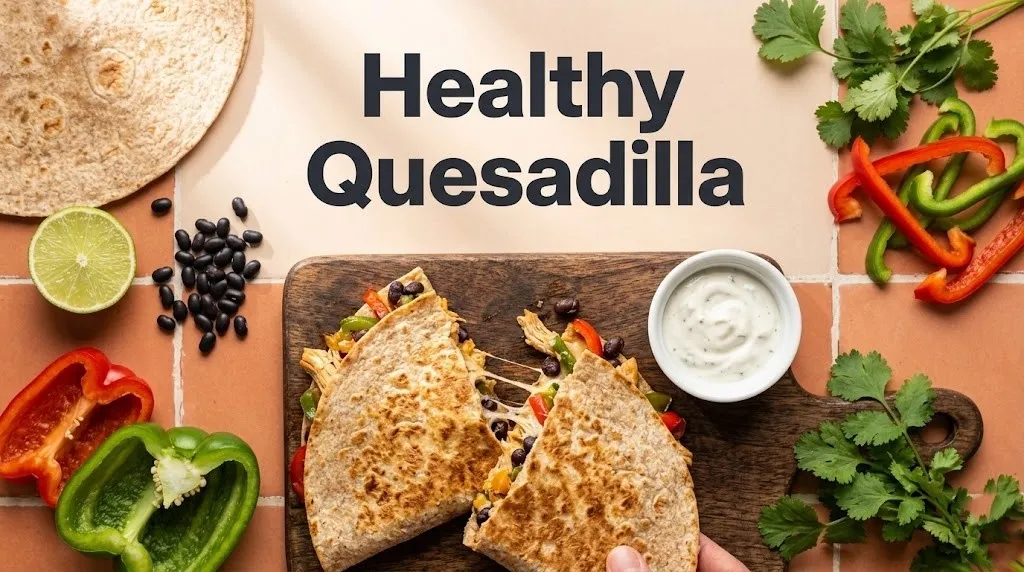
This master recipe produces a crispy, golden-brown whole-wheat quesadilla filled with seasoned chicken, black beans, sauteed peppers and onions, and a moderate amount of sharp cheddar cheese, served with a Greek yogurt sauce instead of sour cream. The recipe serves four and takes roughly 25 minutes from start to finish.
The chicken is seasoned simply with cumin, chili powder, and garlic powder, a flavor combination that works with the cheese and vegetables without overpowering them. Pre-cooked rotisserie chicken or leftover grilled chicken works perfectly here and reduces the active prep time to about 10 minutes. The vegetables are sauteed briefly before being added to the quesadilla to drive off moisture that would otherwise steam the tortilla from the inside and make it soggy.
The cheese quantity is intentional. Two tablespoons of shredded sharp cheddar per quesadilla, roughly 14 grams or half an ounce, provides enough melt and flavor to bind the fillings without dominating the dish. A restaurant quesadilla often contains 4 to 6 ounces of cheese per serving. This recipe uses one-eighth of that amount and does not feel like a compromise.
Ingredients:
- 4 whole-wheat tortillas (8-inch)
- 2 cups cooked, shredded chicken breast
- 1 teaspoon cumin
- 1 teaspoon chili powder
- 1/2 teaspoon garlic powder
- 1/2 teaspoon salt, divided
- 1 cup black beans, drained and rinsed
- 1 bell pepper, thinly sliced
- 1/2 small onion, thinly sliced
- 1/2 cup shredded sharp cheddar cheese
- 1/2 cup plain Greek yogurt
- 1 tablespoon lime juice
- Cooking spray or 1 teaspoon avocado oil
To prepare the quesadillas:
- Toss the shredded chicken with cumin, chili powder, garlic powder, and 1/4 teaspoon salt. Set aside.
- Heat a large non-stick skillet over medium heat. Add the bell pepper and onion with a pinch of salt and cook, stirring occasionally, until softened and lightly browned, about 5 minutes. Remove from the pan and set aside.
- In a small bowl, stir together the Greek yogurt, lime juice, and a pinch of salt to make the sauce.
- Wipe the skillet clean. Place one tortilla in the dry skillet over medium heat and toast for 30 seconds on each side until warm and pliable.
- On one half of the tortilla, sprinkle 1 tablespoon of cheese. Top with a quarter of the chicken, a quarter of the beans, a quarter of the vegetables, and another tablespoon of cheese.
- Fold the empty half of the tortilla over the fillings to form a half-moon. Press down gently with a spatula.
- Cook for 2 to 3 minutes per side, until the tortilla is golden brown and the cheese is melted.
- Transfer to a cutting board, let rest for 1 minute, then slice into two triangles. Repeat with remaining tortillas. Serve with the Greek yogurt sauce.
healthy quesadillas
Healthy quesadillas, in the plural, are a category of meals that rotate through different protein, vegetable, and tortilla combinations, all following the same structural formula: a whole-grain tortilla, a lean protein, vegetables, a small amount of cheese, and a yogurt-based sauce. The formula is infinitely adaptable.
A vegetarian version replaces the chicken with a mixture of black beans and sauteed mushrooms. Mushrooms provide a savory, meaty texture and umami that compensates for the missing chicken. A cup of sliced cremini mushrooms cooked until deeply browned adds roughly 20 calories and 3 grams of protein. Black beans add 8 grams of protein and 7 grams of fiber per half-cup serving. The vegetarian quesadilla has a similar protein count to the chicken version.
A breakfast quesadilla uses scrambled eggs as the protein, with spinach and a sprinkle of cheese. Two scrambled eggs provide 12 grams of protein. A handful of fresh spinach wilted into the eggs adds iron, vitamin K, and volume. The breakfast version clocks in at roughly 350 calories and works as a portable meal that can be wrapped in foil and eaten on the go.
Three quesadilla variations to rotate through:
- Chicken and black bean with peppers and onions (the master recipe)
- Black bean, mushroom, and spinach (vegetarian)
- Scrambled egg, spinach, and tomato (breakfast)
quesadillas healthy
Quesadillas become healthy when the ingredient ratios are inverted from the restaurant model. A restaurant quesadilla is roughly 60 percent cheese, 25 percent tortilla, and 15 percent fillings. A healthy quesadilla is roughly 40 percent vegetables, 30 percent protein, 20 percent tortilla, and 10 percent cheese. The cheese is a flavor accent, not the main ingredient.
The nutritional impact of this ratio shift is significant. A restaurant quesadilla with 4 ounces of cheese contains roughly 32 grams of saturated fat. A healthy quesadilla with half an ounce of cheese contains roughly 4 grams of saturated fat. The American Heart Association recommends limiting saturated fat to 13 grams per day. The restaurant version uses more than double the daily limit in a single dish. The homemade version uses less than a third.
The Academy of Nutrition and Dietetics recognizes that dishes like quesadillas can be part of a healthy dietary pattern when the ingredient proportions are adjusted to emphasize vegetables, lean proteins, and whole grains. The quesadilla format itself is not the problem. The proportions are.
healthy chicken quesadilla recipe
A healthy chicken quesadilla recipe is the master recipe detailed above, and it works because the chicken is seasoned aggressively, the vegetables are pre-cooked to remove moisture, and the cheese is sharp enough that a small amount provides significant flavor impact. The recipe can be scaled up or down and adapts to whatever vegetables are in the refrigerator.
The seasoning on the chicken matters more than the cooking method. Cumin, chili powder, garlic powder, and salt create a flavor profile that stands up to the tortilla and the cheese. Bland chicken disappears in a quesadilla and leaves you wondering why it tastes like nothing. Seasoned chicken holds its own and makes the dish satisfying.
The vegetables should be whatever you have on hand. Bell peppers and onions are classic for good reason, they add sweetness and texture, but sliced zucchini, mushrooms, spinach, or shredded cabbage all work. The key is to cook them before they go into the quesadilla. Raw vegetables release water as they heat, steaming the tortilla from the inside. Pre-cooked vegetables have already shed their water and are ready to be sealed into the quesadilla.
healthy chicken quesadillas
Healthy chicken quesadillas are a practical meal prep option because the components can be cooked in advance and assembled in minutes on the night you want to eat them. The chicken, beans, and vegetables keep for three to four days in the refrigerator. The tortillas and cheese are always ready.
To meal prep healthy chicken quesadillas, cook the chicken, beans, and vegetables on Sunday. Store each component in a separate container in the refrigerator. On Tuesday night, pull them out, assemble the quesadillas, and cook them fresh. The assembly and cooking take 10 minutes. This is faster than ordering delivery and far better for you than a frozen quesadilla from the grocery store.
The USDA FoodData Central database confirms that a typical frozen chicken quesadilla contains roughly 450 calories, 22 grams of fat, and 800 milligrams of sodium per serving. The homemade version delivers roughly 380 calories, 12 grams of fat, and 400 milligrams of sodium. The homemade version also tastes like real food, not a microwave-crisped approximation.
chicken quesadilla recipe healthy
A chicken quesadilla recipe earns the “healthy” label when it replaces the white-flour tortilla with a whole-grain option, uses pre-cooked, seasoned chicken breast instead of fried or dark meat, limits the cheese to a functional binding amount, and adds vegetables that contribute fiber, volume, and micronutrients. The recipe in this article meets each of those criteria.
The tortilla is the most important swap. A whole-wheat tortilla provides 3 to 4 grams of fiber. A white-flour tortilla provides less than 1 gram. Across two halves, the fiber difference is 5 to 6 grams. This is roughly 20 percent of the daily fiber recommendation for an adult woman, gained by swapping one ingredient.
The cooking method is the second most important variable. Quesadillas do not need to be fried in oil to be crispy. A dry non-stick skillet over medium heat toasts the tortilla beautifully, creating a golden, blistered exterior with no added fat. A light spray of cooking oil can be used if your skillet is not reliably non-stick, but a pool of oil is unnecessary and adds calories that do not improve the final texture.
Key Takeaway: A healthy quesadilla is built on three swaps: a whole-grain tortilla, a lean protein, and a restrained amount of cheese. Vegetables add volume and fiber. A dry skillet delivers the crunch.
what makes a quesadilla healthy
A quesadilla is healthy when it is built on a whole-grain tortilla for fiber, contains a lean protein source for satiety, includes vegetables for volume and micronutrients, uses cheese as a binder rather than a filler, and is cooked with minimal or no added fat. Each of these elements is a deliberate choice that improves the nutritional profile.
The tortilla provides the fiber. Whole-wheat, corn, and high-fiber wraps all deliver 2 to 5 grams of fiber per tortilla. Fiber slows carbohydrate digestion, moderates the blood glucose response, and promotes satiety. A white-flour tortilla digests rapidly and produces a sharper blood glucose spike followed by a faster return of hunger.
The protein provides the staying power. Chicken breast, black beans, scrambled eggs, or lean ground turkey all work. Twenty to 25 grams of protein per serving is a reasonable target for a meal-sized quesadilla. This triggers satiety hormones and supports muscle maintenance. The protein should be seasoned well and pre-cooked before it enters the quesadilla.
best tortillas for healthy quesadillas
The best tortillas for healthy quesadillas are whole-wheat tortillas with at least 3 grams of fiber, corn tortillas for a gluten-free option, or high-fiber wraps made with added oat fiber or flaxseed. The tortilla must be pliable enough to fold without cracking and sturdy enough to hold fillings without tearing.
Whole-wheat tortillas are the best all-around choice for quesadillas. They have enough structural integrity to hold a generous filling, a nutty flavor that complements savory ingredients, and 3 to 4 grams of fiber per tortilla. Look for brands with whole-wheat flour as the first ingredient and minimal added sugar. Some whole-wheat tortillas contain honey or sugar for flavor and browning. Choose one with less than 2 grams of added sugar per tortilla.
Corn tortillas are the traditional Mexican choice and are naturally gluten-free. They are smaller, typically 6 inches, and lower in calories at roughly 100 per tortilla. The challenge is that corn tortillas crack when folded unless they are very fresh or have been warmed thoroughly. To use corn tortillas for a quesadilla, heat them in a dry skillet for 30 seconds per side until pliable, then fill and fold quickly. They will be smaller quesadillas, more like a street taco format, but nutritionally excellent.
| Tortilla Type (1 tortilla) | Calories | Fiber | Protein | Best For |
|---|---|---|---|---|
| White flour (8-inch) | 200 | <1 g | 4 g | Not recommended |
| Whole-wheat (8-inch) | 140 | 4 g | 5 g | Best all-around |
| Corn (6-inch) | 100 | 2 g | 2 g | Gluten-free, traditional |
| High-fiber wrap | 120 | 5 g | 5 g | Maximum fiber |
healthy quesadilla fillings
Healthy quesadilla fillings fall into three categories: lean proteins, vegetables, and flavor boosters that add impact without calories. The protein provides satiety. The vegetables provide volume and fiber. The flavor boosters make the quesadilla taste indulgent without adding significant fat or sodium.
Lean proteins for quesadillas include shredded chicken breast, ground turkey, black beans, pinto beans, scrambled eggs, or crumbled tofu. The protein should be cooked and seasoned before entering the quesadilla. Raw protein releases water and fat as it cooks, which makes the tortilla soggy.
Vegetables should be thinly sliced or chopped and pre-cooked. Bell peppers, onions, mushrooms, zucchini, spinach, and shredded cabbage all work. Pre-cooking drives off moisture and concentrates flavor. Spinach can be added raw because it wilts almost instantly from the ambient heat of the other fillings.
Flavor boosters include pickled jalapenos, a tablespoon of salsa, fresh cilantro, sliced green onions, or a sprinkle of smoked paprika. These add complexity without adding the calories that cheese and sour cream contribute.
- Lean proteins: Shredded chicken, black beans, scrambled eggs, ground turkey
- Vegetables: Bell peppers, onions, mushrooms, spinach, zucchini
- Flavor boosters: Pickled jalapenos, fresh cilantro, salsa, lime juice
how to reduce cheese in quesadillas
Reducing cheese in a quesadilla while maintaining creaminess requires using a sharp, full-flavor cheese, shredding it finely so it distributes evenly, and supplementing the filling with ingredients that provide moisture and richness, like mashed avocado, Greek yogurt, or well-caramelized vegetables. Reduced-fat cheese is not the answer. It melts poorly and tastes like plastic.
Sharp cheddar, aged Monterey Jack, or crumbled queso fresco deliver more flavor per gram than mild, pre-shredded cheese blends. Two tablespoons of sharp cheddar, roughly 14 grams, provide enough cheesy presence to make the quesadilla feel satisfying. A pre-shredded mild cheddar blend requires twice the quantity to achieve the same flavor impact.
Finely shredding the cheese from a block rather than using pre-shredded cheese also improves melt quality. Pre-shredded cheese is coated in potato starch or cellulose to prevent clumping. That coating inhibits smooth melting. Cheese shredded fresh from a block melts into a creamier, more cohesive layer.
Quick Tip for Cheese Reduction:
- Use sharp, aged cheeses for maximum flavor impact in small quantities.
- Shred cheese fresh from a block for better melting.
- Add mashed avocado or caramelized onions for creaminess that replaces some of the cheese’s mouthfeel.
restaurant vs homemade quesadilla nutrition
A restaurant chicken and cheese quesadilla contains roughly 700 to 850 calories, 40 grams of fat, 18 grams of saturated fat, 50 grams of carbohydrate, 4 grams of fiber, 40 grams of protein, and 1,500 milligrams of sodium. A healthy homemade version contains roughly 380 calories, 14 grams of fat, 4 grams of saturated fat, 40 grams of carbohydrate, 8 grams of fiber, 30 grams of protein, and 400 milligrams of sodium. The homemade version cuts calories by nearly half, saturated fat by 75 percent, and sodium by 70 percent.
The restaurant version’s numbers are driven by three factors: a large white-flour tortilla, 4 to 6 ounces of cheese, and a cooking surface that is generously oiled or buttered. The tortilla alone often measures 12 inches across and contains 300 calories before any fillings are added. The cheese alone can contribute 450 calories and 28 grams of saturated fat.
The homemade version uses an 8-inch whole-wheat tortilla at 140 calories and half an ounce of cheese at roughly 55 calories. The difference in tortilla size and cheese quantity accounts for roughly 400 calories. The switch from frying in oil to dry-toasting in a non-stick skillet saves an additional 100 to 150 calories.
| Quesadilla Type | Calories | Saturated Fat | Fiber | Sodium |
|---|---|---|---|---|
| Restaurant (chicken and cheese) | 750 | 18 g | 4 g | 1,500 mg |
| Homemade healthy (chicken, bean, veg) | 380 | 4 g | 8 g | 400 mg |
| Frozen grocery (chicken and cheese) | 450 | 8 g | 3 g | 800 mg |
healthy quesadilla for weight loss
A healthy quesadilla can support weight loss when it is built as a protein-rich, fiber-filled meal that keeps you full on roughly 350 to 400 calories. The combination of 30 grams of protein and 8 grams of fiber produces satiety that lasts for hours, reducing the likelihood of snacking between meals.
The key to a weight-loss-friendly quesadilla is volume without calorie density. Vegetables provide volume. A quesadilla packed with sauteed peppers, onions, and mushrooms feels substantial on the plate and in the stomach. The vegetables add fiber and water, which stretch the stomach and trigger stretch receptors that signal fullness to the brain. The calories from vegetables are minimal, roughly 25 to 50 calories per cup, while the volume and satiety contribution is significant.
Portion control is the other factor. A restaurant quesadilla is often 12 inches across and cut into four large triangles. A healthy homemade quesadilla is 8 inches across and cut into two triangles. This is a reasonable meal portion for one person. Eating the full recipe of four quesadillas, eight triangles, would be roughly 1,500 calories, which is a day’s worth of food for many people. The portion is part of the health equation.
Key Takeaway: A healthy quesadilla for weight loss is built on whole-wheat tortillas, lean protein, vegetables, and a measured amount of cheese, toasted in a dry skillet, and served as two halves per person.
Frequently Asked Questions About Healthy Quesadillas
Can I make a healthy quesadilla without cheese?
You can make a healthy quesadilla without cheese by using mashed avocado, refried beans, or a cashew cream sauce as a binder.
The quesadilla will not have the same stretchy melt as a cheese version, but it will be creamy and satisfying.
Add nutritional yeast for a savory, cheese-like flavor without dairy.
What is the healthiest tortilla for quesadillas?
Whole-wheat tortillas with at least 3 grams of fiber are the healthiest practical choice for quesadillas.
Corn tortillas are a close second and are naturally gluten-free.
High-fiber wraps with added oat fiber or flaxseed provide the most fiber per calorie.
Are corn tortillas healthier than flour tortillas for quesadillas?
Corn tortillas are lower in calories and fat than flour tortillas, with 100 calories and 1 gram of fat compared to 200 calories and 4 grams of fat.
Corn tortillas also provide 2 grams of fiber and are naturally gluten-free.
The trade-off is that corn tortillas are smaller and crack when folded unless warmed properly.
How many calories are in a healthy chicken quesadilla?
A healthy chicken quesadilla made with a whole-wheat tortilla, seasoned chicken, black beans, vegetables, and a small amount of cheese contains roughly 350 to 400 calories for two halves.
A restaurant chicken and cheese quesadilla contains 650 to 850 calories.
The homemade version saves roughly 300 to 450 calories per serving.
Can I meal prep quesadillas?
You can meal prep the components of a quesadilla, the chicken, beans, and vegetables, up to four days in advance.
The quesadillas should be assembled and cooked fresh for the best texture.
Pre-cooked quesadillas become soggy when reheated in a microwave, though they can be re-crisped in a dry skillet.
A healthy quesadilla is not a diet food. It is a real meal that happens to be built on ingredients that support your health rather than working against it. The whole-wheat tortilla provides fiber. The chicken and beans provide protein. The vegetables add color, crunch, and micronutrients. The cheese is present but restrained.
The technique is the secret. A hot, dry skillet toasts the tortilla to a golden crisp without the grease bath of a restaurant griddle. Pre-cooked fillings keep the interior from turning to steam. A sharp cheese, finely shredded, melts into a cohesive layer that binds everything together. These are small moves that produce a significant improvement in the final result.
Keep a bag of whole-wheat tortillas in your refrigerator and a can of black beans in your pantry, and you are 10 minutes from a quesadilla whenever the craving strikes. Rotate the proteins and vegetables through the week. The formula is fixed. The variations are endless.