Yes, baked chicken is one of the healthiest protein sources you can eat, provided you avoid oversalting it or smothering it in sugar-laden sauces. A simple 4-ounce oven-baked chicken breast delivers a massive dose of complete protein with minimal saturated fat and zero carbohydrates.
Nearly every dietary pattern, from the keto diet to the DASH diet, finds room for this staple. The American Heart Association regularly emphasizes replacing high-saturated-fat meats with lean poultry to manage LDL cholesterol levels. Baking specifically preserves this lean matrix without adding the extra calories that frying does.
You will walk away knowing exactly how the nutrition changes between a breast and a thigh. We will cover the science of weight loss satiety, the direct calorie swap math against fried chicken, and the precise internal temperature that keeps you safe without turning your dinner into dry cardboard.
Is Baked Chicken Healthy?
Oven-baked chicken is a fundamentally healthy whole food that provides high biological value protein for muscle repair and metabolic function without the inflammatory byproducts that come from high-temperature charring or deep frying. The health status of your meal, however, hinges entirely on two factors: the cut you pick and the additives you introduce before baking.
A naked piece of chicken is pure protein and a moderate amount of fat. It contains no trans fats and no fiber, which means it is not a complete meal. You must pair it with a fiber source to maintain digestive motility. But as a protein delivery vehicle, baking works by using ambient dry heat to denature the protein strands without denaturing the fats into harmful compounds.
The cooking method is passively safe. You set the oven and let the thermal convection do the work. Unlike pan-searing, where the surface of the meat touches scorching metal, baking allows a slower energy transfer. The risk of eating baked chicken lies in the preparation stage, specifically the bacterial cross-contamination of raw poultry juices in your kitchen or the use of a sodium-heavy pre-brined bird.
For those managing histamine intolerance, be aware that cooking and reheating chicken can increase the histamine levels slightly if the meat sits in the “danger zone” between 40 and 140 degrees Fahrenheit for too long after cooking. Cool leftovers immediately in shallow containers. That fast-cooling step is the safety linchpin that makes a Sunday meal-prep session safe for the entire work week.
What Is the Healthiest Way to Cook Chicken?
Baking ranks among the healthiest cooking methods because it requires zero added cooking fat to prevent sticking and uses moderate, controlled temperatures that minimize oxidation. Steaming and poaching technically retain more moisture, but they fail to trigger the Maillard reaction, which leaves the chicken tasting flat and bland.
The Maillard reaction is not just a flavor luxury. It creates surface-level compounds that signal satiety to the brain via the olfactory system during eating. When food smells appetizing, you chew more thoroughly and produce more digestive enzymes. A poached chicken breast may have marginally less protein oxidation, but if you can eat a well-baked chicken breast with just a squeeze of lemon and actually enjoy it, the compliance factor outweighs the microscopic degradation.
The healthiest way to bake chicken relies on a specific temperature band: 375 to 400 degrees Fahrenheit. Below that, the meat steams in its own released water and develops a rubbery pellicle. Above that, you edge into the zone where the peptides begin to char and form advanced glycation end-products, or AGEs. You are looking for a golden, crisp exterior without blackened grill marks.
If you are aiming for absolute minimum fat, baking skinless breasts on a wire rack set over a sheet pan allows the rendering fat to drip away completely. If you are baking with the skin on, you protect the meat beneath from drying out but you absorb the fat-soluble pollutants that may exist in the skin. Research from environmental health scientists suggests that trimming visible poultry fat and skin before eating reduces the body’s exposure to persistent organic pollutants that accumulate in animal adipose tissue.
| Cooking Method | Added Fat Required | Carcinogen Risk | Moisture Retention |
|---|---|---|---|
| Baking (350-400°F) | None/Light Brush | Very Low | Moderate-High |
| Steaming/Poaching | None | None | High |
| Grilling (Charcoal) | Yes (on grates) | High (HCAs, PAHs) | Low |
| Frying (Deep) | High (Oil absorption) | High (Acrylamide in breading) | Low |
| Sautéing | Moderate | Low-Moderate | Moderate |
Baked Chicken Breast Nutrition 4 oz
A standard 4-ounce serving of boneless, skinless baked chicken breast contains approximately 180 calories, 35 grams of protein, and 4 grams of fat, with zero carbohydrates. According to the USDA FoodData Central, this cut is one of the most concentrated dietary sources of lean protein available in the grocery store.
The amino acid profile is what food scientists call a “complete protein.” It delivers all nine essential amino acids, with a particularly high concentration of leucine, the branched-chain amino acid that directly stimulates mammalian target of rapamycin (mTOR) pathways to kickstart muscle protein synthesis. For a 180-pound adult, that single 4-ounce portion provides roughly 60 to 65 percent of the daily protein requirement recommended by the National Institutes of Health for sedentary individuals.
The fat that does exist in the breast is mostly unsaturated or stearic acid, a type of saturated fat that studies indicate has a neutral effect on LDL cholesterol. You are not consuming the palmitic acid spike that you get from beef or pork. The breast is also rich in niacin (vitamin B3), providing nearly 70 percent of your daily value. Niacin acts as a precursor to nicotinamide adenine dinucleotide (NAD+), a coenzyme that declines as you age and is central to cellular energy transfer.
The phosphorus content in that same 4-ounce portion sits at around 250 milligrams. Phosphorus binds with calcium to maintain bone density, but it becomes a problem for individuals with advanced kidney disease whose filtration rate has dropped. If your nephrologist has placed you on a phosphorus binder, you need to account for this invisible load in the chicken breast.
Key Takeaway: A standard 4-ounce baked breast is a near-pure protein block that supports muscle, provides aging-related B-vitamins, and fits almost any macro split you are tracking.
Baked Chicken Thighs Healthy
Baked chicken thighs are healthy, but they occupy a different metabolic category than breasts due to their higher fat and connective tissue content. A 4-ounce baked thigh with the skin removed contains roughly 210 calories, 28 grams of protein, and 10 grams of fat.
The fat in chicken thighs is a mixture of monounsaturated and saturated fats. While you take a slight hit on the saturated fat front compared to the breast, you gain significant culinary and nutritional traction. The thigh meat is a darker, denser myoglobin-rich muscle. Myoglobin is an iron and oxygen-binding protein. Eating dark meat gives you a meaningful bump in heme iron absorption, which is relevant for premenopausal women or athletes with higher iron turnover.
The collagen and connective tissue in the thigh convert to gelatin during the longer baking process required to break down the sinew. That gelatin provides glycine, an amino acid your body uses to synthesize creatine and glutathione. You get a richer, more satiating mouthfeel without having to add butter or cream sauce. The satiety payoff of the thigh is often higher for a person in a calorie deficit than the dry breast, which can lead to a mental craving for high-calorie toppings.
If you keep the skin on during baking, you increase the calorie count to roughly 280 per 4 ounces. The crispy skin is delicious, but it is where the majority of the environmental lipid-soluble residues settle. If you are eating chicken thighs daily as a cost-effective protein source, rotating between skin-off and skin-on is a pragmatic, non-dogmatic way to balance flavor, budget, and long-term toxicology risk profiles.
| Cut (4 oz cooked, no skin) | Calories | Protein (g) | Fat (g) | Saturated Fat (g) | Iron (% DV) |
|---|---|---|---|---|---|
| Chicken Breast | 180 | 35 | 4 | 1.0 | 6% |
| Chicken Thigh | 210 | 28 | 10 | 2.5 | 7% |
| Chicken Drumstick | 200 | 28 | 9 | 2.3 | 7% |
| Chicken Tenderloin | 150 | 30 | 2 | 0.5 | 4% |
Health Benefits of Eating Baked Chicken
Eating baked chicken supports lean body mass retention, cognitive function, and thyroid regulation through its dense micronutrient profile. The protein satisfies structural needs, but the micronutrients inside the meat matrix drive the long-term preventive benefits.
The first and most overlooked benefit is choline. A 4-ounce breast provides roughly 85 milligrams of choline. The NIH Office of Dietary Supplements identifies choline as necessary for the synthesis of phosphatidylcholine, a key component of cell membranes, and acetylcholine, a neurotransmitter that regulates memory and muscle control. Pregnant women specifically need higher choline levels for fetal neural tube closure, often exceeding what they get from eggs alone. Baked chicken is a clean, low-mercury source.
Selenium content is the second hard-hitter. A single serving of chicken often provides 30 to 40 micrograms, about 55 percent of the Recommended Dietary Allowance. Selenium is integrated into selenoproteins that function as antioxidants in the thyroid gland. They protect the thyroid follicular cells from hydrogen peroxide produced during thyroid hormone synthesis. A randomized controlled trial published in the journal Nutrients in 2023 confirmed that a selenium-adequate diet supports normal thyroid volume and function.
The tryptophan in chicken also matters. Tryptophan is a precursor to serotonin and subsequently melatonin. A high-protein meal that includes tryptophan, eaten a few hours before bed, provides the raw material for sleep hormone regulation without the massive insulin spike that a carbohydrate-heavy snack would cause. Turkey gets the post-Thanksgiving credit, but chicken is molecularly similar in its amino acid payload.
Key Health Benefit Checklist:
- Complete muscle repair protein with high leucine content.
- Selenium for thyroid-protective antioxidant networks.
- Choline for brain and liver membrane integrity.
- Niacin for NAD+ biosynthesis and metabolic energy conversion.
- High satiety factor for appetite regulation.
Is Baked Chicken Good for Weight Loss?
Baked chicken is excellent for weight loss because it maximizes protein-induced satiety per calorie, allowing you to maintain a sustained energy deficit without losing lean body mass. The weight loss effect is not mysterious fat-burning; it is pure physics of protein metabolism.
Protein has a diet-induced thermogenesis (DIT) effect of roughly 20 to 30 percent. For every 100 calories of baked chicken you eat, your body burns about 20 to 30 calories simply digesting and processing the amino acids. Carbohydrates only burn about 5 to 10 percent in this process. By centering your calorie-restricted plate around a baked chicken breast, you effectively create a hidden metabolic tax that slightly deepens your deficit.
The physical act of chewing protein is also a satiety trigger. Unlike a smoothie or a bowl of refined pasta, a properly baked chicken breast requires mastication. The oral processing time sends feedback to the brainstem to start cascading satiety hormones like cholecystokinin. You feel fuller, faster, on fewer calories.
However, the weight loss benefit erodes quickly if you rely on sugary barbecue sauces or heavy cream bases to mask the flavor. A tablespoon of standard barbecue sauce adds 6 grams of sugar. Two tablespoons turn your 180-calorie breast into a 260-calorie sugar-and-protein plate. You must lean on dry rubs, herbs, citrus, and vinegar-based marinades to keep the caloric curve flat while driving flavor.
Baked Chicken vs Fried Chicken Calories
Swapping a single 4-ounce serving of fried chicken for a baked one cuts your calorie intake by roughly 200 to 250 calories and reduces your inflammatory fat consumption by over 15 grams. The comparison is not subtle. It is one of the most efficient dietary swaps in the standard American food matrix.
When you deep-fry a piece of chicken, the water inside the muscle fibers rapidly turns to steam and escapes. The void left behind is filled by the frying oil. A piece of fried chicken absorbs up to 10 to 15 percent of its weight in degraded frying oil. That oil is often a thermally stressed omega-6 seed oil that has undergone repeated heating cycles, generating polar compounds and lipid peroxides that directly trigger inflammatory pathways in the vascular endothelium.
The breading or batter further compounds the caloric issue. Refined white flour and starch blends add roughly 15 to 20 grams of rapidly digestible carbohydrates, which spike blood glucose. The protein-to-fat-plus-carb ratio inverts. You go from a protein-dominant food to a fat-and-carb-dominant food.
Baking requires no breading. You can achieve a crisp exterior by thoroughly drying the skin and using a light spray of avocado oil and salt, creating the Maillard crust without the deep-fried oil sponge effect. Your air fryer, which is essentially a convection oven, can close the texture gap even further while keeping the nutritional profile firmly in the “baked” category.
| Nutrient (per 4 oz serving) | Baked Chicken Breast | Fried Chicken Breast (Breaded) |
|---|---|---|
| Calories | 180 | 390 |
| Total Fat | 4 g | 23 g |
| Saturated Fat | 1 g | 5 g |
| Carbohydrates | 0 g | 18 g |
| Protein | 35 g | 26 g |
Key Takeaway: Frying chicken adds a dense layer of oxidized fats and simple starches that fundamentally undermine the metabolic benefits of the lean protein you were trying to eat in the first place.
Is Baking Chicken Healthy vs Grilling?
Baking is healthier than high-heat open-flame grilling when strictly comparing the formation of carcinogenic cooking byproducts, though grilling has a distinct flavor advantage. The direct intense infrared heat of a grill grate over an open flame generates heterocyclic amines and polycyclic aromatic hydrocarbons at a rate that baking in a 375-degree Fahrenheit oven simply does not.
HCAs form when the amino acids, sugars, and creatine in the chicken meat react at high temperatures. The char lines you love on a grilled breast are essentially a visual marker of HCA formation. PAHs form when fat drips from the chicken onto a hot heat source below, causing smoke and flames to erupt upward and coat the meat with pyrolyzed residue. Baking avoids the open flame entirely, so the PAH load on oven-baked chicken is functionally zero.
Grilling a bone-in, skin-on thigh until the skin is blackened shifts the risk profile significantly, particularly for people with a genetic susceptibility to colorectal cancer. The National Cancer Institute advises that flipping meat frequently during grilling and removing charred portions can reduce exposure, but the risk is inherently higher than baking.
However, you do sacrifice the smoke-ring flavor. The pragmatic middle ground in 2026 kitchen science is a two-step technique: bake the chicken until it reaches 150 degrees Fahrenheit internally, then finish it for 60 seconds per side on a very hot cast-iron grill pan indoors. You get the textural browning without the sustained open-flame PAH exposure.
Sodium in Baked Chicken
The natural sodium content in a fresh, unbrined baked chicken breast is low, roughly 70 to 80 milligrams per 4-ounce serving. The problem arises with commercially processed “enhanced” chicken that has been injected with a saline solution to plump the meat.
Processors inject a brine of water, salt, and often “natural flavorings” into commodity chicken to extend shelf life and improve the perceived juiciness. That injection can push the sodium content to over 400 milligrams per serving. The Academy of Nutrition and Dietetics warns that this hidden sodium can completely derail a low-sodium DASH diet plan if you are not checking the fine print on the packaging.
Look for labels that say “minimally processed,” “air-chilled,” or “no retained water.” Air-chilled chicken cools the carcass with cold air rather than a communal cold water bath. It does not absorb the water weight. The texture is cleaner, the skin bakes crispier, and the sodium count is native, not inflated. If air-chilled is too pricey, check the fine print on the frozen or fresh pack. If the ingredient list contains anything other than “chicken,” it has been enhanced.
If you brine the chicken yourself at home, you control the concentration. A 30-minute brine in a 5 percent salt solution will season the meat without fully saturating it with sodium. You then rinse and pat the chicken dry before baking. The flavor is inside the meat fibers, but the massive sodium load is not.
Baked Chicken Internal Temp
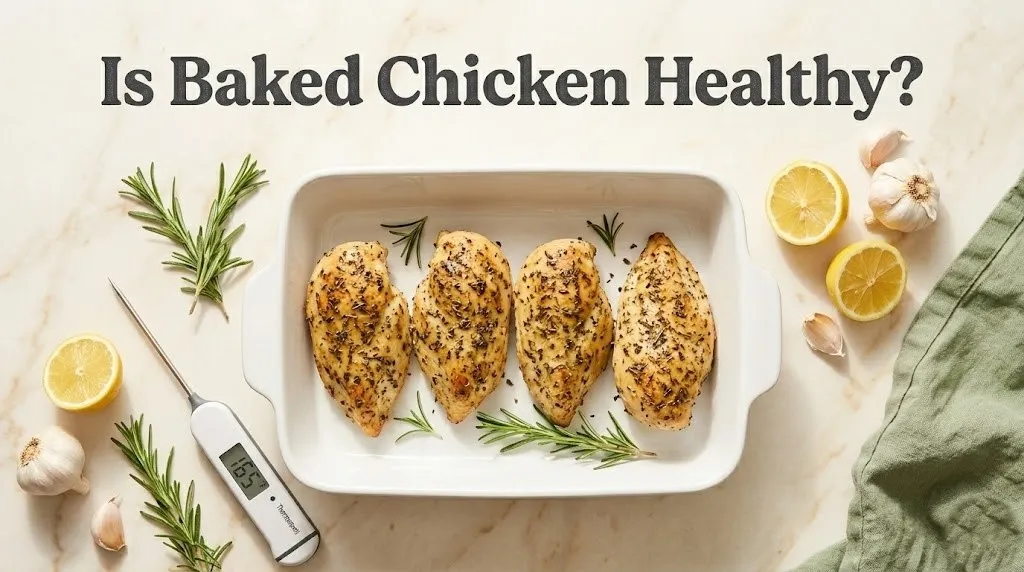
The FDA and USDA mandate that all poultry must reach a safe minimum internal temperature of 165 degrees Fahrenheit to instantly eliminate Salmonella and Campylobacter bacteria. You must measure this temperature at the thickest point of the meat without touching the bone.
The chemical reality of cooking is more nuanced than an instant kill temperature. Pathogen death is a function of both temperature and time. Holding chicken at 150 degrees Fahrenheit for 3 minutes achieves the same log-7 reduction in Salmonella as hitting 165 degrees Fahrenheit instantly. Commercial sous-vide processes rely on this time-temperature curve. In a busy home kitchen, the 165-degree Fahrenheit instant rule is the safest, most foolproof heuristic.
Carryover cooking dictates that you should pull the chicken breast from the oven at 160 degrees Fahrenheit. The residual heat inside the protein matrix will cause the internal temperature to coast upward by another 5 to 8 degrees Fahrenheit while resting. If you pull it at 165 degrees Fahrenheit, it will coast to 170 or higher, squeezing out the moisture pockets and turning the breast fibrous.
A wired leave-in probe thermometer is the most effective tool for this. You monitor the real-time temperature curve without opening the oven door and crashing the ambient heat. Rest the chicken for at least 5 minutes under a loose foil tent. This rest period allows the pressure gradient inside the meat to equalize, so when you slice into it, the juices stay in the meat instead of flooding your cutting board.
Temperature Check Protocol:
- Insert probe into the lateral center of the thickest part of the breast or thigh.
- Verify reading is 160°F (for breast) or 175°F (for thighs, to break collagen).
- Remove from oven and rest for 5 to 10 minutes.
- Confirm a final carryover reading of 165°F (breast) or 180°F (thigh) before slicing.
How to Bake Chicken Without Drying It Out
To bake chicken without drying it out, you must manage the protein coagulation with a specific equilibrium of salt, a hot initial oven temperature, and an absolute refusal to overcook the center. Chicken breast dries out because the muscle fibers contract and wring out water when they reach 165 degrees Fahrenheit and keep climbing.
The first line of defense is a dry brine. Sprinkle kosher salt directly on the raw breast 30 to 60 minutes before baking. Initially, the salt draws moisture out of the chicken via osmosis. Then, the salt dissolves into that moisture, creating a concentrated brine that the muscle fibers reabsorb. The dissolved salt denatures the protein strands, allowing them to hold onto water more effectively during the heat shock of the oven.
The second line of defense is your oven temperature. 400 degrees Fahrenheit is the thermal sweet spot. It is hot enough to brown the exterior rapidly and trap the steam inside the muscle but not so hot that the outside turns to leather before the center is safe. Covering the chicken traps steam and dilutes flavor. You want a dry, uncovered roast on a wire rack.
Pounding the chicken breast to an even thickness is not optional. The tapered tail of a natural breast cooks at a different rate than the thick lobe. Use a meat mallet or a heavy skillet to flatten the breast to a uniform three-quarter-inch thickness. It will cook evenly from edge to edge, and the entire piece will hit the target temperature within a narrow window of time, preventing the thin end from turning into sand.
Healthy Baked Chicken Recipes for Meal Prep
A healthy baked chicken meal prep is a formula that yields four to five identical protein units with varying flavor profiles derived from dry rubs, not sugary glazes. You do not bake one flavor and suffer through it for four days. You apply different spices to a base batch and bake them simultaneously using a partitioned sheet pan.
The base recipe starts with 2 pounds of boneless, skinless chicken breast, trimmed of visible fat and pounded to even thickness. The fat source is a high-oleic oil like avocado oil, just enough to adhere the dry spices. Salt is measured to stay under 300 milligrams of added sodium per serving. The batch is baked at 400 degrees Fahrenheit on a parchment-lined, rimmed baking sheet.
By creating physical dividers on the pan using rolled-up foil, you can assign different spice blends to different sections. This prevents cross-contamination of the flavors and gives you the variety that stops you from ordering takeout on Wednesday.
The 2026 Flavor Zone Meal Prep:
- Base Preparation: Toss 2 lbs of chicken in 2 tbsp avocado oil and a measured 1 tsp kosher salt.
- Zone 1 (Anti-inflammatory): Rub with turmeric, ground ginger, and black pepper.
- Zone 2 (Classic Herb): Rub with dried rosemary, garlic powder, and lemon zest.
- Zone 3 (Smoky Chipotle): Rub with smoked paprika, chipotle powder, and onion powder.
- Bake for 15 to 18 minutes on the center rack until an instant-read probe registers 160°F.
- Rest for 5 minutes before slicing against the grain. Portion into glass containers for the week.
Key Takeaway: The technical mastery of baking chicken comes down to buying an air-chilled bird, pulling it at 160 degrees Fahrenheit, and storing your portions with a final squeeze of citrus right before you seal the lid.
Frequently Asked Questions About Baked Chicken
Is baked chicken healthier than grilled chicken?
Baked chicken is healthier than grilled chicken from a strict carcinogen perspective, as it avoids the heterocyclic amine formation caused by open flames.
Grilled chicken can be equally healthy if you avoid charring and marinate it heavily with herbs that block HCA formation.
Baked chicken remains the safest bet for frequent, high-volume weekly consumption.
Can I eat baked chicken every day?
Yes, you can eat baked chicken every day if you rotate the plant components on your plate and manage the sodium content.
The primary risk of daily consumption is dietary fatigue or displacing fish and legumes, which provide omega-3 fatty acids and different fiber types that chicken lacks.
If you are managing kidney disease, daily high-protein meals require direct supervision from your nephrologist.
Does baking chicken reduce its protein?
No, baking does not destroy the protein content of chicken.
The heat denatures the protein, which is exactly what digestion does, unfolding the structures so your enzymes can access the amino acid chains.
The weight loss in the meat during cooking is water evaporating, not protein turning into something else.
Is the skin on baked chicken healthy?
Baked chicken skin is mostly unsaturated fat and collagen, but it is also the storage site for fat-soluble environmental toxins and adds significant saturated fat.
It is a pleasure worth eating occasionally if the bird is air-chilled and cooked until the fat fully renders to a crisp texture.
For strict weight loss or cardiovascular protocols, removing the skin after baking gives you the protective moisture barrier during cooking without the calorie load on the plate.
Why is my baked chicken tough?
Your baked chicken is tough because the internal temperature exceeded 170 degrees Fahrenheit, causing the muscle fibers to squeeze out all their moisture.
A second cause is baking at a temperature too low for too long, which dehydrates the surface without ever achieving a protective crust.
Use a probe thermometer and pull the chicken at 160 degrees Fahrenheit so carryover cooking finishes it gently at 165 degrees Fahrenheit.
Building a healthy diet is a game of stacking the simple wins, and baking chicken is one of the quietest, most potent wins in the kitchen. You are taking a cheap, accessible protein and processing it with dry heat until it becomes a reliable brick in the foundation of your week.
Next time you open your fridge, pull out that pack of air-chilled breasts, pound them flat, and set your oven to 400 degrees Fahrenheit. Season one half with lemon and rosemary, the other with cumin and oregano, and push the “start” button. You have just secured four days of muscle-supporting, weight-friendly fuel.
The real power of baked chicken is that it does not ask you to be a master chef. It asks only for a thermometer and the patience to pull the pan at the right moment. Give it both, and it will pay you back in satiety and strength every single time.