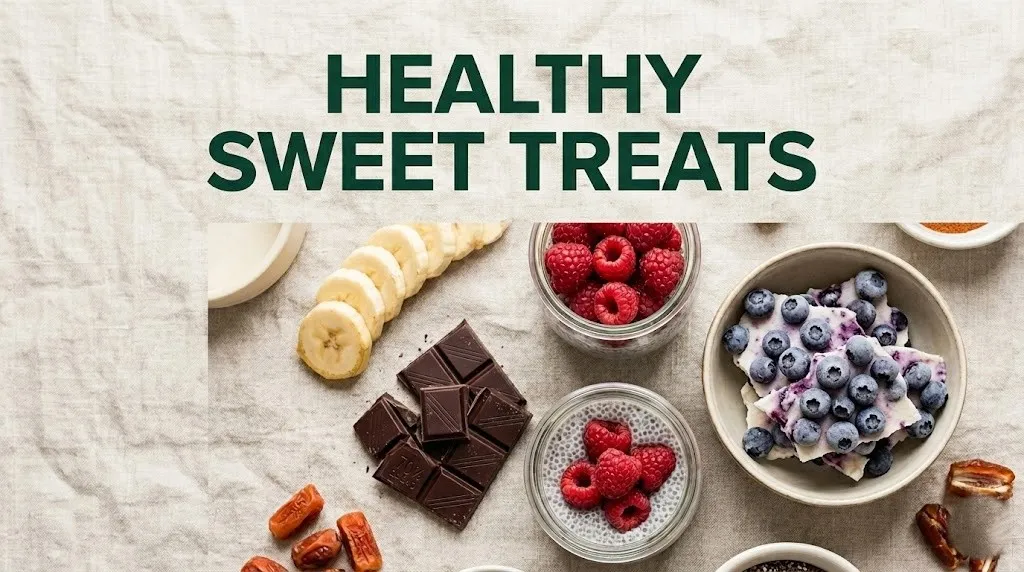
Healthy sweet treats are real, satisfying desserts built around whole ingredients, controlled added sugar, and enough fiber or protein to keep you from crashing 20 minutes after eating.
The American Heart Association recommends no more than 25 grams of added sugar per day for women and 36 grams for men. Most conventional desserts blow past that in a single serving, which is precisely why having a reliable set of genuinely better options matters.
This guide covers 15 specific ideas, from no-bake five-minute recipes to bake-sale-worthy treats your kids will actually want. You’ll get nutritional context for every category, substitution logic, and honest guidance for people managing weight, blood sugar, or dietary restrictions.
Healthy Sweet Treats: What They Are and Why They Matter
Healthy sweet treats are desserts and snacks that deliver sweetness through whole-food ingredients while keeping added sugar, refined carbohydrates, and low-nutrition fats in check.
The distinction matters more than most people realize. A treat sweetened primarily with Medjool dates (Phoenix dactylifera) delivers roughly 16 grams of natural sugar per date, but it also delivers 1.6 grams of dietary fiber, potassium, and magnesium. A standard store-bought cookie of similar size delivers similar sugar with almost none of those supporting nutrients.
That fiber buffer is the key difference. Think of dietary fiber like a slow-release valve on a water pipe. Without it, sugar floods your bloodstream quickly. With it, absorption slows, and your blood glucose stays steadier.
The Academy of Nutrition and Dietetics notes that the context of sugar matters as much as the amount. Sugar in a whole date behaves differently in the body than the same sugar dissolved in a frosting, precisely because of the fiber, water, and micronutrient matrix surrounding it.
Key nutrients to look for in genuinely healthy sweet options include:
- Dietary fiber: at least 2 grams per serving
- Protein: at least 3 grams per serving for a more satisfying treat
- Added sugar: ideally below 8 grams per serving
- Whole-food ingredients: identifiable fruits, nuts, seeds, whole grains, or dairy
People with tree nut allergies should note that many whole-food-based treats rely on almonds or cashews. Seed-based alternatives like sunflower seed butter or tahini (sesame paste) work well in most recipes.
What Makes a Dessert Healthy
A dessert qualifies as healthy when it provides meaningful nutritional value alongside sweetness, rather than sweetness alone.
That sounds obvious, but most so-called “healthy” desserts in grocery stores and on recipe blogs fail this test. A product labeled “low-fat” may replace fat with added sugar. A product labeled “natural” may still contain 20 or more grams of added sugar per serving with negligible fiber or protein.
The USDA Dietary Guidelines for Americans 2020-2025 recommend limiting added sugars to less than 10 percent of total daily calories. On a standard 2,000-calorie diet, that is a ceiling of 50 grams of added sugar per day, though the American Heart Association sets a stricter target of 25 to 36 grams depending on sex.
| What to Look For | What to Limit |
|---|---|
| Whole fruit as primary sweetener | High-fructose corn syrup |
| At least 2g fiber per serving | Refined white flour as base |
| At least 3g protein per serving | More than 10g added sugar per serving |
| Unsaturated fats (nuts, seeds) | Partially hydrogenated oils |
| Identifiable whole-food ingredients | Artificial colors or flavors |
Preparation method changes the nutritional picture meaningfully. A baked oat cookie made with oat flour, mashed banana (Musa spp.), and dark chocolate chips is a different nutritional proposition than a pan of frosted brownies, even if both feel like treats.
People following a diabetic-friendly diet or a low-glycemic eating pattern should pay specific attention to the carbohydrate-to-fiber ratio. A carbohydrate count of 25 grams with 5 grams of fiber produces a net carb figure that affects blood glucose very differently than 25 grams of carbohydrate with 0.5 grams of fiber.
Healthy Sweet Treats for Weight Loss
Healthy sweet treats can fit into a weight-loss eating plan without derailing a calorie deficit, as long as portion size and ingredient quality are managed deliberately.
The principle behind successful weight management is not eliminating dessert. It is choosing options that satisfy the craving efficiently without adding hundreds of empty calories. A Greek yogurt parfait with berries and a teaspoon of honey delivers around 150 to 180 calories, roughly 12 to 15 grams of protein, and genuine satiety. A standard slice of cheesecake delivers 400 to 500 calories with minimal protein or fiber.
Protein is the most important factor in a weight-loss-friendly treat. A study published in the American Journal of Clinical Nutrition found that higher protein intake at meals and snacks is associated with increased satiety and reduced overall calorie consumption across the day.
The practical goal is desserts that stop hunger rather than accelerate it. Standard high-sugar, low-fiber treats trigger a blood glucose spike followed by a drop, which many people experience as increased hunger within an hour or two of eating.
Weight-loss-friendly sweet treat targets per serving:
- Calories: 100 to 200
- Protein: 5 grams or more
- Added sugar: 8 grams or fewer
- Fiber: 2 grams or more
- Saturated fat: below 4 grams
People on very low-calorie diets (below 1,200 calories daily) should work with a registered dietitian before making structural changes to their eating pattern, as macronutrient balance becomes increasingly important at low calorie levels.
Key Takeaway: Healthy sweet treats are defined not just by low sugar, but by the presence of fiber, protein, and whole-food ingredients that support satiety rather than undermine it.
How to Satisfy a Sweet Tooth Healthily
Satisfying a sweet craving in a healthy way works best when you redirect the craving toward whole-food sweetness rather than trying to suppress it entirely.
Suppression rarely works long-term. Research published in the journal Appetite suggests that attempting to completely restrict craved foods tends to increase their psychological salience, making cravings stronger over time rather than weaker.
The more effective strategy is meeting the craving with a genuinely satisfying alternative. Frozen grapes, for example, have a texture that mimics sorbet when eaten directly from the freezer. A square of dark chocolate (Theobroma cacao) with at least 70 percent cacao delivers real sweetness alongside flavonoids, magnesium, and a fat content that slows absorption. A ripe, frozen banana blended alone becomes a creamy, ice cream-like dessert with no added sugar and about 105 calories per medium fruit.
The pattern here is leveraging the natural sugar concentration in fruit, the bitterness-balancing effect of fat in dark chocolate, and the textural satisfaction of cold or creamy foods. These are real sensory levers, not wellness tricks.
| Craving Type | Healthy Redirect | Why It Works |
|---|---|---|
| Ice cream | Frozen banana “nice cream” | Creamy texture, natural sugar, no added fat |
| Candy bar | Dark chocolate + almonds | Fat + flavonoids slow absorption |
| Cookies | Oat-date energy balls | Fiber + natural sweetness, portable |
| Milkshake | Greek yogurt + frozen fruit blend | Protein + natural sweetness |
| Cake | Berry chia seed pudding | Creamy texture, omega-3s, high fiber |
People managing anxiety or stress-related eating should note that the pattern of craving-and-satisfaction is partly habitual. Substituting a whole-food option consistently over several weeks can gradually shift the habit baseline, according to behavioral nutrition research.
Easy Healthy Dessert Recipes with Few Ingredients
The best easy healthy dessert recipes with few ingredients require between 2 and 5 whole-food components and no specialized equipment.
“Few ingredients” is relative to cooking experience. These recipes assume basic kitchen access: a freezer, a blender or food processor, mixing bowls, and measuring spoons. None require a stand mixer, candy thermometer, or pastry skills.
3-Ingredient No-Bake Peanut Butter Oat Cookies
Yield: 12 cookies | Prep: 10 minutes | Chill: 30 minutes | Approx. 120 calories per cookie
- Combine 1 cup (90g) rolled oats, 1/2 cup (125g) natural peanut butter, and 3 tablespoons (60g) raw honey in a bowl.
- Mix until a uniform dough forms. If the mixture is too dry, add 1 teaspoon of water at a time.
- Roll into 12 balls, approximately 1.5 tablespoons each.
- Flatten slightly onto a parchment-lined plate.
- Refrigerate for at least 30 minutes until firm. Store in an airtight container in the fridge for up to 5 days.
Nutritional note per cookie (approximate): 120 calories, 4g protein, 2g fiber, 5g fat, 5g added sugar.
2-Ingredient Banana Chocolate Bark
Yield: 8 pieces | Prep: 5 minutes | Freeze: 90 minutes | Approx. 80 calories per piece
- Slice 2 ripe bananas (Musa spp.) into rounds, about 1cm thick.
- Melt 50g of dark chocolate (minimum 70% cacao) gently over a double boiler or in 30-second microwave bursts, stirring between each.
- Dip each banana slice halfway into the melted chocolate.
- Place on a parchment-lined tray and freeze for 90 minutes minimum.
People with peanut allergies should note that cross-contamination is possible with commercial peanut butter. Sunflower seed butter (sunflower seed paste) is a reliable nut-free alternative in the oat cookie recipe.
Healthy Sweet Treats with No Added Sugar
Healthy sweet treats with no added sugar rely entirely on the natural sugars in whole fruit, dairy, and certain vegetables for their sweetness.
No added sugar does not mean no sugar. A ripe Medjool date (Phoenix dactylifera) contains approximately 16 grams of natural sugar. Frozen mango contains roughly 14 grams of sugar per 100 grams. The critical difference is that these sugars come packaged with fiber, water, vitamins, and minerals that influence how the body processes them.
The FDA defines “no added sugars” as containing no sugars added during processing and no ingredients that are sugar substitutes. Foods can still contain naturally occurring sugars and carry this label.
No-added-sugar treat options with genuine nutritional value include:
- Chia seed pudding (Salvia hispanica): made with unsweetened almond milk and topped with fresh berries. Provides approximately 10 grams of fiber per serving and significant omega-3 fatty acids (alpha-linolenic acid).
- Baked cinnamon pears: halved pears roasted at 190°C (375°F) for 20 minutes with cinnamon and a pinch of cardamom. Natural pectin softens into a caramel-like texture.
- Frozen mango sorbet: blended frozen mango with a squeeze of lime. No added sugar, approximately 100 calories per cup.
- Date and nut bliss balls: blended Medjool dates with unsweetened cocoa powder and walnuts. No added sugar; fiber and healthy fats in every bite.
People monitoring total carbohydrate intake, including those with type 2 diabetes or following a ketogenic diet, should still account for the natural sugar content in these options. No-added-sugar does not mean carbohydrate-free.
Healthy Desserts for Diabetics
Healthy desserts for people with type 2 diabetes prioritize low glycemic index (GI) ingredients, high fiber content, and moderate portion sizes to minimize post-meal blood glucose spikes.
The American Diabetes Association does not recommend eliminating dessert entirely. Its guidance emphasizes carbohydrate counting, portion control, and choosing options that fit within an individual’s daily carbohydrate target, typically set with a registered dietitian.
The glycemic index measures how quickly a carbohydrate-containing food raises blood glucose on a scale of 0 to 100. Foods below 55 are considered low GI. Whole fruit, Greek yogurt, chia seeds (Salvia hispanica), and dark chocolate (Theobroma cacao, 70 percent or higher) all fall in this range.
| Dessert Option | GI Range | Fiber per Serving | Protein per Serving |
|---|---|---|---|
| Chia seed pudding | 30-35 | 10g | 5g |
| Greek yogurt with berries | 25-35 | 2g | 12g |
| Dark chocolate (70% cacao, 30g) | 23 | 2g | 2g |
| Baked cinnamon apple | 38-40 | 3g | 0g |
| Frozen banana nice cream (1/2 banana) | 48-52 | 1.5g | 0.6g |
People with type 2 diabetes vary considerably in their individual glucose response to specific foods based on insulin sensitivity, medication, activity level, and overall diet composition. Anyone using diet to manage blood glucose should work with a registered dietitian or certified diabetes care and education specialist to determine appropriate carbohydrate targets and safe treat options for their specific situation.
Key Takeaway: For people managing blood sugar, the goal is not avoiding sweetness altogether, but choosing options with low glycemic index values, meaningful fiber content, and controlled portions.
High-Protein Healthy Desserts
High-protein healthy desserts are treats that deliver at least 6 to 8 grams of protein per serving, using ingredients like Greek yogurt, eggs, cottage cheese, nut butters, seeds, or protein powder.
Protein’s role in dessert goes beyond muscle support. A study in the journal Nutrients found that protein-rich snacks reduced subsequent calorie intake at the next meal compared to high-carbohydrate snacks with equivalent calorie content. Practically speaking, a high-protein treat is more likely to keep you satisfied until your next meal.
The most protein-dense whole-food dessert bases include:
- Greek yogurt (strained yogurt): approximately 17 grams of protein per 170g serving
- Cottage cheese: approximately 14 grams of protein per 113g serving. Blended smooth, it works as a base for mousse or cheesecake-style fillings.
- Eggs: whole eggs contribute 6 grams of protein each and work as binders in baked treats.
- Natural peanut butter: approximately 8 grams of protein per 2-tablespoon serving
- Hemp seeds (Cannabis sativa, seed only): approximately 10 grams of protein per 3-tablespoon serving
A protein-forward dessert idea requiring no baking: blend 170g Greek yogurt, 1 tablespoon (16g) natural almond butter, 1 teaspoon (7g) raw honey, and a pinch of cinnamon. Top with 30g dark chocolate chips. This delivers approximately 20 grams of protein, 3 grams of fiber, and under 250 calories.
People following a plant-based diet can achieve comparable protein levels using silken tofu, hemp seeds, or pea protein powder as bases. Individuals with dairy allergies should avoid Greek yogurt and cottage cheese entirely; coconut yogurt with added protein powder is a functional alternative, though protein content will vary by brand.
Simple Healthy Desserts Anyone Can Make
Simple healthy desserts are options that require no specialized technique, no unusual equipment, and ingredients most kitchens already have.
The definition of “simple” shifts based on who’s in the kitchen. For a confident home baker, three-ingredient cookies are genuinely quick. For someone who rarely cooks, even those can feel daunting. These options deliberately avoid techniques beyond stirring, blending, and chilling.
Four genuinely simple options:
- Yogurt bark: Spread 250g plain Greek yogurt on a parchment-lined tray. Scatter 100g mixed frozen berries and 2 tablespoons (18g) granola across the top. Freeze for 3 hours. Break into pieces. Stores frozen for 1 week.
- Sliced apple with almond butter: Two tablespoons of natural almond butter (approximately 196 calories, 5g protein, 3g fiber) with one medium apple (Malus domestica) provides fiber, healthy fats, and natural sweetness in under 2 minutes.
- Frozen grapes: Place seedless grapes in the freezer for 2 hours. The texture becomes firm and almost candy-like. One cup provides approximately 62 calories and 1 gram of fiber.
- Banana cocoa mousse: Blend 2 ripe bananas with 2 tablespoons (10g) unsweetened cocoa powder. Serves 2 at approximately 120 calories each.
According to the USDA Dietary Guidelines for Americans, most adults fall short of the recommended 1.5 to 2 cups of fruit per day. Fruit-forward desserts are one of the most straightforward ways to close that gap without adding a supplementary food category to your routine.
People with latex-fruit syndrome (an allergy cross-reaction) may react to bananas, avocados, or kiwi. If you experience oral itching after eating these fruits, a conversation with an allergist is appropriate before making them a daily staple.
Healthy No-Bake Desserts
Healthy no-bake desserts are treats assembled without heat, relying on refrigeration, freezing, or room-temperature setting to achieve the right texture.
No-bake options appeal to people without ovens, those cooking in summer heat, and anyone who wants a ready result faster than a standard baking timeline. The technique is also more forgiving: there is no risk of overbaking, and most no-bake recipes tolerate minor measurement variations better than baked goods do.
No-Bake Dark Chocolate Chia Seed Pudding
Yield: 2 servings | Prep: 5 minutes | Set time: 4 hours or overnight | Approx. 185 calories per serving
- Combine 4 tablespoons (48g) chia seeds (Salvia hispanica) with 400ml unsweetened almond milk in a jar or bowl.
- Add 2 tablespoons (10g) unsweetened cocoa powder and 1 tablespoon (21g) raw honey or 1 teaspoon vanilla extract for flavor without added sugar.
- Whisk thoroughly for 60 seconds to prevent clumping. Clumping happens when chia seeds settle before the gel forms.
- Cover and refrigerate for minimum 4 hours, ideally overnight.
- Stir before serving. Top with 30g fresh raspberries or a few cacao nibs.
This recipe delivers approximately 10 grams of fiber, 5 grams of protein, and omega-3 fatty acids (alpha-linolenic acid, ALA) in each serving. The ALA content in chia seeds is notable: chia seeds are one of the most concentrated plant-based sources of this essential fatty acid.
People following a strict ketogenic diet should note that chia seeds contain approximately 12 grams of carbohydrates per 4-tablespoon serving, though 10 of those grams are fiber, producing a net carbohydrate figure of approximately 2 grams.
Key Takeaway: No-bake desserts built on chia seeds, frozen fruit, and dark chocolate deliver real nutritional value alongside genuine sweetness, often in under 10 minutes of active preparation.
Healthy Frozen Desserts
Healthy frozen desserts are sweet options served cold or frozen, built around whole fruit, dairy, or low-added-sugar bases rather than the cream, sugar, and stabilizer formulas in commercial ice cream.
Commercial ice cream ranges from 200 to 350+ calories per half-cup serving with 15 to 30 grams of added sugar and minimal nutritional return. Frozen alternatives built on whole fruit or yogurt can deliver the same cold, creamy satisfaction with a fundamentally different nutritional outcome.
The most nutritionally sound frozen dessert base options:
- Banana nice cream: One ingredient. Freeze 2 ripe bananas, blend until smooth. Results in a genuinely creamy texture through the natural pectin and water content of the fruit. Add 1 tablespoon (5g) cocoa powder for a chocolate version. Approximately 105 calories per banana used.
- Frozen yogurt bark: Detailed under the simple healthy desserts section. Approximately 90 to 120 calories per portion.
- Mango sorbet: Blend 200g frozen mango with 2 tablespoons (30ml) lime juice. No added sugar, approximately 130 calories per cup, and a meaningful contribution toward daily vitamin C (ascorbic acid) intake.
- Watermelon mint popsicles: Blend 400g watermelon with 10 fresh mint leaves and 2 tablespoons (30ml) lime juice. Pour into popsicle molds and freeze 4 hours. Approximately 45 calories each.
A Harvard T.H. Chan School of Public Health analysis of frozen dessert consumption found that swapping high-sugar, high-fat frozen desserts for fruit-based alternatives was among the dietary shifts most consistently linked to reduced added sugar intake in observational studies.
People with fructose malabsorption should note that high-fructose fruits like mango and watermelon may cause digestive discomfort at large servings. Smaller portions, around 100g, are generally better tolerated.
Healthy Chocolate Desserts
Healthy chocolate desserts use dark chocolate (Theobroma cacao) with a minimum 70 percent cacao content as their primary chocolate source, delivering genuine cocoa flavonoids alongside sweetness.
The cacao content percentage is not a marketing number. It directly indicates the proportion of actual cocoa-derived solids versus sugar and dairy fillers. A 90 percent dark chocolate bar contains roughly 1 to 3 grams of added sugar per square (10g) and approximately 40 to 60mg of flavonoids. A standard milk chocolate bar at the same weight contains 5 to 8 grams of sugar with minimal flavonoid content.
According to research published in the British Journal of Nutrition, regular consumption of high-cacao dark chocolate is associated with improvements in endothelial function (the flexibility of blood vessel walls) and modest reductions in blood pressure in some populations. Serving size context matters: these effects are studied at consumption levels of 20 to 30 grams per day, not a full bar.
Healthy chocolate dessert options worth keeping in your rotation:
- Dark chocolate almond clusters: Melt 70g dark chocolate (70% cacao), stir in 80g raw almonds, drop by spoonfuls onto parchment, chill 30 minutes. Yield: 10 clusters at approximately 120 calories each.
- Cocoa-dusted Medjool dates: Pit 6 dates, press one almond into each, roll in 1 teaspoon (2g) cocoa powder. Each provides approximately 80 calories, 2g fiber, and genuine sweetness.
- 2-ingredient chocolate mousse: Blend 400ml chilled coconut cream with 3 tablespoons (15g) unsweetened cocoa powder and 1 tablespoon (21g) maple syrup. Chill 1 hour. Approximately 150 calories per half-cup serving.
People with caffeine sensitivity should note that dark chocolate contains 12 to 25mg of caffeine per 30g serving. This is considerably less than coffee, but relevant for individuals who react to even small caffeine doses or eat dark chocolate close to bedtime.
Healthy Bake Sale Ideas
Healthy bake sale ideas are treats that appeal broadly enough to sell well in a group setting while being built from nutritionally better ingredients than conventional baked goods.
The challenge of the bake sale is that the audience is varied: children, parents, people with dietary restrictions, and people who just want something tasty. The goal is not to announce the health properties (that rarely drives sales), but to make genuinely delicious things that happen to be nutritionally better.
These options sell well and hold up in packaging:
- No-bake energy balls: 1 cup (90g) rolled oats, 1/2 cup (125g) peanut butter, 3 tablespoons (63g) honey, 1/4 cup (40g) mini dark chocolate chips. Roll into balls, chill. Individually wrap in parchment squares. Approximately 130 calories each.
- Banana oat cookies: Mash 2 ripe bananas, combine with 1 cup (90g) oats, 1/2 teaspoon cinnamon, and 60g dark chocolate chips. Bake at 175°C (350°F) for 12 minutes. Yield: 12 cookies at approximately 90 calories each.
- Almond butter blondies: Use almond flour as the base, sweetened with maple syrup and vanilla. Gluten-optional, dairy-free adaptable. These photograph well and pack cleanly.
- Dates with peanut butter and sea salt: Pit dates, fill with 1 teaspoon natural peanut butter, finish with a flake of sea salt. No baking. Extremely visual for a bake sale table.
Labeling matters at bake sales. Always label common allergens clearly: tree nuts (almonds, peanuts), gluten (oats, unless certified gluten-free), and dairy. This is not just good practice; in many school and organized event settings, allergen disclosure is a legal requirement.
Key Takeaway: Healthy bake sale treats succeed when they’re built for taste first, with nutritional improvements made through ingredient swaps rather than visible “health food” branding.
Healthy Dessert Swaps and Substitutions
Healthy dessert swaps replace high-added-sugar, low-fiber ingredients with whole-food alternatives that perform a similar function in recipes without sacrificing texture or flavor.
The logic behind a good substitution is not just reducing calories. It is replacing an ingredient that delivers sweetness without nutritional return (refined white sugar, margarine, white flour) with one that delivers sweetness alongside fiber, protein, or micronutrients. The swap must work texturally, or the dessert fails.
| Original Ingredient | Healthy Swap | Why It Works | Ratio |
|---|---|---|---|
| White sugar | Mashed banana (Musa spp.) | Provides sweetness + pectin for binding | 1 cup sugar = 1 cup mashed banana |
| Butter | Applesauce (unsweetened) | Provides moisture + mild sweetness | 1:1 replacement by volume |
| All-purpose flour | Oat flour | Higher fiber, similar texture in many baked goods | 1:1 by weight |
| All-purpose flour | Almond flour | Higher protein + fat, denser result | Use 3/4 cup almond flour per 1 cup AP flour |
| Heavy cream | Coconut cream | Similar fat texture, dairy-free | 1:1 by volume |
| Refined sugar (in puddings) | Medjool dates (blended) | Sweetness + fiber + minerals | 1 cup sugar = 1 cup date paste |
| Egg (binding) | 1 tbsp chia seeds + 3 tbsp water | Sets like egg in baked goods | 1 egg = 1 chia “egg” (let sit 10 minutes) |
Texture results vary. Banana substitution for sugar adds moisture, so baked goods may need slightly reduced liquid elsewhere. Almond flour lacks gluten, so baked goods are denser and more crumbly than wheat-flour versions.
People with celiac disease should use only certified gluten-free oat flour, as standard oats are often processed in facilities that handle wheat, risking cross-contamination.
Healthy Sweet Treats Kids Will Eat
Healthy sweet treats that kids will actually eat rely on familiar flavors, appealing textures, and visual presentation, rather than reduced sweetness alone.
Children’s palates are not defective. They genuinely prefer sweeter flavors because their taste receptors are more sensitive to sweetness than adults. The strategy that works is not tricking them with “healthy” foods that don’t taste good; it is meeting them at sweet, creamy, and satisfying while using whole-food ingredients to get there.
Reliably kid-accepted healthy sweet treats:
- Frozen yogurt tubes: Fill reusable popsicle molds with plain Greek yogurt blended with 100g frozen strawberries and 1 tablespoon (21g) honey. Freeze overnight. These look like commercial yogurt tubes and taste genuinely sweet.
- Chocolate-dipped frozen banana pops: Halve bananas, insert popsicle sticks, freeze 1 hour, dip in melted dark chocolate, return to freezer for 30 minutes. Approximately 160 calories each.
- Berry chia seed popsicles: Blend 200g mixed berries with 250ml coconut milk and 2 tablespoons (24g) chia seeds. Freeze in molds for 4 hours. Each popsicle contains approximately 2 grams of fiber.
- Oat and honey granola bars: Combine 2 cups (180g) rolled oats, 1/3 cup (113g) honey, 1/4 cup (65g) peanut butter, and 60g dark chocolate chips. Press into a lined pan, refrigerate 1 hour, cut into 12 bars.
The Academy of Nutrition and Dietetics recommends involving children in food preparation from early ages as a strategy for building positive associations with varied, nutritious foods. Letting kids stir, pour, and assemble their own treats increases their willingness to eat the result, even when the ingredients differ from what they would normally choose.
Children with tree nut or peanut allergies, which are among the most common childhood food allergies according to the Centers for Disease Control and Prevention, should avoid peanut butter and almond-based recipes. Sunflower seed butter (sunflower seed paste, Helianthus annuus) is a nut-free and peanut-free alternative with a comparable protein and fat profile.
Frequently Asked Questions About Healthy Sweet Treats
What are the healthiest sweet snacks you can eat every day?
The healthiest sweet snacks for daily eating are whole-fruit-based options like fresh berries, a small Medjool date (Phoenix dactylifera), or frozen grapes, ideally paired with a protein or fat source to slow sugar absorption. Greek yogurt with berries, a small apple with almond butter, or a square of dark chocolate (70 percent cacao or higher) at 10 to 20 grams are all nutritionally defensible daily options. Rotating variety matters because different fruits provide different vitamins, minerals, and fiber types.
Can I eat healthy desserts and still lose weight?
Yes, healthy desserts can fit within a calorie deficit as long as portion sizes and macronutrient balance are managed. Options built on Greek yogurt, whole fruit, chia seeds (Salvia hispanica), and dark chocolate tend to be satisfying at lower calorie counts than conventional desserts, which supports overall calorie control. Tracking serving sizes, even with healthy ingredients, remains important because calories from nutritious foods still count toward a daily total.
What sweet treats are OK for people with type 2 diabetes?
People with type 2 diabetes can generally eat low-glycemic index sweet treats in controlled portions, particularly options built on chia seeds, Greek yogurt, berries, and dark chocolate with at least 70 percent cacao. The American Diabetes Association recommends focusing on total carbohydrate content and glycemic impact rather than eliminating dessert entirely, and suggests working with a certified diabetes care and education specialist to set individual carbohydrate targets. Portion size is as important as ingredient choice, since even low-GI foods raise blood glucose at large quantities.
How do I make healthy desserts taste as good as regular ones?
Healthy desserts taste comparable to conventional ones when the substitutions preserve the original sensory experience: sweetness, creaminess, or rich chocolate flavor. Ripe bananas, Medjool dates blended into paste, full-fat coconut cream, and high-quality dark chocolate are the most effective tools because they deliver genuine flavor intensity rather than a diluted approximation. Chilling no-bake desserts long enough and using adequately ripe fruit are two technique factors that separate a genuinely good healthy dessert from a disappointing one.
What are the best no-bake healthy dessert recipes with few ingredients?
The best no-bake healthy desserts with few ingredients include chia seed pudding (chia seeds, unsweetened milk, optional cocoa), frozen banana nice cream (one ingredient: frozen ripe bananas), and no-bake oat energy balls (oats, peanut butter, honey). These recipes require 2 to 5 ingredients, no oven, and between 5 and 15 minutes of active preparation time. Setting or freezing time varies from 30 minutes for energy balls to 4 hours for chia pudding, so planning ahead by a few hours delivers the best result.
Healthy sweet treats are not a compromise. They are a different design brief: build for satisfaction with better materials.
The most reliable shift you can make right now is stocking your freezer with ripe bananas, a bag of mixed berries, and a bar of quality dark chocolate with at least 70 percent cacao. Those three ingredients alone cover banana nice cream, chocolate bark, and berry yogurt parfaits without any special knowledge or expensive equipment.
Start with one recipe from this list this week. Taste it honestly. Adjust sweetness with a small amount of raw honey or maple syrup if needed. The goal is not perfect nutrition on every bite, it is a pattern of choices that adds up to genuinely better eating over time.