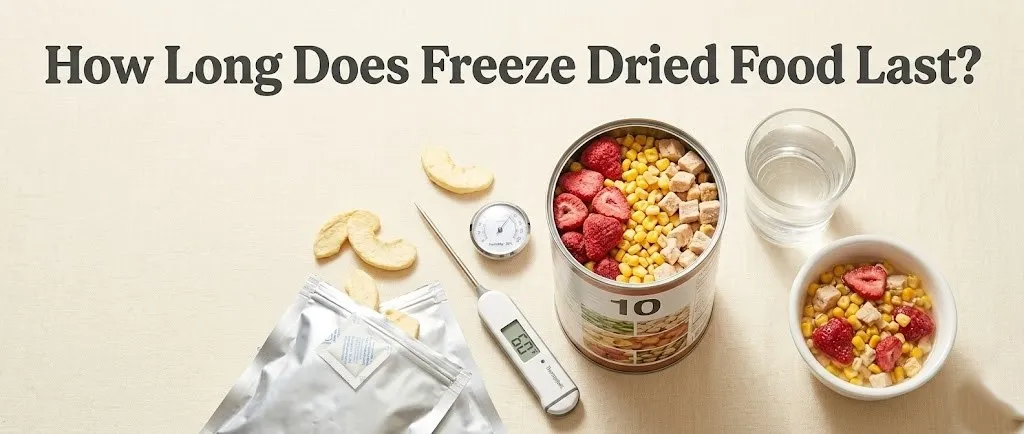
Properly packaged freeze-dried food stored in a cool, dark environment lasts between 25 and 30 years as a life-sustaining staple and essentially indefinitely as a safe, edible food source, though the vitamin content degrades gradually over time. The exact number depends entirely on the food type, the storage temperature, and the integrity of the packaging seal.
This is not a marketing claim invented by emergency food companies. The Brigham Young University Department of Nutrition, Dietetics, and Food Science has conducted accelerated aging studies on freeze-dried products, using the Q10 temperature coefficient to model the degradation curve over decades. The science is sound. A freeze-dried apple stored at 60 degrees Fahrenheit in a sealed Mylar bag with an oxygen absorber will be safe to eat and nutritionally recognizable when your toddler is graduating from college.
We will break down the exact shelf life by food category, show you the storage protocol that gets you to that 30-year mark, and explain the safety step that everyone forgets: how to rehydrate the food without turning it into a bacterial petri dish.
How Long Does Freeze Dried Food Last
Freeze-dried food lasts 25 to 30 years when stored in a sealed, oxygen-free container at a stable temperature of 60 degrees Fahrenheit (15 degrees Celsius) or below, with the specific shelf life varying by food type and fat content. The 30-year number is not a guarantee printed on the can. It is a scientifically modeled estimate based on accelerated aging tests and real-world samples pulled from long-term storage.
The mechanism behind this extreme shelf life is the removal of water. The freeze-drying process, formally called lyophilization, freezes the food solid and then places it under a deep vacuum. The frozen water in the food sublimates, transitioning directly from ice to vapor without passing through the liquid phase. The result is a food with roughly 1 to 2 percent residual moisture content. Bacteria, yeast, and mold require a water activity level above 0.60 to grow. Freeze-dried food sits at a water activity around 0.10 to 0.20, which is a biological desert where nothing can reproduce.
The nutrients in freeze-dried food degrade along a predictable curve. The macronutrients, protein, carbohydrates, and fats, are stable for decades in the absence of oxygen. The micronutrients, particularly ascorbic acid (vitamin C) and thiamine (vitamin B1), are the first to drop. According to research from the USDA Agricultural Research Service, vitamin C retention in freeze-dried fruits stored at room temperature can drop to 50 percent after 10 to 15 years. The food is still safe. It still provides calories and protein. It is simply less vitamin-dense than it was on day one.
The temperature of your storage space is the single largest variable you control. The Q10 rule states that the rate of a chemical reaction, including nutrient degradation, roughly doubles for every 10 degrees Celsius increase in temperature. A can stored at 90 degrees Fahrenheit degrades roughly four times faster than one stored at 60 degrees Fahrenheit. The difference between a garage in Phoenix and a basement in Seattle is not marginal. It is the difference between a 30-year shelf life and a 7-year shelf life.
Freeze Dried Food Shelf Life Chart
A freeze-dried food shelf life chart maps the estimated “life-sustaining” shelf life of different food categories under optimal storage conditions, with low-fat fruits and grains topping the chart at 25 to 30 years, and high-fat meats and dairy products settling in the 10 to 15 year range. The fat content is the rate-limiting factor.
Fats oxidize. Even in an oxygen-free environment, the small amount of residual oxygen trapped in the food matrix and the natural enzymatic activity slowly break down unsaturated fats into rancid free fatty acids. A freeze-dried raspberry has almost no fat and will last three decades with minimal degradation. A freeze-dried slice of cheddar cheese has a high butterfat content and will develop a stale, rancid off-flavor within 10 to 15 years, even though it is still technically safe to eat.
Grains and legumes are the champions of the chart. Freeze-dried rice, pasta, and beans, which are already low-moisture, low-fat foods, become nearly immortal when freeze-dried and sealed. A 2024 study that pulled 30-year-old samples of freeze-dried pinto beans from a storage facility found that the beans rehydrated and cooked identically to fresh-dried beans, with no detectable loss of protein quality.
The chart assumes optimal packaging. A number 10 can, sealed with a nitrogen flush and an oxygen absorber, is the gold standard. A Mylar bag, heat-sealed with an oxygen absorber, is a close second. A plastic bucket with a gamma seal lid, without an oxygen absorber, is not a long-term solution. The chart applies only to properly packaged, unopened containers.
| Food Category | Estimated Shelf Life (Optimal) | Primary Limiting Factor |
|---|---|---|
| Fruits (low-fat) | 25 to 30 years | Vitamin C degradation |
| Vegetables (low-fat) | 20 to 25 years | Texture softening, color fading |
| Grains & Legumes | 30+ years | No significant limit |
| Lean Meats | 15 to 20 years | Protein texture, slight flavor change |
| Fatty Meats | 10 to 15 years | Lipid oxidation (rancidity) |
| Dairy & Cheese | 10 to 15 years | Fat oxidation, off-flavors |
| Full Entree Meals | 15 to 25 years | Varies by dominant ingredient |
Does Freeze Dried Food Go Bad
Yes, freeze-dried food can eventually go bad, but the failure mode is almost never microbial spoilage. It is a gradual loss of texture, flavor, and nutritional quality driven by oxygen exposure, temperature fluctuations, and the slow, inexorable oxidation of fats. The food becomes unappetizing long before it becomes unsafe.
A properly freeze-dried and sealed can of food is functionally sterile and inert. The pathogens that cause foodborne illness, Salmonella, E. coli, Listeria, require free water to reproduce. In a 1 percent moisture environment, they cannot multiply. They may still be present in a dormant state if the raw material was contaminated before freeze-drying, but they cannot increase in number. The risk of food poisoning from a properly processed, sealed, and undamaged can of freeze-dried food is essentially zero, even decades past the best-by date.
The real spoilage pathway is chemical. When the seal on a Mylar bag fails, or when a can is repeatedly opened and closed, oxygen enters the headspace. The oxygen reacts with the polyunsaturated fats in the food, creating lipid peroxides and volatile aldehydes that smell and taste rancid. The food is not going to give you a bacterial infection, but it will taste like stale cardboard soaked in old cooking oil. You will not want to eat it.
Another failure mode is moisture ingress. If a pinhole leak develops in a Mylar bag and the bag is stored in a humid environment, the freeze-dried food will slowly absorb ambient moisture. The water activity rises. Eventually, it crosses the threshold where dormant mold spores can germinate. You will see visible fuzzy growth. That food is compromised and must be discarded. The risk is from mycotoxins produced by the mold, not from the mold itself being acutely toxic.
Freeze Dried Meat Shelf Life
Freeze-dried lean meat, such as chicken breast or lean ground beef, has a shelf life of 15 to 20 years under optimal storage conditions, while fatty meats like bacon or sausage are closer to 10 to 15 years due to the higher rate of lipid oxidation. The leaner the meat, the longer the shelf life.
The freeze-drying process for meat involves cooking the meat first, then freeze-drying the cooked product. The cooking step denatures the proteins and kills vegetative pathogens. The freeze-drying step removes the water and locks the protein matrix into a porous, sponge-like structure that rehydrates in minutes. The cooked-then-dried process means freeze-dried meat is technically ready to eat straight from the can, though the texture is vastly improved by rehydration.
The primary degradation pathway in freeze-dried meat is fat oxidation. Even lean chicken breast contains 3 to 4 grams of fat per 4-ounce serving. Over 15 to 20 years, that fat slowly oxidizes. The meat develops a stale, cardboard-like flavor. The protein quality, measured by the Protein Digestibility Corrected Amino Acid Score, remains largely intact. The meat is still nutritionally functional as a protein source. It simply does not taste fresh.
For emergency food storage, the rule is to stock lean meats and rotate your stock. Do not buy a 20-year supply of freeze-dried bacon and expect it to taste good in 2046. Buy freeze-dried chicken, turkey, and lean beef. Store them at a stable 60 degrees Fahrenheit. Open a can at year 5, year 10, and year 15. Taste it. If the flavor is acceptable, the stock is good. If the flavor has turned, the stock is still safe but should be seasoned heavily in a stew or chili to mask the off-notes.
Freeze Dried Fruit Shelf Life
Freeze-dried fruit has the longest shelf life of any freeze-dried food category, clocking in at 25 to 30 years for low-acid, low-fat fruits like apples and peaches, and 20 to 25 years for high-acid fruits like berries. The fruit’s natural low fat content and high sugar matrix protect it from both microbial growth and oxidative rancidity.
The sugar in the fruit acts as a natural preservative. The sugar molecules bind to the remaining water molecules in the freeze-dried matrix, lowering the water activity even further. A freeze-dried strawberry is essentially a porous sugar-sponge with strawberry flavor embedded in it. The sugar glass physically traps the volatile aromatic compounds that give the fruit its flavor.
The primary degradation pathway in fruit is vitamin C loss and color fading. Ascorbic acid is an inherently unstable molecule. It oxidizes over time, especially in the presence of residual oxygen. A freeze-dried apple stored for 20 years will have a fraction of the vitamin C of a fresh apple, but it will still have all the calories, fiber, and minerals. The color will also fade from vibrant to a dull, muted brown as the pigments oxidize.
Freeze-dried fruit is the ideal entry point for a long-term food storage plan. It is cheap, it lasts effectively forever, and it rehydrates beautifully in oatmeal, yogurt, or baked goods. Even if the vitamin C has degraded, the fruit still adds fiber, flavor, and a sense of freshness to a meal made from stored staples.
Key Takeaway: The shelf life of freeze-dried food is a direct function of fat content, storage temperature, and packaging integrity. Low-fat fruits and grains stored in a sealed can at 60 degrees Fahrenheit will outlast your mortgage.
How to Store Freeze Dried Food for Long Term
To store freeze-dried food for the long term, you must place it in a sealed container with an oxygen absorber, protect it from light, heat, and moisture, and keep it at a stable temperature as close to 60 degrees Fahrenheit as possible. The storage protocol is simple, but the consequences of cutting a corner are severe.
The container is the foundation. A number 10 metal can with an enameled interior is the industry gold standard. The can is completely impermeable to oxygen and light. It is sealed with a double-seam crimp that is mechanically identical to a canned good. A Mylar bag with a zip seal and a heat-sealed top is the second-best option. Mylar, which is a metallized polyethylene terephthalate film, is opaque and has an extremely low oxygen transmission rate. A standard plastic Ziploc bag is useless for long-term storage. Oxygen and moisture pass through the polyethylene like it is a screen door.
The oxygen absorber is the active ingredient. It is a small packet filled with iron oxide powder. When you place it in the sealed container, the iron rusts, consuming the residual oxygen inside the headspace. An oxygen absorber rated for 300cc or 500cc is appropriate for a one-gallon Mylar bag or a number 10 can. Once the oxygen is consumed, the packet stops working. You must work quickly when packing food. The absorbers start reacting the moment they are exposed to ambient air, and they are spent within 20 to 30 minutes.
The location of your storage matters. A basement in a temperate climate is ideal. A garage in a hot climate is a storage death sentence. The temperature stability is as important as the absolute temperature. A storage space that cycles between 50 degrees at night and 90 degrees during the day stresses the food more than a constant 75 degrees. The thermal cycling causes the air inside the container to expand and contract, which can eventually cause micro-leaks in the seal.
Oxygen Absorbers Freeze Dried Food
Oxygen absorbers are non-negotiable for the long-term storage of freeze-dried food because they chemically remove the residual oxygen that drives lipid oxidation, vitamin degradation, and the survival of any aerobic pathogens or insect eggs present in the food. The oxygen absorber is the difference between a 30-year shelf life and a 5-year shelf life.
The chemistry is straightforward. The packet contains fine iron powder mixed with sodium chloride as a catalyst. When exposed to air, the iron oxidizes to form iron oxide, a process commonly known as rusting. The reaction consumes one oxygen molecule for every iron atom that rusts. The packet is sealed in a high-barrier film that allows oxygen to enter but prevents the iron oxide powder from leaking out. The heat generated by the reaction is negligible, just a gentle warmth.
The size of the absorber must match the volume of the container and the headspace. A standard one-gallon Mylar bag with a full load of freeze-dried food requires a 300cc to 500cc absorber. A number 10 can uses a 100cc to 300cc absorber. Using a larger absorber than necessary is not harmful. The packet simply stops working when all the oxygen is consumed. Using a smaller absorber than necessary leaves residual oxygen in the container, which defeats the purpose.
You must work fast after opening the packet of absorbers. The absorbers come vacuum-sealed in a master bag. The moment you open the master bag, all the absorbers inside start reacting with the ambient oxygen. You have roughly 20 to 30 minutes to get them into the individual Mylar bags and seal the bags before the absorbers are spent. Do not open the master bag until you have all your food and bags laid out and ready to fill.
How Long Does Freeze Dried Food Last After Opening
Once you open a can or Mylar bag of freeze-dried food, the shelf life collapses from decades to one to two months for best quality if stored in a cool, dry place, and up to one year if you immediately repackage the remaining contents into a new, smaller Mylar bag with a fresh oxygen absorber. The clock resets every time the seal is broken.
The moment you open the can, you introduce a massive influx of ambient oxygen and moisture. The freeze-dried food, which has been sitting in a pristine nitrogen or vacuum environment for years, suddenly has access to a full atmosphere of reactive gases. The oxidation process accelerates dramatically. The food will not spoil overnight, but the flavor and texture will noticeably degrade within a few weeks.
The best practice after opening a number 10 can is to portion the remaining food into small, quart-sized Mylar bags. Place a fresh 100cc oxygen absorber in each bag, press out as much air as possible, and heat-seal the top with a hair straightener or an impulse sealer. Label the bag with the date and the contents. Store the sealed bags in a dark, cool location. The food will now last another one to two years, essentially resetting the shelf life clock.
If you do not have Mylar bags, the next best option is to place the opened number 10 can in the refrigerator with the plastic lid tightly sealed. The cold temperature slows the oxidation rate and reduces the water activity of the air in the headspace. This buys you roughly three to six months of acceptable quality for fruits and vegetables, and one to two months for meats and dairy.
Signs Freeze Dried Food Has Gone Bad
The signs that freeze-dried food has gone bad are visual mold growth, a rancid or sour odor upon opening, a change in color from vibrant to dark brown or grey, and a soft or chewy texture instead of a dry, crisp, brittle consistency. If the food has any visible moisture or stickiness, discard it.
Mold is the clearest sign of failure. If you see any fuzzy growth, black spots, or webbing on the food, the seal failed and moisture entered. The mold itself may not be acutely toxic, but the mycotoxins produced by certain molds are carcinogenic and not destroyed by cooking. Do not try to pick out the moldy pieces and eat the rest. The mycelial network extends invisibly throughout the food matrix.
A rancid odor is the second red flag. Open the can or bag and take a cautious sniff. If the smell is sharp, sour, or reminiscent of old cooking oil, the fats in the food have oxidized. The food is not necessarily dangerous to eat, but the rancid compounds are inflammatory to the digestive tract and can cause nausea. The smell test is reliable. If your nose says no, your stomach will agree.
A soft or chewy texture means the food has reabsorbed moisture from the environment. The water activity has risen above the safe threshold, and dormant bacterial spores may have germinated. This is particularly dangerous for freeze-dried meats and vegetables, which are low-acid foods. Clostridium botulinum spores, which are heat-resistant and survive the freeze-drying process, can germinate in a moist, low-acid, oxygen-free environment. If the food is soft and the bag was sealed, the risk of botulism is low but not zero. The safest response is to discard the product.
Freeze Dried vs Dehydrated Shelf Life
Freeze-dried food lasts 25 to 30 years, while dehydrated food lasts 5 to 10 years, a difference driven entirely by the residual moisture content. Freeze-drying removes 98 to 99 percent of the water. Dehydration removes 80 to 90 percent. That 10 to 20 percent remaining moisture gap is where the degradation chemistry happens.
The water activity of freeze-dried food sits around 0.10, which is functionally a desert for microorganisms and a very slow environment for chemical reactions. The water activity of dehydrated food sits around 0.40 to 0.60, which is still too dry for bacterial growth but warm enough for enzymatic browning, Maillard reactions, and mold spore germination if any moisture pockets exist. The dehydrated apple slice will brown, harden, and lose flavor within a few years. The freeze-dried apple slice will be crisp and recognizable decades later.
The nutritional retention follows the same gap. Dehydrated food is exposed to heat during the drying process, typically 125 to 160 degrees Fahrenheit for many hours. That heat destroys heat-sensitive vitamins like vitamin C and thiamine before the food even enters storage. Freeze-drying uses sublimation at subzero temperatures, preserving the heat-sensitive vitamins nearly intact. The freeze-dried food starts its storage life with a higher baseline vitamin content and then degrades at a slower rate because of the lower moisture content. It wins on both the starting line and the pace of the race.
The texture difference is the other major consideration. Dehydrated food is often leathery, chewy, and shrunken because the heat collapses the cell walls as the water evaporates. Freeze-dried food retains its original shape and volume because the ice sublimates without collapsing the structure. The rehydrated freeze-dried chicken breast looks and feels like a cooked chicken breast. The rehydrated dehydrated chicken is a shriveled, tough shadow of its former self.
| Preservation Method | Residual Moisture | Shelf Life | Texture After Rehydration |
|---|---|---|---|
| Freeze-Dried | 1 to 2 percent | 25 to 30 years | Porous, tender, near-original |
| Dehydrated | 10 to 20 percent | 5 to 10 years | Dense, chewy, shrunken |
| Canned (Wet) | 60 to 80 percent | 2 to 5 years | Soft, mushy |
Freeze Dried Pet Food Shelf Life
Freeze-dried raw pet food has a shorter shelf life than human-grade freeze-dried food, typically 12 to 24 months from the date of manufacture, because the high fat and organ meat content rapidly oxidizes even in low-oxygen packaging, and because the product is not processed with a pathogen kill step. The 30-year rule does not apply to your dog’s raw food.
Freeze-dried raw pet food is a fundamentally different product category. Human freeze-dried food is cooked before drying. Pet freeze-dried raw food is not. The raw meat, organs, and ground bone are frozen and freeze-dried directly from the raw state. The process does not include a thermal kill step. The manufacturers rely on the low water activity to prevent pathogen growth, but dormant Salmonella and Listeria cells can survive the freeze-drying process and remain viable in the product.
The high fat content is the shelf life ceiling. A freeze-dried raw beef patty for dogs is roughly 25 to 30 percent fat by dry weight. That fat oxidizes rapidly, even in a sealed bag. The manufacturer’s “best by” date is usually 18 months from production. You can extend the shelf life by storing the sealed bags in the freezer, which slows the fat oxidation rate. Freezing freeze-dried pet food essentially pauses the clock.
The FDA Center for Veterinary Medicine issued a 2023 advisory reiterating that freeze-dried raw pet food carries a higher risk of pathogen contamination than cooked pet food. The advisory specifically cautioned households with immunocompromised individuals, young children, or elderly adults to avoid handling or feeding raw freeze-dried pet food, because the bowl, the counter, and the dog’s mouth all become potential fomites for Salmonella transmission. The shelf life is a separate concern from the baseline safety risk. A newly manufactured bag of freeze-dried raw food has the same pathogen risk as a bag that is six months old.
How to Safely Rehydrate Freeze Dried Food
To safely rehydrate freeze-dried food, use boiling water for meats and vegetables, let the food soak for the manufacturer-specified time, and serve or refrigerate the rehydrated food within two hours to prevent bacterial growth. The rehydration step is a food safety checkpoint, not just a texture step.
Freeze-dried food is biologically inert in the can. The moment you add water, you reactivate the food’s water activity. Any dormant bacterial spores on the food surface that survived the freeze-drying process now have the moisture they need to germinate. This is a non-issue for high-acid foods like fruit. It is a genuine risk for low-acid foods like meat and vegetables.
The rehydration protocol for meats must use water that is at least 180 degrees Fahrenheit, which is just below boiling. Pour the hot water directly onto the freeze-dried meat in a bowl or the pouch itself. Seal the pouch or cover the bowl. Let it steep for the time specified on the package, typically 5 to 10 minutes. The hot water provides a thermal kill step against any vegetative bacteria that may have been present as spores. The temperature also melts the fat, improving the mouthfeel.
The rehydrated food must be eaten or refrigerated within two hours of rehydration. Rehydrated meat sitting at room temperature for four hours has entered the USDA danger zone of 40 to 140 degrees Fahrenheit. If you are camping and rehydrate a chicken dinner, eat it immediately. Do not rehydrate it at noon and let it sit in your pack until dinner. If you are using the food at home, rehydrate only what you plan to eat in that meal.
Key Takeaway: Rehydrate freeze-dried meats with hot water, not cold, and eat the food immediately or refrigerate it within two hours. The long shelf life of the dry product does not extend to the rehydrated state.
Frequently Asked Questions About Freeze Dried Food Shelf Life
Can freeze-dried food last 30 years really?
Yes, low-fat, properly packaged freeze-dried food stored at 60 degrees Fahrenheit can last 30 years and remain safe and edible.
The claim is supported by accelerated aging studies conducted by Brigham Young University and real-world samples pulled from long-term storage.
The food will have lost some vitamin C and flavor freshness, but it will still provide calories and protein.
Does freezing freeze-dried food make it last longer?
Yes, freezing freeze-dried food essentially pauses the chemical degradation clock by slowing the oxidation rate of fats and vitamins.
It is not necessary for a 25-year shelf life, but it provides an extra margin of safety for high-fat foods.
Ensure the package is sealed against moisture before placing it in the freezer.
Is freeze-dried food safe to eat without cooking?
Yes, freeze-dried food is safe to eat straight from the package because it was cooked before drying and has no water to support pathogen growth.
Freeze-dried fruits, vegetables, and fully cooked meats are essentially ready-to-eat snacks.
However, the texture is vastly improved by rehydration, and rehydrating meats with hot water adds a safety step against surface bacteria.
How long does freeze-dried cheese last?
Freeze-dried cheese lasts roughly 10 to 15 years, limited by the oxidation of the butterfat in the cheese.
It will be safe to eat beyond that, but the flavor will become progressively rancid and stale.
Store it cold to extend the peak flavor window.
Can you eat freeze-dried food straight from the can?
Yes, you can eat freeze-dried food directly from the can without any preparation.
The food is fully cooked and sterile inside the sealed can.
The texture will be extremely dry and crunchy, so drink water alongside it to help with swallowing and digestion.
A freeze-dried food supply is a 30-year insurance policy written in apple slices and chicken breast. The policy pays out only if you store the cans in a cool basement, not a hot garage, and only if you seal the Mylar bags with the discipline of a lab technician.
Walk through your storage space today. Check the temperature. Look for light exposure. Find the oxygen absorbers you packed three years ago and make sure they were not left exposed to air. The food is patient. It will wait for you. But it will wait longer and stay better if you give it the environment it needs.
If you are just starting your long-term food storage, buy a case of freeze-dried apples, seal them properly, and write the month and year on the can with a permanent marker. In 2056, when you open it, the apples will be crisp, the flavor will be slightly muted, and the calories will be exactly as you left them. That is the promise of freeze-drying, delivered across three decades.