Hot and sour soup is a low-calorie, protein-containing Chinese restaurant staple that can be part of a healthy meal, but its sodium content in takeout versions often exceeds 1,200 milligrams per bowl, which is more than half the American Heart Association’s daily ideal limit of 2,300 milligrams. It is a nutritional double-edged sword: light in calories, heavy in salt.
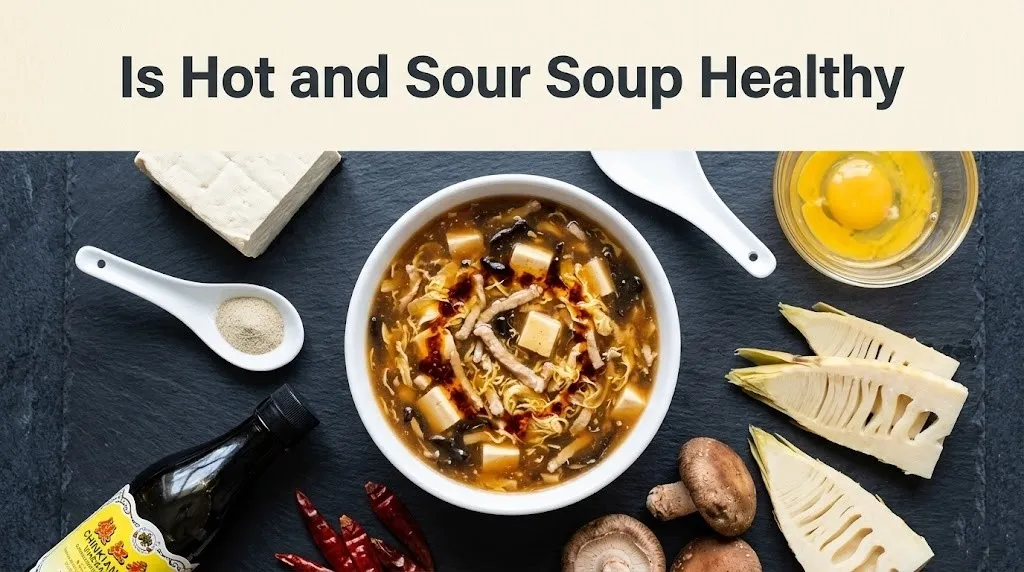
The soup’s signature heat comes from white pepper and chili oil, while the sour punch comes from black rice vinegar, also known as Chinkiang or Zhenjiang vinegar. These are not just flavoring agents. They are bioactive ingredients with documented metabolic effects. Capsaicin from the chili oil triggers a temporary increase in thermogenesis, the body’s heat production, and the acetic acid in the vinegar has been studied for its ability to blunt postprandial blood sugar spikes when consumed at the start of a meal.
This article breaks down the exact calories, protein, fat, and sodium numbers for both restaurant and homemade versions. You will learn how hot and sour soup compares to egg drop soup, wonton soup, and tom yum soup on key health metrics, which ingredients deliver genuine nutritional benefits, and how to order a healthier bowl or make one at home that captures the flavor without the sodium overload.
Is Hot and Sour Soup Healthy
Hot and sour soup is moderately healthy, offering a low-calorie, protein-rich, and vegetable-containing broth that is undermined primarily by the extremely high and unpredictable sodium levels found in restaurant versions. A homemade version with controlled sodium is a legitimately healthy meal component. The takeout version is a sodium gamble.
A standard 1-cup restaurant serving of hot and sour soup provides roughly 90 to 120 calories, 6 to 10 grams of protein, 3 to 5 grams of fat, and 6 to 10 grams of total carbohydrate. These numbers are objectively good for a prepared food. The soup is not battered, fried, or drowning in sugary sauce. The broth is water-based. The protein comes from tofu, egg, and pork. The vegetables include wood ear mushrooms, shiitake mushrooms, bamboo shoots, and daylily buds. On paper, this reads like a nutrient-dense, weight-management-friendly dish.
The problem is the salt shaker, or more accurately, the soy sauce bottle. The sodium in a single restaurant bowl ranges from 700 milligrams on the low end to over 2,000 milligrams on the high end, depending on the chef’s hand and the batch. A large bowl from P.F. Chang’s, for example, contains 1,490 milligrams of sodium for a 12-ounce serving. The American Heart Association recommends no more than 2,300 milligrams of sodium per day for healthy adults. That single bowl of soup consumes 65 percent of the daily sodium budget before the entree arrives. This is not a reason to never eat hot and sour soup. It is a reason to eat it with awareness and to treat restaurant versions as an occasional indulgence, not a daily health food.
| Nutrient | Homemade (1 cup) | Restaurant Average (1 cup) |
|---|---|---|
| Calories | 90 to 140 | 90 to 120 |
| Protein | 8 to 12g | 6 to 10g |
| Total Fat | 3 to 5g | 3 to 5g |
| Total Carbs | 6 to 8g | 6 to 10g |
| Fiber | 1 to 2g | 1 to 2g |
| Sodium | 300 to 500mg | 800 to 1,500mg |
Key Takeaway: Hot and sour soup has a fundamentally healthy structure, low-calorie broth, lean protein, and vegetables. The sodium is the single variable that determines whether a specific bowl is a healthy choice or a salt bomb.
Is Chinese Hot and Sour Soup Healthy
Chinese hot and sour soup, specifically the Szechuan and American-Chinese takeout versions, is nutritionally similar to the general category but often includes more soy sauce, chili oil, and cornstarch than traditional homemade versions. The “Chinese” designation typically refers to the restaurant style, which is more aggressively seasoned and thickened than what might be made in a home kitchen.
Traditional Szechuan hot and sour soup, known as Suan La Tang, has a long history as a folk dish rather than a banquet dish. It was a way to use affordable ingredients like pork scraps, tofu, daylily buds, and wood ear mushrooms, stretched with a peppery, vinegary broth that stimulated the appetite and warmed the body in the damp, cold climate of Sichuan province. The original dish was not a health food by design, but it was nutritionally balanced almost by accident. The combination of pork for protein and fat, tofu for additional protein and calcium, mushrooms for B vitamins and minerals, and a broth that required no heavy cream or butter, produced a soup that was sustaining without being heavy.
The American-Chinese takeout version has drifted in two directions. Some restaurants have added more sugar to balance the sourness, which increases the calorie and carbohydrate counts. Others have increased the cornstarch thickness to make the soup more visually appealing and to give it a longer hold time on a steam table. The thickening adds calories without nutrition and can mute the brightness of the vinegar and pepper. A takeout hot and sour soup that tastes more sweet than sour has likely been adapted to what the restaurant believes is the local palate, and it is less healthy than a sharper, more traditional version.
- Traditional Suan La Tang is thinner, sharper, and less sweet.
- American-Chinese versions are often thicker, sweeter, and saltier.
- The more the soup resembles a sweet-and-sour glaze in flavor, the further it has drifted from its nutritional roots.
Hot and Sour Soup Calories and Macros
A 1-cup serving of hot and sour soup contains approximately 90 to 120 calories, with a macronutrient breakdown of 6 to 10 grams of protein, 3 to 5 grams of fat, and 6 to 10 grams of total carbohydrate. This is a light, protein-forward nutritional profile that fits comfortably into most dietary patterns.
The calorie count is low enough that even a generous 2-cup bowl, a more realistic restaurant portion, comes in at 180 to 240 calories before any added fried noodles or accompaniments. This is exceptionally low for a prepared restaurant food. The low calorie density comes from the fact that the soup is mostly water, with the solids, tofu, pork, egg threads, and vegetables, contributing protein and fiber without a significant fat load. The fats that are present come from the small amount of pork, the egg yolk, and the finishing drizzle of sesame oil or chili oil. None of these are heavily caloric in the quantities used.
The carbohydrate count is low because the soup contains no noodles, rice, or starchy vegetables in meaningful amounts. The cornstarch used as a thickener contributes roughly 2 to 4 grams of carbohydrate per cup. This makes hot and sour soup a naturally low-carbohydrate option compared to noodle soups like wonton soup or ramen. For someone tracking macronutrients, a bowl of hot and sour soup with a side of steamed vegetables and a lean protein makes a complete, calorie-controlled meal.
Hot and Sour Soup Sodium Content
The sodium content of hot and sour soup is the single most important nutritional variable, with restaurant versions ranging from 800 to over 2,000 milligrams of sodium per bowl, depending entirely on the amount of soy sauce, salted chicken broth, and MSG used by the specific kitchen. This range means the soup can be a reasonable choice or a dietary landmine.
Sodium enters hot and sour soup through multiple channels. The broth base is typically a commercial chicken broth that is already salted. Soy sauce adds both salt and free glutamates. Additional salt is added during cooking. MSG, monosodium glutamate, contributes sodium as part of its molecular structure. The final seasoning check by the chef often involves another pinch of salt or a splash of soy sauce. Each of these steps is individually small. Cumulatively, they push the sodium into territory that rivals a fast-food cheeseburger.
There is no practical way to know the sodium content of a specific restaurant’s hot and sour soup without requesting nutritional information, which many independent Chinese restaurants do not have available. The safe assumption is that any restaurant bowl contains at least 1,000 milligrams of sodium, and likely more. For a person with hypertension, kidney disease, or congestive heart failure, this level of sodium in a single dish is clinically relevant. If you are managing a sodium-sensitive condition, the homemade version is the only version that gives you control over the salt shaker. If you are ordering out, ask for the soup to be made with less soy sauce, or request low-sodium soy sauce if the kitchen stocks it. The request may not always be accommodated, but it is worth making.
- Soy sauce is the primary sodium source, contributing roughly 300 to 400 milligrams per tablespoon.
- Commercial broth bases add another 200 to 500 milligrams per cup.
- A single bowl can easily exceed 1,500 milligrams of sodium without tasting overtly salty because the sourness masks the salt perception.
Key Takeaway: The sodium in restaurant hot and sour soup is a hidden variable that can range from acceptable to dangerously high. The sour and spicy flavors mask the salt, making it impossible to gauge sodium by taste alone.
Hot and Sour Soup Protein
Hot and sour soup provides 6 to 10 grams of protein per cup from a combination of tofu, egg, and pork, a modest but meaningful amount for a broth-based soup that can be increased easily with extra tofu or meat. The protein content is one of the strongest nutritional arguments in the soup’s favor.
The protein sources are complementary. Tofu provides soy protein, which is a complete plant protein containing all nine essential amino acids. The egg adds high-biological-value animal protein along with fat-soluble vitamins A and D. The pork strips contribute additional animal protein, iron in its heme form which is more absorbable than plant iron, and B vitamins including thiamin and B12. A cup of hot and sour soup with all three of these protein sources provides a more diverse amino acid profile than a cup of egg drop soup, which relies solely on egg protein, or a cup of wonton soup, which contains minimal filling protein.
For someone following a vegetarian diet, the pork can be omitted and the tofu can be doubled, with the egg retained or omitted depending on whether the person eats eggs. A vegetarian version with double tofu and egg still provides roughly 8 to 12 grams of protein per cup. Adding a half-cup of edamame or a sprinkle of hemp seeds at the table pushes the protein even higher. The soup’s protein content is not fixed. It scales with the amount of protein-rich ingredients added, and the broth base is light enough that it does not become heavy or unbalanced with extra tofu or meat.
Is Hot and Sour Soup Good for Weight Loss
Hot and sour soup is an excellent food for weight loss because it provides a high volume of warm, satiating liquid for very few calories, with enough protein to contribute to fullness, all delivered at the start of a meal when it can reduce the total calorie intake of the subsequent entree. This is the soup-as-appetizer strategy, and research supports it.
A 2007 study published in the journal Appetite found that consuming a low-calorie soup before a meal reduced total meal energy intake by approximately 20 percent compared to not having soup. The mechanism is straightforward. The liquid volume distends the stomach, triggering stretch receptors that signal fullness to the brain. The protein in the soup slows gastric emptying, prolonging the sensation of fullness. The warmth of the soup may also play a role, as warm foods tend to be consumed more slowly than cold foods, giving the body’s satiety signals more time to register.
Hot and sour soup is particularly well-suited to this strategy because its strong, pungent flavors are eaten slowly. You cannot chug a bowl of hot and sour soup the way you might drink a smoothie. The heat and sourness force a slower pace, which enhances the satiety effect. A cup of hot and sour soup consumed over 10 minutes before a meal is a practical, evidence-supported weight management tool. The caveat is that the sodium content of a restaurant version may cause temporary water retention that masks fat loss on the scale. This is a cosmetic issue, not a metabolic one, but it is worth knowing if you are tracking daily weigh-ins.
Hot and Sour Soup vs Egg Drop Soup
Hot and sour soup and egg drop soup are both low-calorie Chinese restaurant soups, but hot and sour soup generally contains more protein from tofu and pork, more fiber from vegetables, and a more complex flavor profile, while egg drop soup is simpler, lower in sodium, and easier to digest. The healthier choice depends on your specific nutritional priorities.
Egg drop soup is essentially chicken broth thickened with cornstarch with ribbons of beaten egg stirred in. It contains roughly 65 to 90 calories per cup, 4 to 6 grams of protein, 1 to 2 grams of fat, and 8 to 10 grams of carbohydrate. The sodium is typically lower than hot and sour soup, averaging 500 to 800 milligrams per cup, because egg drop soup relies less on soy sauce for its flavor. The ingredient list is shorter and the risk of a hidden sodium spike is lower.
Hot and sour soup offers more nutritional complexity. It contains vegetables that egg drop soup lacks, specifically wood ear mushrooms, bamboo shoots, and daylily buds, which contribute small amounts of fiber, potassium, and B vitamins. It also contains tofu, which adds calcium and plant protein. The trade-off is the sodium and the heavier use of oil. If your priority is the absolute lowest calorie and sodium option, egg drop soup wins by a narrow margin. If your priority is more protein, more vegetables, and a more interesting eating experience for a similar calorie cost, hot and sour soup wins.
| Attribute | Hot and Sour Soup (1 cup) | Egg Drop Soup (1 cup) |
|---|---|---|
| Calories | 90 to 120 | 65 to 90 |
| Protein | 6 to 10g | 4 to 6g |
| Sodium | 800 to 1,500mg | 500 to 800mg |
| Fiber | 1 to 2g | 0g |
| Vegetable Content | Mushrooms, bamboo, daylily | Minimal to none |
| Flavor Complexity | High | Low |
Key Takeaway: Hot and sour soup offers more nutritional upside from protein and vegetables, while egg drop soup offers less downside from sodium. If you control the sodium at home, hot and sour soup is the stronger choice.
Is Sweet and Sour Soup Healthy
Sweet and sour soup, a distinct dish from hot and sour soup, is a Cantonese-style preparation that is typically thicker, sweeter, and higher in sugar and calories than hot and sour soup, making it a less healthy choice by most nutritional metrics. The two soups are often confused but are not the same dish.
Sweet and sour soup uses a tomato-based or sugar-and-vinegar-based broth that leans heavily into the sweet end of the flavor spectrum. It often contains pineapple, bell peppers, and a protein such as chicken or pork, and it is thickened with more cornstarch than hot and sour soup. The sugar content, from added white sugar, pineapple juice, or sweetened ketchup, can push the carbohydrate count to 15 to 25 grams per cup, compared to 6 to 10 grams in hot and sour soup. The calorie count is correspondingly higher, often 140 to 180 calories per cup.
The nutritional gap between sweet and sour soup and hot and sour soup is significant enough to matter. A person managing their blood sugar or carbohydrate intake should choose hot and sour soup over sweet and sour soup without question. The vinegar in hot and sour soup provides sourness without sugar, while sweet and sour soup achieves its balance by adding sweeteners to counteract acidity. From a health perspective, the vinegar-forward approach is more compatible with metabolic health goals than the sugar-forward approach.
Is Hot Sour Soup Healthy
Hot sour soup, a shortened name for hot and sour soup, carries the same nutritional profile and the same sodium caveat. The abbreviated phrasing does not change the ingredient list, the cooking method, or the health assessment. It is the same soup.
The shortened name is common in casual conversation and on abbreviated takeout menus where space is limited. The soup served under the name “hot sour soup” is the same Szechuan-derived, vinegar-and-pepper-spiked broth with tofu, pork, egg, and mushrooms. There is no distinct “hot sour soup” that differs from hot and sour soup. The assessment remains that the soup is a low-calorie, protein-containing, vegetable-carrying broth whose health profile is dominated by the sodium content of the specific batch.
The only practical difference is that a restaurant using the shorter name “hot sour soup” may be a more casual, Americanized establishment that leans sweeter and thicker in its preparation. This is a generalization, not a rule, but it is consistent with the pattern that heavily abbreviated menu items often signal a more adapted, less traditional recipe. In any case, the same strategies for ordering and the same awareness of sodium apply.
Hot and Sour Soup and Blood Pressure
Hot and sour soup can negatively affect blood pressure in sodium-sensitive individuals because a single restaurant bowl frequently contains 1,200 to 2,000 milligrams of sodium, which is a significant portion of or exceeds the American Heart Association’s daily limit of 2,300 milligrams. For someone with hypertension, this is a clinically relevant amount of sodium in a single dish.
Sodium attracts and holds water in the bloodstream. A high-sodium meal increases blood volume, which raises blood pressure, a phenomenon that is particularly pronounced in the estimated 50 percent of adults who are salt-sensitive. For someone with diagnosed hypertension, the standard guidance from the American Heart Association is to limit sodium to 1,500 milligrams per day, not 2,300. A bowl of restaurant hot and sour soup can consume that entire budget in one sitting.
The sourness of the soup masks the saltiness on the palate, which is the sensory trick that makes the sodium content so deceptive. A food that tastes salty will naturally limit its own consumption. A food that tastes sour and spicy can carry a heavy sodium load without tasting overtly salted. This is why hot and sour soup is a particular risk for people who are actively monitoring their blood pressure. They may consume a day’s worth of sodium without the sensory warning that would accompany a saltier-tasting dish.
- A single restaurant bowl can exceed 1,500 milligrams of sodium, the entire daily limit for someone with hypertension.
- The sour and spicy flavors mask the salt perception on the palate.
- Anyone with diagnosed hypertension or heart failure should request a low-sodium version or make it at home.
Hot and Sour Soup MSG and Additives
Monosodium glutamate, or MSG, is a common ingredient in restaurant hot and sour soup that contributes umami flavor and has been extensively studied and classified as generally recognized as safe by the FDA. The health concerns around MSG are largely based on anecdotal reports of “MSG symptom complex,” which research has not consistently replicated in blinded studies.
MSG is the sodium salt of glutamic acid, an amino acid that occurs naturally in tomatoes, Parmesan cheese, soy sauce, and breast milk. In hot and sour soup, MSG enhances the savory depth of the broth and amplifies the perception of the other flavors. It is not a preservative, a tenderizer, or an artificial chemical in the pejorative sense. It is a purified, crystallized version of a naturally occurring flavor compound. The FDA, the World Health Organization, and the Academy of Nutrition and Dietetics all classify MSG as safe for the general population.
A small subset of individuals report transient symptoms including headache, flushing, or sweating after consuming large doses of MSG on an empty stomach. These reports are inconsistent and difficult to replicate under controlled conditions, but they are not fabricated. If you believe you are sensitive to MSG, the response is to avoid it, not to debate its existence. Most Chinese restaurants will accommodate a request for “no MSG,” though the soup will taste less intensely savory without it. The broader nutritional point is that MSG contributes sodium, roughly 12 percent by weight, to a soup that is already high in sodium from soy sauce and broth. The sodium is a more firmly established health concern than the glutamate.
Hot and Sour Soup Immune System Benefits
Hot and sour soup provides several nutrients and bioactive compounds that support immune function, including protein for antibody production, iron and B vitamins from pork, vitamin D from mushrooms, and the antimicrobial properties of capsaicin and white pepper. It is not a cure for a cold, but it is a supportive food when you are sick.
The warmth of the broth is the first benefit. Hot liquid increases nasal mucus velocity, helping to clear congested sinuses, a real, measurable physiological effect. The steam from the soup moistens dry nasal passages. The capsaicin in the chili oil and the piperine in the white pepper trigger a mild, temporary increase in nasal secretions, which can provide relief from congestion. This is the same mechanism that makes spicy food a folk remedy for colds. It does not kill the virus, but it makes the symptoms more bearable.
The nutritional support is also relevant. The protein from the tofu, egg, and pork provides the amino acids needed for immune cell production. The iron from the pork supports oxygen transport and energy metabolism, which are often depleted during illness. Shiitake mushrooms contain ergothioneine, a unique antioxidant that concentrates in tissues under oxidative stress. Wood ear mushrooms contain polysaccharides that have been studied for their immune-modulating properties in laboratory settings. None of these compounds will prevent or cure illness on their own. They are incremental contributors to a body that is fighting an infection and needs nutritional support.
Key Takeaway: Hot and sour soup supports immune function the way all nutritious, warm, protein-containing broths do. It provides hydration, amino acids, and symptom relief, not a pharmaceutical cure.
Hot and Sour Soup Vinegar Health Benefits
The black rice vinegar in hot and sour soup contains acetic acid, which has been shown in clinical research to reduce postprandial blood glucose spikes when consumed with or immediately before a carbohydrate-containing meal. This is a genuine, measurable health benefit that applies specifically to the vinegar component of the soup.
A 2005 study in the European Journal of Clinical Nutrition found that consuming vinegar with a high-carbohydrate meal reduced the post-meal blood glucose response by 20 to 30 percent. The mechanism involves acetic acid inhibiting the enzymes that break down starches into simple sugars in the small intestine, effectively slowing the rate at which glucose enters the bloodstream. The effect is comparable to the action of the diabetes medication acarbose, though much weaker.
Hot and sour soup consumed at the start of a Chinese meal that includes rice or noodles leverages this vinegar effect. The acetic acid from the soup’s black rice vinegar primes the digestive system to handle the incoming carbohydrates more gently. This does not make the soup a diabetes treatment. It means that the traditional sequence of a Chinese meal, soup first, then rice and entrees, has a physiological logic that aligns with modern metabolic science. The vinegar is doing measurable work beyond flavoring the broth.
Hot and Sour Soup for Keto Low Carb
Hot and sour soup is naturally low in carbohydrates, with only 6 to 10 grams of total carbohydrate per cup, making it compatible with a low-carbohydrate dietary pattern and adaptable to a strict ketogenic diet with a small modification to the thickener. The base soup is already keto-adjacent.
The carbohydrates in hot and sour soup come from three sources: the cornstarch thickener, the small amount of sugar sometimes added to balance the sourness, and the residual carbohydrates in the tofu and vegetables. The cornstarch is the largest contributor, adding roughly 2 to 4 grams of carbohydrate per cup. For a low-carb diet allowing 50 to 100 grams of carbohydrate per day, this is negligible. For a strict ketogenic diet targeting 20 to 30 grams of net carbs per day, the cornstarch and any added sugar become a meaningful fraction of the daily budget.
The homemade version can be made fully ketogenic by replacing the cornstarch thickener with xanthan gum, used in tiny amounts of one-eighth to one-quarter teaspoon per pot, which thickens the soup with zero carbohydrates. The sugar can be omitted entirely, as the black rice vinegar provides sourness without sweetness. The remaining ingredients, tofu, pork, egg, mushrooms, and bamboo shoots, are all keto-compatible. A homemade keto hot and sour soup thickened with xanthan gum contains roughly 4 to 6 grams of net carbohydrate per cup, fitting easily within a strict keto budget.
- Restaurant hot and sour soup: 6 to 10 grams of net carbs per cup.
- Homemade keto version with xanthan gum: 4 to 6 grams of net carbs per cup.
- Omit any added sugar and ensure the broth is unsweetened for the lowest carb count.
How to Order Healthier Hot and Sour Soup
To order a healthier bowl of hot and sour soup at a restaurant, request a low-sodium soy sauce preparation, ask for extra tofu and vegetables, request the soup be served without the finishing drizzle of chili oil, and order a cup instead of a bowl. These four requests shift the nutritional profile meaningfully.
The sodium request is the most important. A polite “Can you ask the chef to use less soy sauce in the hot and sour soup?” is a reasonable request that many kitchens can accommodate, especially if you are a regular customer. The soup may taste slightly less salty, but the pepper and vinegar flavors will still carry the dish. The extra tofu and vegetables request increases the protein and fiber content of the soup, making it more satiating and nutrient-dense. This request is easy to fulfill because these are inexpensive ingredients that the kitchen has in abundance.
Skipping the chili oil drizzle removes roughly 40 to 60 calories and 5 to 7 grams of fat per bowl, which is a minor but meaningful reduction if you are tracking calories closely. The chili heat can still come from white pepper, which adds no calories or fat. Ordering a cup instead of a bowl halves the portion, and with it, halves the sodium, a simple act of portion control that is more effective than any ingredient substitution.
- Request less soy sauce to lower the sodium directly.
- Ask for extra tofu and vegetables for more protein and fiber.
- Skip the chili oil drizzle to reduce calorie and fat content.
- Order a cup instead of a bowl to control portion size.
Is Hot N Sour Soup Healthy
Hot n sour soup, an abbreviated spelling of hot and sour soup, is the same dish with the same nutritional profile and the same health considerations. The shorthand spelling does not indicate a different recipe or a distinct culinary tradition. It is the same soup, and the sodium caveat remains in full effect.
The “n” abbreviation is common on handwritten takeout menus, online ordering platforms with character limits, and casual conversation. It is a linguistic convenience, not a culinary distinction. Any restaurant listing “Hot N Sour Soup” is serving the same Szechuan-derived, vinegar-and-pepper-spiked broth with tofu, pork, egg, and mushrooms. The nutritional analysis, the sodium warning, the protein assessment, and the weight loss evaluation all apply equally.
The only potential difference is that a restaurant using casual, abbreviated menu language may be a more Americanized, high-volume takeout operation, which tends to correlate with heavier use of cornstarch, sugar, and salt. This is a correlation, not a causation, and it is not reliable enough to base a nutritional decision on. The safest approach is to assume the soup is high in sodium and to apply the same ordering strategies regardless of how it is spelled on the menu.
Hot and Sour Soup vs Tom Yum Soup
Tom yum soup, the Thai hot and sour shrimp soup, is nutritionally comparable to Chinese hot and sour soup but generally contains less sodium, more intense sourness from fresh lime juice, and a different aromatic profile from lemongrass, galangal, and kaffir lime leaves. Tom yum is arguably the healthier choice due to its lower average sodium and the absence of cornstarch.
Tom yum goong, the version with shrimp, provides roughly 90 to 130 calories per cup, 8 to 12 grams of protein, 3 to 6 grams of fat, and 4 to 8 grams of carbohydrate. The sodium in Thai restaurant versions averages 600 to 1,000 milligrams per cup, lower than the 800 to 1,500 milligrams typical of Chinese hot and sour soup. The difference comes from the use of fish sauce instead of soy sauce. Fish sauce is salty, but it is used more sparingly in tom yum because the sourness comes from fresh lime juice, which is bright and acidic without requiring a heavy salt counterbalance.
The other nutritional advantage of tom yum is the fresh herb load. Lemongrass, galangal, and kaffir lime leaves are simmered in the broth and release volatile oils with documented antimicrobial and anti-inflammatory properties. These herbs are present in much larger quantities than the white pepper and chili oil in hot and sour soup. The shrimp provides lean protein and the carotenoid astaxanthin, which gives it its pink color and has antioxidant properties. Tom yum and hot and sour soup are cousin dishes from different culinary traditions, and both can be healthy choices, but tom yum has a slight edge on sodium and phytochemical diversity.
| Attribute | Hot and Sour Soup (1 cup) | Tom Yum Goong (1 cup) |
|---|---|---|
| Calories | 90 to 120 | 90 to 130 |
| Protein | 6 to 10g | 8 to 12g |
| Sodium | 800 to 1,500mg | 600 to 1,000mg |
| Primary Sour Agent | Black rice vinegar | Fresh lime juice |
| Aromatics | White pepper, chili oil | Lemongrass, galangal, kaffir lime |
| Thickener | Cornstarch | None (clear broth) |
Key Takeaway: Tom yum soup edges out hot and sour soup on sodium control and herbal phytochemical content, but both are low-calorie, protein-rich soups that function as healthy meal starters when sodium is managed.
How to Make Healthy Hot and Sour Soup at Home
To make a genuinely healthy hot and sour soup at home, bloom ground white pepper and chili flakes in hot sesame oil, use unsalted chicken broth, limit soy sauce to one tablespoon per quart of broth, load the soup with tofu, pork, and mushrooms, and thicken with a light cornstarch slurry. The homemade version captures all the flavor of the restaurant original with a quarter of the sodium.
Start by heating one tablespoon of sesame oil in a large pot over medium heat. Add one teaspoon of ground white pepper and half a teaspoon of red chili flakes. Bloom the spices in the hot oil for 30 seconds until fragrant. This step infuses the oil with the fat-soluble volatile compounds in the pepper and chili, distributing their heat evenly throughout the soup. Add six cups of unsalted or low-sodium chicken broth, one tablespoon of low-sodium soy sauce, and two tablespoons of black rice vinegar. Bring the broth to a gentle simmer.
Add half a pound of pork loin cut into thin matchsticks and half a pound of firm tofu cut into small cubes. Simmer for 5 minutes. Add a cup of sliced shiitake mushrooms, a half cup of sliced wood ear mushrooms, a half cup of julienned bamboo shoots, and a quarter cup of daylily buds if available. Simmer for another 5 minutes. Mix two tablespoons of cornstarch with three tablespoons of cold water to form a slurry. Bring the soup to a low simmer and slowly pour in the slurry while stirring continuously. Cook for 1 full minute until the soup visibly thickens. Slowly drizzle one beaten egg into the soup while stirring gently in one direction to create the classic egg threads. Finish with a teaspoon of sesame oil and a splash of black rice vinegar at the table.
To prepare healthy hot and sour soup:
- Bloom 1 teaspoon white pepper and half teaspoon chili flakes in 1 tablespoon hot sesame oil for 30 seconds.
- Add 6 cups unsalted chicken broth, 1 tablespoon low-sodium soy sauce, and 2 tablespoons black rice vinegar. Simmer.
- Add 4 ounces each of pork matchsticks and tofu cubes. Simmer for 5 minutes.
- Add 1 cup shiitake mushrooms, half cup wood ear mushrooms, half cup bamboo shoots. Simmer for 5 minutes.
- Thicken with a slurry of 2 tablespoons cornstarch and 3 tablespoons cold water, then drizzle in 1 beaten egg while stirring gently.
Frequently Asked Questions About Hot and Sour Soup
Is hot and sour soup healthier than egg drop soup?
Hot and sour soup generally has more protein and fiber from tofu, pork, and vegetables, making it more nutrient-dense than egg drop soup.
Egg drop soup is lower in calories and sodium but contains almost no vegetables or fiber.
If you can control the sodium by making it at home, hot and sour soup is the nutritionally superior choice.
Can I eat hot and sour soup on a low carb diet?
Yes, hot and sour soup is naturally low in carbohydrates with only 6 to 10 grams per cup, fitting comfortably into a low-carb diet.
The carbohydrates come mostly from the cornstarch thickener and any added sugar.
A homemade version can be made fully keto with 4 to 6 grams of net carbs by using xanthan gum instead of cornstarch.
Why is hot and sour soup so high in sodium?
Hot and sour soup is high in sodium because it contains soy sauce, salted chicken broth, and often MSG, all of which contribute significant amounts of sodium.
The sour and spicy flavors mask the saltiness on the palate, allowing a surprisingly high sodium load without the soup tasting overtly salty.
Restaurant versions are particularly variable, with some bowls exceeding 1,500 milligrams of sodium.
Is hot and sour soup keto friendly?
Hot and sour soup is naturally low-carb and can be made fully keto friendly by replacing the cornstarch thickener with xanthan gum.
The protein from tofu, pork, and egg, and the fats from sesame oil, are all compatible with a ketogenic diet.
A homemade keto version contains 4 to 6 grams of net carbs per cup and fits easily within a strict 20 to 30 gram daily limit.
Does hot and sour soup have MSG?
Many restaurant versions of hot and sour soup contain MSG, which is added to enhance the savory umami flavor of the broth.
MSG is classified as generally recognized as safe by the FDA and is not a health concern for the vast majority of the population.
If you prefer to avoid MSG, you can request it be omitted at most Chinese restaurants, though the soup will taste less intensely savory.
Hot and sour soup is a nutritional paradox. It delivers protein, vegetables, and bioactive compounds like capsaicin and acetic acid in a warm, low-calorie broth that genuinely supports satiety and metabolic health. It also, in its restaurant form, can deliver enough sodium in a single bowl to consume your entire daily budget. The soup is not the problem. The salt shaker in the commercial kitchen is the problem.
The path to making hot and sour soup a healthy choice is the same as it is for most restaurant foods. Make it at home where you control the soy sauce. If you order it out, ask for less salt, skip the chili oil drizzle, order a cup instead of a bowl, and treat it as the appetizer it was designed to be, not as a meal unto itself. Pair it with steamed vegetables and a lean protein, and you have a complete, satisfying meal that capitalizes on everything the soup does well.
The vinegar and pepper that give the soup its name are doing real nutritional work. The heat clears your sinuses. The acetic acid moderates your blood sugar. The protein keeps you full. Honor the soup’s strengths, manage its one major weakness, and enjoy it without guilt.