The healthiest Burger King options center on the Whopper Jr. without mayonnaise, the Impossible Whopper modified, and the chain’s grilled chicken items where available, none of which are perfect health foods but all of which can fit into a calorie-conscious eating plan with smart customizations. You can eat at Burger King without derailing your goals. You just cannot order the default version of anything.
The challenge at Burger King is not a lack of protein. A standard Whopper delivers 28 grams of protein. The problem is that the protein arrives wrapped in a refined white flour bun, slathered in mayonnaise, and flanked by a side of fries and a soda that together can push a single meal past 1,200 calories, 1,800 milligrams of sodium, and 40 grams of sugar. According to the American Heart Association, the ideal daily sodium limit for most adults is 2,300 milligrams. A default Whopper meal consumes more than three-quarters of that limit in one sitting.
This guide ranks every major category of the Burger King menu, from burgers to breakfast to sides, with specific calorie counts, protein grams, sodium warnings, and modification instructions. Menus and pricing change by location, and nutritional data is based on Burger King’s published 2025 to 2026 figures. Always verify with the restaurant’s current nutrition calculator for your specific order.
Healthy Burger King Options
The healthiest Burger King options, ranked by overall nutritional balance, start with the Whopper Jr. without mayo, followed by the Impossible Whopper without mayo, a plain hamburger, and any available grilled chicken sandwich with the bun and sauce modified. These are not “health foods” in an absolute sense. They are the least nutritionally damaging choices on a menu built around fried, salted, and sugared items.
The Whopper Jr. is the standout. At 310 calories, 18 grams of protein, and 18 grams of fat in its standard form, it is already the most calorie-reasonable burger on the core menu. Removing the mayonnaise saves 70 calories and 8 grams of fat, bringing the total to roughly 240 calories, 18 grams of protein, and 10 grams of fat. Adding extra lettuce and tomato adds fiber and volume for negligible calories. Asking for the sandwich to be wrapped in lettuce instead of a bun, a standard modification at most locations, drops the calories to roughly 160 to 180 and the carbohydrates to under 5 grams. This is a genuinely solid fast-food meal.
The Impossible Whopper, at 630 calories and 25 grams of protein in its standard form, is a heavier option that becomes reasonable with modifications. Removing the mayonnaise saves 70 calories. Removing the bun and wrapping it in lettuce drops the total to roughly 350 to 400 calories, 20 grams of protein, and under 10 grams of net carbohydrates. The plant-based patty provides fiber from the soy and potato protein base, a small nutritional advantage over the beef patty.
| Menu Item | Calories (Standard) | Protein | Sodium | Smart Modification |
|---|---|---|---|---|
| Whopper Jr. | 310 | 18g | 390mg | No mayo, add lettuce and tomato |
| Whopper Jr. (no mayo, lettuce wrap) | ~170 | 18g | 310mg | Lowest calorie burger option |
| Impossible Whopper | 630 | 25g | 1,080mg | No mayo, lettuce wrap for low carb |
| Plain Hamburger | 240 | 12g | 380mg | Add extra veggies, no bun for keto |
| Grilled Chicken Sandwich | 470 | 28g | 860mg | No mayo, half bun or lettuce wrap |
Key Takeaway: The Whopper Jr. stripped of mayo and the bun is the single most calorie-efficient protein source on the Burger King menu, delivering 18 grams of protein for roughly 170 calories.
Healthy Options at Burger King
Healthy options at Burger King extend beyond burgers to include the garden side salad, unsweetened iced tea, bottled water, and apple slices where available. These sides and drinks are the supporting cast that turns a reasonable burger choice into a genuinely balanced fast-food meal.
The garden side salad, when dressed with half a packet of a vinaigrette or light dressing, adds roughly 60 to 100 calories and 2 to 3 grams of fiber to the meal. The salad alone is not a meal. It is a tool. Adding a side salad to a Whopper Jr. instead of a medium order of fries saves roughly 300 calories and 15 grams of fat. Over the course of a year of weekly Burger King visits, that swap alone represents a meaningful caloric reduction.
The drink choice is equally impactful. A medium Coca-Cola contains roughly 210 calories and 56 grams of sugar. Swapping it for unsweetened iced tea or bottled water removes those calories from the meal entirely. The American Heart Association recommends a daily added sugar limit of 25 grams for women and 36 grams for men. A medium soda alone doubles the daily limit for women. The healthiest drink choice at Burger King is water, followed by unsweetened iced tea, followed by diet soda for those who prefer it. The calorie savings from a drink swap is the single most impactful change a person can make to any fast-food order.
- Swap fries for a side salad or apple slices to save 300+ calories.
- Swap soda for water or unsweetened iced tea to save 200+ calories and 50+ grams of sugar.
- These two swaps together can turn a 1,200-calorie meal into a 600-calorie meal without changing the burger.
Healthy Choices at Burger King
Making healthy choices at Burger King requires a three-part strategy. Pick a protein source with reasonable calories and saturated fat, remove or halve the refined carbohydrate bun, and replace calorie-dense sides and sugary drinks with lower-calorie alternatives. The strategy is consistent across the entire menu.
The protein source decision is the foundation. Grilled chicken, where available, offers the best protein-to-fat ratio. A grilled chicken breast sandwich provides roughly 28 grams of protein and 8 grams of fat before modifications. The Whopper Jr. patty is next, a flame-grilled beef patty that is smaller and leaner than the full-sized Whopper patty. The Impossible Whopper patty is a reasonable plant-based choice, though it is higher in saturated fat from coconut oil than the beef patty. Chicken fries and chicken nuggets are the weakest protein choices because they are breaded and fried, adding refined carbohydrates and frying oil calories to the protein.
The bun strategy is the second lever. A standard Burger King sesame seed bun adds roughly 180 to 210 calories and 30 to 35 grams of refined carbohydrate. Removing the bun entirely and eating the burger with a knife and fork, or requesting a lettuce wrap, cuts those calories and carbs from the meal. Eating only the bottom half of the bun is a middle-ground strategy that saves roughly 90 to 105 calories and 15 to 18 grams of carbohydrate while retaining some of the burger-eating experience. The bun is not the enemy. The entire bun is simply more refined carbohydrate than most sedentary adults need in a single meal.
Burger King Healthy Items
The specific healthy items at Burger King that a registered dietitian would flag as reasonable choices include the Whopper Jr., the plain hamburger, the garden side salad, apple slices, unsweetened iced tea, and, with modifications, the Impossible Whopper and any available grilled chicken sandwich. These items share a common profile: they are lower in calories, higher in protein relative to their calorie count, and lower in added sugar than the menu average.
The plain hamburger is an underrated choice. At 240 calories and 12 grams of protein, it is the smallest burger on the menu and one of the few items that can be eaten without modification and still fit into a calorie budget. Two plain hamburgers ordered without buns provide 24 grams of protein for roughly 280 calories, a better protein-to-calorie ratio than many protein bars marketed as health foods. The hamburger patties are flame-grilled, not fried on a flat-top, which means they are not cooking in their own rendered fat. The flame-grilling imparts a smoky flavor without added cooking oil.
The availability of these items varies by location. Some Burger King franchises have discontinued their grilled chicken sandwich. Some have removed salads from the menu. The Impossible Whopper is a permanent item in the United States but not available in all international markets. The practical advice is to check the menu board when you arrive and adapt the general strategy to the available items. If grilled chicken is unavailable, the Whopper Jr. modified is the fallback. If salads are unavailable, the apple slices or simply skipping the fries are the fallback.
Healthy Burger King Breakfast
The healthiest Burger King breakfast options are the Egg and Cheese Croissan’wich at 330 calories and 12 grams of protein and the French Toast Sticks ordered in a small portion, both of which are lower in calories and saturated fat than the chain’s heavier breakfast platters and breakfast burritos. Breakfast at Burger King is a nutritional minefield, but a few items stand out.
The Croissan’wich line, a flaky croissant sandwich with egg, cheese, and optional protein, is the core breakfast format. The Egg and Cheese version without meat is the lightest at 330 calories. Adding ham brings it to 370 calories and 18 grams of protein. Adding sausage or bacon pushes the calories into the 450 to 550 range and adds saturated fat. The croissant itself is a butter-laden pastry, not a whole grain, but the overall calorie and protein profile is reasonable for a fast-food breakfast.
The fully loaded breakfast platters and the breakfast burritos are the items to avoid. The Ultimate Breakfast Platter with sausage, eggs, hash browns, and a biscuit can exceed 1,000 calories and 2,500 milligrams of sodium. The Egg-Normous Burrito clocks in at 810 calories and 1,800 milligrams of sodium. These are not breakfast items. They are daily calorie budgets compressed into a single paper wrapper. If a heavy breakfast is the only thing that will satisfy, splitting it with another person is the most practical damage control strategy.
| Breakfast Item | Calories | Protein | Sodium |
|---|---|---|---|
| Egg and Cheese Croissan’wich | 330 | 12g | 660mg |
| Ham, Egg, and Cheese Croissan’wich | 370 | 18g | 930mg |
| French Toast Sticks (3-piece) | 230 | 3g | 260mg |
| Egg-Normous Burrito | 810 | 32g | 1,800mg |
| Ultimate Breakfast Platter | 1,050 | 28g | 2,500mg |
Key Takeaway: The Egg and Cheese Croissan’wich is the most reasonable breakfast sandwich at Burger King. Add ham for more protein. Avoid the platters and burritos unless you split them.
Burger King Burger No Bun Low Carb
Ordering a Burger King burger without the bun is the simplest and most effective strategy for reducing calories and carbohydrates, and the chain will serve any burger wrapped in lettuce or in a plastic container with a fork and knife upon request. This modification turns a sandwich into a high-protein, low-carbohydrate meal.
A standard Whopper contains roughly 670 calories, 28 grams of protein, and 50 grams of carbohydrate. Removing the bun and the mayonnaise reduces those numbers to roughly 300 to 350 calories, 28 grams of protein, and under 5 grams of carbohydrate. The savings come from eliminating the sesame seed bun, roughly 180 to 210 calories and 32 grams of carbohydrate, and the mayonnaise, roughly 70 calories and 8 grams of fat. The remaining patty, lettuce, tomato, onion, pickles, and ketchup form a knife-and-fork meal that is functionally a ground beef salad with condiments.
The modification works across the entire burger menu. A bacon king without a bun or mayo drops from 1,200 calories and 60 grams of fat to roughly 700 calories and 45 grams of fat, still an indulgent meal but one that no longer exceeds the calorie target for an entire day. The lettuce wrap option is available at most locations, though the quality of the wrap depends on the employee assembling it. Requesting the burger in a salad container is sometimes more reliable than the lettuce wrap, which can fall apart. Both requests are standard enough that they will not confuse the kitchen.
- Any burger can be ordered “no bun” or “lettuce wrapped” at no extra charge.
- Removing the bun saves 180 to 210 calories and 30 to 35 grams of carbohydrate.
- The ketchup adds roughly 4 grams of sugar per tablespoon. Ask for it on the side or skip it to reduce sugar further.
Whopper No Bun Calories and Macros
A standard Whopper without the bun and without mayonnaise contains approximately 300 to 350 calories, 25 to 28 grams of protein, 18 to 22 grams of fat, and 5 to 8 grams of carbohydrate, depending on whether ketchup and other condiments are retained. This is a high-protein, moderate-fat, low-carbohydrate meal that fits into a ketogenic or low-carbohydrate dietary pattern.
The protein content of the Whopper patty is the nutritional anchor. At roughly 4 ounces of flame-grilled beef, the patty delivers all nine essential amino acids, heme iron, and B vitamins including B12. The fat content comes from the beef itself, roughly 15 to 18 grams of fat in a standard Whopper patty before condiments. This is a mix of saturated and monounsaturated fat, with a fatty acid profile that reflects the beef’s marbling.
The sodium remains elevated even with the bun removed. A bunless Whopper still contains roughly 600 to 800 milligrams of sodium from the patty seasoning, the ketchup, and the pickles. This is not a low-sodium food, even in its most stripped-down form. If sodium is a primary concern, the only way to reduce it further is to request the patty without added salt, a modification that is technically possible but may not be honored during a busy shift. The most realistic approach is to account for the sodium in the context of the rest of the day’s intake.
Healthy Burger King Chicken Sandwich
The healthiest chicken sandwich at Burger King is the grilled chicken sandwich, where available, which provides roughly 28 grams of protein and can be reduced to under 300 calories by removing the mayonnaise and eating only half the bun or requesting a lettuce wrap. The chicken options at Burger King are a study in contrasts between grilled and fried.
The grilled chicken sandwich, when available, is a boneless, skinless chicken breast fillet that is seasoned and cooked on a grill rather than breaded and deep-fried. It contains roughly 470 calories, 28 grams of protein, 8 grams of fat, and 42 grams of carbohydrate in its standard form. The sodium is 860 milligrams. Removing the mayonnaise saves 70 calories. Eating the sandwich open-faced by discarding the top half of the bun saves roughly 90 calories and 15 grams of carbohydrate. The resulting meal provides 28 grams of protein for roughly 310 calories.
The fried chicken options, including the Royal Crispy Chicken Sandwich and the Chicken Fries, are significantly higher in calories, fat, and refined carbohydrates because of the breading and frying process. The Royal Crispy Chicken contains 650 calories and 37 grams of fat. The Chicken Fries contain 280 calories and 16 grams of fat for a 9-piece order, but they provide only 13 grams of protein for those calories. The grilled chicken sandwich, when available, is the superior choice. When it is not available, the Whopper Jr. is a better option than the fried chicken items.
Burger King Grilled Chicken Options
Burger King’s grilled chicken availability has been inconsistent across locations and over time, with the classic grilled chicken sandwich being removed and reintroduced in various markets, making it the most location-dependent healthy option on the menu. The best practice is to check the menu when you arrive or look online before you go.
As of the 2025 to 2026 menu cycle, Burger King offers a grilled chicken sandwich in some markets, often branded as the Royal Crispy Grilled Chicken or a similar name. The nutritional profile is consistent with a standard grilled chicken breast: high protein, moderate sodium, and low fat before condiments. If a grilled chicken sandwich is available, it is automatically the best non-beef protein choice on the menu. Order it without mayonnaise, with extra vegetables, and with the bun modification of your choice.
If no grilled chicken option is available at your location, the alternatives are the fried chicken items, which are a nutritional downgrade, or a beef burger modified. The Impossible Whopper is a plant-based alternative that provides a similar protein content to the grilled chicken but with more saturated fat from coconut oil. The choice between a modified Whopper Jr., an Impossible Whopper, and a grilled chicken sandwich, when available, comes down to personal dietary priorities around animal protein, plant-based eating, and saturated fat intake.
Burger King Keto Options
A ketogenic eating pattern at Burger King is achievable by ordering any burger without the bun and without ketchup, with the Whopper Jr., the Whopper, and the bacon king serving as the primary protein-and-fat vehicles depending on calorie needs. The menu is surprisingly keto-compatible once the bun and sugary condiments are removed.
The Whopper Jr. without bun, mayo, and ketchup is the best keto choice for a moderate calorie target. It provides roughly 18 grams of protein and 10 grams of fat for approximately 170 calories, with under 2 grams of net carbohydrates. The full-sized Whopper without bun and mayo provides 28 grams of protein and 18 grams of fat for roughly 300 to 350 calories. The bacon king without bun provides 50 grams of protein and 45 grams of fat for roughly 700 calories, suitable for someone on a higher-calorie ketogenic plan or combining two meals into one.
The breakfast menu offers keto options as well. The Croissan’wich fillings can be ordered without the croissant. The egg, cheese, and sausage or bacon patty provide protein and fat with minimal carbohydrates. The French toast sticks and hash browns are not keto compatible. Unsweetened iced tea, diet soda, and bottled water are the keto-compatible drink options.
- Whopper Jr. no bun, no ketchup: 170 calories, 18g protein, 10g fat, under 2g net carbs.
- Whopper no bun, no ketchup: 300 calories, 28g protein, 18g fat, under 2g net carbs.
- Bacon King no bun, no ketchup: 700 calories, 50g protein, 45g fat, under 3g net carbs.
Key Takeaway: Burger King is one of the more keto-friendly fast-food chains because any burger can be de-bunned and the flame-grilled patties are not coated in breading or sugary glazes.
Burger King Vegetarian Options
The primary vegetarian option at Burger King is the Impossible Whopper, which features a plant-based patty from Impossible Foods, though strict vegetarians should be aware that the standard preparation involves cooking the patty on the same broiler as the beef patties, leading to cross-contact with meat juices. A separate cooking method can be requested.
The Impossible Whopper patty is made from soy protein concentrate, potato protein, coconut oil, sunflower oil, and heme, a genetically engineered yeast-derived iron-containing molecule that gives the patty its meat-like flavor and appearance. The patty itself is vegan. The sandwich as ordered comes with mayonnaise and a sesame seed bun, both of which are vegetarian but not vegan. Removing the mayonnaise and requesting the patty be cooked separately, often in a microwave or on a cleaned section of the broiler, makes the meal fully vegan.
For lacto-ovo vegetarians who eat dairy and eggs, the breakfast menu offers additional options. The Egg and Cheese Croissan’wich without meat is vegetarian. The French toast sticks are vegetarian. The garden side salad, where available, is vegetarian. The mac and cheese bites and mozzarella sticks are vegetarian but are fried and high in calories and fat. The Impossible Whopper remains the strongest vegetarian main course, with the understanding that cross-contact is a genuine risk for those who avoid all meat products for ethical or religious reasons.
Burger King Gluten Free Items
Burger King offers limited gluten-free options, and the chain explicitly states that due to shared cooking and preparation areas, it cannot guarantee that any menu item is completely free of gluten cross-contamination. This is a critical safety warning for individuals with celiac disease.
The beef patties, grilled chicken patties, and Impossible Whopper patties do not contain gluten ingredients in their formulation. The problem is the preparation environment. The patties are cooked on a shared broiler that also heats buns. The fryers used for French fries also cook onion rings, mozzarella sticks, and other breaded items, meaning the fries are cross-contaminated with wheat flour. The salad may be prepared on surfaces that also handle croutons and breaded items. For a person with mild gluten sensitivity who can tolerate trace amounts, ordering a burger without the bun and skipping the fries is a reasonable strategy. For a person with celiac disease, the shared preparation environment means Burger King cannot be considered a safe dining option.
- Beef patties and Impossible patties contain no gluten ingredients but are cooked on shared equipment.
- The French fries are cooked in shared fryers with breaded items and are not gluten free.
- The chain’s official allergen statement advises celiac customers to avoid eating at Burger King.
Healthy Burger King Sides
The healthiest sides at Burger King are the garden side salad, apple slices where available, and a small order of French fries if a fried side is non-negotiable, with the understanding that all fried sides share fryer oil with breaded items. The side choice is where many well-intentioned orders collapse into standard fast-food territory.
The garden side salad, with a light dressing, adds 60 to 100 calories, 2 to 3 grams of fiber, and a serving of vegetables to the meal. It does not transform Burger King into a health food restaurant, but it adds nutritional value. The apple slices, when available, add roughly 35 calories and 1 gram of fiber. They are a packaged product, not fresh-cut fruit, but they are a fruit serving with zero added sugar.
The French fries are the default side and the hardest to resist. A small order contains 320 calories, 15 grams of fat, and 42 grams of carbohydrate. A large order contains 430 calories, 20 grams of fat, and 58 grams of carbohydrate. The fries are not a “healthy” side by any definition, but a small order split between two people is a reasonable compromise that provides the sensory satisfaction of fries without the full caloric load. Onion rings, mozzarella sticks, and chicken fries are deep-fried, breaded, and higher in calories and fat than the standard fries. If a fried side is going to be ordered, the small fries are the least damaging choice.
| Side Item | Calories | Fat | Carbs | Fiber |
|---|---|---|---|---|
| Garden Side Salad (no dressing) | 25 | 0g | 5g | 2g |
| Apple Slices | 35 | 0g | 8g | 1g |
| Small French Fries | 320 | 15g | 42g | 3g |
| Medium French Fries | 380 | 18g | 50g | 4g |
| Onion Rings (medium) | 410 | 22g | 48g | 2g |
Burger King Fries Calories and Nutrition
A small order of Burger King French fries contains 320 calories, 15 grams of fat, 42 grams of carbohydrate, and 440 milligrams of sodium. A large order contains 430 calories, 20 grams of fat, 58 grams of carbohydrate, and 590 milligrams of sodium. These numbers are for the fries alone, before ketchup or any dipping sauce.
The fries are made from potatoes, vegetable oil, modified potato starch, rice flour, salt, and dextrose. The dextrose is a simple sugar added to promote browning. The modified potato starch and rice flour create a crispy coating. The fries are not a whole food, but they are also not a nutritional crime in a small portion. The problem is the portion size and the add-ons. A large fries with a side of ketchup and a medium soda creates a meal’s worth of calories from the sides and drink alone, before the burger is counted.
The most practical strategy for fries is to order the smallest size available and share it. A small fries split two ways provides roughly 160 calories per person, which is a reasonable amount of fried food in the context of an otherwise modified meal. The second strategy is to eat the burger first, which provides protein and fat that trigger satiety, and then eat the fries slowly, stopping when full. The fries are not a test of willpower. They are a side dish that should be treated as an indulgence, not a dietary staple.
Burger King Whopper Jr Healthy
The Whopper Jr. is the healthiest burger on the Burger King core menu because it provides 18 grams of protein for only 310 calories in its standard form, and those numbers improve dramatically with simple modifications. It is the leanest, most portion-controlled burger the chain offers.
The Whopper Jr. patty is the same flame-grilled beef as the full-sized Whopper, just smaller. The patty weighs roughly 2 ounces before cooking, compared to 4 ounces for the full Whopper. The bun is proportionally smaller. The result is a burger that captures the flame-grilled flavor of a Whopper without the caloric excess. Removing the mayonnaise, as discussed, saves 70 calories. Removing the bottom half of the bun saves an additional 90 calories. A Whopper Jr. with no mayo and served open-faced on half a bun provides roughly 200 calories and 18 grams of protein.
The Whopper Jr. is also a good option for children or for an adult who wants a burger and a side without exceeding 500 calories total. A Whopper Jr. no mayo, a small fries shared with someone else, and an unsweetened iced tea creates a fast-food meal that clocks in under 500 calories, which is genuinely rare in the quick-service restaurant industry. This is not a recommendation to eat fast food daily. It is a practical strategy for the day when fast food is happening whether you planned it or not.
Impossible Whopper Healthy
The Impossible Whopper is a nutritionally mixed choice that provides 25 grams of plant-based protein and 630 calories in its standard form, with more fiber than the beef Whopper but also more sodium and a similar saturated fat content from coconut oil. It is not automatically healthier than a beef Whopper. It is a different nutritional profile that aligns better with some dietary priorities and worse with others.
The Impossible patty is designed to mimic the taste, texture, and appearance of beef. It achieves this through soy protein for structure, coconut oil for juiciness and saturated fat, and heme for the iron-containing molecule that gives meat its characteristic flavor. The patty contains 19 grams of protein, 14 grams of fat, and 5 grams of fiber. The beef Whopper patty contains 28 grams of protein, 18 grams of fat, and 0 grams of fiber. The Impossible patty has less protein and less total fat, but the saturated fat comes from coconut oil rather than beef tallow, and the patty adds fiber that the beef version lacks.
The sodium is the weak point. The Impossible Whopper contains 1,080 milligrams of sodium in its standard form, roughly 200 milligrams more than the beef Whopper. This comes from the patty seasoning, which is more heavily salted to compensate for the lack of beef flavor compounds. A person choosing the Impossible Whopper for cardiovascular health should be aware that the sodium content is higher than the beef version. A person choosing it for environmental or ethical reasons is making a values-based decision that falls outside the scope of nutritional analysis.
- Impossible Whopper: 630 calories, 25g protein, 5g fiber, 1,080mg sodium.
- Beef Whopper: 670 calories, 28g protein, 0g fiber, 850mg sodium.
- The Impossible version has more fiber but more sodium and less protein.
Key Takeaway: The Impossible Whopper is not a health food upgrade over the beef Whopper. It is a lateral move with more fiber, more sodium, and a plant-based protein source that serves different dietary goals.
How to Order Healthy at Burger King
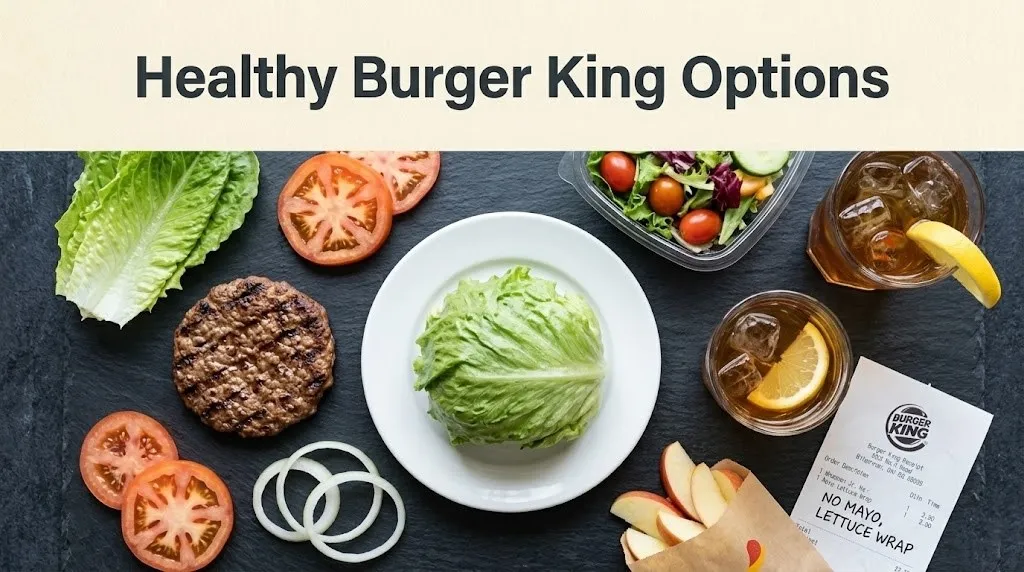
To order a healthy meal at Burger King, say some version of this at the speaker: “I’ll have a Whopper Jr. with no mayonnaise, extra lettuce and tomato, and can you do that lettuce wrapped instead of the bun, a side salad with light dressing, and an unsweetened iced tea.” This single sentence implements every major modification strategy in this article.
The key is to be polite, clear, and specific. Fast-food employees are trained to process orders quickly, and customized orders take slightly longer. “No mayo, lettuce wrap, extra veggies” is a standard enough request that it will not confuse the kitchen. The burger will arrive as a pile of beef patty, cheese if requested, tomato, lettuce, onion, and pickles, wrapped in a few layers of iceberg lettuce. It will be messy. It will also be the most nutritionally sound item available at the restaurant.
If the lettuce wrap is too messy or the location does not offer it, the “no bun, in a container” request is the fallback. The burger will be served in a plastic salad bowl with a lid and a fork and knife. This is less satisfying as a handheld eating experience but equally effective as a nutritional strategy. The side salad and unsweetened iced tea complete the meal. A packet of black pepper and a squeeze of lemon from the iced tea can add flavor to the salad without adding the calories of a creamy dressing.
- “Whopper Jr., no mayo, lettuce wrap, extra veggies.”
- “Side salad with light dressing, unsweetened iced tea.”
- “No bun, in a container please” if lettuce wrap is unavailable.
Burger King Hidden Menu Healthy
Burger King does not have a formal secret menu, but the most useful off-menu customization is ordering two plain hamburger patties a la carte, which provides a high-protein, low-carbohydrate meal for a lower price than the standard burger menu. This is not a listed menu item, but it is a request that most locations can fulfill.
A la carte patties are priced individually and are not advertised. Two a la carte flame-grilled beef patties provide roughly 24 grams of protein and 18 grams of fat for approximately 280 calories, with zero carbohydrates before condiments. This is a better protein-to-calorie ratio than the standard hamburger or Whopper Jr., and it costs less than a full burger. The patties can be topped with lettuce, tomato, onion, and pickles from the condiment station or requested at the counter.
Another off-menu strategy is ordering a “side of grilled chicken” if the location has grilled chicken available for sandwiches. This provides a lean protein portion without the bun or sauce. This request is less standard than the a la carte patties and may not be accommodated at all locations, but it is worth asking. The third hidden-menu strategy is the breakfast burger, ordering a sausage or bacon patty with egg and cheese, no biscuit or croissant, which creates a keto-friendly breakfast bowl of protein and fat for a lower price than the standard breakfast sandwich.
- Two a la carte beef patties: approximately 280 calories, 24g protein, zero carbs.
- Side of grilled chicken: availability varies by location.
- Breakfast protein bowl: sausage, egg, cheese, no bread.
Frequently Asked Questions About Healthy Burger King
What is the lowest calorie burger at Burger King?
The lowest calorie burger at Burger King is the plain hamburger at 240 calories and 12 grams of protein.
The Whopper Jr. without mayonnaise and wrapped in lettuce is even lower at roughly 170 calories with 18 grams of protein.
These two items are the best starting points for building a calorie-conscious fast-food meal at this chain.
Can I eat low carb at Burger King?
Yes, you can eat low carb at Burger King by ordering any burger without the bun, without ketchup, and wrapped in lettuce or served in a container.
The Whopper Jr. without a bun contains under 2 grams of net carbohydrates and 18 grams of protein.
The Impossible Whopper without a bun is also keto compatible with roughly 5 grams of net carbs from the plant-based patty.
Is the Impossible Whopper healthier than a regular Whopper?
The Impossible Whopper is not categorically healthier than a beef Whopper because it has more sodium and less protein, though it does provide 5 grams of fiber that the beef version lacks.
The Impossible Whopper contains 1,080 milligrams of sodium compared to 850 milligrams in the beef Whopper.
The choice between them depends on whether you prioritize fiber and plant-based eating or higher protein and lower sodium.
What is the healthiest side at Burger King?
The healthiest side at Burger King is the garden side salad, which provides vegetables and fiber for 25 calories before dressing.
Apple slices are the second healthiest side at 35 calories and zero added sugar, though availability is limited by location.
If a fried side is non-negotiable, a small French fries split between two people is the most controlled option.
Does Burger King have any healthy breakfast options?
The healthiest Burger King breakfast option is the Egg and Cheese Croissan’wich at 330 calories and 12 grams of protein.
Adding ham increases the protein to 18 grams for 370 calories.
The breakfast platters and burritos are significantly higher in calories and sodium and should be avoided or split.
Eating at Burger King while maintaining a healthy dietary pattern is a damage control exercise. The food is engineered to be hyper-palatable, heavily salted, and portioned to exceed your calorie needs. Your only defense is a set of clear modification rules that you apply consistently. Bun off. Mayo off. Smallest fries available, if any. Water or unsweetened iced tea. Extra vegetables where possible. The Whopper Jr., not the Whopper. The grilled chicken, not the fried. The side salad, not the onion rings.
These rules do not turn Burger King into a health food restaurant. They turn a 1,200-calorie default meal into a 400- to 600-calorie modified meal that delivers adequate protein, some vegetables, and a sodium load that is manageable if the rest of your day is reasonable. This is not a strategy for daily eating. It is a strategy for the day when fast food is the only option within a 30-mile radius of the interstate you are stuck on.
You now have the specific menu items, the modification scripts, and the nutritional numbers. Walk into the next Burger King you cannot avoid and order with precision. The Whopper Jr., no mayo, lettuce wrap, extra veggies. That is your order.