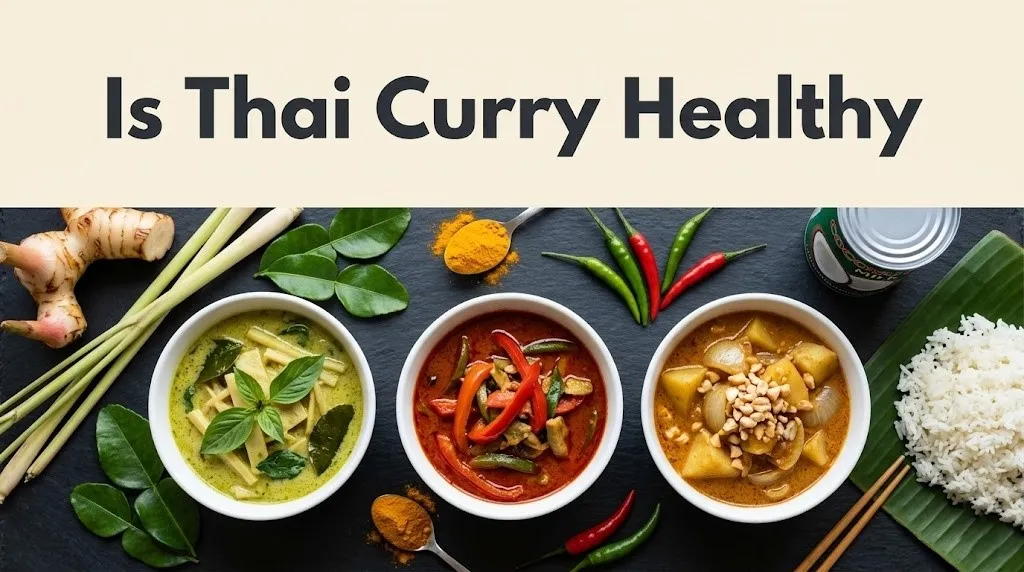
Thai curry is a generally healthy dish built on a foundation of anti-inflammatory herbs and aromatic roots, with its health profile rising or falling almost entirely on how much coconut milk is used and what protein and vegetables are paired with it. It is not a low-calorie health food in its restaurant form, but its individual components, from the curry paste to the fresh herbs, are among the most nutritionally interesting ingredients in global cuisine.
The paste that defines Thai curry is a wet-ground blend of fresh galangal, lemongrass, kaffir lime peel, garlic, shallots, and dried spices including turmeric and coriander seed. These are not powdered from a jar. They are pounded in a mortar while still fresh, releasing volatile oils that research has linked to anti-inflammatory, antimicrobial, and even blood-sugar-moderating effects. According to the Academy of Nutrition and Dietetics, the combination of turmeric and black pepper, which often appear together in Thai curry pastes, enhances the bioavailability of curcumin, turmeric’s primary active compound, by up to 2,000 percent.
This article compares the nutritional profiles of green, red, and massaman curries side by side, explains what the coconut milk saturated fat research actually says, and provides specific strategies for ordering the healthiest Thai curry at a restaurant and lightening it at home. You will also find quick assessments of Thai fried rice and Thai noodle dishes, because the curry question never arrives in isolation.
Is Thai Curry Healthy
Thai curry is a nutritionally dense dish that delivers protein, vegetables, and bioactive compounds from fresh herbs and spices, but its health value is tempered by the 15 to 20 grams of saturated fat from coconut milk in a typical restaurant serving. It is healthy in the way a Mediterranean fish stew is healthy, rich, satisfying, and full of real ingredients, not in the way a plain grilled chicken breast is healthy.
The health assessment depends on context. A bowl of green curry with chicken, bamboo shoots, bell peppers, and Thai basil, served with a modest portion of jasmine rice, is a balanced meal. It provides roughly 350 to 450 calories, 25 grams of protein, and 3 to 4 grams of fiber. A bowl of massaman curry with braised beef, potatoes, and peanuts, served with a large mound of rice and a side of fried spring rolls, is a caloric indulgence that can push past 800 calories and 40 grams of fat. Same cuisine, same general category of dish, completely different nutritional outcomes.
The most defensible position on Thai curry and health is that the curry paste ingredients are genuinely beneficial, the coconut milk is a mixed bag that is calorically dense but metabolically different from butterfat, and the final health profile is determined almost entirely by portion size and what else is in the bowl. A curry that is mostly vegetables and lean protein with a light coconut broth is a healthy meal. A curry that is mostly coconut cream with a few strips of fatty pork and a mountain of white rice is an occasional indulgence.
| Curry Type | Calories (1 cup) | Protein | Total Fat | Saturated Fat | Carbs | Fiber |
|---|---|---|---|---|---|---|
| Green Curry with Chicken | 350 to 420 | 22 to 28g | 22 to 28g | 15 to 20g | 12 to 18g | 2 to 4g |
| Red Curry with Tofu | 320 to 380 | 15 to 20g | 20 to 26g | 14 to 18g | 14 to 18g | 3 to 5g |
| Massaman Curry with Beef | 420 to 520 | 24 to 30g | 28 to 35g | 18 to 25g | 18 to 24g | 2 to 3g |
Key Takeaway: Thai curry is a real-food dish with genuine nutritional strengths from its paste ingredients. The coconut milk fat content is the single variable that determines whether a specific bowl is a healthy staple or a rich indulgence.
Is Green Curry Healthy
Green curry is arguably the healthiest Thai curry because its paste contains the highest proportion of fresh green herbs, including green chili, cilantro root, and Thai basil, which deliver capsaicin, volatile oils, and a modest fiber contribution without the heavier dried spice and peanut load of massaman or the sugar content of some red curry preparations. It is the brightest, freshest, and generally leanest of the major Thai curries.
The green color comes from fresh green bird’s eye chilies, cilantro root, and kaffir lime peel, all pounded raw into the paste. This means the paste retains the full volatile oil content of the fresh herbs, including citronellal from the kaffir lime and eugenol from the basil. These compounds have documented antimicrobial and anti-inflammatory properties in laboratory studies. A 2018 study published in the journal Foods found that fresh Thai green curry paste exhibited measurable antioxidant activity due to its high content of phenolic compounds from the fresh herbs.
The typical protein for green curry is chicken or fish, both lean choices that keep the overall fat content coming primarily from the coconut milk rather than from the protein itself. The vegetables in a standard green curry include bamboo shoots, Thai eggplant, and bell peppers, which contribute fiber, potassium, and vitamin C. A restaurant serving of green curry with chicken and vegetables, eaten with a half-cup of jasmine rice, is a nutritionally complete meal that covers protein, healthy fats, vegetables, and energy-dense carbohydrates. The saturated fat from the coconut milk is the only nutritional red flag, and even that is a nuanced conversation discussed in the coconut milk section below.
- Green curry paste is the freshest, wettest, and most herb-forward of the Thai curry pastes.
- It typically pairs with lean proteins like chicken or fish and light vegetables.
- A standard serving with a half-cup of rice clocks in around 450 to 550 calories total.
Is Red Curry Healthy
Red curry is nutritionally comparable to green curry but is often slightly higher in fat and calories because the red curry paste incorporates dried red chilies, which have a more concentrated flavor that some recipes balance with a heavier hand on the coconut milk. It is still a healthy dish, just a slightly richer one than green curry.
Red curry paste gets its color and heat from dried red spur chilies, which are rehydrated and pounded with the standard aromatics of galangal, lemongrass, garlic, and shallot. The dried chilies have a deeper, smokier flavor than the fresh green chilies in green curry paste, and they are typically used in larger quantities to achieve the desired heat level. This concentrated chili load means red curry is often the spiciest of the major Thai curries. The capsaicin content from the dried red chilies provides thermogenic and potential appetite-modulating effects.
The typical proteins for red curry are chicken, pork, or tofu, and the vegetables include bamboo shoots, bell peppers, and Thai basil. Some versions include pineapple, which adds natural sugar and increases the carbohydrate count by a few grams. The saturated fat content is similar to green curry at 14 to 18 grams per cup, and the overall calorie count ranges from 320 to 420 calories depending on the protein and the specific restaurant’s recipe. Red curry is a healthy choice when it is loaded with vegetables and paired with a lean protein. It becomes less healthy when it is served as a thin, oily broth with a few strips of fatty pork and a small heap of overcooked vegetables.
Is Massaman Curry Healthy
Massaman curry is the least healthy of the major Thai curries because it contains peanuts, potatoes, and often a higher proportion of coconut cream to curry paste, which together increase the calorie, fat, and carbohydrate content beyond that of green or red curry. It is a delicious, calorie-dense, indulgence-level dish.
Massaman curry is a southern Thai dish with strong Persian and Indian Muslim influences, evident in the use of dry spices including cardamom, cinnamon, cloves, and star anise. These spices are not unhealthy. They have their own documented anti-inflammatory and blood-sugar-moderating properties. The issue is not the spice blend. It is the structural components of the dish. Massaman curry is traditionally made with beef or lamb, fattier proteins than chicken or fish. It includes potatoes, which are not unhealthy in themselves but add to the carbohydrate load of a dish that is already served over rice. It is finished with crushed peanuts, which add healthy fats and protein but also calories.
A single cup of restaurant massaman curry with beef can contain 420 to 520 calories, 28 to 35 grams of fat, and 18 to 24 grams of carbohydrate, before rice. With a cup of jasmine rice, the meal pushes past 700 calories and 50 grams of fat. This is not a dish to avoid entirely. It is a dish to eat in a smaller portion, perhaps as a shared plate, or to order with extra vegetables and light rice. The spices in massaman paste are genuinely good for you. The caloric density of the finished dish means the portion size, not the ingredient quality, is the limiting factor.
| Attribute | Massaman Curry | Green Curry |
|---|---|---|
| Primary Protein | Beef or lamb (fattier) | Chicken or fish (leaner) |
| Added Starches | Potatoes | None typically |
| Added Fats | Peanuts, coconut cream | Coconut milk only |
| Spice Profile | Dry spices (cardamom, cinnamon) | Fresh herbs (basil, cilantro) |
| Calories per Cup | 420 to 520 | 350 to 420 |
| Best For | Occasional indulgence | Regular rotation |
Key Takeaway: Massaman curry is the richest, most caloric Thai curry. It is not unhealthy in an absolute sense, but it is indulgence food, not daily staple food, and the portion size should reflect that.
Thai Curry Calories and Macros
A 1-cup restaurant serving of Thai curry with a lean protein contains approximately 320 to 520 calories, with the range driven primarily by the type of curry, the protein choice, and the amount of coconut milk used. The macronutrient breakdown averages 20 to 30 grams of protein, 20 to 35 grams of fat, and 12 to 24 grams of carbohydrate, not including rice.
The protein content is strong across all varieties. A chicken-based green or red curry provides roughly 22 to 28 grams of protein per cup. A tofu-based version provides 15 to 20 grams, which is lower but still meaningful for a plant-based meal. A beef massaman curry provides 24 to 30 grams of protein. The protein quality is high, with all essential amino acids present from the animal or soy protein sources.
The carbohydrate count is deceptively low before rice is added. At 12 to 24 grams per cup, the curry itself is not a high-carbohydrate food. The carbohydrate load comes from the rice served alongside it. A standard restaurant portion of jasmine rice, roughly 1 to 1.5 cups, adds 45 to 68 grams of carbohydrate and 200 to 300 calories. A Thai curry meal with rice is a high-carbohydrate meal by any definition. Someone managing their blood sugar or carbohydrate intake can improve the equation significantly by reducing the rice portion by half or replacing it with cauliflower rice or extra vegetables.
Thai Curry Coconut Milk Saturated Fat
The saturated fat in Thai curry comes almost entirely from coconut milk, which delivers roughly 15 to 25 grams of saturated fat per cup of curry. This is the single most controversial nutritional aspect of Thai curry, and the scientific understanding of coconut fat has evolved substantially over the past decade.
Coconut milk’s saturated fat is composed primarily of medium-chain triglycerides (MCTs), specifically lauric acid, caprylic acid, and capric acid. These fatty acids are metabolized differently from the long-chain saturated fats found in butter, beef, and cheese. MCTs are absorbed directly into the portal vein and transported to the liver, where they are oxidized for energy rather than packaged into chylomicrons and circulated through the lymphatic system. This means they are less likely to be stored as body fat and more likely to be burned as fuel, a metabolic pathway that has made MCT oil a popular supplement.
The American Heart Association has historically recommended limiting coconut oil and coconut milk due to their saturated fat content, citing studies showing that coconut oil raises LDL cholesterol, though to a lesser degree than butter. The counterpoint from more recent research, including a 2020 review in the Journal of the American College of Cardiology, is that the LDL-raising effect of coconut fat is modest and is accompanied by a significant increase in HDL cholesterol, resulting in a neutral or potentially favorable total-to-HDL cholesterol ratio. The science is not settled. The practical takeaway is that coconut milk is not butter, the saturated fat in Thai curry is not the same as the saturated fat in a cheeseburger, and moderate consumption of Thai curry, a few times a month, is unlikely to be the deciding factor in anyone’s cardiovascular health.
- Coconut milk saturated fat is primarily medium-chain triglycerides, metabolized differently from animal saturated fats.
- Research suggests coconut fat raises both LDL and HDL cholesterol, with a net effect that may be neutral.
- The American Heart Association remains cautious, but the evidence is more nuanced than a simple “saturated fat is bad” message.
Thai Curry Paste Health Benefits
Thai curry paste is a concentrated source of bioactive plant compounds including curcumin from turmeric, galangin from galangal, citral from lemongrass, and capsaicin from chilies, each of which has been independently studied for anti-inflammatory, antimicrobial, and metabolic effects. The paste is the nutritional soul of Thai curry.
Turmeric, which appears prominently in yellow curry and massaman curry pastes, contains curcumin, a polyphenol with extensively documented anti-inflammatory properties. Curcumin is poorly absorbed on its own, but black pepper, which contains piperine, enhances its bioavailability by up to 2,000 percent. Thai curry pastes that include both turmeric and white or black pepper are, intentionally or not, a highly bioavailable curcumin delivery system. Galangal, a rhizome related to ginger but sharper and more citrusy, contains galangin, a flavonoid that laboratory studies have shown to possess antimicrobial and anti-inflammatory activity.
Lemongrass contains citral, a terpenoid that gives the plant its lemon-like aroma without the citric acid that would interfere with the curry’s pH balance. Citral has been studied for its antimicrobial properties and its potential to act as a smooth muscle relaxant, which is why lemongrass tea is used as a digestive aid. Capsaicin from the chilies stimulates thermogenesis, a temporary increase in metabolic rate, and triggers the release of endorphins. The combination of these compounds in a single dish means a bowl of Thai curry is not just food. It is a physiologically active mixture that affects the body in measurable ways beyond basic nutrition.
Green Curry vs Red Curry Healthy
Green curry is marginally healthier than red curry due to its higher proportion of fresh herbs and its typically leaner protein pairings, though the differences are small enough that personal taste preference should drive the choice more than a few grams of fat or calories. Both are healthy options.
The nutritional gap between green and red curry is narrow. A cup of green curry with chicken averages 350 to 420 calories and 22 to 28 grams of fat. A cup of red curry with chicken averages 360 to 440 calories and 20 to 26 grams of fat. The green curry has a slight edge in freshness and volatile oil content from the fresh herbs. The red curry has a slight edge in capsaicin content from the dried chilies. The differences are too small to declare a winner on health grounds alone.
The more important distinction is the protein and vegetable pairing. A green curry ordered with tofu and extra vegetables is healthier than a red curry ordered with pork and no vegetable modifications. A red curry ordered with chicken and a request for light coconut milk is healthier than a green curry ordered in its standard restaurant form with a full can of coconut cream. The curry type is a starting point. The customization is where the health profile is determined.
| Attribute | Green Curry | Red Curry |
|---|---|---|
| Paste Base | Fresh green chilies, cilantro root | Dried red chilies |
| Typical Protein | Chicken, fish | Chicken, pork, tofu |
| Fresh Herb Content | Higher | Lower |
| Capsaicin Content | Moderate | Higher |
| Calories per Cup | 350 to 420 | 360 to 440 |
| Best For | Lighter, brighter flavor | Spicier, deeper flavor |
Key Takeaway: Green curry and red curry are nutritional siblings. Choose the one you prefer and customize it with lean protein, extra vegetables, and a lighter coconut milk request if available.
Thai Curry Anti-Inflammatory Properties
The anti-inflammatory properties of Thai curry are among the most well-supported nutritional claims for the dish, grounded in the specific bioactive compounds in the curry paste ingredients. This is not folk medicine. It is food science with published, peer-reviewed evidence.
Curcumin from turmeric is the most extensively researched anti-inflammatory compound in the Thai curry pantry. It inhibits the activity of nuclear factor-kappa B, a protein complex that controls the transcription of DNA and the production of pro-inflammatory cytokines. Chronic low-grade inflammation is implicated in the development of heart disease, type 2 diabetes, and neurodegenerative conditions. Curcumin does not cure these diseases, but dietary intake of curcumin-rich foods is associated with lower levels of inflammatory markers in epidemiological studies.
Galangin from galangal has been shown to inhibit cyclooxygenase-2, an enzyme involved in the production of prostaglandins that mediate pain and inflammation. Capsaicin from chilies depletes substance P, a neuropeptide involved in pain signaling, when consumed regularly over time. These compounds do not work like pharmaceutical anti-inflammatory drugs. They are milder, slower-acting, and cumulative in their effects. A single bowl of Thai curry will not resolve chronic inflammation. A dietary pattern that regularly includes turmeric, galangal, chilies, and other spice-derived anti-inflammatory compounds may contribute to a lower overall inflammatory burden over years.
Thai Curry vs Indian Curry Healthy
Thai curry and Indian curry are both healthy in their traditional forms, with Thai curry having an edge in fresh herb content and a generally lighter texture, while Indian curry has an edge in the diversity and concentration of dry spices. Both cuisines produce curries that are nutritionally superior to Western cream-and-butter-based sauces.
The primary difference is the fat source. Thai curry relies on coconut milk, which is high in saturated fat but medium-chain triglycerides. Indian curry relies on ghee, clarified butter, or vegetable oil, which have different fatty acid profiles and metabolic effects. Thai curry pastes are wet-ground from fresh ingredients, preserving volatile oils that are lost when spices are dried and powdered. Indian curry typically uses dry-roasted and ground spices, which creates a deeper, more complex flavor profile with different bioactive compounds.
The vegetable and protein content is comparable. Both cuisines traditionally serve curry with vegetables and a protein source, though Indian curries are more likely to be fully vegetarian due to the cultural influence of Hinduism and Jainism. The rice accompaniment is also comparable. Both are served with white rice unless brown rice is specifically requested. The health comparison between Thai and Indian curry is a draw. Both are real-food dishes built on spice blends with documented health benefits. The choice between them is culinary, not nutritional.
Healthiest Thai Curry to Order at Restaurant
The healthiest Thai curry to order at a restaurant is a green curry with chicken, tofu, or fish, with a request for light coconut milk if the kitchen can accommodate it, extra vegetables, and a half portion of rice. This combination maximizes the protein-to-fat ratio, increases fiber, and controls the total calorie load.
The request for light coconut milk is not always possible at a restaurant where the curry is made in large batches. If the curry is made to order, the chef can use less coconut milk and more broth or water to thin the sauce. If it is a batch preparation, the modification is not feasible, and the best strategy is to order a smaller portion, such as a cup instead of a bowl, or to eat only half the curry and take the rest home. The extra vegetables request is almost always possible. Bamboo shoots, bell peppers, green beans, and Thai eggplant add volume, fiber, and micronutrients for negligible calories.
The rice strategy is the most impactful single change. A standard restaurant portion of jasmine rice is 1 to 1.5 cups, adding 200 to 300 calories and 45 to 68 grams of carbohydrate. Asking for a half portion of rice, or replacing the rice entirely with a side of steamed vegetables, can cut the meal’s total calorie count by 15 to 25 percent. If neither modification is possible, simply eating only half the rice on the plate achieves the same result.
- Order green curry with chicken, tofu, or fish for the leanest protein.
- Request extra vegetables and light coconut milk if available.
- Ask for a half portion of rice or replace it with steamed vegetables.
How to Make Thai Curry Healthier at Home
To make a healthier Thai curry at home, replace half the coconut milk with vegetable or chicken broth, load the curry with at least three cups of vegetables per serving, use a lean protein, and serve it with a half-cup of brown rice or cauliflower rice. These modifications preserve the creamy texture and aromatic depth while reducing the saturated fat and calorie density.
The half-coconut-milk, half-broth technique is the single most effective modification. Full-fat coconut milk contains roughly 12 to 15 grams of fat per half-cup. Replacing half of it with broth cuts the fat content of the entire dish by roughly 25 to 30 percent without turning the curry watery. The broth adds liquid volume without adding fat, and the remaining coconut milk provides enough richness to coat the palate. The curry will taste slightly less decadent, but it will still taste like a proper Thai curry, not a diet imitation.
The vegetable strategy is to add more than you think you need. A Thai curry can absorb a significant volume of vegetables before the sauce-to-solid ratio feels off. Bell peppers, snap peas, broccoli florets, zucchini, and spinach all work well. Adding three to four cups of vegetables per serving doubles the fiber content and adds vitamin C, potassium, and phytonutrients. The lean protein choice, chicken breast, shrimp, firm tofu, or white fish, keeps the protein high and the fat low.
To make Thai curry healthier at home:
- Replace half the coconut milk with low-sodium vegetable or chicken broth.
- Add at least 3 cups of vegetables per serving. Bell peppers, broccoli, snap peas, and spinach all work well.
- Use a lean protein such as chicken breast, shrimp, or firm tofu.
- Serve with a half-cup of brown rice or cauliflower rice instead of a full cup of white rice.
- Use a high-quality paste with recognizable ingredients and no added hydrogenated fats.
Is Thai Curry Good for Weight Loss
Thai curry can support a weight loss eating plan when it is made with light coconut milk, loaded with vegetables and lean protein, and served with a small portion of rice or no rice at all. The restaurant version, with its generous coconut milk and large rice portion, is harder to fit into a calorie deficit without modification.
A homemade lightened Thai curry with chicken, vegetables, and a half-cup of brown rice can clock in at 400 to 500 calories per serving with 30 to 35 grams of protein and 8 to 10 grams of fiber. This is an excellent weight loss meal. It is high in protein, high in fiber, high in volume, and satisfying in a way that plain chicken and steamed broccoli is not. The curry’s intense flavor from the paste means you do not need heavy sauces or added fats to make the meal palatable.
The restaurant version is more challenging. A standard restaurant green curry with chicken and a full portion of rice can exceed 700 calories and 50 grams of fat. This is not a weight loss meal. It is a maintenance or indulgence meal. The practical strategy for eating Thai curry while losing weight is to make it at home during the week and save the restaurant version for a planned, portion-controlled weekend meal.
Key Takeaway: A homemade lightened Thai curry is one of the best weight loss meals available, high in protein, fiber, and flavor. The restaurant version requires modification to fit into a deficit.
Thai Curry for Keto and Low Carb
Thai curry without rice is naturally low in carbohydrates and can be made fully compatible with a ketogenic diet by ensuring the curry paste contains no added sugar and by using full-fat coconut milk without any broth dilution. The carbohydrates in the curry itself come from the vegetables and any added palm sugar.
A cup of green curry with chicken and vegetables, without rice, contains 12 to 18 grams of total carbohydrate and 3 to 4 grams of fiber, yielding roughly 8 to 15 grams of net carbohydrates. This fits comfortably within a moderate low-carb diet. For strict keto, the vegetable choice matters. Bamboo shoots, spinach, and bell peppers are relatively low in net carbs. Thai eggplant and onions are slightly higher. The palm sugar traditionally added to balance the curry’s heat is a source of added sugar that can be reduced or omitted in a homemade version.
A homemade keto Thai curry uses full-fat coconut milk, no added sugar, low-carb vegetables, and a lean protein, served without rice or over cauliflower rice. A serving prepared this way contains roughly 5 to 8 grams of net carbohydrates, fitting easily within a 20 to 30 gram daily keto budget. The high fat content from the coconut milk, 20 to 25 grams per serving, is compatible with keto macros.
- Restaurant Thai curry without rice: 8 to 15 grams net carbs per cup.
- Homemade keto Thai curry: 5 to 8 grams net carbs per serving.
- Omit palm sugar and use low-carb vegetables for the strictest keto version.
Lemongrass and Galangal Health Benefits
Lemongrass and galangal are two of the foundational aromatics in Thai curry paste, and each contributes specific, research-documented health benefits that go beyond flavor. They are not interchangeable with lemon zest and ginger, though those substitutions work in a pinch.
Lemongrass, Cymbopogon citratus, contains citral, a terpenoid that gives the plant its citrus aroma. Citral has been studied for its antimicrobial activity against foodborne pathogens including Escherichia coli and Salmonella species. A 2015 study in the journal Food Control found that lemongrass essential oil was effective against multiple bacterial strains. Citral also acts as a smooth muscle relaxant, which is why lemongrass tea is used across Southeast Asia as a digestive aid and a mild sedative.
Galangal, Alpinia galanga, is a rhizome related to ginger but with a sharper, more piney, more citrus-forward flavor. It contains galangin, a flavonoid that laboratory research published in the Journal of Ethnopharmacology has identified as having anti-inflammatory and antimicrobial properties. Galangal is not simply “Thai ginger.” It is a distinct species with a distinct phytochemical profile. Fresh galangal is fibrous and must be sliced thin or pounded into a paste to be edible. The effort is worth it. The compound galangin is heat-stable and survives the simmering process, making it into the finished curry.
- Lemongrass citral: antimicrobial, digestive smooth muscle relaxant.
- Galangal galangin: anti-inflammatory, antimicrobial, heat-stable.
- Both are used fresh in traditional Thai curry paste, preserving their volatile oils.
Thai Curry Protein and Vegetables
The protein and vegetable content of a Thai curry is what transforms it from a fragrant coconut broth into a complete meal, and the choices you make here are as important as the curry type for determining the health profile of the dish.
The best protein choices for a healthy Thai curry are chicken breast, shrimp, firm tofu, or white fish such as cod or halibut. These proteins are lean, high in protein relative to their calorie content, and absorb the curry’s flavors without adding significant saturated fat of their own. Chicken thigh is slightly higher in fat and calories but is more forgiving to cook and adds richness. Beef and pork are the richest options and are traditional in massaman and some red curries, but they increase the total fat and calorie content of the dish.
The vegetable choices should be abundant and varied. Bamboo shoots, a traditional ingredient, add a mild crunch and a small amount of fiber. Thai eggplant adds a pleasant bitterness and a spongy texture that absorbs the sauce. Bell peppers add vitamin C and sweetness. Green beans add fiber and a snappy texture. Spinach or bok choy stirred in at the end wilts into the sauce and adds iron and vitamin K. The goal is a curry that is at least half vegetables by volume. A curry that is mostly vegetables and protein with enough coconut milk to coat everything is a healthy meal. A curry that is mostly coconut milk with a few pieces of protein and a token vegetable is a rich soup.
Is Thai Fried Rice Healthy
Thai fried rice, such as khao pad, is a less healthy choice than Thai curry because it is a refined carbohydrate dish cooked in oil, with protein and vegetables playing a supporting role rather than a starring one. It is not unhealthy in an absolute sense, but it does not offer the same nutritional density as a vegetable-forward curry.
A standard serving of Thai chicken fried rice contains roughly 500 to 650 calories, 20 to 25 grams of protein, 15 to 20 grams of fat, and 60 to 75 grams of carbohydrate. The protein content is adequate, but the carbohydrate load is high and the vegetable content is typically low, a scattering of diced carrot, onion, and tomato rather than the generous portion of vegetables in a curry. The rice is fried in oil, adding calories without adding satiety the way the protein and fat in a curry do.
The sodium content is also a concern. Thai fried rice is seasoned with fish sauce and soy sauce, and a restaurant serving can contain 1,200 to 1,800 milligrams of sodium. The same strategies that lighten a curry apply to fried rice. Ask for extra vegetables, choose shrimp or chicken for lean protein, request light sauce, and eat a smaller portion. Fried rice is a satisfying dish, but it is a side dish elevated to an entree, not a nutritionally balanced meal on its own.
Are Thai Noodles Healthy
Thai noodle dishes, including pad thai, pad see ew, and pad kee mao, are generally less healthy than Thai curries because they are built on a base of refined rice noodles, cooked with significant amounts of oil and sugar-laden sauces, and typically contain fewer vegetables than a curry. They are indulgence foods, not everyday health foods.
Pad thai, the most famous Thai noodle dish, contains roughly 600 to 800 calories per restaurant serving, 20 to 25 grams of protein, 20 to 30 grams of fat, and 70 to 90 grams of carbohydrate. The protein comes from shrimp, chicken, or tofu, and the fat comes from the oil used to stir-fry the noodles. The sauce is a mixture of tamarind paste, fish sauce, and sugar, and the sugar content can be substantial. Pad thai is delicious, and it is a high-carbohydrate, high-calorie dish that should be eaten in a controlled portion or shared.
Pad see ew and pad kee mao are similarly structured. Wide rice noodles stir-fried with a protein, a small amount of Chinese broccoli or basil, and a sweet-savory sauce. The vegetable content is minimal. The noodle content is maximal. The calorie and carbohydrate counts are high. A person eating Thai food regularly for health reasons should default to curry with extra vegetables and light rice, not to noodle dishes. The noodles are a treat, and the curry is the staple.
- Pad thai: 600 to 800 calories, 70 to 90 grams of carbs per serving.
- Pad see ew: 650 to 850 calories, 75 to 95 grams of carbs per serving.
- Thai curry with light rice: 450 to 550 calories, 30 to 40 grams of carbs per serving.
Key Takeaway: Thai noodle dishes are calorie-dense, carbohydrate-heavy, and vegetable-light. Thai curry is the healthier default choice on a Thai restaurant menu.
Frequently Asked Questions About Thai Curry Health
Which Thai curry has the least calories?
Green curry with chicken or fish typically has the least calories at 350 to 420 per cup because it uses the freshest, leanest paste and is traditionally paired with lighter proteins.
Red curry is a close second at 360 to 440 calories per cup.
Massaman curry is the highest at 420 to 520 calories per cup due to the addition of potatoes, peanuts, and often coconut cream.
Is coconut milk in Thai curry bad for your heart?
Coconut milk’s saturated fat is primarily medium-chain triglycerides, which are metabolized differently from the long-chain saturated fats in butter and red meat.
Current research suggests coconut fat raises both LDL and HDL cholesterol, and the net effect on cardiovascular risk is still debated.
Moderate consumption, a few times a month, is unlikely to be a deciding factor in heart health for most people.
Can I eat Thai curry on a low carb diet?
Yes, Thai curry without rice is naturally low in carbohydrates at 12 to 18 grams per cup, fitting comfortably into a low-carb diet.
The carbohydrates come from the vegetables and any added sugar, not from the coconut milk or protein.
A homemade keto version with no sugar and low-carb vegetables can be as low as 5 to 8 grams of net carbs per serving.
Is green curry healthier than red curry?
Green curry is marginally healthier than red curry because it uses a higher proportion of fresh herbs, but the difference is small and both are healthy options.
Green curry is typically paired with leaner proteins like chicken and fish, which gives it a slight edge.
Choose the one you prefer and customize it with extra vegetables and a lighter coconut milk request for the healthiest result.
What is the healthiest Thai food to order?
The healthiest Thai food to order is a green or red curry with a lean protein, extra vegetables, and a half portion of rice.
This combination provides protein, fiber, anti-inflammatory compounds from the curry paste, and controlled calories.
Tom yum soup and larb are other excellent choices. Noodle dishes and fried rice are generally less healthy due to their higher carbohydrate and lower vegetable content.
Thai curry is the rare dish that satisfies a comfort food craving while delivering genuine nutritional value. The paste ingredients, galangal, lemongrass, turmeric, kaffir lime, and chilies, are doing real work in your body. The coconut milk is a caloric reality to be managed, not a toxin to be feared. The protein and vegetables are whatever you make them.
The practical path forward is clear. Order green curry with chicken and extra vegetables. Ask for light coconut milk if the kitchen can do it. Eat half the rice. Make it at home during the week with a can of light coconut milk, three cups of whatever vegetables are in your crisper, and a lean protein that cooks quickly. You can eat Thai curry regularly and it can be a cornerstone of a healthy dietary pattern. It just cannot be the unrestrained restaurant version with a full can of coconut cream and a mountain of rice, not every time.
The curry paste is the hero. The coconut milk is the supporting actor. The vegetables and protein are the bulk of the performance. Keep those proportions in mind, and Thai curry will be one of the healthiest, most satisfying meals in your rotation.