Yes, guacamole is healthy. It is made primarily from avocados, which are rich in monounsaturated fat, fiber, and potassium. A quarter-cup serving contains roughly 100 to 120 calories, 9 to 11 grams of heart-healthy fat, and 4 to 5 grams of fiber.
The American Heart Association recommends replacing saturated fats with unsaturated fats to support cardiovascular health. The primary fat in guacamole is oleic acid, the same monounsaturated fat that makes olive oil a health food. The avocado is a rare fruit that is not sweet, is high in fat, and is genuinely good for you.
We will walk through the exact nutritional profile, the specific health benefits of each ingredient, the “chip trap” that turns this healthy dip into a calorie bomb, the best store-bought brands in 2026, and the homemade recipe that takes 10 minutes.
Is Guac Healthy
Yes, guacamole is a healthy food. The avocado base provides monounsaturated fat, which lowers LDL cholesterol when it replaces saturated fat in the diet. The fiber content, 4 to 5 grams per serving, supports digestive health and satiety.
The secondary ingredients amplify the health benefits. Onion and garlic contain organosulfur compounds with anti-inflammatory properties. Jalapeno provides capsaicin, which may slightly boost metabolic rate. Cilantro adds vitamin K and a fresh, herbaceous flavor. Lime juice adds vitamin C and prevents oxidation.
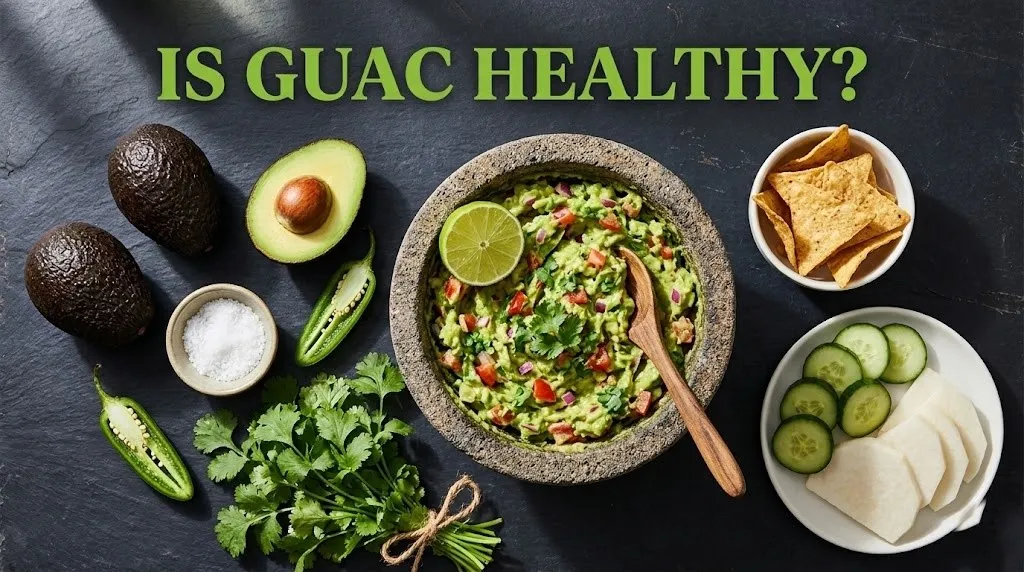
Guacamole is a whole-food dip. Unlike queso, which is a processed cheese product, or ranch, which is mayonnaise and buttermilk powder, guacamole is simply mashed produce. The ingredient list reads like a grocery list, not a chemistry experiment.
Is Guacamole a Healthy Snack
Guacamole is a healthy snack when paired with vegetables or eaten in a measured portion with a reasonable amount of chips. The guacamole itself is nutritionally excellent. The vehicle that carries it to your mouth determines whether the overall snack is healthy.
A cup of cucumber slices with a quarter-cup of guacamole is a 130-calorie snack with 5 grams of fiber. A basket of fried tortilla chips with a cup of guacamole is a 600-calorie appetizer that arrives before you have ordered your entree.
The snack health evaluation depends on the pairing and the portion. The guac is healthy. The chips are the variable. Choose the chip wisely, or skip it entirely and use vegetables.
Key Takeaway: Guacamole is a healthy snack in a vacuum; the chip is the variable that determines whether you are eating a nutritious dip or a high-calorie appetizer.
Guacamole Is It Healthy
Yes, guacamole is healthy. The question is answered the same way regardless of whether it is phrased as “is guac healthy” or “guacamole is it healthy.” The food is identical. The answer is identical.
The health benefits are well-documented. A 2013 study in the Nutrition Journal found that avocado consumers had lower body weight, smaller waist circumference, and higher HDL cholesterol compared to non-consumers. The monounsaturated fat and fiber combination supports metabolic health.
The downsides are contextual. Guacamole is calorie-dense due to the avocado fat. It is easy to overeat. Restaurant portions are often a full cup, delivering 400 to 500 calories before the chips. The healthfulness is dose-dependent.
Is Homemade Guacamole Healthy
Homemade guacamole is healthier than most restaurant and store-bought versions because you control the sodium and the ingredient quality. A homemade batch can be made with half the sodium of a restaurant version.
Restaurant guacamole is often made tableside, which is visually impressive but means the sodium level is unknown. The server may add multiple pinches of salt without measuring. A homemade batch uses a measured half-teaspoon for the entire recipe.
Homemade guacamole also avoids the preservatives and stabilizers found in some store-bought versions. Wholly Guacamole and Good Foods are the exceptions, with clean ingredient lists. The homemade version is fresher, more vibrant, and costs less per serving.
Is Chips and Guac Healthy
Chips and guacamole occupy a nutritional grey zone. The guac is healthy. The chips are a processed, fried, salted grain product. Together, they are a high-calorie, high-sodium snack with redeeming nutritional qualities.
A typical restaurant serving of chips and guac contains 600 to 800 calories. The guacamole accounts for roughly 200 of those calories. The chips, often refilled multiple times, account for the remaining 400 to 600 calories. The chips are the caloric engine of the dish.
The healthy compromise is to count out a specific number of chips. A single serving of tortilla chips is roughly 10 to 12 chips, delivering 140 calories. Paired with a quarter-cup of guacamole, the total snack is 250 calories. This is a reasonable snack. The bottomless basket is the problem.
Is Chips and Guacamole Healthy
The pairing of chips and guacamole is healthy in controlled portions and unhealthy in restaurant portions. The nutritional analysis separates into two components: the dip and the dipper.
The dip is nutrient-dense. The dipper is energy-dense. Together, they create a hyperpalatable combination of salt, fat, and crunch that is difficult to stop eating. The research on ultra-processed foods identifies this specific combination, fat, salt, and refined carbohydrate, as uniquely capable of overriding satiety signals.
A 2026 healthy approach to chips and guacamole uses grain-free tortilla chips, baked corn chips, or vegetable slices as the dipper. The calories drop. The fiber increases. The satisfaction remains.
Is Guac and Chips Healthy
Guac and chips is the same food as chips and guac. The health evaluation is identical. The guacamole is the nutritious component. The chips are the caloric variable.
The sequence of eating matters. Research suggests that eating the guacamole first, on a vegetable slice or a single chip, may trigger satiety signals before the chip consumption escalates. The fat in the avocado stimulates the release of cholecystokinin, a hormone that signals fullness.
A practical strategy is to alternate cucumber slices with tortilla chips. Every other dip is a vegetable. The chip consumption is halved. The guacamole enjoyment is unchanged.
Are Chips and Guac Healthy
Chips and guac are healthy relative to other appetizers like fried calamari, spinach artichoke dip, or loaded nachos. They are less healthy than a plate of raw vegetables with guacamole.
The comparison table clarifies the relative health position:
| Appetizer (1 serving) | Calories | Fat | Saturated Fat | Fiber |
|---|---|---|---|---|
| Chips & Guac | 400 | 25g | 3.5g | 6g |
| Queso & Chips | 450 | 28g | 10g | 1g |
| Spinach Artichoke Dip | 550 | 38g | 14g | 2g |
| Hummus & Pita | 350 | 18g | 2g | 7g |
Chips and guac is not the worst choice on the appetizer menu. It is likely the best choice after a plain salad with dressing on the side.
Are Tortilla Chips and Guacamole Healthy
Tortilla chips and guacamole are a moderate health choice. The corn in tortilla chips is a whole grain when made from whole corn masa. The oil is typically vegetable oil. The salt is significant.
The specific chip choice matters. Stone-ground corn chips fried in avocado oil or coconut oil are a better choice than chips fried in soybean or canola oil. Siete and Late July offer these healthier options in 2026.
A serving of stone-ground chips with a quarter-cup of guacamole is a reasonable, satisfying snack that provides whole-grain fiber, healthy fat, and real food ingredients. The same snack with bottomless restaurant chips is an unmeasured calorie surplus.
Key Takeaway: Tortilla chips and guacamole can be a healthy snack when the chips are a high-quality grain product and the portion is measured; the restaurant version is a calorie trap.
Guacamole Nutrition Facts
A quarter-cup, 60-gram serving of standard guacamole contains 100 to 120 calories, 9 to 11 grams of fat, 1.5 grams of saturated fat, 5 to 7 grams of carbohydrate, 4 to 5 grams of fiber, 1 gram of protein, and 150 to 300 milligrams of sodium.
The fat profile is predominantly monounsaturated. A serving provides roughly 7 grams of monounsaturated fat, the same type found in olive oil. The potassium content is roughly 250 milligrams, 6 percent of the daily value. The fiber is a mix of soluble and insoluble types.
The sodium varies widely. Homemade guacamole can be made with 100 milligrams of sodium per serving. Restaurant and store-bought versions range from 200 to 400 milligrams. The sodium is the only nutritional variable of concern.
How Many Calories in Guacamole
A standard quarter-cup serving of guacamole contains 100 to 120 calories. A half-cup contains 200 to 240 calories. A full cup, which is a common restaurant portion, contains 400 to 480 calories.
The calorie count comes almost entirely from the avocado fat. There is minimal protein and modest carbohydrate from the onion and tomato. The calorie density is high, which is why portion awareness matters.
A Chipotle guacamole serving is 4 ounces, or a half-cup, and contains 230 calories. Adding guac to a burrito bowl adds 230 calories of healthy fat and fiber. The nutritional trade-off is positive. The calorie addition is real.
Is Guacamole Good for Weight Loss
Guacamole can support weight loss because the monounsaturated fat and fiber promote satiety. A quarter-cup serving with vegetables can suppress hunger for 2 to 3 hours.
The satiety mechanism is well-documented. Fat slows gastric emptying. Fiber stretches the stomach. The combination triggers the release of satiety hormones. A 2014 study in the Nutrition Journal found that adding half an avocado to a lunch meal increased satisfaction by 23 percent and reduced the desire to eat by 28 percent over the following 3 hours.
The calorie cost must be accounted for. Adding 200 calories of guacamole to a meal without reducing anything else creates a surplus. Replacing a higher-calorie condiment like mayonnaise or ranch with guacamole creates a deficit. The weight loss effect depends on the substitution, not the addition.
Healthy Homemade Guacamole Recipe
To make the healthiest homemade guacamole in 10 minutes:
- Halve and pit 2 ripe Hass avocados. Scoop the flesh into a medium bowl.
- Add the juice of 1 lime and mash with a fork to your desired consistency.
- Fold in 1/4 cup of finely diced white onion, 1/4 cup of diced Roma tomato, 1 finely minced jalapeno, 2 tablespoons of chopped cilantro, and 1/2 teaspoon of kosher salt.
- Taste and adjust salt and lime juice. Serve immediately.
The lime juice serves two functions. The acid brightens the flavor. The vitamin C slows the enzymatic browning that turns guacamole brown. Press a piece of plastic wrap directly onto the surface of any leftover guacamole and refrigerate immediately.
Is Store Bought Guacamole Healthy
Store-bought guacamole is healthy when the ingredient list is short and free of preservatives. Wholly Guacamole and Good Foods are the two leading clean-label brands in 2026.
Wholly Guacamole’s ingredient list reads: Hass avocado, onion, tomato, jalapeno pepper, cilantro, lime juice, garlic, salt. This is identical to a homemade recipe. The nutrition profile is 100 calories, 9 grams of fat, and 4 grams of fiber per serving.
Avoid store-bought guacamole with added sour cream, mayonnaise, or cream cheese. These products are “guacamole dip” or “avocado dip,” not guacamole. The ingredient list reveals the difference.
Best Healthy Guacamole Brands 2026
The best healthy guacamole brands in 2026 are Wholly Guacamole, Good Foods, and Chipotle’s retail guacamole. All three use clean, recognizable ingredients.
Wholly Guacamole is the most widely available, sold at Costco, Kroger, and Walmart. The single-serving 2-ounce cups are portion-controlled at 90 calories each. Good Foods offers a chunky, homestyle texture. Chipotle’s retail guacamole is the same recipe used in restaurants.
Single-serving cups are the best choice for portion control. The 2-ounce cup is a perfect snack size. The larger tubs invite heavy-handed scooping.
Frequently Asked Questions About Guacamole
Is guacamole healthy for weight loss?
Yes, the monounsaturated fat and fiber in guacamole promote satiety and can support a calorie deficit.
The calories must be accounted for in the daily total.
Adding guacamole without reducing other foods does not support weight loss.
How many calories are in a serving of guacamole?
A quarter-cup serving contains 100 to 120 calories.
A half-cup contains 200 to 240 calories.
Restaurant portions are often a half-cup or larger.
Is chips and guac a healthy snack?
In controlled portions, yes. The guacamole is nutrient-dense.
The chips are the caloric variable.
Count out 10 to 12 chips with a quarter-cup of guac for a reasonable 250-calorie snack.
What is the healthiest chip for guacamole?
Baked corn chips, grain-free cassava chips, or vegetable slices are the healthiest options.
Siete grain-free tortilla chips and Late July baked chips are the best 2026 brands.
Cucumber, jicama, and bell pepper slices eliminate the chip calories entirely.
Is store-bought guacamole as healthy as homemade?
Wholly Guacamole and Good Foods are nutritionally equivalent to homemade.
The ingredient lists are nearly identical: avocado, onion, tomato, lime, cilantro, salt.
Avoid products labeled “guacamole dip” with added sour cream or fillers.
Guacamole is one of the healthiest dips on the planet. It is mashed avocado with onion, tomato, jalapeno, cilantro, and lime. The ingredient list is a farmers market, not a factory. The fat is the same fat that makes olive oil a health food.
The chip is the trap. The guac is innocent. The bottomless basket of fried corn is the caloric engine of the chips-and-guac appetizer. Count the chips. Use vegetables. Enjoy the guac without the baggage.
Make it at home. Control the salt. Eat it within 24 hours. The avocado is a gift from the plant kingdom. Treat it with the respect it deserves.