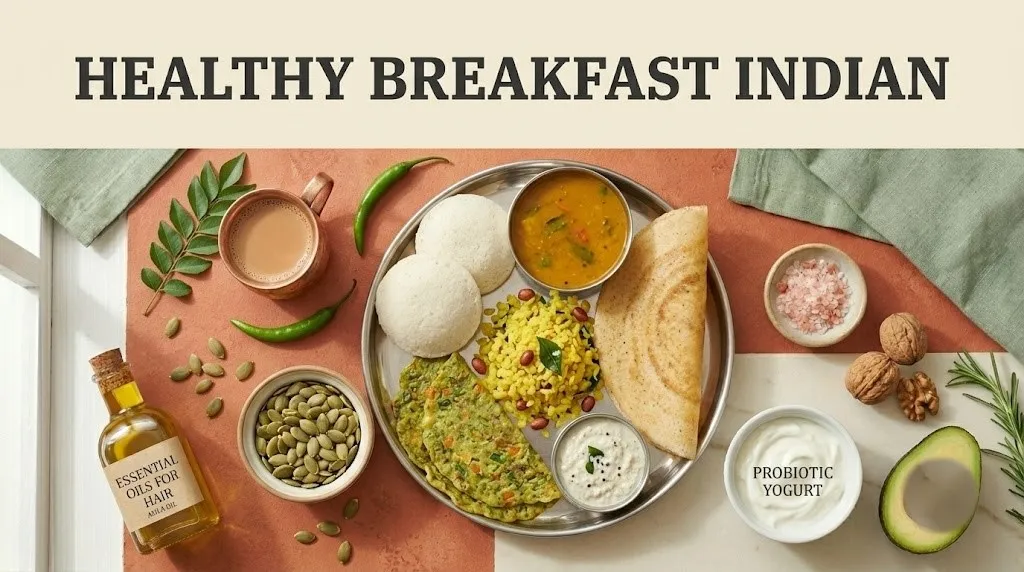
A healthy Indian breakfast combines a whole grain or legume base, a source of protein, and a cooked vegetable component, all seasoned with digestion-supporting spices like ginger, turmeric, and cumin. The traditional Indian breakfast plate is already built on sound nutritional principles. The task is not to reinvent it but to understand why it works and how to optimize it.
The Academy of Nutrition and Dietetics recognizes that traditional dietary patterns from cultures around the world, including Indian cuisine, often contain deeply nutritious meal structures that modern nutritional science validates. The fermented rice and lentil batters of South India, the millet flatbreads of the West, and the stuffed parathas of the North all deliver protein, fiber, and micronutrients in combinations that make biological sense.
This guide covers 17 specific healthy Indian breakfast ideas across regions and dietary needs. You will find full nutritional breakdowns for classic dishes like idli, dosa, and poha, step-by-step recipes for high-protein chillas, and practical strategies for getting a genuinely healthy Indian breakfast on the table in 15 minutes or less on a weekday morning.
What Makes a Healthy Indian Breakfast?
A healthy Indian breakfast balances complex carbohydrates from whole grains or legumes with adequate protein and fiber, includes a small amount of healthy fat for nutrient absorption, and incorporates spices that support digestion and reduce inflammation.
The traditional Indian breakfast structure follows a pattern that nutrition science supports. The base is a grain or legume: rice, wheat, semolina, millet, or lentils. This supplies carbohydrate for morning energy. The protein component comes from lentils, dairy, or eggs: sambar, chutney with dal, yogurt, paneer, or a legume-based main dish. The fat component is typically a small amount of ghee, oil, or coconut used in cooking or as a finishing drizzle. This fat helps absorb the fat-soluble vitamins present in the vegetables and spices.
Vegetables are the component most often missing from Indian breakfasts. A potato-stuffed paratha or a plain upma delivers grain and fat but lacks the fiber and micronutrients that vegetables supply. Adding even a half-cup of cooked spinach, grated carrots, or a side of cucumber and tomato raita significantly improves the nutritional profile. The USDA Dietary Guidelines recommend that half the plate be fruits and vegetables at every meal. Breakfast is no exception.
Spices are the nutritional differentiator that sets Indian breakfasts apart from Western grain-based breakfasts. Turmeric contains curcumin, a compound with documented anti-inflammatory properties. Ginger supports gastric emptying and reduces nausea. Cumin stimulates digestive enzyme production. Curry leaves contain alkaloids that may support blood sugar regulation. These are not just flavoring agents. They are functional food components.
Healthy Indian Breakfast Ideas for Every Region
Indian breakfast traditions vary dramatically by region. Understanding the nutritional strengths of each regional approach helps you build a diverse, interesting breakfast rotation.
South Indian breakfasts center on fermented rice and lentil batters. Idli, dosa, uttapam, and appam are all variations on this theme. The fermentation process, driven by naturally occurring lactobacillus bacteria, partially digests the proteins and carbohydrates, making them more bioavailable. These breakfasts are naturally gluten-free, often vegan or easily made vegan by omitting ghee, and pair with protein-rich sambar and coconut chutney. The weak point is that many South Indian breakfasts are grain-heavy with limited vegetable content unless you specifically add them.
North Indian breakfasts are wheat-forward. Parathas stuffed with potato, cauliflower, radish, or paneer are the most recognizable. Poha, made from flattened rice, is a lighter option popular across central and western India. Chillas, savory lentil or chickpea flour pancakes, are the high-protein star of North Indian breakfast cuisine. North Indian breakfasts tend to include more visible vegetables through stuffed breads and chilla fillings, but they also rely more heavily on gluten-containing wheat.
| Region | Staple Breakfasts | Key Nutritional Strength | Common Weak Point |
|---|---|---|---|
| South India | Idli, dosa, upma, uttapam | Fermented, gluten-free, probiotic | Often low in vegetables |
| North India | Paratha, chilla, poha | Higher vegetable inclusion, protein from dairy | Wheat-heavy, gluten-dependent |
| West India | Dhokla, thepla, handvo | Chickpea flour base, high protein | Some fried preparations |
| East India | Panta bhat, luchi, chena | Fermented rice, fresh cheese protein | Some oil-heavy fried breads |
Key Takeaway: South Indian breakfasts excel at fermentation and probiotics. North Indian breakfasts incorporate more vegetables and protein. Rotate between regions for the widest nutritional variety.
Healthy Indian Breakfast Recipes Worth Mastering
Three Indian breakfast recipes form the foundation of a healthy rotation. Master these, and you have a nutritious answer to every kind of morning, whether you have 10 minutes or an hour.
Idli with sambar is the gold standard for fermented breakfast nutrition. The idli itself is made from a fermented batter of rice and urad dal, a type of black gram. The fermentation increases B vitamin content, particularly folate and riboflavin. The sambar, a lentil-based vegetable stew, supplies additional protein and fiber. A plate of two idlis with a cup of sambar delivers roughly 250 to 300 calories, 10 to 12 grams of protein, and 5 to 7 grams of fiber. The batter must be fermented for 8 to 12 hours, which requires planning but little hands-on time.
Moong dal chilla is a savory lentil pancake that requires only a two-hour soak and a quick blend. It is gluten-free, high in protein, and endlessly adaptable. Add grated zucchini, chopped spinach, diced tomatoes, or crumbled paneer directly into the batter. One chilla made from 1/4 cup of dry moong dal contains about 8 grams of protein and 4 grams of fiber. The batter can be made the night before and stored in the refrigerator.
Poha is the quickest option of the three. Flattened rice cooks in under 10 minutes with no soaking required. The traditional preparation includes turmeric, mustard seeds, curry leaves, onions, and peanuts. The peanuts add protein and healthy fat. The turmeric adds anti-inflammatory compounds. A cup of vegetable poha with peanuts contains roughly 300 calories, 8 grams of protein, and 4 grams of fiber when loaded with vegetables.
Healthy South Indian Breakfast Options
South Indian breakfasts are among the healthiest traditional breakfasts in the world, built on a foundation of fermented, gluten-free, protein-complementary ingredients. Four dishes stand out.
Idli is steamed, making it fat-free aside from the small amount of oil used to grease the molds. The fermentation process breaks down phytic acid, a compound that can inhibit mineral absorption. This means the iron and zinc in the rice and lentils become more bioavailable. Idli is bland on its own, which is a feature, not a bug. It serves as a vehicle for nutrient-dense accompaniments like sambar, coconut chutney, or tomato chutney.
Dosa is the crispier cousin of idli, made from the same fermented batter spread thin on a hot tawa. The thinness means dosa has a higher surface area and absorbs more oil during cooking. A plain dosa cooked with minimal oil shares the nutritional benefits of idli. A masala dosa stuffed with spiced potatoes adds carbohydrates and some fiber from the potato filling but is still a reasonable breakfast choice.
Upma is made from semolina or coarse rice flour, tempered with mustard seeds, curry leaves, ginger, and often vegetables. It cooks quickly and is infinitely customizable. The nutritional weakness of upma is the semolina base. Semolina is a refined grain, lower in fiber than whole wheat or millet. Upgrading to ragi or jowar upma increases the fiber and mineral content.
Puttu is a steamed cylinder of ground rice layered with coconut, popular in Kerala. It is light, fat-free except for the coconut, and pairs beautifully with kadala curry, a spiced black chickpea dish. The combination of rice and chickpeas forms a complete protein with all essential amino acids.
Key Takeaway: South Indian fermented breakfasts offer probiotics, gluten-free whole grains, and complete protein when paired with lentil-based sides.
Healthy North Indian Breakfast Dishes
North Indian breakfasts are hearty, often wheat-based, and more likely to include visible vegetables and dairy protein. The healthiest options are those that maximize whole grains and minimize the amount of fat used in cooking.
Stuffed paratha can be a balanced meal when made with whole wheat flour and a vegetable-heavy filling. A gobi (cauliflower) paratha or mooli (radish) paratha packs a serving of vegetables into the bread itself. The issue with parathas is the fat. Traditional recipes call for generous ghee or butter during cooking. Using a nonstick tawa and limiting the fat to a light brush rather than a heavy drizzle keeps the paratha in healthy territory. Serve with plain yogurt rather than a heavy raita to keep the calorie count reasonable.
Poha bridges the gap between North and West Indian breakfast traditions. The version popular in Madhya Pradesh and Maharashtra includes turmeric, mustard seeds, green chilies, onions, potatoes, and roasted peanuts. The peanuts contribute protein and healthy monounsaturated fat. The potatoes add carbohydrate but also potassium and vitamin C.
Besan chilla is a savory pancake made from chickpea flour, also known as gram flour or besan. Chickpea flour is naturally high in protein and fiber. One chilla made from 1/4 cup of besan contains about 7 grams of protein and 5 grams of fiber. Add grated vegetables directly to the batter. The cooking time is under five minutes per chilla. This is one of the fastest healthy Indian breakfasts that does not require pre-fermentation.
Poha: A Healthy Breakfast Staple with Full Nutrition
Poha is a healthy breakfast choice when it is prepared with plenty of vegetables, a moderate amount of peanuts, and minimal oil. The flattened rice base digests easily and provides quick morning energy.
Flattened rice is rice that has been parboiled, flattened, and dried. The processing partially gelatinizes the starch, which is why poha cooks so quickly and requires no boiling. A one-cup serving of cooked poha contains roughly 200 calories, 4 grams of protein, and about 1 gram of fiber. The fiber content is low because the rice is typically made from white rice, not brown. This is the nutritional limitation of standard poha.
The traditional solution to poha’s low fiber and protein is the addition of peanuts and vegetables. Adding a quarter cup of roasted peanuts contributes 8 grams of protein and 3 grams of fiber. Adding a half cup of mixed vegetables like peas, carrots, and bell peppers adds another 2 to 3 grams of fiber plus vitamin A and vitamin C. The turmeric in the tadka adds curcumin, which requires black pepper for optimal absorption. Fortunately, the tadka often includes both.
For diabetics or anyone watching blood sugar, poha’s glycemic index of roughly 60 to 65 is moderate. The addition of protein and fiber from peanuts and vegetables lowers the effective glycemic load of the meal. A poha made with brown rice flakes, if available, would lower the GI further, but brown rice poha is not widely distributed in most markets. The best practical strategy is to double the vegetables and peanuts and halve the poha to shift the carbohydrate-to-fiber ratio in a more favorable direction.
Quick Tip:
- Use the kanda poha style with onions, turmeric, and peanuts for maximum flavor and nutrition.
- Add a squeeze of lemon juice after cooking. Vitamin C enhances the absorption of iron from the peanuts.
- For higher fiber, mix half poha with half cooked quinoa or cooked millet.
Idli and Dosa: Health Benefits Beyond the Hype
Idli and dosa are genuinely healthy foods, not just culturally beloved ones. The fermentation process, the rice-lentil protein complementarity, and the steaming cooking method each contribute specific health benefits.
The fermentation of idli and dosa batter is performed by naturally occurring lactic acid bacteria, primarily lactobacillus species. These bacteria produce lactic acid, which gives the batter its slightly sour taste. The acid environment partially breaks down the proteins and starches, making them easier to digest. This is why some people who experience bloating from other grain foods tolerate idli well. The fermentation also increases the bioavailability of B vitamins, including folate. The NIH Office of Dietary Supplements notes that folate is critical for red blood cell formation and during pregnancy for neural tube development.
The combination of rice and urad dal creates a complete protein. Rice is low in the essential amino acid lysine but contains adequate methionine. Urad dal is rich in lysine but low in methionine. Together, they supply all nine essential amino acids. This is the principle of protein complementarity that the Academy of Nutrition and Dietetics recognizes in vegetarian diets. You do not need to eat rice and dal at every meal. Eating them within the same day is sufficient.
The steaming method matters. Idli is cooked with steam, not oil. This produces a fat-free base that absorbs the flavors of sambar and chutney without contributing its own fat. Dosa, cooked on a tawa with a small amount of oil, adds about 3 to 5 grams of fat per dosa. The difference is modest but worth noting if you eat dosa daily.
Key Takeaway: Fermentation improves digestibility and B vitamin bioavailability. The rice-dal combination creates a complete vegetarian protein. Steaming keeps idli virtually fat-free.
Fermented Indian Breakfast Foods and Gut Function
Fermented Indian breakfast foods like idli, dosa, dhokla, and appam contain live beneficial bacteria that support the gut microbiome. The fermentation process also produces compounds that improve nutrient absorption and digestive comfort.
The gut microbiome is the collection of bacteria, fungi, and other microorganisms living in the large intestine. Research from the Harvard T.H. Chan School of Public Health has documented that a diverse, well-fed gut microbiome contributes to immune function, mood regulation, and metabolic health. Fermented foods introduce live bacteria that can transiently colonize the gut and interact with the resident microbiome.
The lactic acid bacteria in fermented idli and dosa batter produce short-chain fatty acids as metabolic byproducts. These compounds lower the pH of the gut environment, which can inhibit the growth of pathogenic bacteria. The fermentation also partially breaks down lectins and phytic acid, compounds in legumes and grains that can interfere with digestion and mineral absorption. This is one reason fermented dal-based foods are often described as lighter or easier to digest than their unfermented counterparts.
To maximize the probiotic benefit, the batter must be genuinely fermented, not chemically leavened. Some commercial idli mixes and restaurant preparations use baking soda or other chemical leaveners to speed up the process. These shortcut versions lack the live bacteria and the associated digestive benefits. The best way to ensure fermentation is to make batter at home or purchase fresh batter from a source that confirms traditional fermentation methods.
Protein Rich Indian Vegetarian Breakfast Options
Protein-rich Indian vegetarian breakfasts rely on lentils, legumes, dairy, and the complementary protein effect of grain-legume combinations. Several options deliver 15 to 20 grams of protein per serving.
Moong dal chilla is the highest-protein option relative to preparation time. A two-chilla serving made from half a cup of dry moong dal delivers roughly 16 grams of protein. Add crumbled paneer to the batter for an additional 5 grams per ounce. Besan chilla is a close second, with 14 grams of protein per two-chilla serving.
Dosa with sambar delivers protein from three sources: the urad dal in the dosa batter, the toor dal in the sambar, and the small amount of chana dal often included in the sambar vegetable mix. A standard serving of two dosas with a cup of sambar contains roughly 15 to 18 grams of protein. The protein is spread across complementary sources, improving the amino acid profile.
| Breakfast | Serving Size | Protein (g) | Fiber (g) | Key Protein Source |
|---|---|---|---|---|
| Moong dal chilla | 2 chillas | 16 | 8 | Split yellow gram |
| Besan chilla with paneer | 2 chillas with 1 oz paneer | 20 | 10 | Chickpea flour, dairy |
| Dosa with sambar | 2 dosas, 1 cup sambar | 15 to 18 | 6 to 8 | Urad dal, toor dal |
| Idli with sambar | 3 idlis, 1 cup sambar | 12 to 14 | 5 to 7 | Urad dal, toor dal |
| Yogurt with sprouted moth beans | 1 cup yogurt, 1/2 cup sprouts | 18 | 6 | Dairy, sprouted legumes |
Sprouted legume salads are a grab-and-go protein option that requires no morning cooking. Sprout moth beans or mung beans over two to three days. In the morning, toss half a cup of sprouts with chopped onion, tomato, cucumber, lemon juice, and chaat masala. Add a cup of plain yogurt on the side. This breakfast delivers 18 grams of protein and substantial fiber before 8 AM.
Key Takeaway: Lentil-based chillas and dosa with sambar are the highest-protein traditional Indian breakfasts. Sprouted legumes add even more protein with zero morning cooking time.
Moong Dal Chilla Recipe and Full Nutrition Breakdown
Moong dal chilla is a savory lentil pancake that delivers 16 grams of protein and 8 grams of fiber per two-chilla serving. It is gluten-free, vegan-adaptable, and takes about 15 minutes of active cooking time after soaking.
Moong dal, also called split yellow gram or mung dal, is one of the most easily digestible legumes. Ayurvedic tradition considers it tridoshic, meaning it balances all three doshas. Modern nutrition science notes that moong dal has a lower oligosaccharide content than chickpeas or kidney beans, which means it produces less gas during digestion. This makes it a good legume choice for breakfast, when digestive comfort is a priority.
To prepare moong dal chilla:
- Rinse 1 cup of dried moong dal. Soak in 2 cups of water for 2 hours or overnight in the refrigerator.
- Drain the soaked dal. Add to a blender with a 1-inch piece of ginger, 1 green chili, 1/2 teaspoon cumin seeds, and 1/2 cup water.
- Blend until smooth. The batter should be the consistency of pancake batter. Add water a tablespoon at a time if too thick.
- Transfer batter to a bowl. Stir in finely chopped onion, one small grated carrot, a handful of chopped spinach, and salt to taste.
- Heat a nonstick tawa or skillet over medium heat. Lightly oil the surface.
- Pour 1/4 cup of batter onto the tawa. Use the back of the ladle to spread it into a thin circle.
- Drizzle a few drops of oil around the edges. Cook for 2 to 3 minutes until the underside is golden.
- Flip and cook another 1 to 2 minutes. Serve with green chutney or plain yogurt.
Nutrition per two-chilla serving: approximately 280 calories, 16g protein, 8g fiber, 38g carbohydrate, 6g fat. The chillas are naturally vegan if served with plant-based yogurt or chutney. Those with a history of kidney stones should moderate intake of certain greens like spinach due to oxalate content.
Besan Chilla: A Quick, Healthy Breakfast
Besan chilla is a savory chickpea flour pancake that cooks in under 10 minutes with no soaking, no fermentation, and no blending. It is the fastest route to a high-protein, high-fiber Indian breakfast on a weekday morning.
Besan, or gram flour, is made from ground chickpeas. A quarter cup contains about 7 grams of protein and 5 grams of fiber. The flour is naturally gluten-free, making besan chilla a safe option for people with celiac disease or gluten sensitivity. The batter is simply besan, water, spices, and any chopped vegetables you have on hand. Onion, tomato, spinach, grated zucchini, and fresh cilantro all work well.
The flavor profile of besan is slightly nutty and earthy. It benefits from assertive seasoning. Ajwain (carom seeds) is a traditional addition that adds a thyme-like flavor and is believed to support digestion. Turmeric adds color and anti-inflammatory compounds. Finely chopped green chili and ginger add heat and brightness.
To prepare besan chilla:
- In a bowl, whisk 1 cup besan with 3/4 cup water until smooth. The batter should coat the back of a spoon.
- Add 1/4 cup finely chopped onion, 1/4 cup chopped tomato, 2 tablespoons chopped cilantro, 1/2 teaspoon ajwain, 1/4 teaspoon turmeric, 1/2 teaspoon salt, and finely chopped green chili to taste.
- Heat a nonstick tawa over medium heat. Lightly oil.
- Pour 1/3 cup of batter onto the tawa. Spread gently into a thin circle.
- Cook 2 to 3 minutes per side until golden with brown spots.
- Serve with mint chutney or a squeeze of lemon.
Quick Tip:
- Add a tablespoon of ground flaxseed to the batter for omega-3 fatty acids and extra fiber.
- Besan chilla batter can be made the night before and refrigerated. Stir before using.
- For a higher-protein version, use half besan and half moong dal flour.
Oats Idli for Weight Loss and Busy Mornings
Oats idli is a modern variation on traditional idli that uses rolled oats and semolina instead of the fermented rice and dal batter. It is faster, higher in soluble fiber, and well-suited to weight loss eating patterns.
Rolled oats contain beta-glucan, a soluble fiber that the American Heart Association recognizes as effective for lowering LDL cholesterol. A half-cup of rolled oats delivers about 4 grams of fiber, of which roughly 2 grams are soluble beta-glucan. This fiber forms a gel in the digestive tract that slows gastric emptying and promotes satiety, the feeling of fullness after a meal. This is the mechanism that makes oatmeal and oat-based dishes useful for weight management.
Oats idli does not require fermentation. The leavening comes from baking soda or fruit salt, and the structure comes from semolina. The oats are dry-roasted and ground into a coarse powder. Semolina, yogurt, and a small amount of oil form the binder. The batter is mixed and immediately steamed, which means the entire process from dry ingredients to cooked idlis takes about 20 minutes.
To prepare oats idli:
- Dry roast 1 cup rolled oats in a pan over medium heat until fragrant, about 3 minutes. Cool and grind to a coarse powder.
- In a bowl, mix the oat powder with 1/2 cup fine semolina, 1/2 cup plain yogurt, 1/2 cup water, and salt to taste.
- Add 1 grated carrot, 2 tablespoons chopped cilantro, and 1/2 teaspoon grated ginger.
- Just before steaming, add 1/2 teaspoon baking soda or fruit salt. Mix gently.
- Grease idli molds. Fill each mold three-quarters full with batter.
- Steam for 12 to 15 minutes. Let cool for 2 minutes before unmolding.
Nutrition per 3 idlis: approximately 180 calories, 7g protein, 5g fiber, 30g carbohydrate, 4g fat. Serve with sambar for additional protein or with a light coconut chutney.
Key Takeaway: Oats idli delivers soluble fiber for satiety and heart health in a familiar, comforting format. No fermentation required.
Indian Breakfast Ideas for Diabetics
A diabetic-friendly Indian breakfast focuses on low-glycemic grains, protein inclusion, fiber from legumes and vegetables, and the strategic use of spices that may support blood sugar regulation.
The American Diabetes Association recommends that people with diabetes choose whole grains, include a protein source at every meal, and monitor the total carbohydrate content of meals. A breakfast with 30 to 45 grams of total carbohydrate, at least 10 grams of protein, and at least 5 grams of fiber fits within these guidelines for many adults. Individual targets should be set with a healthcare provider or registered dietitian.
Several traditional Indian breakfasts fit these parameters without modification. A plate of two idlis with a cup of sambar contains roughly 35 grams of carbohydrate, 12 grams of protein, and 6 grams of fiber. The fermentation process lowers the effective glycemic response compared to unfermented rice. A moong dal chilla made from 1/4 cup dry dal with vegetables contains roughly 20 grams of carbohydrate, 8 grams of protein, and 4 grams of fiber. A besan chilla with vegetables falls in a similar range.
| Diabetic-Friendly Breakfast | Approx. Carbs | Approx. Protein | Approx. Fiber | Notes |
|---|---|---|---|---|
| Idli (2) with sambar (1 cup) | 35 g | 12 g | 6 g | Fermented, lower GI |
| Moong dal chilla (2) with vegetables | 20 g | 16 g | 8 g | Lowest carb option |
| Besan chilla (2) with vegetables | 24 g | 14 g | 10 g | High fiber from chickpea flour |
| Oats idli (3) with sambar | 38 g | 12 g | 7 g | Soluble fiber for satiety |
| Sprout salad with yogurt | 22 g | 18 g | 8 g | Highest protein, no grains |
Poha and upma require more caution for diabetics. Both are made from refined grains with a moderate to high glycemic index. Adding a generous portion of peanuts, vegetables, and a side of plain yogurt can bring the glycemic load into a manageable range, but portion control remains important. A smaller serving of poha supplemented with extra peanuts and a boiled egg on the side is a practical compromise.
Vegan Indian Breakfast Ideas
A vegan Indian breakfast eliminates dairy products like yogurt, ghee, paneer, and milk-based chai while preserving the protein and nutritional quality of the meal. Many South Indian breakfasts are naturally vegan or nearly vegan.
South Indian breakfasts are the easiest to veganize because they are built on a foundation of rice, lentils, and coconut. Idli and dosa batter is inherently vegan. Sambar is vegan. Coconut chutney is vegan. A breakfast of idli, sambar, and coconut chutney requires no modification at all. The protein comes from the dal in the sambar and the urad dal in the idli.
North Indian vegan options require more adaptation. Besan chilla is naturally vegan when cooked in oil instead of ghee. Moong dal chilla is naturally vegan. Parathas can be made without ghee, though the texture changes slightly. Poha is typically vegan when cooked with oil rather than ghee.
| Traditional Breakfast | Vegan Substitution | Protein Source |
|---|---|---|
| Idli with ghee drizzle | Skip ghee or use coconut oil | Sambar, urad dal |
| Dosa with ghee | Cook with coconut or sesame oil | Sambar, urad dal |
| Yogurt with paratha | Coconut or soy yogurt | Stuffed paratha filling |
| Paneer paratha | Tofu paratha (crumbled firm tofu) | Tofu, whole wheat |
| Milk chai | Oat milk or soy milk chai | Soy milk protein |
Protein adequacy on a vegan Indian breakfast requires attention. Lentils, chickpeas, and soy products supply lysine, the amino acid most likely to be limiting in grain-based diets. Pairing a grain like rice or wheat with a legume at breakfast ensures a complete amino acid profile. The rice-dal combination in idli and sambar achieves this. The chickpea flour in besan chilla already contains both grain and legume characteristics.
Gluten Free Indian Breakfast Options
Gluten-free Indian breakfasts are abundant because traditional Indian cuisine relies heavily on rice, lentils, chickpea flour, and millets, all of which are naturally free of gluten. The challenge is not finding options but avoiding cross-contamination from wheat-based staples.
The entire South Indian breakfast repertoire is naturally gluten-free. Idli, dosa, uttapam, and upma made from rice or ragi are all safe for someone with celiac disease or gluten sensitivity. The only caution is asafoetida, also called hing, which is sometimes cut with wheat flour as a processing aid. Pure hing powder or whole hing resin does not contain wheat, but compounded hing may. People with celiac disease should verify the purity of their hing source.
Besan chilla and moong dal chilla are gluten-free. Poha made from flattened rice is gluten-free. Dhokla, a steamed chickpea flour cake from Gujarat, is gluten-free. Ragi-based preparations, including ragi dosa and ragi idli, are gluten-free and add the nutritional benefits of finger millet, which is rich in calcium and iron.
The main gluten-containing breakfast foods to avoid are wheat-based parathas, puri, bhatura, upma made from wheat semolina, and any bread-based breakfast like sandwiches or toast. Semolina upma is particularly confusing because it is sometimes labeled as suji or rava, which people may not immediately recognize as a wheat product. Rice rava upma is a gluten-free alternative.
Key Takeaway: South Indian breakfasts and legume-based chillas are almost universally gluten-free. Verify hing purity and confirm that rava upma is made from rice, not wheat.
Quick Healthy Indian Breakfast Under 15 Minutes
A healthy Indian breakfast in under 15 minutes relies on ingredients that require no soaking, no fermentation, and minimal chopping. Several traditional options fit this timeframe, and a few modern adaptations make it even easier.
Besan chilla is the fastest cooked option. The batter takes two minutes to whisk. The cooking takes six to eight minutes for two chillas. The total time from opening the cupboard to sitting down to eat is about 12 minutes.
Poha, when made with pre-washed rice flakes, clocks in at about 12 minutes. The chopping of one onion, one potato, and one green chili takes the most time. Using frozen peas and pre-roasted peanuts eliminates two additional prep steps.
Quick-cooking vegetable upma made from pre-roasted semolina or instant rice rava is ready in about 10 minutes once the water boils. The tadka takes two minutes. The cooking takes eight minutes. Add frozen mixed vegetables directly from the freezer.
The fastest non-cooked option is a sprouted legume salad. If sprouts are prepared over the weekend, the morning assembly is under five minutes. Toss sprouts with chopped tomato, cucumber, lemon juice, and salt. Add a handful of roasted peanuts or a scoop of peanut butter on the side for additional protein and healthy fat.
Quick Tip:
- Keep sprouted moth beans or mung beans in a container in the refrigerator for grab-and-go breakfasts.
- Pre-portion dry chilla batter mixes (flour, spices) in jars so you only add water and vegetables in the morning.
- Frozen grated coconut, frozen peas, and frozen mixed vegetables are morning time-savers.
Indian Breakfast Meal Prep for the Week
Indian breakfast meal prep works because many components keep well in the refrigerator or freezer. A Sunday prep session can set you up for five days of 10-minute weekday breakfasts.
Idli and dosa batter is the ultimate meal prep ingredient. A batch of fermented batter lasts 5 to 7 days in the refrigerator. On Monday, steam idlis. On Tuesday, spread dosas. On Wednesday, make uttapam by adding chopped vegetables directly to the batter. One batch of batter, three different breakfasts.
Sambar freezes well. Make a large pot on Sunday. Portion into individual containers and freeze. Reheat a portion each morning while the idlis steam or the dosa cooks. Coconut chutney does not freeze well but keeps for 3 to 4 days in the refrigerator.
Dry chilla mixes are a 5-minute prep task. Combine besan, spices, and salt in a jar. In the morning, add water and chopped vegetables. The dry mix keeps indefinitely in the pantry.
To prep Indian breakfasts for the week:
- Sunday morning: Ferment idli and dosa batter. Make a large pot of sambar. Portion and freeze.
- Sunday afternoon: Wash and chop onions, tomatoes, and vegetables for the week. Store in airtight containers.
- Sunday evening: Prepare dry chilla mix jars. Rinse poha and dry it on a towel. Store in a sealed container.
- Weekday mornings: Cook from prepped components. Steam idlis from batter. Reheat sambar. Make chilla from dry mix. Cook poha from prepped vegetables.