The minimum temperature for hot holding food is 135 degrees Fahrenheit (57 degrees Celsius) , as established by the FDA Food Code and required by most state and local health departments for foodservice establishments. This temperature is not arbitrary. It sits just above the upper boundary of the temperature danger zone, the range in which bacteria multiply rapidly. Holding food at 135°F or above keeps it outside that zone and prevents the bacterial growth that causes foodborne illness.
The Centers for Disease Control and Prevention (CDC) estimates that 48 million Americans contract foodborne illness each year, resulting in 128,000 hospitalizations and 3,000 deaths. A significant portion of these cases trace back to improper holding temperatures in restaurants, catering operations, and even home kitchens. The temperature number on a health inspector’s clipboard is the frontline defense against these statistics. When you see a steam table or a chafing dish at a buffet, the food inside is supposed to be at 135°F or higher for exactly this reason.
This guide explains the exact temperature requirements, the science behind the danger zone, the specific bacteria that grow when food drops below the threshold, how long food can safely be held, and practical methods for maintaining safe temperatures at home and in commercial settings. Whether you are studying for a ServSafe exam, setting up a holiday buffet, or managing a restaurant kitchen, the number 135°F is the non-negotiable standard you need to know.
What is the minimum temperature for hot holding food
The minimum temperature for hot holding food is 135°F (57°C) , the temperature at which hot food must be maintained to prevent the growth of pathogenic bacteria. This standard comes from the FDA Food Code, which serves as the model for state and local food safety regulations across the United States. Any hot food held below this temperature, even by a few degrees, is in the temperature danger zone and at risk of bacterial contamination.
The 135°F standard applies to all potentially hazardous foods, officially called Time and Temperature Control for Safety (TCS) foods. This category includes meat, poultry, fish, dairy products, eggs, cooked rice, cooked beans, cooked vegetables, and any food that contains these ingredients. A baked potato held on a buffet line is a TCS food. A pot of chili in a slow cooker is a TCS food. A pan of steamed vegetables in a steam table is a TCS food. If it is cooked and it contains moisture and nutrients, it needs to be held at 135°F or above.
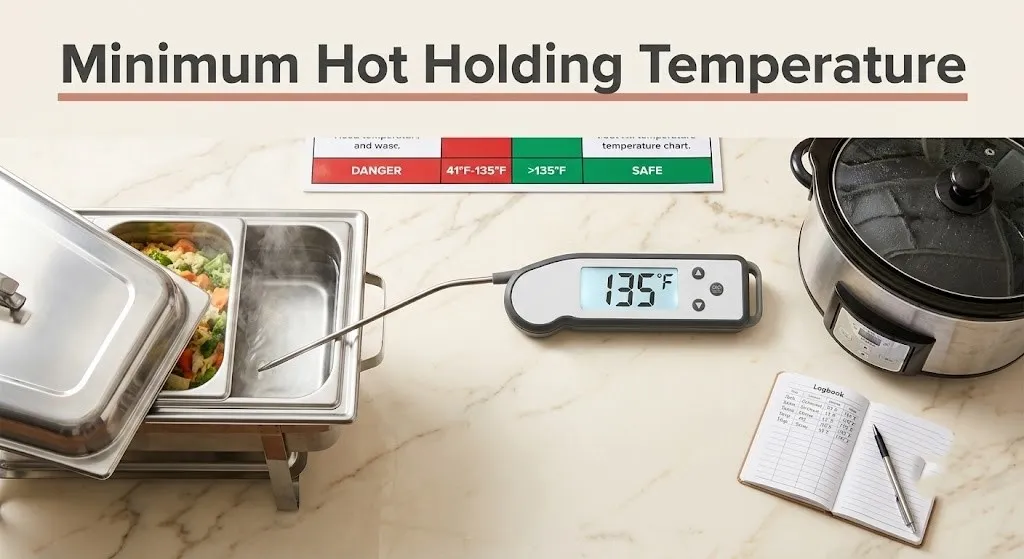
The temperature requirement is enforced at the federal, state, and local levels. Health inspectors carry probe thermometers specifically to verify that hot holding units are maintaining food at 135°F or higher. A violation can result in points deducted from a health inspection score, a requirement to discard the affected food, or in severe cases, temporary closure of the establishment. The standard exists because the consequences of failing to meet it, foodborne illness outbreaks, hospitalizations, and deaths, are severe.
Key Takeaway: The FDA Food Code sets 135°F as the minimum hot holding temperature for all TCS foods. This is a regulatory requirement, not a suggestion.
What is the holding temperature for hot food
The holding temperature for hot food is 135°F or above, with no upper limit specified for safety, though temperatures above 165°F begin to degrade food quality through moisture loss and overcooking. The operational range for hot holding equipment is typically 135°F to 165°F, with the lower end being the safety floor and the upper end being the quality ceiling. Steam tables, warming cabinets, and chafing dishes should be set to maintain food within this range.
Different hot holding equipment maintains temperature through different mechanisms. A steam table uses hot water heated by electricity or gas to warm pans of food from below. The water temperature in a steam table should be at least 150°F to maintain food at 135°F, accounting for heat loss through the pan and the food’s surface. A warming cabinet circulates heated air around pans of food and should be set to 150°F to 160°F to compensate for door openings and air exchange. A chafing dish uses a Sterno fuel can or an electric heating element beneath a water bath and is the least reliable method, requiring frequent temperature checks.
The holding temperature is not a cooking temperature. Food must be cooked to its required internal temperature before being transferred to hot holding. Poultry must reach 165°F. Ground meats must reach 155°F. Whole cuts of beef, pork, and fish must reach 145°F. Once cooked to the appropriate temperature, food can be placed in hot holding equipment set to maintain 135°F or above.
Key Takeaway: Hot food must be held at 135°F or above. Steam tables, warming cabinets, and chafing dishes should be set between 135°F and 165°F.
What temp does hot food need to be held at
Hot food needs to be held at a temperature of 135°F or above, measured at the food’s internal temperature using a calibrated probe thermometer. The surface temperature of the food or the temperature of the holding equipment is not sufficient. The internal temperature of the thickest part of the food must register 135°F or higher. This requirement applies continuously for the entire duration of hot holding, from the moment the food is placed in the holding unit until it is served or discarded.
The internal temperature measurement is critical because food does not heat evenly. A pan of mashed potatoes on a steam table may read 140°F at the bottom where it contacts the heated pan surface and 125°F at the top where it is exposed to room air. Stirring the food periodically, at least every 30 minutes, redistributes the heat and brings the cooler top layer into contact with the warmer bottom. Without stirring, the surface layer can drop into the danger zone even while the steam table is functioning correctly.
The temperature requirement applies regardless of the quantity of food. A single portion held for one customer and a full hotel pan held for a banquet must both be maintained at 135°F or above. The difference is in the monitoring frequency and the difficulty of maintaining temperature. Large volumes of dense food, like a deep pan of chili or a thick roast in a warming cabinet, require more frequent temperature checks and may need to be portioned into smaller, shallower pans to ensure even heating.
Key Takeaway: Hot food must be held at 135°F internal temperature. Measure the thickest part of the food with a probe thermometer and stir periodically.
What is the holding temp for hot food
The holding temp for hot food is 135°F as the minimum and typically not exceeding 165°F as a practical maximum for food quality. The temperature range is bounded on the low end by food safety and on the high end by the degradation of the food itself. Holding food at 180°F or higher is safe from a bacterial standpoint but will dry out meats, break down delicate sauces, and cause vegetables to become mushy within an hour or two.
The 135°F to 165°F range balances safety and quality. At 135°F, bacteria cannot multiply. At 165°F, most food holds well for 2 to 4 hours without significant quality loss. The specific temperature within this range depends on the food. A hearty beef stew holds well at 150°F to 160°F. A delicate cream sauce may separate at temperatures above 145°F and should be held as close to 135°F as safely possible. Dry foods like roasted potatoes and baked chicken benefit from the higher end of the range, which keeps the surface crisp.
The holding temperature must be verified with a thermometer. The dial on the steam table or the set point on the warming cabinet are not reliable indicators of the actual food temperature. Equipment drifts. Thermostats fail. Pans do not conduct heat perfectly. The only way to confirm that food is at a safe temperature is to insert a calibrated probe thermometer into the food itself and read the number.
Key Takeaway: Hot food should be held between 135°F and 165°F, with the specific temperature adjusted to the food type. Verify with a probe thermometer.
Hold hot food at what temperature
Hold hot food at 135°F or above, a requirement that applies to all foodservice operations in the United States under the FDA Food Code and the state and local regulations that adopt it. The temperature is the same whether you are a fast-food chain, a hospital cafeteria, a fine dining restaurant, or a home cook hosting a dinner party. The bacterial growth curve does not care about the setting. It cares about the temperature.
The 135°F standard was established based on the growth characteristics of pathogenic bacteria. At 130°F, some thermophilic bacteria can still grow slowly. At 135°F, the growth of all common foodborne pathogens is halted. The FDA selected 135°F as the regulatory floor because it provides a margin of safety above the 130°F threshold while remaining achievable with standard foodservice equipment. The standard has been in place for decades and is periodically reviewed based on new food safety research.
For home cooks, the 135°F standard is a best practice, not a legal requirement. The health department does not inspect your kitchen. The consequences of failing to hold food at the proper temperature, a foodborne illness affecting your family or guests, are no less real. A probe thermometer costs $10 to $20 and is the difference between guessing and knowing. If you are serving food at a buffet, a holiday dinner, or a party, check the temperature of the food on the serving table. If it is below 135°F, reheat it or replace it with fresh hot food.
Key Takeaway: 135°F is the universal standard for hot holding in commercial and home kitchens. The bacterial growth curve makes no distinction between settings.
What temp is food hot
Food is considered hot from a food safety perspective when it reaches an internal temperature of 135°F or above. This is the temperature at which food exits the temperature danger zone and enters the safe hot holding range. The term “hot” in the context of food safety is a technical designation with a specific temperature boundary, not a subjective description of how the food feels to the touch.
The temperature danger zone is the range between 41°F and 135°F, in which bacteria multiply most rapidly. Food that is between these temperatures is in the danger zone and has a limited safe holding time. Food above 135°F is hot and safe to hold indefinitely from a bacterial perspective, though quality degrades over time. Food below 41°F is cold and safe to hold indefinitely, though it should be covered and protected from contamination.
The transition from cooking temperature to holding temperature is a critical control point in food safety. Food is cooked to a higher internal temperature than the hot holding minimum. Poultry reaches 165°F when fully cooked. It can then be transferred to a holding unit set to maintain 135°F or above. The food cools from its cooking temperature down to the holding temperature naturally and must not be allowed to drop below 135°F during the transfer. Preheating the holding equipment and transferring the food quickly minimize the time spent in the danger zone.
Key Takeaway: Food is considered hot at 135°F or above. Below this temperature, it is in the danger zone and has limited safe holding time.
Temperature danger zone
The temperature danger zone is the range between 41°F and 135°F, in which pathogenic bacteria multiply at rates that can produce dangerous levels of contamination within hours. The concept of the danger zone is the foundational principle of food safety. Every temperature requirement, from refrigeration to cooking to hot holding, is designed to keep food out of this range or to limit the time food spends within it.
Bacteria grow fastest in the center of the danger zone, between 70°F and 125°F. At these temperatures, some species can double in number every 20 minutes. A single bacterium replicating at this rate produces over 2 million bacteria in 7 hours. This is why food left at room temperature for an afternoon is unsafe even if it looks and smells fine. The bacteria are present long before the food shows visible signs of spoilage.
The danger zone boundaries account for the slowest-growing pathogenic bacteria. Listeria monocytogenes can grow at refrigeration temperatures as low as 32°F, which is why cold holding is set at 41°F or below. Some thermophilic bacteria can grow at temperatures approaching 130°F, which is why hot holding is set at 135°F or above. The danger zone is not a zone of equal risk. The warmest part of the zone, near room and body temperature, is the most dangerous because it matches the optimal growth temperature for many human pathogens.
Key Takeaway: The temperature danger zone is 41°F to 135°F. Bacteria multiply fastest between 70°F and 125°F, with some species doubling every 20 minutes.
Bacteria growth temperature range
The bacteria growth temperature range varies by species, but the pathogens most commonly associated with foodborne illness grow optimally between 70°F and 125°F, with growth slowing at the outer edges of the danger zone and stopping entirely above 135°F or below 41°F. Understanding the specific organisms and their temperature preferences clarifies why the holding standards exist.
Staphylococcus aureus grows in the range of 50°F to 120°F and produces a heat-stable toxin that is not destroyed by reheating. It is commonly associated with foods handled by people, such as deli meats, salads, and cream-filled pastries. Clostridium perfringens grows between 50°F and 130°F and is associated with large quantities of meat and poultry held at inadequate temperatures for extended periods. It is sometimes called the “cafeteria germ” because of its association with foodservice holding failures. Bacillus cereus grows between 40°F and 130°F and is associated with cooked rice and other starchy foods left at room temperature.
Salmonella species grow between 41°F and 115°F and are associated with poultry, eggs, and produce. Escherichia coli grows between 44°F and 113°F and is associated with undercooked ground beef and contaminated produce. Listeria monocytogenes grows between 32°F and 113°F, uniquely capable of multiplying at refrigeration temperatures, which is why it is a particular concern in ready-to-eat refrigerated foods.
The 135°F hot holding standard is set above the maximum growth temperature of all these organisms. At 135°F, none of the common foodborne pathogens can reproduce. Some can survive at this temperature in spore form, but the spores remain dormant and do not produce toxins. Reheating food to 165°F before serving provides an additional safety margin by killing vegetative cells that may have been introduced after the initial cooking.
Key Takeaway: Common foodborne pathogens grow between 40°F and 130°F. The 135°F hot holding standard exceeds the growth range of all major foodborne bacteria.
FDA hot holding temperature
The FDA hot holding temperature, as specified in the FDA Food Code, is 135°F (57°C) for all hot-held potentially hazardous foods. The Food Code is updated every four years, with the most recent full edition published in 2022. The 135°F standard has been consistent across recent editions and represents the scientific consensus on the temperature required to prevent bacterial growth in held food.
The FDA Food Code is a model code, not federal law. It becomes enforceable when adopted by state legislatures or local health departments as the basis for their food safety regulations. All 50 states have adopted some version of the FDA Food Code, though a few states reference older editions that may have slightly different requirements. The 135°F hot holding temperature has been standard since the 2009 edition of the Food Code. Restaurants and foodservice operations in compliance with their local health code are, in practice, complying with the FDA standard.
The FDA Food Code also addresses the time that food can be held without temperature control. Hot food can be held without temperature control for up to 4 hours if it is labeled with the time it was removed from temperature control and is discarded at the end of the 4-hour period. This provision allows for temporary buffet service or off-site catering where hot holding equipment is not available. The food must be discarded after 4 hours regardless of its appearance or temperature.
Key Takeaway: The FDA Food Code specifies 135°F as the minimum hot holding temperature. States adopt this standard into their local health codes.
What is the minimum internal holding temperature for hot food
The minimum internal holding temperature for hot food is 135°F, measured at the core of the food product using a probe thermometer. The word “internal” in this standard is important. The temperature of the holding equipment, the temperature of the pan, and the temperature of the food’s surface are not the regulated values. The internal temperature is the value that matters because it represents the coldest part of the food, the location where bacteria are most likely to survive and multiply.
Measuring internal temperature requires inserting the probe thermometer into the thickest part of the food product. For a solid piece of meat, this is the geometric center. For a liquid or semi-solid food like soup or chili, the probe should be inserted to the center of the container and the food should be stirred before measuring to ensure an even temperature distribution. The thermometer should remain in the food until the reading stabilizes, typically 15 to 30 seconds depending on the thermometer type.
The thermometer itself must be calibrated regularly to ensure accuracy. The ice point method is the most common calibration technique. Fill a cup with crushed ice and a small amount of water, insert the thermometer probe without touching the sides or bottom, and adjust the calibration nut until the thermometer reads 32°F (0°C) . Thermometers should be calibrated at least once per week in a commercial kitchen and before any important temperature measurement in a home kitchen.
Key Takeaway: The internal temperature of the food, measured at the thickest point with a calibrated probe thermometer, must be 135°F or above.
Hot food can be held for how long
Hot food can be held at 135°F or above indefinitely from a food safety perspective. Bacteria cannot grow at this temperature, so the food does not become unsafe over time in the way that food in the danger zone does. The practical limit on hot holding is food quality, not food safety. Food held at 135°F for more than 4 hours begins to deteriorate in texture, moisture, and flavor even though it remains safe to eat.
The 4-hour guideline is the industry standard for maximum hot holding time before food quality becomes unacceptable. A pan of scrambled eggs held on a steam table for 8 hours is safe at 135°F. It is also rubbery, dried out, and unappetizing. Restaurants and catering operations typically discard and replace hot-held food after 4 hours for quality reasons, even though the health department would not require it for safety reasons.
If hot food drops below 135°F at any point, the clock starts on the danger zone time limit. Food that has been in the danger zone for less than 2 hours can be reheated to 165°F and returned to hot holding. Food that has been in the danger zone for 2 to 4 hours must be served immediately or discarded. It cannot be returned to hot holding. Food that has been in the danger zone for more than 4 hours must be discarded. These time limits are cumulative. If food is in the danger zone for 1 hour during service and then again for 1 hour during transport, the total is 2 hours.
Key Takeaway: Hot food can be held indefinitely at 135°F or above from a safety standpoint. Quality degrades after 4 hours. Food that drops below 135°F has limited recovery time.
Reheating food temperature
Reheating food temperature for hot holding requires bringing the food to an internal temperature of 165°F (74°C) for at least 15 seconds before it can be placed in hot holding equipment. This is a different standard than the holding temperature. The holding temperature maintains food that is already safe. The reheating temperature makes food safe again if it has been cooled and stored.
Food that has been previously cooked, cooled, and refrigerated must be reheated to 165°F before being placed in a steam table or chafing dish. The food cannot be placed directly from the refrigerator into the holding unit and allowed to warm up gradually. The gradual warming process keeps the food in the danger zone for an extended period, potentially allowing bacterial growth before the food reaches the safe holding temperature.
The reheating requirement applies to all TCS foods that are being reheated for hot holding. It does not apply to food that is being reheated for immediate service. A portion of soup reheated in a microwave for a customer’s order can be heated to any temperature the customer desires. A full pot of soup being reheated for placement on the buffet line must reach 165°F throughout before it is transferred to the holding unit.
Key Takeaway: Food must be reheated to 165°F for 15 seconds before being placed in hot holding equipment. Gradual warming in the holding unit is not permitted.
How to monitor hot holding temperature
How to monitor hot holding temperature involves using a calibrated probe thermometer to check the internal temperature of food at regular intervals and recording the results. The FDA Food Code recommends checking hot holding temperatures at least every 2 hours. Many foodservice operations check every 30 minutes to 1 hour as a best practice. The more frequently you check, the sooner you catch a temperature deviation and can take corrective action.
The monitoring procedure is straightforward but requires consistency. Insert the probe thermometer into the thickest part of the food product. For liquid foods, stir the food first, then measure. Wait for the reading to stabilize. Record the temperature and the time on a log sheet. If the temperature is below 135°F, note the corrective action taken. The log creates a record that health inspectors can review during an inspection and that managers can use to identify equipment problems before they cause a food safety incident.
Infrared thermometers are useful for quickly scanning surface temperatures across a buffet or steam table line, but they are not sufficient as the sole monitoring tool. An infrared thermometer reads surface temperature only. The internal temperature of the food can be 10 to 20 degrees cooler than the surface. An infrared thermometer can identify a pan that needs a probe check but cannot replace the probe check itself.
Key Takeaway: Monitor hot holding temperatures at least every 2 hours with a probe thermometer inserted into the thickest part of the food. Record the results.
Hot holding temperature for buffet
The hot holding temperature for a buffet is 135°F or above, the same standard that applies to commercial foodservice operations. Buffets present additional challenges because the food is exposed to room air, subject to customer contact, and often held in less reliable equipment than a steam table. Chafing dishes, the standard buffet equipment, are less effective at maintaining temperature than commercial steam tables and require more frequent monitoring.
A chafing dish setup consists of a metal frame, a water pan, a food pan, and a heat source, typically a Sterno fuel can or an electric heating element. The water in the water pan should be at a full simmer before the food pan is placed on top. The water bath transfers heat to the food more evenly and gently than direct heat. Without water, the Sterno flame directly heats the food pan, creating hot spots that can burn the food while leaving other areas cool.
Chafing dish temperature management requires attention throughout the event. Check the food temperature every 30 minutes. Stir the food to redistribute heat. Replace the water bath if it evaporates. Replace the Sterno can when it burns out, typically every 2 hours. If a chafing dish cannot maintain food at 135°F, remove the food, reheat it to 165°F in a kitchen oven or on a stove, and return it to a fresh chafing dish setup.
Key Takeaway: Buffet hot holding requires 135°F or above. Chafing dishes need water baths, frequent stirring, and temperature checks every 30 minutes.
Steam table temperature
Steam table temperature for the water bath should be maintained between 150°F and 190°F to keep food at 135°F or above. The water temperature is higher than the target food temperature because heat is lost as it transfers from the water through the pan and into the food. A water bath at 150°F is the minimum for maintaining food temperature. A water bath at 190°F is the maximum before the water begins to boil vigorously, which can create uneven heating and a burn hazard.
The food pan depth affects steam table performance. Shallow pans, 2 to 4 inches deep, heat more evenly and maintain temperature better than deep pans. Deep pans trap cooler food in the center while the edges and bottom overheat. For large quantities of food that would fill a deep pan, use multiple shallow pans instead. Stir the contents of each pan at least every 30 minutes to distribute heat.
Steam tables require preheating. The water should be at temperature before the food pans are placed on the table. Adding cold water and cold food simultaneously to a steam table means both must heat up from room temperature, a process that can take 30 to 45 minutes during which the food is in the danger zone. Preheat the water bath, then add the pans of hot food that have already been cooked or reheated to the proper temperature.
Key Takeaway: Steam table water temperature should be 150°F to 190°F. Use shallow pans, preheat the water, and stir food every 30 minutes.
How to keep food warm for a party
How to keep food warm for a party without commercial equipment requires creative use of home kitchen tools and a willingness to serve food in smaller batches rather than putting everything out at once. The 135°F standard applies to home entertaining just as it does to commercial kitchens, even though no health inspector will check.
Effective home hot holding methods include:
- Slow cookers set to the “warm” or “low” setting, which typically maintain 140°F to 165°F. Check the temperature of your specific slow cooker before relying on it, as models vary.
- Ovens set to 170°F to 200°F, the lowest setting on most home ovens. Cover food with foil to prevent drying. Place a shallow pan of water on the lower rack to add humidity.
- Electric warming trays designed for buffet use, which maintain surface temperatures of 140°F to 160°F.
- Insulated coolers preheated by filling with hot water for 10 minutes, then emptied and lined with towels. Hot food in sealed containers can hold above 135°F for 2 to 3 hours in a preheated cooler.
The most reliable home entertaining strategy is to serve food in shifts. Prepare a full batch but put out half at a time. Keep the second half in the oven at a holding temperature. When the first batch runs low or its temperature drops, replace it with the fresh batch from the oven. This approach keeps the buffet looking fresh and ensures food stays at a safe temperature.
Key Takeaway: Slow cookers, low ovens, warming trays, and insulated coolers are effective home hot holding tools. Serve food in shifts to maintain temperature.
Safe temperature for hot food
The safe temperature for hot food is 135°F or above when held, 165°F when reheated for holding, and the appropriate cooking temperature for the specific food type when initially prepared. These three temperature categories, holding, reheating, and cooking, are distinct and serve different food safety purposes.
Cooking temperatures destroy the bacteria present in raw food. Poultry requires 165°F. Ground meats require 155°F. Whole muscle meats require 145°F. These temperatures are higher than the holding temperature because they must kill bacteria, not just prevent their growth.
Holding temperatures maintain food safety after cooking. Once the food has been cooked to its required temperature, it can be held at 135°F or above indefinitely from a safety perspective. The holding temperature does not need to be as high as the cooking temperature because the bacteria have already been reduced to safe levels.
Reheating temperatures address the gap between refrigeration and holding. Food that has been cooked, cooled, and refrigerated must be reheated to 165°F before it can be placed in holding at 135°F. This requirement ensures that any bacteria that may have been introduced during the cooling and storage process are killed before the food spends extended time at the lower holding temperature.
| Temperature | Purpose | Key Standard |
|---|---|---|
| Cooking | Kill bacteria in raw food | 145°F to 165°F by food type |
| Reheating | Kill bacteria before holding | 165°F for 15 seconds |
| Hot Holding | Prevent bacterial growth | 135°F or above |
| Danger Zone | Temperature range to avoid | 41°F to 135°F |
Key Takeaway: Cooking, reheating, and holding serve different food safety purposes at different temperatures. Know which standard applies.
ServSafe hot holding temperature
ServSafe hot holding temperature is 135°F or above, consistent with the FDA Food Code. ServSafe is the food safety certification program administered by the National Restaurant Association. It is the most widely recognized food handler and manager certification in the United States. The ServSafe curriculum covers hot holding requirements in detail, and the 135°F standard is a core exam question.
The ServSafe curriculum emphasizes the temperature danger zone, proper thermometer use, and the corrective actions required when hot holding temperatures fall below the standard. Students learn that hot-held food found below 135°F must be reheated to 165°F if it has been in the danger zone for less than 2 hours, served immediately or discarded if it has been in the danger zone for 2 to 4 hours, and discarded if it has been in the danger zone for more than 4 hours.
ServSafe certification is required by many state and local health codes for at least one employee per shift in a foodservice establishment. The certification exam tests knowledge of hot holding temperatures among other food safety topics. The specific questions vary by exam version, but the 135°F standard is always tested.
Key Takeaway: ServSafe teaches 135°F as the minimum hot holding temperature, consistent with the FDA Food Code. This is a core exam topic.
Frequently Asked Questions About Hot Holding Food
What is the minimum hot holding temperature for food?
The minimum hot holding temperature for food is 135°F (57°C) as specified by the FDA Food Code.
This temperature prevents the growth of pathogenic bacteria in cooked food held for service.
All TCS foods including meat, poultry, fish, dairy, eggs, and cooked vegetables must be held at 135°F or above.
How long can hot food be held at 135 degrees?
Hot food can be held at 135°F or above indefinitely from a food safety perspective.
Food quality begins to degrade after about 4 hours of hot holding, with moisture loss and texture changes.
If the temperature drops below 135°F, the food is in the danger zone and must be reheated or discarded based on the time it has been below temperature.
What happens if hot food drops below 135°F?
Hot food that drops below 135°F enters the temperature danger zone where bacteria can multiply rapidly.
If the food has been below 135°F for less than 2 hours, reheat it to 165°F and return it to hot holding.
If it has been below 135°F for 2 to 4 hours, serve it immediately or discard it. Over 4 hours, discard it.
Can I use a slow cooker for hot holding?
A slow cooker can be used for hot holding if it maintains food at 135°F or above on the “warm” or “low” setting.
Test your specific slow cooker’s temperature with a probe thermometer before relying on it for hot holding.
Slow cookers work well for soups, stews, and chili but may dry out solid foods over extended periods.
How do I check the temperature of hot held food?
Check the temperature of hot held food by inserting a calibrated probe thermometer into the thickest part of the food.
For liquids, stir the food before measuring to ensure even temperature distribution.
Check temperatures at least every 2 hours in a commercial setting and every 30 minutes at a buffet or party.
The number 135°F is the line between safe and unsafe for hot food. It is not a suggestion, a guideline, or a best practice. It is the regulatory standard derived from decades of food microbiology research and enforced in every licensed foodservice establishment in the United States. When you hold food hot, you hold it at 135°F or above.
The practical application of this standard does not require a commercial kitchen. A probe thermometer, a slow cooker set to warm, an oven on its lowest setting, or a properly set up chafing dish can all maintain food at safe temperatures. The tool matters less than the habit. Check the temperature. Stir the food. Replace what drops below the line. These simple routines are what stand between a successful meal and a foodborne illness outbreak.