Quest protein bars are a useful high-protein, low-sugar convenience food for athletes and active people, but they are an ultra-processed product built on isolated fibers and sugar alcohols, not a whole-food health food. They are healthier than a candy bar. They are less healthy than a cup of Greek yogurt with almonds. Their value depends on what you would eat instead.
A standard Quest Bar delivers roughly 200 calories, 20 grams of protein, and less than 2 grams of sugar, wrapped in a shelf-stable package that fits in a gym bag. The macronutrient profile looks exceptional on the front of the wrapper. The ingredient list on the back reveals a different story: soluble corn fiber, isomalto-oligosaccharides, and erythritol are the ingredients that make the low-net-carb math work. These are industrially produced substances, not foods your grandmother would recognize.
This article examines Quest bars through the lens of a nutrition researcher who has read the ingredient panels, the manufacturing patents, and the digestive science. You will learn what is actually in these bars, how the fiber and sweeteners affect your body, who should avoid them, and how they compare to both other protein bars and whole-food alternatives.
are quest protein bars healthy
Quest protein bars are a healthy choice relative to candy bars and traditional sugar-loaded protein bars, but they are an ultra-processed food that should be used as a strategic snack rather than a daily staple, because the isolated fibers and sugar alcohols that define their nutritional profile can cause digestive distress and do not provide the micronutrients of whole foods.
The nutritional case for Quest bars is built on three numbers: 20 grams of protein, less than 2 grams of sugar, and 14 grams of fiber. The Academy of Nutrition and Dietetics recognizes that high-protein snacks can support satiety and muscle maintenance. The American Heart Association recommends limiting added sugar to 25 to 36 grams per day. A Quest bar uses almost none of that budget. A standard candy bar uses 20 to 30 grams. On paper, the Quest bar wins by a wide margin.
The nutritional case against Quest bars is built on the ingredient list. The protein comes from whey protein isolate and milk protein isolate, both highly refined dairy fractions. The fiber comes from soluble corn fiber, an ingredient manufactured by treating corn starch with enzymes to create indigestible glucose polymers. The sweetness comes from erythritol, sucralose, and stevia. None of these ingredients are inherently dangerous. None of them are whole foods either. The bar is a constructed product, not a grown one.
is quest protein bar healthy
A single Quest protein bar is a healthy snack option for an active person who needs a portable, non-perishable source of protein and is comfortable with the digestive effects of concentrated isolated fibers. It is not a healthy daily habit for someone who could eat real food instead. The singular “bar” versus the plural “bars” matters because the health equation changes with frequency.
Eating one Quest bar after a workout when you are 40 minutes from home and need something to bridge the gap to your next meal is a perfectly reasonable use case. The protein supports muscle repair. The low sugar avoids a blood glucose spike. The convenience is real and valuable. Eating two Quest bars per day as meal replacements because you do not have time to cook is a pattern that replaces whole foods with processed ingredients across a significant portion of your diet.
The USDA Dietary Guidelines recommend that the majority of calories come from whole, minimally processed foods. A Quest bar, by any definition of food processing, falls into the ultra-processed category. It is a formed, packaged product made from fractionated and reconstituted ingredients. This does not make it toxic. It makes it a food to be aware of, not a food to build a diet around.
quest bar nutrition facts
A standard Quest bar, using the Chocolate Chip Cookie Dough flavor as a reference, contains 200 calories, 8 grams of fat (3 grams saturated), 21 grams of total carbohydrate, 14 grams of dietary fiber, 1 gram of sugar, 6 grams of erythritol, and 20 grams of protein. The net carbohydrate count, calculated by subtracting fiber and erythritol from total carbohydrates, is roughly 4 to 5 grams.
The 20 grams of protein in a Quest bar comes from a blend of whey protein isolate and milk protein isolate. Whey is a fast-digesting protein that spikes amino acid levels in the blood quickly after consumption. Milk protein isolate contains both whey and casein, the latter of which digests slowly and provides a sustained release of amino acids. This blend is well suited for a snack that supports muscle protein synthesis over several hours.
The 14 grams of fiber is the number that makes Quest bars unique in the protein bar category. Most protein bars contain 3 to 5 grams of fiber. Quest bars contain 13 to 15 grams, which is roughly half the daily fiber recommendation for an adult woman in a single bar. This fiber is not coming from whole grains, nuts, or vegetables. It is coming from soluble corn fiber and isomalto-oligosaccharides, isolated fibers manufactured from corn starch.
quest bar ingredients explained
A standard Quest bar ingredient list for the Chocolate Chip Cookie Dough flavor reads: protein blend (whey protein isolate, milk protein isolate), soluble corn fiber, almonds, water, natural flavors, cocoa butter, erythritol, unsweetened chocolate, palm oil, sea salt, baking soda, sucralose, steviol glycosides (stevia). Each ingredient serves a structural or sensory purpose.
The protein blend is the first ingredient by weight. Whey protein isolate is the most rapidly absorbed fraction of milk protein. Milk protein isolate provides a mix of whey and casein for sustained amino acid delivery. Both are highly refined and contain minimal lactose, which is why many people with lactose intolerance can tolerate Quest bars despite the dairy content.
Soluble corn fiber is the second ingredient and the functional backbone of the bar’s low-net-carb claim. It is produced by hydrolyzing corn starch and then treating the resulting glucose molecules with enzymes that rearrange their chemical bonds, creating indigestible glucose polymers. The human digestive system lacks the enzymes to break these bonds, so the fiber passes into the large intestine where gut bacteria ferment it. The FDA recognizes soluble corn fiber as a dietary fiber for labeling purposes.
quest bar protein quality
The protein in Quest bars is of high biological quality, containing all nine essential amino acids in adequate amounts to support muscle protein synthesis, but it is an isolated protein fraction stripped of the vitamins, minerals, and bioactive compounds that accompany protein in whole-food sources. The quality is high by amino acid score. The nutritional completeness is low by food matrix standards.
Whey protein isolate has a Protein Digestibility Corrected Amino Acid Score of 1.0, the highest possible score, matching whole egg protein. It is rich in leucine, the branched-chain amino acid that serves as the primary trigger for the mTOR signaling pathway that initiates muscle protein synthesis. A single Quest bar delivers roughly 2.5 to 3 grams of leucine, which exceeds the threshold believed to maximally stimulate muscle protein synthesis in a single meal.
What whey protein isolate lacks is the nutrient package that comes with dairy protein in its whole form. A cup of Greek yogurt provides the same 20 grams of protein plus 200 milligrams of calcium, potassium, magnesium, and probiotics. A Quest bar provides the protein and roughly 15 percent of the Daily Value for calcium, but little else in the way of micronutrients. The protein is high quality in isolation. The food it comes from is nutritionally sparse.
Key Takeaway: Quest bars deliver high-quality protein with almost no sugar, making them a useful tool for specific situations, but their isolated fiber and sweetener load makes them an ultra-processed food, not a whole-food snack.
what is soluble corn fiber in quest bars
Soluble corn fiber, also known as resistant maltodextrin, is a manufactured dietary fiber produced by treating corn starch with heat, acid, and enzymes to create indigestible glucose polymers that resist digestion in the small intestine and are partially fermented in the colon. It is the ingredient that allows Quest bars to claim 14 grams of fiber and very low net carbs.
The manufacturing process begins with standard corn starch, which is a long chain of glucose molecules linked by digestible alpha bonds. The starch is heated, treated with acid, and exposed to enzymes that break and rearrange the glucose chains into a branched structure with both alpha and beta bonds. The beta bonds resist human digestive enzymes. The result is a fiber that is soluble in water, mildly sweet, and contributes bulk and texture to the bar.
The FDA’s 2016 rule on dietary fiber requires that isolated fibers like soluble corn fiber demonstrate a physiological benefit, such as lowering cholesterol or improving bowel function, to be labeled as dietary fiber. The FDA has recognized soluble corn fiber as meeting this standard. It is a legal dietary fiber. Whether it provides the same broad health benefits as the fiber matrix in oats, beans, or vegetables is a separate question that nutrition researchers continue to debate.
quest bar net carbs explained
Quest bars achieve their low net carbohydrate count by replacing sugar and digestible starch with soluble corn fiber, isomalto-oligosaccharides, and erythritol, which the company subtracts from the total carbohydrate count because they are either indigestible fibers or sugar alcohols with negligible caloric impact. The resulting net carb number is 4 to 5 grams per bar.
The net carb calculation on a Quest bar label works as follows: 21 grams of total carbohydrate, minus 14 grams of dietary fiber, minus 6 grams of erythritol, equals roughly 1 gram of net carbohydrate. A small amount of sugar and starch remains, bringing the practical net carb count closer to 4 to 5 grams. This is the math that makes Quest bars popular with people following ketogenic or low-carbohydrate diets.
The validity of net carb calculations depends on whether the subtracted ingredients genuinely do not affect blood glucose. Soluble corn fiber has been shown in published research to produce a minimal glycemic response. Erythritol is absorbed into the bloodstream but excreted unchanged in urine, contributing no calories and no blood glucose response for most people. The net carb math is supported by evidence. However, the FDA does not formally recognize “net carbs” as a labeling term. It is a marketing calculation based on the food chemistry of the specific ingredients.
quest bar sweeteners and sugar alcohols
Quest bars are sweetened with a combination of erythritol, sucralose, and steviol glycosides (stevia). This blend provides sweetness without sugar, allowing the bar to taste like a dessert while containing less than 2 grams of sugar. Each sweetener has a distinct metabolic and digestive profile.
Erythritol is a sugar alcohol produced by fermenting glucose with yeast. It provides roughly 0.2 calories per gram and does not raise blood glucose or insulin levels for the vast majority of people. It is absorbed in the small intestine and excreted unchanged in urine, which is why it does not cause the same digestive distress as other sugar alcohols like maltitol or sorbitol. However, in large doses, typically above 30 to 50 grams in a single sitting, erythritol can cause bloating and diarrhea.
Sucralose is an artificial sweetener made by chlorinating sucrose molecules. It is 600 times sweeter than sugar and passes through the body undigested. The FDA has approved sucralose as safe. The Academy of Nutrition and Dietetics recognizes non-nutritive sweeteners as safe for general consumption. Some observational studies have raised questions about artificial sweeteners and gut microbiome composition, but the evidence is preliminary and inconsistent.
quest bars vs whole food snacks
Quest bars compare favorably to whole-food snacks on protein density and convenience but unfavorably on micronutrient content, food matrix complexity, and digestive tolerance. A Quest bar is a better choice than skipping a meal entirely. It is a worse choice than a planned whole-food snack if you have access to refrigeration and five minutes to eat.
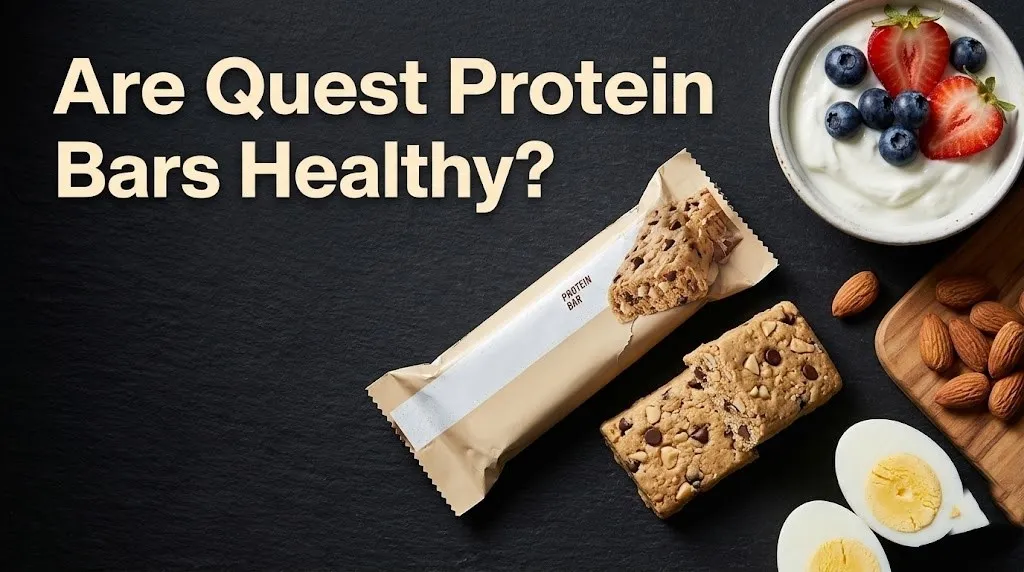
A comparison of a Quest bar to a snack of plain Greek yogurt with almonds and berries illustrates the trade-off. The Quest bar provides 20 grams of protein, 14 grams of isolated fiber, and minimal micronutrients. The yogurt snack provides 20 grams of protein, 3 grams of naturally occurring fiber, 200 milligrams of calcium, probiotics, vitamin C from the berries, and vitamin E from the almonds. The calories are similar. The nutritional value is not.
The convenience factor is real and should not be dismissed. A Quest bar can live in a gym bag for a month. Greek yogurt cannot. For the specific use case of “I need protein immediately after my workout and I cannot get to a refrigerator,” a Quest bar is a practical solution. For the use case of “I am packing my lunch for work and have access to a fridge,” the yogurt and almonds win.
| Snack (per serving) | Calories | Protein | Fiber | Added Sugar | Micronutrient Score |
|---|---|---|---|---|---|
| Quest Bar (Choc Chip Cookie Dough) | 200 | 20 g | 14 g | <1 g | Low |
| Greek yogurt (1 cup) + almonds (1 oz) + berries (1/2 cup) | 280 | 25 g | 5 g | 0 g | High |
| Hard-boiled eggs (2) + apple (1 medium) | 260 | 14 g | 5 g | 0 g | Moderate |
| Standard candy bar | 250 | 3 g | <1 g | 25 g | Very low |
quest bars vs other protein bars
Quest bars occupy a specific niche in the protein bar market: they are among the lowest in sugar and among the highest in fiber, but they use more isolated and processed ingredients than many competitors. The choice between Quest and another bar is a trade-off between macronutrient optimization and ingredient simplicity.
RXBARs, for comparison, use a whole-food ingredient list: egg whites, dates, and nuts. A bar contains roughly 210 calories, 12 grams of protein, and 15 grams of sugar, all from dates. The sugar content is high, but it comes from whole fruit. The ingredient list is short and recognizable. The fiber is lower, roughly 3 to 5 grams. An RXBAR is a better choice if you prioritize ingredient simplicity. A Quest bar is a better choice if you prioritize protein density and low sugar.
ONE Bars and Pure Protein bars fall somewhere in the middle. They use protein blends similar to Quest but often include maltitol, a sugar alcohol that causes more digestive distress than erythritol and has a higher glycemic impact. Quest’s use of erythritol and soluble corn fiber is a deliberate choice to minimize both the sugar and the digestive downsides of other sugar alcohols. Whether that trade-off works for your body is individual.
quest bar digestive side effects
The most common digestive side effects of Quest bars are bloating, gas, abdominal cramping, and changes in bowel frequency, caused by the 14 grams of soluble corn fiber and isomalto-oligosaccharides arriving in the large intestine where gut bacteria ferment them rapidly. These effects are dose-dependent and vary widely between individuals.
Soluble corn fiber is a fermentable substrate. When it reaches the colon, the resident bacteria break it down through a process that produces hydrogen, carbon dioxide, and methane gas. For someone whose gut microbiome is accustomed to a high-fiber diet, 14 grams of fiber in a single sitting may produce mild, transient gas. For someone whose baseline fiber intake is low, that same 14 grams can produce hours of painful bloating and distension.
The IMO syrup used in some Quest bar formulations, though the company has reformulated to reduce IMO content in recent years, is particularly notorious. Isomalto-oligosaccharides are partially digestible, and the portion that resists digestion is rapidly fermented. This can produce a faster and more intense gas response than the slower-fermenting soluble corn fiber. If you notice that certain Quest bar flavors cause more digestive upset than others, check the ingredient list for IMO syrup.
quest bars and IBS
People with irritable bowel syndrome, particularly those with the diarrhea-predominant or mixed subtypes, should approach Quest bars with caution because the concentrated fermentable fibers, sugar alcohols, and dairy proteins can trigger symptoms. Quest bars are not low-FODMAP, the dietary protocol most commonly used to manage IBS symptoms.
Soluble corn fiber and isomalto-oligosaccharides are fermentable oligosaccharides and polysaccharides, the “O” and part of the “P” in FODMAP. Erythritol is generally well tolerated in moderate doses, but the combination of multiple fermentable substrates in a single bar can overwhelm a sensitive gut. A person with IBS who eats a Quest bar may experience symptoms that begin within 30 to 60 minutes and last for several hours.
If you have IBS and want to test whether you tolerate Quest bars, start with a quarter of a bar on a day when you have no other commitments. Wait 24 hours. If no symptoms occur, try half a bar. The goal is to find your personal threshold without triggering a full symptomatic episode. Many people with IBS find that they cannot tolerate any amount of concentrated isolated fibers, and for them, whole-food protein sources are the safer choice.
Key Takeaway: The digestive response to Quest bars is highly individual, but people with IBS, those new to high fiber intake, and anyone sensitive to sugar alcohols should start with a small portion to test tolerance.
healthiest quest bar flavors
The healthiest Quest bar flavors are those with the shortest ingredient lists, the fewest added sweeteners, and the inclusion of recognizable whole-food ingredients like almonds and cocoa. Flavor differences within the Quest product line are small, but they exist and are worth knowing about.
The Chocolate Chip Cookie Dough, Cookies and Cream, and Double Chocolate Chunk flavors tend to have similar base formulations with minor variations in the chocolate and flavoring components. Bars with a nut base, like the almond-containing flavors, provide a small amount of whole-food fat and a more complex texture. Bars with fruit inclusions may have slightly more sugar from the fruit, but the difference is marginal, typically 1 to 2 grams.
The new Quest “Crispy” line uses a different texturizing approach and may have a slightly different fiber profile. The nutritional differences between Quest bar flavors are small enough that flavor preference should drive your choice. All flavors share the same fundamental ingredient structure: protein blend, soluble corn fiber, sweetener system, and flavorings.
who should avoid quest bars
People with milk allergies, individuals with severe IBS or inflammatory bowel disease, those who experience significant digestive distress from isolated fibers or sugar alcohols, and anyone who prefers to eat primarily whole, minimally processed foods should avoid Quest bars or choose an alternative that better fits their needs.
A milk allergy is an immune response to the proteins casein and whey. Quest bars contain both in concentrated form. They are categorically unsafe for anyone with a true milk allergy, regardless of how low the lactose content may be. This is not a lactose intolerance issue. It is an immune safety issue.
People with fructose malabsorption or a sensitivity to polyols should also be cautious. Erythritol is generally well tolerated, but the total load of poorly absorbed carbohydrates in a Quest bar, fiber plus sugar alcohol, can trigger osmotic diarrhea in susceptible individuals. If you have a known sensitivity to sugar-free candies or foods labeled “low net carb,” approach Quest bars with the same caution.
- People with a milk protein allergy (contains whey and casein)
- Individuals with severe IBS or fructose malabsorption
- Those who experience bloating or gas from fiber supplements
- Anyone on a whole-food or minimally processed diet by personal choice
Frequently Asked Questions About Quest Protein Bars
Are Quest bars good for weight loss?
Quest bars can support weight loss because their high protein and fiber content promotes satiety and helps control appetite between meals.
A 200-calorie bar with 20 grams of protein will keep you fuller than a 200-calorie snack with little protein.
The key is using them as a planned snack, not eating them in addition to meals.
Do Quest bars spike blood sugar?
Quest bars produce a minimal blood glucose response in most people because they contain very little sugar and the carbohydrate is mostly indigestible fiber.
The erythritol and soluble corn fiber do not significantly raise blood glucose.
This is why they are popular with people following keto and low-carb diets.
Why do Quest bars make me bloated?
Quest bars can cause bloating because the 14 grams of soluble corn fiber and isomalto-oligosaccharides are rapidly fermented by gut bacteria, producing gas.
The effect is dose-dependent and more pronounced in people not accustomed to high fiber intake.
Eating half a bar at a time or increasing fiber intake gradually from other sources can help.
Are Quest bars keto-friendly?
Quest bars are keto-friendly because they contain only 4 to 5 grams of net carbohydrate per bar.
The low net carb count comes from subtracting the fiber and erythritol from the total carbohydrates.
Most flavors fit easily within a 20 to 50 gram daily net carb limit.
What is the healthiest Quest bar flavor?
All Quest bar flavors share the same core ingredient structure, so the healthiest flavor is the one you enjoy and tolerate best.
Flavors with almonds, like the Chocolate Chip Cookie Dough, provide a small amount of whole-food nut content.
The nutritional differences between flavors are too small to base a health decision on.
Quest protein bars are a tool, not a food group. They solve a specific problem, delivering 20 grams of high-quality protein with almost no sugar in a shelf-stable format, and they solve it effectively. The cost is that you are eating an ultra-processed product built on isolated fibers and sugar alcohols that can cause digestive distress and will never match the nutritional completeness of whole food.
The most practical approach is to use Quest bars for their intended purpose: a portable, non-perishable protein source for situations where real food is not available. Keep one in your gym bag. Keep one in your desk drawer at work. Do not keep them as a daily replacement for breakfast or as a nightly dessert habit.
When you have access to a refrigerator and five minutes to eat, reach for Greek yogurt, almonds, a hard-boiled egg, or a piece of fruit. Those foods provide protein, fiber, and the vitamins, minerals, and phytonutrients that no bar can replicate. Quest bars are a good backup plan. They are not a good primary food.