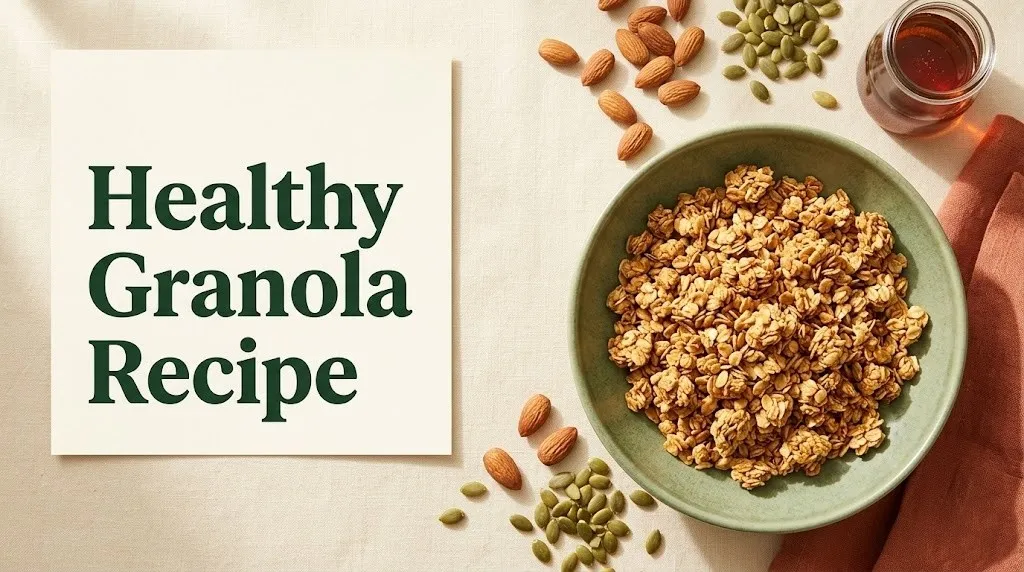
A healthy granola recipe gives you complete control over the fat source, sweetener amount, fiber load, and protein content in a way no commercial product can match. Made right, a half-cup serving delivers around 7 to 9 grams of protein, 5 to 7 grams of fiber, and far less added sugar than any leading grocery store brand.
According to the USDA Dietary Guidelines for Americans 2020-2025, most adults consume more than double the recommended daily limit of added sugars. Granola is one of the quieter contributors to that problem. Many store-bought versions carry 12 to 20 grams of added sugar per half-cup serving, often disguised under names like brown rice syrup or evaporated cane juice.
This guide covers the full picture: what belongs in a genuinely nutritious granola, how to build it step by step, how to adjust it for lower sugar or higher protein goals, how the calories break down per serving, and exactly how homemade stacks up against commercial options on a real nutrition label comparison.
Healthy Granola Recipe: What You’re Actually Making
A healthy granola recipe is a baked mixture of whole grain oats, nuts, seeds, a small amount of fat, and a controlled quantity of natural sweetener, cooked at low temperature until dry and lightly caramelized.
The word “granola” has drifted so far from its origins that it now covers everything from genuinely nutrient-dense baked oat clusters to candy-coated cereal bars with chocolate chips and palm oil. What separates a nutritionally sound version from marketing-friendly versions on grocery shelves comes down to a short list of decisions: which oats, which fat, how much sweetener, and what add-ins.
The base of any legitimate version is rolled oats (Avena sativa). These are whole grain oat groats that have been steamed and flattened. They retain the bran, germ, and endosperm, which means they carry the fiber, protein, and micronutrients the original grain provides. Instant oats work structurally but absorb fat unevenly and bake into a powder-like texture rather than distinct clusters.
The second structural decision is fat. Most recipes use coconut oil or extra-virgin olive oil. Coconut oil produces a slightly crunchier result because of its higher saturated fat content. Extra-virgin olive oil contributes a subtle savory note and a more favorable unsaturated fat profile, which research from the American Heart Association consistently associates with cardiovascular benefit. Both are legitimate choices depending on dietary priorities.
Key components of a nutritionally sound granola:
- Whole grain rolled oats as the primary carbohydrate base
- Unsalted raw nuts (almonds, walnuts, pecans) for protein and healthy fat
- Seeds (pumpkin, sunflower, chia, flax) for added micronutrients and omega-3 content
- A small amount of liquid fat (coconut oil or olive oil) as a binder and crisping agent
- A measured natural sweetener (pure maple syrup or raw honey) at no more than 2 to 3 tablespoons per 3 cups of oats
- Optional flavor enhancers: cinnamon (Cinnamomum verum), pure vanilla extract, sea salt
What Makes Granola Healthy (and What Gets in the Way)
Granola earns its nutritional value from the quality and proportion of whole-food ingredients, not from the word “natural” on the package.
The nutritional strength of a well-built granola comes from three sources working together. Rolled oats contribute beta-glucan, a form of soluble fiber that the Harvard T.H. Chan School of Public Health identifies as one of the most well-studied dietary fibers for its association with reduced LDL cholesterol levels. Nuts provide unsaturated fats, plant protein, vitamin E, magnesium, and manganese. Seeds add omega-3 fatty acids (particularly alpha-linolenic acid, or ALA, from flaxseed and chia) along with zinc, phosphorus, and iron.
What undermines granola’s nutritional standing is almost always one of three things. The first is excessive sweetener: using more than 2 to 3 tablespoons of maple syrup or honey per batch of roughly 10 servings pushes added sugar per serving above the American Heart Association’s recommended daily limit of 25 grams for women and 36 grams for men, especially when people pour a full cup instead of a half-cup serving.
The second problem is refined oils. Recipes using canola oil, vegetable oil blends, or partially hydrogenated fats replace the beneficial fat profile of coconut or olive oil with something nutritionally neutral at best.
The third is dried fruit added in large quantities. Dried cranberries, raisins, and dried mango concentrate natural sugars, and many commercial versions add additional sweeteners to the fruit during processing. One tablespoon of dried cranberries adds approximately 4 grams of sugar. Three tablespoons during a casual pour adds up faster than most people account for.
What keeps granola on the right side of the nutrition ledger:
- Oats as the majority ingredient by weight (at least 60% of total volume)
- No more than 2 to 3 tablespoons of added sweetener per 10-serving batch
- Nuts and seeds making up 20 to 30% of total volume for protein and fat balance
- A fat source that is predominantly unsaturated or minimally processed
- Dried fruit kept to 1 tablespoon per serving, added after baking to preserve texture and limit additional caramelization of fruit sugars
Is Homemade Granola Healthy? The Straight Answer
Homemade granola is healthier than most commercial granola because you control the amount of added sugar, the quality of fat, and the ratio of whole ingredients to fillers.
That said, “homemade” is not automatically synonymous with low-calorie or low-sugar. A home recipe that uses a half cup of honey, a full cup of coconut oil, and two cups of sweetened dried fruit per batch can easily deliver more added sugar per serving than a name-brand grocery product. The advantage of making it yourself is the control, not the act of baking itself.
A peer-reviewed study published in the American Journal of Clinical Nutrition found that diets with higher intakes of whole grains were associated with lower markers of chronic disease risk. But the operative word is “whole grains” in their intact, minimally processed form. The rolled oats in a homemade batch qualify. The rolled oats in a highly sweetened, oil-saturated commercial version still technically count as whole grain, which is why the label can say “made with whole grains” while carrying 18 grams of added sugar per serving.
Making granola at home also removes a category of ingredients the Academy of Nutrition and Dietetics recommends limiting: artificial preservatives, added colors, and certain emulsifiers used in shelf-stable commercial products. These are not acutely harmful at normal dietary exposure levels, but they add nothing nutritionally and contribute to calorie density without increasing satiety.
The short answer: yes, homemade granola is healthier when built with intention. The longer answer is that the recipe and the portion size matter as much as the cooking location.
Key Takeaway: The nutritional quality of granola comes from ingredient ratios and sweetener control, not from whether it is homemade or store-bought. A well-built homemade batch outperforms most commercial products on fiber, protein, and added sugar per serving.
How Many Calories in Homemade Granola?
A standard half-cup serving (approximately 60 grams) of homemade healthy granola contains roughly 280 to 320 calories, depending on the nut load and sweetener quantity.
Think of granola like trail mix in baked form. The calorie count is meaningfully affected by density: a loosely measured half-cup with mostly oats sits toward the lower end of that range, while a half-cup packed with almonds, pecans, and coconut flakes approaches the upper range. Granola is calorie-dense in a way that benefits satiation when portioned correctly, and backfires when scooped casually.
Here’s the calorie breakdown by main ingredient in a standard 10-serving batch:
| Ingredient | Amount Used | Approx. Calories (Total Batch) | Calories Per Serving |
|---|---|---|---|
| Rolled oats | 3 cups (270g) | 1,053 | 105 |
| Raw almonds, chopped | 1 cup (143g) | 828 | 83 |
| Pumpkin seeds | 1/2 cup (64g) | 344 | 34 |
| Coconut oil | 3 tbsp (41g) | 367 | 37 |
| Pure maple syrup | 3 tbsp (60g) | 156 | 16 |
| Unsweetened coconut flakes | 1/2 cup (40g) | 220 | 22 |
| Total (approx.) | 2,968 | 297 |
These numbers are approximations based on USDA FoodData Central reference values. The actual calorie count per serving shifts when ingredients change.
One practical note for anyone managing calorie intake: weigh your granola rather than measuring by volume. A half-cup measured serving can range from 45 grams to 80 grams depending on how tightly packed the scoop is, which is a difference of nearly 100 calories.
People with type 2 diabetes or insulin resistance should note that even at a reasonable calorie count, granola’s carbohydrate density can affect postprandial (after-eating) blood glucose. The fiber from oats helps moderate the glycemic response, but portion size remains the primary variable. A registered dietitian can help determine what serving fits within an individual’s carbohydrate targets.
Heart Healthy Granola: What the Research Says
Granola built around rolled oats and unsalted nuts has a reasonable evidence base for cardiovascular support, specifically through its beta-glucan and unsaturated fat content.
Beta-glucan, the soluble fiber found in the bran layer of oats, has been studied more rigorously than almost any other dietary fiber compound. The Harvard T.H. Chan School of Public Health reports that consuming 3 grams of oat beta-glucan daily is associated with a reduction in LDL cholesterol levels, which is the mechanism the FDA approved for an oat-based cardiovascular health claim in the 1990s. A standard 60-gram serving of rolled oats provides approximately 2 grams of beta-glucan, meaning a full cup serving gets you close to that daily research target.
Walnuts contribute another cardiovascular-relevant compound: alpha-linolenic acid (ALA), a plant-based omega-3 fatty acid. A review in the Journal of Nutrition found that regular walnut consumption was associated with favorable changes in LDL particle size and total cholesterol ratio. The same review noted that benefits were most consistent when walnuts replaced less nutrient-dense snack foods rather than adding additional calories on top.
The fat used in baking matters for heart health too. Extra-virgin olive oil contains predominantly oleic acid, a monounsaturated fatty acid. The American Heart Association recommends replacing saturated fat with unsaturated fat sources in the diet as a strategy for reducing cardiovascular disease risk. Choosing olive oil over butter or refined vegetable shortening in a granola recipe is one of the smaller but consistent steps in that direction.
Granola that is high in added sugar actively works against these benefits. Excess dietary sugar is associated with elevated triglycerides, increased LDL particle density, and systemic inflammation, per data from the American Heart Association’s added sugar position statement. A heart-healthy granola keeps added sweetener at 3 tablespoons or less per 10-serving batch.
Key Takeaway: The heart health case for granola depends almost entirely on keeping added sugar low, using a predominantly unsaturated fat, and including oats and walnuts as the primary solid ingredients. The research supports those specific components, not granola as a category.
Simple Healthy Granola Recipe (Step-by-Step)
This is the base recipe. It produces approximately 10 half-cup servings with roughly 295 calories per serving, 7 grams of protein, 6 grams of fiber, and 5 to 6 grams of total sugar (from maple syrup only, no added dried fruit in the base batch).
Ingredients:
- 3 cups (270g) old-fashioned rolled oats (use certified gluten-free oats for celiac-safe versions)
- 1 cup (143g) raw almonds, roughly chopped
- 1/2 cup (64g) raw pumpkin seeds (pepitas)
- 1/4 cup (32g) ground flaxseed (Linum usitatissimum), for ALA omega-3s
- 3 tablespoons (41g) extra-virgin olive oil
- 3 tablespoons (60g) pure maple syrup (or raw honey for a non-vegan version)
- 1 teaspoon pure vanilla extract
- 1 teaspoon ground cinnamon (Cinnamomum verum)
- 1/4 teaspoon fine sea salt
Instructions:
- Preheat your oven to 325 degrees Fahrenheit (163 degrees Celsius). Line a large rimmed baking sheet with parchment paper.
- Combine oats, almonds, pumpkin seeds, and ground flaxseed in a large mixing bowl. Stir to distribute evenly.
- Whisk olive oil, maple syrup, vanilla extract, cinnamon, and sea salt together in a small bowl until fully combined.
- Pour the liquid mixture over the dry ingredients. Toss thoroughly until every oat and nut is evenly coated. Spend at least 90 seconds on this step; uneven coating creates burnt spots and uneven crunch.
- Spread the mixture in a single, even layer on the prepared baking sheet. Press it firmly and evenly with a spatula or the back of a measuring cup.
- Bake for 25 to 30 minutes, rotating the pan once at the 15-minute mark. Do not stir after rotating. Leaving the mixture undisturbed in the final 10 minutes allows natural clusters to form.
- Remove from the oven when the granola is deep golden brown. It will feel soft when warm. Do not judge doneness by texture while hot.
- Allow to cool completely on the baking sheet, at least 30 minutes, before breaking into clusters and storing.
People with tree nut allergies can replace almonds with an equal volume of sunflower seeds or additional pumpkin seeds without structural changes to the recipe.
How to Make Healthy Homemade Granola That Actually Clusters
Getting homemade granola to form proper clusters depends on three specific variables: binder ratio, pressing technique, and undisturbed cooling.
The binder is what holds clusters together. In most recipes, it is the combination of oil and sweetener, which caramelize during baking to create a sticky film that bonds oats together as they cool. For stronger clusters, some recipes add one or two large egg whites to the liquid mixture before coating the dry ingredients. Egg white proteins set during baking and create a more defined, crunchy cluster structure. This makes the recipe no longer vegan but does not change the calorie count meaningfully (one large egg white adds approximately 17 calories per batch).
The pressing step is underrated. After spreading the mixture on the baking sheet, pressing it firmly with a spatula into a compact, even layer is what determines whether you end up with distinct chunks or a pile of individual oats. The more you compact it before baking, the more defined the clusters after cooling.
The cooling protocol is the most commonly skipped step. Granola must cool completely on the pan, undisturbed, before you break it apart or store it. The caramelized sugars and oils remain pliable and soft when warm. They set and harden as the pan reaches room temperature. Breaking it while it is still warm shatters the forming clusters before they have bonded properly.
Quick Tip:
- Press the raw mixture firmly into the pan before baking. Use a flat spatula or the smooth bottom of a glass.
- Do not stir during the last 10 minutes of baking. Ever.
- Let the pan cool for a minimum of 30 minutes at room temperature before touching it.
- For larger, more defined clusters, add 1 large egg white (lightly beaten) to the liquid mixture.
Healthy Crunchy Granola Recipe: The Texture Secret
Getting genuinely crunchy granola (not just dry granola) requires the right fat ratio, the right temperature, and the right timing.
Crunch in baked granola comes from a thin, even caramelized coating on each oat and nut. Too little fat means the oats dry out without caramelizing, producing a dense, slightly chalky texture. Too much fat creates a greasy result that never crisps cleanly. The target ratio is approximately 1 tablespoon of oil per cup of dry ingredients by volume.
Temperature is the second variable. Baking at 325 degrees Fahrenheit rather than the 350 that many recipes suggest makes a practical difference. At 325, the granola dries slowly and caramelizes evenly. At 350, the outer nuts and edges of the mixture brown faster than the center oats have had time to dry out, which produces an uneven result where parts are burnt and parts remain soft.
The final crunch variable is ambient cooling. Granola crisps as it cools, not just as it bakes. Removing it from the oven when it looks just barely golden (not deep brown) and allowing the residual heat from the pan to finish the caramelization process gives a cleaner, more uniform crunch. If it looks perfectly golden at 325 degrees in the oven, it will be dark and brittle after cooling.
| Variable | Incorrect Approach | Correct Approach |
|---|---|---|
| Fat ratio | Too little oil (less than 2 tbsp per 3 cups oats) | 3 tablespoons oil per 3 cups oats |
| Baking temperature | 350°F or higher | 325°F (163°C) |
| Stirring during baking | Stirring every 10 minutes | Stir once at halfway; leave alone after |
| Removing from oven | When deep golden brown | When light golden; will crisp further on pan |
| Cooling method | Moving to a cooling rack while hot | Leaving on baking sheet for 30+ minutes |
Key Takeaway: Healthy granola clusters, crunch, and nutritional integrity all depend on three things: keeping the sweetener and fat measured precisely, never stirring during the last 10 minutes of baking, and giving the pan a full 30 minutes of undisturbed cooling time.
Best Healthy Granola Ingredients to Use
The best healthy granola uses ingredients with the highest nutritional return per calorie, while keeping added sweeteners and refined fats to a minimum.
Rolled oats are the non-negotiable base. They are one of the most fiber-dense whole grains available at standard grocery prices, with approximately 4 grams of dietary fiber per 40-gram dry serving according to USDA FoodData Central. Quick oats or instant oats produce inferior texture and a more rapidly digested carbohydrate profile. Steel-cut oats do not work in baked granola because they don’t hydrate properly in the short baking window.
Nuts bring the most nutritional diversity to the mixture. Raw walnuts are the top choice for omega-3 content (approximately 2.5 grams of ALA per 28-gram serving). Raw almonds lead on vitamin E and magnesium. Pecans have the highest antioxidant polyphenol content among common baking nuts, according to research in the Journal of Nutrition. Using a mix of two or three nut types gives the best combined micronutrient return.
Seeds deserve more attention than they typically get in granola recipes. Chia seeds (Salvia hispanica) absorb moisture during baking and create a slightly denser cluster while adding 5 grams of fiber and 3 grams of protein per tablespoon. Pumpkin seeds (pepitas) are one of the best plant sources of zinc and magnesium, both of which play roles in immune function and muscle metabolism. Ground flaxseed (Linum usitatissimum) adds ALA and contributes a mild nutty flavor. Whole flaxseeds pass through the digestive system largely intact; ground flaxseed provides better nutrient availability.
Best ingredients by nutritional contribution:
- Oats: beta-glucan fiber, B vitamins, manganese, phosphorus
- Walnuts: ALA omega-3, magnesium, polyphenols
- Almonds: vitamin E, magnesium, plant protein
- Pumpkin seeds: zinc, magnesium, iron, plant protein
- Ground flaxseed: ALA omega-3, lignan antioxidants, fiber
- Chia seeds: soluble fiber, calcium, plant protein
- Extra-virgin olive oil: oleic acid (monounsaturated fat), vitamin E, polyphenols
- Cinnamon: cinnamaldehyde (potential glycemic response modulation, though evidence remains preliminary in human dietary studies)
- Pure maple syrup: trace minerals (manganese, zinc) in addition to sucrose; nutritionally minimal but lower glycemic index than refined table sugar
Low Sugar Granola Recipe: Cutting the Sweet Stuff Back
A low sugar granola recipe uses 1 to 2 tablespoons of natural sweetener per 3-cup batch of oats instead of the 4 to 5 tablespoons found in most standard recipes.
Cutting sweetener this far changes two things: the flavor, and the cluster formation. The less sugar present, the less caramelization occurs, which means clusters are smaller and more fragile. Compensating with an extra tablespoon of oil or an egg white binder largely solves the structural problem without adding sweetener back.
The American Heart Association recommends that women consume no more than 25 grams of added sugar per day and men no more than 36 grams. A batch made with 2 tablespoons of pure maple syrup contains approximately 24 grams of added sugar across 10 servings, which means roughly 2.4 grams per half-cup serving. That’s a number that fits comfortably within any dietary framework.
For flavor at low sweetness levels, leaning into spices and vanilla makes a real difference. 1.5 teaspoons of ground cinnamon, a full teaspoon of vanilla extract, and a generous pinch of sea salt amplify the perceived sweetness without adding sugar. This is the same technique bakers use when reducing sugar in baked goods: amplify everything else the palate reads as warmth and depth.
| Sweetener Type | Amount Per Batch | Added Sugar Per Serving | Notes |
|---|---|---|---|
| Pure maple syrup (3 tbsp) | Standard | 6g | Easiest to measure accurately |
| Pure maple syrup (2 tbsp) | Low sugar | 4g | Smaller clusters; still palatable |
| Pure maple syrup (1 tbsp) | Very low sugar | 2g | Needs egg white binder for structure |
| Raw honey (3 tbsp) | Standard | 6g | Not vegan; stronger flavor |
| Medjool date paste (3 tbsp) | Standard | 5g | Adds fiber; denser texture |
| No sweetener | Zero added sugar | 0g | Very different texture; limited caramelization |
People managing type 2 diabetes may benefit from using the 1 to 2 tablespoon range and pairing granola with a high-protein food (plain Greek yogurt or cottage cheese) to further moderate the combined glycemic response of the meal.
Healthy Granola Recipe Without Honey
A healthy granola recipe without honey is fully achievable by substituting pure maple syrup, date paste, or brown rice syrup as the liquid sweetener.
Pure maple syrup is the most practical direct substitute: it replaces honey at a 1:1 ratio by volume, behaves identically in baking (same caramelization, same moisture contribution, same cluster-forming properties), and keeps the recipe fully vegan. Grade A Dark Amber maple syrup has a more pronounced flavor that some people prefer for granola’s warm, toasty profile.
Medjool date paste offers a slightly different nutritional angle. Dates are a whole fruit, which means the sweetness comes packaged with fiber and a small amount of potassium and iron. A tablespoon of date paste contains approximately 40 calories and 1 gram of fiber, compared to maple syrup’s 52 calories and 0 grams of fiber per tablespoon. The glycemic effect is broadly similar, since both are high in simple sugars; the fiber advantage of date paste is real but modest at these small volumes.
For people avoiding honey due to a vegan dietary practice, this is a non-negotiable substitution. For people who simply dislike honey’s flavor (which can become more intense when baked), maple syrup gives a cleaner, less floral result that most people find more neutral in granola applications.
Brown rice syrup is sometimes marketed as a lower-sugar honey substitute, but its glycemic index is actually quite high, approximately 98 compared to honey’s 58 and pure maple syrup’s 54. It is not a lower-glycemic-impact choice.
Quick Tip:
- Replace honey with pure maple syrup at a 1:1 volume ratio.
- Dark Amber Grade A maple syrup gives the best flavor depth in granola.
- Date paste works well but adds slight stickiness; spread the batch slightly thinner to compensate.
- Avoid brown rice syrup as a “healthier” substitute: its glycemic index is higher than honey’s.
Key Takeaway: The four factors that most improve granola’s nutritional profile are: using certified whole grain rolled oats as the majority ingredient, capping added sweetener at 2 to 3 tablespoons per 10-serving batch, choosing a predominantly unsaturated fat source, and keeping dried fruit measured rather than estimated.
Granola Recipe High Protein: Boosting the Numbers
A standard homemade granola delivers 7 to 9 grams of protein per half-cup serving; a high-protein version can reach 12 to 15 grams through targeted ingredient additions.
The most effective way to raise protein in granola without changing its texture or sweetness is to increase the seed and nut load while adding hemp seeds (Cannabis sativa). Hemp seeds are among the most protein-dense plant foods that integrate cleanly into a baked granola: 3 tablespoons of hulled hemp seeds deliver approximately 10 grams of complete protein (containing all nine essential amino acids), according to USDA FoodData Central data. They do not require pre-soaking, they do not affect cluster formation, and their mild, slightly nutty flavor blends without dominating.
Adding 1/4 cup of unsalted natural almond butter or sunflower seed butter to the wet ingredient mixture is another effective strategy. The nut butter acts as an additional binder (improving cluster formation) and adds protein, healthy fat, and a richer flavor simultaneously. Replace 1 tablespoon of oil with the nut butter to avoid significantly increasing the total fat content.
Protein content per common high-protein granola additions:
| Ingredient | Serving Size | Protein Per Serving |
|---|---|---|
| Hemp seeds (hulled) | 3 tbsp (30g) | 10g |
| Pumpkin seeds (pepitas) | 1/4 cup (32g) | 8.5g |
| Almonds | 1/4 cup (36g) | 7.6g |
| Almond butter (natural) | 1 tbsp (16g) | 3.4g |
| Walnuts | 1/4 cup (29g) | 4.3g |
| Chia seeds | 2 tbsp (20g) | 3.5g |
| Ground flaxseed | 2 tbsp (14g) | 2.6g |
People following a plant-based or vegan diet who rely on granola as a meaningful protein source should prioritize hemp seeds and pumpkin seeds as the additions with the highest protein-to-calorie ratio in this category.
Healthy Granola for Weight Loss: Portion Reality
Granola can fit into a weight management eating plan, but its calorie density makes portion discipline the controlling factor.
This is where granola’s “healthy” reputation most often works against people. Because the ingredients (oats, nuts, seeds) are genuinely nutrient-dense, it is easy to treat granola as a food that can be eaten freely. The reality is that 2 tablespoons of almonds and a third of a cup of oats, once bound with oil and maple syrup, concentrate into roughly 300 calories in a space that looks like a snack. Comparing it to a candy bar on calories per cup, granola frequently wins. Comparing it by volume eaten at a typical pour, the gap narrows.
According to the Academy of Nutrition and Dietetics, effective weight management depends on total energy balance, not individual “superfoods” or food categories. Granola contributes positively when it is a measured component of a balanced eating pattern, not when it is the base layer of a large bowl topped with yogurt, more fruit, and extra honey.
The practical strategy: use granola as a topping, not a bowl base. Two to four tablespoons sprinkled over plain Greek yogurt with fresh berries gives you the textural satisfaction and nutritional benefit of granola at roughly 60 to 80 calories of granola rather than 300. The yogurt protein (typically 17 to 20 grams per 3/4-cup serving of plain Greek yogurt) adds satiety that the granola alone does not provide efficiently.
Think of granola the way you would think of a quality salad crouton: a small amount adds real value in flavor, texture, and nutrition; a generous pile changes the nutritional character of the entire meal.
People using calorie tracking apps should note that pre-measured grams (rather than cups) give meaningfully more accurate results for calorie-dense foods like granola, where packing variation in a measuring cup can change the count by 70 to 100 calories per serving.
Granola vs Store Bought Nutrition: A Real Comparison
Homemade healthy granola consistently outperforms leading commercial brands on added sugar, sodium, and ingredient quality when built with a standard low-sweetener recipe.
The comparison below is based on a homemade recipe using 3 tablespoons of maple syrup, extra-virgin olive oil, rolled oats, almonds, and pumpkin seeds per 10-serving batch, versus published nutrition data for three major commercial brands across a standard half-cup (approximately 60g) serving:
| Metric | Homemade (this recipe) | Commercial Brand A | Commercial Brand B | Commercial Brand C |
|---|---|---|---|---|
| Calories | 295 | 230 | 270 | 280 |
| Total Fat (g) | 10 | 5 | 8 | 9 |
| Saturated Fat (g) | 1.5 | 2 | 3 | 1 |
| Total Carbs (g) | 39 | 43 | 42 | 40 |
| Dietary Fiber (g) | 6 | 3 | 4 | 5 |
| Added Sugar (g) | 5 | 14 | 11 | 8 |
| Protein (g) | 8 | 4 | 5 | 6 |
| Sodium (mg) | 55 | 140 | 120 | 95 |
| Main fat source | Extra-virgin olive oil | Palm oil | Canola oil | Sunflower oil |
The homemade version leads on fiber, protein, and added sugar in this comparison. Commercial brands compensate on total calories (often by reducing fat and nut content), but the reduction in caloric density often comes from increasing sugar and reducing the ingredients that provide satiety.
One note for anyone using commercial granola: the serving size listed on the package is frequently 45 grams (about 1/3 cup), while most people pour closer to 80 to 100 grams. Checking the per-100g nutrition panel rather than the per-serving panel gives a more honest comparison across products.
Key Takeaway: Making granola at home gives you the ability to double the fiber, halve the added sugar, and eliminate palm oil and sodium without meaningful extra effort. The homemade version wins the nutritional comparison most clearly on protein and added sugar per serving.
How to Store Homemade Granola Properly
Homemade granola stores best in an airtight glass container at room temperature for up to 3 weeks, or in the freezer for up to 3 months.
The enemy of properly stored granola is moisture, not air directly. Once granola absorbs ambient humidity, the caramelized coating softens, clusters lose their structure, and oats take on a stale, slightly chewy texture. A tight-sealing glass Mason jar or a hard-sided airtight container performs significantly better than a resealable plastic bag or a loosely covered bowl.
Refrigerating granola is generally not recommended. The temperature differential when you open the refrigerator introduces condensation, which accelerates moisture absorption rather than preventing it. Room temperature in an airtight container, away from direct heat sources (not next to the stove or a sunny window), keeps granola in its best state throughout the storage window.
For freezing: portion granola into individual serving containers or freezer bags before freezing. This lets you take out a single serving without introducing moisture to the entire batch. Granola defrosts at room temperature in approximately 15 minutes and retains its crunch fully when properly sealed before freezing.
If you plan to add dried fruit, add it at serving time rather than mixing it into the stored batch. Dried fruit releases moisture over time, which softens the oat clusters around it.
Storage guidelines summary:
- Room temperature in an airtight glass container: up to 3 weeks
- Freezer in individual portions: up to 3 months
- Add dried fruit at serving, not before storage
- Avoid refrigeration: condensation degrades texture faster than room-temperature storage
- Keep away from direct heat, steam, and sunlight
People storing granola in humid climates may find the room temperature window shortens to 10 to 14 days. If the granola loses crunch before the three-week mark, freeze the remainder immediately rather than allowing further moisture absorption.
Frequently Asked Questions About Healthy Granola
How many calories are in a serving of homemade healthy granola?
A half-cup serving (approximately 60 grams) of homemade healthy granola contains roughly 280 to 320 calories, depending on the nut content and sweetener amount used.
Batches made with higher nut loads or additional coconut flakes sit toward the upper end of that range, while oat-heavy recipes with minimal nuts land near the lower end.
Weighing your portion rather than measuring by cup volume gives the most accurate calorie count, since packing variation in a measuring cup can create a difference of 70 to 100 calories.
Is granola actually healthy or is it just glorified cereal?
Granola made with whole grain rolled oats, raw nuts, seeds, and minimal added sweetener is a nutritionally substantive food with meaningful fiber, plant protein, and unsaturated fat content.
Commercial granola sold in most grocery stores more closely resembles the “glorified cereal” description, with added sugar levels that can reach 12 to 20 grams per half-cup serving and refined oils replacing the nut-derived fats.
The healthfulness of granola depends almost entirely on the recipe and the portion size, not the food category itself.
Can I eat granola every day on a healthy diet?
Yes, a measured portion of homemade low-sugar granola can be part of a daily eating pattern without concern for most adults.
The key qualifier is portion size: a daily half-cup serving used as a topping on yogurt or paired with fruit fits within the USDA Dietary Guidelines for whole grain and fiber recommendations.
Eating a full cup or more daily as a bowl-based meal adds a significant calorie and sugar load that can work against weight management goals over time, even with a well-built recipe.
What is the healthiest oil to use in granola?
Extra-virgin olive oil provides the most favorable fat profile of commonly used granola oils, being high in oleic acid (a monounsaturated fatty acid) and containing natural antioxidants including vitamin E and polyphenols.
Coconut oil is a workable alternative that produces a slightly crunchier texture, though it is higher in saturated fat, and the American Heart Association recommends limiting saturated fat to less than 6% of total daily calories.
Refined vegetable oils, palm oil, and partially hydrogenated fats offer no nutritional advantage and reduce the overall quality of the recipe.
Is homemade granola better for you than store-bought?
Homemade granola is generally better than commercial granola on added sugar, sodium, and ingredient quality when made with a low-sweetener recipe and whole food ingredients.
Most leading commercial granola brands contain 10 to 18 grams of added sugar per half-cup serving, use palm or canola oil rather than olive oil, and provide less dietary fiber and protein per gram than a nut-heavy homemade version.
The one area where some commercial brands perform better is calorie count per serving, since they reduce fat and nut content to lower the number, but that reduction also reduces satiety and nutritional density.
Getting It Right Starts With One Batch
The healthiest granola you can eat is the one you make yourself, with ingredients you can name and amounts you actually measured. That is not a small thing: a homemade batch built with the ratios in this guide will give you more fiber, more protein, and less added sugar per serving than virtually every commercial product currently on shelves.
Start with the base recipe. Get comfortable with the temperature, the pressing technique, and the cooling step. Once those feel reliable, adjust the nuts, adjust the seeds, and dial the sweetener to where you want it.
A jar of well-made granola on your counter is one of the more practical nutritional investments you can make in a single afternoon.