White beans deliver the highest potassium of any commonly eaten food, with roughly 1,189 milligrams (mg) per cooked cup. That’s what the data from USDA FoodData Central shows, and it should immediately change how most people think about which food is highest in potassium.
Most adults in the United States fall short of their daily potassium target. According to the Dietary Guidelines for Americans 2020-2025, potassium is one of the nutrients most frequently under-consumed by the U.S. population. The National Institutes of Health (NIH) Office of Dietary Supplements reports the adequate intake (AI) for potassium is 2,600 mg per day for adult women and 3,400 mg per day for adult men.
This guide covers every major potassium-rich food category, ranked by actual milligrams per serving. You’ll learn how cooking methods affect potassium content, which foods beat bananas by a wide margin, and exactly who needs to watch their potassium levels carefully.
Which Food Is Highest in Potassium?
White beans (Phaseolus vulgaris) are the highest potassium food by per-serving content, providing approximately 1,189 mg of potassium per one cooked cup (approximately 179 grams).
That number surprises most people. The banana has dominated the cultural conversation around potassium for decades, but it delivers around 422 mg per medium fruit. White beans contain nearly three times that amount per serving.
Other legumes follow closely. Cooked lentils (Lens culinaris) provide approximately 731 mg per cup. Beet greens, cooked and drained from a one-cup serving, offer around 1,309 mg, making them the single highest potassium food in the vegetable category.
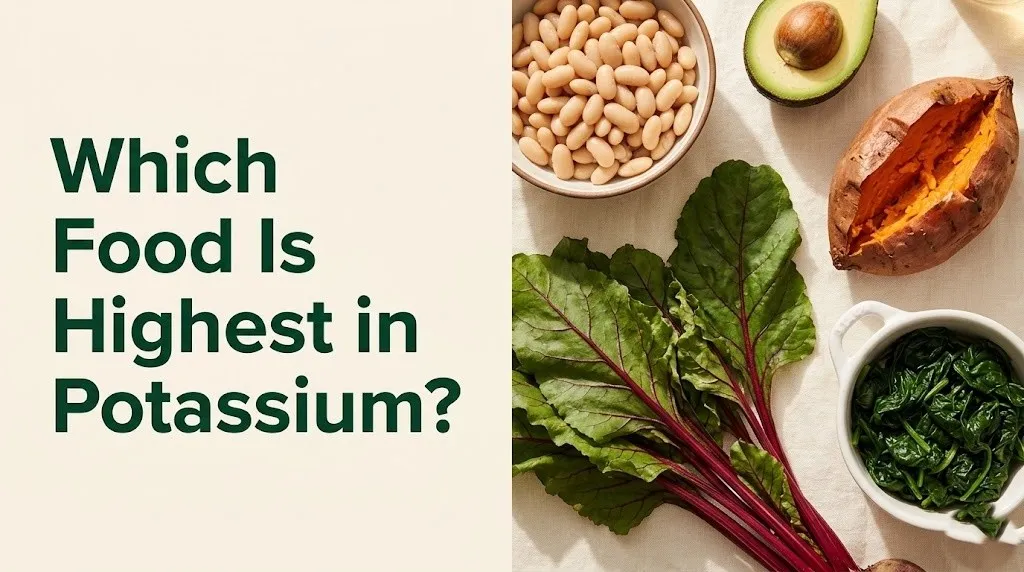
The reason beans and cooked greens rank so high comes down to concentration. Cooking reduces water volume and concentrates minerals. A cup of raw spinach wilts down to a fraction of its volume when cooked, leaving behind a much denser mineral load per gram.
Quick Tip:
- White beans are affordable, widely available canned, and work in soups, stews, and salads
- Canned versions are fine nutritionally; rinse them under water to reduce sodium content by up to 40 percent
- People managing chronic kidney disease should discuss legume portions with their treating physician, as high potassium intake from beans may not be appropriate for all CKD stages
Foods Highest in Potassium Per Serving: The Complete Ranked List
The foods with the most potassium per standard serving span beans, leafy greens, root vegetables, fruits, dairy, and fish. Here is the ranked breakdown based on USDA FoodData Central data.
This is the table most potassium guides never publish. Rather than listing foods by category, this ranks them by actual milligrams so you can directly compare across food types.
| Food | Serving Size | Potassium (mg) |
|---|---|---|
| Beet greens, cooked | 1 cup (144g) | 1,309 |
| White beans, cooked | 1 cup (179g) | 1,189 |
| Tomato paste | 1/4 cup (65g) | 669 |
| Avocado (Persea americana) | 1 medium (150g) | 690 |
| Sweet potato, baked | 1 medium (150g) | 542 |
| Salmon (Salmo salar), cooked | 3 oz (85g) | 534 |
| Spinach, cooked | 1 cup (180g) | 839 |
| Lentils, cooked | 1 cup (198g) | 731 |
| Coconut water | 1 cup (240 ml) | 600 |
| White potato, baked with skin | 1 medium (173g) | 941 |
| Banana (Musa acuminata) | 1 medium (118g) | 422 |
| Plain low-fat yogurt | 1 cup (245g) | 531 |
| Acorn squash, baked | 1 cup cubed (205g) | 896 |
| Swiss chard, cooked | 1 cup (175g) | 961 |
| Black beans, cooked | 1 cup (172g) | 611 |
Note that baked white potato with skin and Swiss chard both exceed 900 mg per cup. Neither gets the cultural recognition they deserve as potassium sources.
People following a vegan or plant-based diet will find most of the top potassium sources naturally align with their eating pattern. Those on a low-carbohydrate or ketogenic diet will want to focus on avocado, salmon, and spinach, as beans and potatoes carry significant carbohydrate loads.
What Food Has the Single Highest Potassium Content?
Beet greens (Beta vulgaris subsp. cicla) contain the highest measurable potassium per cooked cup of any widely available food, at approximately 1,309 mg per one-cup cooked serving.
If you’ve only ever seen beet greens discarded at the store, that’s a missed nutritional opportunity. They’re the leafy tops of standard table beets, and they cook down exactly like Swiss chard or spinach. Their flavor is mild and slightly earthy.
Among concentrated non-vegetable sources, dried apricots are worth noting. A half-cup of dried apricots (approximately 65g) delivers around 755 mg of potassium. The dehydration process removes water while leaving minerals intact, which makes dried fruits potassium-dense by weight. That same concentration effect applies to tomato paste: a quarter-cup contains more potassium than a whole banana.
The key distinction here is concentration versus volume. Beet greens and white beans win on per-serving totals because cooking shrinks their volume while preserving their mineral content. Think of it like reducing a stock: the water evaporates, but everything else stays in the pot.
Key Fact: According to USDA FoodData Central, a baked white potato with skin contains approximately 941 mg of potassium, more than double what most people attribute to it. The skin alone accounts for a meaningful portion of that total, which is why peeling potatoes before cooking removes potassium along with the peel.
Key Takeaway: White beans, beet greens, and Swiss chard deliver far more potassium per serving than bananas. If you’re trying to increase your potassium intake, legumes and dark cooked greens are your most efficient options across any food category.
Foods with More Potassium Than Bananas
Many common foods contain significantly more potassium than a banana, which provides approximately 422 mg per medium fruit.
The banana’s reputation as the go-to potassium food is more about marketing than nutritional reality. Dozens of foods outperform it. Here’s why the misconception persists: bananas are portable, require no cooking, and have been positioned as the athlete’s recovery food for generations. The potassium content is real but unexceptional compared to most vegetables and legumes.
Foods that clearly beat a banana per standard serving include:
- Baked white potato with skin: approximately 941 mg
- Cooked Swiss chard: approximately 961 mg
- Acorn squash, baked: approximately 896 mg
- Cooked spinach: approximately 839 mg
- White beans: approximately 1,189 mg
- Cooked lentils: approximately 731 mg
- Coconut water (1 cup): approximately 600 mg
- Avocado (medium): approximately 690 mg
- Plain low-fat yogurt (1 cup): approximately 531 mg
Even a small serving of tomato paste in a pasta sauce adds more potassium than a banana. A quarter-cup of tomato paste in a sauce shared between two people still delivers meaningful potassium without being a separate food choice.
People with latex-fruit syndrome should note that avocado can trigger cross-reactive allergic responses in those with a latex allergy. This affects a small subset of people but is worth knowing.
Potassium in Sweet Potatoes vs. White Potatoes
White potatoes baked with skin contain more potassium than sweet potatoes, with approximately 941 mg versus 542 mg per medium baked potato.
This surprises nearly everyone. Sweet potatoes are widely considered the healthier potato, and in several nutritional categories they are. They contain far more beta-carotene (the precursor to vitamin A), more vitamin C (ascorbic acid), and score higher on antioxidant measures. But on raw potassium content, the white potato wins.
| Potato Type | Preparation | Potassium (mg) | Notable Nutrients |
|---|---|---|---|
| White potato | Baked, with skin | 941 | Potassium, vitamin C, B6 |
| White potato | Boiled, no skin | ~328 | Significant mineral loss |
| Sweet potato | Baked, with skin | 542 | Potassium, beta-carotene, vitamin C |
| Sweet potato | Boiled, no skin | ~475 | Less loss than white potato when boiled |
The critical variable is preparation. A boiled, skinless white potato loses roughly 65 percent of its potassium to the cooking water compared to a baked version. That’s not a small difference. It’s the difference between a high-potassium food and a fairly ordinary one.
People managing blood sugar levels, including those with type 2 diabetes, should factor in the glycemic index differences between potato types and preparations. Cooling cooked potatoes before eating increases their resistant starch content, which moderates the blood glucose response. This applies to both varieties.
Best Potassium Sources for Heart Health
The best potassium sources for heart health are foods that combine high potassium content with low sodium, ideally consumed as part of the DASH diet pattern.
The American Heart Association (AHA) identifies potassium as one of the key nutrients in blood pressure regulation. The mechanism is straightforward: potassium helps the kidneys excrete more sodium, which reduces blood pressure by relaxing the walls of blood vessels.
For heart health specifically, the foods that offer the most benefit are those where the potassium-to-sodium ratio strongly favors potassium:
- Fresh or frozen spinach (cooked, unsalted): approximately 839 mg potassium, minimal sodium
- Avocado: approximately 690 mg potassium, about 11 mg sodium naturally
- Salmon (Atlantic, wild-caught): approximately 534 mg potassium per 3 oz, high in omega-3 fatty acids (eicosapentaenoic acid and docosahexaenoic acid)
- Lentils: approximately 731 mg potassium per cooked cup, naturally sodium-free before salting
- Plain low-fat yogurt: approximately 531 mg potassium, roughly 170 mg sodium per cup. A solid trade-off.
- Baked sweet potato (with skin): approximately 542 mg potassium, around 36 mg sodium
The DASH diet (Dietary Approaches to Stop Hypertension), developed with support from the National Heart, Lung, and Blood Institute, specifically targets 4,700 mg of potassium per day from food sources. That’s considerably higher than the general adequate intake and reflects the evidence that higher potassium intakes from whole foods are associated with reduced hypertension risk.
Potassium and Blood Pressure: What the Research Says
Higher dietary potassium intake from food is associated with lower blood pressure, particularly in people who also consume high amounts of sodium.
A meta-analysis published in the Journal of the American College of Cardiology found that increasing dietary potassium intake was associated with a measurable reduction in systolic blood pressure. The effect was strongest in people with existing hypertension and in those consuming a high-sodium diet.
The relationship works partly through a sodium-potassium exchange mechanism in the kidneys. Higher circulating potassium encourages the kidneys to excrete more sodium in urine, which reduces fluid retention and lowers vascular pressure. This is not the same mechanism as a blood pressure medication; it is a dietary modulation effect that takes weeks of consistent intake to produce measurable changes.
The Harvard T.H. Chan School of Public Health notes that the combination of high potassium and low sodium is more effective at lowering blood pressure than either factor alone. That’s why processed foods are double trouble: they tend to be high in sodium and nearly devoid of potassium.
People taking ACE inhibitors, potassium-sparing diuretics, or beta-blockers should not significantly increase potassium-rich foods without discussing the change with the prescribing physician, as these medications can raise blood potassium levels. This is a real pharmacological interaction, not a generic caution.
Key Takeaway: Potassium’s blood pressure benefits are strongest when dietary sodium is also reduced. Eating more potassium-rich whole foods while cutting back on processed foods addresses both factors simultaneously.
How Much Potassium Do You Need Per Day?
The NIH Office of Dietary Supplements sets the adequate intake for potassium at 2,600 mg per day for adult women and 3,400 mg per day for adult men.
These figures represent estimated intakes from the general population that appear associated with adequate nutritional status. They are not rigid minimums in the same way as some other nutrients; they are reference points for dietary planning.
| Population Group | Daily Potassium Adequate Intake (AI) |
|---|---|
| Adult women (19 and older) | 2,600 mg |
| Adult men (19 and older) | 3,400 mg |
| Pregnant women | 2,900 mg |
| Breastfeeding women | 2,800 mg |
| Adolescent females (14-18) | 2,300 mg |
| Adolescent males (14-18) | 3,000 mg |
| Children (9-13 years) | 2,300 mg |
| Older adults (65+) | Same as adult figures above |
The Dietary Guidelines for Americans 2020-2025 identifies potassium as a “nutrient of public health concern” for the general U.S. population, meaning most people aren’t getting enough from diet alone.
Older adults face a compounding issue. The kidneys become less efficient at regulating potassium as people age. Both too little and too much potassium can become risks. Anyone over 65 who is considering significantly adjusting their potassium intake through dietary changes should discuss it with their primary care provider, because individual kidney function varies considerably and affects how much potassium the body can safely process.
How to Increase Potassium Intake Naturally
The most effective way to increase potassium intake naturally is to shift the bulk of your meals toward whole plant foods, particularly beans, leafy greens, and starchy vegetables.
You don’t need to track milligrams obsessively. A practical framework works better for most people. If half your plate at every meal contains vegetables or legumes, and you choose minimally processed forms of these foods, hitting the daily adequate intake becomes straightforward.
Here are concrete ways to add potassium without dramatically changing your eating habits:
- Add a cup of cooked spinach or Swiss chard to dinner three nights per week. Each cup adds roughly 800 to 960 mg.
- Use white beans or lentils as a protein base in soups, stews, or grain bowls instead of relying solely on meat.
- Eat the potato skin. Peeling before cooking discards a meaningful share of the potassium.
- Replace salted snacks with avocado toast on whole grain bread. One medium avocado adds roughly 690 mg.
- Add tomato paste to sauces, chilis, and braises instead of crushed tomatoes for a more concentrated potassium hit per tablespoon.
- Drink coconut water after exercise if you want a natural electrolyte source. One cup provides around 600 mg. Choose unsweetened versions.
People following halal or kosher dietary requirements will find that nearly every high-potassium food on this list is naturally compliant, as the major sources are plant-based or fish.
How Cooking Affects Potassium Content in Food
Boiling vegetables in water causes measurable potassium loss, with some studies showing reductions of 30 to 60 percent depending on cooking time and whether the food is cut or whole.
This is one of the most practically important and least discussed facts about potassium in food. Potassium is a water-soluble mineral. When you submerge vegetables or beans in boiling water, potassium leaches into the cooking liquid. If you drain and discard that water, you’re pouring potassium down the sink.
| Cooking Method | Potassium Retention | Notes |
|---|---|---|
| Baking (whole, with skin) | 90 to 100% | Best for potatoes and squash |
| Steaming | 85 to 95% | Excellent for greens and vegetables |
| Microwaving (with minimal water) | 85 to 90% | Convenient and effective |
| Stir-frying | 80 to 90% | Good for leafy greens |
| Boiling (with skin intact) | 60 to 70% | Moderate loss |
| Boiling (peeled and cut) | 40 to 60% | Significant loss |
| Pressure cooking (liquid consumed) | ~90% | Good if you use the cooking liquid |
According to a study published in the Journal of Food Composition and Analysis, potatoes that were peeled and boiled lost nearly twice as much potassium as potatoes baked with skin. The skin acts as a physical barrier that slows mineral diffusion into cooking water.
For people with chronic kidney disease (CKD) who need to deliberately lower their potassium intake, boiling is actually the recommended method. Healthcare providers in renal nutrition specifically advise boiling and discarding the cooking water to reduce the potassium content of vegetables before eating them. For everyone else, the opposite strategy applies.
Key Takeaway: How you cook matters as much as what you cook. Baking or steaming high-potassium vegetables preserves nearly all of their mineral content, while boiling and discarding the water removes a substantial portion before the food ever reaches your plate.
Potassium from Food vs. Potassium Supplements
Potassium from whole food sources is generally more bioavailable and safer than supplemental potassium, and whole food potassium comes paired with fiber, other minerals, and phytochemicals that work together in ways supplements cannot replicate.
The naturally occurring potassium in food exists primarily as organic potassium salts: potassium citrate, potassium malate, potassium phosphate, and potassium gluconate. These forms are absorbed efficiently and metabolized without the gastrointestinal irritation that some people experience with potassium chloride supplements.
Over-the-counter potassium supplements in the United States are limited by the FDA to 99 mg per serving in most product formats. This regulatory cap exists because concentrated supplemental potassium can cause gastrointestinal irritation and, in people with impaired kidney function, can raise blood potassium to dangerous levels. The FDA’s limit is not arbitrary; it reflects real documented risks from high-dose supplemental potassium.
A single cup of cooked white beans delivers more than eleven times the potassium in a standard supplement tablet, with none of the associated risks for a healthy adult. That comparison makes the food-first approach obvious.
People with hyperkalemia (abnormally high blood potassium), those with stage 3 or higher CKD, and anyone taking potassium-sparing medications should not take potassium supplements without direct guidance from their physician. High blood potassium can cause cardiac arrhythmias. This is a real clinical risk, not a theoretical concern.
Potassium in Beans and Legumes
Beans and legumes are the most potassium-dense food group by calorie and by serving, offering a combination of potassium, plant protein, dietary fiber, folate, and iron that makes them nutritionally efficient.
Legumes are often overlooked because they don’t feature prominently in traditional Western dietary patterns. But in the Mediterranean diet, the DASH diet, and most plant-based eating frameworks, legumes are a daily staple, and the potassium content is a meaningful part of why those dietary patterns are associated with lower rates of hypertension and cardiovascular disease.
| Legume | Serving (cooked) | Potassium (mg) | Protein (g) | Fiber (g) |
|---|---|---|---|---|
| White beans (Phaseolus vulgaris) | 1 cup (179g) | 1,189 | 17 | 11 |
| Lentils (Lens culinaris) | 1 cup (198g) | 731 | 18 | 16 |
| Kidney beans | 1 cup (177g) | 713 | 15 | 11 |
| Black beans | 1 cup (172g) | 611 | 15 | 15 |
| Chickpeas (Cicer arietinum) | 1 cup (164g) | 477 | 15 | 13 |
| Soybeans (edamame) | 1 cup (155g) | 676 | 18 | 8 |
| Navy beans | 1 cup (182g) | 708 | 15 | 19 |
White beans and navy beans are particularly notable because they deliver the highest potassium among legumes while also providing substantial fiber and plant-based protein.
People with irritable bowel syndrome (IBS) or who are following a low-FODMAP diet may need to limit some legumes due to their fermentable carbohydrate content. Small portions of canned and well-rinsed lentils are generally better tolerated than larger servings of whole beans in that context. Individual response varies considerably.
Potassium in Leafy Greens and Vegetables
Cooked leafy greens are among the highest-potassium foods per calorie of any food group, making them particularly valuable for people who want to increase potassium intake without adding significant calories.
The key word is cooked. Raw leafy greens contain potassium, but their large water volume and low density means you’d need to eat an enormous bowl of raw spinach to match what a single cup of cooked spinach delivers. Cooking concentrates the mineral content dramatically.
Potassium content in key vegetables per cooked cup:
- Beet greens (Beta vulgaris subsp. cicla): 1,309 mg
- Swiss chard (Beta vulgaris subsp. cicla): 961 mg
- Acorn squash, baked: 896 mg
- Spinach (Spinacia oleracea), cooked: 839 mg
- Butternut squash, baked: 582 mg
- Broccoli, cooked: 457 mg
- Brussels sprouts, cooked: 495 mg
- Kale (Brassica oleracea var. sabellica), cooked: 296 mg
Beet greens deserve specific mention. They are nutritionally equivalent to Swiss chard and spinach but are routinely thrown away because people buy beets for the root only. Cooking beet greens is identical to cooking any other dark leafy green: sauté in a pan with olive oil and garlic, or blanch briefly and finish with lemon juice. They wilt in under 5 minutes.
People on blood-thinning medications such as warfarin should maintain consistent vitamin K intake. Leafy greens are high in phylloquinone (vitamin K1), and large changes in their consumption can affect how warfarin works. The goal isn’t avoidance; it’s consistency. Discuss any major dietary changes with the prescribing physician.
Key Takeaway: Cooked leafy greens like beet greens and Swiss chard deliver more potassium per cup than almost any other food, while remaining extremely low in calories. They are the most potassium-efficient food per calorie available.
What Food Causes High Potassium Levels?
No single food causes dangerously high blood potassium (hyperkalemia) in healthy adults with normal kidney function. High blood potassium is almost always driven by impaired kidney function, medication effects, or both, not by eating too many potassium-rich foods.
The kidneys regulate blood potassium tightly. In a person with healthy kidneys, excess potassium is filtered out and excreted in urine. You cannot eat your way into hyperkalemia if your kidneys are working normally.
That said, in people whose kidneys do not function properly, high-potassium foods become a real concern. Foods that contribute the most dietary potassium and are therefore most relevant to monitor in high-risk individuals include:
- White beans and other legumes (1,000+ mg per cup)
- Cooked leafy greens (800 to 1,300 mg per cup)
- Potassium salt substitutes (these replace sodium chloride with potassium chloride and can deliver very high potassium doses unexpectedly)
- Sports drinks and coconut water consumed in large volumes
- Tomato-based products consumed in quantity (tomato paste, tomato juice, tomato sauce)
- Dried fruits eaten as a significant snack portion
According to the National Kidney Foundation, people with CKD stages 3 through 5 are at elevated risk for hyperkalemia and typically need to limit high-potassium foods under the guidance of a renal dietitian. The specific threshold depends on current kidney function, medication regimen, and individual lab values.
Potassium salt substitutes deserve particular attention. They are marketed as heart-healthy sodium replacements, but they can deliver 400 to 700 mg of potassium per quarter teaspoon. For someone with CKD or who takes certain medications, using these liberally can be problematic.
Potassium and Kidney Disease: Who Needs to Be Careful
People with chronic kidney disease (CKD) at stage 3 or above often need to limit high-potassium foods, because impaired kidneys cannot efficiently filter excess potassium from the blood.
This is the most important safety context in any discussion of potassium-rich foods. For the vast majority of healthy adults, eating more potassium is unambiguously beneficial. For people with CKD, high potassium intake can cause dangerous elevations in blood potassium that affect heart rhythm.
The threshold for potassium restriction varies. Not all people with CKD need to limit potassium equally. Stage 3a CKD may require only modest attention to portion sizes of very high-potassium foods. Stage 4 and 5 CKD typically require structured potassium management with regular blood potassium monitoring. A registered renal dietitian is the appropriate professional to determine individual potassium targets, not a general food guide.
Other groups who should be aware of potassium-related risks:
- People taking ACE inhibitors (such as lisinopril or enalapril): these medications reduce potassium excretion
- People taking potassium-sparing diuretics (such as spironolactone): same retention effect
- People with Addison’s disease: impaired adrenal function affects potassium regulation
- People with type 1 or type 2 diabetes with kidney complications: diabetic nephropathy affects potassium handling
- Older adults with reduced kidney function: kidney filtration capacity declines with age even in the absence of diagnosed CKD
For anyone in these groups who wants to adjust their potassium intake through diet, the practical step is to bring recent bloodwork and a food log to an appointment with the prescribing physician or a registered dietitian who works in renal or cardiovascular nutrition. That is a specific, actionable step, not a generic disclaimer.
The good news: the majority of people reading a food guide about potassium are not in this category. For healthy adults, eating more of the foods on this list is one of the clearer dietary moves supported by evidence.
Key Takeaway: Healthy adults can safely eat as many potassium-rich whole foods as they want. The people who need to monitor intake carefully are those with kidney disease, certain medications, or specific metabolic conditions, and they need individualized guidance, not a one-size-fits-all food list.
Frequently Asked Questions About Potassium-Rich Foods
What single food has the highest amount of potassium?
Beet greens, cooked, contain the highest potassium of any commonly available food at approximately 1,309 mg per one-cup cooked serving.
White beans are a close second at roughly 1,189 mg per cooked cup and are far more widely eaten.
Both far exceed the potassium content of bananas, which provide around 422 mg per medium fruit.
Is it true that bananas are the best source of potassium?
Bananas are a decent potassium source, but they are far from the best.
Dozens of common foods outperform bananas on potassium per serving, including baked potatoes, cooked spinach, avocados, lentils, and white beans.
The banana’s reputation is based more on convenience and cultural familiarity than on its potassium ranking relative to other foods.
How do I know if I’m not getting enough potassium?
Low potassium (hypokalemia) can cause muscle cramps, weakness, fatigue, and constipation, though these symptoms overlap with many other conditions.
The only reliable way to confirm low potassium is through a blood test ordered by a physician.
If you consistently eat few vegetables, beans, or fruits and experience persistent muscle weakness or cramping, discussing potassium levels with your doctor is a reasonable step.
Can eating too many high-potassium foods be dangerous?
For healthy adults with normal kidney function, eating large amounts of potassium-rich foods does not cause dangerous blood potassium levels.
The kidneys excrete excess potassium efficiently when they are working properly.
For people with kidney disease, certain medications, or specific adrenal conditions, high potassium intake can be dangerous, and individual dietary limits should be established through medical evaluation.
What is the best way to eat more potassium without taking a supplement?
The most effective approach is adding cooked leafy greens and legumes to your meals regularly, as these two food groups contain the highest potassium concentrations per serving.
Baking or steaming vegetables rather than boiling them preserves significantly more potassium in the food.
Even small consistent changes, like adding a cup of cooked spinach to dinner or swapping a snack for half an avocado, can meaningfully increase daily potassium intake over time.
Making Potassium Work in Your Day-to-Day Eating
White beans, beet greens, Swiss chard, lentils, baked potatoes with skin, and avocado are the foods that will actually move your daily potassium totals. Bananas are fine, but they’re a starting point, not a ceiling.
Choose cooking methods that preserve what’s in the food. Bake or steam instead of boiling and draining. Keep the skin on potatoes. Add tomato paste to sauces rather than reaching for a supplement tablet that delivers a fraction of what a proper meal can.
If you have kidney disease, are on blood pressure medications, or have any condition that affects how your kidneys handle electrolytes, specific potassium targets should come from a registered dietitian or physician who can review your actual bloodwork. For everyone else, eating more of the foods on this list is one of the most well-supported dietary choices you can make in 2026.