Wet food is generally better for cats than dry food in several key areas, including hydration, urinary health, and protein-to-carbohydrate ratio. That said, the best diet for any individual cat depends on their age, health status, and how your veterinarian assesses their specific needs.
Cats are obligate carnivores, meaning their bodies are biologically built to get most of their nutrition from animal protein and moisture-rich prey. The Cornell Feline Health Center notes that cats have a naturally low thirst drive and are designed to obtain most of their water from food, which is exactly what wet food provides and dry kibble largely does not.
This article covers the nutritional differences between wet and dry cat food, which cats benefit most from a wet food diet, how much to feed, whether mixed feeding makes sense, and how to actually transition a reluctant dry-food cat to wet. Every section is grounded in veterinary and nutritional science, not brand marketing.
Is Wet Food Better for Cats?
Wet food is better for most cats most of the time, particularly when the goal is supporting hydration, urinary tract health, and a diet closer to a cat’s natural nutritional profile.
This does not mean dry food is dangerous. Millions of cats live long, healthy lives eating predominantly dry food. But when you compare what both food types deliver nutritionally, wet food consistently matches feline biology more closely.
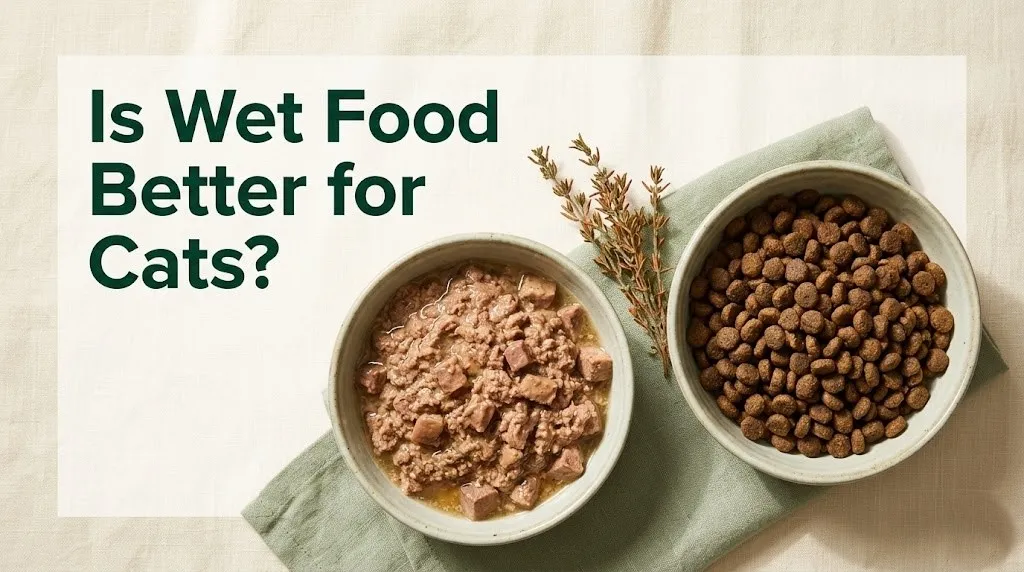
The core reason comes down to moisture. A cat’s ancestral diet, small prey animals, consisted of approximately 70 to 75% water. Wet cat food closely mirrors this, containing 75 to 82% moisture. Dry kibble contains roughly 6 to 10% moisture. That gap has real consequences for a species whose kidneys evolved to concentrate urine rather than rely on drinking water to stay hydrated.
| Feature | Wet Cat Food | Dry Cat Food |
|---|---|---|
| Moisture content | 75 to 82% | 6 to 10% |
| Protein (as-fed basis) | 8 to 12% | 25 to 35% |
| Protein (dry matter basis) | 40 to 50% | 30 to 45% |
| Carbohydrate content | Generally low (0 to 10%) | Often higher (20 to 50%) |
| Caloric density per gram | Lower | Higher |
| Typical cost | Higher per serving | Lower per serving |
Cats with health conditions like chronic kidney disease, feline lower urinary tract disease (FLUTD), or diabetes benefit especially from the high moisture in wet food. For healthy adult cats, the choice matters less urgently, but the biological argument still favors moisture-rich food.
Is Wet Food Good for Cats?
Wet food is nutritionally appropriate for cats and, when formulated to meet AAFCO (Association of American Feed Control Officials) standards, provides a complete and balanced diet.
Good wet food contains high-quality animal protein, essential fatty acids, the amino acid taurine, and sufficient levels of vitamins and minerals for the life stage on the label. Taurine is non-negotiable for cats. Unlike dogs, cats cannot synthesize adequate taurine from other amino acids, and a taurine deficiency causes dilated cardiomyopathy and retinal degeneration.
The key word is “formulated.” Not all wet cat food is equal. Gourmet or “treat” style wet foods sometimes fall short of complete nutrition. Always look for the AAFCO nutritional adequacy statement on the label, which confirms the food meets minimum standards for a specific life stage.
- Kittens need food labeled “for growth” or “for all life stages”
- Adult cats need food labeled “for maintenance” or “for all life stages”
- Senior cats have variable needs that a veterinarian should assess individually
- Cats with kidney disease, diabetes, or heart conditions need foods formulated specifically for those conditions, ideally under veterinary guidance
Wet food is a genuinely good food source for cats. The concern is not whether wet food is good but whether the specific product is complete, appropriately stored, and suited to your cat’s life stage.
Is Wet Food Healthier for Cats?
Wet food is healthier for cats in terms of hydration, lower carbohydrate load, and better alignment with feline metabolic needs. The evidence for these benefits is well-supported in veterinary nutrition literature.
Cats do not have a strong digestive capacity for starches and sugars. Unlike humans or dogs, cats lack the salivary enzyme amylase, which begins carbohydrate digestion in the mouth. Their liver’s ability to regulate blood glucose through the enzyme glucokinase is also limited compared to other mammals. This means a high-carbohydrate diet, common in many dry kibbles, is a genuine nutritional mismatch for cats.
A study published in the Journal of Feline Medicine and Surgery found that cats fed wet food had significantly lower urine specific gravity, indicating more dilute urine and better overall hydration status, compared to cats fed dry food. Concentrated urine is a known risk factor for struvite and oxalate crystal formation, both of which contribute to FLUTD.
The “healthier” label holds for most cats. However, wet food is not automatically superior in every measurable way:
- Dental health: Neither wet nor dry food provides meaningful mechanical teeth cleaning. The American Veterinary Dental College has stated that evidence for dry kibble reducing tartar is not strong. Regular tooth brushing is the most effective dental hygiene for cats.
- Caloric control: Wet food’s lower caloric density per gram makes overeating less likely, but overfeeding is still possible.
- Cost: Wet food costs more per calorie than dry food, which is a real constraint for many households.
The healthier-food conclusion favors wet food, but individual cat health, budget, and veterinary guidance all factor into the real-world decision.
Key Takeaway: Wet food aligns more closely with a cat’s biological design than dry food, primarily because of its high moisture content and lower carbohydrate load, but the best diet for any individual cat depends on age, health status, and veterinary input.
Why Wet Food Is Better for Cats in Key Situations
Wet food is specifically better for cats in several clearly defined health and life situations where hydration, protein quality, and carbohydrate control are medically meaningful.
Think of it this way: a cat eating dry kibble exclusively is like a person getting all their daily fluid from food with no access to water, and just trusting their body to compensate. Cats can compensate to a degree, but research consistently shows their total water intake on a dry food diet remains lower than on a wet food diet, even when fresh water is freely available.
The situations where wet food delivers a measurable advantage include:
- Cats with chronic kidney disease (CKD): Increased hydration slows kidney decline and reduces strain. The Cornell Feline Health Center recommends wet food as a cornerstone of CKD dietary management.
- Cats prone to urinary crystals or FLUTD: Dilute urine reduces crystal formation risk.
- Overweight cats: Lower caloric density per gram makes portion control easier without leaving the cat hungry.
- Senior cats: Aging cats often drink less and have reduced kidney reserve. Wet food compensates for both.
- Cats recovering from illness or surgery: High moisture content and palatability encourage eating during recovery.
- Cats with a poor appetite or dental pain: Soft texture is easier to eat and often more appealing to cats with oral discomfort.
Cats who are young, healthy, well-hydrated, and eating high-quality dry food without any urinary or kidney history may not show a dramatic benefit from switching. But the ceiling of risk from wet food is low, and the potential upside for many cats is real.
Wet Cat Food Moisture Percentage and Hydration Benefits
Wet cat food contains between 75 and 82% moisture by weight, compared to the 6 to 10% found in dry kibble, and this difference has direct consequences for how a cat’s kidneys and urinary system function.
Cats evolved as desert animals and developed kidneys capable of producing highly concentrated urine to conserve water. This adaptation served them well when their diet was fresh prey. It becomes a liability when their only food source is low-moisture kibble and they do not compensate sufficiently by drinking water from a bowl.
Research published in the American Journal of Veterinary Research found that cats consuming wet food had total daily water intake roughly 2.5 times higher than cats consuming equivalent calories from dry food. The cats on dry food drank more from a water source, but not enough to close the gap. Their overall water intake remained lower, and urine concentration remained higher.
| Water Source | Wet Food Diet | Dry Food Diet |
|---|---|---|
| From food | High (75 to 82% of food weight) | Low (6 to 10% of food weight) |
| From drinking | Supplementary | Primary |
| Total daily intake | Higher overall | Lower overall |
| Urine concentration | More dilute | More concentrated |
For cats with no history of urinary or kidney problems, chronic mild dehydration from a dry-food-only diet may not cause noticeable issues for years. For cats already managing CKD, FLUTD, or diabetes, the hydration advantage of wet food is clinically relevant.
Cats with hyperthyroidism may need specially formulated wet food with controlled iodine levels. A veterinarian should guide the choice in those cases, as dietary iodine restriction is sometimes used as part of hyperthyroidism management.
Wet Cat Food Protein Content and AAFCO Standards
AAFCO requires that adult cat food provide a minimum of 26% crude protein on a dry matter basis; quality wet cat foods typically deliver 40 to 50% crude protein on that same dry matter basis, well above the minimum.
Protein is the most important macronutrient for cats. As obligate carnivores, cats use protein not just for muscle maintenance but as a primary energy source. Their liver enzymes are set to a permanently high rate of protein metabolism, meaning they burn through amino acids whether or not their diet supplies enough. A low-protein diet forces cats to break down their own muscle tissue to meet these metabolic demands.
The amino acid taurine deserves specific attention. AAFCO mandates a minimum of 0.1% taurine in wet food (as fed basis) and 0.2% in dry food (the higher requirement accounts for reduced bioavailability during the high-heat extrusion process used to make kibble). Without adequate taurine, cats develop dilated cardiomyopathy, a serious heart condition, and retinal degeneration leading to blindness.
Essential fatty acid arachidonic acid is another cat-specific requirement. Unlike dogs and humans, cats cannot synthesize arachidonic acid from linoleic acid. It must come from animal-based food. Quality wet food made with real meat provides this; plant-based or heavily grain-extended formulas may fall short.
- When reading a wet food label, check that the first ingredient is a named animal protein: chicken, turkey, beef, salmon, or similar.
- Avoid formulas where water or starch is the first ingredient.
- Look for the AAFCO statement confirming the food is “complete and balanced” for your cat’s life stage.
- Wet foods labeled “complementary,” “treat,” or “topper” are not nutritionally complete and should not be a cat’s primary diet.
Is Wet Cat Food Healthier Than Dry for Urinary Health?
Wet cat food is substantially better than dry food for urinary health because it increases urine volume and reduces urine concentration, two factors that directly lower the risk of struvite crystals, oxalate crystals, and feline lower urinary tract disease.
Feline lower urinary tract disease (FLUTD) is an umbrella term covering conditions including urinary crystals, bladder inflammation (idiopathic cystitis), urethral obstruction, and infections. Male cats are especially vulnerable to urethral blockages, which can become life-threatening within 24 to 48 hours if untreated.
The connection to diet is well-documented. The Cornell Feline Health Center cites dietary moisture as one of the primary modifiable risk factors for recurrent FLUTD. A cat producing larger volumes of dilute urine is less likely to develop crystal concentrations than one producing small amounts of highly concentrated urine.
Phosphorus and magnesium levels in food also affect crystal formation:
| Mineral | Role in Urinary Health | Wet Food Advantage |
|---|---|---|
| Phosphorus | High levels stress kidneys | Wet food often lower in total phosphorus |
| Magnesium | Contributes to struvite crystals when concentrated | Dilute urine reduces struvite risk regardless |
| Sodium (moderate) | Encourages water drinking | Some wet foods use moderate sodium to increase intake |
Cats who have had a urinary blockage or recurrent UTIs should be on a veterinary-prescribed urinary health diet. These are different from standard wet food and are formulated to specific pH and mineral targets. Standard wet food improves urinary health generally; prescription urinary diets address clinical disease specifically.
Key Takeaway: The high moisture content in wet food directly lowers urine concentration, which reduces the risk of crystals and urinary tract disease, and this benefit is well-supported by veterinary nutrition research.
Do Cats Need Both Wet and Dry Food?
Cats do not strictly need both wet and dry food, but a combination approach works well for many owners and cats, provided the total daily nutrition is complete and appropriate for the cat’s life stage.
Mixed feeding, sometimes called combination feeding, involves offering wet food at set mealtimes and leaving dry food available for grazing between meals. The appeal is practical: wet food delivers hydration and palatability, while dry food provides convenience and is easier to leave out without spoilage concerns.
The nutritional risk with mixed feeding is calorie management. Both foods count toward the daily total. If a cat eats a full portion of wet food and then grazes freely on dry food, caloric overload accumulates quickly. Dry kibble is calorie-dense; even small amounts add up.
| Feeding Approach | Hydration | Calorie Control | Convenience | Best For |
|---|---|---|---|---|
| Wet food only | Excellent | Good (lower calorie density) | Requires refrigeration of leftovers | CKD, FLUTD, picky eaters |
| Dry food only | Poor | Difficult to control | High | Budget-constrained, healthy cats only |
| Combination feeding | Good | Requires careful tracking | Moderate | Most healthy adult cats |
| Wet food primary, dry as occasional treat | Very good | Good | Moderate | Most cats |
If choosing a combination approach, the American Animal Hospital Association recommends using the manufacturer’s feeding guides as a starting point, then adjusting based on the cat’s body condition score (BCS) with guidance from a veterinarian. A BCS of 4 to 5 out of 9 is considered ideal for most adult cats.
Should Cats Eat Dry Food at All?
Dry food is not harmful to healthy adult cats who stay well-hydrated, but it is not the optimal primary food source for most cats from a nutritional standpoint.
Some cats eat dry food exclusively throughout their lives without developing urinary or kidney problems. This does not mean dry food is ideal; it means cats have enough physiological resilience to tolerate it. The distinction matters when making a proactive feeding decision rather than reacting to a health crisis.
Dry food does have legitimate advantages. It is cheaper per calorie, stores easily at room temperature for long periods, and can be left in a bowl without immediate spoilage risk. For owners managing multiple cats, tight budgets, or demanding schedules, these factors are real.
The concerns with a dry-food-only diet are:
- Chronically lower total water intake, even with free access to fresh water
- Higher carbohydrate content in many kibble formulas, which cats process inefficiently
- Higher caloric density, making overeating and obesity more likely
- The AAFCO taurine standard for dry food accounts for heat degradation during extrusion, so minimum-compliant dry food still delivers required taurine, but processing affects amino acid availability
Cats prone to urinary issues, kidney disease, or obesity should move away from a primarily dry diet. Healthy cats eating high-quality dry food with good hydration habits face a lower risk, but the biological argument still favors including wet food regularly.
Is Wet Food More Filling for Cats?
Wet food is more filling per calorie than dry food because its high water content increases stomach volume without a proportional increase in caloric intake.
A standard 85-gram serving of wet cat food typically contains 60 to 90 calories. An equivalent weight of dry kibble contains roughly 280 to 340 calories. The cat’s stomach experiences similar physical fullness from either amount by weight, but the wet food delivers far fewer calories. This satiety-per-calorie advantage makes wet food a useful tool in managing weight.
Protein also plays a role in satiety. Diets higher in protein tend to produce a more sustained feeling of fullness in mammals, and well-formulated wet food delivers protein at a high dry-matter percentage. Think of it like the difference between eating a chicken breast and eating the same number of calories in crackers. The protein-rich option holds you longer.
For owners managing an overweight cat, this is one of wet food’s most practical benefits. The cat eats a physically satisfying portion without consuming excess calories, which makes portion management less of a battle of wills.
- A cat that consistently begs after meals on a dry food diet is often signaling genuine hunger for volume, not just calories.
- Switching to wet food often reduces that behavior because the stomach is more fully occupied.
- High-fiber wet food formulas can extend this effect further, though fiber content in cat food should be appropriate for carnivores: moderate, not excessive.
Cats with specific health conditions requiring caloric restriction, such as post-surgery recovery from pancreatitis, should have their portions determined by a veterinarian regardless of food type.
Key Takeaway: Wet food delivers more physical fullness per calorie than dry food, making it a practical advantage for weight management and for cats who seem persistently hungry on a kibble-only diet.
Wet Food for Senior Cats
Wet food is especially beneficial for senior cats because aging reduces kidney function, thirst response, and sometimes the ability to chew dry kibble comfortably.
Cats are generally considered senior at 11 years and geriatric at 15 years, according to the American Animal Hospital Association’s feline life stage guidelines. Kidney disease is extremely common in older cats. The Cornell Feline Health Center estimates that more than 30% of cats over 15 years old have some degree of chronic kidney disease. Hydration is central to managing that condition.
Older cats also drink less water as a result of reduced thirst sensitivity, a common change in aging mammals. This decline happens gradually and is often invisible to owners until bloodwork reveals kidney stress. Wet food compensates for this reduced drinking behavior by delivering moisture directly through food.
Texture becomes a factor too. Some senior cats develop dental disease, tooth resorption, or loss of teeth. Pate-style wet food requires no chewing strength. Chunked or shredded varieties in gravy are also manageable for most cats with dental pain, unlike hard kibble.
Nutrient considerations for senior cats include:
- Protein: Senior cats often need higher, not lower, protein levels to maintain muscle mass. Avoid senior formulas that reduce protein significantly.
- Phosphorus: Cats with early CKD benefit from phosphorus-restricted diets. Many prescription senior wet foods address this directly.
- Calories: Metabolic rate slows in very old cats, but some seniors lose weight and need calorie-dense food.
A veterinarian should assess senior cats with bloodwork at least annually to guide dietary adjustments as kidney, thyroid, and metabolic status changes.
Wet Food for Overweight Cats and Cats With Diabetes
Wet food supports weight management in overweight cats and helps stabilize blood glucose in cats with feline diabetes mellitus because of its lower carbohydrate content and higher moisture-to-calorie ratio.
Feline diabetes is strongly associated with high-carbohydrate diets. A study published in the Journal of Feline Medicine and Surgery found that cats managed on a low-carbohydrate, high-protein diet had better glycemic control and higher remission rates than those on standard commercial dry food. Wet food, particularly meat-based formulas with minimal grain or starch content, fits that profile naturally.
| Dietary Feature | Overweight Cats | Diabetic Cats |
|---|---|---|
| Low caloric density | Beneficial | Beneficial |
| High protein (dry matter) | Preserves muscle during weight loss | Reduces glucose spikes |
| Low carbohydrate | Reduces caloric excess | Reduces postprandial glucose |
| High moisture | Supports satiety | Supports kidney health (common comorbidity) |
For overweight cats, the target is gradual weight loss of no more than 0.5 to 1% of body weight per week. Rapid weight loss in cats can trigger hepatic lipidosis (fatty liver disease), a serious and potentially fatal condition. Never put a cat on a severe calorie restriction without veterinary guidance.
For diabetic cats, dietary changes must be coordinated with insulin therapy adjustments. Switching a diabetic cat to a low-carbohydrate wet food can reduce insulin requirements quickly, and without corresponding dose adjustments, hypoglycemia is a real risk. This is one area where veterinary supervision is not optional but a necessary part of the feeding change.
Can Cats Eat Wet Food Every Day?
Yes, cats can eat wet food every day, and for many cats it is the preferred and recommended feeding approach when the food is nutritionally complete and appropriate for the cat’s life stage.
Daily wet food feeding is standard practice in many countries and is broadly supported by veterinary nutrition guidelines. The key qualifier is “complete and balanced.” A wet food carrying the AAFCO nutritional adequacy statement for the appropriate life stage provides everything a cat needs daily without supplementation.
Owners sometimes worry about whether daily wet food causes digestive upset, fishy breath, or loose stools. Fish-heavy wet foods can cause softer stools in some cats due to high fat content and certain fish oils. Rotating proteins, for example alternating between chicken, turkey, and salmon formulas, avoids both nutrient monotony and digestive adaptation to a single protein source.
Food safety matters with daily wet feeding:
- Open cans or pouches must be refrigerated within one hour at room temperature.
- Refrigerated wet food should be used within 24 to 48 hours.
- Always serve refrigerated wet food at room temperature or slightly warmed. Cold food from the fridge is less palatable and may be refused.
- Warming wet food in a microwave risks uneven hot spots. Warming in warm water bath is safer.
Cats eating wet food daily are not at higher risk of dental disease than cats eating dry food, provided routine dental care (brushing or dental treats approved by the Veterinary Oral Health Council) is maintained.
Key Takeaway: Cats can eat complete-and-balanced wet food every day without issue. Rotating protein sources, proper storage, and serving food at room temperature make daily wet feeding both safe and practical.
How Much Wet Food Should a Cat Eat Per Day?
A typical adult cat needs roughly 200 to 250 calories per day, which translates to approximately two to three 85-gram cans or pouches of standard wet food daily, though actual needs vary by body weight, activity level, and health status.
Calorie requirements scale with body weight. The National Research Council’s guidelines for domestic cats suggest approximately 20 calories per pound of ideal body weight per day for a moderately active indoor adult cat. A 10-pound cat needs roughly 200 calories. A 15-pound cat needs roughly 300 calories, though if that cat is overweight, the target should be based on ideal weight, not current weight.
| Cat’s Ideal Body Weight | Approximate Daily Calories | Approximate Wet Food Needed |
|---|---|---|
| 6 lbs | 120 calories | ~1.5 to 2 pouches (85g each) |
| 8 lbs | 160 calories | ~2 to 2.5 pouches |
| 10 lbs | 200 calories | ~2.5 to 3 pouches |
| 12 lbs | 240 calories | ~3 pouches |
| 15 lbs | 300 calories | ~3.5 to 4 pouches |
These figures assume standard wet food at roughly 70 to 90 calories per 85-gram serving. Calorie density varies by formula. Always check the specific product’s calorie information, which should appear on the label or the manufacturer’s website.
Kittens need significantly more calories per pound than adult cats to support growth. Senior cats with reduced activity may need fewer. A veterinarian can calculate a precise target based on body condition score and bloodwork, which is the most accurate approach for cats with health conditions.
How to Switch a Cat From Dry to Wet Food
Most cats can be transitioned from dry to wet food over a 7 to 14 day period using a gradual substitution method, though some dry-food-dependent cats need several weeks to fully accept the new texture and smell.
Cats are neophobic about food texture and smell. A cat raised entirely on kibble may initially refuse wet food not because of taste but because it does not recognize the texture as food. Patience and a slow transition are more effective than abrupt changes, which can cause food refusal and stress.
To transition a cat from dry to wet food:
- Days 1 to 3: Serve the cat’s normal dry food with a very small amount of wet food placed alongside it. Do not mix them yet. Let the cat explore the wet food by smell without pressure to eat it.
- Days 4 to 6: Mix approximately 25% wet food with 75% dry food by caloric equivalent in the same bowl. If the cat eats around the wet portion, try warming it slightly with warm water to increase aroma.
- Days 7 to 9: Adjust to a 50/50 mix by caloric equivalent. Watch for soft stools or vomiting, which can indicate too fast a transition or a protein source the cat does not tolerate.
- Days 10 to 12: Move to a 75% wet / 25% dry ratio. Most cats that are going to accept wet food have done so by this stage.
- Days 13 to 14: Transition to full wet food feeding if the goal is a wet-primary diet.
- If the cat still refuses: Try a different wet food texture (pate versus chunks), a different protein source, or a slightly different temperature. Some cats prefer their wet food at about 35 to 38 degrees Celsius, roughly body temperature, which mimics fresh prey.
A cat that has gone more than 24 hours without eating during a transition needs to return to its previous food temporarily. Prolonged food refusal in cats risks hepatic lipidosis, especially in overweight cats. If a cat refuses food for more than a day, a veterinarian should assess whether an underlying issue is contributing.
Frequently Asked Questions About Wet Cat Food
Is it okay to feed a cat only wet food and no dry food?
Yes, feeding a cat exclusively wet food is nutritionally appropriate when the food is labeled “complete and balanced” by AAFCO for the cat’s life stage.
Most veterinary nutritionists consider a wet-food-only diet fully adequate and often preferable for hydration and urinary health.
Dental hygiene should be maintained through regular tooth brushing or Veterinary Oral Health Council-approved dental products, since neither wet nor dry food meaningfully cleans teeth on its own.
How often should I give my cat wet food?
Most cats do well with wet food fed two times per day at set mealtimes, with portions sized to their daily caloric target.
Free-choice wet food feeding is not recommended because wet food spoils at room temperature within a few hours and can harbor bacterial growth.
For cats who prefer to graze, a combination of timed wet meals and limited dry food access can work, provided total daily calories are tracked.
Does wet food help cats with urinary problems?
Wet food significantly reduces the risk of urinary crystal formation and FLUTD recurrence by increasing urine volume and decreasing urine concentration.
The Cornell Feline Health Center identifies dietary moisture as one of the primary controllable factors in feline urinary health.
Cats with an active urinary blockage, infection, or diagnosed crystal type should eat a veterinary-prescribed urinary diet, not simply any standard wet food.
What is the difference between pate and chunks in gravy for cats?
Pate-style wet food is smooth and uniform in texture, made by blending meat and other ingredients into a loaf or paste form.
Chunks in gravy or shredded varieties consist of distinct pieces of meat in a liquid, which some cats prefer due to a stronger meat aroma and chewable texture.
For cats with dental problems or missing teeth, pate is generally easier to eat; for cats who need encouragement to drink more liquid, the broth or gravy in chunked food adds extra fluid intake.
Can wet food cause diarrhea in cats?
Wet food can cause loose stools or diarrhea if introduced too quickly, if the protein source does not agree with the cat, or if the food has spoiled.
A gradual transition over 7 to 14 days prevents most digestive upset by allowing the cat’s gut flora to adjust.
Persistent diarrhea lasting more than 48 hours warrants a veterinary evaluation, as it may indicate a food intolerance, parasites, or an underlying gastrointestinal condition unrelated to the food change.
The Bottom Line on Wet Food for Cats
Wet food is not a miracle product, but the research consistently supports it as the better default choice for most cats, particularly when hydration, urinary health, and a low-carbohydrate diet are priorities.
For healthy adult cats with no medical history, the shift from a dry-only to a wet-primary diet is one of the most practical, low-effort steps a cat owner can take to support long-term health. The transition takes patience, especially with cats conditioned to kibble since kittenhood. But it is achievable.
If your cat has any existing health condition, from kidney disease to diabetes to recurrent urinary blockages, dietary decisions carry more clinical weight. In those cases, a veterinarian who knows your cat’s bloodwork, history, and current status should guide the specific food choice.