Arizona tea is not a health drink, but it is not equivalent to soda either. The honest answer sits somewhere in the middle, and it depends heavily on which variety you choose and how much of it you actually drink in one sitting.
The issue is not the tea itself. Green tea brewed from Camellia sinensis leaves contains measurable amounts of beneficial compounds. The problem is what surrounds that tea in a 23 oz Arizona can: roughly 45 grams of added sugar if you drink the whole thing, which most people do. The American Heart Association recommends no more than 25 grams of added sugar per day for women and 36 grams per day for men. A single full can of Arizona Green Tea with Ginseng and Honey clears both limits in one sitting.
This article covers the nutrition facts for every major Arizona product line, explains why the antioxidant story is more complicated than the label suggests, compares the brand’s options from healthiest to least healthy, and helps you decide whether Arizona tea has a place in your diet.
Is Arizona Tea Healthy?
Arizona tea occupies a complicated nutritional position: it contains real brewed tea, but its high added sugar content makes it a poor daily beverage choice for most people.
The brand markets itself on the appeal of tea, which carries a broadly positive health reputation. That reputation is earned by brewed, unsweetened tea. Ready-to-drink canned versions like Arizona add enough sugar to shift the product much closer to a sweetened soft drink than a health-supporting beverage.
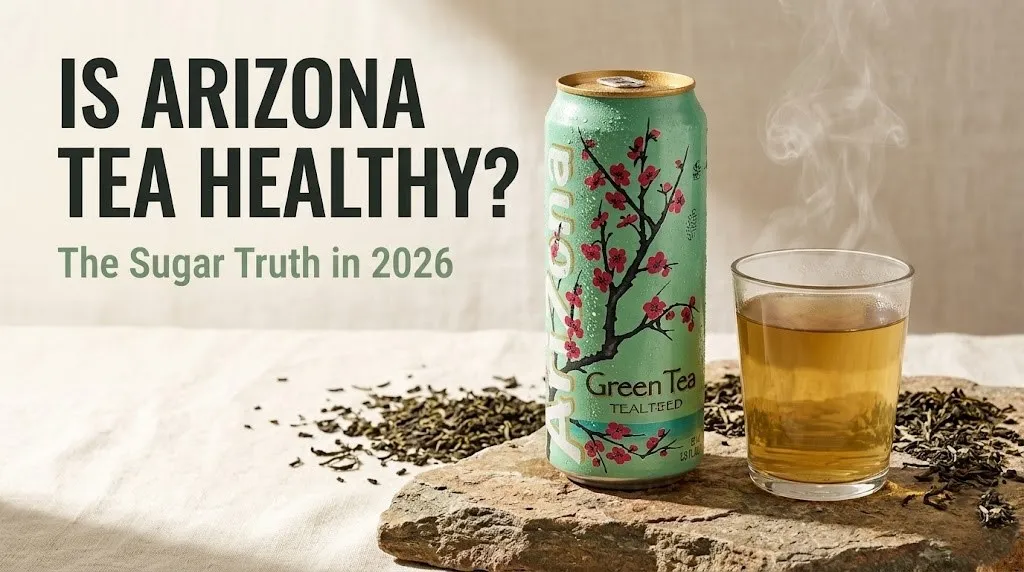
According to the USDA Dietary Guidelines for Americans 2020-2025, added sugars should account for less than 10% of total daily calories. On a 2,000-calorie diet, that is a limit of about 50 grams of added sugar per day. One 23 oz Arizona Green Tea can contains approximately 45 grams of added sugar, using nearly the entire day’s allowance in a single drink.
That does not make Arizona tea poisonous or categorically off-limits. Consumed occasionally, in reasonable quantities, it is a more interesting choice than a cola. But drinking it daily as a hydration strategy or treating it as a health product is where the trouble starts.
| Arizona Tea Healthiness at a Glance | Details |
|---|---|
| Contains real brewed green tea | Yes |
| Contains added sugar | Yes, significant amounts |
| Contains EGCG (catechins) | Trace amounts |
| Calorie-free option available | Yes (Diet Green Tea) |
| Recommended as a daily health drink | No |
| Reasonable occasional beverage | Yes, for most healthy adults |
People managing blood sugar, insulin resistance, or dental health should be particularly cautious, as the sugar load and mild acidity present genuine concerns with regular consumption.
Is Arizona Green Tea Healthy?
Arizona Green Tea with Ginseng and Honey is the brand’s flagship product and its most nutritionally discussed variety. It is not healthy in any functional sense, despite being brewed from real Camellia sinensis (green tea) leaves.
The green tea base does contain polyphenols, specifically catechins including epigallocatechin gallate (EGCG), the compound most associated with green tea’s health reputation. However, research published in the American Journal of Clinical Nutrition has found that ready-to-drink bottled and canned teas contain significantly lower levels of catechins than freshly brewed green tea. Processing, heat treatment, and extended storage all degrade these compounds.
What remains is a beverage with trace polyphenol content, Panax ginseng extract in amounts too small to produce any measurable physiological effect, and enough added sugar to concern any nutrition professional reviewing the label.
The honey listing on the ingredient label also warrants scrutiny. Honey is present, but so is high-fructose corn syrup (HFCS), which appears earlier in the ingredient list, meaning it is present in greater quantity by weight. Marketing imagery of honey bees and natural sweetness can give a misleading impression of the primary sweetener used.
Key points about Arizona Green Tea’s health profile:
- Real green tea base: yes, but with reduced catechin content after processing
- Primary sweetener: high-fructose corn syrup, with honey as secondary
- Ginseng content: too diluted to produce studied benefits
- Antioxidant value: present but modest compared to brewed alternatives
- Added sugar per full 23 oz can: approximately 45 grams
Individuals following a low-sugar diet, managing prediabetes, or monitoring glycemic load should treat this drink as an occasional treat rather than a daily beverage.
Arizona Tea Nutrition Facts
The nutrition facts on Arizona products are technically accurate but structured in a way that routinely misleads consumers. Understanding why requires looking at the serving size, not just the per-serving numbers.
The standard 23 oz Arizona can lists nutritional information per 8 fl oz serving. That means the label data represents roughly one-third of the can. Drinking the whole can, which most people do, means multiplying every figure by approximately 2.5.
| Nutrient | Per 8 oz Serving | Per Full 23 oz Can |
|---|---|---|
| Calories | 70 kcal | ~175 kcal |
| Total Sugars | 18g | ~45g |
| Added Sugars | 17g | ~43g |
| Sodium | 10mg | ~25mg |
| Total Carbohydrates | 18g | ~45g |
| Protein | 0g | 0g |
| Total Fat | 0g | 0g |
This serving size structure is entirely legal under current FDA food labeling regulations, but it creates a real gap between what shoppers read at the store and what they actually consume. A customer checking the label at 18 grams of sugar per serving may not register that they are consuming closer to 45 grams.
For context, a standard 12 oz can of Coca-Cola Classic contains approximately 39 grams of sugar. A full 23 oz Arizona Green Tea can delivers more total sugar than a standard Coke, though the calories are slightly lower due to formulation differences.
People with diabetes or those counting carbohydrates should always calculate based on the full container they plan to consume, not the per-serving figure listed.
Key Takeaway: Arizona tea contains real green tea ingredients, but the serving size label covers only one-third of the standard 23 oz can. Drinking the full can delivers roughly 45 grams of added sugar, more than the American Heart Association’s recommended daily maximum for women.
How Much Sugar Is in Arizona Green Tea?
A full 23 oz can of Arizona Green Tea with Ginseng and Honey contains approximately 45 grams of added sugar, not the 17 to 18 grams displayed on the nutrition label per serving.
This distinction is one of the most important pieces of practical information for anyone trying to evaluate this drink’s healthiness. The label’s “per serving” figure is accurate for exactly 8 fluid ounces. The full can holds about 2.5 of those servings.
The World Health Organization recommends limiting free sugars to less than 10% of total daily energy intake, with additional health benefits observed when that figure drops below 5% (roughly 25 grams per day for most adults). Arizona Green Tea’s full-can sugar content exceeds the 5% recommendation for virtually every adult drinker.
The sugar in Arizona products comes primarily from high-fructose corn syrup (HFCS), with honey listed as a secondary sweetener. HFCS and table sugar (sucrose) are metabolized similarly by the body. The American Heart Association notes that excessive consumption of both is linked to increased risk of obesity, elevated triglycerides, and dental decay.
Sugar content comparison across common beverages (per 12 oz equivalent):
| Beverage | Sugar per 12 oz |
|---|---|
| Arizona Green Tea (scaled to 12 oz) | ~23g |
| Coca-Cola Classic | ~39g |
| Snapple Lemon Tea | ~23g |
| Lipton Brisk Lemon Iced Tea | ~20g |
| Brewed green tea, unsweetened | 0g |
| Fresh-squeezed orange juice | ~26g |
Scaled to a common serving size, Arizona Green Tea’s sugar content is roughly comparable to other sweetened iced teas. It is not uniquely terrible by category, but it is meaningfully higher in sugar than water, plain sparkling water, or unsweetened brewed tea.
Children and adolescents should consume this drink rarely, if at all. The American Academy of Pediatrics recommends that added sugars be limited to no more than 25 grams per day for children over age 2.
Arizona Green Tea Calories: What You’re Actually Getting
A full 23 oz can of Arizona Green Tea delivers approximately 175 calories, almost all of which come from sugar.
At 70 calories per 8 oz serving, the numbers sound modest on the label. Scaled to what you actually drink, the caloric contribution is closer to a light snack than a calorie-free hydration choice. These are almost entirely empty calories: energy with negligible protein, fiber, vitamins, or minerals.
This is not uncommon among sweetened beverages. The term “empty calories” refers specifically to foods and drinks that deliver energy from added sugar or fat without meaningful accompanying nutrients. The USDA Dietary Guidelines for Americans specifically flag sweetened beverages as the leading source of empty calories in the American diet.
Calorie breakdown for Arizona Green Tea varieties (per full can or standard bottle):
| Product | Serving Size | Total Calories (Whole Container) |
|---|---|---|
| Arizona Green Tea with Ginseng and Honey | 23 oz | ~175 kcal |
| Arizona Arnold Palmer Half & Half | 23 oz | ~160 kcal |
| Arizona Black Tea with Lemon | 23 oz | ~175 kcal |
| Arizona Mucho Mango | 23 oz | ~245 kcal |
| Arizona Diet Green Tea | 23 oz | ~10 kcal |
| Arizona Green Tea (11.5 oz can) | 11.5 oz | ~88 kcal |
The smaller 11.5 oz can is a genuinely better option for anyone who enjoys Arizona Green Tea but wants to moderate intake. At roughly half the volume, it delivers half the sugar and half the calories while still providing the flavor experience.
For adults managing caloric intake for weight reasons, treating any full 23 oz Arizona product as a meaningful calorie contribution is the accurate approach, not a negligible one.
Arizona Green Tea Ingredients: What’s Really in the Can?
The ingredient list on Arizona Green Tea with Ginseng and Honey reads: filtered water, high-fructose corn syrup, honey, citric acid, green tea, ginseng extract, natural flavors, ascorbic acid (vitamin C).
The order matters. Ingredients are listed by weight, from greatest to least. Filtered water comes first, as expected. High-fructose corn syrup appears second, ahead of honey. This ordering confirms that HFCS is the dominant sweetener, not honey.
Citric acid serves as a preservative and flavor enhancer. It also contributes mild acidity to the beverage. Research published in the Journal of the American Dental Association has found that repeated exposure to acidic beverages, even mildly acidic ones, can erode tooth enamel over time. This is not unique to Arizona tea, but it is relevant for people who drink multiple cans daily.
Green tea (Camellia sinensis) appears sixth on the list, after two sweeteners, an acid, and honey. This positioning indicates a relatively low concentration of actual tea in the formula.
Ginseng extract (Panax ginseng) appears seventh. While Panax ginseng has been studied for potential effects on cognitive performance and immune support, the quantity present in Arizona’s formula is not disclosed and is widely considered by nutrition researchers to be below therapeutically meaningful thresholds.
Ascorbic acid (vitamin C) functions primarily as an antioxidant preservative in this context, protecting the beverage’s color and flavor during storage. Its presence should not be interpreted as a meaningful dietary source of vitamin C.
Individuals with fructose malabsorption or sensitivities to HFCS should read labels carefully, as HFCS is present in the majority of Arizona’s sweetened product lines.
Key Takeaway: Arizona Green Tea lists high-fructose corn syrup as its second ingredient, before honey. The tea itself appears sixth on the list. This ingredient ordering is essential context for evaluating any health claims associated with the product.
Arizona Green Tea Antioxidants: Do They Actually Help?
Arizona Green Tea contains antioxidants, specifically catechins from the brewed green tea base, but the levels are substantially lower than what you would get from freshly brewed green tea.
The primary bioactive compound in green tea is epigallocatechin gallate (EGCG), a catechin polyphenol with a broad research record linking it to reduced inflammation, improved lipid profiles, and potential protective effects on cardiovascular health. These findings are primarily derived from studies using freshly brewed green tea or standardized EGCG supplements.
Research published in the Journal of Analytical and Food Chemistry and later summarized by Harvard T.H. Chan School of Public Health researchers has found that ready-to-drink tea products often contain far lower polyphenol concentrations than brewed equivalents. Heat processing, oxygen exposure during bottling, and extended shelf storage all degrade catechins. Some studies have found ready-to-drink products containing as little as 10 to 20% of the EGCG present in an equivalent serving of freshly brewed green tea.
Think of it like the difference between fresh-squeezed orange juice and a shelf-stable “orange drink.” The category sounds the same. The actual compound content tells a different story.
The World Health Organization and the Academy of Nutrition and Dietetics do not endorse ready-to-drink sweetened teas as vehicles for meaningful antioxidant intake. The sugar required to make these products palatable also creates its own oxidative stress pathway, partially counteracting any polyphenol benefit the tea base might otherwise provide.
Polyphenol comparison for context:
| Tea Type | Approximate EGCG per 8 oz Serving |
|---|---|
| Freshly brewed green tea | 25 to 86 mg |
| Ready-to-drink bottled green tea (average) | 4 to 15 mg |
| Arizona Green Tea (estimated range) | Not publicly disclosed |
| Brewed black tea | 2 to 10 mg |
| Arizona Diet Green Tea | Trace, not disclosed |
Arizona does not publicly disclose the EGCG or total polyphenol content of its products. Without that data, claims about antioxidant benefits remain unverifiable.
Is Arizona Iced Tea Healthy?
Arizona Iced Tea, referring to the broader product lineup beyond green tea, ranges from moderately sugar-heavy to very sugar-heavy depending on the variety. None of the sweetened versions qualifies as a healthy daily drink.
The brand’s non-green-tea lineup includes black tea varieties, herbal teas, fruit-flavored iced teas, and the half-and-half Arnold Palmer line. These products generally share the same formulation approach: real brewed tea base, significant added sugar, citric acid, and natural flavors.
Black tea varieties contain theaflavins and thearubigins, the polyphenol compounds associated with fermented Camellia sinensis leaves. These compounds have their own research record, including associations with cardiovascular health in population studies from the British Journal of Nutrition. However, the same EGCG degradation concern applies to ready-to-drink black tea as to green tea. Processing reduces compound concentrations.
The fruit-forward varieties like Arizona Mucho Mango or Arizona Fruit Punch contain little to no actual tea-derived compounds. They are flavored, sweetened drinks in Arizona’s packaging.
Sweetened Arizona iced tea varieties compared:
| Product | Primary Ingredient | Sugar per Full Can (23 oz) |
|---|---|---|
| Arizona Green Tea with Honey | HFCS, honey, green tea | ~45g |
| Arizona Black Tea with Lemon | HFCS, black tea | ~45g |
| Arizona Arnold Palmer | HFCS, black tea, lemon juice | ~40g |
| Arizona Mucho Mango | HFCS, mango concentrate | ~60g |
| Arizona Iced Tea with Lemon Flavor | HFCS, black tea | ~42g |
| Arizona Diet Green Tea | No sugar added | ~0g |
Fruit-flavored Arizona products like Mucho Mango deliver more sugar per can than most other varieties and offer essentially no tea-derived nutrients. These sit firmly in the flavored sugar-water category.
Are Arizona Drinks Healthy? A Full Lineup Comparison
As a product lineup, Arizona drinks range from occasionally acceptable to best avoided, depending on the specific product, the quantity consumed, and the individual’s dietary context.
The brand’s portfolio is broad. Beyond the iconic green tea can, Arizona produces black teas, lemonades, energy drinks (Arizona Energy), fruit cocktails, and sparkling beverages. Each product category has a different nutritional profile, and grouping them all under a single health verdict would be misleading.
The best Arizona products for those mindful of sugar intake:
- Arizona Diet Green Tea: Zero added sugar, uses artificial sweeteners; lowest-calorie option in the lineup
- Arizona Green Tea (11.5 oz can): Smaller portion means lower total sugar and calorie consumption
- Arizona Rx Energy Herbal Tonic: Contains ginseng and other botanicals; check label for sugar content, as it varies
The worst from a sugar standpoint:
- Arizona Mucho Mango: Approximately 60 grams of sugar per 23 oz can
- Arizona Fruit Punch: Similar calorie and sugar profile to Mango
- Arizona Watermelon: High sugar, minimal tea content
According to the Academy of Nutrition and Dietetics, no single beverage choice defines a healthy diet. Context, frequency, and overall dietary pattern matter more than any individual product decision. Choosing the smallest available Arizona format, on an occasional basis, within an otherwise low-added-sugar dietary pattern, is a very different situation from drinking a 23 oz can daily.
Vegans can consume most Arizona products without concern. The honey in Arizona Green Tea with Ginseng and Honey makes it non-vegan. Other varieties are typically vegan-friendly, though label verification is always recommended as formulations can change.
Key Takeaway: Arizona’s full product lineup varies widely, from the essentially calorie-free Diet Green Tea to the 60-gram-sugar Mucho Mango. The brand is not monolithic. Choosing a smaller format or a diet variety makes a real difference.
Arizona Green Tea with Honey Nutrition
Arizona Green Tea with Ginseng and Honey is the brand’s best-known product and the variety most often evaluated when people ask whether Arizona tea is healthy.
The “honey” in the name creates a warm, natural association in the mind of the consumer. Honey carries a reputation as a less-processed, more beneficial sweetener than refined sugar. That reputation has some basis: raw honey contains trace amounts of flavonoids, hydrogen peroxide, and gluconic acid, which contribute to its documented antimicrobial properties.
However, the honey in Arizona Green Tea is present in such small quantities that none of these properties are relevant. The dominant sweetener by volume is high-fructose corn syrup, and the body’s metabolic response to a HFCS-heavy drink is not meaningfully improved by the trace honey content.
Nutrition per full 23 oz can:
| Nutrient | Amount (Full Can) |
|---|---|
| Calories | ~175 kcal |
| Total Sugar | ~45g |
| Added Sugar | ~43g |
| Carbohydrates | ~45g |
| Protein | 0g |
| Fat | 0g |
| Sodium | ~25mg |
| Potassium | ~0mg |
| EGCG (catechins) | Not disclosed |
| Vitamin C (ascorbic acid) | Trace (preservative function) |
For people following a ketogenic diet or strict low-carbohydrate dietary plan, a full can of Arizona Green Tea with Honey would exhaust or exceed the entire day’s carbohydrate allocation. Even a single 8 oz serving delivers 18 grams of carbohydrates with no accompanying fiber or protein to moderate the glycemic response.
Individuals with fructose sensitivity or those managing irritable bowel syndrome (IBS) via a low-FODMAP dietary protocol should exercise caution with HFCS-sweetened beverages.
Is the Arizona Arnold Palmer Healthy?
The Arizona Arnold Palmer Half & Half (iced tea and lemonade) is not healthy as a regular drink, but it is slightly lower in calories than some other Arizona products and contains a small amount of black tea.
The Arnold Palmer is a cultural staple in American beverage culture. Arizona’s version mixes black tea with lemonade flavoring, sweetened primarily with high-fructose corn syrup and citric acid. A full 23 oz can delivers approximately 160 to 165 calories and around 40 grams of sugar.
The black tea component provides minimal theaflavins and trace polyphenols. The lemonade component is predominantly citric acid, artificial lemon flavor, and sweetener, with no meaningful ascorbic acid (vitamin C) contribution in most formulations.
| Arizona Arnold Palmer: Nutritional Snapshot |
|---|
| Calories per 8 oz serving: ~65 kcal |
| Calories per full 23 oz can: ~163 kcal |
| Sugar per 8 oz serving: ~17g |
| Sugar per full 23 oz can: ~43g |
| Primary sweetener: High-fructose corn syrup |
| Tea base: Black tea (Camellia sinensis) |
| Notable: Citric acid contributes mild acidity |
The Arnold Palmer lite version exists in some markets and delivers fewer calories. Availability varies by region. Checking local stores or the brand’s official product page for current formulation details is worth doing, as product lines evolve.
For people managing dental health, the combination of citric acid and sugar in the Arnold Palmer creates a more erosive environment than the green tea variety alone. The American Dental Association recommends rinsing with water after consuming acidic beverages.
Is Arizona Diet Green Tea Healthy?
Arizona Diet Green Tea is the brand’s closest offering to a genuinely low-impact beverage choice. With essentially zero calories and no added sugar, it removes the primary health concern attached to the standard product line.
The diet version uses a combination of sucralose and acesulfame potassium (Ace-K) as sweeteners, depending on the production run and market. Both are FDA-approved for general use. The World Health Organization issued a 2023 advisory recommending against using non-sugar sweeteners as a long-term weight management tool, noting that long-term benefits for body weight or disease risk reduction remain unclear. This does not mean these sweeteners are harmful in occasional use; it means the health case for sweetener-based diet drinks is less robust than it once appeared.
The diet version does retain the green tea base, meaning it delivers a similar (trace) level of catechins as the regular version.
Comparison of diet versus standard Arizona Green Tea:
| Feature | Arizona Green Tea (Standard) | Arizona Diet Green Tea |
|---|---|---|
| Calories per 23 oz | ~175 kcal | ~10 kcal |
| Added sugar per 23 oz | ~43g | 0g |
| Sweetener | HFCS, honey | Sucralose, Ace-K |
| Tea base | Green (Camellia sinensis) | Green (Camellia sinensis) |
| Appropriate for diabetics | No (as regular drink) | Better option; still verify |
| Suitable for ketogenic diet | No | Generally yes |
| Appropriate for children | No | Not recommended |
For adults seeking an occasional flavored alternative to water, Arizona Diet Green Tea is the most defensible choice in the brand’s lineup. It should not be consumed by children or in large quantities during pregnancy, where the precautionary principle around artificial sweeteners generally applies.
Key Takeaway: Arizona Diet Green Tea eliminates added sugar but introduces artificial sweeteners whose long-term health implications remain under ongoing review. For most healthy adults seeking an occasional low-calorie drink, it is a reasonable choice.
Arizona Tea vs. Brewed Green Tea: Which Is Better?
Freshly brewed green tea is nutritionally superior to Arizona Green Tea in every category that matters: higher polyphenol content, zero added sugar, zero calories, and substantially more measurable EGCG (epigallocatechin gallate) per serving.
This comparison is not close. Brewing green tea from a quality tea bag or loose-leaf Camellia sinensis takes three to five minutes and produces a beverage with 25 to 86 milligrams of EGCG per 8 oz cup, according to data aggregated by the USDA Nutrient Database. Ready-to-drink bottled and canned teas, including Arizona, have been measured at roughly 4 to 15 milligrams of catechins per 8 oz, with some products falling even lower.
The reasons for this degradation are well documented. Heat during pasteurization, oxidation from bottling and storage, and extended shelf life all reduce polyphenol concentration. This is not a flaw unique to Arizona. It applies across the ready-to-drink tea category.
Think of the catechin content in Arizona Green Tea the way you would think of vitamin C in shelf-stable orange juice from concentrate versus fresh-squeezed juice: the nutrient is present in the original source, but processing and time take their toll.
Benefits of brewed green tea over Arizona Green Tea:
- Significantly higher EGCG content per serving
- Zero added sugar (unsweetened)
- Zero calories
- No high-fructose corn syrup
- Controllable caffeine level depending on brewing time
- Lower cost per serving
- No citric acid or artificial flavors
The only practical advantage Arizona Green Tea holds over brewed tea is convenience. It requires no preparation and is available at virtually every convenience store, gas station, and grocery outlet in the United States.
Is Arizona Green Tea Good for Weight Loss?
Arizona Green Tea is not a useful weight loss tool and should not be incorporated into a weight loss plan as a health-supporting drink.
Despite the connection between green tea and weight management in the research literature, that connection is built on freshly brewed, high-EGCG green tea and standardized green tea extract supplements, not on ready-to-drink canned products with high added sugar. Studies reviewed in the American Journal of Clinical Nutrition have found that green tea extract at meaningful EGCG concentrations may modestly support fat oxidation, primarily during exercise. The EGCG levels in Arizona Green Tea do not approach those studied.
More directly: a full 23 oz can adds approximately 175 calories and 45 grams of sugar to daily intake. Liquid sugar calories are particularly noted by nutrition researchers for their weak satiety signal. Research from the Harvard T.H. Chan School of Public Health has found that calories from sugar-sweetened beverages do not produce the same appetite-suppressing response as equivalent calories from solid foods, meaning these calories are more likely to be consumed in addition to regular food intake rather than in place of it.
For weight management, the hierarchy of beverage choices is clear:
- Best: Water, plain sparkling water, unsweetened brewed tea
- Reasonable: Arizona Diet Green Tea (for adults, occasionally)
- Counterproductive: Arizona Green Tea (standard), Arizona Arnold Palmer, fruit-flavored Arizona varieties
People following a calorie-deficit eating plan should account for Arizona teas fully in their daily intake tracking. Treating them as “basically water” is a common and counterproductive error.
Does Arizona Green Tea Have Caffeine?
Arizona Green Tea with Ginseng and Honey contains caffeine, but in modest amounts. A standard 8 oz serving contains approximately 7.5 milligrams of caffeine, though this figure varies and is not always listed on product labels.
For reference, an 8 oz cup of freshly brewed green tea typically contains 25 to 45 milligrams of caffeine. Arizona’s ready-to-drink version delivers substantially less, both because the tea concentration is lower and because processing affects caffeine levels alongside polyphenols.
A full 23 oz can of Arizona Green Tea delivers roughly 17 to 19 milligrams of caffeine, well below the FDA’s general guidance that caffeine consumption up to 400 milligrams per day is not associated with dangerous effects in healthy adults. For practical purposes, the caffeine in a full Arizona can is comparable to a fraction of a standard cup of coffee.
Caffeine comparison for context:
| Beverage | Caffeine per 8 oz |
|---|---|
| Freshly brewed green tea | 25 to 45 mg |
| Arizona Green Tea (8 oz) | ~7.5 mg |
| Black coffee | 80 to 100 mg |
| Brewed black tea | 40 to 70 mg |
| Arizona Arnold Palmer (8 oz) | ~7 to 12 mg |
| Arizona Diet Green Tea (8 oz) | ~7.5 mg |
| Decaffeinated green tea | <2 mg |
For most healthy adults, the caffeine in Arizona Green Tea is not a meaningful concern. However, individuals with caffeine sensitivity, pregnant women (for whom the American College of Obstetricians and Gynecologists recommends limiting caffeine to 200 milligrams per day), and children should factor in any caffeinated beverage, even low-caffeine ones, as part of their total daily intake.
Key Takeaway: Arizona Green Tea contains caffeine, but at roughly one-quarter the level found in freshly brewed green tea. The caffeine is not a concern for most healthy adults, but pregnant women and children should count it toward their daily total.
Frequently Asked Questions About Arizona Tea
How much sugar is in a full 23 oz can of Arizona green tea?
A full 23 oz can of Arizona Green Tea with Ginseng and Honey contains approximately 45 grams of added sugar.
The nutrition label shows about 18 grams per serving, but the can holds 2.5 servings, making the full-can sugar total the more relevant figure for most drinkers.
This amount exceeds the American Heart Association’s daily added sugar recommendation for women (25g) and approaches the limit for men (36g) in a single beverage.
Is Arizona green tea better for you than soda?
Arizona Green Tea contains slightly fewer calories than many sodas and has a real brewed tea base, which provides trace polyphenols.
However, the full-can sugar content is comparable to or exceeds that of a standard Coca-Cola, making the practical health difference smaller than most people expect.
Both beverages are better treated as occasional drinks rather than daily hydration choices.
Can I drink Arizona green tea every day?
Drinking Arizona Green Tea daily is not recommended for most people due to its high added sugar content.
Regular consumption of sugar-sweetened beverages is associated with increased risk of weight gain, elevated triglycerides, and dental erosion, according to research reviewed by the American Heart Association.
Occasional consumption within an otherwise low-sugar dietary pattern is a different situation than using it as a daily hydration source.
Does Arizona green tea have real health benefits?
Arizona Green Tea provides trace amounts of catechins from its green tea base, but the levels are far below what research studies associate with meaningful health benefits.
The high added sugar content introduces health risks that likely offset any antioxidant advantage in regular drinkers.
Freshly brewed unsweetened green tea delivers the same type of compounds at substantially higher concentrations, with no added sugar.
Which Arizona tea is the healthiest option?
Arizona Diet Green Tea is the healthiest product in the brand’s lineup, offering essentially zero calories and no added sugar.
It uses artificial sweeteners (sucralose and Ace-K in most formulations), which are FDA-approved but best consumed occasionally rather than as a daily beverage.
For those who prefer to avoid artificial sweeteners, the smallest available format of the standard green tea (the 11.5 oz can) reduces total sugar intake by roughly half compared to the full 23 oz version.
The Bottom Line on Arizona Tea
Arizona tea is a convenient, affordable drink with a real brewed tea base. It is not a health product. The sugar content, particularly in the full 23 oz can, is the defining fact that shapes every honest answer about whether it is good for you.
Choose the Diet Green Tea if you want flavor without sugar. Opt for the 11.5 oz can if you enjoy the original green tea and want to cut your sugar intake in half. Drink brewed unsweetened green tea if you want the genuine antioxidant experience the Arizona label evokes but cannot deliver at meaningful levels.
Arizona tea earns a place as an occasional treat. It does not earn a place as a daily health drink.