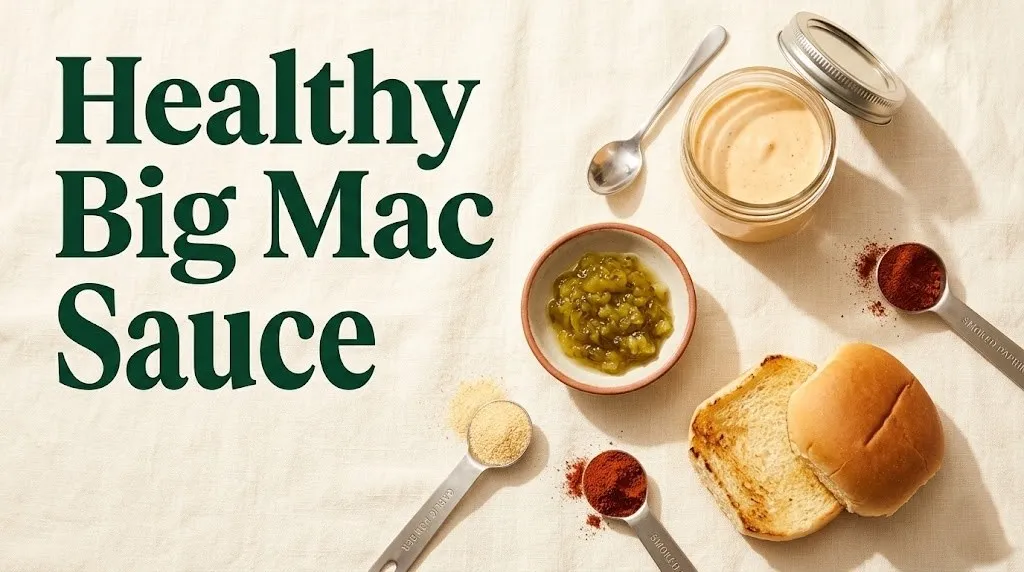
A healthy big mac sauce gives you all the tangy, creamy, pickle-forward flavor of McDonald’s iconic condiment at roughly half the calories and a fraction of the saturated fat. You can make it at home in five minutes with ingredients that are likely already in your refrigerator.
The original McDonald’s Big Mac Special Sauce delivers approximately 70 to 80 calories per tablespoon, according to McDonald’s published nutritional data. Most of that comes from full-fat mayonnaise, which contributes around 7 to 8 grams of fat per tablespoon. The American Heart Association recommends limiting saturated fat to no more than 5 to 6 percent of total daily calories, which makes a high-fat condiment worth reconsidering if you’re using it regularly.
This article covers every version of healthy big mac sauce worth knowing: the base recipe, the Greek yogurt swap, dairy-free options, keto adaptations, vegan versions, and exactly how to use the sauce beyond the burger. You’ll also get the full nutritional breakdown and a straight answer on how long it keeps.
What Is Healthy Big Mac Sauce?
Healthy big mac sauce is a homemade condiment that replicates the flavor of McDonald’s Special Sauce while reducing total calories, saturated fat, and sodium through ingredient substitutions.
The original sauce relies on full-fat mayonnaise as its base. A lighter version swaps some or all of that mayonnaise for plain non-fat Greek yogurt (also called strained yogurt or Lactobacillus acidophilus-cultured yogurt), light mayonnaise, or a plant-based alternative. The rest of the flavor profile remains largely the same.
“Healthy” here is a specific claim worth defining carefully. The homemade version has fewer calories per tablespoon, significantly less saturated fat, and often more protein. It does not become a health food. It becomes a smarter condiment for people who care about what goes into their food.
The Academy of Nutrition and Dietetics defines a “healthier” version of a food as one that reduces nutrients of concern (saturated fat, sodium, added sugar) without removing the food’s core appeal. This sauce does exactly that.
Key points about what makes this version different:
- Replaces high-fat mayonnaise with a protein-rich yogurt base or light mayo
- Reduces saturated fat per serving by 50 to 70 percent
- Maintains the flavor balance of sweet, tangy, savory, and creamy
- Contains no high-fructose corn syrup, artificial colors, or preservatives found in commercial versions
People following calorie-conscious eating plans, weight management programs, or simply trying to reduce ultra-processed ingredients in their diet will find this version worth making.
What Is Big Mac Sauce Made Of?
McDonald’s Big Mac Special Sauce is a mayonnaise-based condiment flavored with sweet pickle relish, yellow mustard, white wine vinegar, garlic powder, onion powder, paprika, and turmeric.
McDonald’s has published partial ingredient lists over the years, and food journalists and recipe developers have reverse-engineered the sauce extensively. The flavor is tangy, slightly sweet, mildly mustardy, and distinctly savory from the onion and garlic powders. It is not identical to thousand island dressing, despite the visual similarity.
Thousand island dressing typically uses ketchup or tomato paste as a base and often includes hard-boiled eggs. Big Mac sauce uses mustard and vinegar instead of ketchup, giving it a noticeably different acidity and a slightly more complex spice profile.
| Ingredient | Big Mac Original | Homemade Healthy Version |
|---|---|---|
| Base fat | Full-fat mayonnaise | Greek yogurt + light mayo |
| Relish | Sweet pickle relish | Sweet or dill pickle relish |
| Mustard | Yellow mustard | Yellow mustard |
| Acid | White wine vinegar | White wine or apple cider vinegar |
| Spices | Garlic powder, onion powder | Same |
| Color spices | Paprika, turmeric | Same |
| Preservatives | Commercial preservatives | None |
People with egg allergies should note that both full-fat mayonnaise and light mayonnaise contain egg. Choosing a fully mayo-free version (Greek yogurt only) or an egg-free vegan mayonnaise is the correct substitution.
Big Mac Sauce Calories: Original vs. Homemade
The original McDonald’s Big Mac Special Sauce contains approximately 70 to 80 calories per 1-tablespoon (15 g) serving, based on McDonald’s published nutritional data. A typical Big Mac uses roughly 2 tablespoons of the sauce, putting the sauce alone at 140 to 160 calories.
A homemade healthy version made with a plain non-fat Greek yogurt base and a small amount of light mayonnaise comes in at approximately 25 to 35 calories per tablespoon, depending on exact ratios.
That difference adds up. If you use this sauce three times per week on burgers, wraps, or salads, a standard homemade version saves you roughly 270 to 360 calories per week compared to the original. That’s not a dramatic health intervention, but it’s a real and sustainable reduction without changing what you eat.
| Version | Calories per tbsp | Total fat per tbsp | Saturated fat per tbsp | Protein per tbsp |
|---|---|---|---|---|
| McDonald’s original | ~75 kcal | ~7.5 g | ~1.2 g | ~0.1 g |
| Light mayo base | ~40 kcal | ~3.5 g | ~0.5 g | ~0.2 g |
| Greek yogurt + light mayo | ~30 kcal | ~1.5 g | ~0.3 g | ~1.5 g |
| Greek yogurt only | ~20 kcal | ~0.2 g | ~0.1 g | ~2 g |
Estimates based on USDA FoodData Central data for individual ingredients. Exact values depend on brand and precise recipe ratios.
People managing calorie targets for weight management will find the Greek yogurt base the most effective swap. Those who prioritize texture above all else may prefer the light mayo base, which lands in the middle range.
Key Takeaway: A homemade healthy big mac sauce made with Greek yogurt cuts calories by roughly 60 percent per tablespoon compared to the McDonald’s original, while adding meaningful protein that the original sauce essentially has none of.
Big Mac Sauce Nutrition Facts Explained
The nutritional profile of healthy big mac sauce shifts depending on which base ingredient you use, but the spice and relish components contribute relatively little to the total calorie or fat count.
Per 1 tablespoon (15 g) of a Greek yogurt and light mayo blend (approximately 60:40 ratio):
| Nutrient | Amount per 1 tbsp |
|---|---|
| Calories | ~30 kcal |
| Total fat | ~1.5 g |
| Saturated fat | ~0.3 g |
| Sodium | ~75 to 110 mg |
| Total carbohydrate | ~2 g |
| Sugars (from relish) | ~1 g |
| Protein | ~1.5 g |
| Calcium | ~20 mg |
Figures are estimates based on USDA FoodData Central ingredient data. Individual results will vary by brand.
The sodium content deserves attention. Sweet pickle relish is the main sodium contributor in this sauce. A single tablespoon of standard sweet pickle relish contains approximately 60 to 80 mg of sodium, according to USDA FoodData Central. People following a low-sodium diet, such as those managing hypertension per the DASH diet framework, should use a reduced-sodium relish or rinse standard relish before adding it.
Plain non-fat Greek yogurt contributes calcium (approximately 15 to 20 percent of the daily value per 100 g serving, per USDA data) and live probiotic cultures including Lactobacillus acidophilus and Bifidobacterium strains. The sauce contains a small amount of yogurt per tablespoon, so the probiotic contribution per serving is modest rather than therapeutic.
People with lactose intolerance should note that Greek yogurt contains significantly less lactose than regular yogurt due to the straining process. Many people with mild lactose intolerance tolerate it well, though individual responses vary.
The Healthy Big Mac Sauce Recipe You’ll Actually Use
This is the base recipe that balances flavor accuracy with real nutritional improvement. It’s designed for people who want genuine Big Mac flavor without the full-fat mayonnaise calorie load.
Ingredients (makes approximately 8 tablespoons, 8 servings):
- 4 tablespoons (60 g) plain non-fat Greek yogurt
- 2 tablespoons (30 g) light mayonnaise (or avocado oil mayo for a slightly richer flavor)
- 2 tablespoons (30 g) sweet pickle relish
- 1 teaspoon (5 ml) yellow mustard
- 1 teaspoon (5 ml) white wine vinegar (or apple cider vinegar)
- 1/2 teaspoon (1.5 g) garlic powder
- 1/2 teaspoon (1.5 g) onion powder
- 1/4 teaspoon (0.75 g) smoked paprika
- 1/8 teaspoon (0.4 g) turmeric (for color; adds negligible flavor at this quantity)
- Pinch of white pepper
- Salt to taste (approximately 1/8 teaspoon, or omit for low-sodium diets)
Estimated nutrition per 1 tablespoon serving: approximately 28 to 32 calories, 1.5 g fat, 1.5 g protein, 2 g carbohydrate.
This recipe works for most home cooks. The relish is the key flavor driver. Don’t skip it or substitute it with chopped pickles, which have a different moisture content and won’t emulsify into the sauce the same way.
People with a mustard allergy (mustard is a named allergen in several countries, including Canada and the EU) should substitute an equal amount of apple cider vinegar and a small pinch of additional paprika to maintain the acidity and color profile.
How to Make Healthy Big Mac Sauce Step by Step
Making healthy big mac sauce at home requires no cooking equipment beyond a bowl and a spoon. The technique is straightforward, but two details make a real difference in the final result.
To make the sauce:
- Measure 4 tablespoons of plain non-fat Greek yogurt into a small mixing bowl. Use a brand that lists live active cultures on the label.
- Add 2 tablespoons of light mayonnaise and stir together until smooth and fully combined. No lumps.
- Add 2 tablespoons of sweet pickle relish. Stir until distributed evenly. Do not drain the relish; the brine adds acidity and flavor.
- Add 1 teaspoon of yellow mustard and 1 teaspoon of white wine vinegar. Stir again.
- Add 1/2 teaspoon garlic powder, 1/2 teaspoon onion powder, 1/4 teaspoon smoked paprika, and 1/8 teaspoon turmeric. Stir thoroughly until the sauce is evenly colored and fragrant.
- Add a pinch of white pepper and taste. Adjust salt if desired.
- Transfer to a small airtight glass jar or sealed container. Refrigerate for at least 20 minutes before serving. The resting period is not optional. It allows the powdered spices to fully hydrate and integrate into the yogurt base.
Quick Tip:
- Taste the sauce after it’s rested, not immediately after mixing. The garlic powder sharpens considerably as it sits.
- If the sauce tastes too tangy, add a pinch more relish for sweetness rather than sugar.
- For a smoother texture, blend the ingredients briefly with an immersion blender before refrigerating.
The 20-minute rest transforms a sauce that tastes raw and spice-forward into one that genuinely mimics the layered, blended flavor of the McDonald’s original.
Healthy Big Mac Sauce with Greek Yogurt: Why It Works
Plain non-fat Greek yogurt replaces full-fat mayonnaise as the primary base in the healthiest version of this sauce. The substitution works because Greek yogurt is thick, slightly tangy, and creamy enough to carry a condiment’s texture.
The nutritional trade-off is genuinely meaningful. Full-fat mayonnaise contains approximately 94 calories and 10 grams of total fat per tablespoon, according to USDA FoodData Central. Plain non-fat Greek yogurt contains approximately 10 calories and 0.1 grams of fat per tablespoon. Replacing most of the mayonnaise with Greek yogurt reduces the fat contribution of the base ingredient by over 90 percent.
A study published in the Journal of the Academy of Nutrition and Dietetics found that substituting Greek yogurt for higher-fat dairy or fat-based ingredients in recipes can significantly reduce calorie density without reducing perceived creaminess in blended or emulsified applications. The thick, strained texture of Greek yogurt is what makes this possible. Regular yogurt is too thin; it will make the sauce watery.
| Ingredient | Calories/tbsp | Fat/tbsp | Protein/tbsp |
|---|---|---|---|
| Full-fat mayonnaise | ~94 kcal | ~10 g | ~0.1 g |
| Light mayonnaise | ~35 kcal | ~3 g | ~0.1 g |
| Plain non-fat Greek yogurt | ~10 kcal | ~0.1 g | ~1.7 g |
| Avocado oil mayonnaise | ~90 kcal | ~10 g | ~0 g |
The protein in Greek yogurt is primarily casein and whey, two high-quality complete proteins. Even in small amounts per tablespoon, the sauce contributes more protein per serving than the original, which contains essentially none.
People with a dairy allergy (not just intolerance) cannot use Greek yogurt and should skip to the dairy-free section below.
Key Takeaway: Greek yogurt works in this sauce because its thick, strained texture mimics the body of mayonnaise while delivering over 90 percent less fat per tablespoon and adding genuine protein the original sauce simply doesn’t have.
Big Mac Sauce Without Mayo: What Are Your Options?
You can make a credible Big Mac sauce with zero mayonnaise, relying entirely on Greek yogurt or plant-based alternatives as the fat and creaminess source.
The flavor difference is real but manageable. Mayonnaise contributes a specific emulsified fat-richness that pure yogurt doesn’t fully replicate. The two most effective mayo-free approaches are a pure Greek yogurt base (best for the lowest possible calorie count) and a blended cashew cream base (best for dairy-free creaminess closest to a mayo texture).
For a pure Greek yogurt base, simply use 6 tablespoons of plain non-fat Greek yogurt in place of the yogurt-mayo blend in the base recipe. The result is tangier and slightly less rich, but still a strong condiment. Think of it the way you’d think of a low-fat sour cream compared to full-fat: slightly lighter in body, still very usable.
Mayo-free options and their characteristics:
| Base Ingredient | Texture | Calories/tbsp | Dairy-Free | Vegan |
|---|---|---|---|---|
| Plain non-fat Greek yogurt | Thick, tangy | ~10 kcal | No | No |
| Plain unsweetened coconut yogurt | Slightly thin, mild | ~15 kcal | Yes | Yes |
| Cashew cream | Rich, neutral | ~30 kcal | Yes | Yes |
| Silken tofu blended | Smooth, neutral | ~12 kcal | Yes | Yes |
| Plain soy yogurt | Moderate body, mild | ~12 kcal | Yes | Yes |
People following a soy-free diet should avoid silken tofu and soy yogurt. Cashew cream or coconut yogurt are the better options in that case. People with tree nut allergies should avoid cashew cream and stick with coconut yogurt or soy yogurt if soy is tolerated.
Low Calorie Big Mac Sauce: What the Numbers Actually Look Like
A low calorie version of big mac sauce contains approximately 20 to 35 calories per 1-tablespoon serving, depending on the base ingredient ratio and exact brand used.
For context, the USDA Dietary Guidelines for Americans 2020-2025 recommend that condiments and sauces be factored into daily calorie budgets, particularly for people managing energy intake. A condiment that delivers under 35 calories per tablespoon is considered low-calorie by most dietary reference frameworks.
The lowest-calorie option is a pure plain non-fat Greek yogurt base with spices and relish. A tablespoon of this version delivers approximately 18 to 22 calories. The slightly richer Greek yogurt and light mayo blend lands at 28 to 32 calories per tablespoon.
What reduces calories most in this recipe:
- Eliminating or minimizing full-fat mayonnaise (saves approximately 60 to 70 calories per tablespoon of fat replaced)
- Using non-fat rather than full-fat or 2% Greek yogurt (saves approximately 5 to 15 calories per tablespoon)
- Choosing a no-added-sugar sweet relish (saves approximately 2 to 5 calories per tablespoon; the savings are small but compound over multiple servings)
- Omitting optional salt additions doesn’t reduce calories but reduces sodium
People who are counting macros or using a calorie-tracking application should enter ingredients by brand since calorie differences between Greek yogurt brands and light mayo brands can vary by 10 to 20 calories per tablespoon.
Low Fat Big Mac Sauce: The Saturated Fat Breakdown
Low fat big mac sauce replaces the high-saturated-fat mayonnaise base with ingredients that contain mostly unsaturated fats or minimal fat overall.
The American Heart Association recommends that saturated fat make up no more than 5 to 6 percent of total daily calories, roughly 11 to 13 grams per day on a 2,000-calorie eating pattern. A single tablespoon of full-fat mayonnaise contributes approximately 1.1 to 1.3 grams of saturated fat. Two tablespoons of the original Big Mac sauce on a burger therefore contributes approximately 2 to 3 grams of saturated fat from the sauce alone, before accounting for the beef patties.
Switching to a Greek yogurt base reduces the saturated fat per tablespoon to approximately 0.1 to 0.3 grams, a reduction of roughly 75 to 90 percent.
| Sauce Version | Saturated Fat per tbsp | % of AHA Daily Max (13g) |
|---|---|---|
| McDonald’s original | ~1.2 g | ~9.2% |
| Light mayo base | ~0.5 g | ~3.8% |
| Greek yogurt + light mayo | ~0.3 g | ~2.3% |
| Greek yogurt only | ~0.1 g | ~0.8% |
The fat in Greek yogurt is primarily saturated fat from dairy, but at such low concentrations per tablespoon of sauce, the contribution is negligible compared to the original.
Harvard T.H. Chan School of Public Health research consistently identifies replacing saturated fat with polyunsaturated and monounsaturated fats as beneficial for cardiovascular health markers. Avocado oil mayonnaise, if used in place of standard light mayo, provides predominantly oleic acid (a monounsaturated fatty acid) and may offer a modest additional benefit over standard light mayo for this reason.
Key Takeaway: The saturated fat reduction in homemade healthy big mac sauce is the most meaningful nutritional improvement. Switching from a full-fat mayo base to a Greek yogurt base cuts saturated fat by up to 90 percent per tablespoon, which adds up quickly for regular sauce users.
Dairy Free Big Mac Sauce: The Best Substitutes
A dairy free big mac sauce replaces both Greek yogurt and standard mayonnaise with plant-based alternatives that maintain the sauce’s creamy, emulsified texture.
Standard mayonnaise made with eggs and oil is technically dairy-free. However, Greek yogurt is not. People who need to avoid dairy entirely (due to a dairy allergy, lactose intolerance, or a vegan dietary pattern) need a replacement for the yogurt base.
The most reliable dairy-free base options are:
- Plain unsweetened coconut yogurt: Closest in texture to Greek yogurt. Use the same 4-tablespoon quantity. Choose a brand that uses live cultures for a flavor that’s subtler than sweetened versions.
- Plain unsweetened soy yogurt: Neutral flavor, moderate thickness. Works well at the same ratio.
- Blended silken tofu: Blend 4 tablespoons of firm silken tofu with 1 teaspoon of apple cider vinegar until completely smooth before adding to the recipe. This produces a remarkably neutral, creamy base with approximately 12 calories and 0.5 grams of fat per tablespoon.
- Cashew cream: Soak 1/4 cup (35 g) of raw cashews in water for at least 4 hours, then drain and blend with 3 tablespoons of water until smooth. Use 4 tablespoons of the resulting cream in the recipe.
People with soy allergies should avoid soy yogurt and silken tofu. People with tree nut allergies should avoid cashew cream. Coconut yogurt is the broadest-compatible option for most dairy-free needs.
Dairy-free versions using coconut or soy yogurt may separate slightly after refrigeration. Stir before serving. This is normal and doesn’t indicate spoilage.
Vegan Big Mac Sauce: Plant-Based and Flavor-Forward
A fully vegan big mac sauce eliminates all animal-derived ingredients, meaning no egg-containing mayonnaise and no dairy-based yogurt.
The flavor achievers in Big Mac sauce (mustard, relish, garlic powder, paprika) are all already vegan. The only non-vegan components are the mayonnaise and Greek yogurt in the base. Replacing both with vegan mayonnaise and a plant-based yogurt produces a sauce that’s genuinely indistinguishable in flavor from the healthier homemade version.
Vegan base combinations that work:
| Vegan Base | Notes | Texture Result |
|---|---|---|
| Vegan mayo + coconut yogurt | Most widely available | Closest to original creamy sauce |
| Vegan mayo + soy yogurt | Neutral flavor | Very similar texture to dairy version |
| Cashew cream only | Rich, no mayo needed | Slightly thicker, nuttier undertone |
| Silken tofu blend | Lowest calorie option | Smooth, very neutral |
Popular vegan mayonnaise brands use aquafaba (chickpea liquid), sunflower oil, or a combination as their emulsification base. Aquafaba-based vegan mayo has an egg-like richness that works particularly well in this sauce.
Mustard is occasionally processed in facilities that handle dairy or eggs. For strict vegan households, check the label for cross-contamination advisories. Most standard yellow mustard brands are vegan-certified, but the manufacturing facility caveat is worth checking.
The USDA Dietary Guidelines for Americans recognize plant-based eating patterns as nutritionally adequate when well-planned. A vegan version of this sauce fits naturally into a plant-based dietary framework with no nutritional compromise relative to the dairy-based version.
Keto Big Mac Sauce: Is It Actually Low Carb?
Big mac sauce can be keto-friendly with one specific adjustment: replacing standard sweet pickle relish with a sugar-free sweet relish or finely chopped dill pickles.
Standard sweet pickle relish contains approximately 5 grams of carbohydrate per tablespoon, most of which comes from added sugar. Per 2 tablespoons of relish (the amount used in the base recipe), that’s roughly 10 grams of total carbohydrate, which represents a notable fraction of the typical 20 to 50 gram daily net carb target on a ketogenic diet.
Sugar-free sweet pickle relish is available at most grocery chains and contains approximately 1 to 2 grams of net carbohydrate per tablespoon. Finely chopped dill pickles are an even lower-carb option at roughly 0.3 grams of net carbohydrate per tablespoon.
Net carb comparison per full recipe batch (8 tablespoons):
| Relish Type | Total Carbs per batch | Net Carbs per batch | Keto-Appropriate |
|---|---|---|---|
| Standard sweet pickle relish | ~10 g | ~9 g | Borderline |
| Sugar-free sweet relish | ~2 to 3 g | ~2 g | Yes |
| Finely chopped dill pickles | ~1 g | ~0.7 g | Yes |
The yogurt base adds minimal carbohydrates. Plain non-fat Greek yogurt contains approximately 3.5 to 4 grams of carbohydrate per 100 grams, according to USDA FoodData Central. At 4 tablespoons (approximately 60 grams) per recipe, the yogurt contributes roughly 2 to 2.5 grams of carbohydrate across the entire batch.
People following strict therapeutic ketogenic diets (for epilepsy management, for example, under medical supervision) should calculate their personal macros carefully with a registered dietitian rather than relying on general guidance.
Key Takeaway: Making big mac sauce keto-friendly is a single swap: trade standard sweet pickle relish for sugar-free relish or chopped dill pickles, and the carbohydrate count drops from borderline to genuinely keto-appropriate.
Big Mac Sauce for Salads and Burgers: How to Use It
Homemade healthy big mac sauce works well beyond burgers. Its creamy, tangy, slightly sweet flavor profile functions as a dipping sauce, salad dressing, and wrap spread with equal effectiveness.
Think of this sauce the way you’d think of a classic remoulade: it’s thick enough to cling to food, acidic enough to cut through richness, and seasoned enough to work across multiple applications. It doesn’t need to live exclusively on a burger bun.
Best uses for healthy big mac sauce:
- As a burger sauce: Spread 1 to 2 tablespoons on the bun. Works on beef, turkey, chicken, black bean, and portobello mushroom patties.
- As a salad dressing: Thin the sauce with 1 to 2 teaspoons of water or apple cider vinegar per 2 tablespoons to achieve a pourable consistency. Pairs well with romaine, shredded cabbage, and grain bowl bases.
- As a dipping sauce: Serve alongside baked sweet potato fries, raw vegetable sticks, or air-fried chicken strips. Use 1 tablespoon per serving as a portion guide.
- In wraps and grain bowls: Use 1 tablespoon as a spread inside lettuce wraps, grain bowls with quinoa or farro, or whole wheat flatbreads.
- As a chip or cracker dip: Works well as a lower-calorie substitute for sour cream-based dips.
For people managing sodium intake, remember that the relish and mustard in the sauce contribute most of the sodium. If using the sauce as a salad dressing, you’re likely consuming 1 to 2 tablespoons, so the sodium contribution is modest. If using it as a dip for multiple servings, portion awareness matters.
According to the USDA Dietary Guidelines for Americans 2020-2025, Americans consume significantly more sodium than the recommended 2,300 milligrams per day. Tracking condiment sodium is a practical, manageable reduction point.
How Long Does Homemade Big Mac Sauce Last?
Homemade big mac sauce lasts 5 to 7 days in the refrigerator when stored in an airtight container at a temperature of 40°F (4°C) or below, which is the safe refrigerator temperature recommended by the USDA Food Safety and Inspection Service.
Unlike commercial McDonald’s sauce, the homemade version contains no preservatives. The pH-lowering effect of vinegar and mustard provides a mild natural preservation effect, but this does not extend shelf life beyond a week without commercial preservation methods.
Storage guidelines:
- Use a clean, dry, airtight glass jar or BPA-free sealed container
- Label the container with the date made
- Store in the coldest part of the refrigerator, not in the door where temperature fluctuates
- Use a clean spoon every time; do not dip directly with a used utensil or food item
- Discard if the sauce develops an off smell, discoloration, or visible mold
Can you freeze big mac sauce?
Freezing is not recommended. Greek yogurt and mayonnaise both separate when frozen and thawed, resulting in a watery, broken sauce that can’t be re-emulsified by stirring. The texture change makes the sauce unpleasant and the visual result unappetizing.
People who want to extend usability should make smaller batches: a half recipe (4 tablespoons) is appropriate for one to two people over a week. The full 8-tablespoon recipe suits households of three to four people.
If you’re using an egg-free vegan mayonnaise base, the sauce may separate more quickly than a standard version. Stir before every use and check the smell at day four. When in doubt, discard after five days.
Frequently Asked Questions About Healthy Big Mac Sauce
Is homemade big mac sauce healthier than McDonald’s?
Yes, a homemade version made with Greek yogurt and light mayo is substantially lower in calories and saturated fat than McDonald’s original Big Mac Special Sauce.
The homemade Greek yogurt version contains approximately 28 to 32 calories per tablespoon compared to roughly 70 to 80 calories per tablespoon in the McDonald’s original.
It also adds protein (roughly 1.5 grams per tablespoon) that the original sauce essentially doesn’t have.
Can I use Greek yogurt instead of mayo in big mac sauce?
Yes, plain non-fat Greek yogurt is one of the most effective mayo substitutes in this sauce, and many people can’t tell the difference once the spices and relish are mixed in.
Use plain, unsweetened, non-fat Greek yogurt only; flavored or sweetened yogurt will make the sauce taste wrong and will add unnecessary sugar.
For the closest texture to the original, use a 60:40 blend of Greek yogurt to light mayonnaise rather than replacing the mayo entirely.
How many calories are in a tablespoon of healthy big mac sauce?
A 1-tablespoon serving of healthy big mac sauce made with the Greek yogurt and light mayo base contains approximately 28 to 32 calories.
A pure Greek yogurt base brings that down to approximately 18 to 22 calories per tablespoon.
Exact values depend on the specific brands used; entering individual ingredients into a nutrition tracking app gives you the most accurate number for your version.
Is big mac sauce keto friendly?
Standard big mac sauce is not ideal for ketogenic diets because standard sweet pickle relish contains approximately 5 grams of carbohydrate per tablespoon, mostly from added sugar.
Swapping standard relish for sugar-free sweet pickle relish or finely chopped dill pickles drops the net carbs per full recipe batch from roughly 10 grams to 2 grams or less.
With that substitution, the sauce fits comfortably into most ketogenic eating frameworks.
How long does homemade big mac sauce last in the fridge?
Homemade big mac sauce keeps for 5 to 7 days in an airtight container in the refrigerator at or below 40°F (4°C).
Because it contains no commercial preservatives, it won’t last as long as a store-bought condiment.
Discard it immediately if you notice any separation that doesn’t resolve with stirring, an off or sour smell beyond the normal tangy yogurt scent, or any visible discoloration.
Make It Once, Use It All Week
The real case for making healthy big mac sauce at home isn’t just about calories. It’s about knowing what’s in your food: no artificial colors, no high-fructose corn syrup, no unpronounceable emulsifiers. Just seven to eight ingredients you can read and verify.
Make a batch on Sunday. Use it on your burger on Monday. Thin it into a salad dressing on Wednesday. Dip your baked sweet potato fries in it on Friday. You’ve just turned one five-minute recipe into five days of genuinely better condiment choices.
The switch to a Greek yogurt base is the one that matters most. Not because yogurt is a miracle ingredient, but because it does the job with a fraction of the fat and twice the protein, without changing the flavor you came here for.