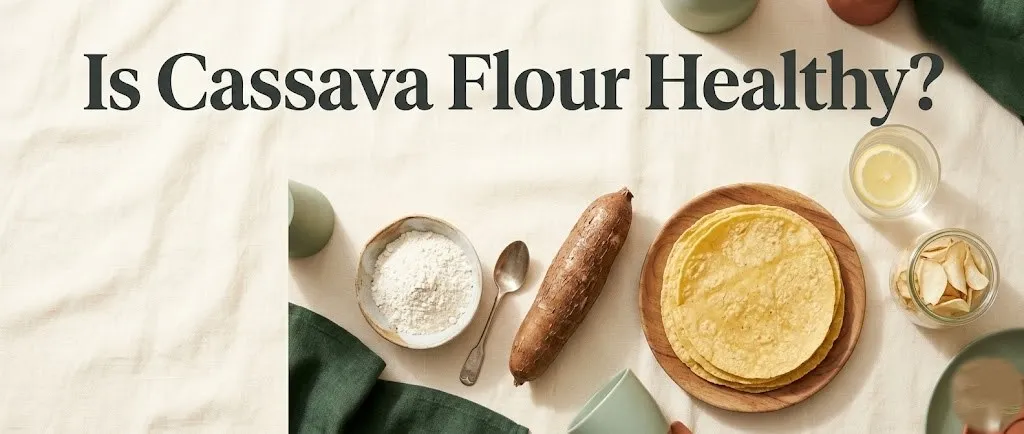
Cassava flour can be a healthy choice for specific people, particularly those with celiac disease or gluten sensitivity who need a grain-free baking alternative. It is not, however, a nutrient-dense flour for general health, and its high glycemic index means it works better as an occasional ingredient than a daily staple.
The global gluten-free flour market continues expanding in 2026, and cassava flour holds a notable position among alternatives made from Manihot esculenta, the cassava root. The Academy of Nutrition and Dietetics recognizes cassava flour as a functional option for people managing medically necessary gluten-free diets. What cassava flour offers in versatility and allergen safety, it lacks in fiber, protein, and micronutrient density compared to whole-grain wheat flour.
This article gives you the straight nutritional breakdown, explains exactly how cassava flour affects blood sugar, walks you through safe usage in your kitchen, and settles the question of whether cassava chips deserve their health halo. You will finish knowing whether this flour belongs in your pantry.
Is Cassava Flour Healthy
Cassava flour is moderately healthy as a gluten-free, grain-free flour option with some resistant starch benefits, but it is not a nutrient-dense superfood. Its health value depends almost entirely on your specific dietary needs and what you compare it against.
For someone with celiac disease or a confirmed wheat allergy, cassava flour is a functional, safe alternative that allows them to bake bread, make tortillas, and prepare foods that would otherwise be off-limits. The World Health Organization recognizes the importance of accessible, safe staple foods, and cassava flour fills that role for millions of people globally, particularly in Africa, South America, and parts of Asia where cassava is a dietary cornerstone.
For a person without gluten sensitivity who simply wants to eat healthier, the calculation shifts. Cassava flour contains roughly 27 grams of carbohydrates per quarter-cup serving, only 2 grams of fiber, and 1 gram of protein. Whole-wheat flour delivers more than double the fiber and six times the protein in an equivalent serving. Swapping wheat flour for cassava flour without a medical reason reduces your protein and fiber intake.
The health assessment also depends on what you pair cassava flour with. Using it in a nutrient-dense recipe with eggs, vegetables, and healthy fats creates a balanced meal. Using it to make fried dough or sugar-heavy baked goods adds calories without meaningful nutrition. Context matters every time.
| Comparison Point | Cassava Flour (1/4 cup, 28g) | Whole-Wheat Flour (1/4 cup, 30g) |
|---|---|---|
| Calories | 110 | 102 |
| Carbohydrates | 27g | 21g |
| Fiber | 2g | 4g |
| Protein | 1g | 6g |
| Fat | 0g | 0.5g |
| Iron | 2% DV | 6% DV |
People managing type 2 diabetes or insulin resistance should treat cassava flour as a high-carbohydrate ingredient and monitor portion sizes carefully.
Cassava Flour Nutrition Facts
Cassava flour contains 110 calories, 27 grams of carbohydrates, 2 grams of fiber, 1 gram of protein, and zero grams of fat per quarter-cup serving. It provides small amounts of vitamin C, thiamin, potassium, and magnesium, but it is not a concentrated source of any micronutrient.
The USDA nutrient database confirms that cassava flour is primarily starch, with carbohydrates making up roughly 90 percent of its caloric content. This nutritional profile makes it an energy-dense food that fueled populations in tropical regions for centuries. The cassava root itself is the third-largest source of food carbohydrates in the tropics after rice and maize, according to the Food and Agriculture Organization.
Vitamin C is present in measurable amounts in fresh cassava root, but the peeling, soaking, drying, and grinding process that transforms the root into shelf-stable flour degrades most of this heat-sensitive vitamin. The vitamin C content in commercial cassava flour is typically less than 5 percent of the daily value per serving. Potassium and magnesium survive processing better, though the amounts remain modest compared to other root vegetables like sweet potatoes.
The absence of fat and the near-absence of protein mean cassava flour should rarely be eaten in isolation. Nutritionists generally recommend pairing cassava flour with protein sources like eggs, meat, or legumes and fat sources like avocado or olive oil to build a complete meal. Flour alone does not make a diet.
Key Takeaway: Cassava flour is a clean source of carbohydrate energy with minimal micronutrients. Treat it as a functional baking ingredient, not a nutritional upgrade over whole-grain flours.
Cassava Flour Benefits
The primary benefits of cassava flour are its gluten-free and grain-free status, its neutral flavor that adapts to both sweet and savory recipes, its nut-free allergen profile, and its content of resistant starch that supports digestive function.
The gluten-free benefit matters most. For the estimated 1 percent of the global population with celiac disease and the additional 6 percent with non-celiac gluten sensitivity, cassava flour provides a wheat alternative that does not trigger an immune response. The Academy of Nutrition and Dietetics includes cassava flour in its list of safe gluten-free grains and starches for medical nutrition therapy. Unlike some gluten-free flour blends that rely on rice flour or nut meals, cassava flour is also grain-free, which makes it suitable for people following paleo, Whole30, or autoimmune protocol diets.
The neutral flavor profile is an underrated practical benefit. Cassava flour tastes mild and slightly earthy. It does not overpower other ingredients the way coconut flour or almond flour can. This neutrality means you can use the same bag of flour for pancakes in the morning and savory flatbreads at dinner without flavor clashes.
The nut-free status solves a real problem in the alternative flour market. Almond flour and coconut flour are common gluten-free options, but tree nut allergies affect roughly 1 percent of the U.S. population. Cassava flour is derived from a root vegetable and carries no cross-reactivity risk with tree nuts or peanuts. Schools, daycare centers, and shared kitchen spaces that enforce nut-free policies can use cassava flour without restriction.
| Benefit | Why It Matters |
|---|---|
| Gluten-free | Safe for celiac disease and gluten sensitivity |
| Grain-free | Compatible with paleo, Whole30, and AIP diets |
| Nut-free | Safe for tree nut and peanut allergies |
| Neutral flavor | Works in both sweet and savory recipes |
| Resistant starch | Feeds beneficial gut bacteria |
Cassava Flour Side Effects
Cassava flour can cause digestive discomfort, blood sugar spikes, and unwanted weight gain when eaten in large portions. Improperly processed cassava flour also carries a rare but serious risk of cyanide exposure from naturally occurring compounds in the raw root.
Digestive discomfort is the most common side effect reported by people who switch to cassava flour abruptly. The resistant starch in cassava flour ferments in the large intestine, which can produce gas, bloating, and cramping when intake increases too quickly. This effect is generally temporary and resolves as gut bacteria adapt. Starting with small portions, one-quarter cup of cassava flour per meal, allows the digestive system to adjust.
The blood sugar concern is well documented. Cassava flour has a high glycemic index, which means it raises blood glucose more rapidly than whole-grain wheat flour or nut-based flours. A single serving of cassava flour contains 27 grams of carbohydrates with minimal fiber and protein to buffer absorption. People who eat cassava-based baked goods on an empty stomach often experience a blood sugar spike followed by a crash, which can trigger hunger, fatigue, and cravings.
Weight gain is a practical concern when cassava flour becomes a daily staple without portion awareness. The calorie density is similar to other flours, about 110 calories per quarter-cup, but cassava flour recipes often call for additional binding agents, extra eggs, or more fat to compensate for the lack of gluten. The resulting baked goods can be more calorie-dense than their wheat-based counterparts.
Quick Tip:
- Introduce cassava flour in half-cup portions or less per meal at first.
- Pair cassava flour foods with protein and fat to slow digestion.
- Buy cassava flour from reputable brands that verify processing methods.
Cassava Flour Glycemic Index
Cassava flour has a high glycemic index, typically ranging between 70 and 85 depending on processing method, which is comparable to or higher than white wheat flour. This means it digests rapidly and can cause blood sugar levels to rise quickly after eating.
The glycemic index measures how fast a carbohydrate-containing food raises blood glucose. Pure glucose scores 100. White bread scores around 75. Whole-wheat bread scores around 55 to 65. Cassava flour, according to published research in the Journal of Nutrition, consistently falls in the 70 to 85 range. Some processing methods that preserve more fiber can lower this slightly, but cassava flour is fundamentally a high-GI ingredient.
The high glycemic response happens because cassava starch is predominantly amylopectin, a branched-chain starch molecule that digestive enzymes break down rapidly. Amylose, the straight-chain starch found in higher proportions in legumes and some whole grains, digests more slowly. Cassava root contains roughly 17 to 20 percent amylose and 80 percent amylopectin. This ratio favors fast digestion and rapid glucose absorption.
The glycemic load, which accounts for portion size, is a more practical number for meal planning. A standard quarter-cup serving of cassava flour has a glycemic load of approximately 20, which qualifies as high. For context, the American Diabetes Association classifies a glycemic load above 20 as high, 11 to 19 as medium, and 10 or below as low. Eating cassava flour alongside fiber, protein, or fat lowers the effective glycemic load of the entire meal.
Cassava Flour Resistant Starch
Cassava flour contains resistant starch, a type of carbohydrate that escapes digestion in the small intestine and ferments in the colon, where it feeds beneficial gut bacteria and produces short-chain fatty acids. The resistant starch content varies significantly depending on how the flour is processed and whether it is heated.
Resistant starch functions like a prebiotic fiber. It travels through the stomach and small intestine without being broken down into glucose. When it reaches the colon, bacteria ferment it and produce butyrate and other short-chain fatty acids. Butyrate is the primary energy source for colonocytes, the cells lining the large intestine. A 2021 study in the British Journal of Nutrition found that dietary resistant starch intake was associated with improved markers of colon health and reduced inflammation in adult participants.
The processing method determines how much resistant starch survives in the final flour. Raw cassava starch contains high levels of resistant starch. High-heat drying and fine grinding can gelatinize some of that starch, converting it to digestible form. Some manufacturers use low-temperature drying specifically to preserve resistant starch content. Labels rarely disclose this processing detail, which makes it difficult for consumers to know what they are getting.
A practical way to increase resistant starch in cassava flour foods is to cook them, then let them cool before eating. Cooling gelatinized starch allows retrogradation, a process where starch molecules realign into a crystalline structure that resists digestion. Cassava flour tortillas or pancakes that are cooked, cooled, and then eaten at room temperature will have more resistant starch than the same foods eaten hot off the griddle.
Key Takeaway: Cooling cassava flour foods after cooking increases their resistant starch content. If you want the gut health benefit, let your cassava pancakes or tortillas cool for 20 minutes before eating them.
Is Cassava Flour Good for Diabetics
Cassava flour is generally not a good choice for people with diabetes when eaten in standard serving sizes because its high glycemic index and low fiber content cause blood sugar to rise rapidly. Portion control and strategic food pairing can make occasional use possible, but it is not an ideal staple flour for diabetes management.
The American Diabetes Association recommends that people with diabetes prioritize carbohydrate sources that are high in fiber, contain protein, and digest slowly. Cassava flour meets none of these criteria. A quarter-cup serving delivers 27 grams of carbohydrates with only 2 grams of fiber and 1 gram of protein. The math is not favorable for blood sugar control.
Blood sugar response varies by individual, and some people with well-managed type 2 diabetes may tolerate small amounts of cassava flour in mixed meals. A cassava flour tortilla filled with grilled chicken, black beans, avocado, and vegetables will produce a slower glucose rise than a plain cassava flour pancake with syrup. The protein and fat in the filling buffer the carbohydrate absorption. The fiber from the beans and vegetables adds further delay.
People with diabetes who want to experiment with cassava flour should start with a very small portion, about one-eighth cup of flour, and use a continuous glucose monitor or finger-stick testing to check their response at 60 and 120 minutes after eating. This personal data is more useful than generalized recommendations. If blood glucose rises more than 50 points from baseline within the first hour, cassava flour in that preparation method is not a good fit.
Quick Tip:
- Substitute half the cassava flour in a recipe with almond flour or coconut flour to lower the glycemic impact.
- Always pair cassava flour foods with at least 15 grams of protein and 10 grams of fiber in the same meal.
- Never eat cassava flour foods as a standalone snack on an empty stomach if you have diabetes.
Is Cassava Flour Keto Friendly
Cassava flour is not keto friendly. A single quarter-cup serving contains 27 grams of carbohydrates, which exceeds the total daily carbohydrate allowance for most people following a standard ketogenic diet.
The ketogenic diet typically limits total daily carbohydrate intake to 20 to 50 grams to maintain nutritional ketosis. One serving of cassava flour uses up more than half of the upper limit and exceeds the lower limit entirely. Even a small cassava flour tortilla or pancake can deliver 15 to 20 grams of net carbohydrates, leaving almost no carbohydrate budget for vegetables, dairy, nuts, or other nutrient-dense foods that day.
The carbohydrate type matters for keto calculations. Net carbohydrates equal total carbohydrates minus fiber and certain sugar alcohols. Cassava flour contains 27 grams of total carbohydrates and 2 grams of fiber, which yields 25 grams of net carbohydrates per serving. This number is incompatible with ketogenic macronutrient targets. Coconut flour, by comparison, contains roughly 8 grams of net carbohydrates per quarter-cup serving. Almond flour contains about 3 grams.
Some cassava flour product labels market themselves as “paleo friendly” or “grain-free,” which can create confusion. Paleo and grain-free are not synonymous with low-carb or keto. Cassava flour aligns with paleo and Whole30 guidelines because it is a minimally processed root vegetable product. It does not align with keto guidelines because root vegetables are carbohydrate-dense by nature.
| Flour (1/4 cup) | Total Carbs | Fiber | Net Carbs | Keto Compatible |
|---|---|---|---|---|
| Cassava flour | 27g | 2g | 25g | No |
| Almond flour | 6g | 3g | 3g | Yes |
| Coconut flour | 16g | 8g | 8g | Yes, in moderation |
| Wheat flour (white) | 24g | 1g | 23g | No |
People following a targeted or cyclical ketogenic diet may occasionally use cassava flour around workouts, but for standard keto, it simply does not fit the macronutrient math.
Cassava Flour Gluten Free
Cassava flour is naturally gluten free. It contains no wheat, rye, barley, or triticale proteins, and it is safe for people with celiac disease, non-celiac gluten sensitivity, and wheat allergy when sourced from a certified gluten-free manufacturer.
The gluten-free status of cassava flour is straightforward because cassava is a root vegetable unrelated to any gluten-containing grain. The Academy of Nutrition and Dietetics confirms that naturally gluten-free foods like cassava are appropriate for medical nutrition therapy in celiac disease management. The safety concern is not the ingredient itself but cross-contamination during processing.
Cross-contamination occurs when cassava flour is processed, milled, or packaged on equipment shared with wheat or other gluten-containing grains. For someone with celiac disease, even trace amounts of gluten below 20 parts per million can trigger an immune response and intestinal damage. This is why certification matters. Cassava flour labeled “certified gluten-free” has been tested to verify it contains less than 20 parts per million of gluten. Flour without this certification may be naturally gluten-free in theory but cross-contaminated in practice.
The gluten-free property also creates the main baking challenge with cassava flour. Gluten is the protein network that gives wheat dough its elasticity, structure, and ability to trap gas during rising. Cassava flour lacks gluten entirely, which means cassava dough does not stretch, does not rise well, and tends to produce dense, crumbly baked goods unless you add binding agents. Common binders paired with cassava flour include xanthan gum, psyllium husk powder, eggs, and ground flaxseed.
Key Takeaway: Cassava flour is reliably gluten-free by nature, but buy certified gluten-free brands if you have celiac disease. The lack of gluten means you will need to add binding agents for successful baking.
Cassava Flour vs Wheat Flour
Cassava flour and wheat flour differ fundamentally in protein content, fiber, gluten structure, glycemic impact, and baking behavior. Cassava flour works as a wheat flour substitute for people with gluten-related medical conditions, but it is not a nutritional equivalent or upgrade.
Wheat flour, particularly whole-wheat flour, contains gluten proteins that form the structural backbone of bread, pizza dough, and most baked goods. These gluten networks trap carbon dioxide produced by yeast or baking powder, creating the airy crumb structure people expect in bread. Cassava flour cannot replicate this without added binders. This difference is functional, not trivial, and it explains why many gluten-free cassava bread recipes call for three or four eggs where a wheat recipe might need one.
Nutritionally, whole-wheat flour outperforms cassava flour on protein, fiber, B vitamins, iron, and zinc. The Harvard T.H. Chan School of Public Health identifies whole grains as a dietary priority because of their documented association with reduced cardiovascular disease risk and improved metabolic health. Cassava flour is not a whole grain and does not confer these benefits. It is a root vegetable starch, nutritionally closer to potato starch than to wheat flour.
White wheat flour and cassava flour are more nutritionally comparable. Both are primarily starch with minimal fiber and protein, both have high glycemic index values, and both are best eaten in moderation alongside more nutrient-dense foods. In this comparison, the choice depends on whether gluten is medically problematic for you, not on nutritional superiority.
| Nutrient (per 1/4 cup) | Cassava Flour | White Wheat Flour | Whole-Wheat Flour |
|---|---|---|---|
| Calories | 110 | 114 | 102 |
| Carbohydrates | 27g | 24g | 21g |
| Fiber | 2g | 1g | 4g |
| Protein | 1g | 3g | 6g |
| Iron (DV) | 2% | 8% | 6% |
| Glycemic Index | 70-85 | 70-75 | 55-65 |
| Gluten | None | Yes | Yes |
People without gluten sensitivity who are choosing cassava flour for perceived health benefits should know that they are trading the proven health benefits of whole grains for a starch flour with fewer protective nutrients.
Cassava Flour for Baking
Cassava flour works well for baking flatbreads, tortillas, pancakes, cookies, and brownies. It produces dense results in yeast-leavened bread and requires additional liquid and binding agents in most recipes compared to wheat flour.
The best results with cassava flour come from recipes specifically developed for it rather than direct one-to-one substitutions in wheat flour recipes. Cassava flour absorbs more liquid than wheat flour and produces a finer, more powdery crumb. Bakers who understand these properties can produce excellent gluten-free baked goods. Bakers who dump cassava flour into a wheat bread recipe without adjustments will pull a dense brick out of the oven.
Successful cassava flour baking follows predictable patterns. Flatbreads and tortillas work because they do not need gluten structure to trap gas. A simple cassava flour tortilla dough needs only cassava flour, warm water, salt, and a small amount of oil. The dough rolls out smoothly between parchment paper and cooks in a hot dry skillet in about a minute per side. The result is flexible, slightly chewy, and neutral in flavor.
Cookies and brownies succeed because their texture relies on fat and sugar more than gluten development. Cassava flour chocolate chip cookies made with butter, brown sugar, egg, and vanilla produce a tender, crisp-edged cookie nearly indistinguishable from a wheat flour version. The cassava flour fades into the background.
Quick Tip:
- Increase liquid by 20 to 25 percent when adapting a wheat recipe to cassava flour.
- Add one teaspoon of xanthan gum or psyllium husk powder per cup of cassava flour for bread-like recipes.
- Rest cassava flour dough for 10 minutes before rolling to allow full hydration.
Cassava Flour Substitute Ratio
The standard substitution ratio for cassava flour in wheat flour recipes is 1 cup of wheat flour replaced by 3/4 to 1 cup of cassava flour, with liquid increased by approximately 20 percent and a binding agent added at 1 teaspoon per cup of cassava flour.
This ratio is not universal. It works for cookies, brownies, quick breads, and pancakes. It does not work for yeasted breads or recipes that depend entirely on gluten for structure. The closer the original recipe is to a quick bread or batter-based preparation, the more successful the substitution. The closer it is to a yeast bread, the less successful.
The liquid adjustment matters because cassava flour is finer and more absorbent than wheat flour. If you swap cassava flour into a wheat pancake recipe without adding extra milk or water, the batter will be too thick and the pancakes will be dry and crumbly. A good starting point is an extra 2 tablespoons of liquid per cup of cassava flour. Watch the batter consistency and adjust. Cassava batter should look slightly wetter than wheat batter because the flour will continue absorbing liquid as it rests.
Binding agents are not optional for most substitutions. Gluten provides both elasticity and binding in wheat dough. Without it, cassava baked goods crumble. Xanthan gum at 1/2 to 1 teaspoon per cup of cassava flour works for most applications. Psyllium husk powder at 1 teaspoon per cup provides binding plus additional fiber. Ground flaxseed mixed with water at 1 tablespoon flaxseed plus 3 tablespoons water per cup of flour adds binding and a mild nutty flavor.
To substitute cassava flour in a standard pancake recipe:
- Replace 1 cup wheat flour with 3/4 cup cassava flour.
- Increase the milk or water by 2 tablespoons.
- Add 1/2 teaspoon xanthan gum or 1 teaspoon psyllium husk powder.
- Let the batter rest for 5 minutes before cooking.
- Cook on medium-low heat. Cassava pancakes need slightly longer cook times.
Key Takeaway: The 3/4 cup cassava flour plus extra liquid plus binder rule works for most non-yeasted recipes. Yeast bread requires a dedicated cassava flour recipe, not a substitution.
Cassava Flour Cyanide Safety
Commercially produced cassava flour sold in regulated markets is safe to eat. Proper processing through peeling, soaking, drying, and cooking removes the cyanogenic glycosides that naturally occur in raw cassava roots.
Raw cassava contains linamarin and lotaustralin, two cyanogenic glycosides that can release hydrogen cyanide when the plant tissue is damaged and enzymes are activated. The Food and Agriculture Organization classifies cassava into sweet varieties with low cyanogenic glycoside content and bitter varieties with higher content. Commercial cassava flour is made from sweet varieties and undergoes multiple processing steps that reduce these compounds to safe levels.
The processing sequence makes the difference between a safe food and a toxic one. Peeling removes the highest concentration of cyanogenic glycosides, which concentrate in the root’s outer layer. Grating or crushing the peeled root releases the glycosides and activates the enzyme that converts them. Soaking in water allows the water-soluble hydrogen cyanide to leach out. Drying and heating drive off remaining volatile cyanide compounds. Each step contributes to the cumulative safety of the final flour.
The World Health Organization has established safety standards for cassava products in the Codex Alimentarius, which specifies maximum cyanogenic glycoside levels for processed cassava foods. Flour purchased from reputable manufacturers in the United States, Canada, Europe, and Australia has been tested and meets these standards.
People who make homemade cassava flour from raw roots should follow the full processing protocol: peel thickly, grate finely, soak in water for 24 to 48 hours, drain and rinse, dry at 60 to 70 degrees Celsius (140 to 158 degrees Fahrenheit) until completely dry, and grind. Skipping any step increases risk. For most home cooks, buying commercially processed cassava flour is safer and more practical.
Is Cassava Chips Healthy
Cassava chips are not a healthy snack in any meaningful nutritional sense. They are a fried, calorie-dense processed food with minimal fiber and protein, nutritionally similar to potato chips despite their health-food marketing.
The term “cassava chips” triggers a health halo for many shoppers. Cassava is a root vegetable. Vegetables are healthy. Therefore cassava chips must be a healthy snack. This reasoning collapses under nutritional scrutiny. A standard 28-gram serving of cassava chips contains approximately 140 to 160 calories, 7 to 9 grams of fat, often including saturated fat from the frying oil, 17 to 20 grams of carbohydrates, and 150 to 250 milligrams of sodium. The fiber content sits around 1 to 2 grams. The protein content is negligible.
The frying process strips away what minimal nutritional value the cassava root offers. The heat degrades vitamin C. The oil adds significant calories. The salt adds sodium that does not exist in the raw root. What remains is a starchy fried snack with a vegetable-based brand story.
Cassava chips are not devoid of any redeeming quality. They are gluten-free and nut-free, which makes them an option for someone with multiple food allergies who wants a crunchy snack. They also tend to be free of artificial colors and flavors, which some potato chip brands include. These are modest advantages that do not override the fundamental nutritional reality.
Quick Tip:
- Treat cassava chips as an occasional snack, not a daily vegetable serving.
- Compare brands. Some use palm oil or coconut oil with higher saturated fat. Others use avocado oil with a better fat profile.
- Look for baked cassava chips, which cut the fat content roughly in half compared to fried.
Cassava Chips vs Potato Chips
Cassava chips and potato chips are nutritionally similar, with comparable calorie, fat, and sodium profiles. Cassava chips are not meaningfully healthier, and the choice between them comes down to allergen needs, ingredient preferences, and taste rather than nutritional superiority.
A side-by-side comparison of standard fried cassava chips and standard fried potato chips reveals more similarities than differences. Both deliver roughly 150 calories per 28-gram serving. Both contain 8 to 10 grams of fat. Both have 15 to 20 grams of carbohydrates. Both have minimal fiber and protein. Cassava chips sometimes have slightly less sodium, but the difference is small enough to be irrelevant in the context of an overall diet.
The oil type matters for both products. Cassava chips fried in avocado oil have a better fatty acid profile than cassava chips fried in palm oil. Potato chips fried in sunflower oil have a different profile than those fried in hydrogenated shortening. Reading the ingredient label reveals more about the health profile than the vegetable source.
Cassava chips hold one genuine advantage for a narrow audience. They are nightshade-free, while potatoes belong to the nightshade family. People following an autoimmune protocol or who have identified nightshade sensitivity through elimination diets can eat cassava chips but cannot eat potato chips. This is a legitimate dietary distinction, not a nutritional one.
| Nutrient (per 28g) | Cassava Chips | Potato Chips |
|---|---|---|
| Calories | 140-160 | 150-160 |
| Total Fat | 7-9g | 8-10g |
| Saturated Fat | 1-7g (varies by oil) | 1-3g (varies by oil) |
| Carbohydrates | 17-20g | 15-18g |
| Fiber | 1-2g | 1g |
| Protein | 0-1g | 1-2g |
| Sodium | 150-250mg | 150-250mg |
Neither snack should be a daily food for someone managing weight, blood pressure, or metabolic health. The vegetable source does not transform a fried snack into a health food.
Cassava Chips Nutrition
Cassava chips contain approximately 150 calories, 8 grams of fat, 18 grams of carbohydrates, 1 gram of fiber, less than 1 gram of protein, and 200 milligrams of sodium per 28-gram serving. These numbers place them in the same nutritional category as other fried snack foods.
The macronutrient breakdown tells the story. Cassava chips are roughly 50 percent fat by calories and 45 percent carbohydrate, with nearly all remaining calories coming from trace protein. There is no meaningful micronutrient contribution. The fat composition depends on the frying oil. Some brands use palm oil, which contains roughly 50 percent saturated fat. Others use sunflower, avocado, or coconut oil, each with different fatty acid profiles.
The serving size on the package matters. A 28-gram serving is about 15 to 18 chips. It is a small handful that disappears quickly. An entire 5-ounce bag of cassava chips, a common size, contains approximately 750 calories, 40 grams of fat, and 1,000 milligrams of sodium. Eating the whole bag during a movie or while working at a desk is not hard to do. The nutritional impact of finishing the bag is substantial.
Baked cassava chips offer a different nutritional profile worth noting. Baked versions typically contain 110 to 120 calories and 3 to 4 grams of fat per serving, roughly 30 percent fewer calories and 50 percent less fat than their fried counterparts. The texture is different, less crispy and less indulgent, but the tradeoff is real. People who genuinely enjoy cassava chips and eat them regularly can cut their cumulative fat and calorie intake meaningfully by switching from fried to baked.
Key Takeaway: Cassava chips are a fried snack with a vegetable name. Their nutritional profile is nearly identical to potato chips. Baked versions reduce the fat and calorie load if you want to include them more often.
Frequently Asked Questions About Cassava Flour
Is cassava flour better than regular flour?
Cassava flour is better than regular flour only for people who need a gluten-free or grain-free alternative.
It contains less protein, less fiber, and fewer micronutrients than whole-wheat flour.
For general health, whole-wheat flour is the nutritionally superior choice.
Can I eat cassava flour every day?
You can eat cassava flour daily in moderate portions, but it should not dominate your diet.
Its high glycemic index and low nutrient density make it a better occasional ingredient than a daily staple.
Pair daily cassava flour foods with protein, fiber, and healthy fats to balance the meal.
Does cassava flour spike blood sugar?
Yes, cassava flour has a high glycemic index of 70 to 85 and raises blood sugar rapidly.
A quarter-cup serving contains 27 grams of carbohydrates with minimal fiber or protein to slow absorption.
Eating cassava flour foods with protein and fat reduces the blood sugar spike.
Is cassava flour safe to eat raw?
No, cassava flour should not be eaten raw in homemade preparations.
Commercially produced cassava flour has been processed with heat to eliminate cyanogenic glycoside risk.
Raw cassava root and inadequately processed flour can contain compounds that release hydrogen cyanide.
Are cassava chips healthier than potato chips?
Cassava chips are not meaningfully healthier than potato chips.
Both are fried snacks with similar calorie, fat, carbohydrate, and sodium profiles.
Cassava chips are a useful alternative only for people avoiding nightshades or seeking gluten-free snacks.
Closing
Cassava flour earns its place in specific pantries. If you need a gluten-free, grain-free, nut-free flour that behaves predictably in pancakes, tortillas, and cookies, cassava flour delivers. If you are simply looking for a healthier flour for general use, whole-wheat flour remains the better choice on protein, fiber, and nutrient density.
Treat cassava chips as exactly what they are: a fried snack with a root vegetable on the label. They are not a vegetable serving, and they are not a health food. Enjoy them occasionally if you like the taste and texture. Do not stock your pantry with them under the impression you are making a meaningfully healthier choice than potato chips.
Use cassava flour when it solves a specific dietary problem for you. Pair it with protein and fat. Cool your cassava baked goods before eating if you want the resistant starch benefit. And buy from reputable brands that verify their processing. An ingredient is only as healthy as how you use it and what you use it alongside.