You have a headache. You open the medicine cabinet and grab the bottle of Tylenol. You shake out two caplets. Then you pause. Your stomach is empty. You skipped breakfast. You remember reading somewhere that pain relievers should be taken with food. You wonder whether that rule applies to acetaminophen, or whether you are about to make a mistake.
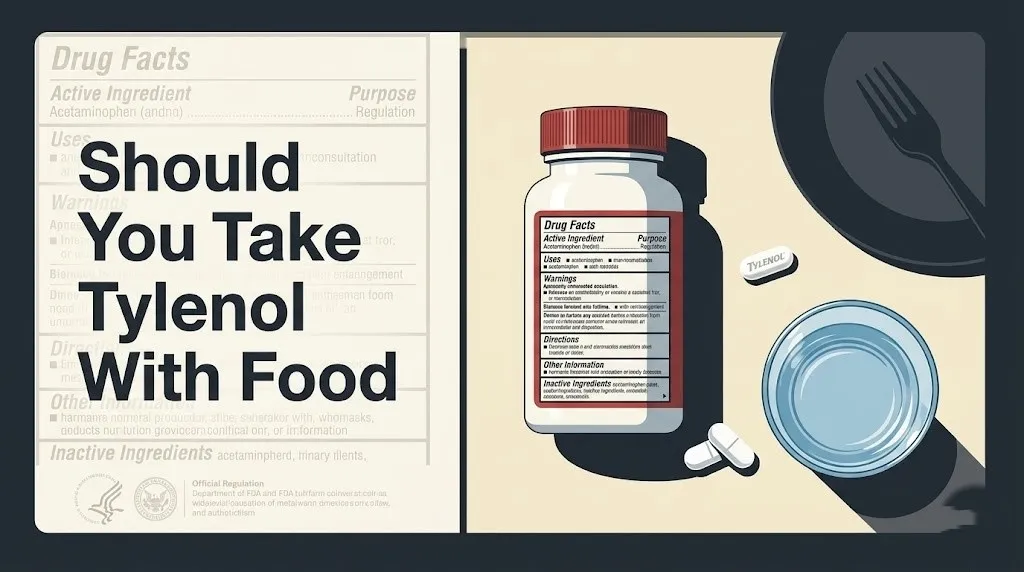
You do not need to take Tylenol with food. Acetaminophen, the active ingredient in Tylenol, does not irritate the stomach lining the way aspirin, ibuprofen, and naproxen do. You can take it on an empty stomach safely. The official Tylenol Drug Facts panel, which is a legally mandated FDA-approved label, does not include a food requirement. If food were necessary, the label would say so.
The confusion exists because the general advice to take pain relievers with food applies to nonsteroidal anti-inflammatory drugs, a class that includes ibuprofen (Advil, Motrin), naproxen (Aleve), and aspirin. Those drugs can damage the stomach lining when taken without food. Acetaminophen belongs to a different drug class with a different mechanism of action. It does not harm the stomach.
What surprises most people is that the FDA Drug Facts panel is a regulatory document, not a suggestion. The dosing instructions, warnings, and directions on an over-the-counter medication label are the result of a federal rulemaking process called the Over-the-Counter Drug Review. If the FDA had determined that acetaminophen required food, that instruction would appear on every bottle. It does not.
should you take tylenol with food
No, you do not need to take Tylenol with food. Acetaminophen does not cause stomach irritation, ulcers, or gastrointestinal bleeding. The Food and Drug Administration does not require a food advisory on the Tylenol Drug Facts panel. You can safely take it on an empty stomach.
The reason acetaminophen is gentle on the stomach comes down to pharmacology. Nonsteroidal anti-inflammatory drugs like ibuprofen work by inhibiting cyclooxygenase enzymes, known as COX-1 and COX-2. COX-1 produces prostaglandins that protect the stomach lining. When ibuprofen blocks COX-1, it shuts off that protective mechanism. The stomach lining becomes vulnerable to acid damage. That is why NSAIDs can cause gastritis, ulcers, and bleeding.
Acetaminophen does not inhibit COX-1 in the stomach. It works primarily in the central nervous system, not at the site of inflammation throughout the body. Its exact mechanism is still not fully understood, but research indicates it acts on a variant of the COX enzyme in the brain and spinal cord. Because it does not block COX-1 in the stomach lining, it does not interfere with the stomach’s protective prostaglandins.
The practical result is that you can take Tylenol on an empty stomach without worrying about stomach damage. If you have ever taken ibuprofen on an empty stomach and felt a gnawing pain an hour later, you know the difference. Tylenol does not cause that.
do you have to take tylenol with food
No, you do not have to take Tylenol with food. There is no medical requirement to do so. The medication is not absorbed more effectively with food. The food does not prevent a side effect that would otherwise occur. Taking Tylenol with food is optional.
The word “have to” in this question implies a requirement or a medical necessity. There is none. The FDA-approved labeling for acetaminophen products does not contain a directive to take the medication with food. By contrast, the labeling for ibuprofen and naproxen explicitly advises consumers to take the medication with food or milk if stomach upset occurs. The presence of that advisory on NSAID labels and its absence on acetaminophen labels is not random. It reflects the scientific evidence.
Some people choose to take Tylenol with food anyway. The food may slow absorption slightly, but the difference is clinically insignificant for most people. A small study published in the Journal of Clinical Pharmacology found that food delayed the peak concentration of acetaminophen by roughly 30 to 60 minutes but did not reduce the total amount absorbed. The pain relief arrives a little later. It still arrives.
If you are taking Tylenol for a headache or acute pain, taking it on an empty stomach gets the medication into your bloodstream faster. If you have a sensitive stomach unrelated to medication, or you simply prefer to take pills with food, that is fine. But you do not have to.
should tylenol be taken with food
Tylenol does not need to be taken with food. It can be taken with or without food, and the choice does not affect the medication’s safety or effectiveness in a meaningful way. The question is about preference, not medical necessity.
The active ingredient acetaminophen has been on the market since 1955. It has been studied extensively. The FDA has reviewed decades of safety data through the Over-the-Counter Drug Review process. At no point has the agency determined that a food requirement is necessary for the safe use of acetaminophen. The labeling reflects that determination.
The contrast with NSAIDs is instructive. The FDA-approved labeling for ibuprofen states: “Take with food or milk if stomach upset occurs.” The labeling for naproxen includes similar language. These are required warnings based on documented gastrointestinal risk. Acetaminophen labeling contains no such language because the risk does not exist.
The legal significance of this labeling distinction matters for product liability purposes. A drug manufacturer has a duty to warn consumers about known risks. If acetaminophen caused stomach damage when taken without food, and the manufacturer failed to include that warning on the label, the manufacturer would face liability under the failure to warn doctrine. The absence of a food warning on Tylenol labels is evidence that the risk is not present.
Key Takeaway: Tylenol does not require food. The FDA label does not include a food requirement because the medication does not harm the stomach lining. You can take it with or without food based on personal preference.
should i take tylenol with food
You do not need to take Tylenol with food. If you are asking for yourself, the answer is that you can safely take the dose in your hand right now even if you have not eaten. The medication will not irritate your stomach.
The first-person phrasing of this question reflects the real situation most people are in when they search. They have the bottle open. They are about to take the pills. They want a clear answer before they swallow. The answer is clear. Take the Tylenol. You do not need to eat first.
The only exception involves a specific medical history. If you have ever had an allergic reaction to acetaminophen, you should not take it at all, with or without food. If you have severe liver disease, you should not take acetaminophen without medical supervision because the drug is metabolized by the liver. Food does not change either of these risks.
If you are taking a combination product that contains acetaminophen plus other active ingredients, check the label. Some combination cold and flu products contain decongestants or antihistamines that can cause stomach upset. The acetaminophen component is not the problem. The other ingredients might be. The label instructions for the specific product control.
does tylenol need to be taken with food
No, Tylenol does not need to be taken with food. The word “need” implies a requirement. There is no requirement. Acetaminophen is not dependent on food for absorption, safety, or effectiveness.
This question uses the generic name “Tylenol” but refers to the active ingredient acetaminophen. The same answer applies to generic acetaminophen products sold under store brand labels. The active ingredient is the same. The lack of a food requirement is the same. Generic acetaminophen is chemically identical to brand-name Tylenol and carries the same FDA-approved labeling.
The pharmacokinetics of acetaminophen explain why food is not needed. Acetaminophen is rapidly and almost completely absorbed from the small intestine. Food in the stomach delays gastric emptying, which means the medication stays in the stomach longer before reaching the small intestine where absorption occurs. The delay does not reduce the total amount absorbed. It just shifts the timing.
For someone in pain who wants relief as quickly as possible, taking acetaminophen on an empty stomach is actually preferable. The medication reaches the bloodstream faster and begins working sooner. The difference is measured in minutes, not hours. For most people, it is not noticeable. For someone with a severe headache, those minutes matter.
should you take acetaminophen with food
No, you should not feel obligated to take acetaminophen with food. The medication does not cause stomach damage, and the FDA does not require a food advisory on acetaminophen labels. You can take it with or without food according to your preference.
This question uses the generic drug name “acetaminophen” instead of the brand name “Tylenol.” The answer is identical. Acetaminophen is the active ingredient. Tylenol is the brand. The pharmacology, the safety profile, and the FDA labeling requirements are the same regardless of which name you use.
Outside the United States, acetaminophen is known as paracetamol. The international name is the same drug. The same pharmacology applies. The same lack of food requirement applies. Regulatory agencies in the United Kingdom, European Union, Canada, and Australia all do not require a food advisory on paracetamol labeling. The global regulatory consensus is consistent with the FDA’s position.
The distinction between acetaminophen and NSAIDs is one of the most important things for consumers to understand about over-the-counter pain relievers. The two drug classes are not interchangeable. They work differently. They have different risks. The food requirement is one of the most visible and practical differences. Acetaminophen does not need food. NSAIDs do.
should acetaminophen be taken with food
Acetaminophen does not need to be taken with food. The FDA-approved labeling does not include a food directive. The medication’s mechanism of action does not involve stomach irritation. The evidence does not support a food requirement.
The Over-the-Counter Drug Review is the regulatory process through which the FDA evaluates the safety and efficacy of nonprescription drug ingredients. Acetaminophen was reviewed and determined to be generally recognized as safe and effective when used according to label directions. The review process examined the need for food and did not find one.
The Drug Facts panel that appears on all over-the-counter acetaminophen products is the legal label. It is required by 21 CFR Part 201.66. The format, content, and wording are specified by regulation. The panel includes directions for use, warnings, and inactive ingredients. It does not include a food requirement because the FDA did not mandate one.
The pharmacy may staple a consumer medication information leaflet to the bag when you pick up a prescription containing acetaminophen. That leaflet is not an FDA-approved document. It is produced by a third-party vendor. It may contain general advice about taking medications with food that applies broadly but is not specific to acetaminophen. The FDA Drug Facts panel is the authoritative source. Trust the label on the bottle.
can you take tylenol with food
Yes, you can take Tylenol with food. It is safe to do so. The food will not interact with the medication in a harmful way. The medication will still work. The only difference is that food may slow the absorption slightly.
The word “can” in this question asks about possibility and safety. Yes, it is possible. Yes, it is safe. Taking Tylenol with food is not harmful. Some people prefer to take any pill with food because the act of swallowing a pill on an empty stomach makes them nauseous. That nausea is psychological or mechanical, not pharmacological. If food helps, eat food.
Food does not interfere with acetaminophen’s mechanism of action. The medication is absorbed in the small intestine. Food slows the rate at which the stomach empties into the small intestine. The total amount of medication that reaches the bloodstream is the same. The peak concentration is slightly lower and occurs slightly later. For chronic pain management, this small difference does not matter. For acute pain relief, taking it on an empty stomach gives a faster onset.
If you are taking extended-release acetaminophen, such as Tylenol Arthritis Pain, the formulation is designed to release medication slowly over time. Food has a minimal effect on the extended-release mechanism. Follow the label directions for that specific product.
should i take acetaminophen with food
You do not need to take acetaminophen with food. If you are asking for yourself, the answer is that you can take the medication without eating first. The choice is yours.
The first-person phrasing of this question indicates the searcher is holding the medication and wants a direct, personal answer. The direct answer is that acetaminophen does not require food. Take the dose. The medication will work whether or not you have eaten.
Some people experience nausea from swallowing pills in general, not from the medication itself. If you are one of those people, taking the pill with a small amount of food, a few crackers, a piece of toast, or a banana, may help with the mechanical sensation of swallowing. That is a personal comfort decision, not a medical requirement.
The safety of acetaminophen on an empty stomach is well established. The drug has been used by billions of people over nearly seven decades. The clinical trial data and post-market surveillance data do not show an association between acetaminophen and gastrointestinal adverse events when taken without food.
do i take tylenol with food
You do not have to take Tylenol with food. You can take it with food if you want to. You can take it without food if you want to. The medication works either way. Your stomach will be fine either way.
The informal phrasing of this question, using “do I” and “Tylenol” together, suggests the searcher is looking for simple, conversational guidance. The guidance is simple. You do not need food. Take the Tylenol now. You will get relief faster on an empty stomach.
The only time-related consideration for Tylenol is the dosing interval. The label instructs users to wait at least 4 to 6 hours between doses, depending on the strength. The maximum daily dose for adults is 3,000 milligrams for extra-strength formulations and 4,000 milligrams for regular-strength formulations, though the FDA has considered lowering these limits. Food does not affect the dosing interval or the maximum daily limit.
If you are taking Tylenol regularly for chronic pain, and you are taking it multiple times per day, you may find it convenient to take it with meals simply because meals are a consistent daily event. Associating the medication with breakfast, lunch, and dinner helps with adherence. The food is a reminder, not a requirement.
Key Takeaway: Tylenol works with or without food. Taking it on an empty stomach provides slightly faster pain relief. Taking it with food may help if you dislike swallowing pills on an empty stomach. The choice is personal, not medical.
do you need to take acetaminophen with food
No, you do not need to take acetaminophen with food. There is no physiological requirement, no safety requirement, and no regulatory requirement. The word “need” is answered with a firm no.
The gastrointestinal safety of acetaminophen is one of its primary clinical advantages over NSAIDs. For patients who cannot tolerate NSAIDs because of gastric ulcers, acid reflux, or gastrointestinal bleeding risk, acetaminophen is the preferred over-the-counter analgesic. This clinical recommendation is based on the drug’s lack of COX-1 inhibition in the stomach.
The American College of Gastroenterology guidelines for the management of dyspepsia and gastric ulcers note that acetaminophen is not associated with an increased risk of gastrointestinal complications. The guidelines recommend acetaminophen as a first-line analgesic for patients with a history of gastrointestinal bleeding or ulcer disease. This recommendation assumes the drug is taken without food, because the safety data were gathered from patients taking the drug in various conditions.
The absence of a food requirement for acetaminophen is not a marketing claim. It is a regulatory and scientific conclusion supported by decades of evidence. The FDA, the European Medicines Agency, and other global regulators have all reached the same conclusion.
do you have to take acetaminophen with food
No, you do not have to take acetaminophen with food. The word “have to” implies compulsion or requirement. There is none. The medication is safe and effective when taken on an empty stomach.
This question is a variant of the same inquiry phrased slightly differently. The repetition of the question in different wordings across the keyword cluster reflects the anxiety people feel about taking medication incorrectly. They are looking for reassurance from multiple phrasings that the answer is consistent. The answer is consistent. Acetaminophen does not require food.
The anxiety is understandable. The general advice to take medication with food is common and often correct. Many antibiotics, for example, cause significant stomach upset when taken on an empty stomach. NSAIDs can cause damage. Iron supplements cause nausea. Prednisone irritates the stomach. Acetaminophen is the exception that proves the rule.
If the general advice has caused you to take Tylenol with food for years, you have not done anything wrong. Taking it with food is harmless. But you have not been protecting your stomach from anything because there is nothing to protect it from.
does acetaminophen need to be taken with food
Acetaminophen does not need to be taken with food. The medication is not dependent on food for absorption. It does not cause stomach irritation. The FDA labeling does not require food. The answer to every version of this question is the same.
The persistence of this question across so many keyword variations suggests a public information gap. People do not know why some pain relievers require food and others do not. Understanding the pharmacological difference between acetaminophen and NSAIDs closes that gap.
NSAIDs like ibuprofen inhibit cyclooxygenase 1, which produces protective prostaglandins in the stomach lining. No prostaglandins means the stomach lining is vulnerable to acid. Food buffers the acid and provides a physical barrier between the medication and the stomach wall. That is why NSAIDs require food.
Acetaminophen does not inhibit COX-1 in the stomach. It does not affect prostaglandin production in the gastric mucosa. It does not damage the stomach lining. There is nothing for food to protect against. That is why acetaminophen does not require food.
| Pain Reliever | Drug Class | Requires Food? | Stomach Risk Without Food | FDA Food Advisory on Label? |
|---|---|---|---|---|
| Tylenol (acetaminophen) | Analgesic/Antipyretic | No | None | No |
| Advil/Motrin (ibuprofen) | NSAID | Yes | Gastritis, ulcers, bleeding | Yes |
| Aleve (naproxen) | NSAID | Yes | Gastritis, ulcers, bleeding | Yes |
| Aspirin | NSAID | Yes | Gastritis, ulcers, bleeding | Yes |
are you supposed to take tylenol with food
No, you are not supposed to take Tylenol with food. There is no instruction, recommendation, or expectation that you do so. The FDA-approved label does not include a food directive. Taking it with food is optional.
The phrase “supposed to” implies a social or instructional norm. The norm exists for NSAIDs because the labels say to take them with food. The norm does not exist for acetaminophen because the label does not say that. If you have been taking Tylenol with food because you thought you were supposed to, you were acting on incorrect information. No harm was done.
The origin of the confusion is likely the broad public health messaging that pain relievers should be taken with food. That messaging is accurate for NSAIDs. It is not accurate for acetaminophen. The two categories of pain relievers have been conflated in public understanding.
The responsibility for clear communication lies partly with the FDA and partly with the manufacturers. The Drug Facts panel for acetaminophen does not proactively state that food is not required. It simply omits the food advisory that appears on NSAID labels. A consumer who does not read both labels side by side would not notice the difference.
do i need to take acetaminophen with food
No, you do not need to take acetaminophen with food. Take the medication as directed on the label. The label does not mention food because food is not relevant to the safe use of this medication.
The first-person phrasing indicates a direct, personal question. The direct, personal answer is that you can take the acetaminophen now, without food, and you will be fine. Your stomach will not be irritated. The medication will work.
The broader lesson is that over-the-counter drug labels are legal documents. They are written by the FDA and the manufacturer through a regulated process. They contain exactly the information a consumer needs to use the product safely. If a warning is not on the label, it is because the FDA determined it was not needed based on the scientific evidence.
Reading the Drug Facts panel on any over-the-counter medication before taking it is a good practice. The panel tells you the active ingredient, the uses, the warnings, the directions, and the inactive ingredients. If you have a question that the panel does not answer, a pharmacist is a good resource. The pharmacy counter is staffed with professionals who answer medication questions every day.
do you take acetaminophen with food
You do not have to take acetaminophen with food. The question uses the present tense to ask about the general practice. The general practice is that acetaminophen is taken without regard to meals.
The general practice is based on the drug’s pharmacological profile. Acetaminophen does not cause stomach damage. It does not require food. The medical community does not instruct patients to take it with food. The labeling does not instruct consumers to take it with food.
Some prescription pain medications combine acetaminophen with an opioid, such as hydrocodone or oxycodone. Those combination products may cause nausea as a side effect of the opioid component. Taking them with food may reduce that nausea. The food recommendation in that case is for the opioid, not the acetaminophen. The acetaminophen is an innocent bystander.
For over-the-counter acetaminophen alone, the answer remains the same. Food is optional. Take the medication as needed for pain or fever, with or without food, according to your preference.
can i take tylenol with food
Yes, you can take Tylenol with food. It is safe. The medication will still work. The food will not interfere. Taking Tylenol with food is a matter of personal preference.
The word “can” asks about permission and safety. Permission is granted. The medication is safe with or without food. You are free to choose whichever method is more comfortable for you.
Some people find that taking any pill with food reduces a general feeling of queasiness that they experience when swallowing pills. That queasiness is not caused by the medication. It is caused by the physical sensation of the pill in the stomach. Food provides a buffer that reduces that sensation. If that describes you, take Tylenol with a small amount of food.
Other people prefer to take Tylenol on an empty stomach because they want the fastest possible pain relief. The medication is absorbed more rapidly when the stomach is empty. If you have a throbbing headache and want relief quickly, take it on an empty stomach with a full glass of water.
is it better to take tylenol with food
It is slightly better to take Tylenol on an empty stomach if you want faster pain relief. It is slightly better to take it with food if you dislike swallowing pills on an empty stomach. Neither option is medically superior. The difference is small and personal.
The word “better” implies a comparison. The comparison between taking Tylenol with food and without food reveals small differences. On an empty stomach, the medication is absorbed faster and reaches peak concentration sooner. That means faster pain relief. The difference is roughly 30 to 60 minutes in the time to peak concentration.
With food, the absorption is slightly slower and the peak concentration is slightly lower. The total amount of medication that reaches the bloodstream is the same. The pain relief is just as complete. It arrives a little later.
For occasional use, the timing difference is trivial. If you are taking Tylenol for a headache that you get once a month, the 30-minute difference does not matter. If you are in severe pain and every minute counts, take it on an empty stomach. If you have a sensitive stomach for psychological reasons, take it with food. The medication works either way.
Legal Bottom Line: The FDA Drug Facts panel is a federally mandated label. The absence of a food requirement on the Tylenol label is a regulatory determination that food is not necessary for safe use. The presence of a food advisory on ibuprofen and naproxen labels is a regulatory determination that food is necessary for safe use. The difference is legal, pharmacological, and clinically meaningful.
Common Questions About Taking Tylenol With Food
Is it safe to take Tylenol on an empty stomach?
Yes, it is safe to take Tylenol on an empty stomach.
Acetaminophen does not irritate the stomach lining or cause gastrointestinal bleeding.
The FDA does not require a food advisory on Tylenol labeling.
NSAIDs like ibuprofen and naproxen are the pain relievers that require food, not acetaminophen.
Why do you need food with ibuprofen but not Tylenol?
Ibuprofen blocks the COX-1 enzyme that produces protective prostaglandins in the stomach lining.
Without those prostaglandins, stomach acid can damage the tissue, causing gastritis and ulcers.
Acetaminophen does not block COX-1 in the stomach and does not affect the stomach lining.
The different mechanisms explain the different food requirements on the labels.
Can Tylenol cause stomach ulcers like ibuprofen?
No, Tylenol does not cause stomach ulcers.
Acetaminophen is not associated with an increased risk of gastrointestinal bleeding, ulceration, or perforation.
The American College of Gastroenterology recommends acetaminophen for pain relief in patients with a history of ulcers or gastrointestinal bleeding.
The stomach safety of acetaminophen is one of its primary clinical advantages over NSAIDs.
What is the best thing to eat if I take Tylenol with food?
A small amount of any food is fine if you prefer to take Tylenol with food.
Crackers, toast, a banana, or yogurt are all reasonable choices.
There is no specific food that improves acetaminophen absorption or effectiveness.
The food is for your comfort, not for the medication’s function.
How long should I wait after eating to take Tylenol?
You do not need to wait after eating to take Tylenol.
You can take it immediately after a meal, with a meal, or on an empty stomach.
If you want the fastest possible relief, take it on an empty stomach with a full glass of water.
The timing difference between taking it with or without food is roughly 30 to 60 minutes.
The most important thing to understand is that acetaminophen is not an NSAID. The rules that apply to ibuprofen and naproxen do not apply to Tylenol. You do not need food to protect your stomach. You do not need to wait after eating. You can take the medication when you need it, with or without a meal.
The FDA label on the bottle is the authoritative source. It tells you everything you need to know. If food were required, the label would say so. It does not.
Take the Tylenol. Your stomach will be fine.