Brazilian food is a sprawling, regionally diverse cuisine built on three culinary pillars: indigenous cassava and tropical fruits, Portuguese stews and sweets, and West African ingredients like dende oil and okra brought by enslaved peoples. It is not a single flavor profile or a handful of dishes. It is an entire continent’s worth of eating traditions compressed into one country, and understanding it requires looking at the ingredients, the history, and the regional differences that make a meal in the Amazon rainforest almost unrecognizable from a meal in the southern cattle lands.
Brazil is the fifth-largest country on Earth by area, with a population exceeding 215 million people spread across 26 states. The Brazilian Ministry of Health published its landmark Dietary Guidelines in 2014, which UNESCO has cited as a model for national food policy. Those guidelines emphasize whole foods, traditional eating patterns, and the cultural importance of shared meals. They also reveal something essential: the core of the Brazilian diet is rice, beans, cassava, fresh fruits, and modest amounts of animal protein, a pattern that looks a lot like what nutrition researchers in other countries are trying to get their populations to adopt.
This guide walks you through the iconic dishes, the everyday staples, the regional distinctions, and the health profile of a cuisine that deserves to be understood as more than a steakhouse concept or an acai bowl. You will learn what Brazilians actually eat day to day, which dishes define the culture, and how to navigate the menu when you walk into a Brazilian restaurant for the first time.
what is brazilian food
Brazilian food is the culinary tradition of Brazil, a cuisine shaped by indigenous ingredients like cassava and hearts of palm, Portuguese colonial influences like salt cod and egg-based sweets, and West and Central African techniques brought by enslaved people including the use of dende oil, okra, and slow-cooked bean stews. It is a food culture defined by abundance, adaptation, and stark regional contrasts.
The indigenous foundation of Brazilian food rests on cassava (Manihot esculenta), also called manioc or yuca. This starchy root is the dietary backbone of the country, appearing as toasted farofa, as a crepe-like tapioca wrap, as a thickener in stews, and as a snack food in countless forms. The Amazon basin contributed hundreds of fruits including acai (Euterpe oleracea), cupuacu, camu camu, and jabuticaba, many of which are only now gaining international recognition for their dense nutrient profiles.
Portuguese colonization beginning in 1500 introduced wheat bread, olive oil, salt cod (bacalhau), egg-based custards, and the practice of preserving meats through salting and smoking. The African influence arrived through the forced migration of enslaved peoples from present-day Nigeria, Benin, Angola, and the Congo. These communities brought dende oil extracted from the African oil palm, okra, black-eyed peas, and the technique of frying foods like acaraje in deep pots of oil. The intersection of these three streams is what makes Brazilian food distinct from the cuisines of its Spanish-speaking neighbors.
what is brazil known for food
Brazil is known globally for churrasco, or grilled meats, feijoada, a black bean and pork stew, and small cheese breads called pao de queijo, but these three icons barely scratch the surface of a cuisine that spans tropical fruit juices, seafood stews, and street snacks sold from beach carts and market stalls.
The international perception of Brazilian food has been heavily shaped by the churrascaria or Brazilian steakhouse model. Restaurants like Fogo de Chao and Texas de Brazil have exported the rodizio service style, where passadores circulate with skewers of grilled meats including picanha, the prized top sirloin cap, and customers flip a card to signal when they want more. This experience is authentically southern Brazilian, rooted in the gaucho culture of Rio Grande do Sul, but it is not how most Brazilians eat daily.
Brazil is also known for its fruit culture in ways that surprise visitors. Juice bars are ubiquitous in Brazilian cities, and fruits like acai, graviola, and maracuja are blended into juices and smoothies that function as breakfast or snacks. The guarana fruit, native to the Amazon, is the basis of a popular soda that outsells cola in parts of Brazil. The national cocktail, the caipirinha, made from cachaca, lime, sugar, and ice, is a direct expression of the country’s sugarcane and citrus abundance.
what food is brazil known for
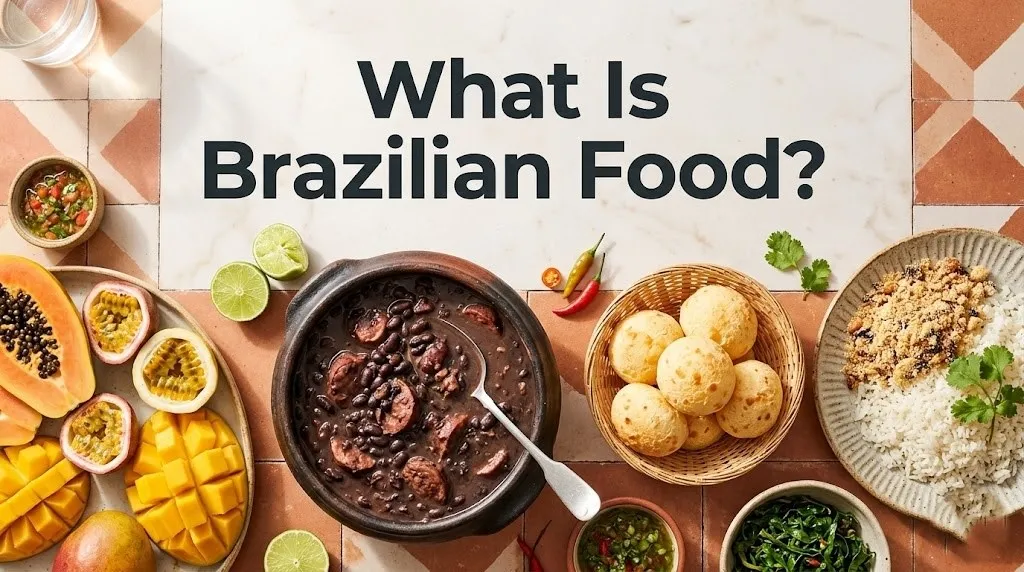
Brazil is known for feijoada, a slow-simmered stew of black beans with smoked and salted pork parts including ears, feet, and sausages, served with rice, sauteed collard greens, toasted cassava flour (farofa), and orange slices. The dish is so iconic that it is often called the national food, though Brazilians debate whether any single dish can represent such a vast country.
Feijoada’s origins are contested. The popular story that enslaved people created it from the pork cuts discarded by plantation owners is now challenged by food historians who trace the dish to European bean and meat stews including French cassoulet and Portuguese cozido. Whatever its precise origin, feijoada became the Saturday lunch tradition across Brazil, a meal meant to be eaten slowly with family over hours, accompanied by a caipirinha and followed by a nap.
Beyond feijoada, Brazil is known for its street food snacks called salgados, which translates to “salty things.” The undisputed king of this category is the coxinha, a teardrop-shaped croquette of shredded chicken encased in a soft dough made from wheat flour and chicken broth, then breaded and fried. Coxinhas are the food Brazilians living abroad miss most acutely, and every bakery and snack bar in Brazil has its own version.
what food does brazil eat
Brazil eats a daily diet built around rice and beans, a pairing that appears on lunch plates across every region and social class, supplemented with a protein, a vegetable, and often farofa or a fried egg. This is not the celebration food of feijoada and churrasco. This is what a Brazilian grandmother cooks on a Tuesday.
The rice and beans combination is nutritionally significant beyond its cultural ubiquity. Rice provides methionine, an essential amino acid that beans lack. Beans provide lysine, which rice lacks. Together they form a complete protein profile that has sustained populations across Latin America for centuries. The beans used vary by region: black beans in Rio de Janeiro, pinto beans in Sao Paulo, and brown beans in Minas Gerais. The rice is typically seasoned with garlic and onion sauteed in oil before the grains are added.
Lunch, called almoco, is the main meal of the day in Brazil. It is typically a sit-down event, even during the workweek. A standard almoco at a por quilo restaurant, the pay-by-weight buffet format that dominates Brazilian lunch culture, includes rice, beans, a protein like grilled chicken or beef, a vegetable, and farofa. Dinner, or jantar, is often lighter: soup, bread with cheese, or leftovers from lunch. Breakfast is small: coffee with milk, bread with butter, and perhaps a slice of papaya or a piece of pao de queijo.
what is brazil famous for food
Brazil is famous for pao de queijo, a small, puffy cheese roll with a crispy exterior and a chewy, almost hollow interior, made from sour cassava starch, eggs, oil, and Minas cheese. These rolls are naturally gluten-free, widely available from bakeries and supermarkets, and universally beloved in a way that transcends regional divisions.
The magic of pao de queijo lies in the cassava starch, specifically polvilho azedo, which is sour or fermented cassava starch. This ingredient gives the rolls their distinctive chewy texture and hollow interior. Standard sweet cassava starch produces a denser roll. The cheese is typically Minas curado, a cow’s milk cheese from the state of Minas Gerais that is semi-hard and salty. Parmesan works as a substitute outside Brazil, though the flavor profile shifts.
Brazil is also famous for moqueca, a seafood stew that comes in two distinct regional styles. The Bahian version, moqueca baiana, is made with coconut milk, dende oil, tomatoes, onions, garlic, cilantro, and firm white fish or shrimp. It is cooked in a clay pot and served with rice and farofa. The Espirito Santo version, moqueca capixaba, omits the coconut milk and dende oil, relying instead on annatto for color and a cleaner seafood flavor. Both are outstanding, and arguing over which is superior is a reliable way to start a friendly fight among Brazilians.
Key Takeaway: Brazilian food is not one thing. It is a daily rhythm of rice and beans, a celebration tradition of feijoada and churrasco, a street snack culture of coxinhas and pao de queijo, and a regional map where each state brings its own ingredients.
what is brazil’s traditional food
Brazil’s traditional food is best understood not as a single dish but as a set of regional cuisines that developed based on local ingredients and historical settlement patterns. The food of the Amazon is indigenous and river-based. The food of Bahia is African-inflected and seafood-heavy. The food of Minas Gerais is Portuguese farmhouse cooking adapted to the Brazilian interior.
The Amazonian tradition centers on freshwater fish like tambaqui and pirarucu, cooked simply or in stews thickened with tucupi, a yellow liquid extracted from wild cassava. Tucupi is lightly fermented and must be boiled for several hours to remove naturally occurring cyanogenic compounds before it is safe to eat. The famous dish pato no tucupi combines duck with this seasoned cassava broth and jambu leaves, which produce a tingling, almost numbing sensation on the tongue.
Mineira cuisine, from the state of Minas Gerais, is the comfort food heart of Brazil. It features pork dishes like feijao tropeiro, beans mixed with toasted cassava flour, sausage, bacon, and collard greens. Pao de queijo is a mineiro invention. The region’s queijo Minas cheese appears on tables across the country. Mineira food is unfussy, generous, and designed to fuel a day of physical labor.
Baiana cuisine, from the state of Bahia, is the most African-influenced regional cooking in Brazil. Acaraje, a fried black-eyed pea fritter stuffed with vatapa and caruru, is both street food and sacred food in the Candomble religion. The use of dende oil, coconut milk, and okra are direct culinary inheritances from West and Central Africa. The flavors are bold, rich, and entirely distinct from the Portuguese-leaning cuisines further south.
| Region | Key Ingredients | Iconic Dishes | Cultural Influence |
|---|---|---|---|
| Amazon (North) | Cassava, freshwater fish, tucupi, jambu, cupuacu | Pato no tucupi, tacaca, grilled pirarucu | Indigenous |
| Bahia (Northeast) | Dende oil, coconut milk, okra, black-eyed peas, seafood | Acaraje, moqueca baiana, vatapa | African and Afro-Brazilian |
| Minas Gerais (Southeast) | Pork, corn, cassava, Minas cheese, collards | Pao de queijo, feijao tropeiro, tutu de feijao | Portuguese colonial |
| Rio Grande do Sul (South) | Beef, chimarrao (yerba mate), wheat | Churrasco, picanha, arroz carreteiro | Gaucho and European immigrant |
what is the national food of brazil
Brazil does not have an officially designated national dish, but feijoada holds that position in the popular imagination and is universally cited as the food that best represents the country on the global stage. It is the dish Brazilians serve to foreign guests, the one featured in international food media, and the meal around which Saturday gatherings are organized.
The debate over feijoada’s status reveals something genuine about Brazilian identity. A country this large and diverse resists singular representation. People from the Amazon might argue that their river fish and cassava traditions are more authentically Brazilian than a dish associated with Rio de Janeiro and the Southeast. Northeasterners might point to acaraje and moqueca. Gauchos might wave a skewer of picanha. No one wins this argument because no single food can stand for the entire country.
If a formal designation were ever made, feijoada completa would be the likely choice. The “completa” refers to the full spread: the bean and meat stew itself, steamed white rice, finely sliced sauteed collard greens, farofa, orange slices, and a spoon of malagueta pepper sauce. The orange is not decorative. Its acidity cuts through the richness of the stew. The farofa adds crunch and absorbs the bean broth. The collards provide a bitter, mineral note that balances the fatty pork. The dish works as a complete sensory system, and that systems-level thinking is what makes it a legitimate national food.
what is brazil’s most popular food
Brazil’s most popular everyday food is not feijoada or churrasco but rice and beans, consumed by the vast majority of the population as the foundation of the midday meal. If you are measuring by frequency of consumption rather than cultural fame, the combination of rice, beans, and some form of protein wins by an enormous margin.
Research conducted by the Brazilian Institute of Geography and Statistics confirms that rice and beans are consumed by over 70 percent of the population regularly. The combination has even been the subject of public health campaigns. The Brazilian Ministry of Health’s dietary guidelines explicitly recommend the rice and beans combination as a healthy traditional pattern, noting that the meal delivers complete protein, dietary fiber, B vitamins, and minerals including iron, magnesium, and potassium.
Beyond the daily staple, pao de queijo is arguably the most universally beloved single food item in Brazil. It crosses regional, class, and age boundaries. You find it at gas stations and high-end bakeries, at breakfast and as an afternoon snack with coffee. Its gluten-free nature, which was an accident of cassava starch being the available ingredient, has made it a global phenomenon as gluten-free eating has expanded. A fresh pao de queijo, split open while still steaming, is one of the small perfect food experiences available in Brazil.
what food do brazilians eat
Brazilians eat a diet that centers lunch as the main meal, features fresh tropical fruits and fruit juices daily, and treats bread and coffee as non-negotiable breakfast items. The eating pattern varies significantly by region, income level, and urban versus rural setting, but certain structural elements are widely shared.
Breakfast, or cafe da manha, is typically small. A cup of strong coffee with hot milk, a bread roll or a piece of pao de queijo with butter, and a slice of papaya or a banana covers the basics. In the Northeast, cuscuz made from corn flour and steamed with salt is a common breakfast starch. Tapioca crepes filled with cheese or coconut are a popular gluten-free breakfast option that has spread from the Northeast to the rest of the country.
Lunch is the anchor. A plate at a self-service buffet restaurant will typically include rice, beans, a grilled protein, sauteed vegetables or a salad, farofa, and perhaps a fried egg on top of the rice. This plate costs by weight and provides a balanced meal for a reasonable price. Dinner is the lightest meal of the three. Soup, a small sandwich, or leftover rice and beans from lunch are common. Misto quente, a grilled ham and cheese sandwich, is a typical evening snack ordered at juice bars and cafes across the country.
what kind of food does brazil eat
Brazil eats a cuisine that can be broadly categorized into home cooking, street food, and celebration food, with each category occupying a distinct place in daily life and drawing on different ingredient traditions. Understanding these categories helps a visitor navigate what to order and when.
Home cooking in Brazil relies on the pantry staples of rice, dry beans, garlic, onion, salt, and oil, supplemented by cassava flour, pasta, and whatever protein and vegetables are affordable and available. This is not flashy food. It is economical, nutritious, and deeply ingrained. The Academy of Nutrition and Dietetics has noted that traditional dietary patterns like this, which are built around legumes and grains with modest animal protein, align well with current public health guidance for chronic disease prevention.
Street food and snack bar culture form the second category. Every Brazilian city has lanchonetes, small counter-service spots selling coxinhas, pao de queijo, empadas (small savory pies), and pastel (thin, crispy fried pastries filled with cheese, meat, or hearts of palm). These are eaten between meals, with coffee, or as a quick lunch alternative. They are not health foods, and Brazilians understand this. They are pleasure foods, consumed in the context of an otherwise whole-food-based diet.
| Meal Category | Typical Foods | When Eaten | Nutritional Character |
|---|---|---|---|
| Home Cooking | Rice, beans, grilled meat, vegetables, farofa | Daily lunch | Balanced, whole-food-based |
| Street Food/Snacks | Coxinha, pastel, pao de queijo, empada | Between meals, quick lunch | Calorie-dense, fried, pleasure-focused |
| Celebration Food | Feijoada, churrasco, moqueca | Weekends, holidays | Rich, abundant, social |
what is brazillian food
Brazilian food is the sum of its regional cuisines, its indigenous, African, and Portuguese roots, and its contemporary urban food culture that has made the city of Sao Paulo one of the world’s great eating destinations. The spelling “brazillian” with two L’s is a common misspelling of “Brazilian,” but the question it represents is genuine: what defines this food for someone encountering it for the first time.
The answer starts with ingredients that appear nowhere else at the same scale. Dende oil is an orange-red palm oil that gives Bahian food its characteristic color and richness. It is high in saturated fat and also rich in carotenoids, the same pigment family that colors carrots. Tucupi is a fermented cassava broth that is mildly poisonous raw and delicious cooked. Polvilho azedo is sour cassava starch that creates the distinctive chew of pao de queijo and the elasticity of tapioca crepes. These are not minor variants on familiar ingredients. They are wholly distinct building blocks.
Brazilian food is also defined by its juice culture. Suco de maracuja, passion fruit juice, is ubiquitous. Caldo de cana, sugarcane juice pressed to order and served with a squeeze of lime, is a street vendor staple. Agua de coco, chilled coconut water served directly in the fruit, is available at beaches, parks, and kiosks nationwide. A country where fresh-pressed juice is cheaper than soda is a country whose food culture has something valuable to teach.
Key Takeaway: Brazilian food is ingredient-driven, not spice-driven. It relies on the quality of cassava, beans, tropical fruits, and specific cuts of meat, prepared simply and eaten in a social context that values time and company as much as flavor.
what is brazil’s favorite food
Brazil does not have one favorite food, but if polling were done at the national level, pao de queijo would likely win the snack category, feijoada would win the celebration category, and coxinha would win the “food you miss most when you leave Brazil” category. These three foods represent the spectrum of Brazilian eating: the daily comfort, the weekend feast, and the portable pleasure.
The love for coxinha deserves special attention because it is not immediately obvious to outsiders why a fried chicken croquette inspires such devotion. The answer is in the texture: a crisp, thin shell that shatters on contact, a soft, savory dough layer underneath, and a moist, seasoned shredded chicken center. The shape, meant to resemble a chicken drumstick, is part of the ritual. The size varies from small party portions to the massive coxinha de feira sold at street markets. Every Brazilian has a strong opinion about where the best coxinha in their city is made.
Brigadeiro, a chocolate truffle made from condensed milk, butter, and cocoa powder rolled in chocolate sprinkles, is the dessert equivalent of a favorite food. It is served at every birthday party, celebration, and informal gathering. Making brigadeiros at home is a common activity for children and families. The recipe is three ingredients and a saucepan. Its simplicity is the point. Brazil’s favorite foods tend toward the straightforward and the satisfying, not the technically elaborate.
what is the food of brazil
The food of Brazil is a living, evolving system of ingredients, dishes, and eating customs that reflects the country’s history as a meeting point of indigenous, European, African, and later immigrant cultures including Japanese, Italian, and Lebanese communities. It is a cuisine that rewards curiosity and resists easy summary.
Sao Paulo, the largest city in South America, houses the world’s largest Japanese diaspora population. The result is a Brazilian-Japanese fusion that has produced dishes like temaki de salmao com cream cheese, salmon and cream cheese hand rolls, and the use of Brazilian fruits in Japanese dessert formats. Italian immigration shaped the pasta culture of the South and Southeast. Pizza paulistana is a style of thin-crust pizza that Paulistanos will defend fiercely against any criticism from New York or Naples.
Lebanese immigration introduced esfiha, an open-faced meat pie, and quibe, a bulgur wheat and meat croquette, both of which are now standard items at bakeries and snack bars across the country. The presence of these foods alongside acaraje and pao de queijo is not fusion in the contemporary restaurant sense. It is the result of generations of people living, cooking, and adapting their traditions to Brazilian ingredients and Brazilian tastes.
| Immigrant Community | Contributions to Brazilian Food |
|---|---|
| Japanese | Temaki, sushi with Brazilian fruits, yakisoba at street markets |
| Italian | Pizza paulistana, fresh pasta, polenta in the South |
| Lebanese/Syrian | Esfiha, quibe, tabule |
| German | Sausages in the South, strudel, beer-brewing traditions |
Frequently Asked Questions About Brazilian Food
What are the most popular Brazilian dishes?
The most popular Brazilian dishes include feijoada, pao de queijo, coxinha, moqueca, and churrasco.
Rice and beans are the everyday foundation eaten by most Brazilians at lunch.
Acaraje and vatapa are iconic street foods from the state of Bahia.
Is Brazilian food spicy?
Brazilian food is generally not spicy in the sense of chili heat, though malagueta pepper sauce is served on the side for those who want to add heat.
The cuisine relies on garlic, onion, cilantro, and herbs for flavor rather than chilies.
The exception is Bahian food, which uses dende oil and malagueta pepper more liberally than other regions.
Is Brazilian food healthy?
Traditional Brazilian food based on rice, beans, grilled meats, vegetables, and fresh fruit is a healthy, whole-food dietary pattern.
The Brazilian Ministry of Health’s dietary guidelines promote this traditional eating pattern over ultra-processed foods.
Fried street snacks like coxinhas and pastels are pleasure foods and should be eaten in moderation.
What is the most eaten food in Brazil?
Rice and beans are the most eaten foods in Brazil, forming the base of the main lunch meal across all regions.
This combination is consumed by more than 70 percent of the population according to national dietary surveys.
The beans provide fiber and iron while the rice provides energy and together they form a complete protein.
Is Brazilian food gluten-free?
Many traditional Brazilian foods are naturally gluten-free because cassava starch replaces wheat flour in key dishes.
Pao de queijo, tapioca crepes, and farofa are all made from cassava and contain no wheat gluten.
However, coxinhas, pastels, and many snack foods use wheat flour, so check with the vendor if you have celiac disease or gluten sensitivity.
Brazilian food is a cuisine you understand by eating, not by reading. The combination of rice and beans that anchors the daily plate, the pao de queijo that accompanies a mid-afternoon coffee, the feijoada that turns a Saturday into an event, and the fresh juice that makes a hot day bearable all tell the story better than any guidebook can.
If you are new to this food, start simple. Find a Brazilian bakery and order a pao de queijo and a coxinha. Find a restaurant that serves feijoada on Saturdays and go with a group. Buy a bag of polvilho azedo and try making pao de queijo at home. The ingredients are increasingly available at Latin grocery stores and online.
What you will discover is a cuisine that is generous, unpretentious, and built on a foundation of ingredients that have nourished generations. Brazilian food is not a trend. It is a vast, deep culinary tradition that rewards every level of engagement.