Food cravings in pregnancy typically start between week 6 and week 12 of the first trimester, peaking in intensity during the second trimester and often tapering off in the third. Most pregnant people notice the first distinct, undeniable urge for a specific food sometime during that six-week window, right alongside the morning sickness and fatigue that define early pregnancy.
According to research published in Frontiers in Psychology, an estimated 50 to 90 percent of pregnant people in the United States experience food cravings at some point during gestation. This is not a cultural quirk or a learned behavior. It is a near-universal biological phenomenon with documented hormonal and nutritional underpinnings. The American College of Obstetricians and Gynecologists recognizes food cravings and aversions as common physiological experiences of pregnancy, not as psychological weaknesses or indicators of nutritional deficiency in most cases.
This article maps out the exact timeline of when cravings begin, why they are so intense during those specific weeks, and how to distinguish a craving from an aversion. You will learn which cravings are the most common across populations, what the science says about the hormonal mechanisms driving you toward pickles at midnight, and how to manage even the most persistent food urges in a way that supports a healthy pregnancy.
When Do Food Cravings Start in Pregnancy
Food cravings during pregnancy most commonly start between the sixth and twelfth week of gestation, which falls squarely in the first trimester and overlaps with the period when human chorionic gonadotropin, or hCG, reaches its highest concentration in the bloodstream. This timing is not random. It is hormonally driven.
The sixth week of pregnancy is roughly two weeks after a missed period for someone with a regular 28-day cycle. By this point, the embryo has implanted in the uterine lining and the placenta is beginning to form. The hormone hCG, produced by the developing placenta, doubles roughly every 48 to 72 hours during these early weeks, peaking around week 10 to 12 before declining and stabilizing. This hCG surge is the same hormonal event that triggers morning sickness, and it is closely associated with the onset of food cravings and aversions. If you wake up at week 7 suddenly repulsed by coffee but desperate for a specific brand of orange juice, you can thank the hCG flooding your system.
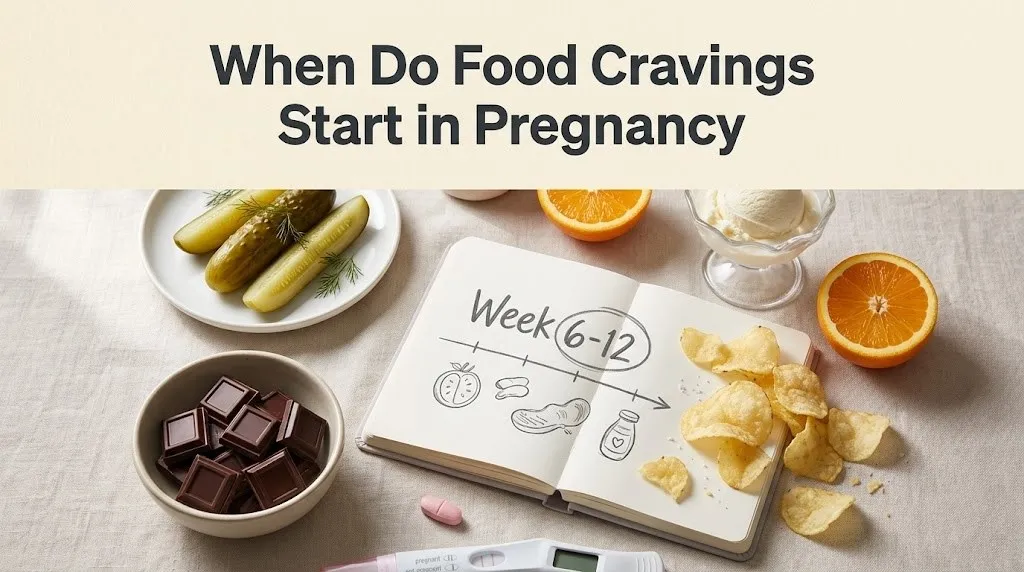
Not everyone experiences cravings on this exact schedule. Some people notice a heightened interest in certain foods as early as week 4 or 5, before they have even taken a pregnancy test. Others do not develop strong cravings until the second trimester, when morning sickness fades and appetite returns. A minority of pregnant people never experience food cravings at all, which is also completely normal and not a sign of any problem with the pregnancy. The range of normal is wide, but the central tendency, the experience of the average pregnant person, is that cravings arrive in the early first trimester and intensify as the weeks progress.
| Trimester | Gestational Weeks | Craving Experience |
|---|---|---|
| First Trimester | Weeks 1 to 13 | Cravings typically begin between weeks 6 and 12, often alongside food aversions and morning sickness |
| Second Trimester | Weeks 14 to 27 | Cravings often peak in intensity and specificity as nausea fades and appetite rebounds |
| Third Trimester | Weeks 28 to 40 | Cravings may persist but often decrease as the growing uterus compresses the stomach and appetite naturally shifts |
Key Takeaway: The hCG surge that peaks around week 10 to 12 is the same biological event that triggers morning sickness and the first unmistakable food cravings. The two experiences share a hormonal origin.
When Do Pregnancy Food Cravings Start
Pregnancy food cravings start for the majority of people during the first trimester, with a pronounced clustering of onset between weeks 6 and 14, a window that captures the late first trimester and the early second trimester. Some researchers describe this as the “craving window,” the period when hormonal flux is at its most dramatic and the sensory systems governing taste and smell are most disrupted.
The distinction between “when do food cravings start” and “when do pregnancy food cravings start” is negligible in practice. The questions are functionally identical and reflect different phrasing of the same search intent. The answer does not change. The onset window is the first trimester, with the caveat that “start” refers to the first time a pregnant person recognizes a thought pattern that goes beyond ordinary hunger and into the territory of an urgent, specific desire for a particular food.
A 2021 study in the Journal of the Academy of Nutrition and Dietetics surveyed pregnant people about the timing and nature of their cravings and found that the average reported onset was between week 7 and week 8. The study noted that cravings tended to shift in content across trimesters, with sweet cravings more common in the first trimester and savory, protein-rich cravings more common in the second. This shift may reflect changing nutritional demands as the pregnancy progresses, though the evidence for a direct causal link between a specific nutrient deficiency and a specific craving remains limited and inconsistent across studies.
How Early Do Food Cravings Start in Pregnancy
Food cravings can start as early as the fifth week of pregnancy, which is roughly one week after a missed period and often before the pregnant person has had their first prenatal appointment. This is the earliest documented onset, though the majority of people who experience cravings will notice them slightly later, between weeks 6 and 8.
The possibility of very early cravings creates a specific experience for the newly pregnant person. They may not yet know they are pregnant or may have only just received a positive test. They are still processing the news, and suddenly they are hit with an overwhelming urge to eat something they have not thought about in years. This can be disorienting, and it can also serve as an early physical confirmation of the pregnancy at a stage when there is no visible bump and the only other symptom may be breast tenderness or fatigue. The craving becomes one of the first embodied signs that something is genuinely different.
For people who are actively trying to conceive, the question of how early cravings can start is often loaded with hope. They are looking for any early signal that this cycle was successful. It is important to be clear that food cravings before a missed period are not a reliable pregnancy indicator. The hormonal shifts of the luteal phase, the two weeks between ovulation and menstruation, can also produce appetite changes and specific food desires. The only way to know if an early craving is a pregnancy craving or a premenstrual craving is to take a pregnancy test.
- Craving onset before week 5 is rare and difficult to distinguish from luteal phase appetite changes.
- Weeks 6 to 8 represent the most common onset window reported in survey-based research.
- Some people report cravings beginning before their positive pregnancy test, but this is anecdotal and not verifiable by test-timing research.
When Do You Start Getting Food Cravings in Pregnancy
You start getting food cravings in pregnancy most often between the sixth and eighth week, which is when the combined effects of rising hCG, increasing estrogen, and a heightened sense of smell converge to fundamentally alter your relationship with food. The word “getting” implies a gradual onset, and for many people, that is exactly how it happens. Cravings do not always arrive as a sudden lightning bolt. They can start as a quiet, persistent thought that grows louder over days.
The early signs that a craving is developing include finding yourself thinking about a specific food at odd times, noticing that a food you normally enjoy tastes different or more intense, and feeling a sense of satisfaction or relief when you eat the craved food that goes beyond ordinary hunger satisfaction. These early signals can be subtle, and many people do not recognize them as pregnancy cravings until the pattern has been established for a week or two. Retrospectively, they realize they have been eating bagels with cream cheese every morning not just because it was convenient, but because it was the only thing that felt right.
The onset of cravings also interacts with the onset of aversions. The two phenomena are linked neurologically and hormonally. The same mechanism that makes certain foods smell repulsive, often coffee, meat, or eggs, may simultaneously narrow your acceptable food list and make the remaining acceptable foods intensely desirable. You do not just want a baked potato. You want a baked potato because it is one of five things that does not make you gag. The craving exists in the negative space created by the aversions.
How Soon Do Food Cravings Start in Pregnancy
Food cravings can start as soon as the fifth or sixth week of pregnancy, which is soon enough that they often serve as one of the earliest physical symptoms of pregnancy alongside nausea, breast tenderness, and fatigue. The phrase “how soon” asks for the earliest possible onset, and the answer is that cravings are a first-trimester symptom that can arrive almost as early as the positive test itself.
The earliest cravings tend to be less specific than the classic “pickles and ice cream” stereotype. In the very early weeks, cravings may manifest as a general pull toward salty carbohydrates, such as crackers, chips, or buttered toast, or a sudden preference for cold, creamy foods like yogurt or milkshakes. These early cravings are sometimes functional. Salted carbohydrates can help settle a queasy stomach, and cold foods lack the strong aromas that trigger aversions in a newly scent-sensitive pregnant nose. The body may be learning what works before it starts sending urgent signals for very specific items.
The earliest possible craving onset, before week 5, is difficult to attribute definitively to pregnancy rather than to the luteal phase or to psychological expectation. The corpus luteum, the temporary endocrine structure that forms after ovulation, produces progesterone that can mimic some early pregnancy symptoms. Once hCG rises enough to sustain the corpus luteum and the placenta begins producing its own hormones, the craving signals become more pronounced and more clearly pregnancy-related. This is the transition that happens between weeks 5 and 7 for most people.
Key Takeaway: Cravings can arrive as early as week 5 or 6, making them one of the earliest pregnancy symptoms. The earliest cravings are often general pulls toward salty carbs or cold, creamy foods that settle the stomach.
When Do You Start Craving Food When Pregnant
You start craving food when pregnant during the first trimester, typically between weeks 6 and 12, a window during which your body is undergoing the most rapid hormonal transformation it will experience during the entire 40 weeks of gestation. The word “craving” here is doing specific work. It is not about being hungry. It is about a focused, urgent desire for a specific taste, texture, or food that feels compelling and satisfying in a way that ordinary hunger does not.
The experience of a pregnancy craving is qualitatively different from regular appetite. A person who is not pregnant might think, “I could go for some chocolate.” A pregnant person experiencing a craving thinks, “I need to eat a Snickers bar, and if I do not get one in the next 20 minutes, I will cry.” The urgency, specificity, and emotional intensity distinguish a craving from ordinary hunger. This intensity is hormonally mediated. The same neurological pathways that evolved to drive a mother to seek out calorie-dense, nutrient-rich foods during pregnancy are being activated by the hormonal milieu, and they do not operate with subtlety.
The timing of craving onset also correlates with the timing of nausea resolution. For many people, the worst of morning sickness occurs between weeks 8 and 12 and begins to lift as hCG levels stabilize or decline in the early second trimester. As the nausea recedes, appetite returns, and it often returns with a vengeance. The second trimester is when cravings hit their peak intensity for many pregnant people. The body has been in a state of food restriction, either from nausea or from aversions, and the lifting of that restriction combined with the increasing energy demands of the growing fetus creates a perfect storm for intense food desires.
When Do Food Cravings Start During Pregnancy
Food cravings start during pregnancy in the first trimester, with the majority of people reporting onset by week 12, though the second trimester is when cravings reach their maximum intensity and frequency for most. The timing has a trajectory. Cravings begin, build, peak, and often subside.
The first trimester onset is the most common answer to the “when do they start” question, but it is incomplete without acknowledging that cravings are a dynamic experience that changes across the pregnancy. A craving for citrus fruit at week 8 may evolve into a craving for cheeseburgers at week 20 and then into a craving for ice cream at week 30. The content of the cravings shifts as the pregnancy progresses and as the nutritional and metabolic demands of the growing fetus change. The second trimester, when the fetus is building lean mass and the maternal blood volume is expanding dramatically, is when many people report the strongest protein and iron-rich food cravings, such as red meat.
The third trimester often brings a shift in craving patterns again. As the uterus expands upward and compresses the stomach, the physical capacity for large meals decreases. Heartburn becomes more common. Cravings for heavy, rich, or large-volume foods may naturally diminish, replaced by a preference for smaller, more frequent snacks. Some people report that their cravings disappear entirely in the final weeks before delivery, replaced by a general disinterest in food or a functional focus on eating for energy rather than pleasure.
When Do You Get Food Cravings in Pregnancy
You get food cravings in pregnancy most consistently during the first and second trimesters, with the second trimester representing the peak period of craving frequency and intensity for most people. The word “get” in this phrasing implies acquisition, and the acquisition of food cravings is a gradual process that builds across the early weeks of pregnancy.
The trajectory is not the same for everyone. For some, cravings arrive suddenly and forcefully. A person who has never liked spicy food wakes up at week 9 and cannot stop thinking about jalapenos. For others, cravings build gradually. A general preference for cold, creamy foods in the first trimester slowly crystallizes into a specific daily need for a particular brand of yogurt by week 14. Both patterns are normal. The sudden-onset pattern is more dramatic and more likely to be remembered and recounted. The gradual pattern is probably more common but less remarked upon because it is less stark.
The question of “when do you get them” is also a question about when you recognize them. Many people do not identify their food urges as pregnancy cravings until someone else points it out. They have been eating the same sandwich every day for two weeks, and a partner or coworker says, “Is that a craving?” The recognition often lags behind the behavior. From a research perspective, this makes the precise timing of craving onset difficult to study, because it relies on self-report and self-awareness, both of which are subjective.
How Early Do You Start Craving Food in Pregnancy
You can start craving food as early as the fifth week of pregnancy, though cravings that begin this early are often subtle and easily confused with premenstrual appetite changes or general hunger. The question of how early cravings can start is really a question about the earliest possible signal the body can send.
The fifth week of pregnancy, calculated from the first day of the last menstrual period, is only about one week past a missed period. At this stage, the embryo is the size of a sesame seed, and hCG levels are rising rapidly but may not yet be high enough to trigger the full sensory disruption that drives pronounced cravings. Some people are exquisitely sensitive to hormonal changes and notice shifts in appetite and food preference at this very early stage. Others have elevated hCG levels for weeks before any food-related symptoms appear. Sensitivity to hCG and the downstream hormonal effects varies from person to person and from pregnancy to pregnancy. The same person may have early cravings in one pregnancy and no cravings until the second trimester in the next.
If you are in the two-week wait between ovulation and your expected period and you notice a strong food craving, it is not possible to attribute it to pregnancy with any certainty. Progesterone, which rises after ovulation regardless of conception status, can influence appetite. The psychological state of hoping to be pregnant can also heighten awareness of physical sensations and create a confirmation bias where normal hunger signals are interpreted as possible pregnancy signs. The only honest answer to “how early” is that cravings can start early enough to be noticeable around the time of a missed period, but they are not a reliable diagnostic tool.
Quick Tip:
- Track your cravings alongside your other symptoms in a pregnancy app or notebook.
- The pattern of cravings over time tells you more than any single craving in isolation.
- If you are trying to conceive, wait for a positive pregnancy test before attributing appetite changes to pregnancy.
When Do You Start to Crave Food in Pregnancy
You start to crave food in pregnancy when the hormonal environment of the first trimester becomes sufficiently established to alter your olfactory sensitivity, your taste perception, and your brain’s reward pathways, which for most people occurs between weeks 6 and 10. The phrase “start to crave” describes the gradual emergence of a new pattern, not a single dramatic event.
The onset of cravings is often preceded by the onset of aversions by a week or two. A person may first notice that coffee smells terrible, that eggs are suddenly repulsive, that the thought of chicken makes them nauseated. As the list of unacceptable foods grows, the list of acceptable foods shrinks, and the foods that remain in the acceptable category start to feel disproportionately appealing. This is the psychological and physiological narrowing that creates the conditions for a craving. You do not just want saltines. You want saltines because they are one of four foods that do not make you feel sick.
This sequential pattern, aversions first, then cravings, makes evolutionary sense. The aversion mechanism may be a protective adaptation to avoid foods that are more likely to harbor pathogens or toxins during the vulnerable first trimester, when organogenesis is occurring. Meat, which spoils easily, and strong-tasting vegetables, which may contain alkaloids or other defensive compounds, are among the most commonly reported aversions. The cravings that follow may be a compensatory mechanism, driving the pregnant person toward calorie-dense, safe foods that will sustain the pregnancy. The system is not perfect, but it has a logical structure.
Key Takeaway: Cravings often follow aversions by a week or two. The foods you crave are sometimes simply the foods that survived the aversion purge, elevated to obsession status by a brain that needs you to eat something.
When Does a Pregnant Woman Start Craving Food
A pregnant woman starts craving food most commonly during the first trimester, between the sixth and twelfth weeks, when the combined influence of human chorionic gonadotropin, estrogen, progesterone, and a dramatically altered sense of smell converge to create the classic pregnancy food urge. The phrasing “a pregnant woman” is a general inquiry about the population-level pattern.
The average onset across multiple studies falls between week 7 and week 8. By week 12, roughly 75 to 85 percent of pregnant people who will experience cravings have already begun to notice them. The remaining 15 to 25 percent either develop cravings later in the second trimester or do not experience them at all. The minority who never develop cravings is estimated at roughly 10 to 15 percent of pregnancies, based on survey data. A lack of cravings is not associated with any adverse pregnancy outcome and should not be a source of concern. It simply reflects the wide variation in how individual bodies respond to the hormonal state of pregnancy.
The onset of cravings is one of the most commonly reported early pregnancy symptoms, ranking alongside fatigue, nausea, breast tenderness, and frequent urination. In popular culture, the pregnancy craving is a well-worn trope, often played for comedy. The lived experience is less funny and more intense than the cultural portrayal suggests. A true pregnancy craving is not a whim. It is a neurologically driven imperative that can be genuinely distressing if the food is unavailable or if the craving is for something unsafe, which occasionally happens with non-food substances, a condition called pica that requires medical attention.
When Do Food Craving Start in Pregnancy
Food cravings start in pregnancy during the first trimester for the vast majority of people, with a typical onset between weeks 6 and 12. The singular “craving” in this phrasing is a minor grammatical variation that does not change the clinical answer.
The hormonal mechanism is well-established. Human chorionic gonadotropin, produced by the syncytiotrophoblast cells of the developing placenta, rises exponentially in early pregnancy, doubling every 48 to 72 hours until it peaks around week 10 to 12. This hormone stimulates the corpus luteum to continue producing progesterone and estrogen, which sustain the uterine lining and prevent menstruation. It also cross-reacts with the thyroid-stimulating hormone receptor, potentially contributing to the nausea and metabolic changes of early pregnancy. The exact mechanism by which hCG influences food cravings is not fully mapped, but the temporal correlation between the hCG curve and the craving onset curve is strong enough that researchers consider hCG a primary driver.
Estrogen, which also rises dramatically during the first trimester, increases olfactory sensitivity. This heightened sense of smell, called hyperosmia, is why a pregnant person can detect the scent of a coworker’s lunch from across the office or be repulsed by the smell of their own refrigerator. Hyperosmia is one of the most powerful drivers of food aversions, and by narrowing the field of acceptable foods, it indirectly shapes the content of food cravings. You crave what does not smell bad to you, and in early pregnancy, that is a very short list.
Pregnancy Cravings vs Aversions Timeline
Food aversions typically appear before food cravings in pregnancy, with aversions often striking as early as week 4 or 5 and cravings following around week 6 to 8, though both phenomena share the same hormonal origins and often coexist throughout the first and second trimesters. The timeline difference is subtle but clinically observable.
Aversions are the first sensory disruption most pregnant people notice. Coffee is the most commonly reported aversion, followed by meat, eggs, and strong-smelling vegetables. These aversions are likely driven by the pregnancy-induced hyperosmia that makes certain volatile organic compounds overwhelming and nauseating. The aversions serve a plausible protective function by steering the pregnant person away from foods with higher pathogen risk during the period when the fetus is most vulnerable to teratogens. This is the “maternal and embryonic protection hypothesis,” and while it is difficult to prove definitively, it is consistent with the timing and the types of foods most commonly avoided.
Cravings appear slightly later and may represent a compensatory mechanism. Once the list of acceptable foods has been narrowed by aversions, the brain’s reward system may amplify the appeal of the remaining safe foods to ensure adequate caloric intake. This is not a conscious process. It is a subcortical, hormonally mediated shift in dopamine signaling and neuropeptide Y activity. The craving is the brain’s way of saying, “You can eat this, and you need to eat something, so eat this now.” The intensity of the craving reflects the urgency of the biological drive, not the nutritional content of the craved food.
| Phenomenon | Typical Onset | Peak Period | Common Triggers |
|---|---|---|---|
| Food Aversions | Week 4 to 6 | First trimester, weeks 6 to 14 | Coffee, meat, eggs, strong odors |
| Food Cravings | Week 6 to 8 | Late first trimester into second trimester | Sweet, salty, high-fat foods, specific cultural items |
Most Common Pregnancy Food Cravings
The most common pregnancy food cravings across populations are sweets, particularly chocolate, followed by high-salt snacks such as chips and pickles, dairy products including ice cream and cheese, and fruit, especially citrus and watermelon. These four categories account for the majority of self-reported cravings in survey research.
Chocolate is the single most commonly craved food in pregnancy in Western populations. A 2022 study in the journal Nutrients surveyed over 2,000 pregnant people and found that chocolate was the top-reported craving, cited by nearly 40 percent of respondents. The appeal of chocolate may be multi-factorial. It is sweet, fatty, and contains psychoactive compounds including theobromine and small amounts of caffeine. It also triggers dopamine release in the brain’s reward pathways. During pregnancy, when the reward system is sensitized by hormonal changes, chocolate becomes an especially potent source of pleasure and comfort.
Pickles and other high-salt, sour, or vinegary foods are the second most iconic craving category, and they may serve a functional purpose. Blood volume expands by approximately 50 percent during pregnancy, which increases the body’s demand for sodium to maintain fluid balance and blood pressure. A craving for pickles, olives, or salted chips may reflect a genuine physiological need for more dietary sodium. The sour component of pickles and citrus fruits may also help combat the metallic taste, called dysgeusia, that many pregnant people experience in the first trimester.
- Chocolate is the most commonly craved food in Western pregnancy populations.
- Pickles, olives, and chips may reflect an increased physiological need for sodium due to blood volume expansion.
- Dairy products provide calcium and protein, both in high demand during pregnancy.
- Fruit, especially citrus and watermelon, may help combat the metallic taste of early pregnancy and provide hydration.
Key Takeaway: The most common cravings, sweets, salt, dairy, and fruit, make biological sense against the backdrop of pregnancy’s metabolic demands. The body may not be wise, but it is not random.
How to Manage Pregnancy Cravings
Managing pregnancy cravings involves honoring the craving in a structured, portion-controlled way that satisfies the sensory urge without displacing the nutrient-dense foods that support fetal development. The goal is not to suppress cravings entirely. It is to integrate them into an overall healthy dietary pattern.
The least effective strategy is complete denial. Telling a pregnant person to ignore a craving through sheer willpower is nutritionally and psychologically unrealistic. The craving is hormonally driven and neurologically reinforced. It will not go away because a dietitian says it should. Complete denial often leads to a binge-restrict cycle where the craved food is eventually consumed in excess because the restriction became unsustainable. The more effective strategy is planned indulgence. If you crave ice cream every night, buy a high-quality pint, portion a half-cup into a small bowl, eat it slowly, and enjoy it without guilt. The craving is satisfied. The portion is controlled. The nutritional damage is minimal.
Another effective strategy is substitution that addresses the sensory profile of the craving rather than the exact food. A craving for salty, crunchy chips might be addressed with roasted chickpeas tossed in olive oil and sea salt. A craving for a milkshake might be addressed with a smoothie made from frozen banana, Greek yogurt, a tablespoon of cocoa powder, and milk. These substitutions deliver the cold, creamy, sweet, or salty experience the craving demands while adding protein, fiber, and micronutrients that the craved food might lack.
- Plan your indulgences. Buy single-serving portions of the craved food to avoid finishing an entire family-sized package.
- Pair the craved food with a nutrient-dense food. Eat your pickles alongside a cheese stick for protein and calcium.
- Identify the sensory profile you want. Salty crunch, cold and creamy, sweet and fatty. Find a more nutrient-dense food that matches it.
Pica Cravings During Pregnancy Warning Signs
Pica is a condition where a pregnant person craves and consumes non-food substances such as ice, clay, starch, dirt, or chalk, and it is a warning sign that requires medical evaluation because it is strongly associated with iron deficiency anemia and can pose serious health risks to both the pregnant person and the fetus. Pica is not a quirky craving. It is a symptom.
The most common form of pica in pregnancy is pagophagia, which is the compulsive consumption of ice. Craving ice is not the same as enjoying a cold drink on a hot day. Pagophagia involves eating multiple cups or trays of ice daily, often chewing it for extended periods. This behavior is so strongly correlated with iron deficiency that the American College of Obstetricians and Gynecologists includes it as a screening question for anemia. If you find yourself eating ice compulsively, tell your prenatal care provider. A simple blood test for serum ferritin and hemoglobin can identify or rule out iron deficiency, and supplementation often resolves the craving within days to weeks.
Other forms of pica, such as eating laundry starch (amylophagia), clay or dirt (geophagia), or chalk, are less common but more dangerous. These substances can contain lead, parasites, or other contaminants. They can also displace nutrient-dense foods and cause bowel obstructions. If you are craving any non-food substance, do not indulge the craving. Call your prenatal care provider that day. This is a medical issue, not a dietary preference, and it needs professional evaluation and treatment.
- Craving ice compulsively (pagophagia) is the most common form of pica and is linked to iron deficiency anemia.
- Craving starch, clay, dirt, or chalk is less common and more dangerous due to contamination and obstruction risks.
- Pica cravings are not something to manage at home. Tell your prenatal provider promptly.
Healthy Pregnancy Craving Substitutes
Healthy substitutes for common pregnancy cravings can satisfy the sensory urge while providing more of the nutrients pregnancy demands, such as calcium, iron, protein, and folate. The substitution strategy is not about deprivation. It is about building a better version of the craving.
For a sweet, creamy craving like ice cream, a smoothie made from frozen banana, plain Greek yogurt, a tablespoon of unsweetened cocoa powder, and a splash of milk delivers the cold, thick, sweet experience with roughly 15 grams of protein, 300 milligrams of calcium, and no added sugar beyond the natural sugars in the banana and milk. The protein and fat from the yogurt provide satiety that ice cream alone would not, potentially reducing the intensity of the craving for longer.
For a salty, crunchy craving like chips, roasted chickpeas or shelled edamame tossed in olive oil and salt and roasted at 400 degrees Fahrenheit until crispy deliver the salt and crunch with fiber, protein, and iron. A cup of roasted chickpeas provides roughly 15 grams of protein and 12 grams of fiber, compared to 2 grams of protein and 1 gram of fiber in a comparable serving of potato chips. For a sour craving like pickles, fresh cucumber slices soaked briefly in vinegar with a pinch of salt and sugar provide the sour-salty profile with fewer additives and less sodium than commercially jarred pickles.
| Craving | Craved Food | Healthier Substitute | Nutritional Upgrade |
|---|---|---|---|
| Sweet and creamy | Ice cream | Greek yogurt with cocoa and frozen banana | Adds 15g protein, 300mg calcium |
| Salty and crunchy | Potato chips | Roasted chickpeas or edamame | Adds 13g protein, 11g fiber |
| Sour and salty | Jarred pickles | Quick-pickled cucumber in vinegar | Reduces sodium, no preservatives |
| Chocolate | Candy bar | Square of dark chocolate (70%+) with almonds | Adds fiber, healthy fats, less sugar |
When Does Food Craving Start in Pregnancy
Food craving starts in pregnancy during the first trimester, most commonly between the sixth and eighth weeks, as the hormonal environment becomes sufficiently altered to change taste perception, olfactory sensitivity, and the brain’s reward response to food. The singular “craving” and the grammatical structure of this phrasing do not change the biological answer.
The onset of cravings is one of the most reliable physical signs that the hormonal machinery of pregnancy is fully online. The same hCG that made the pregnancy test positive is now reorganizing your sensory relationship with food. For many people, this is the moment when pregnancy stops being an abstract concept confirmed by a plastic stick and starts being a daily physical reality. The craving is proof. Something is genuinely different, and that something is growing.
If you are in the early weeks of pregnancy and wondering when the cravings will start, the answer is that they may have already started in a form you have not yet recognized. That daily desire for buttered toast, the sudden need for a specific brand of lemonade, the conviction that the only acceptable dinner is a baked potato with cheese, these are cravings. They may not look like the dramatic movie version, but they are the real thing. They are your body’s way of navigating the hormonal storm of early pregnancy using food as the compass.
Frequently Asked Questions About Pregnancy Food Cravings
Can pregnancy cravings start before a missed period?
Pregnancy cravings are very unlikely to start before a missed period because hCG levels have not risen enough to alter taste and smell at that point.
Any food urges experienced during the two-week wait are more likely related to luteal phase progesterone or psychological anticipation.
A positive pregnancy test is a more reliable early indicator than any food craving that appears before a missed period.
What is the most common pregnancy craving?
Chocolate is the most commonly reported pregnancy craving in Western populations, cited by nearly 40 percent of pregnant people in survey research.
Pickles, chips, ice cream, cheese, and citrus fruits round out the top five most commonly craved food categories.
The specific foods craved vary by culture, but sweet, salty, and creamy foods dominate the craving profiles across populations.
Why am I craving spicy food during pregnancy?
Craving spicy food during pregnancy may be related to the body’s attempt to combat the metallic taste of early pregnancy or to stimulate appetite when nausea suppresses hunger.
Capsaicin, the active compound in chili peppers, triggers the release of endorphins, which can provide a temporary mood boost during the emotional flux of the first trimester.
Spicy food is generally safe during pregnancy, but it can worsen heartburn, which is more common in the second and third trimesters as the uterus compresses the stomach.
Is it normal to have no pregnancy cravings at all?
Yes, it is completely normal to have no pregnancy cravings at all, and roughly 10 to 15 percent of pregnant people never experience them.
The absence of cravings is not associated with any adverse pregnancy outcome or nutritional deficiency.
Every body responds to the hormonal state of pregnancy differently, and a lack of cravings simply reflects individual variation in sensitivity to hCG and estrogen.
What does craving ice mean during pregnancy?
Craving and compulsively chewing ice, called pagophagia, is a well-documented sign of iron deficiency anemia and should be reported to your prenatal care provider promptly.
A simple blood test can check your ferritin and hemoglobin levels, and iron supplementation often resolves the ice craving within days to weeks.
Eating ice in large quantities can damage tooth enamel and is not a harmless quirk, it is a symptom that warrants medical evaluation.
The food cravings of pregnancy arrive like most pregnancy symptoms, on their own schedule and with their own intensity, shaped by hormones you did not control and a neurology you did not design. The average pregnant person first notices them around week 7, right in the thick of the first trimester, when hCG is peaking and the smell of coffee across the office is enough to ruin an afternoon. The cravings that follow are the body’s way of navigating that sensory disruption, pulling you toward foods that feel safe, satisfying, or simply bearable.
Treat the cravings as information, not as commands. A craving for red meat might reflect your expanded blood volume and iron needs. A craving for ice cream every night might reflect a need for calcium and calories. A craving for ice cubes is a different category entirely, a warning sign to flag for your provider, not a quirky anecdote. Most cravings are benign and manageable with a mix of planned indulgence and smart substitution.
You are building a human body from scratch. That project requires energy, nutrients, and occasionally a specific brand of pickle at an inconvenient hour. Feed the project well, honor the cravings that fit within a healthy pattern, and call your provider about the ones that do not. The cravings will likely fade as the pregnancy ends. The baby, and your restored relationship with your refrigerator, will remain.